Medical Imaging AI Marketplaces Market (2026-2036)
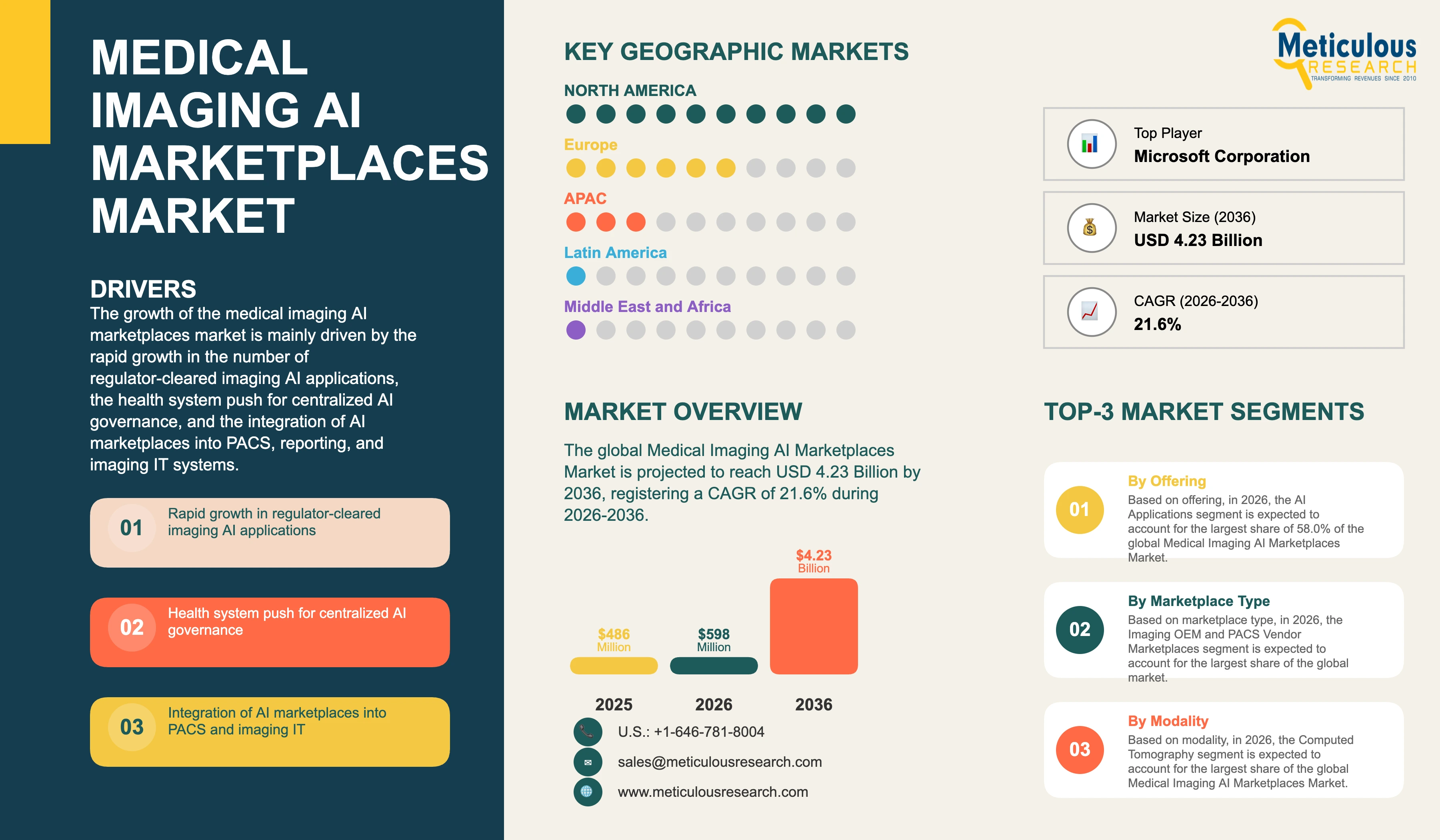
The global medical imaging AI marketplaces market was valued at USD 486.0 million in 2025. This market is expected to reach USD 4.23 billion by 2036 from an estimated USD 598.0 million in 2026, registering a CAGR of 21.6% during the forecast period (2026-2036).
- Published
- Nov 2026
- Pages
- 288
- Format
- PDF + Excel
- Report ID
- MRHC - 1042480
- Base year
- 2025
- 2025 · BASELINE
- $486.0M
- 2036
- $4.23B
- CAGR 2026–2036
- 21.6%
2025 baseline · 2026–2036 forecast at 21.6% CAGR · hover a bar for the value
Key highlights
The FDA's list of AI-enabled medical devices reached 1, 524 devices through 30 March 2026, of which 1,163, or 76%, are radiology devices, with 92 new AI devices added in the first quarter of 2026 alone.
A permanent Category I CPT code (75577) for AI-based coronary plaque analysis on coronary CT angiography took effect on 1 January 2026, with a 2026 Medicare Physician Fee Schedule national average payment of about USD 1,021.
Bayer announced in September 2025 that it would exit the radiology AI platform business, discontinuing its Calantic platform and the services of its Blackford Analysis subsidiary.
Microsoft's Precision Imaging Network delivers third-party imaging AI results into the PowerScribe reporting system, with more than 17,000 healthcare facilities connected to its PowerShare network, and added Cortechs.ai's neuro and prostate imaging tools in June 2026.
deepc partnered with Konica Minolta in January 2026 to connect its deepcOS platform to the Exa PACS, and Ferrum Health partnered with Avicenna.AI in November 2025 to add more than 50 algorithms to its platform.
GE HealthCare completed its USD 2.3 billion acquisition of Intelerad in March 2026 to build a cloud-first, AI-enabled enterprise imaging platform, and Aidoc raised USD 150 million in April 2026 to expand its aiOS platform and CARE foundation model.
Sectra agreed in March 2026 to acquire Oxipit, developer of the autonomous chest X-ray AI ChestLink, and CARPL.ai raised USD 10 million in a Series A led by the International Finance Corporation in July 2026.
Platform and orchestration is the fastest-growing offering, AI developer-led enterprise platforms are the fastest-growing marketplace type, and cardiovascular is the fastest-growing clinical area.
By offering, AI applications account for the largest share of 58.0% in 2026, while platform and orchestration registers the highest CAGR.
By marketplace type, imaging OEM and PACS vendor marketplaces account for the largest share in 2026, while AI developer-led enterprise platforms register the highest CAGR.
By deployment, cloud-based marketplaces account for the largest share in 2026 and also register the highest CAGR.
By modality, computed tomography accounts for the largest share in 2026, while mammography registers the highest CAGR.
By clinical area, neurology accounts for the largest share in 2026, while cardiovascular registers the highest CAGR.
By end user, hospitals and health systems account for the largest share of 55.4% in 2026, while diagnostic imaging centers register the highest CAGR.
By geography, North America accounts for the largest share of 48.5% in 2026, while Asia-Pacific registers the highest CAGR of 25.9%.
Report summary
| Particulars | Details |
|---|---|
| Base Year | 2025 |
| Estimated Year | 2026 |
| Forecast Period | 2026-2036 |
| Market Size in 2025 | USD 486.0 million |
| Market Size in 2026 | USD 598.0 million |
| Market Size by 2036 | USD 4.23 billion |
| CAGR (2026-2036) | 21.6% |
| Format | PDF, Excel & Cloud Portal · 288 pages |
| Largest Segment by Offering (2026) | AI Applications (58.0%) |
| Largest Segment by End User (2026) | Hospitals and Health Systems (55.4%) |
| Largest Region (2026) | North America (48.5%) |
| Fastest-Growing Region | Asia-Pacific (CAGR 25.9%) |
| Companies Profiled | 12 companies and other companies |
| Segments Covered | Offering, Marketplace Type, Deployment, Modality, Clinical Area, End User, Geography |
| Countries Covered | U.S., Canada, Germany, U.K., France, Netherlands, Sweden, Spain, Italy, Rest of Europe, China, Japan, India, Australia, South Korea, Singapore, Rest of Asia-Pacific, Brazil, Mexico, Rest of Latin America, Saudi Arabia, U.A.E., Israel, South Africa, Rest of Middle East & Africa |
Report overview
Segments covered: offering, marketplace type, deployment, modality, clinical area, end user.
The growth of this market is mainly driven by the rapid rise in the number of regulator-cleared imaging AI applications, which hospitals cannot integrate one by one, the push by health systems to manage all imaging AI through a single governed platform, the addition of AI marketplaces to PACS, reporting, and imaging IT systems that radiologists already use, and new reimbursement for specific imaging AI services. However, factors such as the limited payment for most imaging AI tools, which makes it hard for hospitals to justify spending, and the integration and validation work needed to run AI safely on local data are expected to restrain the growth of this market to some extent.
Medical imaging AI marketplaces are platforms that allow hospitals, imaging centers, and teleradiology groups to find, test, buy, deploy, and monitor AI applications from many different developers through a single connection to their imaging systems. A marketplace typically combines a catalog of regulator-cleared AI applications with an orchestration layer that routes each scan to the right algorithms, returns results into the PACS, worklist, or reporting system, and tracks how each algorithm performs. Revenue comes from platform subscriptions, the sale of AI applications through the marketplace, and services such as integration, validation, and monitoring.
The need for marketplaces comes from the sheer number of imaging AI products. The FDA's list of AI-enabled medical devices reached 1,524 devices through 30 March 2026, and 1,163 of them, or 76%, are radiology devices. Most of these products address a single finding on a single type of scan, such as a brain bleed on CT or a lung nodule on X-ray, so a hospital that wanted broad AI coverage would otherwise need dozens of separate contracts, integrations, and security reviews. Marketplaces reduce this to one integration and one procurement process, which is why hospitals increasingly buy imaging AI through platforms rather than directly from each developer.
Several types of companies operate these marketplaces, and imaging equipment and PACS vendors such as GE HealthCare, Siemens Healthineers, Philips, and Sectra offer AI marketplaces within their imaging IT systems, and Microsoft offers third-party AI through its Precision Imaging Network, which is connected to the PowerScribe reporting system used by many U.S. radiologists. Independent, vendor-neutral platforms such as CARPL.ai, deepc, Ferrum Health, and Incepto connect to any PACS, while AI developers such as Aidoc have turned their own products into enterprise platforms that also host third-party models. Aidoc reports that 69% of its customers run non-Aidoc models on its aiOS platform.
The market is going through a period of consolidation and repositioning, as Bayer announced in September 2025 that it would exit the radiology AI platform business and discontinue its Calantic platform and Blackford Analysis services, showing that a marketplace alone is hard to run profitably without a strong position in imaging workflow. At the same time, GE HealthCare completed its USD 2.3 billion acquisition of Intelerad in March 2026 to strengthen its cloud-first enterprise imaging platform, and Sectra agreed to acquire autonomous chest X-ray AI developer Oxipit in March 2026 to add its own AI to its Amplifier marketplace.
Reimbursement is beginning to support specific imaging AI services, and from 1 January 2026, AI-based coronary plaque analysis on coronary CT angiography is billed under a permanent Category I CPT code (75577), with a Medicare Physician Fee Schedule national average payment of about USD 1,021 and a hospital outpatient rate of about USD 951. Elucid reports that more than 70% of covered Americans now have coverage policies in place for this service. Paid AI services like this give imaging providers a direct financial reason to deploy AI and increase the value of platforms that can deliver several reimbursable applications through one connection.
Cloud deployment and foundation models are changing how marketplaces work, as hospitals increasingly prefer to run AI in the cloud to avoid installing and maintaining on-site servers for each algorithm, and vendors are building large models that detect many findings at once. Aidoc's CARE foundation model received FDA clearance in January 2026 for triage across multiple findings on CT, and Aidoc raised USD 150 million in April 2026 to expand the model and its aiOS platform. Multi-finding models reduce the number of separate applications a hospital needs, which pushes marketplaces to compete on governance, workflow integration, and monitoring rather than only on the size of their catalogs. Over the forecast period, the market is expected to shift toward platforms that combine foundation models, specialized third-party applications, and governance tools in one place, with imaging IT vendors and well-funded AI developers holding the strongest positions.
AI developer-led enterprise platforms are projected to register the highest CAGR, while imaging OEM and PACS vendor marketplaces hold the largest share in 2026.
Cardiovascular is projected to register the highest CAGR, while neurology holds the largest share in 2026.
North America is expected to account for the largest share of 48.5% of the market in 2026.
Asia-Pacific is projected to register the highest CAGR of 25.9% during the forecast period, led by China, India, Japan, and Australia.
The report profiles 12 companies, including Microsoft Corporation, GE HealthCare Technologies Inc., Siemens Healthineers AG, Koninklijke Philips N.V., Sectra AB, Aidoc Medical Ltd., and CARPL.ai. The top five players account for an estimated 47.2% of the market in 2025.
Medical imaging AI marketplaces let hospitals and imaging centers find, test, buy, deploy, and monitor AI applications from many developers through a single connection to their PACS, worklist, and reporting systems. The platform routes each scan to the right algorithms, returns results into the radiologist's workflow, and tracks how each algorithm performs.
Cloud-based deployment accounts for the largest share of the market in 2026 and is also projected to register the highest CAGR, as hospitals prefer to avoid installing and maintaining on-site servers for each AI application.
Report infographic
Market dynamics
15 factors across 5 forcesRapid growth in the number of regulator-cleared imaging AI applications
Regulators are clearing new imaging AI products at a steady pace, and radiology accounts for about three-quarters of all AI-enabled devices on the FDA's list. The FDA added 92 AI-enabled devices in the first quarter of 2026 alone, most of them for imaging. Each new product covers a narrow task, so the number of applications that a hospital would need to manage for broad coverage keeps rising.
Hospitals cannot integrate, secure, and monitor each of these products separately, because each direct contract requires its own legal review, IT integration, and validation. Marketplaces solve this problem by offering a single integration that gives access to hundreds of applications. CARPL.ai reports that its catalog exceeded 300 applications from more than 100 partners by July 2026, and Sectra reports more than 100 validated applications on its Amplifier marketplace, showing how quickly these catalogs are growing. As catalogs grow, hospitals can add new clinical uses through a simple configuration step rather than a new procurement and IT project, which shortens the time from purchase to clinical use from months to weeks.
Health system push for centralized AI governance
As hospitals deploy more AI, they need to know which algorithms are running, how well they perform on local patients, and whether their performance changes over time. Many health systems have set up AI governance committees that require central oversight of all clinical AI. Marketplaces and enterprise platforms provide this oversight by tracking each algorithm's use, accuracy, and impact from a single dashboard and by allowing hospitals to test AI on their own data before full deployment.
This governance need is shifting spending from individual algorithms to platforms, and Aidoc has stated that hospitals are consolidating standalone tools under centralized AI governance frameworks, and Ferrum Health positions its platform as an AI governance suite that lets clinicians validate AI on local data without patient information leaving the hospital's network. Platforms that offer strong governance features are winning enterprise contracts that cover many sites and departments. Regulators are also paying closer attention to how AI performs after deployment, and the FDA's guidance on predetermined change control plans for AI devices further encourages hospitals and vendors to track performance over time.
Integration of AI marketplaces into PACS, reporting, and imaging IT systems
Radiologists want AI results to appear inside the systems they already use, rather than in separate windows or applications. Imaging IT vendors are therefore building AI marketplaces directly into their PACS, worklists, and reporting tools. Microsoft's Precision Imaging Network delivers third-party AI results into PowerScribe, and Microsoft added Cortechs.ai's neuro and prostate imaging tools in June 2026, while GE HealthCare added third-party AI orchestration to its True PACS and Centricity PACS systems and deepc partnered with Konica Minolta in January 2026 to connect its platform to the Exa PACS.
Built-in marketplaces remove much of the integration work that previously slowed AI adoption, and they allow imaging IT vendors to sell AI alongside their core systems. This also gives AI developers access to large installed bases, as Microsoft reports that more than 17,000 healthcare facilities are connected to its PowerShare network. For hospitals, buying AI from their existing PACS or reporting vendor also simplifies contracting, security reviews, and support, which is a key reason why marketplaces built into imaging IT systems hold the largest share of the market.
New reimbursement for imaging AI services
Payment for specific AI-based imaging services is creating new revenue for imaging providers. The new Category I CPT code 75577 for AI coronary plaque analysis took effect in January 2026 with national Medicare payment rates in both office and hospital settings, and Similar payment pathways are being sought for other AI services, such as quantitative brain and lung imaging.
Reimbursable AI services give imaging centers and hospitals a clear return on investment, which encourages them to adopt platforms that can deliver these services quickly. Marketplaces that include reimbursable applications and help customers bill for them correctly have a strong selling point, especially with outpatient imaging centers that operate on tight margins. Each new reimbursement code also sends a signal to AI developers about where to invest, which is expected to increase the number of applications in cardiovascular, oncology, and other areas with clear clinical and financial value.
Table of contents
14 chapters · 142 sections · 288 pages · click to expandSegmental analysis
| Segment | Largest share (2026) | Fastest growth (2026–2036) |
|---|---|---|
| By Offering | AI applications | Platform and orchestration |
| By Marketplace Type | Imaging OEM and PACS vendor marketplaces | AI developer-led enterprise platforms |
| By Deployment | Cloud-based | Cloud-based marketplaces |
| By Modality | Computed tomography | Mammography |
| By Clinical Area | Neurology | Cardiovascular |
| By End User | Hospitals and health systems | Diagnostic imaging centers |
| Other segments | Hospitals and health systems | Diagnostic imaging centers |
By Offering
- Medical Imaging AI Marketplaces Market Analysis by Offering
- The AI applications segment is expected to account for the largest share of 58.0% of the global medical imaging AI marketplaces market.
- The large share of this segment is mainly due to the sale of a growing number of regulator-cleared AI applications through marketplaces, with hospitals paying subscription or per-study fees for applications covering findings such as brain bleeds, pulmonary embolism, fractures, lung nodules, and breast lesions.
- Reimbursed applications such as AI coronary plaque analysis further add to application revenue.
- Hospitals usually buy AI applications through marketplaces on a subscription basis, with pricing set per site, per study, or per number of scans, and the marketplace operator shares the revenue with the AI developer.
- The most widely used applications are triage tools that flag urgent findings such as brain bleeds, large vessel occlusions, pulmonary embolism, and fractures, so that radiologists can read these scans first, followed by detection and quantification tools for lung nodules, breast lesions, prostate cancer, and coronary plaque.
- Health systems typically start with a few high-value applications in emergency and stroke care and then add others in oncology, cardiology, and musculoskeletal imaging as they gain confidence, which steadily increases spending per customer.
- Application revenue is also supported by the large and growing number of cleared products, which gives buyers more choice, and by reimbursement for services such as AI coronary plaque analysis.
- Over the forecast period, foundation models that cover many findings at once are expected to change how applications are priced, with more spending moving to bundled, system-wide licenses.
- However, the platform and orchestration segment is projected to register the highest CAGR during the forecast period.
- The rapid growth of this segment is driven by hospitals' need for central AI governance, performance monitoring, and workflow integration across all their AI tools, and by the shift of vendors toward charging for platform features rather than only for individual applications.
- The services segment, which includes integration, validation, and training, remains important for hospitals with limited IT resources.
- Services revenue is expected to grow steadily as hospitals ask vendors to handle integration, local validation, and ongoing performance monitoring on their behalf.
- AI applications are expected to account for the largest share of 58.0% of the market in 2026, while platform and orchestration is projected to register the highest CAGR.
By Marketplace Type
- Medical Imaging AI Marketplaces Market Analysis by Marketplace Type
- The imaging OEM and PACS vendor marketplaces segment is expected to account for the largest share of the market.
- The large share of this segment is mainly due to the large installed base of imaging equipment and PACS from GE HealthCare, Siemens Healthineers, Philips, Sectra, and other vendors, which allows them to offer AI marketplaces directly inside the systems radiologists already use.
- Reporting and imaging IT network marketplaces, led by Microsoft's Precision Imaging Network, also hold a significant share due to the wide use of PowerScribe.
- Radiologists spend most of their working day inside PACS and reporting systems, so AI that appears directly in these tools is easier to adopt and more likely to be used.
- Imaging OEM and PACS vendors take advantage of this by offering marketplaces that are already connected to their systems, which removes much of the integration work and allows hospitals to buy AI through existing contracts, support agreements, and security approvals.
- GE HealthCare's acquisition of Intelerad has expanded its installed base of PACS customers, Sectra's Amplifier marketplace offers more than 100 validated applications to its PACS users, and Siemens Healthineers and Philips offer AI through their own imaging platforms and scanners.
- These vendors are also adding their own AI to their marketplaces, as shown by Sectra's agreement to acquire Oxipit.
- Their main limitation is that hospitals with systems from several vendors may prefer neutral platforms, which is why independent and developer-led platforms are growing faster.
- However, the AI developer-led enterprise platforms segment is projected to register the highest CAGR during the forecast period.
- The rapid growth of this segment is driven by AI developers such as Aidoc turning their products into enterprise platforms that host third-party models, the use of foundation models that cover many findings, and strong investor funding for these platforms.
- Vendor-neutral independent platforms also grow faster than the overall market, supported by demand from multi-vendor hospital groups and teleradiology providers.
By Deployment
- Medical Imaging AI Marketplaces Market Analysis by Deployment
- The cloud-based segment is expected to account for the largest share of the market.
- This segment is also projected to register the highest CAGR during the forecast period.
- The large share and fast growth of this segment are mainly due to hospitals' preference to avoid installing and maintaining on-site servers for each AI application, the ability of cloud platforms to add new applications quickly, and the move of imaging IT vendors to cloud-first strategies, as seen in GE HealthCare's acquisition of Intelerad.
- Cloud platforms also make it easier for vendors to update applications, monitor performance across many sites, and add new features without visits to each hospital.
- Cloud-based marketplaces allow hospitals to add new AI applications without buying servers, graphics processing units, or storage for each one, and they make it easier for vendors to update models, monitor performance across many sites, and add new features.
- They also suit multi-site health systems, imaging center chains, and teleradiology providers that need the same AI across many locations and PACS systems.
- Concerns about sending patient images outside the hospital network have eased as vendors have adopted strong encryption, de-identification, regional data hosting, and recognized security certifications, and as hospitals have moved other clinical systems to the cloud.
- Major imaging IT vendors are also moving to cloud-native platforms, including GE HealthCare after its acquisition of Intelerad and Microsoft through its Precision Imaging Network, which brings more AI usage onto cloud infrastructure.
- Hybrid deployments, which process some data on site and some in the cloud, remain common among hospitals with strict data rules, while on-premise deployments are used mainly where data cannot leave the hospital network or where internet connectivity is limited.
By Modality
- Medical Imaging AI Marketplaces Market Analysis by Modality
- The computed tomography segment is expected to account for the largest share of the market.
- The large share of this segment is mainly due to the large number of AI applications for CT, including triage tools for brain bleeds, strokes, pulmonary embolism, and fractures, and the new reimbursement for AI coronary plaque analysis on coronary CT angiography.
- CT scans are also common in emergency settings, where fast AI triage has clear clinical value.
- Many foundation models, such as Aidoc's CARE model, also focus on CT first because of its high volume and the wide range of findings it covers.
- CT is one of the highest-volume advanced imaging modalities in hospitals and is used heavily in emergency departments for head injuries, strokes, chest pain, abdominal pain, and trauma, where fast detection of urgent findings has a direct effect on patient outcomes.
- This has made CT the main focus for AI developers, and many of the most widely adopted applications, such as triage for intracranial hemorrhage, large vessel occlusion, pulmonary embolism, and cervical spine fractures, run on CT scans.
- CT is also used for lung cancer screening, cardiac imaging, and cancer staging, each of which has its own set of AI tools for detection and measurement.
- Reimbursement for AI coronary plaque analysis on coronary CT angiography adds a further source of revenue, and foundation models that detect many findings on CT at once are expected to increase the value of CT AI to hospitals.
- However, the mammography segment is projected to register the highest CAGR during the forecast period.
- The rapid growth of this segment is driven by the adoption of AI in breast cancer screening programs facing radiologist shortages, the growing evidence that AI can support or replace one of two human readers in screening, and the integration of breast AI into reporting platforms such as Microsoft's Precision Imaging Network.
- X-ray, MRI, ultrasound, and other modalities make up the rest of the market.
- Computed tomography is expected to account for the largest share of the market in 2026, while mammography is projected to register the highest CAGR.
By Clinical Area
- Medical Imaging AI Marketplaces Market Analysis by Clinical Area
- The neurology segment is expected to account for the largest share of the market.
- The large share of this segment is mainly due to the early and wide adoption of AI for stroke and brain bleed detection, where minutes matter for treatment, and the large number of cleared neurology AI applications available through marketplaces.
- Stroke care was one of the first areas where imaging AI showed clear clinical value, because AI can alert stroke teams within minutes when a scan shows a large vessel occlusion or brain bleed, which shortens the time to treatment.
- Many hospitals adopted AI for stroke and brain bleed detection before any other application, and these tools are now widely used in comprehensive and primary stroke centers.
- Neurology AI also includes tools for brain MRI, such as volume measurement for dementia and multiple sclerosis, and monitoring of patients receiving new Alzheimer's disease treatments, which require regular MRI scans to check for side effects.
- Microsoft's addition of Cortechs.ai's neuro imaging tools to its Precision Imaging Network in June 2026 shows the continued demand for neurology AI through marketplaces.
- However, the cardiovascular segment is projected to register the highest CAGR during the forecast period.
- The rapid growth of this segment is driven by the new Category I CPT code for AI coronary plaque analysis, broad commercial insurance coverage for this service, and the growing use of coronary CT angiography in chest pain assessment.
- Oncology, pulmonology, musculoskeletal, and other clinical areas make up the rest of the market, with oncology growing quickly due to lung and breast cancer screening.
By End User
- Medical Imaging AI Marketplaces Market Analysis by End User
- The hospitals and health systems segment is expected to account for the largest share of 55.4% of the market.
- The large share of this segment is mainly due to the high imaging volumes in hospitals, their need for AI triage in emergency and inpatient care, and their adoption of enterprise AI platforms to govern AI across many sites and departments.
- Large health systems with many hospitals are moving from buying AI department by department to choosing enterprise platforms that cover all their sites, which increases the size of contracts and favors marketplace and platform vendors.
- Hospitals also have the strongest need for AI triage, because emergency departments and inpatient wards generate urgent scans around the clock, often read by small teams at night.
- Many health systems have set up AI governance committees that require central approval and monitoring of all clinical AI, which pushes them toward platforms with built-in governance, validation, and monitoring.
- Academic medical centers within this segment also act as early adopters and testing sites for new AI applications, helping vendors build evidence that supports wider adoption.
- Budget pressure remains a constraint, so hospitals tend to focus first on applications with clear clinical and operational value, such as stroke, pulmonary embolism, and fracture triage.
- However, the diagnostic imaging centers segment is projected to register the highest CAGR during the forecast period.
- The rapid growth of this segment is driven by the new reimbursement for AI services performed in outpatient settings, the need of imaging center chains to increase radiologist productivity, and the use of AI in outpatient screening programs.
- Teleradiology providers and academic and research institutes make up the rest of the market.
- Teleradiology providers are important buyers because they read scans for many hospitals and need AI that works across many different PACS and scanner types.
Other segments
- Hospitals and health systems are expected to account for the largest share of 55.4% of the market in 2026, while diagnostic imaging centers are projected to register the highest CAGR.
Geographic analysis
North America
Largest shareIn 2026, North America is expected to account for the largest share of 48.5% of the global medical imaging AI marketplaces market. The large share of this region is mainly due to the large number of FDA-cleared imaging AI applications, the wide use of Microsoft's PowerScribe reporting platform and its Precision Imaging Network, the presence of leading platform vendors such as Aidoc, Ferrum Health, and GE HealthCare, and the new Medicare reimbursement for AI coronary plaque analysis. Canada adds demand from provincial health systems adopting AI to manage imaging backlogs. The U.S. also has the largest number of imaging centers and teleradiology providers, which are key buyers of AI platforms that work across many sites and systems. The U.S. is the largest single country market, as it has the highest number of FDA-cleared imaging AI products, a large network of hospitals, imaging centers, and teleradiology groups, and strong investment in AI by both health systems and venture-backed developers. Radiologist shortages and rising imaging volumes are pushing U.S. providers to adopt AI to keep reading times under control, and large imaging center operators such as RadNet are building AI into their own operations. The U.S. is also where new reimbursement for imaging AI, such as payment for AI coronary plaque analysis, has been introduced first, which gives providers a direct financial reason to adopt platforms that deliver paid services.
Asia-Pacific
Fastest growthAsia-Pacific is projected to register the highest CAGR of 25.9% during the forecast period. Growth is driven by rising imaging volumes and radiologist shortages in China, India, and Southeast Asia, the growth of teleradiology in the region, and the spread of cloud-based AI platforms. India is home to CARPL.ai, which raised funding in July 2026 to scale globally, while Japan, Australia, and South Korea have well-developed imaging markets and active AI developers. China has a large domestic imaging AI industry with its own regulatory approval process, while Australia and Singapore have strong teleradiology and private hospital sectors that are early adopters of AI platforms.
Europe
In Europe, adoption is supported by national screening programs, the presence of vendor-neutral platforms such as deepc in Germany and Incepto in France, and Sectra's Amplifier marketplace, which is used by hospitals in Sweden, the U.K., and other countries. The U.K., Germany, France, and the Nordic countries are the largest markets in the region. The EU's Medical Device Regulation and AI Act shape how vendors certify and document their AI applications and platforms in Europe. National health services in the U.K. and the Nordic countries are also funding AI deployment programs to reduce reporting backlogs, which supports adoption of platforms that can deliver several applications at once.
Latin America
Latin America and the Middle East & Africa account for smaller shares of the market. Brazil and Mexico lead adoption in Latin America, where private hospital groups and teleradiology providers are using AI to handle growing imaging volumes.
Middle East & Africa
In the Middle East & Africa, Saudi Arabia and the U.A.E. are investing in digital health and AI as part of national health plans, and Israel is home to several leading imaging AI developers, including Aidoc.
Competitive landscape
Imaging IT and equipment vendors hold the strongest positions in this market because they control the systems where radiologists work. GE HealthCare, Siemens Healthineers, Philips, and Sectra offer AI marketplaces within their PACS and imaging platforms, and Microsoft's Precision Imaging Network delivers third-party AI through PowerScribe and PowerShare. GE HealthCare strengthened its position by completing the acquisition of Intelerad in March 2026, and Sectra agreed to acquire Oxipit to add its own autonomous chest X-ray AI to the Amplifier marketplace.
Independent and AI developer-led platforms compete on neutrality, governance, and breadth of content. Aidoc offers its aiOS enterprise platform and CARE foundation model, and reports that most of its customers also run third-party models on aiOS. CARPL.ai, deepc, Ferrum Health, and Incepto offer vendor-neutral platforms that connect to any PACS, with CARPL.ai reporting one of the largest catalogs in the market. RadNet's DeepHealth offers an AI-enabled imaging operating system that uses Incepto's orchestration technology in Europe.
The market has seen both new investment and exits, as Bayer announced in September 2025 that it would discontinue its Calantic platform and Blackford Analysis services, while Aidoc raised USD 150 million in April 2026 and CARPL.ai raised USD 10 million in July 2026. The top five players are estimated to account for 47.2% of the market in 2025, reflecting the strong position of imaging IT vendors, while a large number of smaller platforms compete for the rest.
Vendors compete on several factors, including the size and quality of their AI catalog, the depth of integration with PACS, worklists, and reporting systems, governance and monitoring features, cloud capabilities, and the strength of their installed base. Imaging IT vendors have an advantage in installed base and workflow, independent platforms in neutrality and catalog breadth, and AI developer-led platforms in their own AI content and foundation models. Partnerships are common across these groups, with many AI developers offering their applications through several marketplaces at once, and many platforms partnering with PACS vendors to reach more hospitals.
Some of the key players operating in the medical imaging AI marketplaces market are Microsoft Corporation, GE HealthCare Technologies Inc., Siemens Healthineers AG, Koninklijke Philips N.V., Sectra AB, Aidoc Medical Ltd., CARPL.ai, deepc GmbH, Ferrum Health, Inc., Incepto Medical SAS, RadNet, Inc. (DeepHealth), and Konica Minolta, Inc., among others.
The competitive balance is expected to shift over the forecast period as cloud-based platforms, foundation models, and enterprise governance tools become more important. Vendors that control both the radiologist's workspace and a strong AI portfolio are likely to gain share, while smaller marketplaces may partner with or be acquired by larger players.
- —
GE HealthCare completed its USD 2.3 billion acquisition of Intelerad in March 2026, Aidoc raised USD 150 million in April 2026, Sectra agreed to acquire Oxipit in March 2026, and Bayer exited the radiology AI platform business in September 2025. A Category I CPT code for AI coronary plaque analysis took effect on 1 January 2026.
- Microsoft Corporation
- GE HealthCare Technologies Inc.
- Siemens Healthineers AG
- Koninklijke Philips N.V.
- Sectra AB
- Aidoc Medical Ltd.
- CARPL.ai
- Ferrum Health, Inc.
- Incepto Medical SAS
- RadNet, Inc. (DeepHealth)
- Konica Minolta, Inc.
Expert perspectives
This market exists because hospitals cannot manage hundreds of separate AI products one by one. The steady flow of new FDA clearances, mostly in radiology, means that the value of a single connection to many applications keeps rising. However, the market's growth depends on hospitals being willing to pay for AI, and outside a few reimbursed services, that willingness depends on clear proof of time savings or better outcomes.
The market is moving from catalogs to control, as hospitals now care less about how many applications a marketplace offers and more about governance, monitoring, and how well AI fits into existing workflows. This favors vendors that control the radiologist's workspace, such as PACS and reporting vendors, and AI developers that have built strong enterprise platforms. Independent marketplaces without a workflow position face pressure, as Bayer's exit shows, and are likely to partner with or be acquired by larger players.
Platform and orchestration is the fastest-growing offering, because hospitals are paying for governance and integration rather than only for algorithms. AI developer-led enterprise platforms are the fastest-growing marketplace type, supported by foundation models and strong investor funding. Cardiovascular is the fastest-growing clinical area due to the new reimbursement for AI coronary plaque analysis, and mammography is the fastest-growing modality due to AI adoption in breast screening.
Asia-Pacific is the fastest-growing region at a CAGR of 25.9%, supported by rising imaging volumes, radiologist shortages, and cloud-based platforms, while North America remains the largest market through 2036. The biggest swing factor is reimbursement: broader payment for imaging AI services would speed up adoption across many applications, while limited payment would keep hospitals focused on a small number of proven tools. Regulatory changes, such as clearer rules for updating AI models after approval, could also speed up the release of improved applications through marketplaces.
Overall, growth in this market rests on the steady increase in cleared AI applications and the need for hospitals to manage them safely at scale. Vendors that combine workflow integration, governance tools, and reimbursable content are expected to capture most of this growth.
For buyers, the key decision is shifting from which algorithms to buy to which platform to standardize on. Health systems are likely to choose one main platform for most of their imaging AI and add specialized applications through it, which means that early platform choices will shape vendor positions for many years. Vendors that win these platform decisions now, especially in large U.S. health systems and national programs in Europe and Asia-Pacific, will be well placed to capture the growth expected through 2036.
Customer perspectives
Chief Medical Information Officer - Multi-hospital health system, U.S.
We had eleven AI contracts and eleven integrations, and nobody could tell me which ones were actually working. Moving everything onto one platform gave us one place to switch tools on, check their accuracy, and switch them off.
Central governance has become a key buying factor, which is why platform and orchestration is the fastest-growing offering and why hospitals and health systems hold 55.4% of the market. Large health systems increasingly require one platform across all their sites.
Medical Director - Outpatient imaging center group, U.S.
Plaque analysis now has a real CPT code, so the AI pays for itself on every coronary CT we read. We wanted a platform that could give us that and our triage tools without a separate project for each.
Reimbursement for AI coronary plaque analysis is driving adoption among outpatient providers, which supports the fast growth of the diagnostic imaging centers segment and the cardiovascular clinical area. Outpatient groups also value platforms that support correct billing for paid AI services.
Rising imaging volumes and radiologist shortages are driving cloud-based AI adoption in emerging markets, which supports Asia-Pacific's position as the fastest-growing region at a CAGR of 25.9%. Vendor-neutral and cloud-based platforms are well suited to these multi-site private hospital groups.
“Our scan volumes are growing much faster than we can hire radiologists. A cloud marketplace lets us add AI for chest X-ray and CT across all our hospitals without putting servers in every site.”
Frequently asked questions
The market was valued at USD 486.0 million in 2025 and USD 392.0 million in 2024, and is estimated at USD 598.0 million in 2026.
Cite this report
Meticulous Research. (2026). Medical Imaging AI Marketplaces Market - Global Opportunity Analysis and Industry Forecast (2026-2036) (Report No. MRHC - 1042480). Meticulous Market Research Pvt. Ltd. https://www.meticulousresearch.com/product/medical-imaging-ai-marketplaces-market-7163