ADC CDMO Market (2026-2036)
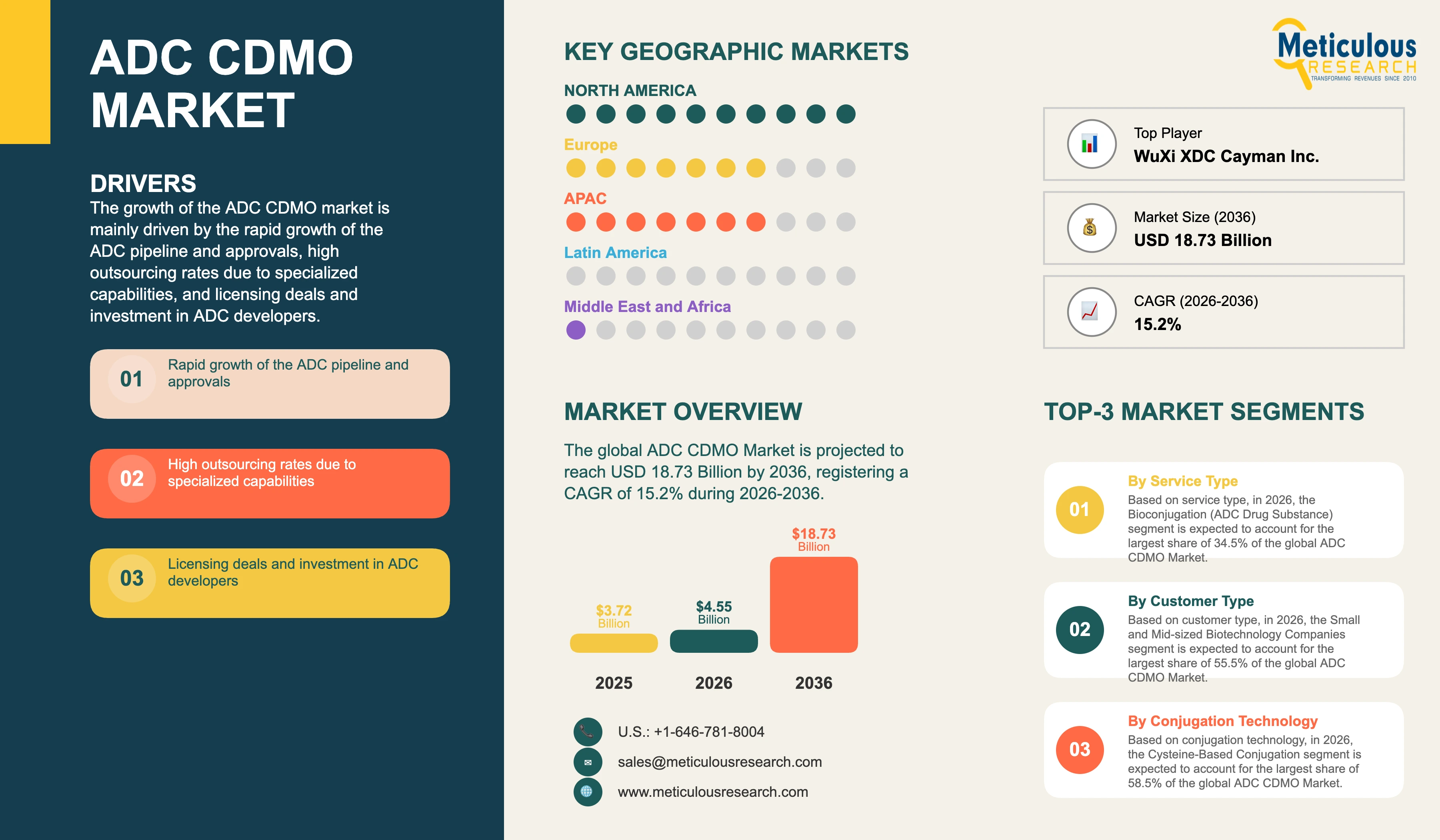
The global antibody-drug conjugate (ADC) contract development and manufacturing organization (CDMO) market was valued at USD 3.72 billion in 2025. This market is expected to reach USD 18.73 billion by 2036 from an estimated USD 4.55 billion in 2026, registering a CAGR of 15.2% during the forecast period (2026-2036).
- Published
- Nov 2026
- Pages
- 268
- Format
- PDF + Excel
- Report ID
- MRHC - 1042510
- Base year
- 2025
- 2025 · BASELINE
- $3.72B
- 2036
- $18.73B
- CAGR 2026–2036
- 15.2%
2025 baseline · 2026–2036 forecast at 15.2% CAGR · hover a bar for the value
Key highlights
As of 30 June 2026, 23 ADCs had received regulatory approval worldwide, with more under review, and the FDA approved two new ADCs in 2025, bringing the cumulative number of FDA-approved ADCs to 16.
WuXi XDC, the largest dedicated bioconjugate CRDMO, reported 2025 revenue of RMB 5,944 million, up 46.7%, with 226 integrated ADC projects, a backlog of about USD 1.49 billion, and its Singapore site on track to begin GMP release in the first half of 2026.
Lonza announced in October 2026 that its large-scale bioconjugation expansion in Visp, Switzerland, will include three multiproduct suites operational from 2028, along with 500-liter single-use capacity in existing suites from 2027, and it expanded ADC development capacity at its Oss, Netherlands, site in February 2026.
Merck KGaA is investing EUR 70 million to triple capacity at its bioconjugation center of excellence in St. Louis, Sterling Pharma Solutions invested more than GBP 10 million to more than double GMP bioconjugation capacity at Deeside, U.K., and Lotte Biologics began full-scale operations at its USD 100 million ADC facility in Syracuse, New York, in 2025.
Chinese drugmakers signed a record USD 135.7 billion in cross-border out-licensing deals in 2025, with ADCs one of the most active modalities, and Gilead agreed in April 2026 to acquire ADC developer Tubulis, showing strong large pharma demand for ADC assets.
Lotte Biologics signed a contract with Rakuten Medical in January 2026 to produce monoclonal antibody intermediates and conjugates at its Syracuse site, and Samsung Biologics has added ADC conjugation services to its large-scale biologics campus in South Korea.
Drug product fill-finish is the fastest-growing service type, commercial-phase manufacturing is the fastest-growing development phase, and site-specific conjugation is the fastest-growing conjugation technology.
By service type, bioconjugation (ADC drug substance) accounts for the largest share of 34.5% in 2026, while drug product fill-finish registers the highest CAGR.
By development phase, clinical-phase services account for the largest share in 2026, while commercial-phase services register the highest CAGR.
By payload type, microtubule inhibitors account for the largest share in 2026, while other and novel payloads register the highest CAGR.
By conjugation technology, cysteine-based conjugation accounts for the largest share in 2026, while site-specific conjugation registers the highest CAGR.
By customer type, small and mid-sized biotechnology companies account for the largest share of 55.5% in 2026, while large pharmaceutical companies register the highest CAGR.
By geography, North America accounts for the largest share of 41.0% in 2026, while Asia-Pacific registers the highest CAGR of 18.1%.
Report summary
| Particulars | Details |
|---|---|
| Base Year | 2025 |
| Estimated Year | 2026 |
| Forecast Period | 2026-2036 |
| Market Size in 2025 | USD 3.72 billion |
| Market Size in 2026 | USD 4.55 billion |
| Market Size by 2036 | USD 18.73 billion |
| CAGR (2026-2036) | 15.2% |
| Format | PDF, Excel & Cloud Portal · 268 pages |
| Largest Segment by Service Type (2026) | Bioconjugation (ADC Drug Substance) (34.5%) |
| Largest Segment by Customer Type (2026) | Small and Mid-sized Biotechnology Companies (55.5%) |
| Largest Region (2026) | North America (41.0%) |
| Fastest-Growing Region | Asia-Pacific (CAGR 18.1%) |
| Companies Profiled | 14 companies and other companies |
| Segments Covered | Service Type, Development Phase, Payload Type, Conjugation Technology, Customer Type, Geography |
| Countries Covered | U.S., Canada, Switzerland, U.K., Germany, France, Italy, Netherlands, Ireland, Rest of Europe, China, Japan, South Korea, India, Singapore, Australia, Rest of Asia-Pacific, Israel, Brazil, Rest of the World |
Report overview
Segments covered: service type, development phase, payload type, conjugation technology, customer type.
The growth of this market is mainly driven by the rapid growth of the global ADC pipeline and the number of approved ADCs, the high share of ADC development and manufacturing that is outsourced because of the need for highly potent compound handling and specialized bioconjugation capabilities, the large volume of ADC licensing deals between Chinese biotechs and global pharmaceutical companies, and the shift of many ADC programs from clinical to commercial manufacturing. However, factors such as the high capital cost and long lead time of building containment facilities for highly potent payloads and the complexity of technology transfer and supply chain coordination across antibody, payload-linker, conjugation, and fill-finish steps are expected to restrain the growth of this market to some extent.
Antibody-drug conjugates combine a monoclonal antibody that targets cancer cells or other diseased cells with a highly potent drug, called the payload, joined by a chemical linker. The antibody carries the payload directly to the target cells, which allows much more potent drugs to be used than in conventional chemotherapy while limiting damage to healthy tissue. ADCs have become one of the fastest-growing classes of cancer drugs, led by products such as Enhertu, Padcev, and Trodelvy, and as of mid-2026, 23 ADCs had been approved worldwide, with many more in late-stage development. China approved the world's first bispecific ADC in June 2026, and ADCs are increasingly being tested in earlier lines of treatment, where patient numbers and treatment durations are larger.
Manufacturing ADCs is complex and requires several distinct capabilities, because the antibody must be produced in mammalian cell culture, the payload and linker must be synthesized as highly potent active pharmaceutical ingredients (HPAPIs) in facilities with strict containment, the antibody and payload-linker must be joined in a bioconjugation step under highly potent containment, and the final drug product must be filled and finished, often as a lyophilized powder, in sterile facilities that can handle cytotoxic products. Few drug developers have all of these capabilities in-house, which is why a large share of ADC development and manufacturing is outsourced to CDMOs. Each step also has its own regulatory requirements, and sponsors must show regulators that the whole chain is controlled, which favors experienced partners.
The ADC CDMO market includes several types of providers, with large integrated CDMOs, such as Lonza, WuXi XDC, Samsung Biologics, and Catalent, offer antibody production, payload-linker synthesis, conjugation, and fill-finish at commercial scale. Specialist bioconjugation CDMOs, such as Piramal Pharma Solutions, Abzena, Sterling Pharma Solutions, and Ajinomoto Bio-Pharma Services, focus on conjugation and related services, while HPAPI specialists, such as Axplora, Veranova, and CordenPharma, supply payloads and linkers. Fill-finish specialists, such as BSP Pharmaceuticals, provide sterile drug product capacity for cytotoxic ADCs. Merck KGaA's MilliporeSigma operates a dedicated bioconjugation center of excellence in St. Louis, and new entrants such as Lotte Biologics have built ADC facilities in the U.S.
Demand for ADC CDMO services is growing quickly because of the size and maturity of the ADC pipeline. Hundreds of ADCs are in clinical development, and many are moving from early trials to late-stage studies and commercial launch, which requires larger-scale and more complex manufacturing. WuXi XDC alone reported 226 integrated ADC projects at the end of 2025, and Lonza states that it manufactures the majority of commercially available ADCs. The number of new ADC approvals is expected to increase over the forecast period as late-stage programs from global pharmaceutical companies and Chinese biotechs reach the market.
China has become a major source of ADC innovation, as Chinese biotechs have developed a large number of ADCs and licensed many of them to global pharmaceutical companies, and Chinese drugmakers signed a record USD 135.7 billion in cross-border out-licensing deals in 2025, with ADCs among the most active categories. Many of these programs were developed with Chinese CDMOs such as WuXi XDC, and as they move into global trials and commercial supply, they create demand for capacity in China, Singapore, Europe, and the U.S. At the same time, concerns about supply chain security and possible U.S. restrictions on Chinese biotechnology suppliers are encouraging some sponsors to dual-source or move manufacturing to Western and other Asian CDMOs.
CDMOs are responding with a wave of capacity investments, as Lonza is expanding bioconjugation capacity in Visp and development capacity in Oss, WuXi XDC is adding capacity in Wuxi and Singapore, Merck KGaA is tripling capacity in St. Louis, Sterling Pharma Solutions has more than doubled capacity in Deeside, and Samsung Biologics and Lotte Biologics have launched ADC services. Many of these investments focus on larger-scale commercial suites and integrated services that combine antibody, payload-linker, conjugation, and fill-finish steps, which reduce technology transfer risk and shorten timelines for customers. Despite this investment, many sponsors report that commercial-scale conjugation and cytotoxic fill-finish slots remain hard to secure, especially for launches planned in the next few years.
We licensed two ADCs from China, and we now need commercial supply in Europe and the U.S. as well as in Asia. Securing conjugation and cytotoxic fill-finish capacity years ahead has become one of our top priorities.
The licensing of ADC assets by large pharma and their need for diversified commercial capacity are driving the fast growth of the large pharmaceutical companies segment and the commercial and fill-finish segments.
Our partners want global-standard manufacturing and a second source outside China. We are working with CDMOs that have sites in Singapore and Europe so that our programs can move smoothly into global trials.
Global licensing and supply chain diversification are supporting rapid growth in Asia-Pacific, the fastest-growing region at a CAGR of 18.1%, along with new capacity in Singapore and South Korea. Chinese developers increasingly see dual-source manufacturing as a condition for successful global licensing.
Report infographic
Market dynamics
15 factors across 5 forcesRapid growth of the ADC pipeline and approvals
ADCs have become one of the most active areas of drug development, with hundreds of programs in clinical trials across many cancer types and, increasingly, in other diseases. The success of products such as Enhertu, which has delivered strong results across several tumor types, has encouraged pharmaceutical and biotech companies to invest heavily in ADCs, and new targets, linkers, and payloads are expanding the range of possible products. As of mid-2026, 23 ADCs had been approved worldwide, and several more were under regulatory review.
Each ADC program requires development and manufacturing services from early process development through clinical supply and, if successful, commercial production. As programs advance, batch sizes grow and quality requirements become stricter, which increases spending on CDMO services. The growing number of late-stage and commercial ADCs is therefore a key driver of market growth, and it is pushing CDMOs to build larger commercial-scale capacity. ADCs are also being combined with immunotherapies and tested in earlier lines of treatment, which could greatly increase the number of patients treated and the volume of product needed.
High outsourcing rates due to specialized capabilities
ADC manufacturing requires a combination of capabilities that few companies have in-house, including mammalian cell culture for antibodies, synthetic chemistry for highly potent payloads and linkers, containment for handling cytotoxic compounds at very low exposure limits, specialized bioconjugation and purification processes, and sterile fill-finish for cytotoxic products. Building and operating these facilities requires large investments and specialized staff, and many ADC developers, especially small and mid-sized biotechs, do not have the resources to do so.
As a result, a large share of ADC development and manufacturing is outsourced to CDMOs, and even large pharmaceutical companies with in-house capabilities often use CDMOs for specific steps, such as payload-linker synthesis or conjugation, or for additional capacity. Integrated CDMOs that can handle all steps under one roof are particularly attractive because they reduce the complexity of managing multiple suppliers and shorten development timelines. Safety rules for handling cytotoxic payloads also make it costly for companies to build small in-house facilities for occasional use, which further supports outsourcing.
Licensing deals and investment in ADC developers
Large pharmaceutical companies have signed many licensing deals and acquisitions to gain access to ADC assets and technology platforms, particularly from Chinese biotechs. Chinese drugmakers signed a record USD 135.7 billion in cross-border out-licensing deals in 2025, and ADCs were among the most active modalities. Large deals, such as Gilead's agreement in April 2026 to acquire Tubulis, and earlier acquisitions such as Pfizer's purchase of Seagen and AbbVie's purchase of ImmunoGen, show the strategic importance of ADCs to large pharmaceutical companies.
These deals provide funding to ADC developers and move programs into global development, which increases demand for CDMO services. When large pharmaceutical companies acquire or license ADCs, they often need to secure additional or dual-source manufacturing capacity in the U.S. and Europe, creating new contracts for CDMOs with global networks. This flow of funding and programs is expected to support strong demand for ADC CDMO services throughout the forecast period. Venture funding for ADC-focused biotechs has also remained strong compared with other modalities, giving these companies the resources to fund clinical manufacturing.
Shift of ADC programs to commercial manufacturing
As more ADCs are approved and launched, demand is shifting from small-scale clinical batches to larger-scale commercial manufacturing, which generates higher and more stable revenue for CDMOs. Commercial supply contracts are typically long-term and include process performance qualification, validation, and ongoing production, and they require CDMOs to maintain consistent quality and regulatory compliance across multiple markets.
CDMOs are investing in commercial-scale suites to capture this demand, with Lonza's new large-scale bioconjugation facility in Visp, with three multiproduct suites operational from 2028, and WuXi XDC's expansion of commercial manufacturing capacity in Wuxi and Singapore are examples. WuXi XDC reported 10 new late-stage process performance qualification projects in 2025, indicating that more partnered ADCs are approaching commercialization. Commercial-phase services are the fastest-growing development phase in this market. Commercial supply also creates demand for related services, such as stability testing, release testing, and post-approval process changes, which add recurring revenue. Each approved ADC therefore supports long-term outsourcing revenue for its manufacturing partners well beyond the initial supply contract.
Table of contents
13 chapters · 127 sections · 268 pages · click to expandGeographic analysis
North America
Largest shareIn 2026, North America is expected to account for the largest share of 41.0% of the global ADC CDMO market. The large share of this region is mainly due to the large number of U.S. biotech and pharmaceutical companies developing ADCs, strong venture and pharmaceutical funding for ADC programs, and the presence of CDMO facilities operated by Merck KGaA, Catalent, Abzena, Lotte Biologics, Piramal, and others. The U.S. is the largest single country market, as it is home to many of the leading ADC developers and the largest market for approved ADCs. U.S. sponsors are increasingly seeking domestic or dual-source manufacturing to strengthen supply chain security, which is encouraging CDMOs to invest in U.S. capacity, as Lotte Biologics has done in Syracuse and Merck KGaA in St. Louis. Canada contributes demand from its biotech sector and research institutions. Many U.S. ADC developers also use CDMOs in Europe and Asia for part of their supply chain, so U.S. demand supports CDMO revenue in several regions.
Asia-Pacific
Fastest growthAsia-Pacific is projected to register the highest CAGR of 18.1% during the forecast period. Growth is driven by China's large and fast-growing ADC pipeline, the global licensing of Chinese ADCs, the expansion of WuXi XDC's capacity in China and Singapore, and the entry of South Korean CDMOs such as Samsung Biologics and Lotte Biologics into ADC services. Japan, with Daiichi Sankyo's strong ADC franchise, and India, with growing CDMO capabilities, also contribute to regional growth. Singapore is emerging as a hub for ADC manufacturing outside China, supported by WuXi XDC's new site and strong government incentives for biomanufacturing, while South Korea's large biologics CDMOs are using their antibody capacity to offer integrated ADC services.
Europe
Europe holds a significant share of the market, supported by Lonza's major bioconjugation hub in Visp, Switzerland, and its development site in Oss, the Netherlands, as well as Piramal's Grangemouth site and Sterling Pharma Solutions' Deeside site in the U.K., BSP Pharmaceuticals in Italy, and HPAPI suppliers such as Axplora. Switzerland, the U.K., Germany, Italy, and France are the main markets. The Rest of the World accounts for a small share, with demand from Israel, Brazil, and other countries with growing biotech sectors. European demand is also supported by large pharmaceutical companies headquartered in the region, such as AstraZeneca, Roche, Novartis, and Sanofi, which have significant ADC pipelines and often outsource conjugation and fill-finish steps.
Competitive landscape
The ADC CDMO market is relatively concentrated, with a few large integrated providers holding a significant share of the market and a wider group of specialists serving specific steps or customer segments. WuXi XDC is the largest dedicated bioconjugate CRDMO, with 2025 revenue of RMB 5,944 million and a large portfolio of integrated ADC projects, and Lonza is a leading provider of commercial ADC manufacturing, with major bioconjugation and HPAPI capacity in Visp. Samsung Biologics and Catalent also offer integrated ADC services, and Merck KGaA operates a major bioconjugation center in St. Louis.
Specialist CDMOs compete on technical expertise, flexibility, and speed, as Piramal Pharma Solutions, Abzena, Sterling Pharma Solutions, and Ajinomoto Bio-Pharma Services focus on bioconjugation and related services, while Axplora, Veranova, and CordenPharma supply payloads and linkers, and BSP Pharmaceuticals provides cytotoxic fill-finish. New entrants, such as Lotte Biologics, are building ADC capacity to diversify their biologics CDMO businesses. Large biologics CDMOs see ADCs as an important growth area, as they can use their existing antibody capacity to win integrated programs.
The top five players are estimated to account for 58.0% of the market in 2025, reflecting the strong positions of WuXi XDC, Lonza, and other integrated providers. Smaller specialists still win many early-stage programs because of their flexibility and technical depth, and some of these programs later become important commercial contracts. Competition is expected to center on integrated services, commercial-scale capacity, geographic diversity, technical capabilities for next-generation ADCs, and regulatory track records. Customer relationships tend to be long-lasting, because switching CDMOs for an approved ADC requires regulatory approval and extensive comparability testing.
CDMOs use several strategies to grow in this market, including capacity expansions, acquisitions of specialist providers and sites, partnerships and alliances to offer integrated services, and investments in proprietary conjugation and payload technologies. Many are also expanding in the U.S., Europe, and Singapore to meet sponsor demand for supply chain diversification. Some CDMOs are also licensing proprietary linker and conjugation technologies to customers, which creates additional revenue and deepens partnerships.
Some of the key players operating in the ADC CDMO market are Lonza Group AG, WuXi XDC Cayman Inc., Samsung Biologics Co., Ltd., Merck KGaA (MilliporeSigma), Catalent, Inc., Piramal Pharma Solutions, Abzena Ltd., Sterling Pharma Solutions Ltd., Ajinomoto Bio-Pharma Services, BSP Pharmaceuticals S.p.A., Lotte Biologics Co., Ltd., Axplora, Veranova, L.P., and AGC Biologics, among others. Competition centers on capacity, speed, quality track record, and integrated services.
- —
Lonza announced further bioconjugation expansion in Visp in October 2026, WuXi XDC reported 46.7% revenue growth in 2025 and is starting GMP release in Singapore, Merck KGaA is tripling bioconjugation capacity in St. Louis, and Gilead agreed to acquire Tubulis in April 2026. Together, these moves show continued investment in ADC capacity and growing interest in new conjugate formats.
- Lonza Group AG
- WuXi XDC Cayman Inc.
- Samsung Biologics Co., Ltd.
- Merck KGaA (MilliporeSigma)
- Catalent, Inc.
- Piramal Pharma Solutions
- Abzena Ltd.
- Sterling Pharma Solutions Ltd.
- Ajinomoto Bio-Pharma Services
- BSP Pharmaceuticals S.p.A
- Lotte Biologics Co., Ltd.
- Axplora
- Veranova
- L.P.
- AGC Biologics
Expert perspectives
The ADC CDMO market is one of the fastest-growing segments of the pharmaceutical outsourcing industry, supported by the strong clinical and commercial success of ADCs and the specialized capabilities needed to make them. Because ADC manufacturing combines biologics, highly potent chemistry, and sterile cytotoxic fill-finish, outsourcing rates are higher than for most other drug types, and CDMOs with integrated capabilities have strong pricing power.
The market is being shaped by the rise of China as an ADC innovation hub and by the licensing of Chinese ADCs to global pharmaceutical companies. WuXi XDC has benefited greatly from this trend, but supply chain security concerns and potential U.S. restrictions on Chinese suppliers are creating opportunities for CDMOs in the U.S., Europe, South Korea, and Singapore. Sponsors are increasingly seeking dual-source arrangements, which supports investment across multiple regions. This could gradually reduce the concentration of capacity in a few hubs, while increasing total industry capacity.
Drug product fill-finish is the fastest-growing service type, as sterile cytotoxic capacity becomes a bottleneck, and commercial-phase services are the fastest-growing development phase as more ADCs reach the market. Site-specific conjugation and novel payloads are the fastest-growing technology and payload segments, reflecting the evolution of ADC design. Large pharmaceutical companies are the fastest-growing customer group as they acquire and license ADC assets.
North America remains the largest market, while Asia-Pacific is the fastest-growing region at a CAGR of 18.1%. The main swing factors are the clinical success of late-stage ADC programs, which will determine commercial demand, U.S. policy toward Chinese biotechnology suppliers, which could shift manufacturing between regions, and the pace of ADC adoption beyond oncology. The level of competition among similar ADCs targeting the same tumors, such as HER2 and TROP2, will also affect how many programs reach commercial scale.
For sponsors, the key decision is choosing CDMO partners that can support programs from development through commercial supply, with secure and diversified capacity. CDMOs that combine integrated capabilities, commercial-scale capacity in multiple regions, and strong technology for next-generation ADCs will be best placed to win long-term partnerships. Early commitment matters, as capacity for commercial conjugation and fill-finish is often reserved years in advance.
Overall, growth in this market rests on the continued expansion of the ADC pipeline and the high outsourcing rates driven by the complexity of ADC manufacturing. CDMOs that invest early in capacity and technology are expected to capture most of this growth. Integrated providers that cover antibody, payload-linker, conjugation, and fill-finish services under one contract are expected to be particularly well placed.
Customer perspectives
Vice President of CMC - ADC-focused biotech, U.S.
We have no conjugation capability of our own, and we cannot afford three separate suppliers and the tech transfers between them. Having one partner run the antibody, payload-linker, and conjugation took months off our timeline to the clinic.
The reliance of biotechs on integrated CDMO services is why small and mid-sized biotechnology companies hold 55.5% of the market and why bioconjugation, the core step in ADC manufacturing, holds the largest share of service revenue at 34.5%. Speed to clinic is often the main factor biotechs use when choosing a CDMO.
Frequently asked questions
The market was valued at USD 3.72 billion in 2025 and USD 2.95 billion in 2024, and is estimated at USD 4.55 billion in 2026.
Cite this report
Meticulous Research. (2026). ADC CDMO Market - Global Opportunity Analysis and Industry Forecast (2026-2036) (Report No. MRHC - 1042510). Meticulous Market Research Pvt. Ltd. https://www.meticulousresearch.com/product/adc-cdmo-market-7193