AI in Mental Health Market (2026-2036)
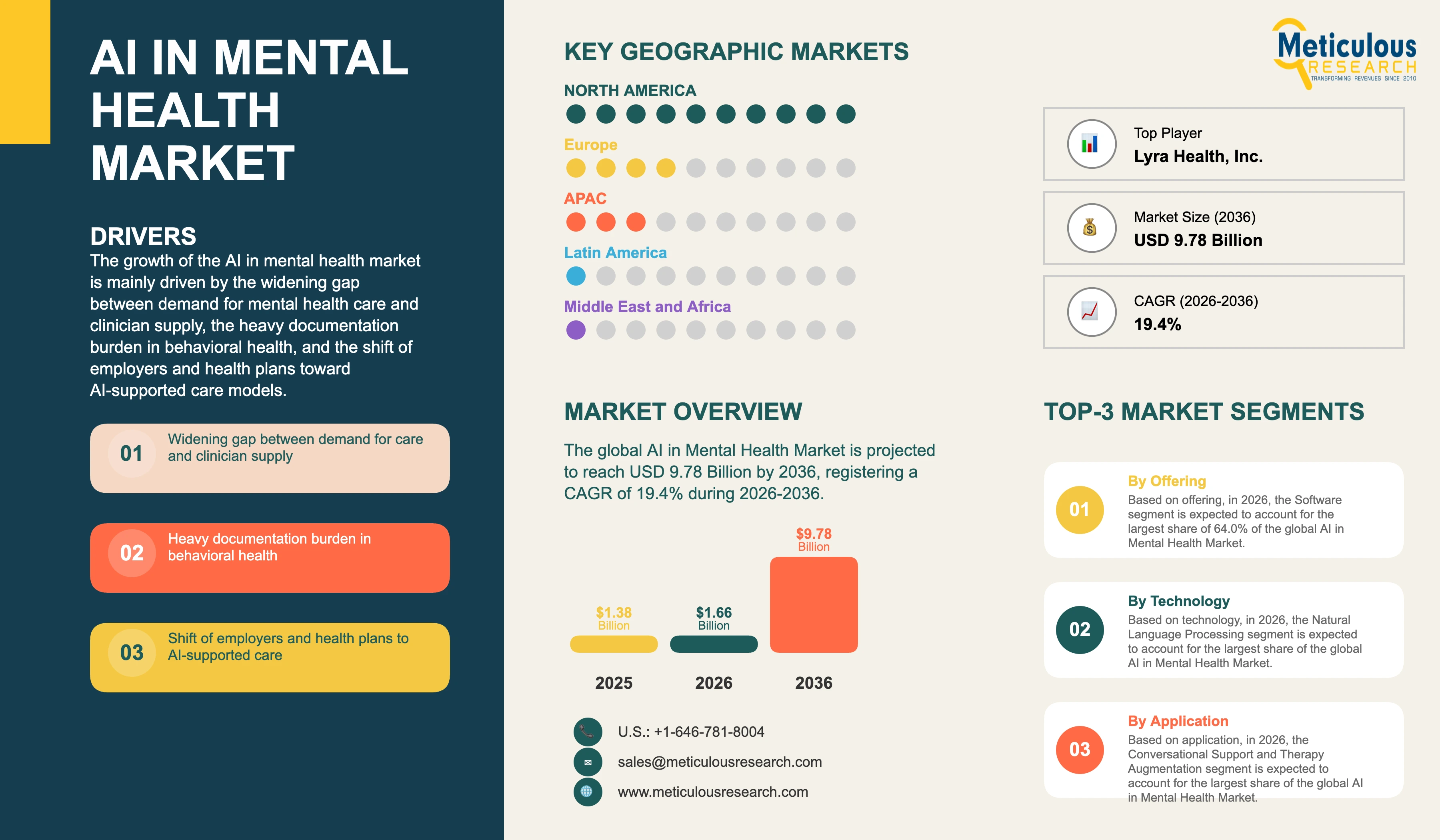
The global AI in mental health market was valued at USD 1.38 billion in 2025. This market is expected to reach USD 9.78 billion by 2036 from an estimated USD 1.66 billion in 2026, registering a CAGR of 19.4% during the forecast period (2026-2036).
- Published
- Nov 2026
- Pages
- 245
- Format
- PDF + Excel
- Report ID
- MRHC - 1042506
- Base year
- 2025
- 2025 · BASELINE
- $1.38B
- 2036
- $9.78B
- CAGR 2026–2036
- 19.4%
2025 baseline · 2026–2036 forecast at 19.4% CAGR · hover a bar for the value
Key highlights
The World Health Organization reported in September 2025 that more than one billion people live with a mental health condition, while the global median mental health workforce is just 13 workers per 100,000 people.
In the U.S., 137 million people, about 40% of the population, lived in a Mental Health Professional Shortage Area as of December 2025, according to the Health Resources and Services Administration.
The FDA's Digital Health Advisory Committee met on 6 November 2025 to discuss generative AI-enabled digital mental health devices; the FDA noted that it has authorized more than 1,200 AI-enabled devices but none using generative AI for mental health conditions.
Illinois signed the Wellness and Oversight for Psychological Resources Act into law in August 2025, banning AI from providing therapy or making therapeutic decisions, with Nevada and Utah also passing laws on AI in mental health care in 2025.
Universal Health Services completed its USD 835 million acquisition of Talkspace in August 2026, Spring Health completed its acquisition of Alma in May 2026, and Sword Health agreed in September 2026 to acquire Headspace in a deal worth up to USD 300 million.
Generative AI and large language models form the fastest-growing technology, and clinical documentation and workflow automation is the fastest-growing application.
By offering, software accounts for the larger share of 64.0% in 2026 and also registers the higher CAGR.
Large care platforms are adding AI through acquisitions and in-house development, combining AI support, human therapists, and psychiatric care in one service for employers and health plans.
Health plans and public health systems are among the fastest-growing buyers, using AI for screening, triage, care navigation, and voice-based outreach to reach members with unmet behavioral health needs.
By technology, natural language processing accounts for the largest share in 2026, while generative AI and large language models register the highest CAGR.
By application, conversational support and therapy augmentation accounts for the largest share in 2026, while clinical documentation and workflow automation registers the highest CAGR.
By condition, depression and anxiety disorders account for the largest share in 2026, while substance use disorders register the highest CAGR.
By end user, healthcare providers account for the largest share of 38.6% in 2026, while health plans register the highest CAGR.
By geography, North America accounts for the largest share of 54.0% in 2026, while Asia-Pacific registers the highest CAGR of 23.4%.
Report summary
| Particulars | Details |
|---|---|
| Forecast Period | 2026-2036 |
| Base Year | 2025 |
| Estimated Year | 2026 |
| CAGR (Value) | 19.4% |
| Format | PDF, Excel & Cloud Portal · 245 pages |
| Market Size (Value) in 2025 | USD 1.38 billion |
| Market Size (Value) in 2026 | USD 1.66 billion |
| Market Size (Value) in 2036 | USD 9.78 billion |
| Segments Covered | Offering, Technology, Application, Condition, End User, Geography |
| Countries Covered | U.S., Canada, U.K., Germany, France, Netherlands, Spain, Italy, Sweden, Rest of Europe, China, Japan, India, Australia, South Korea, Singapore, Rest of Asia-Pacific, Brazil, Mexico, Rest of Latin America, Israel, Saudi Arabia, U.A.E., South Africa, Rest of Middle East & Africa |
| Key Companies | 13 companies and other companies |
| Largest Segment by Offering (2026) | Software (64.0%) |
| Largest Segment by End User (2026) | Healthcare Providers (38.6%) |
| Largest Region (2026) | North America (54.0%) |
| Fastest-Growing Region | Asia-Pacific (CAGR 23.4%) |
Report overview
Segments covered: offering, technology, application, condition, end user.
The growth of this market is mainly driven by the large and growing gap between demand for mental health care and the number of available clinicians, the heavy documentation burden in behavioral health that AI can reduce, the shift of employers and health plans toward AI-supported care navigation and between-session support, and growing payer coverage for digital and AI-enabled mental health services. However, factors such as tightening state and national rules on AI use in therapy, and concerns about the safety of AI chatbots for people at risk, are expected to restrain the growth of this market to some extent. Even so, demand for scalable digital support is expected to keep spending growing at a steady pace across all regions.
AI in mental health covers software and services that use natural language processing, machine learning, generative AI, and voice analytics to support the screening, treatment, monitoring, and administration of mental health care. The main uses are AI conversational tools that support patients between therapy sessions, intake and triage tools that assess symptoms and route patients to the right level of care, ambient documentation tools that write clinical notes for therapists, care navigation that matches people to suitable providers, and models that flag patients at rising risk. Buyers include behavioral health providers, employers, health plans, government agencies, and individual consumers.
Demand is driven by a clear shortage of care, as the World Health Organization reported in September 2025 that more than one billion people are living with a mental health condition, while the median number of mental health workers worldwide is just 13 per 100,000 people and median government spending on mental health has stayed at 2% of health budgets since 2017. In the U.S., the Health Resources and Services Administration counted 137 million people, about 40% of the population, living in Mental Health Professional Shortage Areas as of December 2025, up from 122 million a year earlier. AI is being adopted mainly to stretch the capacity of the existing workforce rather than to replace clinicians.
Most of the market's current revenue comes from AI that supports clinicians and care systems rather than from fully automated therapy. Behavioral health organizations are buying AI documentation tools such as Eleos and Netsmart's Bells to cut the time therapists spend on notes, and NHS Talking Therapies services in England use Limbic's AI assessment tool, which holds Class IIa UKCA medical device status and has completed assessments for more than 500,000 patients. Employer and health plan platforms such as Lyra Health, Spring Health, and Talkspace use AI to match people to care and to support them between sessions, with clinicians remaining responsible for treatment.
Regulators are moving to set rules for patient-facing AI, and the FDA's Digital Health Advisory Committee met in November 2025 to discuss generative AI-enabled mental health devices, focusing on risks such as missed signs of crisis and on the need for clear escalation to humans and ongoing performance monitoring. At the state level, Illinois banned AI from providing therapy or making therapeutic decisions in August 2025, and Nevada and Utah passed their own laws on AI in mental health care. These rules favor AI products that work under clinical supervision and limit the market for standalone AI therapy apps.
The consumer side of the market has proven difficult to build as a business. Woebot Health, one of the most studied AI therapy chatbots, shut down its consumer app on 30 June 2025, with its founder pointing to the cost and difficulty of meeting FDA requirements, and Talkspace reported a 30% fall in consumer revenue in 2025 while its payer revenue grew 38%. At the same time, new consumer products such as Slingshot AI's Ash, launched in July 2025 with USD 93 million in total funding, show that investors still see demand for AI support built specifically for mental health rather than general-purpose chatbots.
The market is consolidating around large care platforms, as Universal Health Services completed its USD 835 million acquisition of Talkspace in August 2026, Spring Health completed its acquisition of Alma in May 2026 and now reaches more than 170 million lives, and Sword Health agreed in September 2026 to acquire Headspace. These deals combine AI tools with large clinician networks and payer contracts, which is where most of the paying demand for AI in mental health now sits. Over the forecast period, the market is expected to shift further toward AI that is built into care platforms, electronic health records, and payer programs, with standalone consumer apps forming a smaller share of spending. This shift is also expected to raise the importance of clinical evidence, data privacy, and integration capabilities in vendor selection.
North America is expected to account for the largest share of 54.0% of the market in 2026.
Asia-Pacific is projected to register the highest CAGR of 23.4% during the forecast period, led by India, China, Japan, and Australia.
The report profiles 13 companies, including Lyra Health, Inc., Spring Care, Inc. (Spring Health), Talkspace, Inc., Headspace (OrangeDot, Inc.), Netsmart Technologies, Inc., Eleos Health, Inc., and Limbic Ltd. The top five players account for an estimated 26.4% of the market in 2025.
AI is mainly used to support clinicians and care teams rather than replace them. Common uses include clinical documentation, screening and triage, care navigation and provider matching, between-session support with clinician oversight, and remote monitoring and risk prediction for people with behavioral health needs.
Software is expected to account for the larger share of 64.0% of the market in 2026.
Report infographic
Market dynamics
15 factors across 5 forcesWidening gap between demand for mental health care and clinician supply
The number of people seeking mental health care has grown much faster than the number of clinicians available to treat them. The World Health Organization estimates that more than one billion people live with a mental health condition, and the Health Resources and Services Administration reports that only about 27% of the need for mental health professionals in U.S. shortage areas is currently met. Training new therapists and psychiatrists takes years, so health systems and payers cannot close the gap through hiring alone. Long waiting lists also mean that many people get worse before they receive care, which increases the cost of treatment and pushes health systems to look for ways to reach people earlier.
AI helps by extending the reach of each clinician, as intake and triage tools handle initial assessments, conversational tools provide support between sessions, and care navigation tools route people with milder needs to coaching or digital programs so that therapists can focus on people with more serious needs. Limbic reports that its tools are used by 45% of NHS Talking Therapies services, showing how public health systems are using AI to manage rising demand with limited staff.
Heavy documentation burden in behavioral health
Therapists and counselors spend a large part of their working time on clinical notes, treatment plans, and compliance paperwork, especially in community behavioral health and substance use treatment, where Medicaid and state rules require detailed records. This administrative load is a major cause of burnout and staff turnover in an already short-staffed field. AI documentation tools listen to sessions, draft notes in the formats that payers require, and check them for compliance before submission.
Adoption of these tools has been fast because the savings are easy to measure. Netsmart reports that users of its Bells Documentation Assistant completed 7.2 million notes in a year and cut documentation time by up to 67%, and Eleos reports that it supports almost 40,000 clinicians. In February 2026, the California Mental Health Services Authority selected Eleos as its statewide AI partner for county behavioral health departments, showing that public buyers are now adopting these tools at scale. Lower documentation time also helps providers see more patients and reduce clinician burnout, which is a major cause of staff turnover in behavioral health.
Shift of employers and health plans toward AI-supported care models
Employers and health plans are under pressure to provide mental health benefits that people can use quickly while keeping costs under control. Platforms such as Lyra Health and Spring Health use AI to assess members, match them to the right type and level of care, and provide support between sessions. Lyra Health launched its AI support tool in October 2025 alongside a set of safety principles, and Talkspace introduced Tee, its AI mental health guide, before its acquisition by Universal Health Services.
These buyers prefer AI that sits inside a supervised care model, with clear routes to human clinicians and crisis support, rather than standalone chatbots. As a result, AI spending is concentrated among large care platforms that hold employer and health plan contracts, and these platforms are using acquisitions to add clinician networks and AI capabilities at the same time. Employers and health plans increasingly want to see measurable outcomes, such as faster access to care and lower total healthcare costs, which favors vendors that can show results across large member populations.
Growing payer coverage for digital and AI-enabled mental health services
Reimbursement for digital mental health is expanding, which gives AI-enabled services a clearer path to revenue. The U.S. Centers for Medicare & Medicaid Services added payment codes for digital mental health treatment devices to its 2025 Physician Fee Schedule, and Germany's DiGA program reimburses prescribed digital health applications, with mental health as the most common indication area. Cognoa's AI-based autism diagnosis aid, Canvas Dx, is covered under several Medicaid programs and by commercial payers.
Payer coverage matters because it moves AI products from small pilot budgets to recurring, per-patient revenue. Health plans are also buying AI care management tools directly, such as Ellipsis Health's voice-based AI care manager, Sage, to reach members with behavioral health needs that their care teams cannot contact in time. As payers gain experience with these tools and see evidence of lower acute care use, coverage is expected to widen to more products and more member groups.
Table of contents
13 chapters · 150 sections · 245 pages · click to expandSegmental analysis
| Segment | Largest share (2026) | Fastest growth (2026–2036) |
|---|---|---|
| By Offering | — | — |
| By Technology | Natural language processing | Generative AI and large language models |
| By Application | Conversational support and therapy augmentation | Clinical documentation and workflow automation |
| By Condition | Depression and anxiety disorders | Substance use disorders |
| By End User | Healthcare providers | Health plans |
| Other segments | Depression and anxiety disorders | Substance use disorders |
By Offering
- AI in Mental Health Market Analysis by Offering
- The software segment is expected to account for the larger share of 64.0% of the global AI in mental health market.
- This segment is also projected to register the higher CAGR during the forecast period.
- The large share of this segment is mainly due to the sale of AI as subscription products for documentation, triage, conversational support, and care navigation, and to the inclusion of AI features in behavioral health electronic health records and employer care platforms.
- Its faster growth is supported by the spread of generative AI documentation tools and usage-based pricing that lowers the cost of adoption for smaller providers.
- Software buyers in this market range from large behavioral health providers and health systems to employers, health plans, and public mental health services, and each group buys AI in a different way.
- Providers mostly buy AI documentation, intake, and triage tools as subscriptions priced per clinician or per session, often as add-ons to their electronic health records from vendors such as Netsmart.
- Employers and health plans buy AI as part of wider mental health platforms from companies such as Lyra Health, Spring Health, and Talkspace, where AI supports care navigation, between-session support, and outreach alongside human therapists.
- Public services, such as NHS Talking Therapies in the U.K., use AI tools such as Limbic Access for self-referral and assessment.
- Software revenue grows as vendors add new AI modules to existing contracts, extend tools from pilot sites to whole organizations, and move from fixed licenses to usage-based pricing that scales with the number of sessions or members covered.
- The services segment includes implementation and integration, clinical validation, training, and AI-enabled managed services such as care management and outreach delivered on behalf of health plans and providers.
- Services remain important because most behavioral health organizations need help connecting AI tools to their records systems, setting up clinical safeguards, and training staff, but their share declines over the forecast period as more of this work is built into software.
- Services are, however, still needed for clinical validation, staff training, and change management, especially in large health systems and public agencies.
By Technology
- AI in Mental Health Market Analysis by Technology
- The natural language processing segment is expected to account for the largest share of the market.
- The large share of this segment is mainly due to its central role in reading and generating clinical text, analyzing therapy conversations, and powering structured conversational tools for intake and support.
- Machine learning and predictive analytics are used mainly for risk prediction, provider matching, and outcome tracking, while speech and voice analytics are used for vocal biomarker screening and voice-based care management.
- Natural language processing is the core technology behind most AI tools used in mental health today, because therapy and behavioral health care are based largely on conversation and written records.
- NLP tools transcribe and summarize therapy sessions, extract symptoms and risk factors from clinical notes, check documentation against payer requirements, and power structured chat tools that guide patients through intake questions and evidence-based exercises.
- These uses are well established and have been adopted by large provider organizations and public services, which gives this segment a large and stable revenue base.
- NLP is also used to flag language that may signal risk of self-harm so that clinicians can follow up quickly, which is an important safety feature that buyers now expect in any patient-facing tool.
- Over the forecast period, much of this NLP capability is expected to be delivered through generative AI and large language models, which is why that segment grows fastest.
- However, the generative AI and large language models segment is projected to register the highest CAGR during the forecast period.
- The rapid growth of this segment is driven by the spread of ambient documentation tools that draft notes from therapy sessions, the launch of purpose-built mental health models by Talkspace, Slingshot AI, Lyra Health, and Limbic, and the use of generative AI for between-session support within supervised care models.
- This segment is expected to become the largest technology by the end of the forecast period.
- Speech and voice analytics also grow quickly, supported by voice-based screening and care management tools used by health plans.
- Generative AI and large language models are projected to register the highest CAGR during the forecast period, while natural language processing holds the largest share in 2026.
By Application
- AI in Mental Health Market Analysis by Application
- The conversational support and therapy augmentation segment is expected to account for the largest share of the market.
- The large share of this segment is mainly due to the wide use of AI tools that support patients between sessions within employer and health plan care platforms, the large user bases of apps such as Wysa and Headspace, and the use of AI to deliver structured cognitive behavioral therapy exercises.
- Screening, assessment, and triage is the next largest application, followed by care navigation and provider matching, and remote monitoring and risk prediction.
- Conversational support tools are used mainly within supervised care models, where AI helps patients practice skills, track mood, and complete cognitive behavioral therapy exercises between sessions with a human clinician, and escalates concerns to the care team when needed.
- This approach allows employers, health plans, and providers to offer support to many more people than their clinicians could reach alone, and it is more acceptable to regulators and professional bodies than standalone AI therapy.
- Large digital mental health platforms include these tools in their services for employers and health plans, and consumer apps such as Wysa and Headspace reach large numbers of users directly.
- Growth in this segment is, however, shaped by state laws in the U.S. that restrict AI from providing therapy or making therapeutic decisions, which is pushing vendors to design conversational tools that clearly support, rather than replace, licensed clinicians and that include strong safety protocols for users in crisis.
- However, the clinical documentation and workflow automation segment is projected to register the highest CAGR during the forecast period.
- The rapid growth of this segment is driven by the heavy documentation burden in behavioral health, the clear and measurable time savings that AI documentation tools deliver, and the lower regulatory risk of AI that supports administrative work, which remains permitted even under restrictive state laws.
- Statewide purchasing, such as California's selection of Eleos, is also speeding up adoption among community providers.
- Remote monitoring and risk prediction also grow quickly as health plans and providers seek to identify members at risk of crisis or hospital admission earlier.
- Conversational support and therapy augmentation is expected to account for the largest share of the market in 2026, while clinical documentation and workflow automation is projected to register the highest CAGR.
By Condition
- AI in Mental Health Market Analysis by Condition
- The depression and anxiety disorders segment is expected to account for the largest share of the market.
- The large share of this segment is mainly due to the high prevalence of these conditions, which the World Health Organization identifies as the most common mental health conditions worldwide, and to the focus of most AI support, screening, and digital therapy tools on these conditions.
- Depression and anxiety are also the conditions most often treated in primary care, employer programs, and digital mental health services, and they account for much of the demand for therapy that the current workforce cannot meet.
- Most AI screening tools, such as those based on the PHQ-9 and GAD-7 questionnaires, are built around these conditions, and many conversational support tools deliver cognitive behavioral therapy techniques that are well proven for depression and anxiety.
- Employers and health plans focus their mental health programs on these conditions because they affect a large share of their members and are linked to lost productivity and higher medical costs.
- Regulatory activity is also concentrated here, as the FDA has discussed how generative AI tools for major depressive disorder could be evaluated, and voice-based screening tools such as Ellipsis Health's target depression and anxiety.
- These factors are expected to keep this segment the largest condition segment throughout the forecast period.
- However, the substance use disorders segment is projected to register the highest CAGR during the forecast period.
- The rapid growth of this segment is driven by the heavy documentation and compliance requirements in substance use treatment, the expansion of AI tools designed for group therapy and addiction care, and public funding for addiction treatment services.
- Neurodevelopmental disorders also grow faster than the market, supported by AI-based diagnostic aids such as Cognoa's Canvas Dx for autism.
- Serious mental illnesses such as schizophrenia and bipolar disorder account for a smaller share, but AI tools for relapse prediction and medication adherence are gaining interest among providers and payers.
By End User
- AI in Mental Health Market Analysis by End User
- The healthcare providers segment is expected to account for the largest share of 38.6% of the market.
- The large share of this segment is mainly due to the adoption of AI documentation, triage, and risk prediction tools by behavioral health organizations, hospitals, community mental health centers, and public services such as NHS Talking Therapies, and to the inclusion of AI features in the electronic health records these providers use.
- Behavioral health providers face long waiting lists, high clinician turnover, and heavy documentation and compliance work, which makes AI tools that save clinician time particularly valuable to them.
- Documentation tools are the most widely adopted, as they can reduce the time clinicians spend on notes and help organizations meet payer requirements, while triage and risk prediction tools help providers decide who needs care most urgently.
- Community mental health centers and substance use treatment providers, which often rely on public funding, are adopting AI through their electronic health record vendors and through statewide programs such as California's selection of Eleos for county behavioral health departments.
- Hospitals and health systems are also using AI to support psychiatric emergency care and to coordinate behavioral health with physical care.
- As AI tools become standard features in behavioral health records systems, adoption is expected to spread from large organizations to smaller practices over the forecast period.
- However, the health plans segment is projected to register the highest CAGR during the forecast period.
- The rapid growth of this segment is driven by health plans' growing use of AI care management and outreach tools to reach members with behavioral health needs, the expansion of AI-enabled mental health platforms into health plan contracts, and payers' interest in tools that reduce costly emergency and inpatient care.
- Employers, individual consumers, and government and public health agencies make up the rest of the market.
- Employers are important buyers through employee assistance and mental health benefit programs, while government agencies are expanding their use of AI in public mental health services.
- Health plans are projected to register the highest CAGR, while healthcare providers account for the largest share of 38.6% in 2026.
Other segments
- Depression and anxiety disorders are expected to account for the largest share of the market in 2026, while substance use disorders are projected to register the highest CAGR.
Geographic analysis
North America
Largest shareIn 2026, North America is expected to account for the largest share of 54.0% of the global AI in mental health market. The large share of this region is mainly due to the severe shortage of mental health professionals in the U.S., the large employer and health plan market for mental health benefits, and the presence of most leading AI mental health companies, including Lyra Health, Spring Health, Talkspace, Eleos, and Netsmart. U.S. regulators and states are also setting the first detailed rules for AI in mental health, which shape product design worldwide. Canada adds demand from provincial health systems and employer benefit programs. The U.S. market also benefits from strong venture funding for AI mental health companies, although state laws on AI therapy shape which products can be offered in each state. The U.S. accounts for most of the regional market, supported by a large and fragmented behavioral health sector, high spending by employers and health plans on mental health benefits, and a strong base of venture-funded AI mental health companies. Demand is also driven by the U.S. workforce shortage, with large parts of the population living in areas designated as mental health professional shortage areas. At the same time, state laws on AI in mental health care, such as those passed in Illinois, Nevada, and Utah, are shaping which products vendors can offer and are pushing the market toward clinician-supervised and administrative uses of AI.
Asia-Pacific
Fastest growthAsia-Pacific is projected to register the highest CAGR of 23.4% during the forecast period. Growth is driven by very low numbers of mental health professionals per person in many countries, the use of mobile-first AI tools to provide anonymous support where stigma limits face-to-face care, and government and employer investment in digital health. India, China, Japan, and Australia are the largest markets in the region, and India-founded Wysa is one example of a regional developer whose AI conversational tool has gained international regulatory recognition. Australia, Japan, China, and Singapore are also investing in digital mental health services, while India's large and young population and limited workforce create strong long-term demand.
Europe
In Europe, adoption is supported by public health system use of AI, such as the NHS Talking Therapies services that use Limbic for assessment and triage, and by Germany's DiGA program, which reimburses prescribed digital health applications and lists mental health as its most common indication area. The U.K., Germany, France, and the Netherlands are the largest markets in the region. Medical device rules, the GDPR, and the EU AI Act shape how vendors design and certify AI tools that interact with patients.
Latin America
Latin America and the Middle East & Africa account for smaller shares of the market. Brazil and Mexico are the largest markets in Latin America, where employers and private insurers are adding digital mental health benefits.
Middle East & Africa
In the Middle East & Africa, Israel is home to several AI mental health developers, while Saudi Arabia and the U.A.E. are investing in digital health as part of national health strategies, as shown by the launch of Cognoa's Canvas Dx in Saudi Arabia in January 2026.
Competitive landscape
Large employer and health plan care platforms hold the strongest position in this market, because they combine AI tools with clinician networks and long-term benefit contracts. Lyra Health, Spring Health, Talkspace, and Headspace use AI for assessment, care matching, and between-session support within supervised care models, and recent deals have added scale to these platforms. Universal Health Services completed its acquisition of Talkspace in August 2026, Spring Health closed its acquisition of Alma in May 2026, and Sword Health agreed in September 2026 to acquire Headspace.
Specialist vendors compete in specific parts of the care process, with Eleos Health and Netsmart leading in AI documentation and compliance for behavioral health and substance use providers, Limbic in AI assessment and triage for public mental health services, and Ellipsis Health in voice-based screening and AI care management for health plans. Wysa and Slingshot AI focus on conversational AI support, Cognoa on AI-based diagnosis of autism in young children, and Modern Health on AI-supported employer mental health programs. Vendors with regulatory clearances, published clinical evidence, and strong safety protocols are gaining advantage as rules tighten.
The market remains fragmented, with the top five players estimated to account for 26.4% of the market in 2025. Woebot Health's exit from the consumer market in June 2025 and the consolidation of consumer apps into larger platforms show that standalone AI apps without payer or employer channels find it hard to scale. Acquisitions are expected to continue as care platforms and health systems look to add AI capabilities and clinician capacity together.
Some of the key players operating in the AI in mental health market are Lyra Health, Inc., Spring Care, Inc. (Spring Health), Talkspace, Inc., Headspace (OrangeDot, Inc.), Sword Health, Inc., Netsmart Technologies, Inc., Eleos Health, Inc., Limbic Ltd., Wysa Ltd., Ellipsis Health, Inc., Cognoa, Inc., Slingshot AI, Inc., and Modern Health, Inc., among others.
Vendors compete on clinical evidence, safety protocols, integration with electronic health records and payer systems, the size of their clinician networks, and their ability to show measurable outcomes to buyers. Large care platforms have an advantage in distribution through employer and health plan contracts, while specialist AI companies compete on purpose-built models, regulatory clearances, and specific uses such as documentation, voice analysis, or autism diagnosis. Partnerships between AI developers and electronic health record vendors, health plans, and public health systems are a common route to scale. Such partnerships give vendors access to large patient populations and established referral pathways.
- —
Universal Health Services completed its USD 835 million acquisition of Talkspace in August 2026, Spring Health completed its acquisition of Alma in May 2026, and Sword Health agreed in September 2026 to acquire Headspace. The FDA's Digital Health Advisory Committee met in November 2025 to discuss generative AI-enabled mental health devices. These moves point to continued consolidation across the market.
- Lyra Health, Inc.
- Spring Care, Inc. · Spring Health
- Talkspace, Inc.
- Headspace (OrangeDot, Inc.)
- Sword Health, Inc.
- Netsmart Technologies, Inc.
- Eleos Health, Inc.
- Limbic Ltd.
- Wysa Ltd.
- Ellipsis Health, Inc.
- Cognoa, Inc.
- Slingshot AI, Inc.
- Modern Health, Inc.
Expert perspectives
Spending in this market is driven by the shortage of clinicians more than by interest in AI itself. Buyers are paying for tools that let each therapist see more patients, spend less time on notes, and focus on people with the greatest need, which is why documentation, triage, and care navigation are attracting the most investment. AI that replaces human therapy entirely remains a small and uncertain part of the market, limited by state laws, regulatory caution, and weak consumer willingness to pay.
The market is settling around supervised, hybrid care models in which employer and health plan platforms combine AI tools with large clinician networks. Recent acquisitions of Talkspace, Alma, and Headspace show that buyers value AI most when it sits inside a care system with clear clinical responsibility. Specialist vendors with strong positions in documentation, triage, and diagnosis are likely to grow through partnerships with electronic health record vendors and public health systems, or to be acquired by larger platforms.
Generative AI and large language models are the fastest-growing technology and are expected to become the largest by 2036, as ambient documentation and purpose-built mental health models spread. Clinical documentation and workflow automation is the fastest-growing application because its benefits are immediate, easy to measure, and permitted even under the most restrictive state laws. Health plans are the fastest-growing end user, as they turn to AI care management to reach members before their needs become acute.
Asia-Pacific is the fastest-growing region at a CAGR of 23.4%, supported by very large unmet need and the spread of mobile-first AI tools, while North America remains the largest market through 2036. The biggest uncertainty is regulation: a clear FDA pathway for generative AI mental health devices would open a large new market for prescribed AI therapy, while a wider spread of state bans would keep AI focused on administrative and supervised uses.
For buyers, the main question is moving from whether to use AI to how to use it safely and at scale. Providers, health plans, and public systems are expected to favor vendors that can integrate AI into existing workflows, provide clear safety and escalation processes, and report measurable results, which will shape vendor positions through 2036.
Overall, growth in this market rests on a care gap that cannot be closed by hiring alone and on AI tools that have proven they can save clinician time. Vendors that combine clinical evidence, safety protocols, and access to payer and employer channels are expected to capture most of this growth.
Customer perspectives
Chief Clinical Officer - community behavioral health organization, U.S.
Our therapists were spending evenings finishing notes, and that was a big part of why people left. The documentation tool gave them back hours every week, and our compliance reviews now catch problems before claims go out.
Documentation time is a direct cause of burnout and turnover in behavioral health, which is why clinical documentation and workflow automation is the fastest-growing application and why healthcare providers hold 38.6% of the market.
Director of Behavioral Health - regional health plan, U.S.
Our care managers can only reach a fraction of the members who need behavioral health support. AI outreach lets us check in with far more people and bring in a nurse or therapist when the conversation shows a problem.
Health plans are turning to AI care management to reach members before their needs become acute, which supports the fast growth of the health plans segment and the use of voice-based tools such as Ellipsis Health's Sage.
Service Manager - NHS Talking Therapies service, U.K.
Demand keeps rising, but our clinical team does not. AI assessment means people get a full intake at any time of day, and our clinicians start the first appointment already knowing what the person needs.
Public services are using AI to manage rising demand with limited staff, as shown by the use of Limbic's Class IIa assessment tool across NHS Talking Therapies services, and screening, assessment, and triage is one of the largest applications in this market. Buyers also expect clear clinical evidence before scaling these tools.
Frequently asked questions
The market was valued at USD 1.38 billion in 2025 and USD 1.14 billion in 2024, and is estimated at USD 1.66 billion in 2026.
Cite this report
Meticulous Research. (2026). AI in Mental Health Market - Global Opportunity Analysis and Industry Forecast (2026-2036) (Report No. MRHC - 1042506). Meticulous Market Research Pvt. Ltd. https://www.meticulousresearch.com/product/ai-in-mental-health-market-7189