Mammography Market (2026-2036)
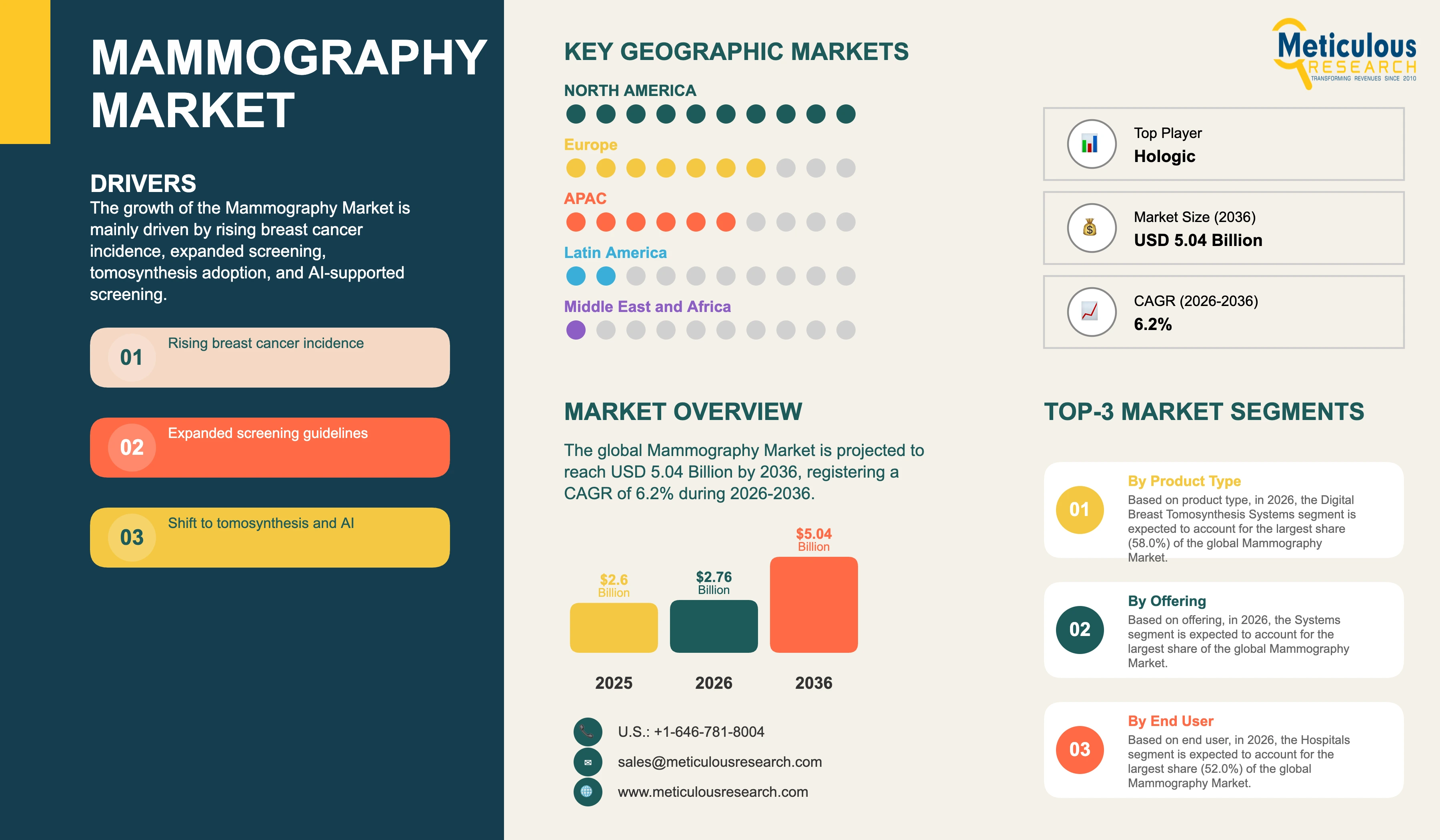
The global mammography market was valued at USD 2.60 billion in 2025. This market is expected to reach USD 5.04 billion by 2036 from an estimated USD 2.76 billion in 2026, registering a CAGR of 6.2% during the forecast period (2026-2036).
- Published
- Nov 2026
- Pages
- 271
- Format
- PDF + Excel
- Report ID
- MRHC - 1042631
- Base year
- 2025
- 2025 · BASELINE
- $2.60B
- 2036
- $5.04B
- CAGR 2026–2036
- 6.2%
2025 baseline · 2026–2036 forecast at 6.2% CAGR · hover a bar for the value
Key highlights
On April 30, 2024, the U.S. Preventive Services Task Force finalized its recommendation for biennial screening mammography for women aged 40 to 74 years, lowering the starting age from 50, and the recommendation includes both digital mammography and digital breast tomosynthesis as effective screening approaches, according to the USPSTF statement published in JAMA and ABC News reporting.
Since September 10, 2024, an FDA rule under the Mammography Quality Standards Act has required all U.S. mammography facilities to tell women in their results letters whether their breasts are dense or not dense and to advise them to discuss additional screening with their provider. Before the federal rule, 38 states required some form of breast density notification, according to PhillyVoice and the American Cancer Society.
Results from the MASAI randomized trial of 105, 934 women in Sweden, published in The Lancet in January 2026, showed that AI-supported mammography screening had a non-inferior interval cancer rate, with 12% fewer interval cancers, and higher sensitivity of 80.5% compared with 73.8% for standard double reading, with specificity of 98.5% in both groups, according to The Lancet abstract and AJMC.
Earlier MASAI analyses showed that AI support reduced radiologists' screen-reading workload by 44% and detected 29% more cancers without increasing false positives, according to The ASCO Post, which strengthens the case for AI in screening programs facing staff shortages.
Blackstone and TPG completed their acquisition of Hologic, the leading supplier of mammography and breast tomosynthesis systems, on April 7, 2026, in a transaction valued at up to USD 79 per share, or about USD 18.3 billion, with a contingent value right tied to global revenue goals for Hologic's Breast Health business in fiscal 2026 and 2027, according to Hologic and Pulse 2.0. Breast imaging providers are also investing in contrast-enhanced mammography and AI-based risk assessment to offer more personalized screening, particularly for women with dense breasts or a higher risk of breast cancer. This shift is gradually changing screening practice in many countries.
By product type, digital breast tomosynthesis systems account for the largest share of 58.0% in 2026, while contrast-enhanced and other mammography systems register the highest CAGR.
By offering, systems account for the largest share in 2026, while software and AI solutions register the highest CAGR.
By application, screening accounts for the larger share in 2026 and also registers the higher CAGR.
By end user, hospitals account for the largest share of 52.0% in 2026, while diagnostic imaging and breast care centers register the highest CAGR.
By geography, North America accounts for the largest share of 40.0% in 2026, while Asia-Pacific registers the highest CAGR of 8.6%.
Report summary
| Particulars | Details |
|---|---|
| Base Year | 2025 |
| Estimated Year | 2026 |
| Forecast Period | 2026-2036 |
| Market Size in 2025 | USD 2.60 billion |
| Market Size in 2026 | USD 2.76 billion |
| Market Size by 2036 | USD 5.04 billion |
| CAGR (2026-2036) | 6.2% |
| Format | PDF, Excel & Cloud Portal · 271 pages |
| Largest Segment by Product Type (2026) | Digital Breast Tomosynthesis Systems (58.0%) |
| Largest Segment by End User (2026) | Hospitals (52.0%) |
| Largest Region (2026) | North America (40.0%) |
| Fastest-Growing Region | Asia-Pacific (CAGR 8.6%) |
| Companies Profiled | 13 companies and other companies |
| Segments Covered | Product Type, Offering, Application, End User, Geography |
| Countries Covered | U.S., Canada, Rest of North America, Germany, U.K., France, Italy, Spain, Netherlands, Sweden, Switzerland, Belgium, Denmark, Norway, Finland, Austria, Poland, Ireland, Rest of Europe, China, Japan, India, South Korea, Australia, Indonesia, Vietnam, Thailand, Singapore, Malaysia, Philippines, Taiwan, New Zealand, Rest of Asia-Pacific, Brazil, Mexico, Argentina, Colombia, Chile, Peru, Rest of Latin America, Saudi Arabia, U.A.E., Israel, South Africa, Turkey, Egypt, Rest of Middle East & Africa |
Report overview
Segments covered: product type, offering, application, end user.
The growth of this market is mainly driven by the rising incidence of breast cancer, the expansion of screening guidelines, such as the U.S. Preventive Services Task Force's 2024 recommendation to begin biennial screening at age 40, the shift from 2D digital mammography to digital breast tomosynthesis, the growing adoption of artificial intelligence for screening and reading support, the U.S. Food and Drug Administration's breast density notification requirement, which took effect in September 2024, and the expansion of screening programs in Asia-Pacific and other emerging markets. However, factors such as the high cost of tomosynthesis and advanced mammography systems, shortages of breast radiologists and technologists, concerns about false positives and overdiagnosis, and limited screening infrastructure and awareness in many low- and middle-income countries are expected to restrain the growth of this market to some extent.
Mammography is an X-ray imaging technique designed specifically for examining the breast and is the primary method for breast cancer screening and an important tool for diagnosing breast abnormalities. Screening mammography is performed in women without symptoms to detect breast cancer early, when it is more treatable, while diagnostic mammography is used to evaluate breast lumps, pain, nipple discharge, abnormal screening findings, and other symptoms. Breast cancer is the most commonly diagnosed cancer among women worldwide, and organized screening programs have been shown to reduce breast cancer mortality.
This report covers the global mammography market, including full-field digital mammography systems, digital breast tomosynthesis systems, contrast-enhanced and other mammography systems, related services, and software and AI solutions for mammography, such as reading workstations, computer-aided detection and AI software, and breast density assessment software. State and federal legislation in the U.S. is also expanding insurance coverage of supplemental breast imaging, which supports demand for advanced mammography capabilities. The market is analyzed by product type, offering, application, end user, and geography. Breast ultrasound, breast MRI, molecular breast imaging, and breast biopsy devices are analyzed in separate reports. The market is measured on a revenue basis at manufacturer selling prices, on a sales basis in each country.
Mammography technology has evolved from analog film-screen systems to full-field digital mammography and, more recently, to digital breast tomosynthesis, also known as 3D mammography. Tomosynthesis acquires multiple low-dose images of the breast from different angles and reconstructs them into thin slices, which reduces the effect of overlapping tissue, improves cancer detection, and reduces recall rates, particularly in women with dense breasts. In the U.S., tomosynthesis has become the standard of care at most screening facilities, and its adoption is growing in Europe and Asia-Pacific.
Artificial intelligence is transforming how mammograms are read, triaged, and assessed in screening programs around the world. AI software can detect suspicious findings, triage examinations, assess breast density, and estimate breast cancer risk. The MASAI randomized trial in Sweden, published in The Lancet in January 2026, showed that AI-supported screening reduced interval cancers and increased sensitivity compared with standard double reading, while earlier results showed a significant reduction in radiologists' workload. These results are encouraging screening programs in Europe and elsewhere to adopt AI to address shortages of breast radiologists.
Digital breast tomosynthesis systems account for the largest share of the market by product type, while contrast-enhanced and other mammography systems are the fastest-growing product type. Systems account for the largest share by offering, while software and AI solutions are the fastest-growing offering. Screening is the largest and fastest-growing application. Hospitals are the largest end user, while diagnostic imaging and breast care centers are the fastest-growing end user. North America accounts for the largest share of the market, while Asia-Pacific is the fastest-growing region.
Screening guidelines and regulations strongly influence demand for mammography systems, services, and software in each country. In the U.S., the U.S. Preventive Services Task Force recommended biennial screening from age 40 in 2024, and the FDA's breast density notification rule took effect in September 2024. In Europe, organized national screening programs typically invite women aged 50 to 69 or older, and several countries are extending screening to younger and older age groups. In Asia-Pacific, screening programs are expanding in China, Japan, South Korea, and other countries, although participation rates vary widely.
The market is concentrated among a small number of large imaging companies, led by Hologic, GE HealthCare, Siemens Healthineers, and Fujifilm, which offer mammography and tomosynthesis systems, along with regional manufacturers such as United Imaging Healthcare, IMS Giotto, Planmed, Metaltronica, and Allengers. AI software companies, such as Lunit, ScreenPoint Medical, Therapixel, and RadNet's DeepHealth, are an increasingly important part of the market. Hologic, the market leader, was acquired by Blackstone and TPG in April 2026.
Over the forecast period, the mammography market is expected to grow steadily, supported by rising breast cancer incidence, expanded screening guidelines, the replacement of 2D systems with tomosynthesis, the adoption of AI, the growth of contrast-enhanced mammography, and the expansion of screening in emerging markets. The pace of growth will depend on healthcare budgets, reimbursement, workforce availability, and screening participation rates. Upgrade paths that allow facilities to add tomosynthesis or AI to existing systems are also popular with buyers.
Tomosynthesis is now our standard for screening, and with more women starting at 40 and density notifications, we are adding capacity and looking closely at AI to manage reading volumes.
This comment explains why tomosynthesis systems account for 58.0% of the market and why software and AI solutions are the fastest-growing offering.
The randomized evidence on AI has changed the conversation. We see AI as a way to maintain double-reading quality while coping with radiologist shortages.
This comment explains why software and AI solutions are the fastest-growing offering, why screening is the fastest-growing application, and why hospitals, which account for 52.0% of the market, remain central to national screening programs.
Many of our patients have dense breasts, so tomosynthesis and contrast-enhanced mammography are increasingly important for finding cancers that 2D images can miss.
This comment explains why Asia-Pacific is the fastest-growing region and why contrast-enhanced and other systems are the fastest-growing product type.
North America is expected to account for the largest share of 40.0% of the market in 2026, mainly due to high tomosynthesis adoption, the USPSTF's 2024 screening recommendation, the FDA's breast density rule, high healthcare spending, and the presence of major companies.
Asia-Pacific is projected to register the highest CAGR of 8.6% during the forecast period, driven by rising breast cancer incidence, expanding screening programs, healthcare investment, dense breast prevalence, and regional manufacturers.
The report profiles 13 companies, including Hologic, GE HealthCare, Siemens Healthineers, Fujifilm, United Imaging Healthcare, IMS Giotto, Planmed, Metaltronica, Allengers, Lunit, ScreenPoint Medical, Therapixel, and RadNet (DeepHealth).
Contrast-enhanced mammography combines mammography with an iodinated contrast agent to highlight areas of increased blood flow associated with cancer, providing information similar to breast MRI at a lower cost for diagnostic and supplemental imaging.
In the MASAI randomized trial of 105,934 women in Sweden, AI-supported screening reduced interval cancers by 12% and increased sensitivity from 73.8% to 80.5% compared with standard double reading, while earlier analyses showed a 44% reduction in radiologists' screen-reading workload.
In 2026, the screening segment is expected to account for the larger share of the mammography market, and it is also projected to register the higher CAGR during the forecast period.
Report infographic
Market dynamics
18 factors across 5 forcesRising incidence of breast cancer
Breast cancer is the most commonly diagnosed cancer among women worldwide, and its incidence is increasing due to aging populations, changes in reproductive patterns, lifestyle factors, and improved detection. Incidence is also rising among younger women in some countries, which has influenced recent changes in screening guidelines. The growing number of breast cancer cases is increasing demand for both screening and diagnostic mammography.
Breast cancer incidence is rising particularly rapidly in many Asian, Latin American, and African countries, where screening infrastructure is still developing. This trend is expected to drive significant investment in mammography systems in these regions over the forecast period. In many of these countries, a larger share of breast cancers are diagnosed at later stages, which makes early detection through screening a public health priority.
Breast cancer survivors also require regular surveillance mammography after treatment, which adds to the volume of diagnostic examinations as survival rates improve. Women with a family history of breast cancer or genetic risk factors are also advised to begin screening earlier and screen more frequently, which further increases screening volumes.
Expansion of screening guidelines and programs
Breast cancer screening guidelines in many countries are expanding to include more women and a wider range of age groups. On April 30, 2024, the U.S. Preventive Services Task Force finalized its recommendation for biennial screening mammography for women aged 40 to 74, lowering the starting age from 50 and including digital breast tomosynthesis as an effective screening approach. Several European countries are extending screening programs to women in their forties and seventies, and countries in Asia-Pacific are expanding organized screening.
The expansion of screening eligibility increases the number of women who should receive regular mammograms, which increases demand for mammography capacity, systems, and services. Health systems must add equipment, staff, and screening sites to meet this demand. Modeling cited by the USPSTF indicated that starting screening at 40 could further reduce breast cancer deaths, which is encouraging health plans and providers to expand capacity for women in their forties.
Shift from 2D mammography to digital breast tomosynthesis
Digital breast tomosynthesis improves cancer detection and reduces recall rates compared with 2D digital mammography, particularly in women with dense breasts. Tomosynthesis has become the standard of care in many U.S. screening facilities and is increasingly being adopted in Europe and Asia-Pacific. Health systems and imaging centers are replacing 2D digital mammography systems with tomosynthesis systems, which have higher prices and drive revenue growth.
The inclusion of tomosynthesis in the USPSTF screening recommendation and growing evidence from European trials are expected to further accelerate the shift to tomosynthesis over the forecast period. Tomosynthesis is also increasingly used for diagnostic workups and image-guided biopsies, which increases its value to breast centers.
Adoption of artificial intelligence for screening and reading
Artificial intelligence is increasingly used to support mammography screening by detecting suspicious findings, triaging examinations, assessing breast density, and estimating risk. The MASAI randomized trial in Sweden showed that AI-supported screening reduced interval cancers by 12% and increased sensitivity compared with standard double reading, and earlier results showed that AI reduced radiologists' screen-reading workload by 44%.
Screening programs facing shortages of breast radiologists are adopting AI to maintain or improve screening performance with fewer readers. The adoption of AI is driving growth in the software and AI solutions segment and increasing the value of mammography systems that integrate AI tools. Several national screening programs in Europe are evaluating or deploying AI to replace or support one of the two readers in double reading, which could significantly increase demand for AI software.
Breast density notification and supplemental imaging
Since September 10, 2024, the FDA has required all U.S. mammography facilities to notify women whether their breasts are dense or not dense and to advise them to discuss additional screening with their provider. Dense breast tissue reduces the sensitivity of mammography and increases breast cancer risk, and almost half of women aged 40 and older who get mammograms have dense breasts, according to the National Cancer Institute.
Breast density notification is increasing awareness among women and providers, encouraging the use of tomosynthesis, which performs better in dense breasts, and increasing demand for supplemental imaging, including contrast-enhanced mammography, which supports growth in advanced mammography systems and breast density assessment software.
Table of contents
12 chapters · 157 sections · 271 pages · click to expandSegmental analysis
| Segment | Largest share (2026) | Fastest growth (2026–2036) |
|---|---|---|
| By Product Type | Digital breast tomosynthesis systems | Contrast-enhanced and other mammography systems |
| By Offering | Systems | Software and AI solutions |
| By Application | Screening | — |
| By End User | Hospitals | Diagnostic imaging and breast care centers |
| Other segments | Hospitals | Diagnostic imaging and breast care centers |
By Product Type
- Mammography Market Analysis by Product Type
- The digital breast tomosynthesis systems segment is expected to account for the largest share of 58.0% of the global mammography market.
- The large share of this segment is mainly due to the widespread adoption of tomosynthesis as the standard of care in the U.S., where most screening facilities now offer 3D mammography, the higher price of tomosynthesis systems compared with 2D systems, growing adoption in Europe and Asia-Pacific, evidence that tomosynthesis improves cancer detection and reduces recall rates, particularly in women with dense breasts, and the inclusion of tomosynthesis in the USPSTF's 2024 screening recommendation.
- Tomosynthesis systems are offered by Hologic, GE HealthCare, Siemens Healthineers, Fujifilm, United Imaging Healthcare, IMS Giotto, Planmed, and others.
- Tomosynthesis systems generate synthetic 2D images in addition to 3D slices, which allows radiologists to reduce radiation dose by eliminating the need for a separate 2D acquisition.
- The ongoing replacement of 2D digital mammography systems with tomosynthesis systems is expected to drive continued growth in this segment.
- However, the contrast-enhanced and other mammography systems segment is projected to register the highest CAGR during the forecast period.
- The rapid growth of this segment is driven by the growing use of contrast-enhanced mammography for diagnostic evaluation, preoperative staging, and supplemental screening of women with dense breasts or high risk, its lower cost and greater availability compared with breast MRI, the need for supplemental imaging following the FDA's breast density notification rule, and growing clinical evidence supporting its use.
- The segment also includes mammography systems with advanced capabilities such as integrated biopsy guidance.
- The full-field digital mammography systems segment forms the second-largest segment, supported by the large installed base of 2D digital mammography systems, their lower cost, and their continued use in screening programs in Europe, Asia-Pacific, and emerging markets where tomosynthesis adoption is still developing.
- However, this segment is expected to grow slowly as facilities replace 2D systems with tomosynthesis systems.
- Manufacturers are also improving tomosynthesis with faster scan times, wider angles, lower doses, and AI-based image reconstruction, which improves image quality and reduces reading times.
- Upgradeable platforms allow facilities to start with 2D digital mammography and later add tomosynthesis or contrast-enhanced capabilities, which spreads investment over time.
By Offering
- The systems segment is expected to account for the largest share of the global mammography market.
- The large share of this segment is mainly due to the high value of mammography and tomosynthesis systems, the ongoing replacement of 2D systems with tomosynthesis, the purchase of new systems to expand screening capacity in response to expanded screening guidelines, and investments in mammography capacity in emerging markets.
- However, the software and AI solutions segment is projected to register the highest CAGR during the forecast period.
- The rapid growth of this segment is driven by the adoption of AI for detection, triage, breast density assessment, and risk prediction, strong clinical evidence from the MASAI trial published in The Lancet in January 2026, the need to address shortages of breast radiologists, the growing use of breast density assessment software following the FDA's density notification rule, and the shift to subscription and per-study pricing models.
- AI software is offered by mammography system manufacturers and specialized AI companies such as Lunit, ScreenPoint Medical, Therapixel, and RadNet's DeepHealth.
- The services segment forms a significant segment, supported by maintenance, repair, quality assurance, training, and upgrade services for the large installed base of mammography systems.
- Regulatory quality standards for mammography, such as those under the Mammography Quality Standards Act in the U.S., require regular testing and maintenance, which creates steady demand for services.
- Service contracts also provide manufacturers with recurring revenue and opportunities to sell upgrades and software, and multi-vendor service providers compete with manufacturers for service business in mature markets.
- Services include installation, maintenance, quality assurance, applications training, and upgrades, and they are essential because regulations require regular testing and because screening programs depend on high system availability.
- Software subscriptions for AI and workflow tools are also growing quickly.
By Application
- Mammography Market Analysis by Application
- The screening segment is expected to account for the largest share of the global mammography market.
- The large share of this segment is mainly due to the large number of women who undergo regular screening mammography, organized national screening programs in Europe, Asia-Pacific, and other regions, the USPSTF's 2024 recommendation for biennial screening from age 40, and the use of tomosynthesis and AI to improve screening performance.
- This segment is also projected to register the highest CAGR during the forecast period, driven by expanded screening eligibility, the expansion of screening programs in emerging markets, the adoption of AI in screening, the use of mobile screening units to reach underserved women, and the growth of supplemental screening for women with dense breasts.
- The diagnostic segment accounts for the remaining share of the market and includes mammography performed to evaluate symptoms and abnormal screening findings, surveillance of breast cancer survivors, and contrast-enhanced mammography for diagnostic evaluation and staging.
- The growth of diagnostic mammography is also supported by the rising number of breast cancer survivors who require surveillance imaging.
- Diagnostic examinations also typically require more images and radiologist time, which increases their value per procedure.
- This supports steady demand for diagnostic-capable systems.
- Diagnostic mammography is used to evaluate breast lumps, abnormal screening results, and symptoms, and it often involves additional views, tomosynthesis, contrast-enhanced imaging, and image-guided biopsy, which increases the value of diagnostic-capable systems.
By End User
- The hospitals segment is expected to account for the largest share of 52.0% of the global mammography market.
- The large share of this segment is mainly due to the large number of hospitals that offer screening and diagnostic mammography, the role of hospitals in national screening programs in many countries, the concentration of diagnostic mammography, contrast-enhanced mammography, and breast biopsy services in hospital breast centers, and the greater financial resources of hospitals for purchasing advanced systems.
- However, the diagnostic imaging and breast care centers segment is projected to register the highest CAGR during the forecast period.
- The rapid growth of this segment is driven by the shift of screening mammography to outpatient imaging centers and dedicated breast centers, the growth of large imaging center networks in the U.S. and other countries, investment in tomosynthesis and AI by imaging center operators, and patient preference for convenient outpatient screening.
- The mobile screening units and other end users segment accounts for the remaining share of the market and includes mobile mammography programs that serve rural and underserved communities.
- Hospitals perform a large share of diagnostic mammography and biopsies and participate in national screening programs in many countries, while diagnostic imaging and breast care centers are expanding rapidly because they offer convenient, high-volume screening with short waiting times.
- Mobile screening units help reach women in rural and underserved areas and are widely used in organized screening programs.
Other segments
- The hospitals segment is expected to account for the largest share of 52.0% of the mammography market, while the diagnostic imaging and breast care centers segment is projected to register the highest CAGR during the forecast period.
Geographic analysis
North America
Largest shareIn 2026, North America is expected to account for the largest share of 40.0% of the global mammography market. The large share of this region is mainly due to the high adoption of digital breast tomosynthesis in the U.S., the USPSTF's 2024 recommendation for biennial screening from age 40, the FDA's breast density notification rule, which took effect in September 2024, high healthcare spending, the large number of imaging centers and breast centers, the early adoption of AI, and the presence of major companies such as Hologic and GE HealthCare. Hologic, the market leader, was acquired by Blackstone and TPG in April 2026 in a transaction valued at about USD 18.3 billion. Canada also contributes to the regional market, with provinces expanding screening to women in their forties.
Asia-Pacific
Fastest growthAsia-Pacific is projected to register the highest CAGR of 8.6% during the forecast period. The rapid growth of this region is mainly driven by rising breast cancer incidence, growing awareness, the expansion of national screening programs in China, Japan, South Korea, Australia, and other countries, increasing healthcare investment, the higher prevalence of dense breasts among Asian women, which supports the adoption of tomosynthesis, and the presence of regional manufacturers such as Fujifilm and United Imaging Healthcare that offer competitive systems. India, Indonesia, and Vietnam have large populations of women with limited access to screening, which represents significant long-term growth potential.
Europe
Europe accounts for a significant share of the market, supported by well-established organized national screening programs, the extension of screening to younger and older age groups in several countries, growing adoption of tomosynthesis, and strong interest in AI-supported screening following the MASAI trial in Sweden. The presence of companies such as Siemens Healthineers, IMS Giotto, Planmed, and Metaltronica also supports the regional market.
Latin America
Latin America accounts for a smaller share of the market, with demand concentrated in Brazil and Mexico, where governments are expanding screening programs, while the Middle East & Africa accounts for the smallest share, with growing investment in breast cancer screening in Saudi Arabia, the U.A.E., and South Africa. Regional differences in breast cancer incidence, screening guidelines, healthcare spending, reimbursement, and workforce availability shape the demand for mammography around the world. Regions with expanding screening programs and growing healthcare investment are expected to see the fastest growth over the forecast period. The availability of trained staff and reimbursement for advanced imaging will also influence regional adoption. Latin America and the Middle East & Africa account for smaller shares of the market, but breast cancer screening is expanding in Brazil, Mexico, Argentina, Colombia, Chile, Saudi Arabia, the U.A.E., Israel, Turkey, and South Africa. Several countries are investing in national screening programs and mobile screening units to improve early detection, and breast cancer awareness campaigns are increasing participation. Affordable systems, training, and service networks are key factors for growth in these regions, where many women are diagnosed at later stages. Training programs for radiographers and radiologists are also important in these regions.
Competitive landscape
The global mammography market is consolidated, with the top five players estimated to account for about 75% of the market in 2025. The market includes large imaging companies with comprehensive mammography portfolios, regional manufacturers, and specialized AI software companies.
Hologic is the market leader in mammography and tomosynthesis systems and offers breast imaging software, AI, and biopsy solutions, and was acquired by Blackstone and TPG in April 2026. GE HealthCare, Siemens Healthineers, and Fujifilm offer mammography, tomosynthesis, and contrast-enhanced mammography systems, while United Imaging Healthcare is a growing competitor, particularly in China. IMS Giotto, Planmed, Metaltronica, and Allengers offer mammography systems in Europe, India, and other markets. Lunit, ScreenPoint Medical, Therapixel, and RadNet's DeepHealth offer AI software for mammography screening, detection, and risk assessment.
Companies in this market compete on image quality, radiation dose, tomosynthesis performance, patient comfort, contrast-enhanced and biopsy capabilities, AI integration, workflow efficiency, price, service, and installed base relationships. Key strategies include launching new tomosynthesis and contrast-enhanced systems, integrating AI into systems and workflows, acquiring and partnering with AI companies, expanding in emerging markets, and offering service and software subscriptions.
Recent competitive activity has focused on consolidation and AI. Blackstone and TPG completed their acquisition of Hologic in April 2026, with part of the consideration tied to future Breast Health revenue goals, while AI companies and imaging providers continue to consolidate and form partnerships to offer integrated screening solutions. The publication of the MASAI trial results in January 2026 has strengthened the case for AI-supported screening. Manufacturers have also continued to expand contrast-enhanced and biopsy capabilities on their platforms.
We expect competition to increase in software and AI solutions as more companies obtain regulatory approvals and as screening programs adopt AI. Manufacturers that integrate AI into their systems and offer complete breast health solutions, from screening to diagnosis and biopsy, are likely to strengthen their positions, while regional manufacturers compete on price in emerging markets. Partnerships between system manufacturers and AI developers are also expected to increase, as customers prefer AI tools that are integrated into their existing systems and reading workstations rather than standalone products.
Some of the key players operating in the mammography market are Hologic, Inc., GE HealthCare Technologies Inc., Siemens Healthineers AG, Fujifilm Holdings Corporation, Shanghai United Imaging Healthcare Co., Ltd., IMS Giotto S.p.A., Planmed Oy, Metaltronica S.p.A., Allengers Medical Systems Limited, Lunit Inc., ScreenPoint Medical B.V., Therapixel SA, and RadNet, Inc. (DeepHealth), among others. Consolidation among breast imaging AI vendors is expected to continue as the market matures.
- —
Blackstone and TPG completed their acquisition of Hologic in April 2026, the MASAI trial published in The Lancet in January 2026 showed that AI-supported screening reduced interval cancers by 12%, and the FDA's breast density notification rule took effect in September 2024.
- Hologic, Inc.
- GE HealthCare Technologies Inc.
- Siemens Healthineers AG
- Fujifilm Holdings Corporation
- Shanghai United Imaging Healthcare Co., Ltd.
- IMS Giotto S.p.A
- Planmed Oy
- Metaltronica S.p.A
- Allengers Medical Systems Limited
- Lunit Inc.
- ScreenPoint Medical B.V.
- Therapixel SA
- RadNet, Inc. (DeepHealth)
Expert perspectives
The mammography market is a mature but evolving market, driven by the shift to tomosynthesis, the adoption of AI, and the expansion of screening guidelines and programs. The USPSTF's 2024 recommendation to begin screening at age 40, the FDA's breast density notification rule, and strong evidence for AI-supported screening are creating new demand for mammography capacity, advanced systems, and software.
Over the forecast period, the market is expected to grow at a CAGR of 6.2%, from USD 2.76 billion in 2026 to USD 5.04 billion in 2036. Growth will be supported by rising breast cancer incidence, expanded screening, tomosynthesis adoption, AI, contrast-enhanced mammography, and expansion in emerging markets. The market's moderate growth rate reflects the large installed base in developed markets and the faster growth of software, AI, and emerging-market demand.
Among the market segments, tomosynthesis systems are the largest product type, while contrast-enhanced and other systems grow fastest. Systems are the largest offering, while software and AI solutions grow fastest. Screening is the largest and fastest-growing application, and hospitals are the largest end user, while diagnostic imaging and breast care centers grow fastest. North America is the largest region, and Asia-Pacific is the fastest-growing region at a CAGR of 8.6%.
In our view, the most important factor for the market over the forecast period will be the adoption of AI in screening programs. The MASAI trial provides the strongest evidence to date that AI can improve screening performance while reducing workload, and national screening programs in Europe and elsewhere are likely to adopt AI over the next few years. This will drive strong growth in software and AI solutions and may change how screening is organized. However, the speed of AI adoption will depend on regulatory approvals, procurement processes, and how screening programs manage liability and quality assurance. Vendors that can provide strong local evidence will move faster.
We also expect the shift to tomosynthesis to continue in Europe and Asia-Pacific, supported by evidence of improved detection and the higher prevalence of dense breasts in Asian women. Contrast-enhanced mammography is expected to grow strongly as a lower-cost alternative to breast MRI for supplemental and diagnostic imaging. Emerging markets will also become increasingly important as breast cancer incidence rises and governments expand screening.
Overall, we believe the mammography market will grow steadily over the forecast period, with contrast-enhanced systems, software and AI solutions, screening, breast care centers, and Asia-Pacific providing the fastest growth. Companies that combine advanced imaging systems with AI, workflow solutions, and strong service will be best positioned to benefit. Service and software revenue will remain an important stabilizer for manufacturers.
Customer perspectives
Customers for mammography systems and software include hospitals, diagnostic imaging centers, breast care centers, national screening programs, and mobile screening operators, while key decision-makers include breast radiologists, radiology department heads, screening program managers, hospital executives, and procurement teams. Purchasing decisions depend mainly on image quality, cancer detection performance, recall rates, radiation dose, patient comfort, tomosynthesis and contrast-enhanced capabilities, AI integration, workflow, price, reimbursement, and service. Screening programs also consider the vendor's ability to support AI integration, training, and long-term service across many sites. Uptime and fast repairs matter because screening schedules are fully booked weeks in advance. Breast care centers also focus on patient comfort and throughput, while hospitals emphasize diagnostic capabilities and integration with biopsy and oncology services. Service quality and system uptime are also a priority for all buyers.
Frequently asked questions
The global mammography market was valued at USD 2.60 billion in 2025, up from USD 2.45 billion in 2024, and is estimated at USD 2.76 billion in 2026. The market includes mammography and tomosynthesis systems, services, and software and AI solutions.
The global mammography market is expected to reach USD 5.04 billion by 2036, supported by rising breast cancer incidence, expanded screening guidelines, the shift to tomosynthesis, AI adoption, breast density notification, and screening expansion in emerging markets.
The market is expected to register a CAGR of 6.2% from 2026 to 2036.
Digital breast tomosynthesis, also known as 3D mammography, acquires multiple low-dose images of the breast from different angles and reconstructs them into thin slices, which reduces the effect of overlapping tissue, improves cancer detection, and reduces recall rates.
Market growth is mainly driven by the rising incidence of breast cancer, the expansion of screening guidelines and programs, the shift from 2D mammography to tomosynthesis, the adoption of AI, and breast density notification and supplemental imaging.
The high cost of tomosynthesis and advanced systems and shortages of breast radiologists and technologists restrain growth, while false positives, overdiagnosis, and screening debate and regulatory and integration requirements for AI are key challenges.
Key growth opportunities include software and AI solutions, contrast-enhanced mammography, the expansion of screening in Asia-Pacific and emerging markets, and mobile screening and outreach programs.
Digital breast tomosynthesis systems are expected to account for the largest share of 58.0% of the market in 2026, while contrast-enhanced and other mammography systems are projected to register the highest CAGR.
Systems are expected to account for the largest share of the market in 2026, while software and AI solutions are projected to register the highest CAGR.
In 2026, the screening segment is expected to account for the larger share of the mammography market, and it is also projected to register the higher CAGR during the forecast period.
In 2026, the hospitals segment is expected to account for the largest share of 52.0% of the mammography market, while the diagnostic imaging and breast care centers segment is projected to register the highest CAGR during the forecast period.
North America is expected to account for the largest share of 40.0% of the market in 2026, mainly due to high tomosynthesis adoption, the USPSTF's 2024 screening recommendation, the FDA's breast density rule, high healthcare spending, and the presence of major companies.
Asia-Pacific is projected to register the highest CAGR of 8.6% during the forecast period, driven by rising breast cancer incidence, expanding screening programs, healthcare investment, dense breast prevalence, and regional manufacturers.
The report profiles 13 companies, including Hologic, GE HealthCare, Siemens Healthineers, Fujifilm, United Imaging Healthcare, IMS Giotto, Planmed, Metaltronica, Allengers, Lunit, ScreenPoint Medical, Therapixel, and RadNet (DeepHealth).
Blackstone and TPG completed their acquisition of Hologic in April 2026, the MASAI trial published in The Lancet in January 2026 showed that AI-supported screening reduced interval cancers by 12%, and the FDA's breast density notification rule took effect in September 2024.
Contrast-enhanced mammography combines mammography with an iodinated contrast agent to highlight areas of increased blood flow associated with cancer, providing information similar to breast MRI at a lower cost for diagnostic and supplemental imaging.
In the MASAI randomized trial of 105,934 women in Sweden, AI-supported screening reduced interval cancers by 12% and increased sensitivity from 73.8% to 80.5% compared with standard double reading, while earlier analyses showed a 44% reduction in radiologists' screen-reading workload.
Cite this report
Meticulous Research. (2026). Mammography Market - Global Opportunity Analysis and Industry Forecast (2026-2036) (Report No. MRHC - 1042631). Meticulous Market Research Pvt. Ltd. https://www.meticulousresearch.com/product/mammography-market-7314