Cathode Active Material Precursors Market (2026-2036)
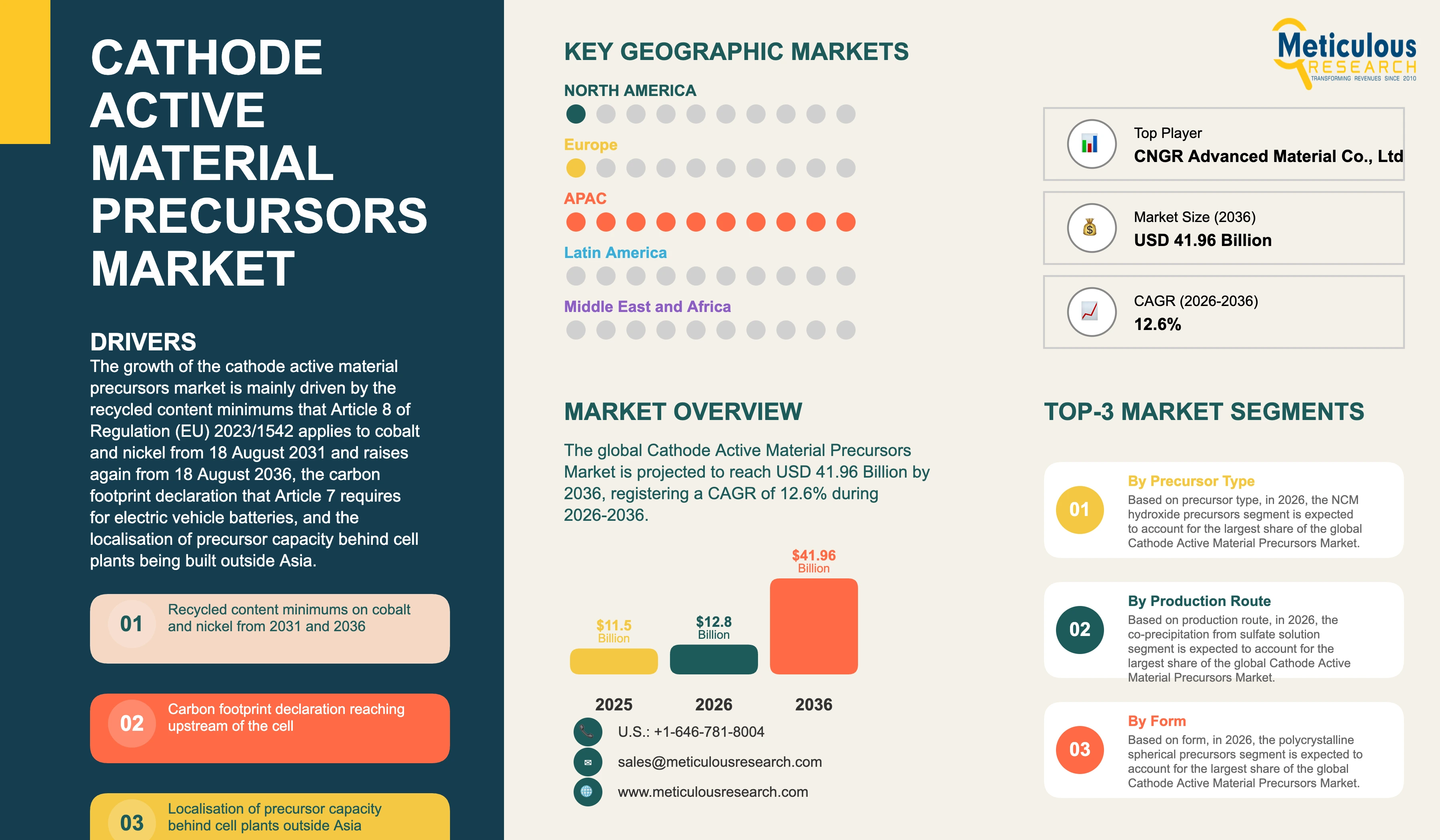
The global cathode active material precursors market was valued at USD 11.50 billion in 2025. This market is expected to reach USD 41.96 billion by 2036 from an estimated USD 12.80 billion in 2026, registering a CAGR of 12.6% during the forecast period (2026-2036).
- Published
- Nov 2026
- Pages
- 283
- Format
- PDF + Excel
- Report ID
- MRCHM - 1042669
- Base year
- 2025
- 2025 · BASELINE
- $11.50B
- 2036
- $41.96B
- CAGR 2026–2036
- 12.6%
2025 baseline · 2026–2036 forecast at 12.6% CAGR · hover a bar for the value
Key highlights
The global cathode active material precursors market is estimated at USD 12.80 billion in 2026 and is projected to reach USD 41.96 billion by 2036.
Market volume is estimated at 1, 620.00 kilotons in 2026 and is projected to reach 5,901.16 kilotons by 2036 at a CAGR of 13.8%, measured as precursor material supplied on a dry basis.
The average selling price is estimated at USD 7.90 per kg in 2026 and is projected to reach USD 7.11 per kg by 2036 as iron phosphate precursors take a larger share of the mix.
NCM hydroxide precursors are expected to account for the largest precursor type share in 2026, while manganese-rich and LMFP precursors are projected to register the highest CAGR of 22.4%.
Co-precipitation from sulfate solution is expected to hold the largest production route share in 2026, while hydrometallurgical recovery and recycled feed routes are projected to grow fastest at a CAGR of 24.6%.
Polycrystalline spherical precursors are expected to be the largest form in 2026, while single-crystal precursors are projected to register the highest CAGR of 21.8%.
Electric vehicles are expected to account for the largest application share in 2026, while stationary energy storage is projected to grow fastest at a CAGR of 18.2%.
Asia-Pacific is expected to hold the largest regional share in 2026, while Europe is projected to register the highest CAGR of 18.6%.
Regulation (EU) 2023/1542 is dated 12 July 2023, was published on 28 July 2023 and entered into force on 17 August 2023.
Article 8(2) requires a minimum recycled content from 18 August 2031 of 16% cobalt, 85% lead, 6% lithium and 6% nickel.
Article 8(3) raises those minimums from 18 August 2036 to 26% cobalt, 85% lead, 12% lithium and 15% nickel.
Article 8(1) sets an earlier date of 18 August 2028, or 24 months after the relevant delegated act, whichever is later, for documentation of the recycled shares.
The cobalt and nickel minimums act on this market directly, because the precursor is where cobalt and nickel enter a cathode.
The lithium minimums act on the lithium compound added after the precursor rather than on the precursor itself.
Article 7(1) requires a carbon footprint declaration for electric vehicle batteries from 18 February 2025 or 12 months after the entry into force of the relevant delegated or implementing act, whichever is the latest.
The 18 August 2036 thresholds fall within the forecast period of this report.
Report summary
| Particulars | Details |
|---|---|
| Base Year | 2025 |
| Forecast Period | 2026-2036 |
| Market Size in 2025 | USD 11.50 billion |
| Market Size in 2026 | USD 12.80 billion |
| Market Size by 2036 | USD 41.96 billion |
| Value CAGR (2026-2036) | 12.6% |
| Format | PDF, Excel & Cloud Portal · 283 pages |
| Volume in 2026 | 1,620.00 kilotons |
| Volume by 2036 | 5,901.16 kilotons |
| Volume CAGR (2026-2036) | 13.8% |
| Volume Basis | Precursor material supplied on a dry basis |
| Average Selling Price in 2026 | USD 7.90 per kg |
| Average Selling Price by 2036 | USD 7.11 per kg |
| Price Direction | Falling on mix shift to iron phosphate precursors, not on reduced conversion cost |
| Measurement Basis | Co-precipitated and synthesised intermediates combined with a lithium compound to produce cathode active material, covering mixed metal hydroxide precursors for NCM, NCA and NMA, iron phosphate and related precursors for LFP and LMFP, and manganese-based precursors, and excluding lithium carbonate, lithium hydroxide and other lithium compounds, finished cathode active material, battery-grade nickel, cobalt and manganese sulfates and other upstream intermediates, anode materials, separators and electrolytes, and black mass from battery recycling |
| Largest Precursor Type | NCM hydroxide precursors |
| Fastest-Growing Precursor Type | Manganese-rich and LMFP precursors (CAGR 22.4%) |
| Largest Production Route | Co-precipitation from sulfate solution |
| Fastest-Growing Production Route | Hydrometallurgical recovery and recycled feed routes (CAGR 24.6%) |
| Largest Form | Polycrystalline spherical precursors |
| Fastest-Growing Form | Single-crystal precursors (CAGR 21.8%) |
| Largest Application | Electric vehicles |
| Fastest-Growing Application | Stationary energy storage (CAGR 18.2%) |
| Largest Region | Asia-Pacific |
| Fastest-Growing Region | Europe (CAGR 18.6%) |
| Segments Covered | Precursor Type, Production Route, Form, Application, and Geography |
| Geographies Covered | Asia-Pacific, Europe, North America, Latin America, and Middle East & Africa |
| Companies Profiled | 11 companies, including CNGR Advanced Material Co., Ltd., GEM Co., Ltd., Zhejiang Huayou Cobalt Co., Ltd., Umicore SA, BASF SE, and POSCO Future M Co., Ltd. |
Report overview
Segments covered: precursor type, production route, form, application.
In volume terms, this market is estimated at 1,620.00 kilotons in 2026 and is projected to reach 5,901.16 kilotons by 2036, registering a CAGR of 13.8% during the same period, measured as precursor material supplied on a dry basis. The average selling price is estimated at USD 7.90 per kg in 2026 and is projected to decline to USD 7.11 per kg by 2036, a fall driven by iron phosphate precursors taking a larger share of a mix currently weighted toward nickel-bearing hydroxides rather than by any reduction in the cost of making a given precursor.
The growth of this market is mainly driven by the recycled content minimums that Article 8 of Regulation (EU) 2023/1542 applies to cobalt and nickel from 18 August 2031 and raises again from 18 August 2036, the carbon footprint declaration requirement that Article 7 places on electric vehicle batteries, the localisation of precursor capacity to serve cell plants being built outside Asia, and the growth of electric vehicle and stationary storage cell production itself. However, factors such as the capital intensity and long qualification cycles of a co-precipitation plant, and the dependence of precursor economics on nickel, cobalt and manganese prices that producers do not set, are expected to restrain the growth of this market to some extent.
Nickel-cobalt-manganese hydroxide precursors account for the largest share of this market because nickel-bearing chemistries carry the energy density that passenger vehicle platforms specify and because the nickel and cobalt they contain command a far higher value per kilogram than an iron phosphate precursor. Manganese-rich and lithium manganese iron phosphate precursors grow fastest because they offer a path to higher voltage and energy without the nickel and cobalt content that both the cost and the recycled content requirements bear on most heavily.
Cathode active material precursors are the co-precipitated or synthesised intermediates that are combined with a lithium compound and calcined to produce cathode active material. Market sizing in this report is on both a value basis in USD and a volume basis in kilotons measured as precursor material supplied on a dry basis, with average selling price derived from the two. The measurement basis covers mixed metal hydroxide precursors for NCM, NCA and NMA chemistries, iron phosphate and related precursors for LFP and LMFP, and manganese-based precursors, and it excludes lithium carbonate, lithium hydroxide and other lithium compounds, finished cathode active material, battery-grade nickel, cobalt and manganese sulfates and other upstream intermediates, anode materials, separators and electrolytes, and black mass from battery recycling.
Separating the precursor from the lithium compound is what makes this market measurable, and it is also what determines which regulatory requirements act on it. A precursor contains the transition metals and not the lithium, so a producer sells a nickel, cobalt and manganese product whose price moves with those metals while the lithium is procured separately by the cathode maker and added at calcination. Measuring the two together would blend two different price drivers into one series and would double count against the lithium compound market. The boundary is also where the industry contracts, since precursor and lithium are bought under separate agreements.
Regulation (EU) 2023/1542 is dated 12 July 2023, was published on 28 July 2023 and entered into force on 17 August 2023. Article 8(2) requires a minimum recycled content from 18 August 2031 of 16% cobalt, 85% lead, 6% lithium and 6% nickel, and Article 8(3) raises those minimums from 18 August 2036 to 26% cobalt, 85% lead, 12% lithium and 15% nickel. Article 8(1) sets an earlier date of 18 August 2028, or 24 months after the relevant delegated act, whichever is later, for documentation of the recycled shares. Article 7(1) requires a carbon footprint declaration for electric vehicle batteries from 18 February 2025 or 12 months after the entry into force of the relevant delegated or implementing act, whichever is the latest.
Of those four metals only two act on this market, and that distinction is the one most often missed. Cobalt and nickel enter a cathode through the precursor, so a recycled content minimum on either is ultimately a requirement that recycled metal be present in the co-precipitated hydroxide, which makes the precursor plant the point in the chain where compliance is created and documented. Lithium enters after the precursor and its minimums therefore fall on the lithium compound rather than here, and lead belongs to a different battery chemistry altogether. A precursor producer reads Article 8 as a nickel and cobalt requirement.
The 2036 thresholds landing inside the forecast period is what makes the regulation a commercial fact rather than a distant one. A plant commissioned in the late 2020s will still be operating in 2036, so the 26% cobalt and 15% nickel minimums have to be designed into the feed strategy of capacity being built now, not retrofitted later. That means securing recycled nickel and cobalt units over a horizon in which the volume of end-of-life batteries available is itself uncertain. Feed security rather than plant capacity is becoming the constraint on compliant supply.
Co-precipitation from sulfate solution is the route by which almost all precursor is made and will remain so. Nickel, cobalt and manganese sulfates are dissolved and precipitated together under controlled pH, temperature, stirring and residence time to build a hydroxide particle of specified composition, size, density and internal structure, and the process determines properties the cathode maker cannot recover later. The particle is in effect engineered rather than simply made, which is why precursor is a specialty product sold on specification rather than a commodity chemical sold on assay.
Carbon footprint is the second requirement in the regulation and it reaches further up the chain than the recycled content provisions. Article 7 places a declaration obligation on the battery, but the figure declared accumulates from the mining, refining and precipitation that precede the cell, and precursor production is both energy intensive and reliant on refined metal whose own footprint varies widely by source. A producer serving European customers therefore needs a traceable and low footprint metal supply rather than merely a competitive one. That favours locations with low carbon electricity and a documented metal provenance.
Localisation of capacity follows cell plants rather than the other way round. Precursor is a dense, stable solid that ships economically, so there is no transport logic requiring it to be made near a cathode plant, but qualification cycles are long, specifications are plant-specific and the recycled content and carbon footprint provisions make a documented regional supply chain valuable in its own right. European and North American precursor investment is therefore being made on regulatory and customer proximity grounds rather than on cost. Asia-Pacific retains the overwhelming majority of capacity throughout the forecast period.
Chemistry mix is what drives the volume and value divergence in this market. Iron phosphate precursors cost a fraction of a nickel-bearing hydroxide per kilogram and are taking a larger share of cell production as lithium iron phosphate extends from stationary storage into volume passenger platforms, so tonnage grows faster than value and average selling price falls from USD 7.90 per kg in 2026 to USD 7.11 per kg by 2036. The decline is a mix effect rather than a cost reduction. Reading it as deflation in precursor manufacturing would misstate the economics of every plant in the industry.
Report infographic
Market dynamics
15 factors across 5 forcesRecycled Content Minimums on Cobalt and Nickel From 2031 and 2036
Article 8(2) of Regulation (EU) 2023/1542 requires a minimum recycled content from 18 August 2031 of 16% cobalt, 85% lead, 6% lithium and 6% nickel, and Article 8(3) raises those minimums from 18 August 2036 to 26% cobalt, 85% lead, 12% lithium and 15% nickel, with Article 8(1) setting an earlier documentation date of 18 August 2028 or 24 months after the relevant delegated act, whichever is later. Cobalt and nickel enter a cathode through the precursor, so those two minimums are in substance a requirement that recycled metal be present in the co-precipitated hydroxide and be documented at that point in the chain. A plant commissioned now will still be running when the 2036 thresholds apply. The provisions therefore shape feed strategy for capacity being built today rather than for a later generation of plants, and they reach any producer supplying a cell maker that serves Europe rather than European plants alone, which is why the provisions govern investment and feed decisions well outside the region they were written for, and well before the thresholds themselves apply.
Carbon Footprint Declaration Reaching Upstream of the Cell
Article 7(1) requires a carbon footprint declaration for electric vehicle batteries from 18 February 2025 or 12 months after the entry into force of the relevant delegated or implementing act, whichever is the latest, and the figure declared accumulates from the mining, refining and precipitation that precede the cell rather than from cell assembly alone. Precursor production is energy intensive and depends on refined metal whose own footprint varies widely by source and route, which makes the precursor step a material contributor to the declared figure. A producer serving European customers consequently competes on traceable low footprint metal supply and low carbon electricity rather than on conversion cost alone. The requirement acts on where and how precursor is made rather than on how much is demanded, and it rewards a producer with documented provenance over one with a lower conversion cost, which is a reordering of how this market has competed until now and of what a customer audits before buying.
Localisation of Precursor Capacity Behind Cell Plants Outside Asia
Precursor is a dense stable solid that ships economically, so there is no transport logic placing it near a cathode plant, but qualification cycles run long, specifications are plant-specific and the recycled content and carbon footprint provisions make a documented regional supply chain valuable on its own terms. Cell and cathode investment in Europe and North America has therefore pulled precursor investment behind it, on regulatory and customer proximity grounds rather than on cost. Those projects start from a small base and grow quickly, which is why Europe registers the highest regional CAGR at 18.6% while Asia-Pacific retains the overwhelming majority of capacity. The investment logic is compliance and customer proximity rather than freight, since precursor ships economically over any distance.
Cell Production Volume in Electric Vehicles and Stationary Storage
Every kilogram of cathode active material requires a precursor, so demand in this market is a direct function of cell output rather than a share of a discretionary spend, and both electric vehicle and stationary storage cell production continue to expand. Stationary storage adds demand with a different chemistry weighting and a different duty, favouring iron phosphate over nickel-bearing precursors and growing at the highest application CAGR of 18.2%. The two together make precursor volume growth faster than value growth. The driver is volumetric and it operates independently of the regulatory provisions above, so it sets a floor under demand growth whatever happens to the compliance timetable.
Table of contents
12 chapters · 144 sections · 283 pages · click to expandSegmental analysis
| Segment | Largest share (2026) | Fastest growth (2026–2036) |
|---|---|---|
| By Precursor Type | NCM hydroxide precursors | Manganese-rich and LMFP precursors |
| By Production Route | Co-precipitation from sulfate solution | Hydrometallurgical recovery and recycled feed routes |
| By Form | Polycrystalline spherical precursors | Single-crystal precursors |
| By Application | Electric vehicles | Stationary energy storage |
By Precursor Type
- Cathode Active Material Precursors Market Analysis by Precursor Type
- The NCM hydroxide precursors segment is expected to account for the largest share of the global cathode active material precursors market.
- The large share of this segment is mainly due to the energy density that nickel-bearing chemistries provide and that passenger vehicle platforms specify, the far higher value per kilogram that the contained nickel and cobalt command than an iron phosphate precursor, and the installed co-precipitation capacity built around these compositions.
- However, the manganese-rich and LMFP precursors segment is projected to register the highest CAGR of 22.4% during the forecast period.
- The rapid growth of this segment is attributed to higher voltage and energy than iron phosphate without the nickel and cobalt loading of an NCM precursor, the reduced exposure to the metals that Article 8 of Regulation (EU) 2023/1542 subjects to recycled content minimums from 18 August 2031 and 18 August 2036, and the greater abundance and wider geographic distribution of manganese than cobalt.
- Iron phosphate and other LFP precursors hold the largest volume position and grow faster than the market in tonnage while contributing less to value, which is the source of the divergence between the two growth rates in this report.
- NCA and NMA precursors occupy a narrower position in high-nickel applications where aluminium rather than manganese is used as the stabilising element.
- Precursor type is set by the cell chemistry a platform has adopted rather than chosen by the precursor producer, so the mix in this market tracks cell chemistry decisions taken several years earlier, and a producer competes by being qualified across more than one chemistry rather than by promoting a preferred one.
By Production Route
- Cathode Active Material Precursors Market Analysis by Production Route
- The co-precipitation from sulfate solution segment is expected to account for the largest share of the global cathode active material precursors market.
- The large share of this segment is mainly due to its use for almost all precursor currently produced, the control it provides over particle size, density and internal structure that determine electrochemical performance, and the installed base of reactor trains and the operating knowledge built around them.
- However, the hydrometallurgical recovery and recycled feed routes segment is projected to register the highest CAGR of 24.6% during the forecast period.
- The rapid growth of this segment is attributed to recovery of nickel and cobalt from production scrap and end-of-life batteries producing sulfate solutions that feed co-precipitation directly, which is the only practical way to place recycled metal inside a precursor and document it, and to the documentation date of 18 August 2028 or 24 months after the relevant delegated act, whichever is later, that precedes the 2031 and 2036 minimums.
By Form
- Cathode Active Material Precursors Market Analysis by Form
- The polycrystalline spherical precursors segment is expected to account for the largest share of the global cathode active material precursors market.
- The large share of this segment is mainly due to the packing density a spherical secondary particle delivers in an electrode coating, the established precipitation control that produces it reproducibly at scale, and its suitability across the full range of nickel contents currently in production.
- However, the single-crystal precursors segment is projected to register the highest CAGR of 21.8% during the forecast period.
- The rapid growth of this segment is attributed to the absence of the grain boundaries along which a polycrystalline particle cracks as it expands and contracts through cycling, the worsening of that effect as nickel content rises, and the improvement in cycle life and reduction in gas generation at high voltage that follows, achieved through precipitation and calcination control rather than different raw materials.
- Other morphologies cover the specialised particle architectures used where a cathode maker is targeting a particular combination of rate capability and energy, including gradient compositions in which nickel content varies between the core and the surface of the particle to combine capacity with surface stability.
- These remain a small share of the market because each requires precipitation control beyond what a standard reactor train provides.
- Form is determined jointly by the precursor producer and the cathode maker during qualification rather than specified independently, since the calcination step that follows depends on what the particle entering it can withstand.
By Application
- Cathode Active Material Precursors Market Analysis by Application
- The electric vehicles segment is expected to account for the largest share of the global cathode active material precursors market.
- The large share of this segment is mainly due to the cell volume that vehicle electrification represents relative to every other application, the energy density requirement that favours the nickel-bearing precursors carrying the highest value per kilogram, and the scale of automotive qualified capacity already committed.
- However, the stationary energy storage segment is projected to register the highest CAGR of 18.2% during the forecast period.
- The rapid growth of this segment is attributed to specification on cycle life and installed cost rather than mass or volume, which favours iron phosphate precursors, to deployment driven by electricity market and policy factors independent of the vehicle cycle, and to shorter qualification than an automotive platform requires.
- Consumer electronics accounts for a smaller and slower growing share built on the high-voltage cobalt oxide and high-nickel chemistries that portable devices specify for volumetric energy, where the precursor requirement per cell is small but the specification is demanding.
- Other applications cover power tools, two and three wheelers and industrial equipment.
- Application does not determine precursor chemistry directly, but it sets the weighting between energy density and installed cost that the cell maker optimises, and through that the chemistry mix a precursor producer is asked to supply.
Geographic analysis
Asia-Pacific
Largest shareIn 2026, Asia-Pacific is expected to account for the largest share of the global cathode active material precursors market. The large share of this region is mainly due to the concentration of co-precipitation capacity in China, South Korea and Japan, the nickel and cobalt refining and sulfate production that feeds it, the cathode and cell manufacturing immediately downstream, and the operating experience built over two decades of precursor production. China is projected to register a CAGR of 11.2%, South Korea a CAGR of 12.6% and Japan a CAGR of 10.4% during the forecast period. A producer in Asia-Pacific supplying a cell maker serving Europe therefore faces the same documentation requirements as a European plant, which is why the Article 8(1) documentation date matters more widely than the regional shares suggest. Metal provenance and electricity carbon intensity consequently enter siting decisions alongside capital and labour cost. Where the precursor is made is becoming a function of where its compliance can be demonstrated rather than only of where conversion is cheapest or of where the metal was originally refined and shipped from.
Europe
Fastest growthHowever, Europe is projected to register the highest CAGR of 18.6% during the forecast period. The rapid growth of this region is attributed to the recycled content minimums that Article 8 of Regulation (EU) 2023/1542 applies from 18 August 2031 and raises from 18 August 2036, the carbon footprint declaration that Article 7 requires for electric vehicle batteries, the cell and cathode capacity being built that pulls precursor investment behind it, and the low carbon electricity available in several candidate locations. Finland is projected to register a CAGR of 19.8%, Germany a CAGR of 19.2% and Hungary a CAGR of 18.8%, all from a small base.
North America
North America is projected to grow at 17.0%, with the United States at 17.4%, where cell plant investment and critical mineral sourcing requirements have drawn precursor projects that start from almost no installed capacity.
Latin America
Latin America is projected to grow at 13.0% and the Middle East & Africa at 12.0%, both from very small bases, with activity concentrated where nickel, cobalt or manganese resources or low cost energy offer a reason to convert locally rather than export intermediates. Regulation written in one jurisdiction reaches capacity decisions in another in this market, because the recycled content and carbon footprint provisions attach to a battery placed on the European market regardless of where its precursor was made.
Competitive landscape
The global cathode active material precursors market is characterised by the presence of large Chinese precursor specialists operating at a scale no other producers match, Korean and Japanese materials companies integrated with domestic cell manufacturing, and European chemical companies building capacity on regulatory and customer proximity grounds. Competition is contested on particle engineering capability, on integration into nickel and cobalt refining and recovery, and on qualification positions with cathode and cell makers rather than on conversion price, since a precursor is validated against a specific platform and substitution is a requalification. CNGR Advanced Material Co., Ltd., GEM Co., Ltd., Zhejiang Huayou Cobalt Co., Ltd., Umicore SA and BASF SE together accounted for an estimated 46.2% of this market in 2026, while the companies profiled in this report together accounted for an estimated 70.8%.
Regulation (EU) 2023/1542 entered into force on 17 August 2023, with Article 8(2) requiring 16% recycled cobalt and 6% recycled nickel from 18 August 2031, Article 8(3) raising those to 26% and 15% from 18 August 2036, and Article 8(1) setting a documentation date of 18 August 2028 or 24 months after the relevant delegated act, whichever is later. Backward integration into refining and hydrometallurgical recovery, qualification of manganese-rich and single-crystal precursors, and commitment of precursor capacity in Europe and North America accounted for most competitive activity through 2026.
Integration rather than conversion capacity separates the competitors, because a producer that controls its metal units can document provenance and recycled content while one buying refined metal on the market cannot. GEM Co., Ltd. and Zhejiang Huayou Cobalt Co., Ltd. compete from recovery and refining positions, CNGR Advanced Material Co., Ltd. on scale and chemistry breadth, Umicore SA and BASF SE on European capacity with documented metal supply, and POSCO Future M Co., Ltd., EcoPro Materials Co., Ltd. and L&F Co., Ltd. through integration with Korean cell manufacturing. Some of the key players operating in the cathode active material precursors market are CNGR Advanced Material Co., Ltd. (China), GEM Co., Ltd. (China), Zhejiang Huayou Cobalt Co., Ltd. (China), Umicore SA (Belgium), BASF SE (Germany), POSCO Future M Co., Ltd. (South Korea), EcoPro Materials Co., Ltd. (South Korea), Sumitomo Metal Mining Co., Ltd. (Japan), Tanaka Chemical Corporation (Japan), Ningbo Ronbay New Energy Technology Co., Ltd. (China), and L&F Co., Ltd. (South Korea), among others.
- —
Regulation (EU) 2023/1542 is dated 12 July 2023, was published on 28 July 2023 and entered into force on 17 August 2023. Article 8(2) requires a minimum recycled content from 18 August 2031 of 16% cobalt, 85% lead, 6% lithium and 6% nickel, and Article 8(3) raises those minimums from 18 August 2036 to 26% cobalt, 85% lead, 12% lithium and 15% nickel. Article 8(1) sets an earlier date of 18 August 2028, or 24 months after the relevant delegated act, whichever is later, for documentation of the recycled shares. Article 7(1) requires a carbon footprint declaration for electric vehicle batteries from 18 February 2025 or 12 months after the entry into force of the relevant delegated or implementing act, whichever is the latest.
- CNGR Advanced Material Co., Ltd.
- GEM Co., Ltd.
- Zhejiang Huayou Cobalt Co., Ltd.
- Umicore SA
- BASF SE
- POSCO Future M Co., Ltd
Expert perspectives
Volume grows at 13.8% against 12.6% in value over the forecast period, and the average selling price falls from USD 7.90 per kg in 2026 to USD 7.11 per kg by 2036. That decline is a mix effect as iron phosphate precursors take share from nickel-bearing hydroxides, not a reduction in the cost of making any given precursor. Reading it as deflation in precursor manufacturing would misstate the economics of every plant in the industry.
Article 8 of Regulation (EU) 2023/1542 is a nickel and cobalt requirement on this market and nothing else. Cobalt and nickel enter a cathode through the precursor, so the 16% and 6% minimums from 18 August 2031 and the 26% and 15% minimums from 18 August 2036 are requirements that recycled metal be present in the co-precipitated hydroxide. The lithium minimums fall on the lithium compound added afterwards and lead belongs to another chemistry entirely.
The 2036 thresholds sitting inside the forecast period is what makes this a capacity planning question rather than a compliance one. A plant commissioned in the late 2020s is still operating in 2036, so the 26% cobalt and 15% nickel minimums have to be designed into its feed strategy now. What actually limits compliance is the availability of recovered units, which depends on how many batteries reach end of life and are collected, and no precursor producer controls that.
Production scrap is the trap in the recycled feed arithmetic. It supplies the near-term shortfall but declines as cell manufacturing yields improve, so the most accessible source of recycled nickel and cobalt is shrinking exactly as the thresholds rise. A feed strategy built on scrap satisfies 2031 and fails 2036. End-of-life collection capacity rather than hydrometallurgical capability is what has to be in place.
Carbon footprint under Article 7 reaches further than the recycled content provisions and is less widely planned for. The declared figure accumulates from mining, refining and precipitation, all of which precede the cell, and refined metal footprints vary widely by source and route. A producer serving European customers competes on traceable low footprint metal and low carbon electricity rather than on conversion cost, which is why Finland and similar locations are attracting investment.
What should temper expectations of regional rebalancing is qualification time. Precursor is validated against a specific cell and vehicle platform because particle size, density and structure determine performance the cathode maker cannot recover later, so a new plant reaches useful utilisation long after mechanical completion. Europe grows at 18.6% and North America at 17.0% from very small bases, while Asia-Pacific holds the overwhelming majority of capacity throughout.
Customer perspectives
Precursor is qualified as a platform component rather than purchased on composition, and metal provenance and recycled share have become procurement criteria because the obligation to declare them passes down the chain.
Conversion margin sits on a purchased metal value that producers do not control, so competition rests on particle engineering and metal integration, while sulfate by-product and water handling constrain where capacity can be sited.
The later recycled content thresholds are the harder constraint, because production scrap declines as cell manufacturing yields improve and compliance then depends on end-of-life collection volumes rather than on processing capability or on the hydrometallurgical capacity a producer has already installed to handle it.
“We do not buy precursor on assay, we buy a particle that behaves a particular way in our cell, and once it is qualified against a platform we are not changing it without going through the whole process again. What has changed is that we now ask where the nickel and cobalt came from and what the recycled share is, because our customers have to declare it.”
“The conversion margin is a thin layer on a large purchased metal value, so the metal cycle moves our revenue whatever we do with volume. Where we can actually compete is particle engineering and controlling our own units. The by-product and water side is what decides where we can build at all.”
“The 2036 numbers are the ones that worry us, not the 2031 numbers. We can meet the earlier thresholds on manufacturing scrap, but scrap falls as the industry gets better at making cells, and the end-of-life volume has to be there instead. That is a collection problem, not a chemistry problem.”
Frequently asked questions
This market was valued at USD 10.22 billion in 2024 and USD 11.50 billion in 2025, and is estimated at USD 12.80 billion in 2026. In volume terms it is estimated at 1,620.00 kilotons in 2026 as precursor material supplied on a dry basis.
Cite this report
Meticulous Research. (2026). Cathode Active Material Precursors Market - Global Opportunity Analysis and Industry Forecast (2026-2036) (Report No. MRCHM - 1042669). Meticulous Market Research Pvt. Ltd. https://www.meticulousresearch.com/product/cathode-active-material-precursors-market-7352