Battery Cell Cooling Fluids Market (2026-2036)
The global battery cell cooling fluids market was valued at USD 655.7 million in 2025. This market is expected to reach USD 3.49 billion by 2036 from an estimated USD 764.4 million in 2026, registering a CAGR of 16.4% during the forecast period (2026-2036).
- Published
- Nov 2026
- Pages
- 255
- Format
- PDF + Excel
- Report ID
- MRCHM - 1042668
- Base year
- 2025
- 2025 · BASELINE
- $655.7M
- 2036
- $3.49B
- CAGR 2026–2036
- 16.4%
2025 baseline · 2026–2036 forecast at 16.4% CAGR · hover a bar for the value
Key highlights
The global battery cell cooling fluids market is estimated at USD 764.4 million in 2026 and is projected to reach USD 3.49 billion by 2036.
Market volume is estimated at 182.00 kilotons in 2026 and is projected to reach 686.65 kilotons by 2036 at a CAGR of 14.2%, measured as fluid supplied for first fill and service fill.
The average selling price is estimated at USD 4.20 per kg in 2026 and is projected to rise to USD 5.08 per kg by 2036 as dielectric fluids take a larger share of the mix.
Water-glycol coolants are expected to account for the largest fluid type share in 2026, while single-phase dielectric fluids are projected to register a CAGR of 28.6%.
Two-phase dielectric fluids are projected to register the highest fluid type CAGR of 31.0% from the smallest base.
Glycol based chemistry is expected to hold the largest base chemistry share in 2026, while synthetic ester chemistry is projected to grow fastest at a CAGR of 29.4%.
Indirect cold plate cooling is expected to be the largest cooling architecture in 2026, while direct immersion cooling is projected to register the highest CAGR of 30.2%.
Passenger electric vehicles are expected to account for the largest end use share in 2026, while commercial and heavy-duty vehicles are projected to grow fastest at a CAGR of 19.8%.
Asia-Pacific is expected to hold the largest regional share in 2026 and is also projected to register the highest CAGR of 18.0%.
GB 38031-2025, Safety Requirements for Power Batteries for Electric Vehicles, is a mandatory national standard that took effect on 1 July 2026.
GB 18384-2025, Safety Requirements for Electric Vehicles, is a mandatory national standard that took effect on the same date.
GB 38031-2025 requires that no fire or explosion occurs in a thermal runaway event, while still requiring alarm signals.
The standard requires that smoke released in such an event must not harm occupants.
The previous standard required only that a battery provide a thermal event alarm five minutes before a fire or explosion.
GB 38031-2025 introduces a bottom impact test evaluating protection against underbody collisions.
GB 38031-2025 introduces a fast-charge cycling test under which batteries must remain free of fire or explosion during subsequent external short-circuit tests after 300 fast-charging cycles.
GB 18384-2025 requires a mandatory physical one-touch power-off mechanism that disconnects the high-voltage circuit from the energy storage system in a single action, replacing previous software-dependent methods.
GB 47497-2026, Fire Detectors for Vehicles, addresses early thermal runaway warning for power batteries.
Report summary
| Particulars | Details |
|---|---|
| Base Year | 2025 |
| Forecast Period | 2026-2036 |
| Market Size in 2025 | USD 655.7 million |
| Market Size in 2026 | USD 764.4 million |
| Market Size by 2036 | USD 3.49 billion |
| Value CAGR (2026-2036) | 16.4% |
| Format | PDF, Excel & Cloud Portal · 255 pages |
| Volume in 2026 | 182.00 kilotons |
| Volume by 2036 | 686.65 kilotons |
| Volume CAGR (2026-2036) | 14.2% |
| Volume Basis | Fluid supplied for first fill and service fill of battery thermal management circuits |
| Average Selling Price in 2026 | USD 4.20 per kg |
| Average Selling Price by 2036 | USD 5.08 per kg |
| Price Direction | Rising, as dielectric fluids take a larger share of a mix currently dominated by water-glycol |
| Measurement Basis | Heat transfer fluids circulated in the thermal management circuit of a traction or stationary battery pack, excluding thermal interface materials, gap fillers and pads, phase change materials, refrigerants in the vehicle air-conditioning or heat pump circuit, coolants serving power electronics, traction motors and fuel cells outside the battery loop, dielectric fluids for data centre immersion cooling, and transformer and switchgear oils |
| Largest Fluid Type | Water-glycol coolants |
| Fastest-Growing Fluid Type | Two-phase dielectric fluids (CAGR 31.0%) |
| Largest Base Chemistry | Glycol based |
| Fastest-Growing Base Chemistry | Synthetic ester (CAGR 29.4%) |
| Largest Cooling Architecture | Indirect cold plate cooling |
| Fastest-Growing Cooling Architecture | Direct immersion cooling (CAGR 30.2%) |
| Largest End Use | Passenger electric vehicles |
| Fastest-Growing End Use | Commercial and heavy-duty vehicles (CAGR 19.8%) |
| Largest Region | Asia-Pacific |
| Fastest-Growing Region | Asia-Pacific (CAGR 18.0%) |
| Segments Covered | Fluid Type, Base Chemistry, Cooling Architecture, End Use, and Geography |
| Geographies Covered | Asia-Pacific, Europe, North America, Latin America, and Middle East & Africa |
| Companies Profiled | 11 companies, including BASF SE, The Lubrizol Corporation, Shell plc, TotalEnergies SE, ExxonMobil Corporation, and BP p.l.c. |
Report overview
Segments covered: fluid type, base chemistry, cooling architecture, end use.
In volume terms, this market is estimated at 182.00 kilotons in 2026 and is projected to reach 686.65 kilotons by 2036, registering a CAGR of 14.2% during the same period, measured as fluid supplied for first fill and service fill of battery thermal management circuits. The average selling price is estimated at USD 4.20 per kg in 2026 and is projected to rise to USD 5.08 per kg by 2036, which is a reversal of the usual direction and reflects dielectric immersion fluids taking a larger share of a mix currently dominated by water-glycol at a fraction of the price per kilogram.
The growth of this market is mainly driven by the mandatory national standards GB 38031-2025 and GB 18384-2025 that took effect on 1 July 2026 and require that a power battery produce no fire and no explosion in a thermal runaway event, the fast charging rates that concentrate heat generation beyond what an indirect cold plate can remove at the cell surface, the energy density increases that leave less thermal margin inside a pack, and the growth of electric vehicle production volumes themselves. However, factors such as the added mass, pumping power and sealing requirements that a direct immersion architecture imposes on a pack, and the cost per kilogram of a dielectric fluid against a water-glycol coolant, are expected to restrain the growth of this market to some extent.
Water-glycol coolants account for the largest share of this market because indirect cold plate cooling remains the architecture in almost every vehicle platform in production and a glycol coolant carries far more heat per unit volume than any dielectric fluid at a small fraction of the cost. Single-phase dielectric fluids grow faster because direct contact with the cell removes the thermal resistance of the plate, the gap filler and the cell casing, which is the only way to meet a no-fire requirement under fast-charge duty at the pack level.
Battery cell cooling fluids are heat transfer fluids circulated in the thermal management circuit of a traction or stationary battery pack, either indirectly through a cold plate in contact with the cells or in direct contact with the cells themselves. Market sizing in this report is on both a value basis in USD and a volume basis in kilotons measured as fluid supplied for first fill and service fill of battery thermal management circuits, with average selling price derived from the two. The measurement basis excludes thermal interface materials, gap fillers and pads, phase change materials, refrigerants circulating in the vehicle air-conditioning or heat pump circuit, coolants serving power electronics, traction motors and fuel cells outside the battery loop, dielectric fluids for data centre immersion cooling, and transformer and switchgear oils.
The rising price path in this market is unusual and it is the single most important thing to understand about the forecast. Almost every chemical market sees average selling price fall as capacity scales, but here the mix is shifting from a water-glycol coolant costing a few dollars a kilogram toward dielectric fluids costing several times that, so the weighted average rises from USD 4.20 per kg in 2026 to USD 5.08 per kg by 2036 even as each individual fluid becomes cheaper to produce. Value therefore grows at 16.4% against 14.2% in volume. Reading the value growth as demand growth would overstate the number of vehicles involved by a wide margin.
GB 38031-2025, Safety Requirements for Power Batteries for Electric Vehicles, and GB 18384-2025, Safety Requirements for Electric Vehicles, are mandatory national standards that took effect on 1 July 2026. GB 38031-2025 requires that no fire or explosion occurs in a thermal runaway event, that alarm signals are still provided and that smoke released must not harm occupants, where the previous standard required only a thermal event alarm five minutes before a fire or explosion. It introduces a bottom impact test evaluating protection against underbody collisions and a fast-charge cycling test under which batteries must remain free of fire or explosion during subsequent external short-circuit tests after 300 fast-charging cycles. GB 18384-2025 requires a mandatory physical one-touch power-off mechanism that disconnects the high-voltage circuit from the energy storage system in a single action, replacing previous software-dependent methods.
The change from a five-minute warning to no fire at all is the most consequential shift in battery thermal requirements of the past decade, because it moves the design objective from giving occupants time to escape to preventing the event propagating at all. A pack that satisfies the earlier requirement can allow a single cell to ignite provided the alarm precedes it, while a pack satisfying the new one must absorb and remove the heat of a failing cell fast enough that neighbouring cells never reach their own runaway threshold. Heat removal at the cell surface is the mechanism that does that. The standard therefore acts directly on the cooling fluid and the architecture around it rather than on the cell chemistry alone.
The fast-charge cycling test is the provision that will reshape fluid selection most quickly. Requiring a battery to come through 300 fast-charging cycles and then survive an external short circuit without fire or explosion sets a durability condition on the whole thermal system, not a single-event one, since a pack that runs hot across those cycles degrades toward a state in which a short circuit is far more likely to propagate. That places a requirement on the fluid to hold its heat transfer and dielectric properties over years of thermal cycling rather than to perform once. Fluid life and oxidative stability become qualification criteria rather than specification details.
Indirect cold plate cooling remains the architecture in almost every platform in production, and it will carry the larger part of this market throughout the forecast period. A water-glycol coolant circulating through an aluminium plate in contact with the base or sides of the cells carries far more heat per unit volume than any dielectric fluid, costs a small fraction as much per kilogram, and works with pumps, seals and materials the industry has used for decades. The weakness is the path the heat must take, passing from the cell interior through its casing, through a gap filler and through the plate wall before it reaches the fluid at all.
Direct immersion removes that path and that is the whole of its appeal. Placing the cells in a dielectric fluid puts the coolant against the cell casing with no intervening layers, which raises the rate at which heat can be taken out of a cell and, critically, out of one cell that has begun to fail while its neighbours have not. The fluid must be electrically insulating, chemically compatible with cell casings, busbars and seals, and stable over pack life. Those requirements rule out water-based fluids entirely and explain the price gap the architecture has to justify.
Fast charging is what makes the thermal problem acute rather than merely present. Heat generated in a cell rises with the square of current, so a charging rate that halves the time more than doubles the heat to be removed in that period, and it is generated inside the cell where an indirect system reaches it slowly. Charging infrastructure and vehicle platforms have moved toward rates that an indirect plate struggles to serve without derating the charge itself. Each increase in charging rate therefore widens the case for direct contact cooling independently of any regulatory requirement.
Commercial and heavy-duty vehicles face the same physics at a larger scale and with harder duty. A truck or bus pack carries several times the energy of a passenger vehicle pack, is charged at high rates on a commercial schedule rather than overnight, and operates to a duty cycle in which downtime for thermal reasons has a direct revenue cost. Pack volume also makes the mass and pumping penalty of immersion proportionally less significant than in a passenger car. Those segments therefore adopt advanced thermal architectures ahead of passenger platforms rather than behind them.
Report infographic
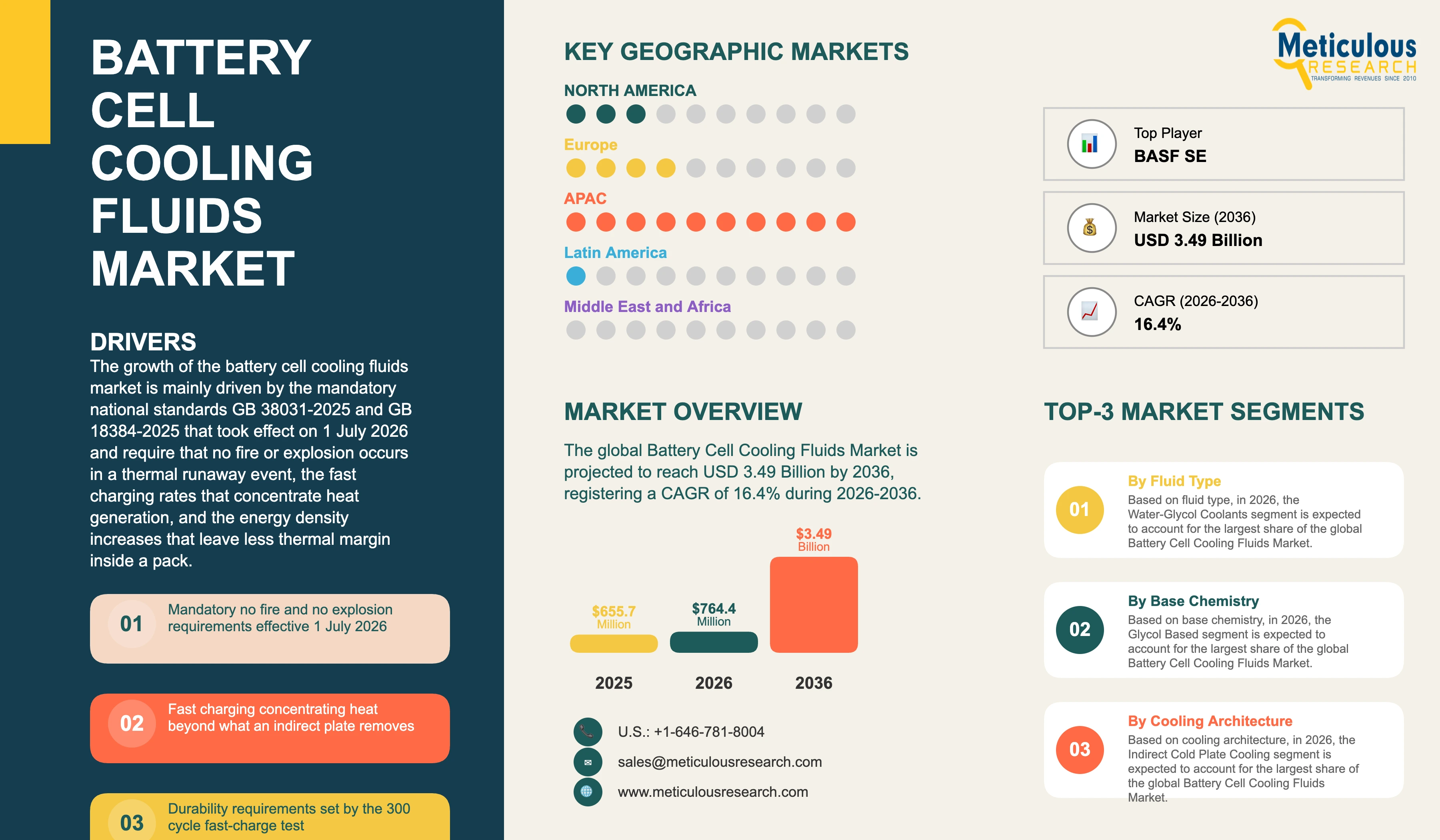
Market dynamics
15 factors across 5 forcesMandatory No Fire and No Explosion Requirements Effective 1 July 2026
GB 38031-2025 and GB 18384-2025 took effect as mandatory national standards on 1 July 2026, and GB 38031-2025 requires that no fire or explosion occurs in a thermal runaway event, that alarm signals are still provided and that smoke released must not harm occupants, where the previous standard required only a thermal event alarm five minutes before a fire or explosion. Preventing propagation rather than warning of it requires heat to be removed from a failing cell fast enough that its neighbours never reach their own threshold, which acts on the cooling fluid and the architecture around it rather than on cell chemistry alone. The requirement applies to the largest electric vehicle market in the world. It is the single largest driver in this market over the forecast period, and it arrived at the start of it rather than part way through, so platforms entering production in the forecast period are the first designed to it from the outset rather than adapted to it after launch, which is why its effect on architecture choice shows up early in the period.
Fast Charging Concentrating Heat Beyond What an Indirect Plate Removes
Heat generated in a cell rises with the square of current, so a charging rate that halves the time more than doubles the heat to be removed in that period, and it is generated inside the cell where an indirect system reaches it only after the heat has crossed the casing, a gap filler and the plate wall. Vehicle platforms and charging infrastructure have moved toward rates at which an indirect plate cannot keep the cell within its window without derating the charge, which defeats the purpose of the faster rate. Direct contact with a dielectric fluid removes the thermal resistance of those layers. The driver is physical rather than regulatory and applies in every market, so it continues to operate wherever charging rates rise irrespective of what any standard requires.
Durability Requirements Set by the 300 Cycle Fast-Charge Test
GB 38031-2025 introduces a fast-charge cycling test under which batteries must remain free of fire or explosion during subsequent external short-circuit tests after 300 fast-charging cycles, which sets a durability condition on the whole thermal system rather than a single-event one. A pack that runs hot across those cycles degrades toward a state in which a short circuit propagates more readily, so the fluid must hold its heat transfer and dielectric properties through years of thermal cycling rather than perform once on a test bench. Fluid life, oxidative stability and compatibility with pack materials become qualification criteria rather than specification details. That raises the value of a formulated fluid against a commodity one, and it moves the basis of competition from price per kilogram to performance retained over pack life.
Energy Density Increases Leaving Less Thermal Margin Inside a Pack
Packing more energy into the same volume reduces the spacing between cells, the thermal mass available to absorb a transient and the surface area through which heat can leave, so a design that was thermally comfortable at one energy density is marginal at a higher one. The bottom impact test introduced by GB 38031-2025 adds a structural requirement that competes for the same pack volume, since protection against underbody collisions consumes space that might otherwise hold cooling. Thermal management therefore has to achieve more within a tighter envelope. Direct contact cooling uses the space between cells that an indirect system leaves empty, which is why the architecture question and the energy density question are being settled together in current platform development rather than one after the other.
Table of contents
12 chapters · 148 sections · 255 pages · click to expandGeographic analysis
Asia-Pacific
Largest shareIn 2026, Asia-Pacific is expected to account for the largest share of the global battery cell cooling fluids market and is also projected to register the highest CAGR of 18.0% during the forecast period. The large share and rapid growth of this region are mainly due to the concentration of cell and pack manufacturing and electric vehicle assembly in China, South Korea and Japan, the mandatory national standards GB 38031-2025 and GB 18384-2025 that took effect on 1 July 2026 requiring that no fire or explosion occurs in a thermal runaway event, the fast-charge cycling test requiring freedom from fire or explosion in external short-circuit testing after 300 fast-charging cycles, and the charging infrastructure build-out that has pushed platform charging rates higher than elsewhere. China is projected to register a CAGR of 18.8%, India a CAGR of 19.6% and South Korea a CAGR of 16.2%.
Europe
Europe is projected to grow at 14.6%, with Germany at 14.8% and France at 14.0%, where vehicle electrification targets, cell plant investment and the premium platforms that adopt high charging rates first support demand, and where several fluid suppliers hold their formulation and additive capability.
North America
North America is projected to grow at 14.2%, with the United States at 14.2%, driven by light truck and commercial vehicle electrification where pack energy is large and charging is scheduled commercially.
Latin America
Latin America is projected to grow at 14.0% and the Middle East & Africa at 13.0%, both from small bases where bus and commercial fleet electrification and stationary storage rather than passenger vehicle production account for most demand. Service fill rather than first fill is the larger share in both, since vehicles are predominantly imported rather than assembled locally and the installed fleet is the source of demand. Standards set in one jurisdiction govern design decisions well beyond it in this market, which is why the regional pattern understates the reach of the Chinese requirements. A platform engineered to produce no fire or explosion in a thermal runaway event and to survive external short-circuit testing after 300 fast-charging cycles is generally built to one specification worldwide rather than two, because the pack thermal architecture cannot practically be varied by market. Cell and pack manufacturing is also concentrated, so the fluid is specified where the pack is built rather than where the vehicle is sold. Formulation and additive capability remains concentrated in Europe, North America and Japan, which separates where the fluid is designed from where it is consumed.
Competitive landscape
The global battery cell cooling fluids market is characterised by the presence of integrated oil and gas companies with lubricant and specialty fluid divisions, chemical companies holding coolant and additive technology, and specialist coolant formulators. Competition is contested on qualification with cell and pack manufacturers rather than on price, because a fluid in a sealed pack is validated against every material in the enclosure and across years of thermal cycling, which makes substitution a requalification rather than a purchase. BASF SE, The Lubrizol Corporation, Shell plc, TotalEnergies SE and ExxonMobil Corporation together accounted for an estimated 41.8% of this market in 2026, while the companies profiled in this report together accounted for an estimated 64.6%.
GB 38031-2025 and GB 18384-2025 took effect as mandatory national standards on 1 July 2026, requiring that no fire or explosion occurs in a thermal runaway event, introducing a bottom impact test and a fast-charge cycling test after 300 cycles, and requiring a physical one-touch power-off mechanism. Immersion fluid qualification with cell and pack manufacturers, movement of dielectric chemistry from fluorinated fluids toward synthetic esters and engineered hydrocarbons, and extension of formulated coolant ranges into commercial vehicle and stationary storage duty accounted for most competitive activity through 2026, with platform qualification wins rather than capacity additions the measure of competitive progress in this market rather than share of a tender.
Platform qualification rather than capacity separates the competitors, because a fluid tied to a platform holds that position for its production life while a fluid that misses the qualification window waits for the next one. The Chemours Company competes in two-phase fluids specifically, Arteco NV and FUCHS SE through formulated coolant positions with vehicle manufacturers, and ENEOS Holdings, Inc. and Idemitsu Kosan Co., Ltd. through proximity to Asian cell and pack production. Some of the key players operating in the battery cell cooling fluids market are BASF SE (Germany), The Lubrizol Corporation (U.S.), Shell plc (U.K.), TotalEnergies SE (France), ExxonMobil Corporation (U.S.), BP p.l.c. (U.K.), FUCHS SE (Germany), The Chemours Company (U.S.), Arteco NV (Belgium), ENEOS Holdings, Inc. (Japan), and Idemitsu Kosan Co., Ltd. (Japan), among others.
- —
GB 38031-2025, Safety Requirements for Power Batteries for Electric Vehicles, and GB 18384-2025, Safety Requirements for Electric Vehicles, took effect as mandatory national standards on 1 July 2026. GB 38031-2025 requires that no fire or explosion occurs in a thermal runaway event, that alarm signals are still provided and that smoke released must not harm occupants, where the previous standard required only a thermal event alarm five minutes before a fire or explosion. It introduces a bottom impact test evaluating protection against underbody collisions and a fast-charge cycling test under which batteries must remain free of fire or explosion during subsequent external short-circuit tests after 300 fast-charging cycles. GB 18384-2025 requires a mandatory physical one-touch power-off mechanism disconnecting the high-voltage circuit from the energy storage system in a single action. GB 47497-2026, Fire Detectors for Vehicles, addresses early thermal runaway warning for power batteries.
- BASF SE
- Lubrizol Corporation
- Shell plc
- TotalEnergies SE
- ExxonMobil Corporation
- BP p.l.c
Expert perspectives
Value grows at 16.4% against 14.2% in volume over the forecast period, and the average selling price rises from USD 4.20 per kg in 2026 to USD 5.08 per kg by 2036. That direction is the opposite of almost every chemical market and it comes entirely from mix, as dielectric fluids costing several times water-glycol take a larger share. Reading the value growth as demand growth would overstate the number of vehicles involved by a wide margin.
The move from a five-minute warning to no fire at all is the most consequential change in battery thermal requirements of the past decade. A pack meeting the old requirement could allow a cell to ignite provided the alarm came first; a pack meeting GB 38031-2025 must remove the heat of a failing cell fast enough that its neighbours never reach their own threshold. That is a demand on the coolant and the architecture, not on the cell chemistry.
The 300 cycle fast-charge test is the provision the market has underweighted. Requiring freedom from fire or explosion in external short-circuit testing after 300 fast-charging cycles makes this a durability requirement on the whole thermal system rather than a single-event one, so fluid life and oxidative stability become qualification criteria. That favours a formulated fluid over a commodity one and shifts value toward the formulators.
Immersion will not displace cold plates and the forecast should not be read as predicting it. Water-glycol carries substantially more heat per unit volume at a fraction of the cost, and that is a property of the fluids rather than of the formulations, so immersion wins where thermal resistance at the cell surface is the binding limitation and loses where total heat removal is. Indirect cooling holds the larger share throughout.
Commercial and heavy-duty platforms rather than passenger cars are where advanced architectures arrive first, which inverts the usual order. Pack energy is several times larger, charging is on a commercial schedule, thermal downtime carries direct revenue cost, and the mass and pumping penalty of immersion is proportionally smaller in a large pack. Those segments grow at 19.8% while passenger vehicles carry the volume.
What should shape supplier strategy is that qualification, not capacity, is the gate. A fluid in a sealed pack is validated against every material in the enclosure over years of cycling, so it is qualified as a pack component rather than bought against a specification, and substitution is a requalification. Positions won in the current round of platform development will hold for those platforms, which makes the next two or three years unusually decisive.
Customer perspectives
The shift from a thermal event warning to a no fire requirement has moved pack thermal design from steady-state heat rejection to preventing propagation, which places the coolant and its contact with the cell at the centre of the architecture.
In commercial operation the thermal constraint is one of vehicle availability, and the mass penalty of a larger fluid volume is immaterial against the revenue cost of downtime, which justifies a more expensive architecture.
Qualification of a dielectric fluid extends across every material in a sealed pack over years of thermal cycling, and that timeline rather than thermal performance governs how quickly immersion architectures are adopted.
“The requirement changed from telling the occupants to get out to the pack not burning at all, and that is a completely different engineering problem. We are now sizing the thermal system around stopping one bad cell from taking its neighbours, not around steady-state heat rejection. The fluid and how it touches the cell have moved to the centre of that.”
“Our vehicles charge fast because they have to be back out earning, so heat is an availability problem for us rather than a comfort one. A few extra kilograms of coolant in a pack this size is nothing against a vehicle standing idle. We will pay for the architecture that lets us charge at the rate the schedule needs.”
“Qualifying an immersion fluid is not a fluid test, it is a test of every seal, adhesive and insulation material in the enclosure over years of cycling. That takes longer than a vehicle programme wants to wait, and if a seal supplier changes we reopen it. That timeline, not the thermal data, is what governs how fast this moves.”
Frequently asked questions
This market was valued at USD 554.9 million in 2024 and USD 655.7 million in 2025, and is estimated at USD 764.4 million in 2026. In volume terms it is estimated at 182.00 kilotons in 2026 as fluid supplied for first fill and service fill.
Cite this report
Meticulous Research. (2026). Battery Cell Cooling Fluids Market - Global Opportunity Analysis and Industry Forecast (2026-2036) (Report No. MRCHM - 1042668). Meticulous Market Research Pvt. Ltd. https://www.meticulousresearch.com/product/battery-cell-cooling-fluids-market-7351