Graphite Purification Chemicals Market (2026-2036)
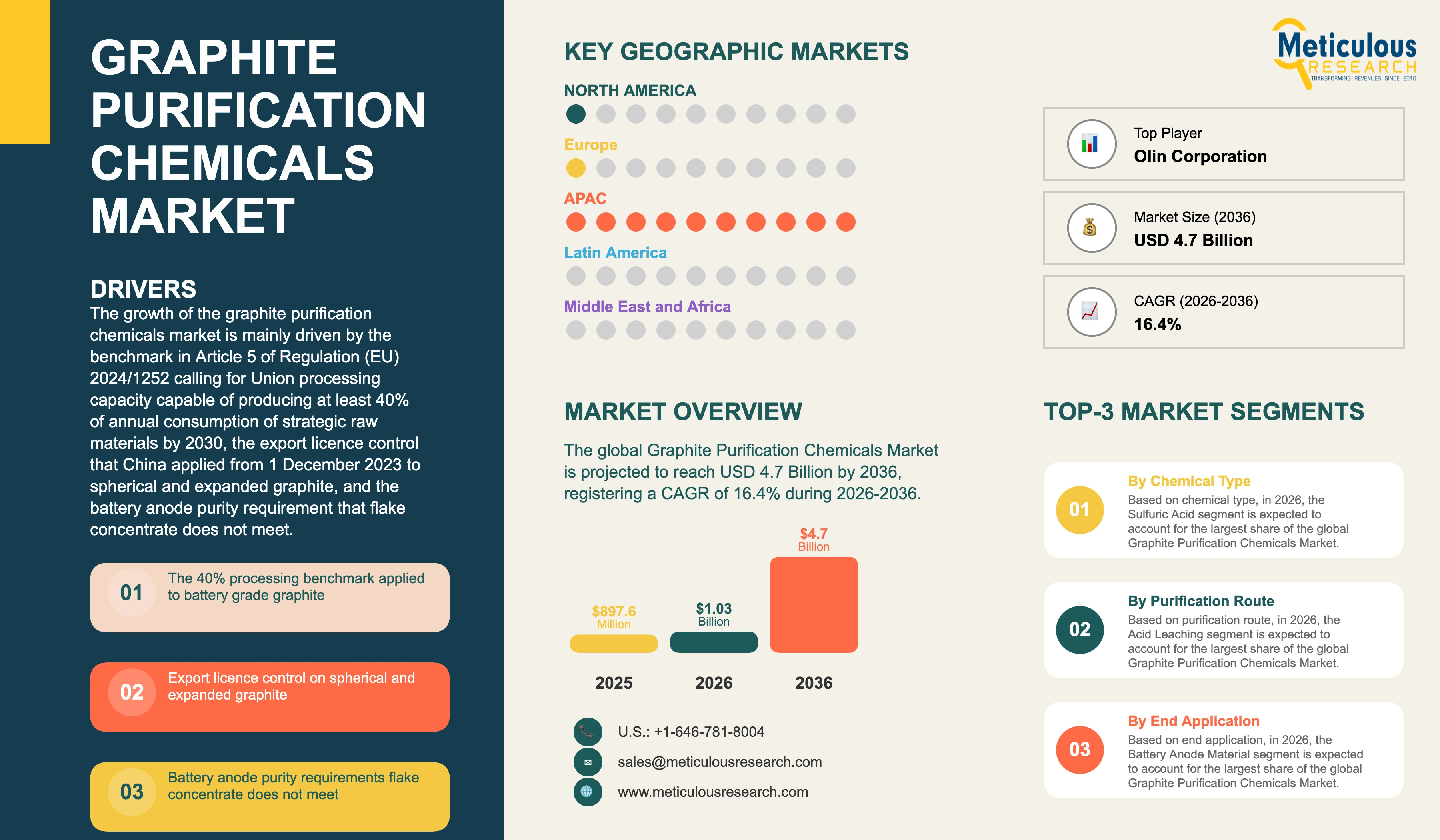
The global graphite purification chemicals market was valued at USD 897.6 million in 2025. This market is expected to reach USD 4.70 billion by 2036 from an estimated USD 1.03 billion in 2026, registering a CAGR of 16.4% during the forecast period (2026-2036).
- Published
- Nov 2026
- Pages
- 265
- Format
- PDF + Excel
- Report ID
- MRCHM - 1042672
- Base year
- 2025
- 2025 · BASELINE
- $897.6M
- 2036
- $4.70B
- CAGR 2026–2036
- 16.4%
2025 baseline · 2026–2036 forecast at 16.4% CAGR · hover a bar for the value
Key highlights
The global graphite purification chemicals market is estimated at USD 1.03 billion in 2026 and is projected to reach USD 4.70 billion by 2036.
Market volume is estimated at 1, 180.00 kilotons in 2026 and is projected to reach 4,942.43 kilotons by 2036 at a CAGR of 15.4%, measured as chemicals consumed on a 100% active basis.
The average selling price is estimated at USD 0.87 per kg in 2026 and is projected to rise to USD 0.95 per kg by 2036 as hydrofluoric acid and chlorination chemistry take a larger share of the mix.
This market is upstream of both the flexible graphite market and the anode material market and is not additive to either.
Sulfuric acid is expected to account for the largest chemical type share in 2026, while chlorinating agents are projected to register the highest CAGR of 22.6%.
Acid leaching is expected to hold the largest purification route share in 2026, while chlorination is projected to grow fastest at a CAGR of 23.4%.
Natural flake graphite is expected to be the largest graphite type served in 2026, while recycled and reclaimed graphite is projected to register the highest CAGR of 28.4%.
Battery anode material is expected to account for the largest end application share in 2026, while nuclear and semiconductor grade graphite is projected to grow fastest at a CAGR of 21.4%.
Asia-Pacific is expected to hold the largest regional share in 2026, while North America is projected to register the highest CAGR of 26.8%.
Article 5(1)(a)(ii) of Regulation (EU) 2024/1252 sets a benchmark that by 2030 Union processing capacity, including all intermediate processing steps, should be capable of producing at least 40% of the annual consumption of strategic raw materials in the Union.
Article 5(1)(a)(i) sets a 10% benchmark for extraction capacity and Article 5(1)(a)(iii) a 25% benchmark for recycling capacity over the same horizon.
Article 5(1)(b) sets a benchmark that no third country accounts for more than 65% of the annual consumption in the Union of any individual strategic raw material.
Annex I Section 1 of Regulation (EU) 2024/1252 lists "graphite - battery grade" among the strategic raw materials, so the 40% processing benchmark applies to the grade this market is largely consumed to produce.
Purification is the processing step for graphite, which makes the Article 5 processing benchmark a direct call for purification capacity rather than an indirect one.
The Ministry of Commerce and the General Administration of Customs of China announced in October 2023 temporary export control measures for graphite items that took effect on 1 December 2023.
Those measures brought high-strength, high-purity and high-density synthetic graphite materials and products under export licence control as highly sensitive items.
They also brought natural flake graphite products under export licence control, including spherical graphite and expanded graphite.
They removed temporary export control from less sensitive graphite products such as carbon electrodes for furnaces used in the steel, metallurgy and chemical sectors.
Export permit applications are made to the Ministry of Commerce through provincial commerce authorities and licences must be renewed every six months.
The stated purpose of the measures is to protect national security, and they replace a temporary export control measure dating from 2006.
Report summary
| Particulars | Details |
|---|---|
| Base Year | 2025 |
| Forecast Period | 2026-2036 |
| Market Size in 2025 | USD 897.6 million |
| Market Size in 2026 | USD 1.03 billion |
| Market Size by 2036 | USD 4.70 billion |
| Value CAGR (2026-2036) | 16.4% |
| Format | PDF, Excel & Cloud Portal · 265 pages |
| Volume in 2026 | 1,180.00 kilotons |
| Volume by 2036 | 4,942.43 kilotons |
| Volume CAGR (2026-2036) | 15.4% |
| Volume Basis | Chemicals consumed on a 100% active basis |
| Average Selling Price in 2026 | USD 0.87 per kg |
| Average Selling Price by 2036 | USD 0.95 per kg |
| Price Direction | Rising, as hydrofluoric acid and chlorination chemistry take share from sulfuric and hydrochloric acid |
| Measurement Basis | Acids, alkalis, oxidisers and chlorinating agents consumed in acid leaching, alkali roasting and leaching, chlorination and intercalation of natural and synthetic graphite, excluding the graphite itself, flotation and beneficiation reagents upstream of purification, thermal purification which consumes energy rather than chemicals, coating pitch and chemical vapour deposition carbon precursors, electrode binders, and effluent neutralisation and water treatment reagents downstream |
| Relationship to Adjacent Markets | Upstream of the flexible graphite market and the anode material market; not additive to either, since the chemicals counted here are consumed to produce the graphite those markets measure as product |
| Largest Chemical Type | Sulfuric acid |
| Fastest-Growing Chemical Type | Chlorinating agents (CAGR 22.6%) |
| Largest Purification Route | Acid leaching |
| Fastest-Growing Purification Route | Chlorination (CAGR 23.4%) |
| Largest Graphite Type | Natural flake graphite |
| Fastest-Growing Graphite Type | Recycled and reclaimed graphite (CAGR 28.4%) |
| Largest End Application | Battery anode material |
| Fastest-Growing End Application | Nuclear and semiconductor grade graphite (CAGR 21.4%) |
| Largest Region | Asia-Pacific |
| Fastest-Growing Region | North America (CAGR 26.8%) |
| Segments Covered | Chemical Type, Purification Route, Graphite Type, End Application, and Geography |
| Geographies Covered | Asia-Pacific, Europe, North America, Latin America, and Middle East & Africa |
| Companies Profiled | 11 companies, including Olin Corporation, Dow Inc., Solvay SA, Honeywell International Inc., BASF SE, and Nouryon Chemicals Holding B.V. |
Report overview
Segments covered: chemical type, purification route, graphite type, end application.
In volume terms, this market is estimated at 1,180.00 kilotons in 2026 and is projected to reach 4,942.43 kilotons by 2036, registering a CAGR of 15.4% during the same period, measured as chemicals consumed on a 100% active basis. The average selling price is estimated at USD 0.87 per kg in 2026 and is projected to rise to USD 0.95 per kg by 2036 as hydrofluoric acid and chlorination chemistry take a larger share of a mix currently dominated by sulfuric and hydrochloric acid at a fraction of the price per kilogram.
The growth of this market is mainly driven by the processing capacity benchmark in Article 5 of Regulation (EU) 2024/1252, which calls for Union capacity capable of producing at least 40% of annual consumption of strategic raw materials by 2030 and for which purification is the processing step in the case of graphite, the export licence control that China applied from 1 December 2023 to spherical and expanded graphite and to high-purity synthetic graphite, the battery anode output that requires purity levels ordinary flake graphite does not reach, and the nuclear and semiconductor grades that require the most aggressive purification of all. However, factors such as the hydrofluoric acid handling, permitting and effluent requirements that constrain where purification can be sited, and the availability of thermal purification as a route that consumes energy rather than chemicals, are expected to restrain the growth of this market to some extent.
Sulfuric acid accounts for the largest share of this market because acid leaching is the dominant purification route worldwide and sulfuric acid is consumed in the largest quantity within it at the lowest cost per kilogram. Chlorinating agents grow fastest because high-temperature chlorination reaches purity levels that acid leaching alone does not and is the route being selected for the nuclear, semiconductor and high-end battery grades where residual metal content matters most.
Graphite purification chemicals are the reagents consumed in raising natural and synthetic graphite from concentrate purity to the high-purity and battery grades that downstream applications require, and in intercalating graphite for subsequent expansion. Market sizing in this report is on both a value basis in USD and a volume basis in kilotons measured as chemicals consumed on a 100% active basis, with average selling price derived from the two. The measurement basis covers acids, alkalis, oxidisers and chlorinating agents consumed in acid leaching, alkali roasting and leaching, chlorination and intercalation, and it excludes the graphite itself, flotation and beneficiation reagents used upstream of purification, thermal purification which consumes energy rather than chemicals, coating pitch and chemical vapour deposition carbon precursors, electrode binders, and effluent neutralisation and water treatment reagents downstream of the process.
This market sits upstream of both the flexible graphite market and the anode material market and is not additive to either, because the chemicals counted here are consumed to produce the purified and intercalated graphite that those markets then measure as product. A kilogram of sulfuric acid consumed in intercalation appears in this market and the expanded graphite made with it appears in the flexible graphite market, so adding the two would count the same step twice from different sides. The three markets describe consecutive positions in one chain.
Article 5(1)(a)(ii) of Regulation (EU) 2024/1252 sets a benchmark that by 2030 Union processing capacity, including all intermediate processing steps, should be capable of producing at least 40% of the annual consumption of strategic raw materials in the Union, alongside a 10% benchmark for extraction capacity under Article 5(1)(a)(i), a 25% benchmark for recycling capacity under Article 5(1)(a)(iii) and a benchmark under Article 5(1)(b) that no third country accounts for more than 65% of annual Union consumption of any individual strategic raw material. Annex I Section 1 lists "graphite - battery grade" among the strategic raw materials, so the processing benchmark reaches the grade this market is largely consumed to produce.
Purification is what processing means in the case of graphite, which makes that benchmark a direct demand signal rather than an indirect one. Flake concentrate leaving a mine is not usable in an anode or a high-purity application until silicates, iron, aluminium and other mineral impurities have been removed, and that removal is a chemical operation rather than a physical one. Building Union capacity capable of supplying 40% of consumption therefore means building purification capacity, and purification capacity consumes acids, alkalis and chlorinating agents in proportion to its output. The benchmark converts almost directly into chemical demand.
Export licence control on the purified products pushes in the same direction from the opposite end. The Ministry of Commerce and the General Administration of Customs of China announced in October 2023 temporary export control measures for graphite items that took effect on 1 December 2023, bringing high-strength, high-purity and high-density synthetic graphite materials and products under licence as highly sensitive items and bringing natural flake graphite products under licence including spherical graphite and expanded graphite, while removing control from less sensitive products such as carbon electrodes for furnaces used in steel, metallurgy and chemical sectors. Export permits are applied for through provincial commerce authorities and renewed every six months.
The two measures together explain why purification capacity is being built where it previously was not. A licence requirement renewable every six months on spherical and expanded graphite makes a buyer outside China dependent on an administrative decision rather than a commercial one, and the European benchmark gives that buyer a policy reason to build the step domestically. Neither measure changes how much purified graphite the world needs. Both change where it is purified, and the chemicals follow the purification rather than the graphite.
Acid leaching is the dominant route and will remain so through the forecast period. Treating flake concentrate with mineral acids, most commonly sulfuric and hydrochloric, dissolves the metal oxide and silicate impurities and takes purity from the mid-nineties into the high nineties by carbon content at modest cost, which is sufficient for many industrial applications. Hydrofluoric acid is added where silicates resist other acids, since it attacks silica directly, and that is what lifts purity into the range battery and high-purity applications require. The route consumes a large tonnage of inexpensive reagent, which is why volume in this market is large and value per kilogram is low.
Chlorination reaches further than acid leaching and is the route being selected where residual metal content governs the application. Passing a chlorinating agent over graphite at high temperature converts metallic impurities into volatile chlorides that leave as gas rather than requiring dissolution and washing, which reaches purity levels acid treatment cannot and avoids the large aqueous effluent volume that leaching generates. Capital cost and gas handling are higher. Chlorinating agents consequently register the highest chemical type CAGR at 22.6% and chlorination the highest route CAGR at 23.4%.
Hydrofluoric acid is the chemical that determines where purification can be sited. It attacks silica, which makes it the most effective reagent against the silicate impurities that limit graphite purity, and it is also acutely hazardous, strictly regulated in handling and transport, and productive of a fluoride effluent requiring dedicated treatment. A purification plant using it needs permitting, containment and worker protection that a plant using only sulfuric and hydrochloric acid does not. Several projects outside China are consequently being designed around hydrofluoric-free routes at some cost in purity or capital.
Intercalation is a smaller but distinct part of the market serving a different downstream product. Treating flake graphite with sulfuric acid and an oxidiser inserts the acid between the graphene layers so that rapid heating later expands the flake into the worm-like form from which flexible graphite sheet is pressed, and the chemistry is consumed in the intercalation step rather than in impurity removal. The reagents overlap with those used in purification but the purpose and the dosing do not. Expanded and flexible graphite therefore appears as a separate end application in this market.
Recycled graphite is the fastest-growing feedstock and the most chemically demanding. Graphite recovered from production scrap and end-of-life batteries arrives contaminated with electrolyte residues, binder, metal current collector fragments and cathode material, so returning it to anode specification requires more aggressive and more varied chemistry than purifying virgin flake. The 25% recycling capacity benchmark under Article 5(1)(a)(iii) of Regulation (EU) 2024/1252 applies to strategic raw materials including battery grade graphite. Recycled and reclaimed graphite consequently registers the highest graphite type CAGR at 28.4%.
Report infographic
Market dynamics
15 factors across 5 forcesThe 40% Processing Benchmark Applied to Battery Grade Graphite
Article 5(1)(a)(ii) of Regulation (EU) 2024/1252 sets a benchmark that by 2030 Union processing capacity, including all intermediate processing steps, should be capable of producing at least 40% of the annual consumption of strategic raw materials in the Union, and Annex I Section 1 lists "graphite - battery grade" among those materials. Purification is what processing means for graphite, because flake concentrate is unusable in an anode until silicates, iron and aluminium have been chemically removed, so the benchmark translates into purification capacity and purification capacity consumes acids, alkalis and chlorinating agents in proportion to output. The 10% extraction and 25% recycling benchmarks under the same article reinforce the same direction. The benchmark converts almost directly into chemical demand, and it does so for capacity being permitted and constructed now rather than at the 2030 date itself, because a plant intended to be operating by then is already in design today.
Export Licence Control on Spherical and Expanded Graphite From December 2023
The Ministry of Commerce and the General Administration of Customs of China announced in October 2023 temporary export control measures for graphite items taking effect on 1 December 2023, which brought high-strength, high-purity and high-density synthetic graphite materials and products under export licence control as highly sensitive items and brought natural flake graphite products including spherical graphite and expanded graphite under licence, with permits applied for through provincial commerce authorities and renewed every six months. A buyer outside China is consequently dependent on an administrative decision rather than a commercial one for the purified product. The response has been to build the purification step domestically rather than to import it. Chemical demand follows the purification rather than the graphite, and the reagents consumed are available locally where the purified graphite was not, which is why the chemical demand materialises in the region rather than following the trade flow in purified graphite itself.
Battery Anode Purity Requirements That Flake Concentrate Does Not Meet
An anode requires carbon content well above what flake concentrate leaving a mine provides, because residual metallic impurities cause side reactions that consume lithium inventory and raise self-discharge, and the purity gap can only be closed chemically. Every tonne of anode material therefore carries a quantity of purification chemical behind it, which makes demand here a direct function of anode output rather than a share of a discretionary spend. Battery anode material accounts for the largest end application share in this market on that basis. The driver is volumetric and operates independently of the regulatory provisions above, so it underpins demand whatever happens to the policy timetable. Purity requirements also rise with cell energy density, which raises chemical consumption per tonne alongside the underlying growth in processed tonnage itself.
Nuclear and Semiconductor Grades Requiring the Most Aggressive Purification
Nuclear graphite and the graphite used in semiconductor process equipment are specified at residual metal levels an order of magnitude below battery grade, because a contaminant carried into a reactor core or a wafer process is more costly than the component itself, and reaching those levels requires chlorination or repeated hydrofluoric treatment rather than a single acid leach. Chemical consumption per tonne of graphite in those applications is therefore several times that of battery grade. Volumes are modest but the chemical intensity is the highest in the market. Nuclear and semiconductor grade graphite registers the highest end application CAGR at 21.4%. Qualification in those applications also runs for years, so a reagent supply position once established is held for the operating life of the plant rather than retendered annually.
Table of contents
12 chapters · 148 sections · 265 pages · click to expandGeographic analysis
Asia-Pacific
Largest shareIn 2026, Asia-Pacific is expected to account for the largest share of the global graphite purification chemicals market. The large share of this region is mainly due to the concentration of graphite purification capacity in China, the flake resource and spherical graphite production located alongside it, the anode material manufacturing in China, South Korea and Japan that consumes the output, and the commodity acid and chlor-alkali supply available at scale in the region. China is projected to register a CAGR of 14.4%, India a CAGR of 18.6% and South Korea a CAGR of 17.8% during the forecast period.
North America
Fastest growthHowever, North America is projected to register the highest CAGR of 26.8% during the forecast period, from a very small base. The rapid growth of this region is attributed to purification capacity being built where almost none existed, the export licence control that China applied from 1 December 2023 to spherical and expanded graphite, the anode material plants committed alongside cell manufacturing, and the critical mineral sourcing requirements attached to vehicle incentives. The United States is projected to register a CAGR of 27.2% and Canada a CAGR of 24.8%.
Europe
Europe is projected to grow at 25.0%, with Sweden at 26.2%, Germany at 25.6% and Finland at 25.0%, where the 40% processing benchmark under Article 5(1)(a)(ii) of Regulation (EU) 2024/1252 applies to battery grade graphite as a strategic raw material and where purification projects are being permitted alongside anode and cell capacity.
Latin America
Latin America is projected to grow at 16.0% and the Middle East & Africa at 15.0%, in both cases where flake resources or low cost energy offer a reason to purify locally rather than export concentrate. Where purification happens is becoming a policy outcome rather than a cost outcome, and the chemicals follow it. A licence requirement renewable every six months on spherical and expanded graphite leaving China and a Union benchmark calling for 40% of processing capacity by 2030 both point the same way, and neither changes how much purified graphite the world consumes. Commodity acid and caustic supply is available in every region, so reagent availability does not constrain where a plant is built, while hydrofluoric acid supply and fluoride effluent permitting frequently do. Regional growth in this market therefore tracks permitting and policy rather than chemical logistics, and the fastest growth sits where the smallest installed base coincides with the strongest of the policy requirements now in force.
Competitive landscape
The global graphite purification chemicals market is characterised by the presence of large commodity chemical producers for whom graphite purification is one outlet among many, chlor-alkali producers supplying caustic soda and chlorine, and fluorochemical producers supplying hydrofluoric acid from a narrower base. Competition is contested on supply reliability and on process chemistry support to new purification plants rather than on price, since the commodity reagents are priced by far larger end markets. Olin Corporation, Dow Inc., Solvay SA, Honeywell International Inc. and BASF SE together accounted for an estimated 34.2% of this market in 2026, while the companies profiled in this report together accounted for an estimated 52.8%. Those shares describe supply into the graphite purification application only rather than the total output of the companies concerned.
Article 5(1)(a)(ii) of Regulation (EU) 2024/1252 sets a 40% processing capacity benchmark by 2030 for strategic raw materials including battery grade graphite as listed in Annex I Section 1, and the Ministry of Commerce and the General Administration of Customs of China brought spherical graphite, expanded graphite and high-purity synthetic graphite under export licence control with effect from 1 December 2023. Reagent package supply agreements with new purification projects, development of hydrofluoric-free process chemistry, and chlorination route qualification for high-purity grades accounted for most competitive activity through 2026.
Fragmentation here reflects the commodity nature of most of the reagents rather than an absence of competitive structure, since the chemicals are sold into many industries and graphite is a small outlet for each supplier. Olin Corporation, Westlake Corporation and Dow Inc. compete from chlor-alkali positions, Honeywell International Inc., Daikin Industries, Ltd., Zhejiang Juhua Co., Ltd. and Do-Fluoride New Materials Co., Ltd. in hydrofluoric acid and fluorochemicals, and Solvay SA, Evonik Industries AG and Nouryon Chemicals Holding B.V. in peroxides and oxidisers. Some of the key players operating in the graphite purification chemicals market are Olin Corporation (U.S.), Dow Inc. (U.S.), Solvay SA (Belgium), Honeywell International Inc. (U.S.), BASF SE (Germany), Nouryon Chemicals Holding B.V. (Netherlands), Westlake Corporation (U.S.), Evonik Industries AG (Germany), Daikin Industries, Ltd. (Japan), Zhejiang Juhua Co., Ltd. (China), and Do-Fluoride New Materials Co., Ltd. (China), among others.
- —
Article 5(1)(a)(ii) of Regulation (EU) 2024/1252 sets a benchmark that by 2030 Union processing capacity, including all intermediate processing steps, should be capable of producing at least 40% of the annual consumption of strategic raw materials in the Union, with a 10% benchmark for extraction under Article 5(1)(a)(i), a 25% benchmark for recycling under Article 5(1)(a)(iii) and a benchmark under Article 5(1)(b) that no third country accounts for more than 65% of annual Union consumption of any individual strategic raw material, and Annex I Section 1 lists "graphite - battery grade" among those materials. The Ministry of Commerce and the General Administration of Customs of China announced in October 2023 temporary export control measures for graphite items that took effect on 1 December 2023, bringing high-strength, high-purity and high-density synthetic graphite materials and products under export licence control as highly sensitive items and bringing natural flake graphite products including spherical graphite and expanded graphite under licence, while removing control from less sensitive products such as carbon electrodes for furnaces. Export permits are applied for through provincial commerce authorities and renewed every six months, the stated purpose is to protect national security, and the measures replace a temporary export control measure dating from 2006.
- Olin Corporation
- Dow Inc.
- Solvay SA
- Honeywell International Inc.
- BASF SE
- Nouryon Chemicals Holding B.V
Expert perspectives
Value grows at 16.4% against 15.4% in volume over the forecast period, and the average selling price rises from USD 0.87 per kg in 2026 to USD 0.95 per kg by 2036 as hydrofluoric acid and chlorination chemistry take share from sulfuric and hydrochloric acid. This remains a low-value, high-tonnage market in absolute terms, and the price movement reflects which chemistry is being selected rather than any change in what a reagent costs.
This total is upstream of the flexible graphite market and the anode material market and must not be summed with either. The acid consumed in intercalation is counted here and the expanded graphite made with it is counted there, so adding them would count one step twice from two sides. The three describe consecutive positions in a single chain.
Article 5(1)(a)(ii) of Regulation (EU) 2024/1252 is a purification benchmark in substance even though it says processing. Flake concentrate is unusable in an anode until silicates, iron and aluminium have been chemically removed, so building Union capacity capable of supplying 40% of consumption means building chemical purification, and the reagent demand follows output almost proportionally. Few regulatory benchmarks convert into chemical demand this directly.
Export licence control works on the same variable from the other end. Bringing spherical and expanded graphite under licence from 1 December 2023, with permits renewed every six months, makes a buyer outside China dependent on an administrative decision for a purified product. Neither that measure nor the European benchmark changes how much purified graphite the world needs; both change where it is purified, and the chemicals follow the purification rather than the mine.
What should temper the growth rate is thermal purification. Heating graphite to very high temperature volatilises impurities with no reagent at all, produces no aqueous effluent and no fluoride waste, and competes for exactly the same duty, so every tonne purified thermally consumes none of the chemicals counted here. Where power is cheap and low in carbon intensity, and where a carbon footprint declaration applies to the finished battery, that comparison can favour the thermal route.
Hydrofluoric acid rather than purity is what decides plant location. It is the only common reagent that attacks the silicates limiting graphite purity, and it is also acutely hazardous and productive of a fluoride effluent requiring dedicated treatment, so permitting rather than chemistry governs where a leaching plant can be built. That is why hydrofluoric-free and chlorination routes are being selected in new jurisdictions and why the same operator may run different chemistry at different sites.
Customer perspectives
Reagent tonnage is high and unit cost low, so effluent neutralisation and disposal rather than chemical purchase cost is what governs the economics of a plant, which is what drives the interest in routes that entirely avoid aqueous processing.
Export licence control exposed the absence of purification capacity outside the established base, while the processing benchmark supports building it locally and fluoride effluent permitting has emerged as the governing constraint on where that capacity can actually be sited.
The highest purity grades require chlorination rather than acid leaching, at higher capital and gas handling cost, and consume several times the chemical quantity per tonne that battery grade material requires, which makes that one application chemically intensive out of all proportion to its tonnage. Battery grade purification requires.
“Our reagent bill is large in tonnage and small in unit cost, so what actually governs the plant is the effluent side. Neutralising and disposing of spent liquor costs us more than some of the acid does. That is why we looked hard at routes that keep the impurities out of water altogether.”
“When spherical graphite went under export licence we discovered how little purification capacity existed anywhere else. Building it locally is the only answer, and the processing benchmark gives us a reason to. What surprised us is how much of the question turns out to be about fluoride permits.”
“For nuclear and semiconductor material the specification is an order below battery grade, and you cannot get there with a single acid leach. We chlorinate, which costs more in capital and gas handling but takes the metals out as vapour. Chemical consumption per tonne is several times what the battery people use.”
Frequently asked questions
This market was valued at USD 792.0 million in 2024 and USD 897.6 million in 2025, and is estimated at USD 1.03 billion in 2026. In volume terms it is estimated at 1,180.00 kilotons in 2026 on a 100% active basis.
Cite this report
Meticulous Research. (2026). Graphite Purification Chemicals Market - Global Opportunity Analysis and Industry Forecast (2026-2036) (Report No. MRCHM - 1042672). Meticulous Market Research Pvt. Ltd. https://www.meticulousresearch.com/product/graphite-purification-chemicals-market-7355