Flexible Graphite Market (2026-2036)
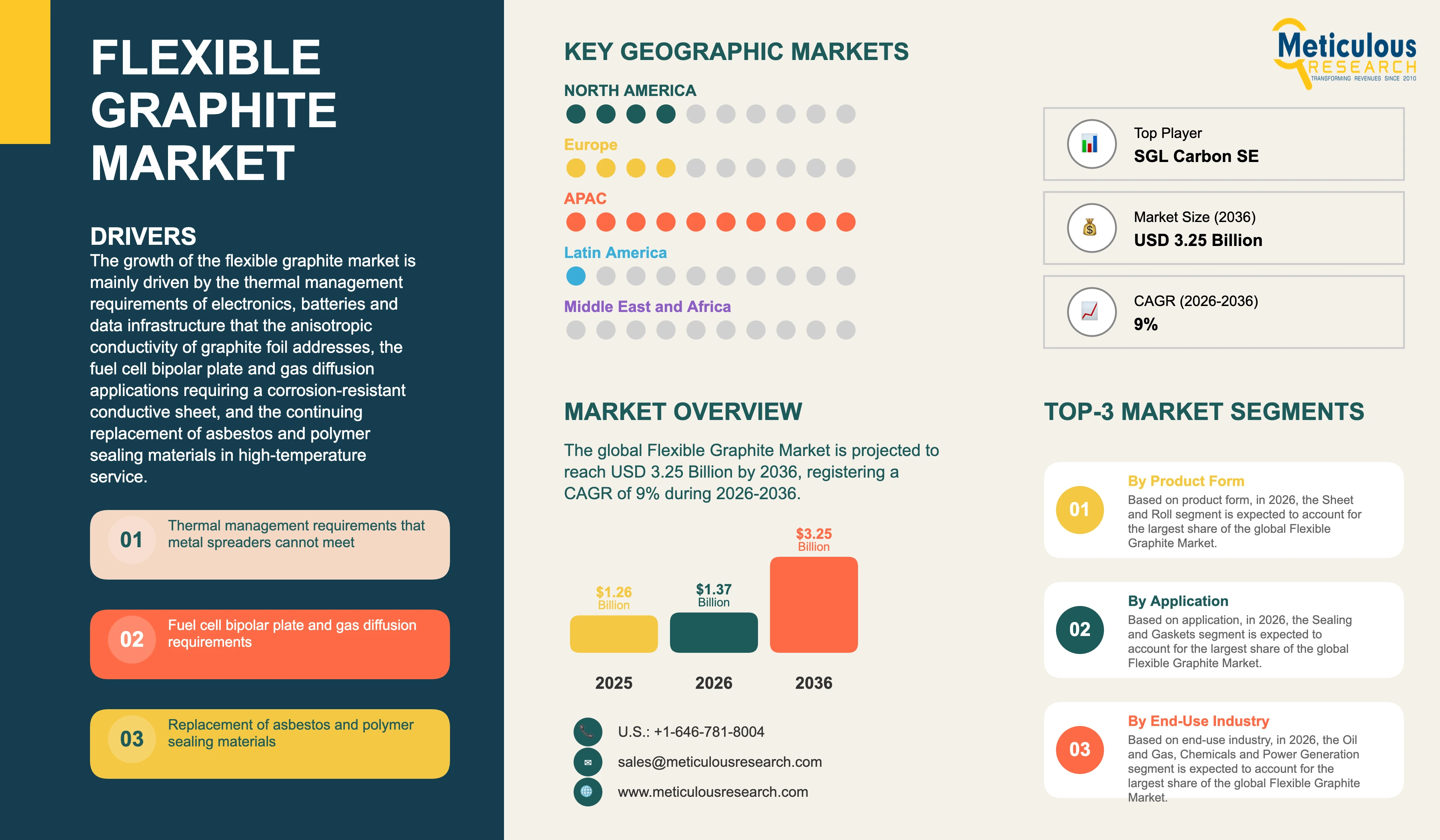
The global flexible graphite market was valued at USD 1.26 billion in 2025. This market is expected to reach USD 3.25 billion by 2036 from an estimated USD 1.37 billion in 2026, registering a CAGR of 9.0% during the forecast period (2026-2036).
- Published
- Nov 2026
- Pages
- 274
- Format
- PDF + Excel
- Report ID
- MRCHM - 1042671
- Base year
- 2025
- 2025 · BASELINE
- $1.26B
- 2036
- $3.25B
- CAGR 2026–2036
- 9.0%
2025 baseline · 2026–2036 forecast at 9.0% CAGR · hover a bar for the value
Key highlights
The global flexible graphite market is estimated at USD 1.37 billion in 2026 and is projected to reach USD 3.25 billion by 2036.
Market volume is estimated at 56.00 kilotons in 2026 and is projected to reach 118.69 kilotons by 2036 at a CAGR of 7.8%, measured as sheet, foil, laminate and formed parts supplied.
The average selling price is estimated at USD 24.50 per kg in 2026 and is projected to rise to USD 27.37 per kg by 2036 as high-purity grades take share from commodity sealing sheet.
Sheet and roll are expected to account for the largest product form share in 2026, while tape and foil for thermal management are projected to register the highest CAGR of 14.2%.
Standard purity grades are expected to hold the largest purity share in 2026, while high-purity grades are projected to grow fastest at a CAGR of 11.4%.
Sealing and gaskets are expected to be the largest application in 2026, while thermal management in electronics and batteries is projected to register the highest CAGR of 15.4%.
Oil and gas, chemicals and power generation are expected to account for the largest end-use industry share in 2026, while automotive and e-mobility are projected to grow fastest at a CAGR of 13.8%.
Asia-Pacific is expected to hold the largest regional share in 2026 and is also projected to register the highest CAGR of 10.2%.
Regulation (EU) 2024/1252 of 11 April 2024 establishes a framework for ensuring a secure and sustainable supply of critical raw materials and was published in the Official Journal on 3 May 2024.
Article 49 provides that the Regulation enters into force on the twentieth day following that of its publication in the Official Journal.
Article 5(1)(a)(i) sets a benchmark that by 2030 Union extraction capacity should be able to supply at least 10% of the annual consumption of strategic raw materials in the Union.
Article 5(1)(a)(ii) sets a benchmark that Union processing capacity, including all intermediate processing steps, should be capable of producing at least 40% of that annual consumption.
Article 5(1)(a)(iii) sets a benchmark that Union recycling capacity should be capable of producing at least 25% of that annual consumption.
Article 5(1)(b) sets a benchmark that no third country accounts for more than 65% of the annual consumption in the Union of any individual strategic raw material.
Annex I Section 1 lists the strategic raw materials and its graphite entry reads "graphite - battery grade".
Annex II Section 1 lists the critical raw materials and its graphite entry reads simply "graphite".
Flexible graphite is made from high-purity natural flake graphite rather than battery grade material, so it falls within the critical raw materials list but outside the strategic raw materials list.
The Article 5 capacity benchmarks and the 65% single third country benchmark therefore do not apply to the grade of graphite this market consumes, although it depends on the same deposits and processing base.
Article 3(3) requires the Commission to assess whether synthetic graphite should remain on the strategic raw materials list.
Report summary
| Particulars | Details |
|---|---|
| Base Year | 2025 |
| Forecast Period | 2026-2036 |
| Market Size in 2025 | USD 1.26 billion |
| Market Size in 2026 | USD 1.37 billion |
| Market Size by 2036 | USD 3.25 billion |
| Value CAGR (2026-2036) | 9.0% |
| Format | PDF, Excel & Cloud Portal · 274 pages |
| Volume in 2026 | 56.00 kilotons |
| Volume by 2036 | 118.69 kilotons |
| Volume CAGR (2026-2036) | 7.8% |
| Volume Basis | Sheet, foil, laminate and formed parts supplied |
| Average Selling Price in 2026 | USD 24.50 per kg |
| Average Selling Price by 2036 | USD 27.37 per kg |
| Price Direction | Rising, as high-purity thermal management and fuel cell grades take share from commodity sealing sheet |
| Measurement Basis | Sheet, foil, laminate and formed product made by exfoliating intercalated natural flake graphite and compressing the expanded material without binder, excluding anode-grade spherical and synthetic graphite, graphite electrodes for electric arc furnace steelmaking, isostatic and extruded graphite blocks, graphene and graphene films, pyrolytic and polymer-derived graphite sheet, expandable graphite sold as unexpanded intercalated powder for flame retardancy, and carbon fibre and carbon-carbon composites |
| Largest Product Form | Sheet and roll |
| Fastest-Growing Product Form | Tape and foil for thermal management (CAGR 14.2%) |
| Largest Purity Grade | Standard purity |
| Fastest-Growing Purity Grade | High purity (CAGR 11.4%) |
| Largest Application | Sealing and gaskets |
| Fastest-Growing Application | Thermal management in electronics and batteries (CAGR 15.4%) |
| Largest End-Use Industry | Oil and gas, chemicals and power generation |
| Fastest-Growing End-Use Industry | Automotive and e-mobility (CAGR 13.8%) |
| Largest Region | Asia-Pacific |
| Fastest-Growing Region | Asia-Pacific (CAGR 10.2%) |
| Segments Covered | Product Form, Purity Grade, Application, End-Use Industry, and Geography |
| Geographies Covered | Asia-Pacific, Europe, North America, Latin America, and Middle East & Africa |
| Companies Profiled | 10 companies, including SGL Carbon SE, NeoGraf Solutions, LLC, Mersen SA, Toyo Tanso Co., Ltd., Nippon Carbon Co., Ltd., and Morgan Advanced Materials plc |
Report overview
Segments covered: product form, purity grade, application, end-use industry.
In volume terms, this market is estimated at 56.00 kilotons in 2026 and is projected to reach 118.69 kilotons by 2036, registering a CAGR of 7.8% during the same period, measured as sheet, foil, laminate and formed parts supplied. The average selling price is estimated at USD 24.50 per kg in 2026 and is projected to rise to USD 27.37 per kg by 2036, a reversal of the usual direction that reflects high-purity thermal management and fuel cell grades taking share from commodity sealing sheet rather than any increase in the cost of producing a given grade.
The growth of this market is mainly driven by the thermal management requirements of electronics, batteries and data infrastructure that the anisotropic in-plane conductivity of graphite foil addresses, the fuel cell bipolar plate and gas diffusion applications that require a corrosion-resistant conductive sheet, the replacement of asbestos and polytetrafluoroethylene sealing materials in high-temperature process service, and the supply security policy now applied to graphite as a critical raw material. However, factors such as the dependence of production on natural flake graphite concentrated in a small number of countries, and the oxidation of unprotected graphite above roughly 450 degrees Celsius in air that limits service in oxidising atmospheres, are expected to restrain the growth of this market to some extent.
Sealing and gasket applications account for the largest share of this market because flexible graphite combines chemical inertness, resilience and service to high temperature in a way no polymer gasket material matches, and because refinery, chemical and power plant flange populations are large and replaced on maintenance cycles. Thermal management grows faster because the heat flux in compact electronics and battery packs has risen to a level that metal spreaders cannot handle within the thickness and mass available.
Flexible graphite is sheet, foil, laminate and formed product made by exfoliating intercalated natural flake graphite and compressing the expanded worms into a self-bonding material without binder. Market sizing in this report is on both a value basis in USD and a volume basis in kilotons measured as sheet, foil, laminate and formed parts supplied, with average selling price derived from the two. The measurement basis excludes anode-grade spherical and synthetic graphite, graphite electrodes for electric arc furnace steelmaking, isostatic and extruded graphite blocks, graphene and graphene films, pyrolytic and polymer-derived graphite sheet, expandable graphite sold in unexpanded intercalated powder form as a flame retardant additive, and carbon fibre and carbon-carbon composites.
Excluding pyrolytic graphite sheet matters more than it appears, because the two compete in the same thermal management sockets while being entirely different products. Pyrolytic sheet is produced by graphitising a polymer film and reaches higher in-plane conductivity in very thin gauges, while flexible graphite is compressed exfoliated natural flake and dominates where thickness, compressibility or cost matter. Combining them would blend a mineral-derived product with a polymer-derived one and obscure the graphite supply exposure that defines this market. A customer choosing between them is choosing between supply chains as much as between materials.
Regulation (EU) 2024/1252 of 11 April 2024 establishes a framework for ensuring a secure and sustainable supply of critical raw materials and was published in the Official Journal on 3 May 2024, with Article 49 providing that it enters into force on the twentieth day following publication. Article 5(1) sets benchmarks for 2030 under which Union extraction capacity should be able to supply at least 10% of annual consumption of strategic raw materials, processing capacity including all intermediate steps should be capable of producing at least 40%, recycling capacity should be capable of producing at least 25%, and no third country should account for more than 65% of annual Union consumption of any individual strategic raw material.
Which list graphite sits on decides whether any of that applies, and the two lists are not worded the same. Annex I Section 1, the strategic raw materials list, carries the entry "graphite - battery grade", while Annex II Section 1, the critical raw materials list, carries simply "graphite". Flexible graphite is made from high-purity natural flake rather than battery grade material, so it is a critical raw material but not a strategic one, and the Article 5 capacity benchmarks and the 65% single-country benchmark do not reach the grade this market consumes. Article 3(3) separately requires the Commission to assess whether synthetic graphite should remain on the strategic list.
The consequence is a gap between exposure and support that participants in this market feel directly. Flake graphite for flexible graphite comes from the same deposits and passes through much of the same processing base as battery grade material, so the supply concentration risk is substantially the same, while the capacity building benchmarks, permitting provisions and strategic project designations attach to the battery grade entry. A producer of sealing sheet therefore competes for feedstock against a battery sector whose demand is policy-supported and whose purchasing is not. The listing distinction is the most commercially consequential sentence in the Regulation for this market.
Sealing is the application the material was commercialised for and it remains the base of the market. Flexible graphite is chemically inert to almost everything except strong oxidisers, retains resilience under bolt load, recovers after thermal cycling and serves to temperatures no polymer gasket survives, which is why it replaced asbestos in refinery, chemical and power plant flanges and continues to displace polytetrafluoroethylene in high-temperature service. Flange populations are large and gaskets are replaced on maintenance turnaround cycles rather than on failure. Demand in that segment is therefore steady and tied to installed plant rather than to new construction.
Thermal management is where the growth is and it rests on a property metals do not have. Compressed exfoliated graphite is strongly anisotropic, conducting heat along the sheet far better than through it, which lets a thin foil move heat sideways out of a hot spot and spread it across a larger area rather than conducting it straight through to whatever sits behind. Power density in compact electronics and in battery packs has risen to the point where a metal spreader cannot do that within the available thickness and mass. Thermal management consequently registers the highest application CAGR at 15.4%.
Fuel cells use the material for a combination of properties nothing else offers at the price. A bipolar plate must conduct electricity, conduct heat, resist a wet acidic environment and be formable into flow channels in a thin section, and graphite satisfies all four where a coated metal plate requires the coating to survive the full stack life. Gas diffusion components use the same base material in different form. Volumes remain modest against sealing but the value per kilogram is higher and the growth rate is well above the market.
Oxidation is the limitation that defines where the material can be used and no formulation removes it. Graphite oxidises in air at temperatures above roughly 450 degrees Celsius, so flexible graphite in an oxidising atmosphere loses material from exposed edges over time even though the same product serves far higher temperatures in a reducing or inert environment or where the gasket is confined within a flange face. Oxidation inhibitors and metal foil laminates extend the range rather than eliminating the mechanism. Specification therefore turns on atmosphere and edge exposure as much as on temperature.
Feedstock concentration is the structural risk and it is upstream of every producer. Flexible graphite requires large flake natural graphite of high carbon content, which occurs in a small number of deposits and is intercalated and exfoliated in a processing base concentrated in a small number of countries, so a producer in Europe or North America is exposed to a supply chain it does not control regardless of where it converts sheet. The purification and intercalation steps are also where most of the capability sits, not in the pressing. That is why vertical position rather than converting capacity separates the competitors.
Report infographic
Market dynamics
15 factors across 5 forcesThermal Management Requirements That Metal Spreaders Cannot Meet
Compressed exfoliated graphite conducts heat along the sheet far better than through it, which allows a thin foil to move heat sideways out of a hot spot and spread it over a larger area rather than conducting it straight through to the component behind, and no metal offers that anisotropy. Power density in compact electronics, in battery packs and in data infrastructure has risen to the point where a metal spreader cannot achieve the same result within the thickness and mass a design allows. The requirement grows with every increase in processor or cell power density rather than with unit volume alone. Thermal management registers the highest application CAGR at 15.4%. The same property also makes a single foil useful as a propagation barrier between cells, so one part serves two functions and displaces hardware rather than adding to it, which is how it gets specified into packs that were already designed around a different thermal approach and have no spare volume to give.
Fuel Cell Bipolar Plate and Gas Diffusion Requirements
A bipolar plate must conduct electricity, conduct heat, resist a wet acidic environment and be formable into flow channels in a thin section at once, and graphite satisfies all four where a coated metal plate depends on the coating surviving the full stack life. Gas diffusion components use the same base material in a different form, so a single feedstock serves several positions in a stack. Value per kilogram in these applications is well above sealing sheet. The driver is a materials property combination rather than a cost advantage, which makes it durable as fuel cell volumes rise rather than vulnerable to a cheaper substitute. A single feedstock also serves plates and diffusion layers, so a producer qualified in one position is already close to qualifying in the other.
Replacement of Asbestos and Polymer Sealing Materials in High-Temperature Service
Flexible graphite is chemically inert to almost everything except strong oxidisers, retains resilience under bolt load, recovers after thermal cycling and serves temperatures no polymer gasket survives, which is why it replaced asbestos in refinery, chemical and power plant flanges and continues to displace polytetrafluoroethylene in high-temperature duty. Refinery, chemical and power plant flange populations are large and gaskets are replaced on maintenance turnaround cycles rather than on failure, which makes the demand recurring and tied to installed plant rather than to new construction. The driver is a substitution still in progress rather than a completed one, and it runs on plant maintenance schedules rather than on capital investment cycles, which makes the demand far less sensitive to the construction cycle than most other industrial materials of its kind.
Supply Security Policy Applied to Graphite as a Critical Raw Material
Regulation (EU) 2024/1252, published in the Official Journal on 3 May 2024 and entering into force on the twentieth day following publication under Article 49, lists graphite in Annex II Section 1 as a critical raw material, which brings monitoring, risk assessment and strategic stockpiling attention to the material even though the Article 5 capacity benchmarks attach to the Annex I entry for battery grade graphite. Recognition as critical has made supply chain mapping and qualified alternative sourcing a requirement for industrial customers rather than a precaution. Buyers are consequently willing to qualify a second producer where they previously ran single source. The effect on this market is on where material is bought rather than on how much, and it favours producers able to document a chain from deposit to sheet over those buying expanded graphite on the open merchant market.
Table of contents
12 chapters · 146 sections · 274 pages · click to expandGeographic analysis
Asia-Pacific
Largest shareIn 2026, Asia-Pacific is expected to account for the largest share of the global flexible graphite market and is also projected to register the highest CAGR of 10.2% during the forecast period. The large share and rapid growth of this region are mainly due to the natural flake graphite resource and the purification, intercalation and exfoliation capacity concentrated in China, the electronics and battery manufacturing that consumes thermal management grades, the refinery and chemical plant construction that generates sealing demand, and the fuel cell programmes in China, Japan and South Korea. China is projected to register a CAGR of 10.6%, India a CAGR of 11.8% and South Korea a CAGR of 10.0%.
Europe
Europe is projected to grow at 7.6%, with Germany at 7.4%, where the sealing and high-temperature industrial base is mature and demand is driven by replacement rather than installation, and where Regulation (EU) 2024/1252 has made feedstock provenance a purchasing consideration for industrial customers even though the Article 5 benchmarks attach to battery grade graphite rather than to the grade this market consumes. Several of the leading integrated producers hold their purification and exfoliation capability in the region.
North America
North America is projected to grow at 7.8%, with the United States at 7.8%, on refinery and chemical plant maintenance demand together with data infrastructure thermal management that has grown faster than the industrial base around it. A European or North American converter is therefore exposed to a feedstock chain it does not control however local its own operation appears. Regional share describes conversion rather than supply security, and the two will not converge within the forecast period because the processing steps that matter cannot be relocated as easily as a press line, nor permitted anywhere near as quickly once a candidate site has been identified and properly assessed.
Latin America
Latin America is projected to grow at 7.0% and the Middle East & Africa at 6.8%, both almost entirely on oil, gas and petrochemical sealing demand served through imported sheet rather than local production. Where the material is converted and where it is made are different questions in this market, and the second one is the constraint. Pressing and calendering sheet can be done close to a customer, but purification, intercalation and exfoliation require chemical handling, effluent treatment and permitting that concentrate that capability in a small number of locations, and the flake itself comes from a limited set of deposits.
Competitive landscape
The global flexible graphite market is characterised by the presence of integrated carbon and graphite companies that purify, intercalate, exfoliate and convert in one chain, specialist thermal management producers, and Chinese producers operating close to the flake resource. Competition is contested on vertical position and on qualification in engineered parts rather than on sheet price, because most of the technical capability sits upstream of pressing and because customers in the growing applications buy finished components to drawing. SGL Carbon SE, NeoGraf Solutions, LLC, Mersen SA, Toyo Tanso Co., Ltd. and Nippon Carbon Co., Ltd. together accounted for an estimated 38.4% of this market in 2026, while the companies profiled in this report together accounted for an estimated 56.2%.
Regulation (EU) 2024/1252 was published in the Official Journal on 3 May 2024 and enters into force on the twentieth day following publication under Article 49, listing graphite in Annex II Section 1 as a critical raw material while Annex I Section 1 lists only graphite of battery grade as strategic. Qualification of thin foil and tape formats for electronics and data infrastructure, development of laminated and inhibited constructions for oxidising service, and extension of fuel cell plate and gas diffusion supply accounted for most competitive activity through 2026.
Vertical integration separates the field more sharply here than in most materials markets, because a converter buying expanded graphite has little scope to differentiate and no protection against feedstock movement. NeoGraf Solutions, LLC competes in thermal management specifically, SGL Carbon SE and Mersen SA across sealing and high-temperature industrial duty, Toyo Tanso Co., Ltd. and Nippon Carbon Co., Ltd. in high-purity and semiconductor service, and Qingdao Haida Graphite Co., Ltd. and Qingdao Tennry Carbon Co., Ltd. from proximity to the flake resource. Some of the key players operating in the flexible graphite market are SGL Carbon SE (Germany), NeoGraf Solutions, LLC (U.S.), Mersen SA (France), Toyo Tanso Co., Ltd. (Japan), Nippon Carbon Co., Ltd. (Japan), Morgan Advanced Materials plc (U.K.), Nippon Pillar Packing Co., Ltd. (Japan), Qingdao Haida Graphite Co., Ltd. (China), Qingdao Tennry Carbon Co., Ltd. (China), and Graphite India Limited (India), among others.
- —
Regulation (EU) 2024/1252 of 11 April 2024, establishing a framework for ensuring a secure and sustainable supply of critical raw materials, was published in the Official Journal on 3 May 2024 and under Article 49 enters into force on the twentieth day following publication. Article 5(1) sets benchmarks for 2030 under which Union extraction capacity should supply at least 10% of annual consumption of strategic raw materials, processing capacity including all intermediate steps should be capable of producing at least 40%, recycling capacity should be capable of producing at least 25%, and no third country should account for more than 65% of annual Union consumption of any individual strategic raw material. Annex I Section 1 lists "graphite - battery grade" among the strategic raw materials while Annex II Section 1 lists "graphite" among the critical raw materials, and Article 3(3) requires the Commission to assess whether synthetic graphite should remain on the strategic list.
- SGL Carbon SE
- NeoGraf Solutions, LLC
- Mersen SA
- Toyo Tanso Co., Ltd.
- Nippon Carbon Co., Ltd.
- Morgan Advanced Materials plc
Expert perspectives
Value grows at 9.0% against 7.8% in volume over the forecast period, and the average selling price rises from USD 24.50 per kg in 2026 to USD 27.37 per kg by 2036. That direction comes from mix rather than from cost, as high-purity thermal management and fuel cell grades take share from commodity sealing sheet. A tonnage view of this market therefore understates what is happening in it.
The sentence that matters most in Regulation (EU) 2024/1252 is the difference between two annex entries. Annex I Section 1 lists "graphite - battery grade" as strategic while Annex II Section 1 lists simply "graphite" as critical, and flexible graphite is made from high-purity natural flake rather than battery grade material. It is therefore critical but not strategic.
That distinction leaves the sector with exposure and without support. The flake comes from the same deposits and passes through much of the same processing base as battery grade material, so the concentration risk is substantially identical, but the Article 5 benchmarks of 10% extraction, 40% processing, 25% recycling and the 65% single third country limit attach to the battery grade entry. A sealing sheet producer competes for feedstock against a policy-supported battery sector.
Sealing is the base and thermal management is the growth, and they are almost separate businesses. One uses chemical inertness and resilience under bolt load against installed flange populations on maintenance cycles; the other uses anisotropic conductivity in thin foil against power densities metal spreaders cannot serve. Thermal management grows at 15.4% and tape and foil at 14.2% while sealing carries the volume.
In battery packs the material does two jobs with one part, which is why it keeps winning sockets. In-plane conductivity spreads heat away from a cell while through-plane conductivity is low enough to resist passing it to the next one, so a single foil performs thermal management and propagation resistance without added parts or mass. That matters more as pack fire requirements tighten and pack volume stays fixed.
What should temper the thermal management outlook is pyrolytic graphite sheet. It reaches higher in-plane conductivity in very thin gauges from a polymer-derived supply chain entirely separate from natural flake, and it competes for exactly the fastest-growing sockets. Flexible graphite holds where thickness, compressibility or cost decide and loses where peak conductivity in tens of microns does, so the contest runs socket by socket through the whole forecast period rather than resolving in either direction, and a design win in one device generation does not carry automatically into the generation that follows it.
Customer perspectives
High-temperature and aggressive chemical duty makes the material the only option in certain service, with replacement on maintenance turnarounds, while edge oxidation in hot air makes the construction rather than the grade the critical thing in the specification that has to be got right.
Thickness constraints make anisotropic in-plane conduction the deciding property, parts are purchased finished rather than as sheet, and polymer-derived graphite sheet is evaluated against it on every design.
Critical raw material status has turned feedstock provenance into recorded purchasing information and prompted qualification of second suppliers, while the grade used in this market falls outside the strategic listing that policy support follows.
“Graphite gaskets go into the service where nothing else survives the temperature and the chemistry, and we replace them on turnaround rather than waiting for a leak. What we have learned to specify carefully is the construction, because bare graphite on an exposed edge in hot air will lose material over a few years.”
“We have almost no thickness to work with, so the only thing that helps is a material that moves heat sideways rather than straight through to the next layer. We buy it as a die-cut part with the adhesive already on it, not as sheet. The alternative is polymer-derived sheet, and we evaluate both on every design.”
“Since graphite went on the critical raw materials list our board asks where it comes from, so we now record the origin of the flake and where it was processed. That has made us qualify a second supplier on parts where we ran one for years. The grade we buy is not the one the policy targets, which does not make our exposure any smaller.”
Frequently asked questions
This market was valued at USD 1.16 billion in 2024 and USD 1.26 billion in 2025, and is estimated at USD 1.37 billion in 2026. In volume terms it is estimated at 56.00 kilotons in 2026 as sheet, foil, laminate and formed parts supplied.
Cite this report
Meticulous Research. (2026). Flexible Graphite Market - Global Opportunity Analysis and Industry Forecast (2026-2036) (Report No. MRCHM - 1042671). Meticulous Market Research Pvt. Ltd. https://www.meticulousresearch.com/product/flexible-graphite-market-7354