Lithium Manganese Rich Cathodes Market (2026-2036)
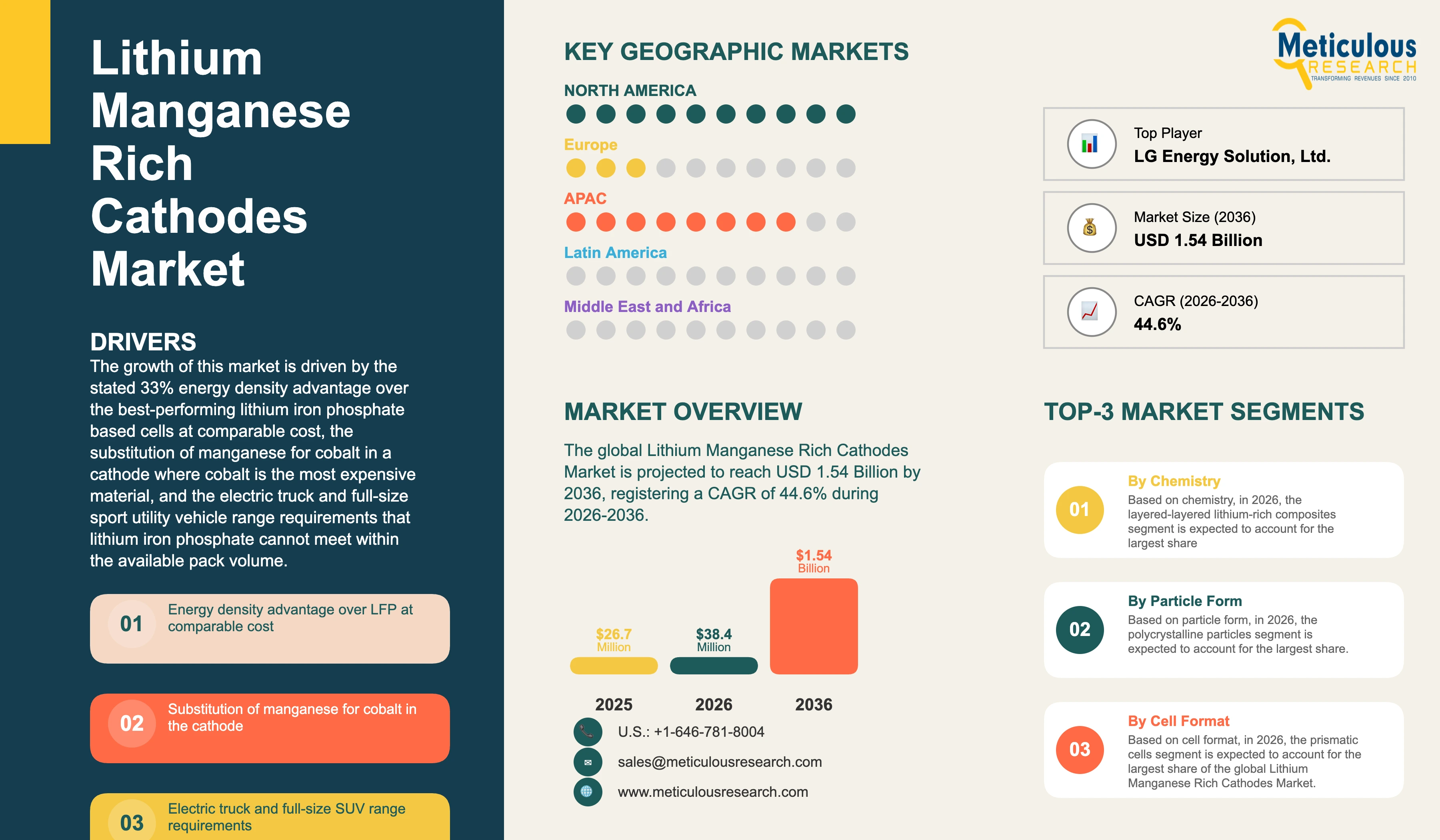
The global lithium manganese rich cathodes market was valued at USD 26.7 million in 2025. This market is expected to reach USD 1.54 billion by 2036 from an estimated USD 38.4 million in 2026, registering a CAGR of 44.6% during the forecast period (2026-2036).
- Published
- Nov 2026
- Pages
- 241
- Format
- PDF + Excel
- Report ID
- MREP - 1042673
- Base year
- 2025
- 2025 · BASELINE
- $26.7M
- 2036
- $1.54B
- CAGR 2026–2036
- 44.6%
2025 baseline · 2026–2036 forecast at 44.6% CAGR · hover a bar for the value
Key highlights
The global lithium manganese rich cathodes market is estimated at USD 38.4 million in 2026 and is projected to reach USD 1.54 billion by 2036.
Market volume is estimated at 1, 600.00 tonnes in 2026 and is projected to reach 80,670.00 tonnes by 2036 at a CAGR of 48.0%, measured as cathode active material supplied.
The 2026 volume represents qualification and pre-production quantities rather than commercial output.
The average selling price is estimated at USD 24.00 per kg in 2026 and is projected to reach USD 19.03 per kg by 2036.
This market measures finished cathode active material and is not additive to the cathode active material precursors market, which measures the manganese-rich precursors from which it is made.
Layered-layered lithium-rich composites are expected to account for the largest chemistry share in 2026, while manganese-rich low-nickel layered compositions are projected to register the highest CAGR of 49.0%.
Polycrystalline particles are expected to hold the largest particle form share in 2026, while single-crystal particles are projected to grow fastest at a CAGR of 51.4%.
Prismatic cells are expected to be the largest cell format in 2026, while cylindrical cells are projected to register the highest CAGR of 51.6%.
Electric trucks and full-size sport utility vehicles are expected to account for the largest application share in 2026, while stationary energy storage is projected to grow fastest at a CAGR of 52.8%.
North America is expected to hold the largest regional share in 2026, while Asia-Pacific is projected to register the highest CAGR of 48.6%.
General Motors and LG Energy Solution announced on 14 May 2025 their intention to commercialise lithium manganese rich prismatic battery cells for future General Motors electric trucks and full-size sport utility vehicles.
Ultium Cells, the General Motors and LG Energy Solution joint venture, plans commercial production of lithium manganese rich prismatic cells in the United States by 2028.
Pre-production is expected to begin at an LG Energy Solution facility by late 2027.
Final production-design validation is to take place at the General Motors Battery Cell Development Center in Warren, Michigan, which is expected to open earlier in 2027.
The announcement states that the lithium manganese rich prismatic cell delivers 33% higher energy density than the best-performing lithium iron phosphate based cells, at a comparable cost.
General Motors states an aim of more than 400 miles of range in an electric truck, with significant battery pack cost savings against a high-nickel pack.
The announcement describes manganese as more affordable than cobalt, the most expensive cathode material.
LG Energy Solution reports more than 200 patent applications across Korea, the United States, Europe, Japan and China as of 31 December 2024, with its first lithium manganese rich chemistry patent dating to 2010.
No investment amount or production capacity figure was stated in the announcement.
Report summary
| Particulars | Details |
|---|---|
| Base Year | 2025 |
| Forecast Period | 2026-2036 |
| Market Size in 2025 | USD 26.7 million |
| Market Size in 2026 | USD 38.4 million |
| Market Size by 2036 | USD 1.54 billion |
| Value CAGR (2026-2036) | 44.6% |
| Volume in 2026 | 1,600.00 tonnes |
| Volume by 2036 | 80,670.00 tonnes |
| Volume CAGR (2026-2036) | 48.0% |
| Volume Basis | Cathode active material supplied |
| Commercialisation Status | The 2026 figure represents qualification and pre-production quantities; commercial production of lithium manganese rich prismatic cells is planned in the United States by 2028, with pre-production expected at an LG Energy Solution facility by late 2027 |
| Average Selling Price in 2026 | USD 24.00 per kg |
| Average Selling Price by 2036 | USD 19.03 per kg |
| Measurement Basis | Layered oxide cathode active materials in which manganese is the dominant transition metal and lithium content exceeds conventional layered stoichiometry, covering layered-layered lithium-rich composites, manganese-rich low-nickel layered compositions and related variants, and excluding conventional NCM and NCA cathodes, lithium iron phosphate, lithium manganese iron phosphate and other olivines, lithium manganese oxide spinel, lithium cobalt oxide, sodium-ion cathode materials, cathode active material precursors, lithium compounds and anode materials |
| Relationship to Adjacent Markets | Not additive to the cathode active material precursors market, which measures the manganese-rich precursors from which this material is made |
| Largest Chemistry | Layered-layered lithium-rich composites |
| Fastest-Growing Chemistry | Manganese-rich low-nickel layered compositions (CAGR 49.0%) |
| Largest Particle Form | Polycrystalline particles |
| Fastest-Growing Particle Form | Single-crystal particles (CAGR 51.4%) |
| Largest Cell Format | Prismatic cells |
| Fastest-Growing Cell Format | Cylindrical cells (CAGR 51.6%) |
| Largest Application | Electric trucks and full-size sport utility vehicles |
| Fastest-Growing Application | Stationary energy storage (CAGR 52.8%) |
| Largest Region | North America |
| Fastest-Growing Region | Asia-Pacific (CAGR 48.6%) |
| Segments Covered | Chemistry, Particle Form, Cell Format, Application, and Geography |
| Geographies Covered | North America, Asia-Pacific, Europe, Latin America, and Middle East & Africa |
| Companies Profiled | 11 companies, including LG Energy Solution, Ltd., General Motors Company, POSCO Future M Co., Ltd., EcoPro BM Co., Ltd., Umicore SA, and BASF SE |
Report overview
Segments covered: chemistry, particle form, cell format, application.
In volume terms, this market is estimated at 1,600.00 tonnes in 2026 and is projected to reach 80,670.00 tonnes by 2036, registering a CAGR of 48.0% during the same period, measured as cathode active material supplied. The 2026 figure represents qualification and pre-production quantities rather than commercial output, since General Motors and LG Energy Solution announced on 14 May 2025 that their Ultium Cells joint venture plans commercial production of lithium manganese rich prismatic cells in the United States by 2028, with pre-production expected at an LG Energy Solution facility by late 2027. The average selling price is estimated at USD 24.00 per kg in 2026 and is projected to decline to USD 19.03 per kg by 2036 as output moves from pilot to commercial scale and as the low cobalt content of the chemistry is reflected in price.
The growth of this market is mainly driven by the energy density advantage that General Motors and LG Energy Solution state the chemistry delivers over lithium iron phosphate at comparable cost, the substitution of manganese for cobalt in a cathode where cobalt is the most expensive material, the electric truck and full-size sport utility vehicle programmes that require range a lithium iron phosphate pack cannot deliver within the available volume, and the commercial production timeline now committed for 2028. However, factors such as the voltage fade and first-cycle capacity loss that have historically limited lithium and manganese rich layered oxides, and the absence of commercial production anywhere before 2028, are expected to restrain the growth of this market to some extent.
Layered-layered lithium-rich composites account for the largest share of this market because they carry the longest development history and the largest body of patent and process knowledge, including a first lithium manganese rich chemistry patent that LG Energy Solution dates to 2010. Manganese-rich low-nickel layered compositions grow faster because they reach the cost position the chemistry exists to achieve while presenting less of the voltage fade that the most lithium-rich formulations exhibit.
Lithium manganese rich cathodes are layered oxide cathode active materials in which manganese is the dominant transition metal and lithium content exceeds the stoichiometry of a conventional layered cathode. Market sizing in this report is on both a value basis in USD and a volume basis in tonnes measured as cathode active material supplied, with average selling price derived from the two. The measurement basis covers layered-layered lithium-rich composites, manganese-rich low-nickel layered compositions and related manganese-rich layered variants, and it excludes conventional nickel cobalt manganese and nickel cobalt aluminium cathodes, lithium iron phosphate, lithium manganese iron phosphate and other olivine chemistries, lithium manganese oxide spinel, lithium cobalt oxide, sodium-ion cathode materials, cathode active material precursors, lithium compounds and anode materials.
Excluding lithium manganese iron phosphate matters because the two are often discussed together as manganese-rich alternatives while belonging to different structural families. A lithium manganese rich cathode is a layered oxide operating at high voltage with lithium in the transition metal layer, while lithium manganese iron phosphate is an olivine phosphate operating on a different voltage plateau with a different synthesis route and a different failure behaviour. Combining them would merge two chemistries that compete for the same vehicle programmes from opposite directions. The boundary also keeps this market consistent with the precursor market, where the two share a segment because their precursors are made in the same plants.
This market measures finished cathode active material and is not additive to the cathode active material precursors market. The manganese-rich precursor measured there is the input from which the material measured here is made, so the two describe consecutive positions in one chain and adding them would count a single step from two sides. Lithium is procured separately and added at calcination, which is why it falls outside both figures.
General Motors and LG Energy Solution announced on 14 May 2025 their intention to commercialise lithium manganese rich prismatic battery cells for future General Motors electric trucks and full-size sport utility vehicles, with Ultium Cells, the joint venture between the two companies, planning commercial production in the United States by 2028, pre-production expected at an LG Energy Solution facility by late 2027, and final production-design validation to take place at the General Motors Battery Cell Development Center in Warren, Michigan, which is expected to open earlier in 2027. The announcement states that the cell delivers 33% higher energy density than the best-performing lithium iron phosphate based cells at a comparable cost, and that General Motors aims for more than 400 miles of range in an electric truck with significant battery pack cost savings against a high-nickel pack.
That announcement is what converts this chemistry from a research subject into a market with a timeline. Lithium and manganese rich layered oxides have been studied for well over a decade, and LG Energy Solution dates its first lithium manganese rich chemistry patent to 2010 and reports more than 200 patent applications across Korea, the United States, Europe, Japan and China as of 31 December 2024, but no commercial cell production existed before this programme. A stated production date gives precursor suppliers, equipment makers and competing cathode producers a schedule to work against.
The energy density claim is the figure to build a commercial case on because it is stated against a specific alternative. Thirty-three per cent higher energy density than the best-performing lithium iron phosphate cells at comparable cost places the chemistry in the gap that has defined cathode selection for a decade, between a cheap chemistry that cannot deliver range in a large vehicle and a high-nickel chemistry that delivers range at a cost and cobalt exposure manufacturers have been trying to escape. A chemistry occupying that gap does not need to beat either on its own terms.
Cobalt substitution is the structural economic argument and the announcement states it directly, describing manganese as more affordable than cobalt, the most expensive cathode material. Replacing cobalt and much of the nickel with manganese lowers the raw material bill of a cathode, reduces exposure to the metals subject to recycled content minimums under European battery rules, and draws on a metal that is both more abundant and less geographically concentrated. The saving is in the cathode rather than in the cell architecture around it. That makes it available to any manufacturer that can make the chemistry work.
Voltage fade is the problem that has kept this chemistry out of production and it has not disappeared. Lithium and manganese rich layered oxides lose average discharge voltage over repeated cycling as the layered structure rearranges, which reduces delivered energy even where capacity is retained, and they exhibit a large first-cycle capacity loss as oxygen is released from the lattice during initial activation. Doping, surface coating, electrolyte additive packages and particle engineering address these mechanisms rather than removing them. The commercial question is whether the mitigation holds over the life of a vehicle warranty.
Prismatic format is where the chemistry is being commercialised first, and that is a design decision rather than a chemical one. A prismatic cell gives a large flat surface for heat removal and packs efficiently into the floor of a truck or full-size sport utility vehicle, which is exactly the vehicle class the announced programme targets, and the format tolerates the thicker electrodes that a lower voltage, higher capacity cathode suits. Pouch and cylindrical formats follow as other manufacturers qualify the chemistry for their own platforms. Cylindrical grows fastest from the smallest base for that reason.
Large vehicles are where the chemistry has its clearest application because they are where lithium iron phosphate runs out of room. A truck or full-size sport utility vehicle needs more energy than a passenger car for the same range, and the floor volume available does not scale with the requirement, so a chemistry that adds a third more energy density at comparable cost solves a problem that discounting a cheaper cathode cannot. General Motors states an aim of more than 400 miles of range in an electric truck. Electric trucks and full-size sport utility vehicles consequently hold the largest application share.
Polycrystalline particles are expected to hold the largest share in 2026, on established co-precipitation and calcination control and the packing density they deliver.
Single-crystal particles are projected to register the highest CAGR of 51.4% during the forecast period.
Prismatic cells are expected to account for the largest share in 2026, as the announced commercial programme is built on lithium manganese rich prismatic cells.
Cylindrical cells are projected to register the highest CAGR of 51.6% during the forecast period, from the smallest base.
Electric trucks and full-size sport utility vehicles are expected to hold the largest share in 2026, as the announced programme targets those vehicles and General Motors states an aim of more than 400 miles of range in an electric truck.
Stationary energy storage is projected to register the highest CAGR of 52.8% during the forecast period.
North America is expected to account for the largest share in 2026, on the plan for Ultium Cells to produce lithium manganese rich prismatic cells commercially in the United States by 2028 and the production-design validation to be carried out at the General Motors Battery Cell Development Center in Warren, Michigan. The United States is projected to grow at 43.6% and Canada at 40.8%.
Asia-Pacific is projected to register the highest CAGR of 48.6% during the forecast period, with China at 49.4% and South Korea at 48.0%.
Europe is projected to grow at a CAGR of 40.0%, with Germany at 40.6%, where the recycled content minimums applying to cobalt and nickel from 2031 and rising from 2036 give a manganese-rich cathode a compliance advantage alongside its cost advantage, and where cell capacity is being built that will require a chemistry positioned between lithium iron phosphate and high nickel.
The Middle East & Africa is projected to grow at a CAGR of 36.0% and Latin America at a CAGR of 38.0%, both from negligible bases and almost entirely through imported cells rather than local cathode production.
LG Energy Solution, Ltd., General Motors Company, POSCO Future M Co., Ltd., EcoPro BM Co., Ltd. and Umicore SA together accounted for an estimated 58.4% of this market in 2026. The 11 companies profiled in this report together accounted for an estimated 86.2%.
Report infographic
Market dynamics
15 factors across 5 forcesEnergy Density Advantage Over Lithium Iron Phosphate at Comparable Cost
General Motors and LG Energy Solution stated on 14 May 2025 that their lithium manganese rich prismatic cell delivers 33% higher energy density than the best-performing lithium iron phosphate based cells at a comparable cost, which places the chemistry in the position cathode selection has lacked for a decade between a cheap material that cannot deliver range in a large vehicle and a high-nickel material that delivers range at a cost manufacturers have been trying to escape. A chemistry occupying that gap competes on the combination rather than on either measure alone. General Motors aims for more than 400 miles of range in an electric truck on that basis. The claim is specific, attributed and tied to a production programme rather than a laboratory result, which is what distinguishes this chemistry from the manganese-rich compositions that have been published for years without a route to a vehicle.
Substitution of Manganese for Cobalt in the Cathode
The announcement describes lithium manganese rich chemistry as using more manganese, which it states is more affordable than cobalt, the most expensive cathode material, and replacing cobalt and much of the nickel lowers the raw material bill that dominates cathode cost. The same substitution reduces exposure to the metals subject to recycled content minimums under European battery rules and draws on a metal that is more abundant and less geographically concentrated than cobalt. General Motors states significant battery pack cost savings against a high-nickel pack without giving a figure. The saving sits in the cathode rather than in the cell architecture, which makes it available to any manufacturer that can make the chemistry work, rather than in a cell design or a pack architecture that only one manufacturer can build, which is why cathode producers unconnected with the announced programme are qualifying their own compositions rather than waiting for a licence to the announced one.
Electric Truck and Full-Size Sport Utility Vehicle Range Requirements
A truck or full-size sport utility vehicle requires more energy than a passenger car for the same range while the floor volume available for a pack does not scale with the requirement, so lithium iron phosphate reaches a practical limit in that vehicle class regardless of how far its cost falls. Adding a third more energy density at comparable cost addresses that directly, which is why the announced programme targets future General Motors electric trucks and full-size sport utility vehicles specifically. The requirement is physical rather than commercial. Electric trucks and full-size sport utility vehicles consequently hold the largest application share in this market, and that share is set by the vehicle class the first programme targets rather than by relative chemistry economics.
A Committed Commercial Production Timeline From 2028
Ultium Cells, the General Motors and LG Energy Solution joint venture, plans commercial production of lithium manganese rich prismatic cells in the United States by 2028, with pre-production expected at an LG Energy Solution facility by late 2027 and final production-design validation at the General Motors Battery Cell Development Center in Warren, Michigan, which is expected to open earlier in 2027. Dates of that specificity allow precursor suppliers, equipment makers and competing cathode producers to plan against a schedule rather than a prospect, which is what moves a chemistry from research into a supply chain. Capacity and qualification decisions elsewhere follow the announced timeline rather than anticipate it, which is why competing producers are working to the same dates rather than to their own, and why supplier qualification is already under way well ahead of production itself rather than after it begins.
Table of contents
12 chapters · 135 sections · 241 pages · click to expandSegmental analysis
| Segment | Largest share (2026) | Fastest growth (2026–2036) |
|---|---|---|
| By Chemistry | Layered-layered lithium-rich composites | — |
| Other segments | — | Manganese-rich low-nickel layered compositions |
By Chemistry
- Layered-layered lithium-rich composites are expected to account for the largest share in 2026, on the longest development history and the accumulated process and patent position around them.
Other segments
- Manganese-rich low-nickel layered compositions are projected to register the highest CAGR of 49.0% during the forecast period.
Geographic analysis
North America
Largest shareIn 2026, North America is expected to account for the largest share of the global lithium manganese rich cathodes market. The large share of this region is mainly due to the announced plan for Ultium Cells to produce lithium manganese rich prismatic cells commercially in the United States by 2028, the final production-design validation to be carried out at the General Motors Battery Cell Development Center in Warren, Michigan, expected to open earlier in 2027, the electric truck and full-size sport utility vehicle demand concentrated in the region, and the critical mineral sourcing requirements attached to vehicle incentives there. The United States is projected to register a CAGR of 43.6% and Canada a CAGR of 40.8% during the forecast period.
Asia-Pacific
Fastest growthHowever, Asia-Pacific is projected to register the highest CAGR of 48.6% during the forecast period. The rapid growth of this region is attributed to the cathode active material manufacturing base in China, South Korea and Japan that can qualify a new chemistry without building new plant, the pre-production expected at an LG Energy Solution facility by late 2027, the manganese-rich development programmes among Chinese cathode producers, and the stationary storage demand that suits the cost position of the chemistry. China is projected to register a CAGR of 49.4% and South Korea a CAGR of 48.0%.
Europe
Europe is projected to grow at 40.0%, with Germany at 40.6%, where the recycled content minimums applying to cobalt and nickel from 2031 and rising from 2036 give a manganese-rich cathode a compliance advantage alongside its cost advantage, and where cell capacity is being built that will need a chemistry between lithium iron phosphate and high nickel.
Latin America
Latin America is projected to grow at 38.0% and the Middle East & Africa at 36.0%, both from negligible bases and almost entirely through imported cells rather than local cathode production. Where this chemistry is produced is being decided by a single announced programme rather than by resource or cost position, which is unusual even for an emerging material. A commercial plan for production in the United States by 2028 with pre-production at a Korean facility in late 2027 locates the first supply chain across two regions by design, and competing producers are qualifying against that schedule rather than setting their own. Manganese resources and cathode manufacturing capability are both available more widely than the programme implies. Regional share in the early part of the forecast period therefore describes one programme rather than an industry.
Competitive landscape
The global lithium manganese rich cathodes market is characterised by the presence of a cell manufacturer and a vehicle manufacturer jointly commercialising the chemistry, Korean and Chinese cathode active material producers qualifying their own compositions, and European chemical companies with cathode positions. Competition is contested on voltage fade mitigation and on freedom to operate against an accumulated patent position rather than on price, since no commercial production exists before 2028 and there is no established price to compete against. LG Energy Solution, Ltd., General Motors Company, POSCO Future M Co., Ltd., EcoPro BM Co., Ltd. and Umicore SA together accounted for an estimated 58.4% of this market in 2026, while the companies profiled in this report together accounted for an estimated 86.2%.
General Motors and LG Energy Solution announced on 14 May 2025 their intention to commercialise lithium manganese rich prismatic cells, with Ultium Cells planning commercial production in the United States by 2028, pre-production expected at an LG Energy Solution facility by late 2027, a stated 33% energy density advantage over the best-performing lithium iron phosphate based cells at comparable cost, and an aim of more than 400 miles of range in an electric truck. Qualification of manganese-rich compositions by cathode producers, single-crystal particle development, and joint cathode and electrolyte programmes accounted for most competitive activity through 2026.
Concentration at this level reflects the stage of the market rather than a durable structure, since a chemistry with one announced commercial programme is necessarily held by the companies running it. LG Energy Solution, Ltd. holds the patent position built from a first filing dated to 2010 and more than 200 applications as of 31 December 2024, POSCO Future M Co., Ltd., EcoPro BM Co., Ltd. and L&F Co., Ltd. compete through Korean cathode capacity, and Beijing Easpring Material Technology Co., Ltd. and Ningbo Ronbay New Energy Technology Co., Ltd. through Chinese production. Some of the key players operating in the lithium manganese rich cathodes market are LG Energy Solution, Ltd. (South Korea), General Motors Company (U.S.), POSCO Future M Co., Ltd. (South Korea), EcoPro BM Co., Ltd. (South Korea), Umicore SA (Belgium), BASF SE (Germany), L&F Co., Ltd. (South Korea), Beijing Easpring Material Technology Co., Ltd. (China), Ningbo Ronbay New Energy Technology Co., Ltd. (China), Sumitomo Metal Mining Co., Ltd. (Japan), and Ford Motor Company (U.S.), among others.
- —
General Motors and LG Energy Solution announced on 14 May 2025 their intention to commercialise lithium manganese rich prismatic battery cells for future General Motors electric trucks and full-size sport utility vehicles. Ultium Cells, the joint venture between the two companies, plans commercial production in the United States by 2028, pre-production is expected at an LG Energy Solution facility by late 2027, and final production-design validation is to take place at the General Motors Battery Cell Development Center in Warren, Michigan, which is expected to open earlier in 2027. The announcement states that the cell delivers 33% higher energy density than the best-performing lithium iron phosphate based cells at a comparable cost, that General Motors aims for more than 400 miles of range in an electric truck with significant battery pack cost savings against a high-nickel pack, and that manganese is more affordable than cobalt, the most expensive cathode material. LG Energy Solution reports more than 200 patent applications across Korea, the United States, Europe, Japan and China as of 31 December 2024, with its first lithium manganese rich chemistry patent dating to 2010.
- LG Energy Solution, Ltd.
- General Motors Company
- POSCO Future M Co., Ltd.
- EcoPro BM Co., Ltd.
- Umicore SA
- BASF SE
Expert perspectives
Volume grows at 48.0% against 44.6% in value over the forecast period, and the average selling price falls from USD 24.00 per kg in 2026 to USD 19.03 per kg by 2036 as output moves from pilot to commercial scale and as the low cobalt content is reflected in price. The 2026 figure is qualification and pre-production quantity rather than output, so the growth rate describes a base effect as much as a market, and it should be read that way.
What makes this a market rather than a research topic is a date. Ultium Cells plans commercial production of lithium manganese rich prismatic cells in the United States by 2028, with pre-production at an LG Energy Solution facility by late 2027 and validation at the General Motors facility in Warren, Michigan expected to open earlier in 2027. Precursor suppliers and competing cathode producers now have a schedule to work against.
The 33% energy density claim matters because of what it is measured against. Stated against the best-performing lithium iron phosphate cells at comparable cost, it places the chemistry in the gap that has defined cathode selection for a decade, between a cheap material that cannot deliver range in a large vehicle and a high-nickel material that delivers it at a cost and a cobalt exposure manufacturers have been trying to escape.
Voltage fade has not been solved, only mitigated, and that is the central risk in this forecast. Lithium and manganese rich layered oxides lose average discharge voltage as the structure rearranges and show a large first-cycle capacity loss as oxygen leaves the lattice, and doping, coating, electrolyte additives and particle engineering manage rather than remove those mechanisms. Whether the mitigation holds across a truck warranty is the question the first programme will answer.
The commercial composition will be less enriched than the best-performing one. Manganese-rich low-nickel formulations reach the cost position the chemistry exists for while showing less voltage fade than the most lithium-rich ones, and a vehicle programme values predictable degradation over peak capacity, which is why that segment grows fastest at 49.0% even though the layered-layered composites carry the longer development history.
Freedom to operate deserves more attention than it usually receives in an emerging materials market. LG Energy Solution dates its first lithium manganese rich patent to 2010 and reports more than 200 applications across five jurisdictions as of 31 December 2024, all accumulated while no commercial production existed. A producer entering now meets a filing position rather than open ground, which is part of why the market is so concentrated at the start of the period.
Customer perspectives
Pack volume in a large vehicle is fixed, so a cheaper cathode cannot be compensated for with additional cells, which makes an energy density gain at comparable cost the route to range rather than a change in pack size.
The composition has been understood for well over a decade and the barrier to commercialisation is the loss of average discharge voltage through cycling, which current doping, coating and electrolyte approaches mitigate rather than eliminate.
Stationary installations are specified on installed cost and cycle count rather than mass, and capacity can be oversized to accommodate voltage loss, which makes the chemistry easier to adopt there than in a vehicle with fixed pack volume, which is why the chemistry reaches stationary applications on different terms from automotive ones.
“In a full-size truck the floor is the floor, so we cannot solve range by buying a cheaper cell and fitting more of them. A third more energy at the same cost is the only thing that gets us past 400 miles without going back to a high-nickel pack and the cost that comes with it.”
“Everybody has known the composition for fifteen years. The reason it has not shipped is that the voltage drifts down as it cycles and you lose energy even when the capacity looks fine. We manage it with doping, coatings and the right electrolyte, but we are managing it rather than fixing it.”
“For a grid installation I care about installed cost and how many cycles I get, not about mass. If the voltage drifts I can oversize the system, which a vehicle cannot do. That makes this chemistry more straightforward for us than it is for an automotive programme.”
Frequently asked questions
This market was valued at USD 16.7 million in 2024 and USD 26.7 million in 2025, and is estimated at USD 38.4 million in 2026. In volume terms it is estimated at 1,600.00 tonnes in 2026 as cathode active material supplied.
Cite this report
Meticulous Research. (2026). Lithium Manganese Rich Cathodes Market - Global Opportunity Analysis and Industry Forecast (2026-2036) (Report No. MREP - 1042673). Meticulous Market Research Pvt. Ltd. https://www.meticulousresearch.com/product/lithium-manganese-rich-cathodes-market-7356