Bio Based Transformer Fluids Market (2026-2036)
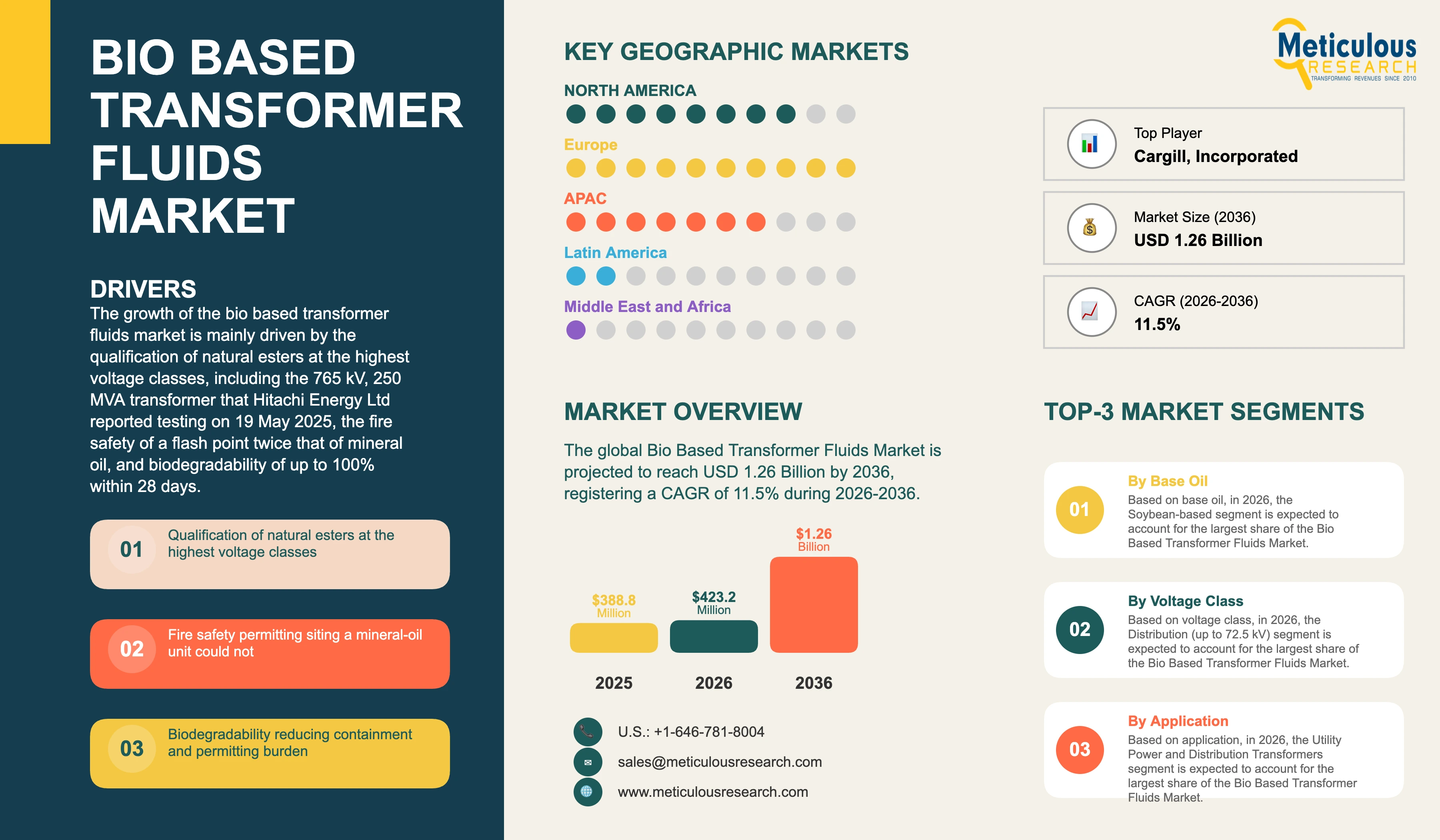
The global bio based transformer fluids market was valued at USD 388.8 million in 2025. This market is expected to reach USD 1.26 billion by 2036 from an estimated USD 423.2 million in 2026, registering a CAGR of 11.5% during the forecast period (2026-2036).
- Published
- Nov 2026
- Pages
- 261
- Format
- PDF + Excel
- Report ID
- MREP - 1042684
- Base year
- 2025
- 2025 · BASELINE
- $388.8M
- 2036
- $1.26B
- CAGR 2026–2036
- 11.5%
2025 baseline · 2026–2036 forecast at 11.5% CAGR · hover a bar for the value
Key highlights
The global bio based transformer fluids market is estimated at USD 423.2 million in 2026 and is projected to reach USD 1.26 billion by 2036.
Market volume is estimated at 92.00 kilotons in 2026 and is projected to reach 323.53 kilotons by 2036 at a CAGR of 13.4%, measured as insulating fluid supplied for first fill and service fill.
The average selling price is estimated at USD 4.60 per kg in 2026 and is projected to reach USD 3.90 per kg by 2036 as the premium over mineral oil narrows.
Soybean-based fluid is expected to account for the largest base oil share in 2026, while high-oleic sunflower and comparable oils are projected to register the highest CAGR of 16.0%.
Distribution transformers up to 72.5 kV are expected to hold the largest voltage class share in 2026, while extra and ultra high voltage above 420 kV is projected to grow fastest at a CAGR of 16.0%.
Utility power and distribution transformers are expected to be the largest application in 2026, while data centres are projected to register the highest CAGR of 21.0%.
Europe is expected to hold the largest regional share in 2026, while Asia-Pacific is projected to register the highest CAGR of 14.6%.
Hitachi Energy Ltd announced on 19 May 2025 the successful testing of a 765 kV, 400 kV single-phase natural ester-filled transformer rated at 250 MVA.
The company states that the transformer is the first in the world at that voltage and power level.
Natural ester is described as having a flash point twice that of mineral oil, together with self-extinguishing properties.
Virgin natural esters are described as up to 100% biodegradable within 28 days.
The unit incorporates the rupture-resistant TXpand technology of Hitachi Energy Ltd.
The transformer was designed, manufactured and tested to advance the TrafoStar platform, which the company states has been used for more than 30,000 power transformers.
The company states it has supplied natural ester-filled transformers for over 20 years, with products installed in more than 40 countries.
The release notes that a typical three-phase 765 kV transformer may supply a city of 250, 000 people, and that electricity passes through an average of four to five transformers between generation and the end user.
The release does not state the test location, the test dates or standards, the installation site, the customer, an absolute flash point value, or a commercial availability timeline.
This market covers natural ester insulating liquids and excludes mineral oil, silicone fluids and gas-to-liquid fluids, and synthetic esters except where they carry certified bio-based content.
Report summary
| Particulars | Details |
|---|---|
| Base Year | 2025 |
| Forecast Period | 2026-2036 |
| Market Size in 2025 | USD 388.8 million |
| Market Size in 2026 | USD 423.2 million |
| Market Size by 2036 | USD 1.26 billion |
| Value CAGR (2026-2036) | 11.5% |
| Format | PDF, Excel & Cloud Portal · 261 pages |
| Volume in 2026 | 92.00 kilotons |
| Volume by 2036 | 323.53 kilotons |
| Volume CAGR (2026-2036) | 13.4% |
| Volume Basis | Insulating fluid supplied for both first fill and service fill |
| Average Selling Price in 2026 | USD 4.60 per kg |
| Average Selling Price by 2036 | USD 3.90 per kg |
| Price Direction | Average selling price declines across the forecast period as production volumes rise and the premium over mineral oil narrows, rather than through any change in fluid specification |
| Measurement Basis | Natural ester insulating liquids derived from vegetable oils, by base oil, voltage class and application, and excluding mineral and naphthenic insulating oils, silicone fluids, gas-to-liquid and other synthetic hydrocarbon fluids, synthetic esters except where they carry certified bio-based content, the transformers and tanks themselves, and base vegetable oils sold as commodity oils rather than as formulated dielectric fluid |
| Relationship to Adjacent Markets | This market is a fraction of the total transformer insulating fluid market rather than an addition to it, since every tonne counted here substitutes for mineral oil, and it is not additive to the transformer market it supplies or to the vegetable oil markets upstream of it |
| Largest Base Oil | Soybean-based |
| Fastest-Growing Base Oil | High-oleic sunflower and comparable oils (CAGR 16.0%) |
| Largest Voltage Class | Distribution, up to 72.5 kV |
| Fastest-Growing Voltage Class | Extra and ultra high voltage, above 420 kV (CAGR 16.0%) |
| Largest Application | Utility power and distribution transformers |
| Fastest-Growing Application | Data centres (CAGR 21.0%) |
| Largest Region | Europe |
| Fastest-Growing Region | Asia-Pacific (CAGR 14.6%) |
| Segments Covered | Base Oil, Voltage Class, Application, and Geography |
| Geographies Covered | Europe, North America, Asia-Pacific, Latin America, and Middle East & Africa |
| Companies Profiled | 9 companies, including Cargill, Incorporated, M&I Materials Limited, Shell plc, Apar Industries Limited, Savita Oil Technologies Limited, and Nynas AB |
Report overview
Segments covered: base oil, voltage class, application.
In volume terms, this market is estimated at 92.00 kilotons in 2026 and is projected to reach 323.53 kilotons by 2036, registering a CAGR of 13.4% during the same period, measured as insulating fluid supplied for both first fill and service fill. The average selling price is estimated at USD 4.60 per kg in 2026 and is projected to decline to USD 3.90 per kg by 2036 as production volumes rise and the premium over mineral oil narrows.
The growth of this market is mainly driven by the qualification of natural esters at the highest voltage classes, including the 765 kV single-phase 250 MVA transformer that Hitachi Energy Ltd reported testing on 19 May 2025 as the first in the world at that voltage and power level, the fire safety that a flash point twice that of mineral oil and self-extinguishing behaviour provide, the biodegradability of up to 100% within 28 days that virgin natural esters offer, and the grid build-out for renewable generation and data centre load. However, factors such as the price premium over mineral oil, the higher viscosity that affects cooling design and retrofill, the oxidation stability that requires sealed or nitrogen blanketed designs, and the vegetable oil feedstock exposure to food and fuel markets are expected to restrain the growth of this market to some extent.
Soybean-based fluid accounts for the largest share of this market because it has the longest service history in utility transformers and the widest base oil availability. High-oleic sunflower and comparable oils grow faster because a higher oleic content improves oxidation stability, which is the property that limits natural ester use in free-breathing and higher temperature designs.
Bio based transformer fluids are insulating and cooling liquids derived from vegetable oils, known as natural esters, used in place of mineral oil in power and distribution transformers. Market sizing in this report is on both a value basis in USD and a volume basis in kilotons measured as insulating fluid supplied for both first fill and service fill, with average selling price derived from the two. The measurement basis covers natural ester fluids by base oil, voltage class and application, and it excludes mineral and naphthenic insulating oils, silicone fluids, gas-to-liquid and other synthetic hydrocarbon fluids, synthetic esters except where they carry certified bio-based content, the transformers and tanks themselves, and the base vegetable oils where sold as commodity oils rather than as formulated dielectric fluid.
Separating natural esters from synthetic esters matters because the two are routinely grouped as ester fluids while differing in origin. A synthetic ester is typically made from a petrochemical polyol and acids and is not bio-based unless certified as such, whereas a natural ester is a refined and additised vegetable oil. They also differ in viscosity, oxidation stability and price, and in the voltage classes where each is favoured, so a market combining them would describe a performance category rather than a bio-based material.
Hitachi Energy Ltd announced on 19 May 2025 the successful testing of a 765 kV, 400 kV single-phase natural ester-filled transformer rated at 250 MVA, stating that it is the first in the world at that voltage and power level, incorporating its rupture-resistant TXpand technology and designed, manufactured and tested to advance the TrafoStar platform used for more than 30,000 power transformers. The company states it has supplied natural ester-filled transformers for over 20 years with products installed in more than 40 countries, and describes natural ester as having a flash point twice that of mineral oil with self-extinguishing properties, with virgin natural esters up to 100% biodegradable within 28 days.
Reaching 765 kV matters because voltage class has been the boundary on this material rather than acceptance. Natural esters have been standard in distribution transformers for two decades and have moved steadily up the voltage range, but the highest transmission classes involve insulation distances, partial discharge behaviour and cooling duty that a more viscous fluid with different dielectric properties had not been proven against. A successful test at 765 kV and 250 MVA removes the argument that the material is confined to lower voltages. The release does not state the test location, dates, standards, installation site, customer, an absolute flash point value or a commercial timeline.
Fire safety rather than environmental performance is what sells this fluid to a utility. A flash point twice that of mineral oil with self-extinguishing behaviour changes what a transformer has to be built and sited to survive, which permits shorter clearances to buildings, reduced or eliminated fire walls and deluge systems, and installation inside buildings and in dense urban substations where a mineral-oil unit would be refused. The saving appears in civil works and land rather than in the fluid price, which is why the premium is accepted on new builds more readily than on replacements.
Biodegradability is the second argument and it acts on siting as well as on reporting. Up to 100% biodegradation within 28 days means a leak or a tank rupture presents a far smaller containment problem than mineral oil, which matters where a transformer sits near water, over an aquifer, in a protected area or offshore. Spill containment bunding, monitoring and remediation obligations fall accordingly. The environmental case therefore reduces capital and permitting cost rather than appearing only in a sustainability report.
Viscosity is the engineering penalty and it is the reason adoption is not universal. Natural esters are more viscous than mineral oil, particularly cold, which reduces convective cooling and means a transformer must be designed for the fluid rather than simply filled with it. Retrofilling an existing mineral-oil unit is possible but usually requires derating or additional cooling, and residual mineral oil affects the properties of the mixture. Most of this market therefore arrives with new transformers rather than by conversion, which ties demand to equipment orders.
Oxidation stability is the other constraint and it governs which base oils succeed. Vegetable oils oxidise and polymerise on exposure to air and heat, so natural ester units are generally sealed or nitrogen blanketed rather than free-breathing, and base oils with a higher oleic and lower polyunsaturate content resist the effect better. That is the property driving the base oil mix rather than price. High-oleic sunflower and comparable oils consequently register the highest base oil CAGR at 16.0%.
Grid investment rather than fluid substitution drives the volume, which makes this market a function of transformer orders. Renewable generation requires collector and step-up transformers at sites that are often remote, environmentally sensitive or offshore, data centre load requires substantial new substation capacity frequently inside buildings or close to them, and ageing transmission assets are being replaced across Europe and North America. Each of those drivers favours a fluid that reduces fire and spill risk. Data centres consequently register the highest application CAGR at 21.0%.
Feedstock cost is set outside this market and that is a structural exposure. Soybean, rapeseed and sunflower oils are traded into food and biofuel markets whose volumes and policy support are far larger than dielectric fluid use, so the base oil price moves with harvests, crush margins and fuel blending mandates rather than with transformer demand. A fluid producer consequently cannot hedge its input through its own market, and a crop-based feedstock invites a land use question that a used cooking oil feedstock does not.
Supply of this fluid is concentrated in a small number of specialists rather than among the large oil companies that dominate mineral insulating oil. Formulating a natural ester requires base oil selection, refining to dielectric purity, antioxidant and pour point additive packages and long-term qualification with transformer manufacturers, which is a different capability from refining naphthenic oil. The field is therefore narrow, and position rests on OEM approvals rather than on distribution reach.
Europe is expected to account for the largest share in 2026, on environmental and fire regulations governing substation siting, dense urban networks requiring indoor installations and the offshore wind build-out. Germany is projected to grow at 11.4%, the United Kingdom at 11.0% and France at 10.6%.
Asia-Pacific is projected to register the highest CAGR of 14.6% during the forecast period, with India at 16.6%, China at 15.4% and Japan at 12.0%.
Europe holds the largest regional share and is projected to grow at a CAGR of 11.1%, on environmental and fire regulations governing substation siting, the density of urban networks requiring indoor installations, the offshore wind build-out requiring transformers where spill containment is impractical, and the replacement of ageing transmission assets.
The Middle East & Africa is projected to grow at a CAGR of 11.0% on grid expansion, constrained by high ambient temperatures that affect fluid selection. Latin America is projected to grow at a CAGR of 10.0%, with Brazil at 10.0%, on transmission investment and domestic vegetable oil availability.
Cargill, Incorporated, M&I Materials Limited, Shell plc, Apar Industries Limited and Savita Oil Technologies Limited together accounted for an estimated 62.8% of this market in 2026. The 9 companies profiled in this report together accounted for an estimated 78.4%.
Report infographic
Market dynamics
15 factors across 5 forcesQualification of Natural Esters at the Highest Voltage Classes
Hitachi Energy Ltd announced on 19 May 2025 the successful testing of a 765 kV, 400 kV single-phase natural ester-filled transformer rated at 250 MVA, stating that it is the first in the world at that voltage and power level, on a TrafoStar platform used for more than 30,000 power transformers and with rupture-resistant TXpand technology. Voltage class rather than acceptance has been the boundary on this material, so proving it at the top of the transmission range opens the largest units to it.
Proving the material at the top of the transmission range also validates it for every class below, which matters to a utility writing one standard specification across its whole asset base.
Each unit at that class also carries a far larger fluid volume than a distribution transformer, so a small number of transmission orders moves the tonnage in this market more than a large number of distribution units does.
Each transmission unit also carries a far larger fluid volume than a distribution transformer, so a small number of such orders moves tonnage in this market more than many distribution units do.
Fire Safety Permitting Siting a Mineral-Oil Unit Could Not
A flash point twice that of mineral oil with self-extinguishing behaviour changes what a transformer must be built and sited to survive, permitting shorter clearances to buildings, reduced or eliminated fire walls and deluge systems, and installation inside buildings and dense urban substations where a mineral-oil unit would be refused. The saving appears in civil works and land rather than in the fluid price. That is why the premium is accepted readily on new builds and resisted on straightforward replacements.
The comparison a buyer makes is therefore between a fluid premium and a civil works saving, not between two fluids, and the result depends on how constrained the site is rather than on how the oils are priced.
Biodegradability Reducing Containment and Permitting Burden
Virgin natural esters are described as up to 100% biodegradable within 28 days, so a leak or rupture presents a far smaller containment problem than mineral oil, which matters where a transformer sits near water, over an aquifer, in a protected area or offshore, and spill bunding, monitoring and remediation obligations fall accordingly. The environmental property therefore reduces capital and permitting cost rather than appearing only in a sustainability report. It is often the deciding factor on sensitive sites.
On sensitive sites the property is frequently decisive rather than advantageous, because a mineral-oil unit would not be permitted there at all, which removes the price comparison entirely.
Grid Build-Out for Renewable Generation and Data Centre Load
Renewable generation requires collector and step-up transformers at sites that are frequently remote, environmentally sensitive or offshore, data centre load requires substantial new substation capacity often inside or adjacent to buildings, and ageing transmission assets are being replaced across Europe and North America, with Hitachi Energy Ltd noting that electricity passes through an average of four to five transformers between generation and the end user. Each of those drivers favours a fluid that reduces fire and spill risk. Data centres register the highest application CAGR at 21.0%.
Each of those drivers also brings a buyer with a different decision process, from a utility standards committee to a data centre design team, which is why adoption rates differ sharply between applications served by the same fluid.
A fourth driver is the twenty-year service record. Hitachi Energy Ltd states it has supplied natural ester-filled transformers for over 20 years with products installed in more than 40 countries, which gives a utility field evidence of paper insulation ageing, moisture behaviour and maintenance practice that no laboratory programme can provide and removes the reliability objection that usually accompanies a fluid change.
Table of contents
11 chapters · 132 sections · 261 pages · click to expandSegmental analysis
| Segment | Largest share (2026) | Fastest growth (2026–2036) |
|---|---|---|
| By Base Oil | Soybean-based | High-oleic sunflower and comparable oils |
| By Voltage Class | Distribution segment up to 72.5 kV | Rapid growth of this |
| By Application | Utility power and distribution transformers | Data centres |
| Other segments | Distribution transformers up to 72.5 kV | Extra and ultra high voltage above 420 kV |
By Base Oil
- Bio Based Transformer Fluids Market Analysis by Base Oil
- The soybean-based segment is expected to account for the largest share of the global bio based transformer fluids market.
- The large share of this segment is mainly due to the longest service history of any natural ester base oil in utility transformers, the widest availability of the base oil at dielectric quality, and the transformer manufacturer approvals that have been built around it over two decades.
- However, the high-oleic sunflower and comparable oils segment is projected to register the highest CAGR of 16.0% during the forecast period.
- The rapid growth of this segment is attributed to higher oleic and lower polyunsaturate content resisting the oxidation and polymerisation that limit natural ester use, which widens the designs and operating temperatures the fluid can serve and addresses the property that constrains the material rather than its price.
- Rapeseed and canola-based fluid holds the second position, with availability concentrated in Europe and an oxidation profile between soybean and high-oleic oils.
- Used cooking oil and recycled feedstocks serve a small but growing share where a buyer wants to avoid a crop-based claim.
- Base oil determines oxidation stability, low temperature behaviour and feedstock exposure simultaneously, and it is fixed by transformer manufacturer approval rather than selected per order, so a producer commits to a base oil for the life of a qualification.
- Soybean-based fluid is expected to account for the largest share in 2026, on the longest service history in utility transformers and the widest availability of base oil at dielectric quality.
- High-oleic sunflower and comparable oils are projected to register the highest CAGR of 16.0% during the forecast period.
By Voltage Class
- Bio Based Transformer Fluids Market Analysis by Voltage Class
- The distribution segment up to 72.5 kV is expected to account for the largest share of the global bio based transformer fluids market.
- The large share of this segment is mainly due to natural esters having been standard in distribution transformers for two decades, the large number of units installed in urban, indoor and pole-mounted positions where fire and spill risk govern, and the straightforward thermal duty at that size.
- Base oil also sets the low temperature behaviour that governs cold climate use, since pour point and cold start viscosity differ across the oils and additive packages only partly compensate, which is why the base oil mix differs by region as well as by design.
- However, the extra and ultra high voltage segment above 420 kV is projected to register the highest CAGR of 16.0% during the forecast period.
- The rapid growth of this segment is attributed to the successful test of a 765 kV, 250 MVA natural ester-filled transformer stated as the first in the world at that voltage and power level, the disproportionate fluid volume each such unit holds, and the difficult siting and fire separation requirements transmission operators face.
- High voltage units above 72.5 kV to 420 kV occupy the middle position and have absorbed most of the voltage class expansion of the past decade, including offshore wind collector and step-up duty.
- Voltage class determines fluid volume per unit far more than unit count does, so tonnage in this market is driven by a relatively small number of large transformers rather than by the distribution population that dominates by number.
By Application
- Bio Based Transformer Fluids Market Analysis by Application
- The utility power and distribution transformers segment is expected to account for the largest share of the global bio based transformer fluids market.
- The large share of this segment is mainly due to utilities operating the great majority of installed transformers, the urban and environmentally sensitive sites within their networks where fire and spill performance govern, and the replacement of ageing assets across Europe and North America.
- Voltage class also determines how a qualification is won.
- Distribution fluid is approved against a standard product range, while a transmission unit is qualified for a specific design and test programme, so a supplier moving up the voltage range is selling into engineering projects rather than into a product catalogue.
- However, the data centres segment is projected to register the highest CAGR of 21.0% during the forecast period.
- The rapid growth of this segment is attributed to substantial new substation capacity being sited inside or immediately alongside buildings, where a flash point twice that of mineral oil and self-extinguishing behaviour permit arrangements a mineral-oil unit would not be approved for, and the operator compares the fluid premium against floor area and fire protection cost.
- Renewable energy applications cover wind collector and step-up transformers, including offshore installations where spill containment is impractical, and solar plant transformers on sites with limited fire-fighting access.
- Industrial and commercial applications take the fluid into mining, rail, petrochemical and building installations where fire separation is constrained.
- Application mix therefore reflects where fire and spill risk constrain siting rather than where transformers are most numerous.
- Applications also differ in who takes the decision and how quickly.
- A utility revises a standard specification through an engineering committee over years, while a data centre operator standardises a design across sites and can adopt within a single build programme, so the fastest-growing application is also the one with the shortest decision cycle.
- Base oil choice also determines the regional supply position of a producer.
- Soybean and rapeseed availability is concentrated in particular growing regions, so a fluid producer serving several continents either ships base oil long distances or formulates regionally from different oils, and the latter requires separate transformer manufacturer approvals for each formulation.
- Application mix also determines whether a sale is a first fill or a service fill.
- New-build utility, renewable and data centre projects generate first fill volume tied to transformer orders, while the installed base accumulated over two decades generates service fill that continues irrespective of order flow, and the second is the more stable of the two revenue streams.
Other segments
- Distribution transformers up to 72.5 kV are expected to hold the largest share in 2026, on natural esters having been standard at that class for two decades and the number of units in urban, indoor and pole-mounted positions.
- Extra and ultra high voltage above 420 kV is projected to register the highest CAGR of 16.0% during the forecast period.
- Utility power and distribution transformers are expected to account for the largest share in 2026, on utilities operating the great majority of installed transformers and on the sensitive sites within their networks.
- Data centres are projected to register the highest CAGR of 21.0% during the forecast period.
Geographic analysis
Europe
Largest shareIn 2026, Europe is expected to account for the largest share of the global bio based transformer fluids market. The large share of this region is mainly due to the environmental and fire regulations governing substation siting, the density of urban networks requiring indoor installations, the offshore wind build-out requiring transformers where spill containment is impractical, and the replacement of ageing transmission assets. Germany is projected to register a CAGR of 11.4%, the United Kingdom a CAGR of 11.0% and France a CAGR of 10.6% during the forecast period.
Asia-Pacific
Fastest growthHowever, Asia-Pacific is projected to register the highest CAGR of 14.6% during the forecast period. The rapid growth of this region is attributed to the scale of transmission and distribution investment across India and China, the ultra high voltage programmes that the 765 kV qualification addresses directly, the data centre construction concentrated in the region, and the transformer manufacturing base located there. India is projected to register a CAGR of 16.6%, China a CAGR of 15.4% and Japan a CAGR of 12.0%.
North America
North America is projected to grow at 9.6%, with the United States at 9.8% and Canada at 9.0%, on utility replacement programmes, data centre substation construction and the long service history of natural esters in the region.
Latin America
Latin America is projected to grow at 10.0%, with Brazil at 10.0%, on transmission investment and domestic vegetable oil availability.
Middle East & Africa
The Middle East & Africa is projected to grow at 11.0% on grid expansion, constrained by high ambient temperatures that affect fluid selection. Ambient temperature is a further regional variable that the share figures conceal, since high ambient conditions reduce the thermal headroom a more viscous fluid leaves and cold climates raise the pour point requirement, so the same fluid is not equally suitable everywhere. Regional demand in this market follows siting constraints and regulation rather than transformer numbers, which is why Europe leads a market where Asia-Pacific installs far more transformers. A dense urban network with strict fire and environmental rules converts a larger share of its transformer orders to natural ester than a network building on open land, so regional share describes regulatory and spatial conditions rather than electricity demand. Regional share therefore describes regulatory and spatial conditions rather than electricity demand, and a forecast built on transformer unit numbers alone would misplace this market substantially. Service fill is a further element of this market that the application figures understate. A natural ester unit requires periodic topping up and occasional replacement over a service life measured in decades, so the installed base built over the past twenty years generates a recurring requirement that is specified by the original fluid and rarely retendered, which gives an approved supplier an annuity behind each first fill it wins.
Competitive landscape
The global bio based transformer fluids market is characterised by the presence of a small number of dielectric fluid specialists holding long-standing transformer manufacturer approvals, regional insulating oil producers extending into natural esters, and specialty lubricant companies supplying formulated fluids. Competition is contested on transformer manufacturer approval and service history rather than on price, because a utility is qualifying a fluid into a transformer design with a service life measured in decades. Cargill, Incorporated, M&I Materials Limited, Shell plc, Apar Industries Limited and Savita Oil Technologies Limited together accounted for an estimated 62.8% of this market in 2026, while the companies profiled in this report together accounted for an estimated 78.4%, a concentration that reflects how few producers hold approvals across the voltage range.
Hitachi Energy Ltd announced on 19 May 2025 the successful testing of a 765 kV, 400 kV single-phase natural ester-filled transformer rated at 250 MVA, described as the first in the world at that voltage and power level, with rupture-resistant TXpand technology on the TrafoStar platform used for more than 30,000 power transformers, and stated that it has supplied natural ester-filled transformers for over 20 years with products installed in more than 40 countries. Qualification of fluids at higher voltage classes, development of oxidation-stable high-oleic formulations, and approval of recycled feedstocks accounted for most competitive activity through 2026.
Approval position rather than formulation capability separates the competitors, because a fluid not listed in a transformer manufacturer specification cannot be supplied into a new unit whatever its properties. Cargill, Incorporated and M&I Materials Limited compete from the longest-established dielectric ester positions, Shell plc, Nynas AB and TotalEnergies SE from insulating oil businesses extending into esters, Apar Industries Limited and Savita Oil Technologies Limited from transformer oil production serving the large Asian transformer industry, and Fuchs SE and DSI Ventures, Inc. from specialty formulation. Some of the key players operating in the bio based transformer fluids market are Cargill, Incorporated (U.S.), M&I Materials Limited (U.K.), Shell plc (U.K.), Apar Industries Limited (India), Savita Oil Technologies Limited (India), Nynas AB (Sweden), TotalEnergies SE (France), Fuchs SE (Germany), and DSI Ventures, Inc. (U.S.), among others.
- —
Hitachi Energy Ltd announced on 19 May 2025 the successful testing of a 765 kV, 400 kV single-phase natural ester-filled transformer rated at 250 MVA, stating that it is the first in the world at that voltage and power level. The unit incorporates the rupture-resistant TXpand technology of the company and was designed, manufactured and tested to advance the TrafoStar platform, which the company states has been used for more than 30,000 power transformers. Natural ester is described as having a flash point twice that of mineral oil together with self-extinguishing properties, and virgin natural esters as up to 100% biodegradable within 28 days. The company states it has supplied natural ester-filled transformers for over 20 years with products installed in more than 40 countries, and notes that a typical three-phase 765 kV transformer may supply a city of 250,000 people and that electricity passes through an average of four to five transformers between generation and the end user. The release does not state the test location, the test dates or standards, the installation site, the customer, an absolute flash point value, or a commercial availability timeline.
- Cargill, Incorporated
- M&I Materials Limited
- Shell plc
- Apar Industries Limited
- Savita Oil Technologies Limited
- Nynas AB
Expert perspectives
Volume grows at 13.4% against 11.5% in value over the forecast period, and the average selling price falls from USD 4.60 per kg in 2026 to USD 3.90 per kg by 2036 as production volumes rise and the premium over mineral oil narrows. The gap between the two rates is the premium compressing rather than the market weakening.
The 765 kV test matters because voltage class, not acceptance, has been the limit on this material. Natural esters have been standard in distribution transformers for two decades and have moved up the range steadily, and a successful test at 765 kV and 250 MVA, stated as the first in the world at that voltage and power level, removes the argument that they belong at lower voltages. The release gives no test location, dates, standards, installation site or customer, so it establishes capability rather than a delivery.
Where the money is saved is not in the fluid. A flash point twice that of mineral oil with self-extinguishing behaviour permits shorter clearances, reduced fire walls and deluge systems and indoor installation, and up to 100% biodegradation within 28 days reduces bunding, monitoring and remediation obligations. Buyers are therefore pricing the premium against civil works and land, which is why adoption concentrates on constrained sites rather than spreading evenly.
Viscosity is the reason this is a new-build market rather than a retrofit one. A natural ester is more viscous than mineral oil, particularly cold, so a transformer must be designed for it, and retrofilling generally requires derating or added cooling and leaves residual oil in the mixture. Demand is consequently tied to transformer order books rather than to the installed population, which makes grid investment the variable to watch.
Oxidation stability is the quiet constraint and it shapes the base oil mix. Vegetable oils oxidise and polymerise in air and heat, so these units are generally sealed or nitrogen blanketed, which excludes the free-breathing designs embedded in many utility standard specifications. That is why high-oleic oils grow at 16.0% and why adoption decisions sit with engineering standards committees rather than with procurement.
The exposure that a producer cannot manage is feedstock. Soybean, rapeseed and sunflower oils are priced by food and biofuel markets far larger than dielectric fluid use, so input cost moves with harvests and blending mandates rather than with transformer demand, and a crop feedstock invites a land use question that used cooking oil does not. Tonnage is also driven by a small number of large transmission units rather than by the distribution population that dominates by count.
Customer perspectives
The premium is assessed against fire separation, clearance and containment cost rather than against mineral oil price, so adoption concentrates where siting is constrained and is resisted where it is not.
That asymmetry explains the shape of this market. A network with many constrained sites converts a large share of its orders, while one building mainly on open land converts almost none, so adoption varies by network geography rather than by utility policy.
Because a natural ester requires a transformer designed for its viscosity and generally a sealed or nitrogen blanketed configuration, adoption is decided at engineering standards level rather than in procurement, which lengthens the cycle and makes it hard to reverse.
Maintenance practice changes as well, since dissolved gas interpretation and moisture limits differ from mineral oil and condition monitoring thresholds have to be reset, which is work a standards department rather than a procurement team undertakes.
Data centre substations are frequently sited inside or alongside buildings, where fire performance determines whether the layout is approved and the fluid premium is compared against floor area and fire protection cost.
Taken together the three perspectives describe a fluid bought for what it allows a site to be rather than for what it costs, specified by engineers rather than buyers, and adopted fastest where space and fire separation are scarcest.
“The fluid costs more and the fire wall we no longer have to build costs a great deal more. On a constrained urban site the arithmetic is not close, and on an open rural site it does not work at all.”
“This is not a purchasing decision for us, it is a specification change. Moving to ester means sealed designs, different cooling assumptions and retraining our maintenance people, so it goes through engineering standards, not the oil tender.”
“We need transformers close to the load and often inside the building envelope. A self-extinguishing fluid is what makes that layout approvable, and floor area is worth far more to us than the oil fill.”
Frequently asked questions
This market was valued at USD 351.5 million in 2024 and USD 388.8 million in 2025, and is estimated at USD 423.2 million in 2026. In volume terms it is estimated at 92.00 kilotons in 2026 as insulating fluid supplied for first fill and service fill.
Cite this report
Meticulous Research. (2026). Bio Based Transformer Fluids Market - Global Opportunity Analysis and Industry Forecast (2026-2036) (Report No. MREP - 1042684). Meticulous Market Research Pvt. Ltd. https://www.meticulousresearch.com/product/bio-based-transformer-fluids-market-7367