Jack-Up Rigs Market (2026-2036)
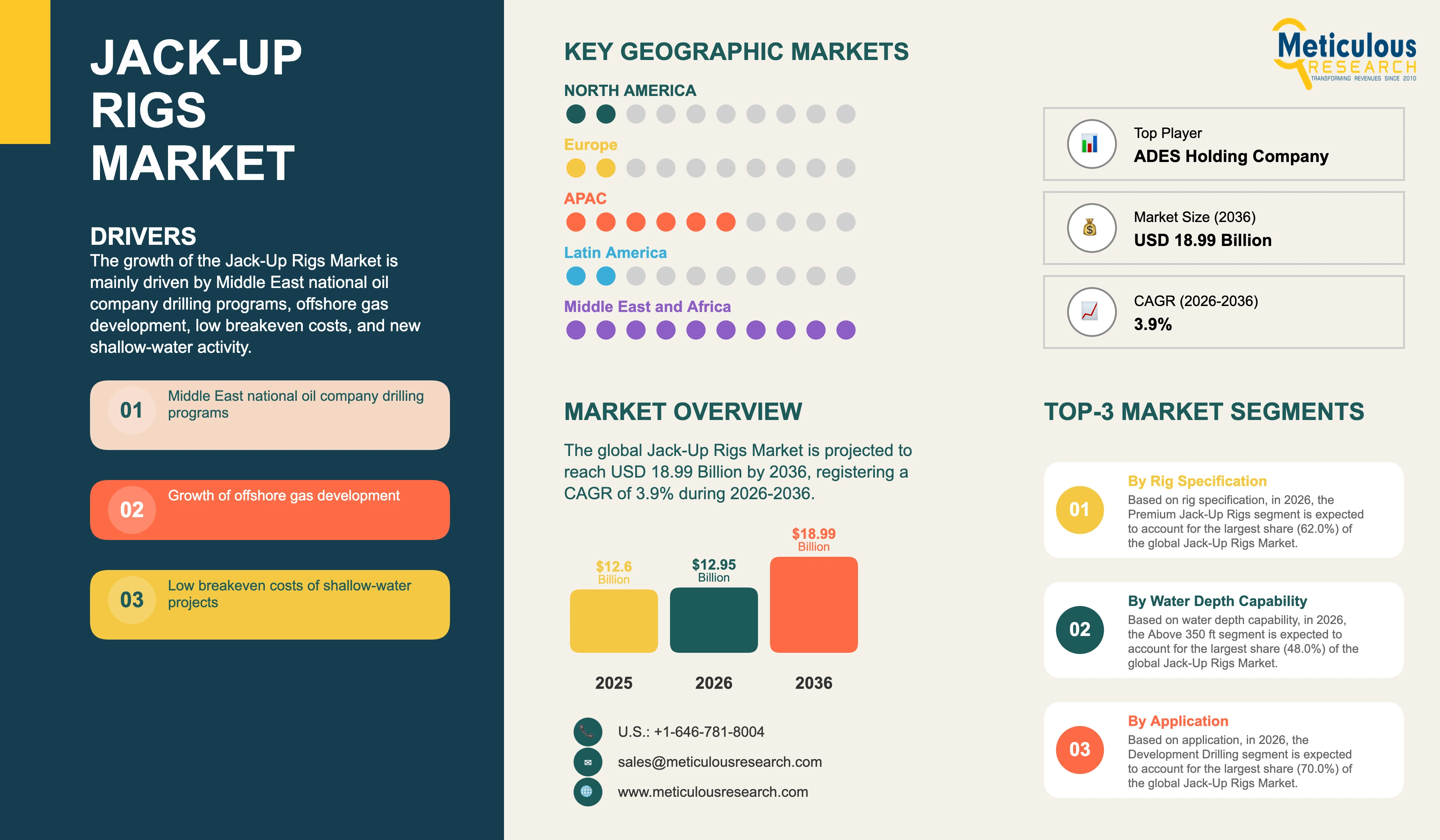
The global jack-up rigs market was valued at USD 12.60 billion in 2025. This market is expected to reach USD 18.99 billion by 2036 from an estimated USD 12.95 billion in 2026, registering a CAGR of 3.9% during the forecast period (2026-2036).
- Published
- Nov 2026
- Pages
- 248
- Format
- PDF + Excel
- Report ID
- MREP - 1042716
- Base year
- 2025
- 2025 · BASELINE
- $12.60B
- 2036
- $18.99B
- CAGR 2026–2036
- 3.9%
2025 baseline · 2026–2036 forecast at 3.9% CAGR · hover a bar for the value
Key highlights
ADES Holding, which operates the world's largest offshore jack-up fleet, completed the acquisition of Shelf Drilling in November 2025, adding 33 jack-up rigs and bringing its fleet to 83 offshore and 40 onshore units across 20 countries, including new entries into Norway and the U.K.
ADES reported 2025 revenue of SAR 6.69 billion, or about USD 1.78 billion, up 7.9%, a record backlog of SAR 34.71 billion at the end of 2025, and 2026 EBITDA guidance of SAR 4.50 billion to SAR 4.87 billion, up 26% to 37%, supported by higher utilization and the integration of Shelf Drilling.
After temporary suspensions of offshore rigs in the Gulf during the 2026 regional conflict, ADES received resumption notices covering all of its suspended offshore rigs in Saudi Arabia, with contracted jack-up utilization holding at around 90% and dayrates remaining firm.
Borr Drilling, which owns 29 modern jack-up rigs built after 2008, acquired five premium jack-up rigs through a 50/50 joint venture for USD 287 million in July 2026, and had secured 21 contract commitments representing about 4,350 days and USD 541 million of dayrate equivalent backlog in the first half of 2026.
Borr Drilling reported second-quarter 2026 operating revenue of USD 232.3 million and technical utilization of 98.4%, with 24 of its 29 wholly owned rigs contracted or committed across Southeast Asia, the Middle East and North Africa, West Africa, Europe, and the Americas.
ADES signed multi-year contracts to deploy three premium jack-up rigs in Nigeria for the West African Exploration and Production Company under an agreement valued at SAR 2.73 billion, or about USD 729 million.
Velesto Energy, Malaysia's leading jack-up driller, reported full-year 2025 utilization of 72%, down from 87% in 2024, and an average fourth-quarter dayrate of USD 112,000 per day, reflecting softer activity in parts of Southeast Asia during 2025.
By rig specification, premium jack-up rigs account for the largest share of 62.0% in 2026 and also register the highest CAGR.
By water depth capability, above 350 ft accounts for the largest share of 48.0% in 2026 and also registers the highest CAGR.
By application, development drilling accounts for the largest share in 2026, while well intervention, plug and abandonment, and other registers the highest CAGR.
By geography, Middle East & Africa accounts for the largest share of 46.0% in 2026 and also registers the highest CAGR of 4.7%.
Report summary
| Particulars | Details |
|---|---|
| Forecast Period | 2026-2036 |
| Base Year | 2025 |
| Estimated Year | 2026 |
| CAGR (Value) | 3.9% |
| Format | PDF, Excel & Cloud Portal · 248 pages |
| Market Size (Value) in 2025 | USD 12.60 billion |
| Market Size (Value) in 2026 | USD 12.95 billion |
| Market Size (Value) in 2036 | USD 18.99 billion |
| Segments Covered | Rig Specification, Water Depth Capability, Application, Geography |
| Countries Covered | Saudi Arabia, Qatar, UAE, Kuwait, Egypt, Nigeria, Rest of Middle East & Africa, China, India, Malaysia, Vietnam, Indonesia, Thailand, Rest of Asia-Pacific, U.K., Norway, Netherlands, Denmark, Rest of Europe, Mexico, Suriname, Trinidad and Tobago, Rest of Latin America, U.S., Canada |
| Key Companies | 12 companies and other companies |
| Largest Segment by Rig Specification (2026) | Premium Jack-Up Rigs (62.0%) |
| Largest Segment by Water Depth Capability (2026) | Above 350 ft (48.0%) |
| Largest Region (2026) | Middle East & Africa (46.0%) |
| Fastest-Growing Region | Middle East & Africa (CAGR 4.7%) |
Report overview
Segments covered: rig specification, water depth capability, application.
The growth of this market is mainly driven by sustained shallow-water drilling programs of national oil companies in the Middle East, especially in Saudi Arabia, Qatar, the UAE, and Kuwait, growing offshore gas development to supply domestic markets and LNG exports, rising shallow-water activity in West Africa, India, Southeast Asia, and Latin America, the low breakeven costs and short cycle times of shallow-water projects, and the growing use of jack-up rigs for well intervention and plugging and abandonment work. However, factors such as the contract suspensions announced by Saudi Aramco in 2024, temporary rig suspensions in the Gulf during the 2026 regional conflict, an aging global fleet, limited newbuild construction, and declining activity in mature basins such as the North Sea and the U.S. Gulf of Mexico are expected to restrain the growth of this market to some extent.
A jack-up rig is a self-elevating mobile offshore drilling unit that consists of a buoyant hull and three or four movable legs. The rig is towed or self-propelled to location, where its legs are lowered to the seabed and the hull is jacked up above the sea surface to provide a stable drilling platform. Jack-up rigs are the most widely used type of mobile offshore drilling unit and are mainly used in water depths of up to about 400 feet, although some modern units can operate in deeper water. They are used for exploration, appraisal, and development drilling, as well as for well intervention, workover, plugging and abandonment, and accommodation services.
This report covers global revenue from jack-up rig contract drilling services, measured mainly as dayrate revenue earned by drilling contractors and national oil company drilling subsidiaries, together with mobilization fees and associated services provided with the rig. It covers premium, standard, and harsh-environment jack-up rigs in all water depth categories and for all applications. The construction and sale of new jack-up rigs, liftboats, accommodation-only units, floating rigs such as semi-submersibles and drillships, platform rigs, and onshore rigs are excluded from the scope of this report, as are third-party oilfield services such as cementing, logging, and directional drilling provided separately by service companies.
Jack-up rigs account for the largest number of offshore drilling rigs in the world, with several hundred units in operation. Fleet ownership is concentrated among a small number of international drilling contractors, including ADES, Borr Drilling, Valaris, and Noble, regional contractors such as Velesto in Malaysia and Gulf Drilling International in Qatar, joint ventures with national oil companies such as ARO Drilling, the joint venture between Saudi Aramco and Valaris, and drilling subsidiaries of national oil companies such as China Oilfield Services in China and Arabian Drilling in Saudi Arabia.
Demand for jack-up rigs is driven mainly by national oil companies in the Middle East and Asia, which operate large shallow-water fields with long production lives. Saudi Aramco is the single largest user of jack-up rigs in the world, and its drilling plans have a strong influence on global utilization and dayrates. In 2024, Saudi Aramco announced a wave of contract suspensions after reducing its plans to expand maximum sustainable crude oil production capacity, which released a large number of rigs into the international market. Contractors redeployed many of these rigs to other regions, and several suspended rigs later returned to work in Saudi Arabia.
The market was affected again in 2026, when the regional conflict in the Gulf led to the temporary suspension of some offshore rigs. These suspensions were short-term, and by the second half of 2026, drilling contractors had received notices to resume operations, with contracted jack-up utilization at around 90% for leading contractors. Outside the Middle East, demand is supported by shallow-water drilling in India, Southeast Asia, China, West Africa, Mexico, and other regions, while demand in the North Sea and the U.S. Gulf of Mexico is declining as fields mature.
Modern premium jack-up rigs, which were built after 2000 and have larger deck space, higher hook loads, and better drilling efficiency, command higher dayrates and utilization than older standard rigs. Harsh-environment jack-up rigs, which are designed for the North Sea and other challenging regions, earn the highest dayrates. The global fleet is aging, and very few new jack-up rigs have been ordered since 2015, which is expected to tighten supply as older rigs are retired. Shipyards that built many of today's premium rigs have shifted to other work.
Over the forecast period, the market is expected to grow steadily, supported by Middle East and Asian drilling programs, offshore gas development, and new shallow-water projects in West Africa and Latin America. Premium jack-up rigs are expected to remain the largest and fastest-growing specification, while rigs rated for water depths above 350 feet grow fastest. The Middle East & Africa is expected to remain the largest region and to grow fastest.
We need reliable rigs for long-term development programs, and we prefer modern rigs with strong safety records and efficient operations.
This comment explains why the Middle East & Africa is the largest region and why premium rigs are growing fastest.
We contracted a premium jack-up for our shallow-water gas project because it can handle high-pressure wells and drill efficiently.
This comment explains why premium rigs and the Middle East & Africa are growing.
We use jack-up rigs for plugging and abandonment of platform wells because they provide a stable platform and good deck space.
This comment explains why well intervention and plugging and abandonment is the fastest-growing application.
Across all customer groups, safety performance, operational uptime, and the ability to mobilize rigs quickly are critical selection criteria. National oil companies increasingly evaluate contractors on long-term performance, local content, and emissions reduction, and they prefer contractors that can support multi-year programs with consistent crews and equipment. Independent operators, in contrast, often contract rigs for shorter programs and place more emphasis on dayrates and availability. As a result, contractors must balance long-term national oil company contracts with shorter, higher-margin work for independent operators to optimize fleet utilization.
Report infographic
Market dynamics
16 factors across 5 forcesLong-term drilling programs of Middle East national oil companies
National oil companies in the Middle East operate some of the world's largest shallow-water oil and gas fields, and they rely on jack-up rigs for long-term development drilling programs. Saudi Aramco, Qatar Energy, ADNOC, Kuwait Oil Company, and other national oil companies award multi-year contracts that provide stable demand and high utilization for jack-up contractors. ADES reported a record backlog of SAR 34.71 billion at the end of 2025, with most of its backlog from Gulf Cooperation Council countries.
These programs are designed to maintain and expand production capacity over long periods, and they are less sensitive to short-term oil price changes than the drilling programs of independent operators. Although Saudi Aramco suspended a number of jack-up contracts in 2024, it has since restarted several suspended rigs, including a ten-year renewal for an ADES rig and the resumption of Shelf Drilling's Harvey H. Ward, which has a contract end date of October 2029. ADNOC's plans to expand its oil production capacity and Qatar's North Field gas expansion are also expected to support demand. The Middle East is expected to remain the most important market for jack-up rigs throughout the forecast period, accounting for the largest share of global demand.
Growth of offshore gas development
Rising demand for natural gas for power generation, industry, and LNG exports is driving shallow-water gas development in the Middle East, Asia, and other regions. Qatar's North Field expansion, Saudi Arabia's offshore gas projects, gas developments in India, Malaysia, Indonesia, and Egypt, and shallow-water gas projects in West Africa all require jack-up rigs for development drilling. Gas wells are often deeper and more demanding than oil wells, which increases demand for premium and high-specification jack-up rigs.
Many governments see natural gas as a transition fuel, and national oil companies are increasing gas investments to meet domestic demand and reduce oil consumption in power generation. This trend is expected to support demand for jack-up rigs in gas-rich regions over the forecast period.
Low breakeven costs and short cycle times of shallow-water projects
Shallow-water projects drilled with jack-up rigs generally have lower development costs and shorter cycle times than deepwater projects, which allows operators to bring new production online quickly and at low cost. Many shallow-water developments are infill drilling or tiebacks to existing platforms, which use existing infrastructure and generate attractive returns even at moderate oil prices. These economics make jack-up drilling programs attractive to both national oil companies and independent operators, and they help sustain demand during periods of oil price volatility. The ability of jack-up rigs to drill multiple wells from a single platform location also improves efficiency.
Jack-up rigs are also highly mobile and can be moved between locations and regions relatively quickly, which allows operators to start drilling programs at short notice and contractors to redeploy rigs to where demand is strongest. This flexibility was demonstrated in 2024 and 2025, when contractors moved many rigs released from Saudi Arabia to Southeast Asia, West Africa, India, and Latin America, where they found new contracts within months.
New shallow-water activity in West africa, india, Southeast asia, and Latin America
Shallow-water drilling activity is increasing in several important regions outside the Middle East. In West Africa, operators in Nigeria, Côte d'Ivoire, Cameroon, Angola, and other countries are contracting premium jack-up rigs, as shown by ADES' contract to deploy three premium jack-up rigs in Nigeria under an agreement valued at about USD 729 million. In India, ONGC and other operators have contracted additional jack-up rigs for offshore programs. In Southeast Asia, operators in Vietnam, Malaysia, Indonesia, and Thailand are contracting jack-up rigs for development and exploration.
In Latin America, Mexico remains an important jack-up market, and Borr Drilling has received multi-year extensions for rigs in Mexico. New shallow-water activity in Suriname, where PETRONAS has started operations with a Borr Drilling rig, and in Trinidad and Tobago is also expected to add demand. Borr Drilling reported that 24 of its 29 wholly owned rigs were contracted or committed in mid-2026, including six in Southeast Asia, five in West Africa, and seven in the Americas, which shows the geographic breadth of demand outside the Middle East.
Table of contents
11 chapters · 125 sections · 248 pages · click to expandSegmental analysis
| Segment | Largest share (2026) | Fastest growth (2026–2036) |
|---|---|---|
| By Rig Specification | Premium jack-up rigs | Premium jack-up rigs |
| By Water Depth Capability | Above 350 ft | Above 350 ft |
| By Application | Development drilling | Other |
| Other segments | Above 350 ft | — |
By Rig Specification
- Jack-Up Rigs Market Analysis by Rig Specification
- The premium jack-up rigs segment is expected to account for the largest share of 62.0% of the global jack-up rigs market.
- The large share of this segment is mainly attributed to the strong preference of national oil companies and international operators for modern rigs with higher hook loads, larger deck space, greater variable deck load, and better drilling efficiency, as well as the higher dayrates and utilization that these rigs command.
- Premium rigs are used for demanding development wells, high-pressure gas wells, and extended-reach wells in the Middle East, Asia, and West Africa.
- Premium rigs are generally defined as independent-leg cantilever rigs built after 2000, with modern drilling equipment, larger cantilever reach, and higher hook loads.
- The premium jack-up rigs segment is also projected to register the highest CAGR during the forecast period.
- The rapid growth of this segment is primarily driven by the retirement of older standard rigs, the growing complexity of wells, and the preference of operators for rigs with better safety and efficiency.
- Contractors such as Borr Drilling and ADES are expanding their premium fleets through acquisitions.
- The gap between premium and standard rigs is expected to widen over the forecast period, as national oil companies in the Middle East and Asia increasingly specify modern rigs in their tenders.
- Meanwhile, the standard and harsh-environment jack-up rigs segments are expected to witness steady growth, supported by low-cost workover and development programs in the Middle East, India, and Southeast Asia, and plugging and abandonment and carbon storage work in the North Sea.
By Water Depth Capability
- Jack-Up Rigs Market Analysis by Water Depth Capability
- The above 350 ft segment is expected to account for the largest share of 48.0% of the global jack-up rigs market.
- The large share of this segment is mainly attributed to the large number of modern rigs rated for water depths of 350 to 400 feet or more, which are widely used in the Middle East, Asia, and West Africa, and which offer flexibility to operate in a wide range of locations.
- Rigs rated for deeper water can operate in most shallow-water locations around the world, which gives contractors more options for contracting them and helps them achieve higher utilization.
- Many premium rigs built in the 2000s and 2010s, including Borr Drilling's fleet, fall into this category, and they are the preferred choice for gas wells and other demanding wells in the Middle East, Southeast Asia, and West Africa.
- The above 350 ft segment is also projected to register the highest CAGR during the forecast period.
- The rapid growth of this segment is primarily driven by increasing demand for rigs that can operate in deeper shallow-water locations, such as gas fields in the Middle East and West Africa, and by the retirement of older rigs with lower water depth ratings.
- Meanwhile, the 251 to 350 ft and up to 250 ft segments are expected to witness steady growth, supported by their large use in the Arabian Gulf, where water depths are generally shallow, and in shallow coastal waters, although older rigs in these classes are gradually being retired.
By Application
- Jack-Up Rigs Market Analysis by Application
- The development drilling segment is expected to account for the largest share of 70.0% of the global jack-up rigs market.
- The large share of this segment is mainly attributed to the large and long-term development drilling programs of national oil companies in the Middle East and Asia, which drill hundreds of wells each year to maintain and increase production from shallow-water fields.
- Development drilling includes production wells, injection wells, and infill wells drilled from existing platforms or new wellhead platforms, and it typically involves multi-year contracts with stable utilization.
- National oil companies such as Saudi Aramco, ADNOC, Qatar Energy, ONGC, and China National Offshore Oil Corporation account for most development drilling demand, and their programs are expected to continue throughout the forecast period.
- However, the well intervention, plugging and abandonment, and other segment is projected to register the highest CAGR during the forecast period.
- The rapid growth of this segment is primarily driven by the increasing number of mature shallow-water fields that require workover and well abandonment, as well as decommissioning programs in the North Sea, the Gulf of Mexico, and Southeast Asia.
- Plugging and abandonment work is expected to provide important employment for older rigs and harsh-environment rigs, especially in mature basins where drilling demand is declining.
- They also help contractors keep crews and equipment active between drilling contracts.
- Meanwhile, the exploration and appraisal drilling segment is expected to witness steady growth, supported by new shallow-water exploration in West Africa, Southeast Asia, and India, new licensing rounds, and follow-on development drilling after successful exploration programs.
Other segments
- The above 350 ft segment is expected to account for the largest share of the jack-up rigs market, and it is also projected to register the highest CAGR during the forecast period.
Geographic analysis
Middle East & Africa
Largest shareIn 2026, the Middle East & Africa is expected to account for the largest share of 46.0% of the global jack-up rigs market. The large share of this region is mainly due to the large drilling programs of national oil companies in Saudi Arabia, Qatar, the UAE, Kuwait, and other Gulf countries, which together operate the largest concentration of jack-up rigs in the world, as well as growing shallow-water activity in Egypt, Nigeria, and other African countries. The Middle East & Africa is also projected to register the highest CAGR of 4.7% during the forecast period. The rapid growth of this region is mainly due to the resumption of suspended rigs in Saudi Arabia, capacity expansion plans in the UAE and Qatar, offshore gas development, and new premium rig contracts in Nigeria and other West African countries. Within the Middle East & Africa, Saudi Arabia is the largest country market, followed by Qatar, the UAE, and Kuwait. Saudi Arabia's offshore programs include both oil and gas fields, and the resumption of suspended rigs in 2025 and 2026 has supported a recovery in activity. Egypt's offshore gas program in the Mediterranean and the Gulf of Suez also supports demand.
Asia-Pacific
Asia-Pacific is the second-largest region, supported by China, India, Malaysia, Vietnam, Indonesia, and Thailand. In Asia-Pacific, China is the largest market, with China Oilfield Services operating a large domestic fleet for China National Offshore Oil Corporation. India's ONGC has been increasing offshore drilling to raise domestic production, and Southeast Asian markets such as Malaysia, Vietnam, Indonesia, and Thailand provide steady demand. In West Africa, Nigeria is emerging as a major market for premium jack-up rigs, and Côte d'Ivoire, Cameroon, and Angola also offer opportunities.
Europe
Europe is mainly a harsh-environment market and is expected to grow slowly. In Europe, the U.K., Norway, the Netherlands, and Denmark use harsh-environment rigs, but demand is moderated by maturing basins and fiscal policy.
Latin America
Mexico is the largest market in Latin America, where Pemex and private operators use jack-up rigs for shallow-water development in the Bay of Campeche, and new markets such as Suriname and Trinidad and Tobago are expected to add demand.
North America
North America is mainly supported by well intervention and abandonment in the U.S. Gulf of Mexico.
Competitive landscape
The global jack-up rigs market is moderately consolidated, with the top five players estimated to account for about 45% of the market in 2025. The market includes international drilling contractors, regional contractors, joint ventures with national oil companies, and drilling subsidiaries of national oil companies.
ADES operates the world's largest offshore jack-up fleet after acquiring Shelf Drilling, with 83 offshore rigs. Borr Drilling operates a modern fleet of premium jack-up rigs, and Valaris operates jack-up rigs and is a partner in ARO Drilling, its joint venture with Saudi Aramco. China Oilfield Services operates a large jack-up fleet in China and internationally, and Arabian Drilling operates jack-up rigs in Saudi Arabia.
Noble operates harsh-environment jack-up rigs in the North Sea, Saipem operates jack-up rigs in the Middle East and other regions, Velesto operates jack-up rigs in Malaysia, Vantage Drilling operates jack-up rigs internationally, and Gulf Drilling International operates jack-up rigs in Qatar. Seatrium is a leading builder and upgrader of jack-up rigs. Companies compete on rig specifications, safety performance, operational efficiency, dayrates, and relationships with national oil companies. Key strategies include acquisitions, joint ventures, geographic diversification, rig upgrades, and long-term contracts.
ADES reported 2025 revenue of about USD 1.78 billion and a record backlog of SAR 34.71 billion, while Borr Drilling reported second-quarter 2026 operating revenue of USD 232.3 million. Shelf Drilling, now part of ADES, reported 2024 revenue of USD 985.2 million before the acquisition. These figures show the scale of the leading contractors. National oil company drilling subsidiaries and joint ventures have stable domestic demand, while international contractors compete for contracts across multiple regions. Barriers to entry are high because of the capital cost of rigs, the need for safety and operational track records, and long-term customer relationships.
We expect consolidation to continue, with larger contractors acquiring smaller fleets and national oil company drilling subsidiaries expanding internationally. Contractors are also forming alliances, such as the strategic alliance between Arabian Drilling and Shelf Drilling, to deploy rigs in new markets. Competition is expected to be strongest for premium rigs in Southeast Asia and West Africa, where several contractors are targeting growth. Pricing discipline remains important.
Some of the key players operating in the jack-up rigs market are ADES Holding Company, Borr Drilling Limited, Valaris Limited, China Oilfield Services Limited, ARO Drilling, Arabian Drilling Company, Noble Corporation plc, Saipem S.p.A., Velesto Energy Berhad, Vantage Drilling International, Gulf Drilling International, and Seatrium Limited, among others.
- —
ADES completed the acquisition of Shelf Drilling and signed contracts for three premium jack-up rigs in Nigeria, Borr Drilling acquired five premium jack-up rigs through a joint venture, and suspended rigs in Saudi Arabia returned to work.
- ADES Holding Company
- Borr Drilling Limited
- Valaris Limited
- China Oilfield Services Limited
- ARO Drilling
- Arabian Drilling Company
- Noble Corporation plc
- Saipem S.p.A
- Velesto Energy Berhad
- Vantage Drilling International
- Gulf Drilling International
- Seatrium Limited
Expert perspectives
The jack-up rigs market has shown resilience despite the contract suspensions of 2024 and the regional conflict of 2026. We expect steady growth over the forecast period, driven by the Middle East, Asia, and West Africa, while activity in mature basins declines.
Over the forecast period, the market is expected to grow at a CAGR of 3.9%, from USD 12.95 billion in 2026 to USD 18.99 billion in 2036. Growth will be supported by national oil company drilling programs, offshore gas development, and new shallow-water projects, while demand volatility, aging fleets, and declining activity in mature basins will moderate growth.
In terms of segments, premium jack-up rigs remain the largest and fastest-growing specification, rigs rated above 350 ft remain the largest and fastest-growing water depth category, and development drilling remains the largest application, while well intervention and plugging and abandonment grow fastest. The Middle East & Africa remains the largest region and grows fastest at a CAGR of 4.7%.
For contractors, the key priorities are to maintain modern fleets, diversify geographically, build strong relationships with national oil companies, and manage costs and debt. Consolidation is expected to continue. We believe that the limited supply of new rigs will support dayrates for premium rigs over the forecast period.
We expect the market to recover modestly in 2026 as suspended rigs return to work in Saudi Arabia and new contracts start in West Africa and Asia, followed by steady growth in the following years. Our forecast assumes that Brent oil prices remain in a range that supports national oil company investment and that the regional conflict does not cause prolonged disruption to Gulf drilling programs. A sharp fall in oil prices or further contract suspensions could slow growth, while faster growth in gas development or a tighter rig supply could support higher dayrates. In our view, contractors with modern fleets, diversified customer bases, and strong balance sheets will be the main beneficiaries of the market's growth. Smaller contractors with older rigs and high debt may face pressure to consolidate or exit the market.
We also believe that the industry has become more disciplined after the downturn of 2015 to 2020, with contractors focusing on cash flow, debt reduction, and shareholder returns rather than fleet expansion. This discipline, together with limited newbuild orders, should help the market avoid the oversupply that affected it in the past. We expect dayrates for premium rigs to rise gradually over the forecast period, while dayrates for standard rigs remain under pressure.
Customer perspectives
Buyers of jack-up drilling services include national oil companies, international oil companies, and independent operators. Their decisions depend mainly on rig specifications, safety record, operational efficiency, dayrates, and contractor relationships. Contract duration and flexibility are also important.
Frequently asked questions
The global jack-up rigs market was valued at USD 12.60 billion in 2025, down from USD 12.80 billion in 2024 due to contract suspensions in Saudi Arabia, and is estimated at USD 12.95 billion in 2026. The market is measured as contract drilling revenue from jack-up rigs.
The global jack-up rigs market is expected to reach USD 18.99 billion by 2036, supported by national oil company drilling programs, offshore gas development, and new shallow-water projects.
The market is expected to register a CAGR of 3.9% from 2026 to 2036, with the fastest growth in premium rigs, rigs rated above 350 ft, well intervention and plugging and abandonment, and the Middle East & Africa.
The 2026 regional conflict led to the temporary suspension of some offshore rigs in the Gulf, but these suspensions were short-term. ADES received resumption notices for all of its suspended offshore rigs in Saudi Arabia, with contracted jack-up utilization at around 90% and dayrates remaining firm.
Market growth is mainly driven by long-term drilling programs of Middle East national oil companies, the growth of offshore gas development, the low breakeven costs of shallow-water projects, and new shallow-water activity in West Africa, India, Southeast Asia, and Latin America.
Contract suspensions, demand volatility, and declining activity in mature basins restrain growth, while the aging fleet, reactivation costs, financial pressure, and consolidation are key challenges.
Key opportunities include the tightening supply of modern rigs, plugging and abandonment and well intervention, expansion in new markets, and carbon capture and storage drilling.
Premium jack-up rigs are expected to account for the largest share of 62.0% of the market in 2026 and are also projected to register the highest CAGR.
Well intervention, plugging and abandonment, and other applications are projected to register the highest CAGR, while development drilling accounts for the largest share of 70.0%.
The Middle East & Africa is expected to account for the largest share of 46.0% of the market in 2026, mainly due to the drilling programs of national oil companies in the Gulf.
The Middle East & Africa is projected to register the highest CAGR of 4.7% during the forecast period, driven by Saudi Arabia, the UAE, Qatar, and West Africa.
ADES' acquisition of Shelf Drilling, completed in November 2025, created the world's largest offshore jack-up fleet with 83 offshore rigs, expanded ADES into 20 countries, and is expected to generate operational synergies of USD 50 million to USD 60 million by 2027.
The report profiles 12 companies, including ADES Holding Company, Borr Drilling Limited, Valaris Limited, China Oilfield Services Limited, ARO Drilling, Arabian Drilling Company, Noble Corporation plc, Saipem S.p.A., Velesto Energy Berhad, Vantage Drilling International, Gulf Drilling International, and Seatrium Limited.
ADES completed the acquisition of Shelf Drilling and signed contracts for three premium jack-up rigs in Nigeria, Borr Drilling acquired five premium jack-up rigs through a joint venture, and suspended rigs in Saudi Arabia returned to work.
In 2026, the above 350 ft segment is expected to account for the largest share of the jack-up rigs market, and it is also projected to register the highest CAGR during the forecast period.
Cite this report
Meticulous Research. (2026). Jack-Up Rigs Market - Global Opportunity Analysis and Industry Forecast (2026-2036) (Report No. MREP - 1042716). Meticulous Market Research Pvt. Ltd. https://www.meticulousresearch.com/product/jack-up-rigs-market-7399