IoT in Manufacturing Market (2022-2029)
The IoT in Manufacturing Market is expected to reach $233.6 billion by 2029, at a CAGR of 13.7% during the forecast period of 2022–2029.
- Published
- Oct 2022
- Pages
- 250
- Format
- PDF + Excel
- Report ID
- MR-687
- Base year
- 2021
- 2029 · FORECAST
- $233.6B
- 2029
- $233.6B
- CAGR 2022–2029
- 13.7%
2021 baseline · 2022–2029 forecast at 13.7% CAGR · hover a bar for the value
Key highlights
The IoT in Manufacturing Market is expected to reach $233.6 billion by 2029, at a CAGR of 13.7% during the forecast period of 2022–2029.
Hardware Segment to Witness the Largest Share Through 2022
Automotive Segment to Dominate the IoT in Manufacturing Market
Report summary
| Particulars | Details |
|---|---|
| Base Year | 2021 |
| Estimated Year | 2022 |
| Forecast Period | 2022–2029 |
| Market Size (2029) | USD 233.60 billion |
| CAGR (2022–2029) | 13.7% |
| Format | PDF, Excel & Cloud Portal · 250 pages |
| Segments Covered | By Component: Hardware, Platform Network Management, Device Management, Application Management, Data Management, Satellite Network, Cellular Network, Near Field Communication (NFC), Other Connectivity Mode · By Deployment Mode: On-premise Deployment Mode, Cloud-based Deployment Mode · By Organization Size: Small and Medium-sized Enterprises (SMEs), Large Enterprises · By Application: Surveillance & Safety, Quality Management, Resource Optimization, Inventory & Warehouse Management, Machine Inspection & Maintenance, Production Planning, Energy Management, Smart Robotics · By End User: Automotive, Electronics & Semiconductors, Heavy Metals & Machine Manufacturing, Energy & Utility, Aerospace and Defense, Medical Devices, Pharmaceuticals, Other End Users |
| Countries Covered | North America (Canada), Europe (U.K., Germany, France, Italy, Spain, Rest of Europe), Asia-Pacific (Japan, China, India, South Korea, Rest of Asia-Pacific) |
| Key Companies | Intel Corporation, Cisco Systems, Inc., SAP SE, International Business Machines Corporation, Siemens AG, PTC Inc., Robert Bosch GmbH, Atos SE, Microsoft Corporation, HCL Technologies Limited, Zebra Technologies Corporation, Oracle Corporation, Hitachi, Ltd., Software AG |
Report overview
Segments covered: component, deployment mode, organization size, application, end user. Regions: North America, Europe, Asia-Pacific.
The rising demand for industrial automation in manufacturing and growing investments in Industry 4.0 are the major factors driving the growth of this market. However, data security and privacy issues in IoT can restrain market growth to a certain extent. Emerging 5G technology to help IoT adoption is expected to offer significant opportunities for the growth of this market.
The COVID-19 pandemic emerged in Wuhan, China, in December 2019. By March 2020, the virus had spread to most countries, with the WHO declaring COVID-19 a global pandemic. Governments worldwide imposed nationwide lockdowns to control the spread of the infection. The lockdown restrictions impacted manufacturing operations, with production facilities either completely shutting down or running at reduced capacities to ensure social distancing and employee safety.
COVID-19 widely influenced the manufacturing industry to reduce its dependency on manual labor and adapt to advanced technologies such as AI, machine learning, and IoT. The adoption of IoT in manufacturing helped organizations to improve their productivity and optimize the workforce required for the same role. It also facilitated remote factory monitoring at greater efficiency, irrespective of time and place constraints. However, COVID-19 has illustrated the importance of IoT, forcing organizations to increase their investments in deploying IoT technology in the manufacturing sector. IoT investment increased across most organizations, with businesses planning to invest the greatest proportion of their IT budgets on IoT projects over the next three years. The manufacturing sector is increasing its adoption of IoT technology. Despite the adverse impact on the manufacturing sector, it is expected to result in the accelerated growth of IoT adoption in the long run.
The industrial sector is concentrating on automation, machine learning, and real-time data processing to automate the manufacturing industries. Considering the significance of automated industrialization, organizations are planning and implementing Industry 4.0 to transform their traditional manufacturing industry into a smart one by adopting new and advanced technologies, including IoT, artificial intelligence, robotics, cloud technology, and analytics. The deployment of advanced technologies for better connectivity and higher output, and utilization of resources help organizations achieve higher efficiency in the manufacturing sector. This is transforming nations, production systems, and how goods & services are delivered to markets. This wave of transformation has important implications for industrial development, skills requirement, global value chains, and countries' efforts to effectively attract investment in Industry 4.0. Governments worldwide are encouraging the adoption of disruptive technologies across different sectors to promote industrial automation. For instance, in 2022, Indian manufacturers adopted the Industry 4.0 plans to increase the manufacturing sector's contribution to 25% of GDP by 2025 from the current level of 16%. Additionally, there is an increase in the importance of data gathered from machines and various processes in Industry 4.0 that will be analyzed to improve the manufacturing output of factories.
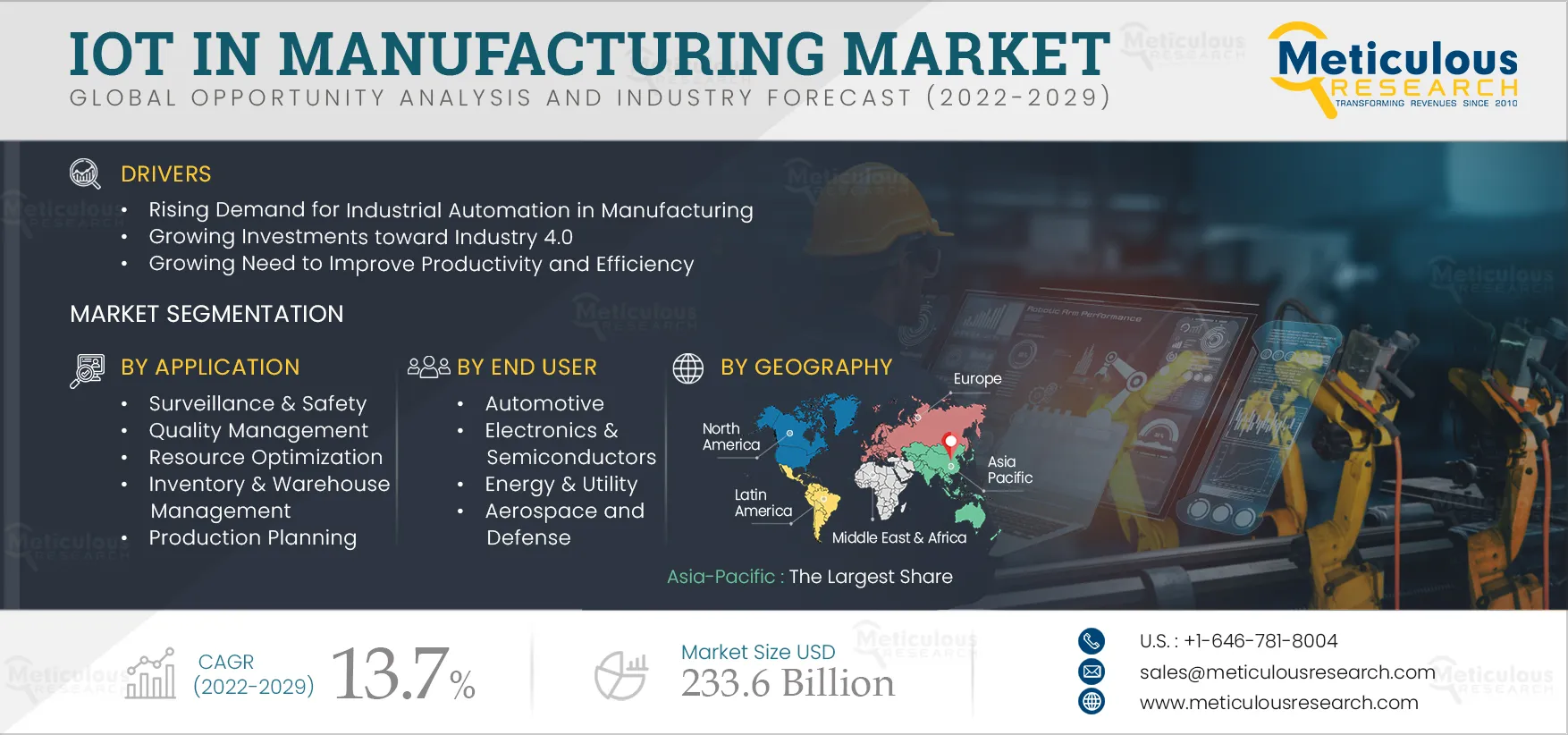
Table of contents
13 chapters · 130 sections · 250 pages · click to expandSegmental analysis
| Segment | Largest share (2022) | Fastest growth (2022–2029) |
|---|---|---|
| By Component | Hardware | Platform |
| By End User | Automotive | Asia-Pacific |
By Component
- Hardware Segment to Witness the Largest Share Through 2022
- The hardware segment is expected to account for the largest share of the global IoT in manufacturing market.
- The large market share of this segment is attributed to factors such as consistent engagement of the manufacturing sector in improving efficiency, reducing costs, and increasing overall equipment effectiveness (OEE) through better access to information from real-time solutions.
- However, the platform segment is expected to register the highest CAGR during the forecast period.
- The rising adoption of IoT platforms in the manufacturing sector by various end users to improve operational efficiency drives the segment’s growth.
By End User
- Automotive Segment to Dominate the IoT in Manufacturing Market
- The automotive segment is expected to account for the largest share of the global IoT in manufacturing market.
- The large market share of this segment is attributed to factors such as increasing smart factories, increasing emphasis on developing next-generation automobile warehouses, and the growing need to reduce unplanned downtime for better designing of products.
- Asia-Pacific is expected to account for the largest share of the global IoT in manufacturing market and is expected to register the highest CAGR during the forecast period.
- Factors such as technological innovations, the growing number of industrial organizations, and the increasing adoption of IoT devices to optimize operational efficiency drive market growth.
Competitive landscape
- Intel Corporation
- Cisco Systems, Inc.
- SAP SE
- International Business Machines Corporation
- Siemens AG
- PTC Inc.
- Robert Bosch GmbH
- Atos SE
- Microsoft Corporation
- HCL Technologies Limited
- Zebra Technologies Corporation
- Oracle Corporation
- Hitachi, Ltd.
- Software AG
Frequently asked questions
The global IoT in manufacturing market is projected to reach $233.6 billion by 2029 at a CAGR of 13.7% during the forecast period.
Cite this report
Meticulous Research. (2022). IoT in Manufacturing Market - Global Opportunity Analysis And Industry Forecast (2022-2029) (Report No. MR-687). Meticulous Market Research Pvt. Ltd. https://www.meticulousresearch.com/product/iot-in-manufacturing-market-5371