Insulating Glass Sealants Market (2026-2036)
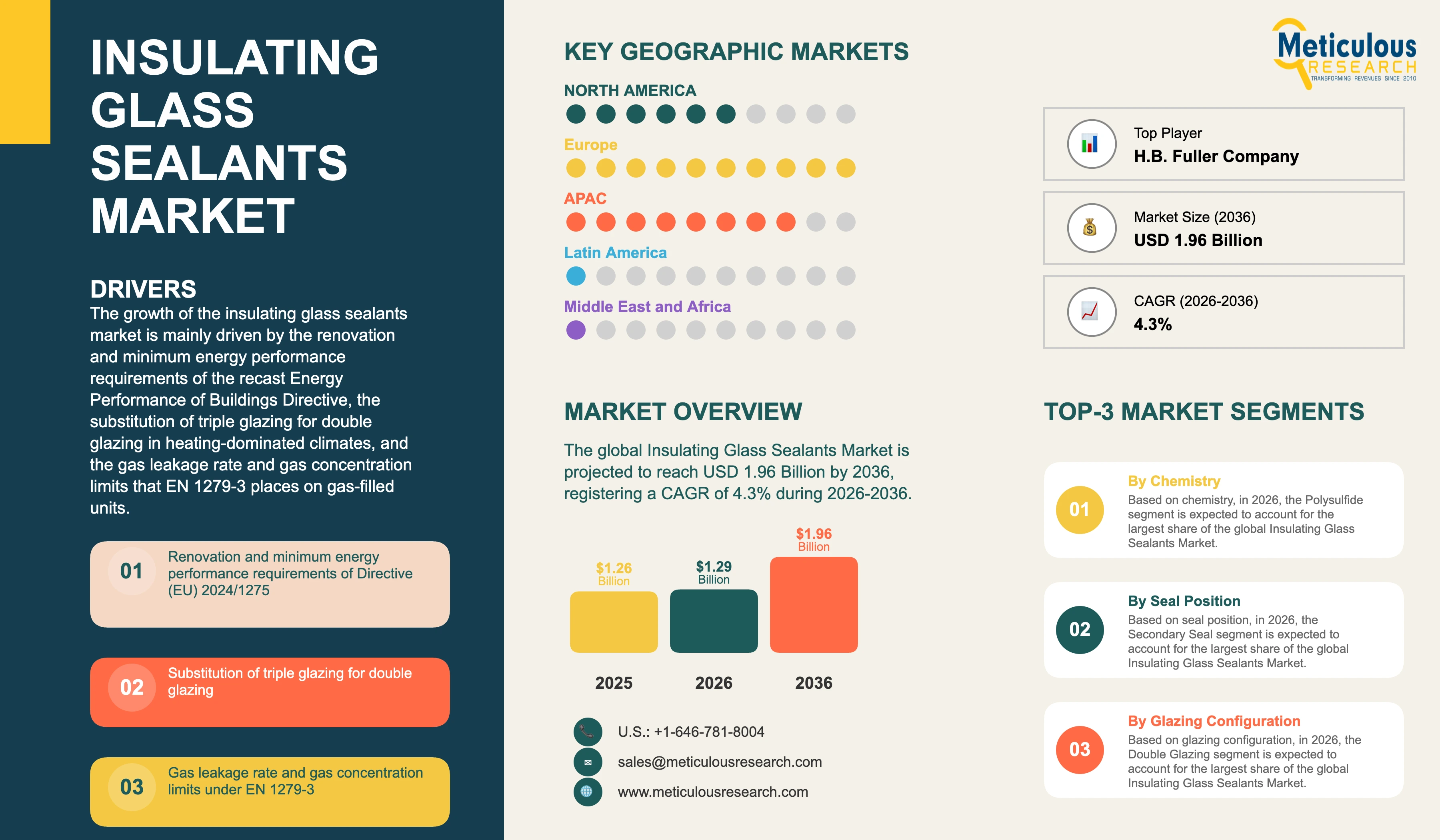
The global insulating glass sealants market was valued at USD 1.26 billion in 2025. This market is expected to reach USD 1.96 billion by 2036 from an estimated USD 1.29 billion in 2026, registering a CAGR of 4.3% during the forecast period (2026-2036).
- Published
- Nov 2026
- Pages
- 270
- Format
- PDF + Excel
- Report ID
- MRCHM - 1042653
- Base year
- 2025
- 2025 · BASELINE
- $1.26B
- 2036
- $1.96B
- CAGR 2026–2036
- 4.3%
2025 baseline · 2026–2036 forecast at 4.3% CAGR · hover a bar for the value
Key highlights
The global insulating glass sealants market is estimated at USD 1.29 billion in 2026 and is projected to reach USD 1.96 billion by 2036.
Market volume is estimated at 248.00 kilotons in 2026 and is projected to reach 411.80 kilotons by 2036 at a CAGR of 5.2%.
The average selling price is estimated at USD 5.20 per kg in 2026 and is projected to reach USD 4.75 per kg by 2036.
Polysulfide is expected to account for the largest chemistry share in 2026, while silicone is projected to register the highest CAGR of 6.4%.
Secondary seals are expected to hold the largest share by seal position in 2026, while primary seals are projected to grow fastest at a CAGR of 5.4%.
Double glazing is expected to be the largest glazing configuration in 2026, while triple glazing is projected to register the highest CAGR of 7.2%.
Argon-filled units are expected to account for the largest share by gas fill in 2026, while krypton and other noble gas fills are projected to grow fastest at a CAGR of 7.8%.
Residential new build is expected to be the largest end-use sector in 2026, while residential renovation is projected to grow fastest at a CAGR of 6.6%.
Europe is expected to hold the largest regional share in 2026, while Asia-Pacific is projected to register the highest CAGR of 5.6%.
Directive (EU) 2024/1275 was published in the Official Journal on 8 May 2024, entered into force on 28 May 2024 and carries a general transposition deadline of 29 May 2026.
That directive requires minimum energy performance standards for non-residential buildings that trigger renovation of the worst-performing 16% by 2030 and the worst-performing 26% by 2033.
For residential buildings it requires each member state to set a trajectory cutting average primary energy use by 16% by 2030 and by 20% to 22% by 2035, with at least 55% of the decrease coming from the worst-performing buildings.
The annual energy renovation rate in the European Union was around 1% at the time of adoption, against the rates those trajectories require.
Draft national renovation plans were due on 31 December 2025 and final plans are due on 31 December 2026.
Life-cycle global warming potential disclosure in energy performance certificates applies from January 2028 for new buildings above 1,000 square metres and from January 2030 for all new buildings.
Financial incentives for stand-alone fossil fuel boilers were required to end from 1 January 2025.
EN 1279-3:2018 specifies the long term test method and requirements for limit values for gas leakage rate and for gas concentration tolerances in gas-filled insulating glass units.
EN 1279-2:2018 covers the long term test method and requirements for moisture penetration, and EN 1279-4:2018 covers methods of test for the physical attributes of edge seal components and inserts.
EN 1279-1:2018 sets generalities, system description, rules for substitution, tolerances and visual quality, EN 1279-5:2018 is the product standard and EN 1279-6:2018 governs factory production control.
Regulation (EU) 2024/3110 entered full application on 7 January 2026 for products covered by a harmonised standard or a European assessment document cited in the Official Journal.
Report summary
| Particulars | Details |
|---|---|
| Base Year | 2025 |
| Forecast Period | 2026-2036 |
| Market Size in 2025 | USD 1.26 billion |
| Market Size in 2026 | USD 1.29 billion |
| Market Size by 2036 | USD 1.96 billion |
| Value CAGR (2026-2036) | 4.3% |
| Format | PDF, Excel & Cloud Portal · 270 pages |
| Volume in 2026 | 248.00 kilotons |
| Volume by 2036 | 411.80 kilotons |
| Volume CAGR (2026-2036) | 5.2% |
| Average Selling Price in 2026 | USD 5.20 per kg |
| Average Selling Price by 2036 | USD 4.75 per kg |
| Measurement Basis | Primary and secondary edge seal sealant consumed in insulating glass unit fabrication, excluding spacer bars and warm-edge spacer systems, desiccants, glass, the inert gas fill, structural glazing sealants applied on site, and window perimeter and glazing sealants |
| Largest Chemistry Segment | Polysulfide |
| Fastest-Growing Chemistry Segment | Silicone (CAGR 6.4%) |
| Largest Seal Position Segment | Secondary seal |
| Fastest-Growing Seal Position Segment | Primary seal (CAGR 5.4%) |
| Largest Glazing Configuration | Double glazing |
| Fastest-Growing Glazing Configuration | Triple glazing (CAGR 7.2%) |
| Largest Gas Fill Segment | Argon-filled |
| Fastest-Growing Gas Fill Segment | Krypton and other noble gas filled (CAGR 7.8%) |
| Largest End-Use Sector | Residential new build |
| Fastest-Growing End-Use Sector | Residential renovation (CAGR 6.6%) |
| Largest Region | Europe |
| Fastest-Growing Region | Asia-Pacific (CAGR 5.6%) |
| Segments Covered | Chemistry, Seal Position, Glazing Configuration, Gas Fill, End-Use Sector, and Geography |
| Geographies Covered | Europe, Asia-Pacific, North America, Middle East & Africa, and Latin America |
| Companies Profiled | 14 companies, including H.B. Fuller Company, Sika AG, Dow Inc., Henkel AG & Co. KGaA, Fenzi S.p.A., and RPM International Inc. |
Report overview
Segments covered: chemistry, seal position, glazing configuration, gas fill, end-use sector.
In volume terms, this market is estimated at 248.00 kilotons in 2026 and is projected to reach 411.80 kilotons by 2036, registering a CAGR of 5.2% during the same period. The average selling price is estimated at USD 5.20 per kg in 2026 and is projected to decline to USD 4.75 per kg by 2036 as hot-melt and two-part secondary sealant capacity expands in Asia-Pacific and volume contracts move from drum to bulk supply.
The growth of this market is mainly driven by the renovation and minimum energy performance requirements of the recast Energy Performance of Buildings Directive, the substitution of triple glazing for double glazing in heating-dominated climates, the gas leakage rate and gas concentration limits that EN 1279-3 places on gas-filled units, and the move to argon and krypton fills that depend on the edge seal to hold them. However, factors such as the thin-margin fabrication economics that tie sealant selection to cost per unit, and the dependence of edge seal durability on the fabrication line rather than on the sealant alone, are expected to restrain the growth of this market to some extent.
Polysulfide accounts for the largest share of this market because it carries most two-part secondary sealing on established fabrication lines at the lowest cost per kilogram while meeting the moisture and gas requirements of EN 1279. Silicone grows faster because structurally glazed and curtain wall units require the ultraviolet stability and adhesion to exposed edges that polysulfide cannot provide.
Insulating glass sealants are the materials that seal the cavity between two or more panes of glass in an insulating glass unit, holding the gas fill in, keeping moisture out and carrying the structural load between panes. Market sizing in this report is on both a value basis in USD and a volume basis in kilotons, with average selling price derived from the two. The measurement basis is primary and secondary edge seal sealant consumed in insulating glass unit fabrication, and it excludes spacer bars and warm-edge spacer systems, desiccants, glass, the inert gas fill itself, structural glazing sealants applied on site and window perimeter and glazing sealants.
The edge seal is a two-material system rather than a single product. A primary seal of polyisobutylene is applied to the spacer faces as the moisture and gas barrier, and a secondary seal of polysulfide, polyurethane, silicone or hot-melt butyl fills the channel behind it and carries the mechanical load that holds the unit together. The two materials are specified against different properties, since the primary seal is selected for permeation resistance and the secondary seal for adhesion, modulus and durability, and they are supplied by different production processes. Secondary sealant accounts for most of the mass in a unit while primary sealant determines whether the unit holds its gas.
Performance is defined by a test series rather than by a specification sheet. EN 1279-1:2018 sets generalities, system description, rules for substitution, tolerances and visual quality; EN 1279-2:2018 gives the long term test method and requirements for moisture penetration; EN 1279-3:2018 gives the long term test method and requirements for limit values for gas leakage rate and for gas concentration tolerances; EN 1279-4:2018 gives methods of test for the physical attributes of edge seal components and inserts; EN 1279-5:2018 is the product standard; and EN 1279-6:2018 governs factory production control. A sealant qualifies as part of a system under EN 1279-1 and manufactured to EN 1279-6, not as a material in isolation.
The rules for substitution in EN 1279-1 are what govern commercial access. A fabricator holding a tested system cannot change the secondary sealant, the primary sealant, the spacer or the desiccant without establishing that the substitution is permitted under those rules, and the alternative is to repeat the long term moisture and gas leakage testing. EN 1279-3 allows components such as edge seals or spacers to be tested to show that they let a unit meet the requirements of EN 1279-1 Clause 6, which gives suppliers a route to qualify a material for use across fabricators. Whether a sealant can be sold into an existing line therefore depends on the substitution position as much as on the performance.
Directive (EU) 2024/1275, the recast Energy Performance of Buildings Directive, published in the Official Journal on 8 May 2024 and in force from 28 May 2024 with a general transposition deadline of 29 May 2026 is the demand instrument behind the market. It requires minimum energy performance standards for non-residential buildings that trigger renovation of the worst-performing 16% by 2030 and the worst-performing 26% by 2033, and requires each member state to set a residential trajectory cutting average primary energy use by 16% by 2030 and by 20% to 22% by 2035, with at least 55% of the decrease coming from renovating the worst-performing buildings. Draft national renovation plans were due on 31 December 2025 and final plans are due on 31 December 2026. The annual energy renovation rate at adoption was around 1%, which indicates the scale of the increase those trajectories require.
Glazing is the component most directly affected by those requirements, because window replacement delivers a measurable improvement in primary energy use in a single intervention and can be carried out without vacating a building. The directive also introduces building renovation passports to guide owners renovating in several steps, which makes staged glazing replacement a recognised route rather than an incomplete one. Life-cycle global warming potential disclosure in energy performance certificates applies from January 2028 for new buildings above 1,000 square metres and from January 2030 for all new buildings, which brings the embodied impact of the unit alongside its thermal performance. Financial incentives for stand-alone fossil fuel boilers were required to end from 1 January 2025, shifting heating demand reduction onto the building fabric.
Gas fill is what makes the sealant a performance component rather than an assembly material. An argon or krypton fill lowers the centre-of-glass thermal transmittance of a unit, and the benefit persists only for as long as the edge seal holds the gas, which is why EN 1279-3 sets limit values for gas leakage rate and gas concentration tolerances rather than measuring the fill at manufacture alone. Krypton is substantially more expensive than argon and is used in narrow cavities and triple-glazed units where argon performs less well, so a leaking seal destroys more value per unit. The gas requirement consequently pulls specification toward the primary seal and toward tighter control of the fabrication line.
Regulation (EU) 2024/3110, the recast Construction Products Regulation, which entered full application on 7 January 2026 applies to products covered by a harmonised standard or a European assessment document cited in the Official Journal, which brings environmental declaration and digital documentation into the conditions of sale for materials already tested under EN 1279. Fabricators operate on thin margins against a glass and spacer bill of materials, and sealant is a small fraction of unit cost but the component that determines whether the unit survives its warranty. That combination keeps price pressure on the sealant while making a failure disproportionately expensive, which is the commercial tension running through this market.
Double glazing is expected to account for the largest share in 2026.
Triple glazing is projected to register the highest CAGR of 7.2% during the forecast period.
Residential new build is expected to hold the largest share in 2026.
Residential renovation is projected to register the highest CAGR of 6.6% during the forecast period.
Europe is expected to account for the largest share in 2026, supported by the renovation requirements of Directive (EU) 2024/1275 and by triple glazing already standard in northern and central European markets. Germany is projected to grow at 4.6% and Poland at 5.8%.
Asia-Pacific is projected to register the highest CAGR of 5.6% during the forecast period, with China at 5.4% and India at 7.8%.
Europe is projected to grow at a CAGR of 4.2% and holds the largest regional share, supported by Directive (EU) 2024/1275, by the EN 1279 test and system framework that governs fabrication in the region, and by triple glazing already standard in heating-dominated markets. Germany is projected at 4.6% and Poland at 5.8%.
The Middle East & Africa is projected to grow at a CAGR of 5.0% as Gulf commercial construction specifies solar-control double glazing. Latin America is projected to grow at a CAGR of 3.8%, with Mexico the principal market.
H.B. Fuller Company, Sika AG, Dow Inc., Henkel AG & Co. KGaA and Fenzi S.p.A. together accounted for an estimated 44.2% of this market in 2026. The 14 companies profiled in this report together accounted for an estimated 72.5%.
Report infographic
Market dynamics
15 factors across 5 forcesRenovation and Minimum Energy Performance Requirements of the Recast Energy Performance of Buildings Directive
Directive (EU) 2024/1275, the recast Energy Performance of Buildings Directive, published in the Official Journal on 8 May 2024 and in force from 28 May 2024 with a general transposition deadline of 29 May 2026 requires minimum energy performance standards for non-residential buildings that trigger renovation of the worst-performing 16% by 2030 and the worst-performing 26% by 2033, and requires member states to set a residential trajectory cutting average primary energy use by 16% by 2030 and by 20% to 22% by 2035, with at least 55% of the decrease coming from the worst-performing buildings. The annual energy renovation rate at adoption was around 1%, so meeting those trajectories requires a substantial increase in activity within a defined period. Glazing replacement delivers a measurable reduction in primary energy use in one intervention without vacating a building, which places it early in most renovation sequences. Final national renovation plans are due on 31 December 2026, which fixes the timetable fabricators are planning capacity against. The non-residential thresholds are set nationally rather than centrally, so the volume reaching glazing varies by member state while the deadline does not, and fabricators are adding capacity against the deadline rather than against a confirmed volume.
Substitution of Triple Glazing for Double Glazing
A triple-glazed unit carries two cavities rather than one, which doubles the primary and secondary seal length per unit of glazed area and increases sealant consumption more than proportionally because the thicker unit requires a deeper secondary channel. The thermal performance required by renovation trajectories and by zero-emission new build standards is reached with triple glazing in heating-dominated climates where double glazing cannot deliver it. Triple-glazed units are heavier and carry greater mechanical load at the edge, which raises the modulus and adhesion requirements on the secondary sealant rather than merely the quantity. Each conversion from double to triple glazing therefore lifts both volume and the value per kilogram of the material specified.
Gas Leakage Rate and Gas Concentration Limits Under EN 1279-3
EN 1279-3:2018 specifies the long term test method and requirements for limit values for gas leakage rate and for gas concentration tolerances in gas-filled insulating glass units, applying to units made under EN 1279-1:2018 and manufactured to EN 1279-6:2018, and allowing components such as edge seals or spacers to be tested to show that they let a unit meet EN 1279-1 Clause 6. A gas fill delivers its thermal benefit only while it remains in the cavity, so the standard tests retention over time rather than the fill at manufacture. That places the primary seal and the integrity of its application under direct measurement and rules out materials that pass a short-term check. Demand consequently concentrates on sealant systems with established long term test evidence rather than on equivalent-looking alternatives.
Movement to Argon and Krypton Gas Fills
An inert gas fill lowers the centre-of-glass thermal transmittance of a unit, and krypton is used in narrow cavities and in triple-glazed units where argon performs less well despite being substantially more expensive. The more valuable the fill, the greater the cost of a seal that leaks it, which shifts fabricator attention from sealant price toward retention performance. EN 1279-3 measures that retention as a limit value rather than as a target, so a unit either qualifies or does not. Gas-filled construction therefore converts the edge seal from an assembly cost into a performance component that is specified and tested, which is what supports value growth in a market whose unit volumes grow with construction. Fill selection is also decided at specification rather than on the fabrication line, so the requirement reaches the sealant through the unit specification rather than through the fabricator.
Table of contents
13 chapters · 145 sections · 270 pages · click to expandSegmental analysis
| Segment | Largest share (2026) | Fastest growth (2026–2036) |
|---|---|---|
| By Chemistry | Polysulfide | — |
| Other segments | — | Silicone |
By Chemistry
- Polysulfide is expected to account for the largest share in 2026, carrying most two-part secondary sealing on established lines.
- Secondary seals are expected to hold the largest share in 2026, as the channel behind the spacer accounts for most of the material mass in a unit.
- Argon-filled units are expected to hold the largest share in 2026, as argon is the default fill in most European and North American residential glazing.
Other segments
- Silicone is projected to register the highest CAGR of 6.4% during the forecast period.
- Primary seals are projected to register the highest CAGR of 5.4% during the forecast period.
- Krypton and other noble gas filled units are projected to register the highest CAGR of 7.8% during the forecast period.
Geographic analysis
Europe
Largest shareIn 2026, Europe is expected to account for the largest share of the global insulating glass sealants market. The large share of this region is mainly due to the renovation and minimum energy performance requirements of Directive (EU) 2024/1275, which trigger renovation of the worst-performing 16% of non-residential buildings by 2030 and the worst-performing 26% by 2033, the triple glazing already standard in heating-dominated northern and central European markets, and the EN 1279 test and system framework that originates in the region and governs fabrication there. Germany is projected to register a CAGR of 4.6% and Poland a CAGR of 5.8% during the forecast period.
Asia-Pacific
Fastest growthHowever, Asia-Pacific is projected to register the highest CAGR of 5.6% during the forecast period. The rapid growth of this region is attributed to the conversion from single glazing to insulating glass in residential and commercial construction across China, India and southeast Asia, the building energy codes being tightened in those markets, and the local sealant manufacturing capacity that has been added close to glass processing clusters. China is projected to register a CAGR of 5.4% and India a CAGR of 7.8%.
North America
North America holds the second-largest share, supported by established insulating glass fabrication and by argon fill as the residential default, and the region is projected to grow at 3.2%, with the United States at 3.2%.
Middle East & Africa
The Middle East & Africa is projected to grow at 5.0% as Gulf commercial construction specifies solar-control double glazing, and Latin America at 3.8%, with Mexico the principal market as window fabrication serving both domestic demand and export expands and Brazil holding the commercial glazing demand. Climate rather than construction volume explains much of the regional difference in which chemistry competes. Heating-dominated markets specify triple glazing and gas fills that place the gas retention requirement of EN 1279-3 at the centre of the decision, while cooling-dominated markets reach their performance target with solar-control coatings on double-glazed units where the edge seal faces a less demanding duty. Gas fill adoption varies on the same basis, which is why primary sealant intensity per square metre of glazing differs across regions with similar output. Fabrication is in all cases regional, since insulating glass units are heavy, fragile and made to size, and sealant supply follows that footprint. Sealant is in consequence formulated and filled regionally even where the supplier is global, and the registered systems a supplier holds differ by region because the spacer and desiccant platforms they are tested with differ.
Competitive landscape
The global insulating glass sealants market is characterised by the presence of adhesives and sealants specialists, diversified chemical companies with silicone positions, insulating glass edge seal specialists, and regional Chinese sealant manufacturers serving domestic glass processing clusters. Competition is contested on registered EN 1279 systems rather than on material properties, since a fabricator holding a tested system cannot change the sealant outside the substitution rules of EN 1279-1:2018 without repeating long term moisture and gas leakage testing. H.B. Fuller Company, Sika AG, Dow Inc., Henkel AG & Co. KGaA and Fenzi S.p.A. together accounted for an estimated 44.2% of this market in 2026, while the companies profiled in this report together accounted for an estimated 72.5%.
Directive (EU) 2024/1275 was published on 8 May 2024, entered into force on 28 May 2024 and carries a general transposition deadline of 29 May 2026, with final national renovation plans due on 31 December 2026, which fixes the period over which European renovation demand builds. Regulation (EU) 2024/3110 entered full application on 7 January 2026 and brings environmental declaration and digital documentation into the conditions of sale. Suppliers responded through registered system coverage across warm-edge spacer platforms, silicone secondary sealant positions for structurally glazed and triple-glazed units, and declaration data issued as a standard part of supply. System registration breadth and documentation accounted for most competitive activity through 2026.
Edge seal specialists hold positions where the registered system rather than corporate scale decides the specification, and they compete directly with the diversified suppliers on tested lines. Fenzi S.p.A. supplies insulating glass sealants and edge seal components as its principal business, while Guangzhou Baiyun Chemical Industry Co., Ltd., Chengdu Guibao Science & Technology Co., Ltd. and Hangzhou Zhijiang Silicone Chemicals Co., Ltd. serve the Chinese glass processing base. Some of the key players operating in the insulating glass sealants market are H.B. Fuller Company (U.S.), Sika AG (Switzerland), Dow Inc. (U.S.), Henkel AG & Co. KGaA (Germany), Fenzi S.p.A. (Italy), RPM International Inc. (U.S.), Arkema S.A. (France), Wacker Chemie AG (Germany), Shin-Etsu Chemical Co., Ltd. (Japan), KCC Corporation (South Korea), Soudal Holding NV (Belgium), Guangzhou Baiyun Chemical Industry Co., Ltd. (China), Chengdu Guibao Science & Technology Co., Ltd. (China), and Hangzhou Zhijiang Silicone Chemicals Co., Ltd. (China), among others.
- —
Directive (EU) 2024/1275 was published in the Official Journal on 8 May 2024, entered into force on 28 May 2024 and carries a general transposition deadline of 29 May 2026, with draft national renovation plans due on 31 December 2025 and final plans on 31 December 2026. Financial incentives for stand-alone fossil fuel boilers were required to end from 1 January 2025. Regulation (EU) 2024/3110 entered full application on 7 January 2026.
- H.B. Fuller Company
- Sika AG
- Dow Inc.
- Henkel AG & Co. KGaA
- Fenzi S.p.A
- RPM International Inc
Expert perspectives
Volume grows at 5.2% against 4.3% in value over the forecast period, and the average selling price falls from USD 5.20 per kg in 2026 to USD 4.75 per kg by 2036 as hot-melt and two-part secondary sealant capacity expands in Asia-Pacific and volume contracts move from drum to bulk supply. Volume outrunning value is the signature of a market where the fastest-growing geography is also the lowest-priced one, and the European mix shift toward silicone and triple glazing is what keeps the gap as narrow as it is.
Triple glazing is the mechanism rather than the market. A second cavity doubles the primary and secondary seal perimeter per square metre of glazing and requires a deeper secondary channel, and the greater unit weight raises the modulus and adhesion requirement rather than only the quantity. A conversion from double to triple glazing consequently lifts sealant consumption per square metre and the price of the material specified at the same time, which is why the configuration segment grows faster than any geography.
The regulatory instrument has firm dates and firm percentages. Directive (EU) 2024/1275 triggers renovation of the worst-performing 16% of non-residential buildings by 2030 and 26% by 2033, requires residential primary energy to fall 16% by 2030 and 20% to 22% by 2035 with at least 55% from the worst performers, and sets final national renovation plans for 31 December 2026 against an annual renovation rate of around 1% at adoption. Glazing is the renovation step most often taken first, so sealant demand arrives earlier in that cycle than demand for insulation or heating measures.
What protects incumbents here is not formulation but the substitution rules. EN 1279-1:2018 sets rules for substitution, and changing a secondary sealant, primary sealant, spacer or desiccant outside them means repeating long term moisture and gas leakage testing that measures retention over an extended period. A better material with no substitution route reaches only new lines and new system registrations, which is why polysulfide holds the largest chemistry share despite the performance case for alternatives.
Warm-edge spacer adoption is the opening that performance alone does not provide. Replacing aluminium at the cavity perimeter changes the stiffness, thermal expansion and channel geometry the secondary sealant bonds to, so a sealant qualified on an aluminium system is not automatically qualified on a warm-edge one. That forces system requalification on lines where sealant selection had been settled, and it is where a challenger material actually gets evaluated.
Gas fill is what turns the edge seal into a specified component. EN 1279-3:2018 sets limit values for gas leakage rate and gas concentration tolerances rather than measuring the fill at manufacture, and krypton used in narrow cavities and triple-glazed units costs substantially more than argon. The more valuable the fill, the more a leaking seal destroys, which is the reason the primary seal segment grows faster than the secondary seal that accounts for most of the mass.
Customer perspectives
Registered system coverage with the fabricator spacer and desiccant rather than material performance is the first selection criterion, because substitution outside the permitted rules means repeating long term testing.
Structural loading and ultraviolet exposure narrow secondary sealant selection to silicone on glazed facades, and declaration data is now requested alongside performance for the certificate calculation.
The imbalance between sealant cost and failure liability drives conservatism and price pressure at the same time, and line throughput rather than material cost decides selection where capacity is the constraint.
“Our tested systems are our licence to sell, so we do not change a sealant casually. Substituting outside what the standard permits means running the long term tests again, and those take as long as they take. If a supplier wants our business the first question is whether the system is already registered with our spacer and our desiccant, not how the material performs on a datasheet.”
“On a structurally glazed facade the edge seal is carrying load and sitting in ultraviolet, so the secondary sealant is a silicone question and not an open one. On triple glazing the units are heavier and the channel is deeper, which is a different conversation again. We now ask for the declaration data as well, because the certificate calculation needs it.”
“Sealant is a small part of what a unit costs and the whole of what a warranty claim costs. A failed edge seal means replacing glass and reinstalling, so we are cautious, but we are also quoting against people using the cheapest thing that passes. Where throughput is our limit, a hot-melt that needs no racking is worth more to us than a cheaper two-part.”
Frequently asked questions
This market was valued at USD 1.24 billion in 2024 and USD 1.26 billion in 2025, and is estimated at USD 1.29 billion in 2026. In volume terms it is estimated at 248.00 kilotons in 2026.
Cite this report
Meticulous Research. (2026). Insulating Glass Sealants Market - Global Opportunity Analysis and Industry Forecast (2026-2036) (Report No. MRCHM - 1042653). Meticulous Market Research Pvt. Ltd. https://www.meticulousresearch.com/product/insulating-glass-sealants-market-7336