Cross Laminated Timber Adhesives Market (2026-2036)
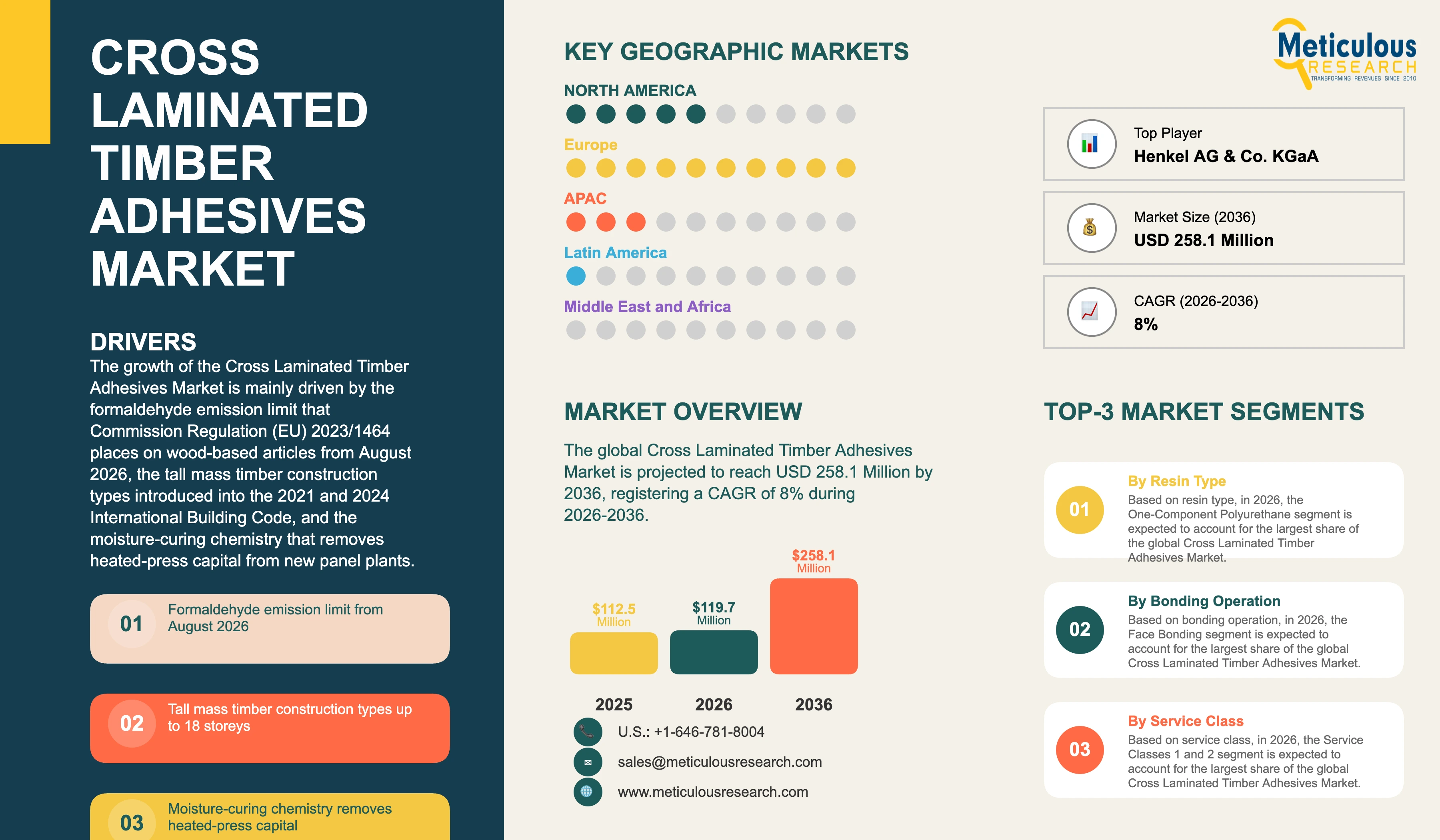
The global cross laminated timber adhesives market was valued at USD 112.5 million in 2025. This market is expected to reach USD 258.1 million by 2036 from an estimated USD 119.7 million in 2026, registering a CAGR of 8.0% during the forecast period (2026-2036).
- Published
- Nov 2026
- Pages
- 273
- Format
- PDF + Excel
- Report ID
- MRCHM - 1042648
- Base year
- 2025
- 2025 · BASELINE
- $112.5M
- 2036
- $258.1M
- CAGR 2026–2036
- 8.0%
2025 baseline · 2026–2036 forecast at 8.0% CAGR · hover a bar for the value
Key highlights
The global cross laminated timber adhesives market is estimated at USD 119.7 million in 2026 and is projected to reach USD 258.1 million by 2036.
Market volume is estimated at 18.70 kilotons in 2026 and is projected to reach 46.50 kilotons by 2036 at a CAGR of 9.5%.
The average selling price is estimated at USD 6.40 per kg in 2026 and is projected to reach USD 5.55 per kg by 2036.
One-component polyurethane is expected to account for the largest resin type share in 2026, and it is also projected to register the highest CAGR of 9.1%.
Face bonding is expected to be the largest bonding operation in 2026, while edge bonding is projected to grow fastest at a CAGR of 10.8%.
Service classes 1 and 2 are expected to hold the largest service class share in 2026, while service class 3 is projected to register the highest CAGR of 10.0%.
Residential buildings are expected to be the largest end-use sector in 2026, while commercial and office buildings are projected to grow fastest at a CAGR of 9.4%.
Europe is expected to hold the largest regional share in 2026, while North America is projected to register the highest CAGR of 11.8%.
Commission Regulation (EU) 2023/1464 caps formaldehyde emissions at 0.062 mg per cubic metre for wood-based articles and furniture and at 0.08 mg per cubic metre for other articles.
The compliance period for article producers under that regulation runs 36 months from entry into force, reaching August 2026.
The 2021 and 2024 International Building Code introduced construction types IV-A, IV-B and IV-C, permitting mass timber buildings of up to 18, 12 and 9 storeys.
Cross laminated timber is placed on the European market under EN 16351:2021 or through European Technical Assessment against EAD 130005-00-0304.
One-component polyurethane adhesives for load-bearing timber are classified under EN 15425:2017, with LOCTITE HB S109 ECO PURBOND classified I 90 GP 0,3 w as a Type I adhesive.
Henkel states bio-based content of 63% of organic mass for LOCTITE HB S109 ECO PURBOND, linked to ISCC PLUS certified bio-circular feedstock through mass balance.
DIBt renewed national approval Z-9.1-896 on 21 July 2025, valid to 21 July 2030, for the two-component polyurethane LOCTITE CR 821 PURBOND held by Henkel & Cie. AG.
Henkel reports fire resistance greater than 60 minutes for LOCTITE HB X, a fast-curing one-component polyurethane for mass timber.
Report summary
| Particulars | Details |
|---|---|
| Base Year | 2025 |
| Forecast Period | 2026-2036 |
| Market Size in 2025 | USD 112.5 million |
| Market Size in 2026 | USD 119.7 million |
| Market Size by 2036 | USD 258.1 million |
| Value CAGR (2026-2036) | 8.0% |
| Format | PDF, Excel & Cloud Portal · 273 pages |
| Volume in 2026 | 18.70 kilotons |
| Volume by 2036 | 46.50 kilotons |
| Volume CAGR (2026-2036) | 9.5% |
| Average Selling Price in 2026 | USD 6.40 per kg |
| Average Selling Price by 2036 | USD 5.55 per kg |
| Measurement Basis | Adhesive consumed in cross laminated timber panel manufacture, covering face bonding, edge bonding and finger jointing inside the panel plant, and excluding glued laminated timber, laminated veneer lumber, I-joist and on-site construction adhesives |
| Largest Resin Type Segment | One-component polyurethane |
| Fastest-Growing Resin Type Segment | One-component polyurethane (CAGR 9.1%) |
| Largest Bonding Operation | Face bonding |
| Fastest-Growing Bonding Operation | Edge bonding (CAGR 10.8%) |
| Largest Service Class Segment | Service classes 1 and 2 |
| Fastest-Growing Service Class Segment | Service class 3 (CAGR 10.0%) |
| Largest End-Use Sector | Residential buildings |
| Fastest-Growing End-Use Sector | Commercial and office buildings (CAGR 9.4%) |
| Largest Region | Europe |
| Fastest-Growing Region | North America (CAGR 11.8%) |
| Segments Covered | Resin Type, Bonding Operation, Service Class, End-Use Sector, and Geography |
| Geographies Covered | Europe, North America, Asia-Pacific, Latin America, and Middle East & Africa |
| Companies Profiled | 12 companies, including Henkel AG & Co. KGaA, Jowat SE, KLEBCHEMIE M. G. Becker GmbH & Co. KG, Sika AG, H.B. Fuller Company, and Prefere Resins Holding GmbH |
Report overview
Segments covered: resin type, bonding operation, service class, end-use sector.
The growth of this market is mainly driven by the formaldehyde emission limit that Commission Regulation (EU) 2023/1464 places on wood-based articles from August 2026, the tall mass timber construction types introduced into the 2021 and 2024 International Building Code, the moisture-curing chemistry that removes heated-press capital from new panel plant investment, and the embodied carbon and bio-based content requirements entering building procurement. However, factors such as the bond line thickness and press time limits that adhesive cure imposes on panel plant throughput, and the delamination performance required of a bond line in service class 3 exposure, are expected to restrain the growth of this market to some extent.
Cross laminated timber adhesives are the structural adhesives applied between the lamellas of a cross laminated timber panel and along the joints within each layer. Market sizing in this report is on both a value basis in USD and a volume basis in kilotons, with average selling price derived from the two. The measurement basis is adhesive consumed in cross laminated timber panel manufacture, covering face bonding between layers, edge bonding within a layer and finger jointing of lamellas inside the panel plant, and it excludes glued laminated timber, laminated veneer lumber, I-joist and on-site construction adhesives.
Henkel AG & Co. KGaA groups its engineered wood offering by application into cross-laminated timber, glue-laminated timber, finger-jointed timber, I joists and I beams, and other areas covering solid wood panels, structural insulation panels and laminated veneer lumber, with face bonding, finger jointing and edge bonding appearing as operations within those applications. The same offering is grouped by technology into polyurethane adhesives, water-based adhesives that can be cold pressed, hot pressed or radio frequency cured, and hot melt adhesives. Panel producers therefore buy against a bonding operation and a cure route rather than against a resin family, and a supplier range is assembled to cover the operations inside one plant.
Standards define what can be sold into load-bearing use. The technical data sheet for LOCTITE HB S109 ECO PURBOND, dated January 2024, cites classification I 90 GP 0,3 w under EN 15425:2017 as a Type I adhesive, together with EN 14080:2013 for glued laminated timber, EN 15497:2014 for structural finger-jointed solid timber, EN 16351:2021 for cross laminated timber and EAD 130005-00-0304, and ETAG 019 for face bonding. Service classes 1, 2 and 3 under EN 1995-1-1 and Type I suitability for service class 3 under AS/NZS 4364:2010 are stated on the same sheet. A product without the matching classification cannot be specified for a structural panel, so assessment breadth rather than formulation decides which operations a supplier can serve.
National approvals sit on top of the European framework. The same product carries German DIBt approvals Z-9.1-765, Z-9.1-802 and Z-9.1-833, Belgian UBAtc approval ATG 12/2888, Dutch certification under KOMO BRL 2338 and the Finnish M1 criteria for low-emission building materials. DIBt renewed approval Z-9.1-896 on 21 July 2025 with validity to 21 July 2030, covering the two-component polyurethane LOCTITE CR 821 PURBOND held by Henkel & Cie. AG for bonding steel rods into glued laminated timber, softwood laminated veneer lumber and edge-bonded cross laminated timber without relief grooves. Approvals expire on five-year cycles, which means a supplier carries a continuous renewal programme rather than a one-off qualification cost.
Commission Regulation (EU) 2023/1464, adopted on 14 July 2023, which caps formaldehyde emissions into indoor air at 0.062 mg per cubic metre for wood-based articles and furniture and at 0.08 mg per cubic metre for other articles, with a 36-month compliance period for article producers that runs to August 2026. Melamine-urea-formaldehyde and phenol-resorcinol-formaldehyde adhesives release formaldehyde from the cured bond line, while one-component polyurethane does not, and the Henkel data sheet states its product as solvent-free and formaldehyde-free. Panel producers selling into buildings where indoor air emissions are measured consequently specify on the basis of the adhesive chemistry rather than on bond strength alone, and the limit applies to the article placed on the market rather than to the adhesive supplied to the plant.
Cure route determines what a panel plant has to build. One-component polyurethane cures on air humidity and moisture in the wood, so a press only has to apply pressure rather than heat, while the formaldehyde-based resins require heated or radio frequency pressing to reach cure. The Henkel data sheet gives a maximum assembly time of 10 minutes, a minimum press time of 25 minutes for bond lines up to 0.1 mm and 75 minutes for bond lines between 0.1 and 0.3 mm, and final bonding strength at one to three hours depending on bond line thickness. Capital cost per cubic metre of installed panel capacity is lower without a heated press, which is the reason new entrants to panel production start on polyurethane.
Demand follows building code permission rather than timber supply. The 2021 and 2024 editions of the International Building Code introduced construction types IV-A, IV-B and IV-C, which permit mass timber buildings of up to 18, 12 and 9 storeys and are based on the heavy timber type while allowing mass timber or noncombustible materials. WoodWorks lists 23 completed or under-construction United States projects that exceed what pre-2021 codes allowed. Each storey added to the permitted height raises the panel volume per building rather than the number of buildings, so adhesive volume per project scales faster than project count.
Bio-based content has become a product specification. Henkel reports that 63% of the organic mass of LOCTITE HB S109 ECO PURBOND is linked to ISCC PLUS certified materials through a mass balance approach using bio-circular feedstock, and markets LOCTITE HB S ECO and LOCTITE CR821 ECO as bio-based structural options. Mass timber is specified in the first place for embodied carbon reasons, so an adhesive carrying fossil feedstock sits against the rationale for the panel it bonds. Certification is tracked separately from structural classification and appears on the same data sheets, which places two qualification layers on the same product.
Softwood species carry the approvals that national authorities have issued, with DIBt approval Z-9.1-896 naming spruce, fir and pine specifically and excluding timber treated with preservatives or fire retardants. Hardwood lamellas offer higher strength per unit of cross section and are available where softwood supply is constrained, but they present denser and less permeable surfaces that a moisture-cured adhesive bonds differently. An adhesive approved for hardwood face bonding opens panel production in regions without a softwood resource and allows thinner panels at the same load capacity. The approval work is the barrier rather than the formulation, and the supplier that completes it reaches a species base that the existing approvals do not cover. Beech, birch and poplar are the species being brought into structural panel production in Europe, and eucalyptus and radiata pine plantations hold the resource in the southern hemisphere, so an approval covering denser species also opens panel production in regions currently importing it, where the panel is presently shipped rather than made.
Face bonding is expected to hold the largest share in 2026.
Edge bonding is projected to register the highest CAGR of 10.8% during the forecast period.
Residential buildings are expected to hold the largest share in 2026.
Commercial and office buildings are projected to register the highest CAGR of 9.4% during the forecast period.
Europe is expected to account for the largest share in 2026, supported by panel production capacity in Austria, Germany and the Nordic countries and by the EN 16351:2021 and national approval framework.
North America is projected to register the highest CAGR of 11.8% during the forecast period, with the United States at 12.1% and Canada at 10.9%.
Europe is projected to grow at a CAGR of 6.0%, supported by established panel capacity and by Commission Regulation (EU) 2023/1464 applying to wood-based articles from August 2026. Austria is projected to register a CAGR of 5.2% and Germany a CAGR of 6.4%.
The Middle East & Africa is projected to grow at a CAGR of 8.0% from a small base, with panels imported rather than produced regionally. Latin America is projected to grow at a CAGR of 7.6%, with Chile and Brazil holding the softwood resource and Mexico the principal construction market.
Henkel AG & Co. KGaA, Jowat SE, KLEBCHEMIE M. G. Becker GmbH & Co. KG, Sika AG and H.B. Fuller Company together accounted for an estimated 68.5% of this market in 2026. The 12 companies profiled in this report together accounted for an estimated 88.0%.
Report infographic
Market dynamics
13 factors across 5 forcesThe Formaldehyde Emission Limit on Wood-Based Articles From August 2026
Commission Regulation (EU) 2023/1464, adopted on 14 July 2023, which caps formaldehyde emissions into indoor air at 0.062 mg per cubic metre for wood-based articles and furniture and at 0.08 mg per cubic metre for other articles, with a 36-month compliance period for article producers that runs to August 2026 applies to the article placed on the market, which for a cross laminated timber panel means the emission from the cured bond lines inside it. Melamine-urea-formaldehyde and phenol-resorcinol-formaldehyde systems release formaldehyde from those bond lines over the service life of the panel, while one-component polyurethane is formaldehyde-free and the Henkel data sheet states it as such alongside being solvent-free. A panel producer cannot meet a measured indoor air limit by process control if the resin itself is the source, so the restriction operates as a chemistry substitution rather than as an emissions management requirement. The limit of 0.062 mg per cubic metre is the stricter of the two bands set by the regulation and applies specifically to wood-based articles and furniture, which places cross laminated timber in the tightest category rather than in the general one.
Tall Mass Timber Construction Types in the 2021 and 2024 International Building Code
Construction types IV-A, IV-B and IV-C in the 2021 and 2024 International Building Code permit mass timber buildings of up to 18, 12 and 9 storeys, where earlier editions limited heavy timber to a fraction of that height. WoodWorks lists 23 United States projects built or under construction that exceed the limits of pre-2021 codes, which measures how quickly the permission has been taken up. Panel volume per building rises with every additional storey while the design and approval cost per project stays broadly fixed, so the taller buildings consume adhesive more efficiently from a supplier perspective than low-rise work does. The types are based on heavy timber and allow mass timber or noncombustible materials, which puts the bonded panel in direct competition with concrete and steel on projects that were previously closed to it.
Moisture-Curing Chemistry That Removes Heated-Press Capital From New Panel Plants
One-component polyurethane cures on air humidity and on moisture already present in the timber, so the press in a panel plant applies pressure without applying heat. The Henkel data sheet gives minimum press times of 25 minutes for bond lines up to 0.1 mm and 75 minutes between 0.1 and 0.3 mm at 20 degrees Celsius and 12% wood moisture, with final bonding strength reached in one to three hours. Water-based systems by contrast are cold pressed, hot pressed or radio frequency cured, and Henkel lists all three routes within its water-based technology. Removing the heated press lowers capital cost per cubic metre of installed capacity and shortens plant construction, which is why panel capacity added outside the established European producers has been built on polyurethane rather than on the formaldehyde-based resins.
Embodied Carbon and Bio-Based Content Requirements in Building Procurement
Mass timber is specified for embodied carbon reasons, and the adhesive inside the panel is counted in the same assessment. Henkel reports 63% of the organic mass of LOCTITE HB S109 ECO PURBOND as linked to ISCC PLUS certified materials through mass balance using bio-circular feedstock, and positions LOCTITE HB S ECO and LOCTITE CR821 ECO as bio-based structural polyurethanes. The same data sheet cites the M1 criteria for low-emission building materials, which sit alongside the structural classification rather than replacing it. Procurement that scores embodied carbon per square metre reaches the adhesive line in the panel specification, and a certified bio-circular grade earns a position that an equivalent fossil-feedstock product cannot on performance alone.
Table of contents
12 chapters · 134 sections · 273 pages · click to expandSegmental analysis
| Segment | Largest share (2026) | Fastest growth (2026–2036) |
|---|---|---|
| By Resin Type | One-component polyurethane | Large share and rapid growth of this |
| By Bonding Operation | Face bonding | Edge bonding |
| By Service Class | Service classes 1 and 2 | Service class 3 |
| By End-Use Sector | Residential buildings | Commercial and office buildings |
| Other segments | Service classes 1 and 2 | Service class 3 |
By Resin Type
- Cross Laminated Timber Adhesives Market Analysis by Resin Type
- The one-component polyurethane segment is expected to account for the largest share of the global cross laminated timber adhesives market, and it is also projected to register the highest CAGR of 9.1% during the forecast period.
- The large share and rapid growth of this segment are mainly due to the formaldehyde-free composition that meets the 0.062 mg per cubic metre indoor air limit Commission Regulation (EU) 2023/1464 sets for wood-based articles from August 2026, the moisture cure that lets a panel plant press without heat and so lowers capital cost per cubic metre of installed capacity, and the Type I classification under EN 15425:2017 that load-bearing face bonding requires.
- Henkel holds that classification as I 90 GP 0, 3 w for LOCTITE HB S109 ECO PURBOND together with EN 16351:2021 and ETAG 019 coverage, which is the assessment set a structural panel is specified against.
- Melamine-urea-formaldehyde carries the largest share of the formaldehyde-based resins, retained in plants running heated or radio frequency presses where the equipment is already installed and the cost per kilogram is below the polyurethanes.
- Phenol-resorcinol-formaldehyde holds exposure-critical and historic specifications on the strength of its weathering record, and two-component polyurethane sits in connection bonding rather than face bonding, with DIBt approval Z-9.1-896 covering LOCTITE CR 821 PURBOND for bonding steel rods into timber.
- Emulsion polymer isocyanate occupies a narrow position where a water-based system with faster handling is preferred.
- One-component polyurethane is expected to account for the largest share in 2026, and it is also projected to register the highest CAGR of 9.1% during the forecast period.
By Bonding Operation
- Cross Laminated Timber Adhesives Market Analysis by Bonding Operation
- The face bonding segment is expected to account for the largest share of the global cross laminated timber adhesives market.
- The large share of this segment is mainly due to the bonded area it covers, since every interface between layers spans the full panel face and a five-layer panel carries four such planes, the structural function the face bond performs in transferring shear between orthogonal layers, and the ETAG 019 face bonding assessment that panel producers specify against.
- However, the edge bonding segment is projected to register the highest CAGR of 10.8% during the forecast period.
- The rapid growth of this segment is attributed to the airtightness requirements that energy performance certification places on completed buildings and that an unbonded lamella joint cannot meet, the acoustic performance a closed joint provides in a wall or floor panel, and the recognition of edge-bonded panels without relief grooves in national approvals including DIBt Z-9.1-896.
- Edge bonding adds bonded area within a layer without adding a press cycle, which raises adhesive consumption per cubic metre of panel output.
- Finger jointing lengthens lamellas before lay-up and is assessed separately, with EN 15497:2014 covering structural finger-jointed solid timber and the Henkel data sheet giving curing times for finger joints alongside press times for face bonding.
- Bonded area per joint is small against a face bond, but joint frequency rises as panel producers lengthen panels and recover yield from shorter boards, and the Henkel sheet names flange-web and web-web connections in I-joists under the same operation.
- Adhesive consumption in this operation tracks lamella yield recovery rather than panel volume.
By Service Class
- Cross Laminated Timber Adhesives Market Analysis by Service Class
- The service classes 1 and 2 segment is expected to account for the largest share of the global cross laminated timber adhesives market.
- The large share of this segment is mainly due to the interior and roofed applications that make up most panel volume in residential, office and institutional buildings, the availability of every approved grade for those classes where only some carry service class 3 qualification, and the moisture stability of a protected bond line that avoids the cyclic wetting a class 3 bond undergoes.
- However, the service class 3 segment is projected to register the highest CAGR of 10.0% during the forecast period.
- The rapid growth of this segment is attributed to exposed and semi-exposed mass timber in the taller construction types where the panel is left visible rather than encapsulated, the bridge, canopy and external structure applications that sit outside a weather envelope, and the narrower set of grades holding Type I service class 3 qualification which carries a price premium over the interior grades.
- Delamination testing after cyclic soaking and drying governs that qualification, and the Henkel data sheet states Type I suitability for service class 3 under AS/NZS 4364:2010 separately from its EN 15425 classification, which indicates the exposure performance is tested rather than inferred from the interior rating.
By End-Use Sector
- Cross Laminated Timber Adhesives Market Analysis by End-Use Sector
- The residential buildings segment is expected to account for the largest share of the global cross laminated timber adhesives market.
- The large share of this segment is mainly due to the repetitive wall and floor panel geometry that suits panel production and prefabrication, the mid-rise residential stock that cross laminated timber reached first in European markets, and the panel area per square metre of floor in a cellular residential layout against an open commercial one.
- However, the commercial and office buildings segment is projected to register the highest CAGR of 9.4% during the forecast period.
- The rapid growth of this segment is attributed to construction types IV-A, IV-B and IV-C in the 2021 and 2024 International Building Code which permit up to 18, 12 and 9 storeys and open building heights previously closed to timber, the embodied carbon targets corporate occupiers apply to new space, and the exposed structure specified for appearance in commercial interiors which draws on the fire and service class 3 grades rather than the interior ones.
- Panel volume per building rises with each permitted storey while design and approval cost per project stays broadly fixed, so the taller commercial buildings consume adhesive at a higher rate per project than the low-rise work that preceded them.
Other segments
- Service classes 1 and 2 are expected to account for the largest share in 2026.
- Service class 3 is projected to register the highest CAGR of 10.0% during the forecast period.
Geographic analysis
North America
Fastest growthConstruction types IV-A, IV-B and IV-C in the 2021 and 2024 International Building Code opened buildings of up to 18 storeys to mass timber, and the 23 United States projects WoodWorks lists as exceeding pre-2021 limits are being supplied from panel capacity built since the code change. New plants specify adhesive at the engineering stage and qualify one product for the life of the line, so a supplier present during plant commissioning holds the position without competing for it afterwards. Panel capacity added in North America is being built on polyurethane for the same capital reasons as elsewhere, which concentrates the opportunity in the chemistry rather than spreading it across resin families. Approval routes differ from the European framework, and Henkel states that LOCTITE HB X is designed to meet the latest fire and heat resistance standards on four continents. However, North America is projected to register the highest CAGR of 11.8% during the forecast period. The rapid growth of this region is attributed to construction types IV-A, IV-B and IV-C in the 2021 and 2024 International Building Code permitting mass timber buildings of up to 18, 12 and 9 storeys, the 23 United States projects WoodWorks lists as built or under construction beyond pre-2021 code limits, and the panel capacity commissioned since the code change which specifies adhesive at the engineering stage and qualifies one product for the life of the line. The United States is projected to register a CAGR of 12.1% and Canada a CAGR of 10.9%. North American specification works from performance-rated panel standards and from code construction types instead, and Henkel describes LOCTITE HB X as designed against fire and heat resistance standards on four continents rather than one. A supplier holding both routes serves panel producers in either region, while a formulator qualified in one carries evidence that does not transfer into the other. North American Capacity Build-Out Under Performance-Rated Panel Standards Geographic Analysis
Europe
Largest shareIn 2026, Europe is expected to account for the largest share of the global cross laminated timber adhesives market. The large share of this region is mainly due to the panel production capacity concentrated in Austria, Germany and the Nordic countries where the product originated, the EN 16351:2021 product standard and the EAD 130005-00-0304 assessment route that govern how panels reach the market, and the national approval framework that supports specification, with German DIBt, Belgian UBAtc and Dutch KOMO certifications all appearing on a single adhesive data sheet. Commission Regulation (EU) 2023/1464 applies to wood-based articles placed on the European market from August 2026, which reinforces the regional position of the formaldehyde-free chemistries already dominant there. Austria is projected to register a CAGR of 5.2% and Germany a CAGR of 6.4% during the forecast period.
Asia-Pacific
Asia-Pacific is projected to grow at 8.6%, supported by timber construction policy in Japan and by panel capacity additions in Australia and New Zealand where AS/NZS 4364:2010 provides the adhesive classification route. Japan is projected to register a CAGR of 9.8% during the forecast period. Approval route rather than construction volume explains much of the regional difference in which products compete. European market access runs through EN 15425 classification, EN 16351 or an EAD-based European Technical Assessment, and then through national approvals that each specify their own species, thickness and service class limits.
Latin America
Latin America is projected to grow at 7.6%, with Chile and Brazil holding the softwood resource and Mexico the principal construction market.
Middle East & Africa
The Middle East & Africa is projected to grow at 8.0% from a small base, with panels imported rather than produced regionally.
Competitive landscape
The global cross laminated timber adhesives market is characterised by the presence of structural adhesive specialists, engineered wood resin producers and industrial adhesive companies serving panel plants directly. Competition is contested on the assessment and national approval portfolio rather than on resin formulation, since a panel producer qualifies one adhesive for the life of a press line and needs that product to cover its species, panel thicknesses and service classes. Henkel AG & Co. KGaA, Jowat SE, KLEBCHEMIE M. G. Becker GmbH & Co. KG, Sika AG and H.B. Fuller Company together accounted for an estimated 68.5% of this market in 2026, while the companies profiled in this report together accounted for an estimated 88.0%.
DIBt renewed approval Z-9.1-896 on 21 July 2025 with validity to 21 July 2030 for the two-component polyurethane LOCTITE CR 821 PURBOND held by Henkel & Cie. AG, covering glued laminated timber, softwood laminated veneer lumber and edge-bonded cross laminated timber without relief grooves. Henkel published the LOCTITE HB S109 ECO PURBOND data sheet in January 2024 stating EN 15425:2017 classification I 90 GP 0,3 w, coverage under EN 16351:2021 and EAD 130005-00-0304, and 63% of organic mass linked to ISCC PLUS certified bio-circular feedstock through mass balance. The same supplier separates LOCTITE HB S as its structural polyurethane from LOCTITE HB X as a fast-curing heat- and fire-resistant grade reporting fire resistance greater than 60 minutes, and markets LOCTITE HB S ECO and LOCTITE CR821 ECO as bio-based structural options. Approval renewal, bio-based certification and fire-resistant grades accounted for most competitive activity through 2026.
Engineered wood resin producers hold the formaldehyde-based positions in plants running heated and radio frequency presses, where melamine-urea-formaldehyde and phenol-resorcinol-formaldehyde systems remain specified and the installed equipment favours them. Prefere Resins Holding GmbH and Metadynea Austria GmbH supply those resins into European engineered wood production, while Franklin International, Inc. serves North American mass timber producers and Kiilto Oy the Nordic market. Some of the key players operating in the cross laminated timber adhesives market are Henkel AG & Co. KGaA (Germany), Jowat SE (Germany), KLEBCHEMIE M. G. Becker GmbH & Co. KG (Germany), Sika AG (Switzerland), H.B. Fuller Company (U.S.), Arkema S.A. (France), Franklin International, Inc. (U.S.), Prefere Resins Holding GmbH (Germany), Metadynea Austria GmbH (Austria), Kiilto Oy (Finland), Follmann Chemie GmbH (Germany), and Collano Adhesives AG (Switzerland), among others.
- —
DIBt renewed approval Z-9.1-896 on 21 July 2025, valid to 21 July 2030, for the two-component polyurethane LOCTITE CR 821 PURBOND held by Henkel & Cie. AG, covering edge-bonded cross laminated timber without relief grooves. Henkel published the LOCTITE HB S109 ECO PURBOND data sheet in January 2024 with EN 15425:2017 classification I 90 GP 0,3 w and 63% ISCC PLUS linked bio-circular organic mass. Commission Regulation (EU) 2023/1464 reaches full application for article producers in August 2026.
- Henkel AG & Co. KGaA
- Jowat SE
- Sika AG
- H.B. Fuller Company
- Prefere Resins Holding GmbH
Expert perspectives
Volume grows at 9.5% against 8.0% in value over the forecast period, and the average selling price falls from USD 6.40 per kg in 2026 to USD 5.55 per kg by 2036 as panel plant scale raises order sizes and isocyanate prepolymer supply widens. The kilograms required grow faster than the revenue they generate, so capacity planned from the value line alone provides for less adhesive than panel production will consume.
Commission Regulation (EU) 2023/1464 reaches this market through the panel rather than through the adhesive, since the 0.062 mg per cubic metre limit applies to the wood-based article placed on the market and the bond lines inside it are the emission source. Process control cannot remove formaldehyde that the resin itself releases, so the restriction operates as a substitution from melamine and phenolic systems to polyurethane rather than as an emissions management requirement. Panel producers running heated presses face a chemistry change and a press utilisation change at the same time.
Approval portfolios rather than formulations set the competitive structure. A single Henkel product carries EN 15425 classification, EN 16351 and EAD coverage, ETAG 019 face bonding assessment, three German DIBt approvals, a Belgian ATG, a Dutch KOMO certificate, an Australian and New Zealand classification and the Finnish M1 criteria, and the German approvals run on five-year renewal cycles. That cost is fixed per formulation and recovered across kilograms sold, which is why five suppliers hold an estimated 68.5% of a market this size.
Mass balance certification is the most transferable development of the past two years. Reporting 63% of organic mass as ISCC PLUS linked bio-circular feedstock attaches an embodied carbon claim to a product that is chemically identical to the conventional grade, so the approval file is untouched and no new test programme is required. Competitors reach the same position by securing certified feedstock rather than by developing a product, which makes feedstock procurement the barrier instead of formulation capability.
North America is where the volume growth sits and where positions are being set now. Construction types IV-A, IV-B and IV-C permit up to 18 storeys and the panel capacity supplying those buildings has largely been commissioned since the code change, with adhesive specified during plant engineering and qualified for the life of the press line. A supplier absent from plant commissioning competes afterwards against an incumbent that requalification cost protects.
Edge bonding adds bonded area within a layer without a further press cycle, airtightness certification on completed buildings penalises the unbonded joint, and DIBt Z-9.1-896 now names grooveless edge-bonded panels as a covered type. Adhesive consumption per cubic metre rises with the operation rather than with panel volume, which is the mechanism behind volume in this market growing faster than panel output, and it gives the operation a weight in the forecast beyond the share it currently holds.
Customer perspectives
“We qualify one adhesive for a press line and we keep it, because requalifying means repeating the approval work for every species and thickness we sell. Press time is what governs our output, and the difference between a thin bond line and a thick one is the difference between twenty-five minutes and seventy-five in the press. Open time sets how big a panel we can lay up before the glue skins. Price per kilogram is the last thing we look at.”
“Clients specify mass timber for embodied carbon, so an adhesive on fossil feedstock sits against the reason the panel was chosen. We need the certificate to pass through into the building assessment, and we need the indoor air figures because the new formaldehyde limit applies to the panel we install, not to the glue the factory bought. A product that gives us both without a performance trade-off is what we ask the panel supplier for.”
“The code lets us go to eighteen storeys now, and on those buildings the timber is usually left exposed, which means the glue line is in the fire path rather than behind plasterboard. We also get asked for canopies and external structures, and that is a different exposure class with a much shorter list of qualified adhesives. What we cannot do is carry evidence from one jurisdiction into another.”
Frequently asked questions
This market was valued at USD 105.6 million in 2024 and USD 112.5 million in 2025, and is estimated at USD 119.7 million in 2026. In volume terms it is estimated at 18.70 kilotons in 2026.
Cite this report
Meticulous Research. (2026). Cross Laminated Timber Adhesives Market - Global Opportunity Analysis and Industry Forecast (2026-2036) (Report No. MRCHM - 1042648). Meticulous Market Research Pvt. Ltd. https://www.meticulousresearch.com/product/cross-laminated-timber-adhesives-market-7331