Cyanoacrylate Industrial Adhesives Market (2026-2036)
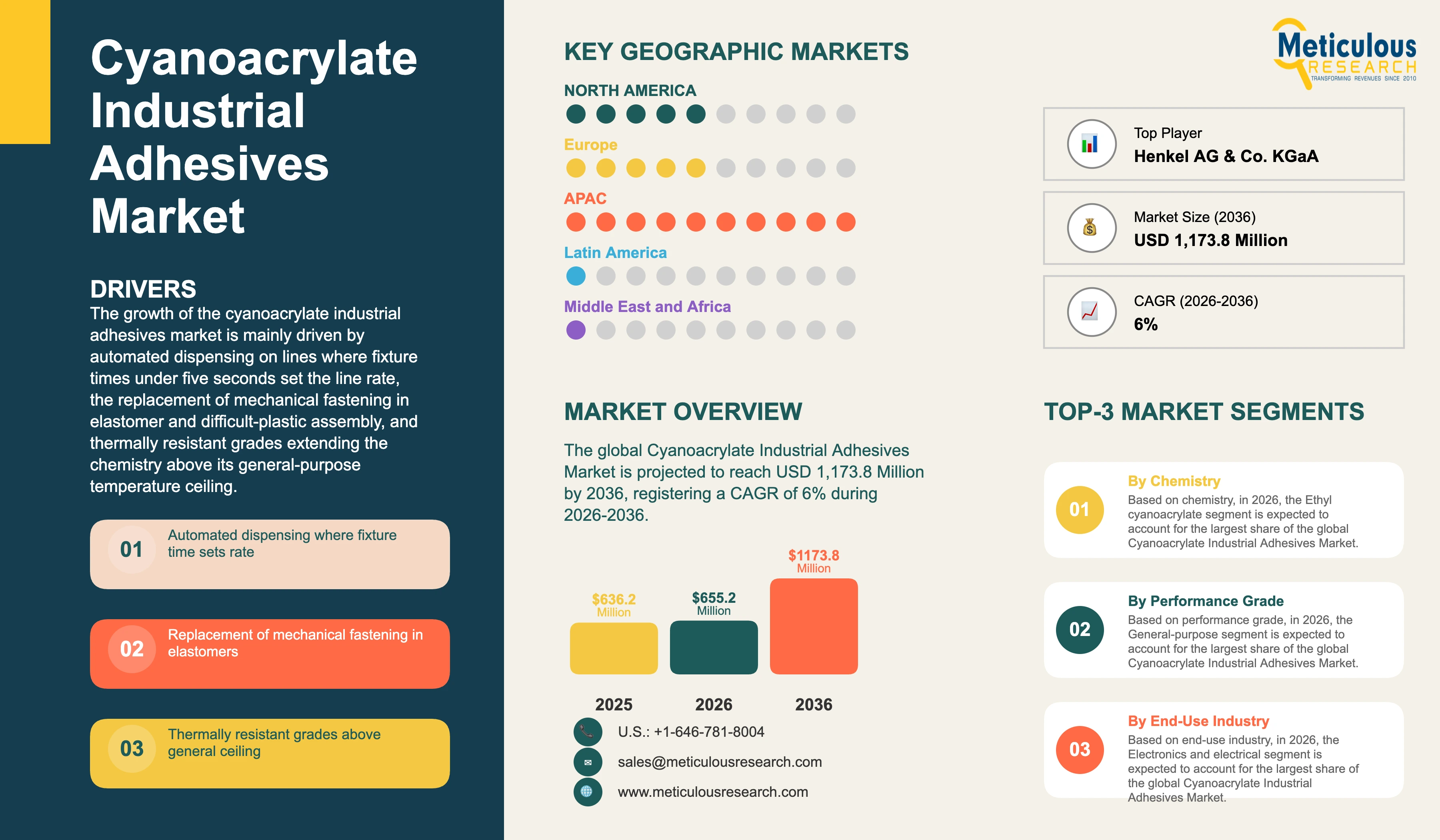
The global cyanoacrylate industrial adhesives market was valued at USD 636.2 million in 2025. This market is expected to reach USD 1,173.8 million by 2036 from an estimated USD 655.2 million in 2026, registering a CAGR of 6.0% during the forecast period (2026-2036).
- Published
- Nov 2026
- Pages
- 265
- Format
- PDF + Excel
- Report ID
- MRCHM - 1042649
- Base year
- 2025
- 2025 · BASELINE
- $636.2M
- 2036
- $1.17B
- CAGR 2026–2036
- 6.0%
2025 baseline · 2026–2036 forecast at 6.0% CAGR · hover a bar for the value
Key highlights
The global cyanoacrylate industrial adhesives market is estimated at USD 655.2 million in 2026 and is projected to reach USD 1,173.8 million by 2036.
Market volume is estimated at 15.60 kilotons in 2026 and is projected to reach 31.30 kilotons by 2036 at a CAGR of 7.2%.
The average selling price is estimated at USD 42.00 per kg in 2026 and is projected to reach USD 37.50 per kg by 2036.
Ethyl cyanoacrylate is expected to account for the largest chemistry share in 2026, while alkoxy alkyl cyanoacrylate is projected to register the highest CAGR of 7.8%.
General-purpose grades are expected to hold the largest performance grade share in 2026, while light cure and dual cure grades are projected to grow fastest at a CAGR of 8.6%.
Medium viscosity products are expected to account for the largest viscosity share in 2026, while gel and thixotropic products are projected to register the highest CAGR of 7.1%.
Electronics and electrical is expected to be the largest end-use industry in 2026, while medical devices are projected to grow fastest at a CAGR of 8.2%.
Asia-Pacific is expected to hold the largest regional share in 2026, and it is also projected to register the highest CAGR of 7.0%.
Henkel states instant bond fixture times of under five seconds and two-part cyanoacrylate fix times as low as 15 seconds for its instant adhesive range.
Permabond reports a fixture time of 2 to 3 seconds for grade 792, a surface insensitive very fast set product with higher temperature resistance.
Permabond states that most cyanoacrylates reach a service temperature ceiling of around 80 to 90 degrees Celsius.
Permabond grade 825 is stated to resist up to 200 degrees Celsius without a secondary cure and to retain 80% of strength after 1,000 hours at 180 degrees Celsius.
Permabond grades 919, 920 and 922 are stated to resist 250 degrees Celsius after post cure.
Permabond grade 751 is stated at 150% elongation at break with shear strength above 10 N per square millimetre on many metals, and passes ISO 10993-5 cytotoxicity testing.
Annex II of the Classification, Labelling and Packaging Regulation requires mixtures containing cyanoacrylates to carry a specific warning that the adhesive bonds skin and eyes in seconds.
The Council confirmed on 17 November 2025 that CLP labelling provisions originally applying from 1 July 2026 and 1 January 2027 are deferred to 1 January 2028.
Report summary
| Particulars | Details |
|---|---|
| Base Year | 2025 |
| Forecast Period | 2026-2036 |
| Market Size in 2025 | USD 636.2 million |
| Market Size in 2026 | USD 655.2 million |
| Market Size by 2036 | USD 1,173.8 million |
| Value CAGR (2026-2036) | 6.0% |
| Format | PDF, Excel & Cloud Portal · 265 pages |
| Volume in 2026 | 15.60 kilotons |
| Volume by 2036 | 31.30 kilotons |
| Volume CAGR (2026-2036) | 7.2% |
| Average Selling Price in 2026 | USD 42.00 per kg |
| Average Selling Price by 2036 | USD 37.50 per kg |
| Measurement Basis | Cyanoacrylate adhesive supplied for industrial assembly, maintenance and repair, excluding retail consumer packs, topical skin closure products regulated as medical devices, and the activators, primers and debonders sold alongside the adhesive |
| Largest Chemistry Segment | Ethyl cyanoacrylate |
| Fastest-Growing Chemistry Segment | Alkoxy alkyl cyanoacrylate (CAGR 7.8%) |
| Largest Performance Grade Segment | General purpose |
| Fastest-Growing Performance Grade Segment | Light cure and dual cure (CAGR 8.6%) |
| Largest Viscosity Segment | Medium viscosity |
| Fastest-Growing Viscosity Segment | Gel and thixotropic (CAGR 7.1%) |
| Largest End-Use Industry | Electronics and electrical |
| Fastest-Growing End-Use Industry | Medical devices (CAGR 8.2%) |
| Largest Region | Asia-Pacific |
| Fastest-Growing Region | Asia-Pacific (CAGR 7.0%) |
| Segments Covered | Chemistry, Performance Grade, Viscosity, End-Use Industry, and Geography |
| Geographies Covered | Asia-Pacific, Europe, North America, Latin America, and Middle East & Africa |
| Companies Profiled | 13 companies, including Henkel AG & Co. KGaA, H.B. Fuller Company, 3M Company, Toagosei Co., Ltd., Arkema S.A., and Permabond Engineering Adhesives Limited |
Report overview
Segments covered: chemistry, performance grade, viscosity, end-use industry.
In volume terms, this market is estimated at 15.60 kilotons in 2026 and is projected to reach 31.30 kilotons by 2036, registering a CAGR of 7.2% during the same period. The average selling price is estimated at USD 42.00 per kg in 2026 and is projected to decline to USD 37.50 per kg by 2036 as bulk packaging displaces small-pack supply on automated lines and monomer capacity in Asia-Pacific widens.
The growth of this market is mainly driven by automated dispensing on high-volume assembly lines where fixture times under five seconds set the line rate, the replacement of mechanical fastening in elastomer and difficult-plastic assembly, the thermally resistant grades that extend cyanoacrylate above the temperature ceiling of general-purpose products, and medical device assembly using cytotoxicity-tested grades. However, factors such as the blooming and odour that limit standard grades in visible and enclosed assemblies, and the moisture sensitivity that imposes shelf life and cold storage requirements on the supply chain, are expected to restrain the growth of this market to some extent.
Ethyl cyanoacrylate accounts for the largest share of this market because it carries general-purpose bonding across metals, plastics and elastomers at the lowest cost per joint of the available chemistries. Alkoxy alkyl cyanoacrylate grows faster because the low odour and non-blooming behaviour it provides is the condition for use in enclosed electronic assemblies and on visible surfaces.
Cyanoacrylate industrial adhesives are single-component esters of cyanoacrylic acid that polymerise on contact with surface moisture to form a rigid bond within seconds. Market sizing in this report is on both a value basis in USD and a volume basis in kilotons, with average selling price derived from the two. The measurement basis is cyanoacrylate adhesive supplied for industrial assembly, maintenance and repair, and it excludes retail consumer packs, topical skin closure products regulated as medical devices, and the activators, primers and debonders sold alongside the adhesive.
Permabond Engineering Adhesives Limited groups its range by chemistry into ethyl cyanoacrylate for general purpose bonding, methyl cyanoacrylate for specialised metal bonding, and alkoxy cyanoacrylate for low odour and low bloom work, describing the last of these as alkoxy alkyl cyanoacrylates. Henkel AG & Co. KGaA groups its instant adhesive offering by product type into two-part cyanoacrylate adhesive, instant adhesive gel and instant bond adhesives, and then by attribute into high strength, high temperature, high toughness, light cure, low odour and low bloom, and surface insensitive. Both suppliers therefore sell against a performance attribute and a viscosity rather than against a monomer, and the chemistry sits behind the selection rather than driving it.
Fixture speed is what the product is specified for. Henkel states instant bond fixture times of under five seconds and two-part cyanoacrylate fix times as low as 15 seconds, which prevents sagging, and notes that metal bonds need no clamping. Permabond reports a fixture time of 2 to 3 seconds for grade 792. On an automated line the fixture time rather than the ultimate strength sets how fast parts can index out of the bonding station, so a second saved at fixture converts directly into throughput. That relationship is why cyanoacrylate holds assembly positions where slower chemistries offer higher strength.
Temperature is the boundary of the chemistry and the axis on which it has moved most. Permabond states that most cyanoacrylates reach a ceiling of around 80 to 90 degrees Celsius, places grade 825 at up to 200 degrees Celsius without a secondary cure with 80% strength retained after 1,000 hours at 180 degrees Celsius, and lists grades 919, 920 and 922 as resisting 250 degrees Celsius after post cure. Henkel carries a high temperature position under LOCTITE 3092. Each step upward opens assemblies that were previously closed to cyanoacrylate, and the grades carrying the higher ratings price above the general-purpose products.
Substrate difficulty rather than substrate variety governs grade selection. Henkel names nitrile, butyl, polyurethane, silicone, EPDM and natural rubber among its elastomer substrates and polypropylene and polyethylene among the plastics, with metal, wood and paper alongside. Permabond lists mild and stainless steel, aluminium and brass, polycarbonate, polypropylene, polyethylene, PTFE and other polyolefins, rubbers, composites, silicone and ceramics, and separates acidic or plated surfaces as the case for surface insensitive grades. Low-energy polyolefins and acidic surfaces either inhibit cure or demand a primer, so the grade that bonds them without surface preparation removes a process step rather than only improving a bond.
Blooming and odour set the limits of the general-purpose chemistry. Cyanoacrylate monomer that volatilises before it polymerises settles as a white deposit near the bond line, which is unacceptable on a visible surface or inside a sealed optical or electronic assembly. Permabond identifies grades 940 and 943 as low odour and non-blooming in wicking and general-purpose forms, and Henkel carries the same position under LOCTITE 4310. The alkoxy alkyl chemistry that delivers the behaviour costs more per kilogram than ethyl, so the choice is made on assembly appearance and enclosure rather than on bond performance.
Cure in shadowed areas is addressed by combining mechanisms. Henkel states that its light cure grades cure where light reaches and moisture cure in dark areas, and carries LOCTITE 4080 in that position, while Permabond lists 130UV and 135UV as dual-cure products. A dual-cure product gives an immediate fixture on exposed bond line and completes cure under the part where light cannot reach, which suits bonded assemblies with hidden joints. The two-part route addresses the same problem differently, since a mixed system cures through a gap without depending on surface moisture or light.
Labelling obligations attach to the chemistry itself. Annex II of the Classification, Labelling and Packaging Regulation requires mixtures containing cyanoacrylates to carry a specific warning stating that the adhesive bonds skin and eyes in seconds, which applies whatever the grade or the industrial setting. Regulation (EU) 2024/2865, the revision of the Classification, Labelling and Packaging Regulation, which entered into force on 10 December 2024 adds further labelling and format requirements, and the Council confirmed on 17 November 2025 that provisions originally applying from 1 July 2026 and 1 January 2027 are deferred to 1 January 2028 under the Omnibus VI simplification package. Permabond states that its products are not labelled for consumer use, which is the commercial boundary between the industrial supply covered here and the retail packs that are not.
Electronics and electrical is expected to hold the largest share in 2026.
Medical devices are projected to register the highest CAGR of 8.2% during the forecast period.
Asia-Pacific is expected to account for the largest share in 2026, and it is also projected to register the highest CAGR of 7.0%, supported by electronics assembly concentration and regional monomer and formulation capacity. China is projected to grow at 7.4% and India at 9.2%.
Asia-Pacific is projected to register the highest CAGR of 7.0% during the forecast period.
Europe is projected to grow at a CAGR of 4.8%, supported by automotive and industrial assembly and by the presence of Henkel, Permabond, Arkema, Chemence and Afinitica. Germany is projected to register a CAGR of 4.4%.
The Middle East & Africa is projected to grow at a CAGR of 6.2% from a small base, served through distribution rather than regional formulation. Latin America is projected to grow at a CAGR of 5.8%, with Mexico the principal market as electronics and automotive assembly locates there.
Henkel AG & Co. KGaA, H.B. Fuller Company, 3M Company, Toagosei Co., Ltd. and Arkema S.A. together accounted for an estimated 57.0% of this market in 2026. The 13 companies profiled in this report together accounted for an estimated 83.0%.
Report infographic
Market dynamics
15 factors across 5 forcesAutomated Dispensing on Lines Where Fixture Time Sets the Rate
Fixture time rather than ultimate strength determines how fast a part can index out of a bonding station, and Henkel states instant bond fixture times of under five seconds with two-part cyanoacrylate fix times as low as 15 seconds. Permabond reports 2 to 3 seconds for grade 792. A line running at those rates needs no clamping fixture and no oven, which Henkel notes for metal bonds, so the bonding station occupies less floor space and less capital than a thermally cured alternative. Henkel sells dispensing equipment and custom dispensing tools within the same offering as the adhesive, which indicates that the dispensing system rather than the bottle is what a line buyer specifies. Volume per line rises with cycle rate rather than with bond area, so automation raises consumption without changing the joint design. Dose accuracy rather than bond strength governs consistency at those rates, since the quantity applied is measured in milligrams and a line indexing every few seconds leaves no opportunity to inspect a joint before the next part arrives.
Replacement of Mechanical Fastening in Elastomer and Difficult-Plastic Assembly
Henkel names nitrile, butyl, polyurethane, silicone, EPDM and natural rubber as cyanoacrylate substrates alongside polypropylene and polyethylene, and Permabond lists grade 105 for elastomer bonding and PTFE and other polyolefins among its substrates. An elastomer cannot be bolted or welded, and a snap fit in a low-energy plastic adds tooling cost and a failure mode that a bonded joint does not have. Permabond grade 751 is stated at 150% elongation at break with shear strength above 10 N per square millimetre on many metals, which allows a joint to flex with the part rather than concentrating load at a fastener. Substitution of this kind removes components from a bill of materials rather than competing with another adhesive, so it adds volume to the market rather than redistributing it. Permabond separates grades 101, 102 and 200 for plastic bonding and 105 for elastomer bonding within the same range, which indicates the substrate groups are served by distinct formulations rather than by one general product stretched across them.
Thermally Resistant Grades Extending Cyanoacrylate Above the General-Purpose Ceiling
Permabond places most cyanoacrylates at a service ceiling of around 80 to 90 degrees Celsius, which has historically kept the chemistry out of under-bonnet, motor and lighting assemblies. Grade 825 is stated at up to 200 degrees Celsius without a secondary cure, retaining 80% of strength after 1,000 hours at 180 degrees Celsius, and grades 919, 920 and 922 are stated to resist 250 degrees Celsius after post cure. Henkel carries the same position under LOCTITE 3092. Each assembly brought inside the temperature envelope is one previously served by an epoxy or a mechanical fastener, and the thermally resistant grades carry a price per kilogram above the general-purpose products, so the extension raises value faster than volume within the segment. Post cure is the qualifying condition on the highest ratings, so an assembly reaching 250 degrees Celsius accepts an added process step that the 200 degree grade avoids, and the choice between them is made on line capability rather than on temperature alone.
Medical Device Assembly Using Cytotoxicity-Tested Grades
Permabond states that grade 751 passes ISO 10993-5 cytotoxicity testing and lists medical device bonding as its application, while Henkel names medical among the industries its instant adhesives serve. Needle bonding, catheter and tubing assembly, and the joining of moulded polymer housings all require a fixture in seconds on parts too small and too thin-walled to clamp. Biological evaluation evidence is held per grade rather than per supplier, so a device manufacturer qualifies a specific product and holds it for the life of the device file. Device assembly volumes are small per joint but the grades carry the highest price per kilogram in the market, which is why the segment contributes value out of proportion to the kilograms it consumes. Permabond names aerospace, defence and transportation alongside medical for grade 910, which shows the same qualification discipline applying wherever a joint enters a controlled product file.
Table of contents
12 chapters · 136 sections · 265 pages · click to expandSegmental analysis
| Segment | Largest share (2026) | Fastest growth (2026–2036) |
|---|---|---|
| By Chemistry | Ethyl cyanoacrylate | Alkoxy alkyl cyanoacrylate |
| By Performance Grade | General-purpose | Light cure and dual cure |
| By Viscosity | Medium viscosity | Gel and thixotropic |
| By End-Use Industry | Electronics and electrical | Medical devices |
| Other segments | General-purpose grades | Light cure and dual cure grades |
By Chemistry
- Cyanoacrylate Industrial Adhesives Market Analysis by Chemistry
- The ethyl cyanoacrylate segment is expected to account for the largest share of the global cyanoacrylate industrial adhesives market.
- The large share of this segment is mainly due to the general-purpose position Permabond assigns it across metals, plastics and elastomers, the lowest cost per joint among the available chemistries, and the breadth of viscosity and performance combinations available in it, from wicking grades through thixotropic gels to toughened and surface insensitive products.
- Permabond grade 910 sits in this chemistry as its original general-purpose metal bonding product, which indicates how long the installed specification base has been in place.
- However, the alkoxy alkyl cyanoacrylate segment is projected to register the highest CAGR of 7.8% during the forecast period.
- The rapid growth of this segment is attributed to the low odour and non-blooming behaviour that Permabond assigns to the chemistry and carries in grades 940 and 943, the sealed electronic and optical assemblies that cannot tolerate a volatile deposit on a contact or a lens, and the enclosed workspaces where odour limits the use of ethyl grades independently of the assembly.
- Device miniaturisation shortens the distance between bond line and sensitive surface, which tightens the requirement as products shrink.
- Methyl cyanoacrylate holds specialised metal bonding where Permabond positions it, and butyl and octyl esters carry the flexible and biologically evaluated grades, with Permabond 751 stated at 150% elongation at break and passing ISO 10993-5 cytotoxicity testing.
- The remaining chemistries occupy narrow positions defined by a single property requirement rather than by a substrate or an industry.
- Ethyl cyanoacrylate is expected to account for the largest share in 2026, supported by its general-purpose position across metals, plastics and elastomers.
- Alkoxy alkyl cyanoacrylate is projected to register the highest CAGR of 7.8% during the forecast period.
By Performance Grade
- Cyanoacrylate Industrial Adhesives Market Analysis by Performance Grade
- The general-purpose segment is expected to account for the largest share of the global cyanoacrylate industrial adhesives market.
- The large share of this segment is mainly due to the volume of routine bonding across industrial assembly and maintenance where no single property is governing, the position Permabond assigns to grades 240 and 910 and Henkel to its core instant adhesive range, and the absence of a qualification requirement that would push a user toward a specialised grade.
- However, the light cure and dual cure segment is projected to register the highest CAGR of 8.6% during the forecast period.
- The rapid growth of this segment is attributed to the combined mechanism Henkel describes, curing where light reaches and moisture curing in dark areas, which addresses shadowed bond lines that neither route serves alone, the positional control a light-triggered fixture gives a robot or operator, and the cure confirmation that optical, display and sensor assembly processes require as part of the production record.
- Permabond carries 130UV and 135UV in this position and Henkel LOCTITE 4080.
- Permabond lists 130UV as a UV cure cyanoacrylate within its standard data sheet range rather than as a specialty item, which indicates the mechanism has moved into routine supply.
- Toughened grades hold the assemblies where peel and impact rather than shear govern, with Permabond listing 731 and 737 for peel, shear and impact strength in clear and black forms.
- Surface insensitive grades hold acidic and plated substrates that would otherwise need a primer operation, and thermally resistant grades hold the assemblies above the general-purpose temperature ceiling.
By Viscosity
- Cyanoacrylate Industrial Adhesives Market Analysis by Viscosity
- The medium viscosity segment is expected to account for the largest share of the global cyanoacrylate industrial adhesives market.
- The large share of this segment is mainly due to the tolerance it offers across both close-fitting and slightly imperfect joints without wicking away or sagging, the suitability for manual and semi-automated application where dose control is less precise, and the breadth of chemistry and performance combinations offered in it.
- However, the gel and thixotropic segment is projected to register the highest CAGR of 7.1% during the forecast period.
- The rapid growth of this segment is attributed to vertical surface and overhead application where a liquid runs before it cures, the gap filling that Permabond assigns to grade 2010 for maximum gap fill and 2011 as a non-sag surface insensitive gel, and the operator control a non-drip product gives in assembly and repair work.
- Henkel carries instant adhesive gel as a distinct product type for vertical surfaces and gap filling rather than as a viscosity variant.
- Wicking and low viscosity products hold the joints that are assembled before the adhesive is applied, where the liquid is drawn into an already closed fit by capillary action, and Permabond assigns grades 101 and 919 to that method.
- Retrofit and repair of bonded or press-fitted assemblies depends on it, since no other application route reaches a bond line that cannot be opened.
By End-Use Industry
- Cyanoacrylate Industrial Adhesives Market Analysis by End-Use Industry
- The electronics and electrical segment is expected to account for the largest share of the global cyanoacrylate industrial adhesives market.
- The large share of this segment is mainly due to the joint count per assembly in wire tacking, component staking, speaker and magnet bonding and connector retention, the fixture times under five seconds that match electronics line rates, and the small dose per joint that suits a chemistry sold by the gram rather than the kilogram.
- However, the medical devices segment is projected to register the highest CAGR of 8.2% during the forecast period.
- The rapid growth of this segment is attributed to needle, catheter and tubing assembly on parts too small and thin-walled to clamp, the biological evaluation evidence that grades such as Permabond 751 carry through ISO 10993-5 cytotoxicity testing, and the device file qualification that holds a selected grade for the life of the product.
- Grades serving this segment carry the highest price per kilogram in the market, so it contributes value out of proportion to the volume it consumes.
Other segments
- General-purpose grades are expected to hold the largest share in 2026.
- Light cure and dual cure grades are projected to register the highest CAGR of 8.6% during the forecast period.
- Medium viscosity products are expected to account for the largest share in 2026.
- Gel and thixotropic products are projected to register the highest CAGR of 7.1% during the forecast period.
Geographic analysis
Asia-Pacific
Largest shareIn 2026, Asia-Pacific is expected to account for the largest share of the global cyanoacrylate industrial adhesives market, and it is also projected to register the highest CAGR of 7.0% during the forecast period. The large share and rapid growth of this region are mainly due to the concentration of electronics assembly across China, Taiwan, South Korea, Vietnam and Malaysia where joint count per assembly and line rate both favour the chemistry, the cyanoacrylate monomer and formulation capacity sited in the region including Toagosei Co., Ltd. and Taoka Chemical Co., Ltd. in Japan and Guangzhou Baiyun Chemical Industry Co., Ltd. in China, and the medical device and consumer goods manufacturing added across southeast Asia. China is projected to register a CAGR of 7.4% and India a CAGR of 9.2% during the forecast period. Japan is projected to register a CAGR of 4.6%. Monomer supply rather than formulation capability explains the regional structure. Cyanoacrylate monomer is produced at a small number of sites, with Japanese producers long established in it, and formulation into graded products is a comparatively light operation that can sit close to demand. Shelf life and refrigerated storage limit how far a finished product travels economically, which keeps filling and packaging regional while monomer moves internationally. The division concentrates value capture upstream in Asia-Pacific and leaves the branded positions with suppliers close to the assembly plants.
Europe
Europe holds the second-largest share, supported by automotive and industrial assembly and by the presence of Henkel AG & Co. KGaA, Permabond Engineering Adhesives Limited, Arkema S.A., Chemence Limited and Afinitica Technologies, S.L., and the region is projected to grow at 4.8%. The labelling obligations in Annex II of the Classification, Labelling and Packaging Regulation apply across the region, and the deferral confirmed on 17 November 2025 moves the further requirements to 1 January 2028. Germany is projected to register a CAGR of 4.4% during the forecast period.
North America
North America is projected to grow at 5.2%, supported by medical device manufacturing, aerospace and defence assembly and the industrial maintenance channel, with 3M Company, H.B. Fuller Company, Dymax Corporation and Master Bond, Inc. supplying the market. The United States is projected to register a CAGR of 5.3%.
Latin America
Latin America is projected to grow at 5.8%, with Mexico the principal market as electronics and automotive assembly locates there, and Brazil holding the industrial maintenance demand.
Middle East & Africa
The Middle East & Africa is projected to grow at 6.2% from a small base, served through distribution rather than regional formulation.
Competitive landscape
The global cyanoacrylate industrial adhesives market is characterised by the presence of diversified adhesive companies, cyanoacrylate specialists and monomer producers serving industrial assembly plants and maintenance distribution. Competition is contested on the breadth of the graded range rather than on the monomer, since an assembly plant selects on fixture time, viscosity, bloom behaviour, temperature rating and substrate tolerance and prefers to source the combinations it needs from one supplier. Henkel AG & Co. KGaA, H.B. Fuller Company, 3M Company, Toagosei Co., Ltd. and Arkema S.A. together accounted for an estimated 57.0% of this market in 2026, while the companies profiled in this report together accounted for an estimated 83.0%.
Henkel AG & Co. KGaA organises its instant adhesive offering into two-part cyanoacrylate adhesive, instant adhesive gel and instant bond adhesives, and holds named attribute positions with LOCTITE 4902 for high strength, LOCTITE 3092 for high temperature, LOCTITE 4203 for high toughness, LOCTITE 4080 for light cure and LOCTITE 4310 for low odour and low bloom, alongside dispensing equipment and custom dispensing tools supplied with the adhesive. Permabond Engineering Adhesives Limited publishes a graded range spanning wicking, thixotropic and gel forms, surface insensitive grades 791 and 792, toughened grades 731 and 737, low odour and non-blooming grades 940 and 943, the flexible grade 751 at 150% elongation passing ISO 10993-5, high temperature grade 825 at 200 degrees Celsius without post cure, and grades 919, 920 and 922 resisting 250 degrees Celsius after post cure. Graded range breadth, dispensing integration and published thermal ageing data accounted for most competitive activity through 2026.
Monomer producers and regional specialists hold positions that the branded suppliers do not contest directly. Toagosei Co., Ltd. and Taoka Chemical Co., Ltd. in Japan combine monomer production with formulated product, which gives them a cost position in Asia-Pacific, while Chemence Limited and Afinitica Technologies, S.L. supply formulated and private-label cyanoacrylate into European distribution. Some of the key players operating in the cyanoacrylate industrial adhesives market are Henkel AG & Co. KGaA (Germany), H.B. Fuller Company (U.S.), 3M Company (U.S.), Toagosei Co., Ltd. (Japan), Arkema S.A. (France), Permabond Engineering Adhesives Limited (U.K.), ThreeBond Holdings Co., Ltd. (Japan), Taoka Chemical Co., Ltd. (Japan), Chemence Limited (U.K.), Afinitica Technologies, S.L. (Spain), Dymax Corporation (U.S.), Master Bond, Inc. (U.S.), and Guangzhou Baiyun Chemical Industry Co., Ltd. (China), among others.
- —
The Council gave final approval on 17 November 2025 to deferring CLP labelling provisions from 1 July 2026 and 1 January 2027 to 1 January 2028 under the Omnibus VI simplification package, following the entry into force of Regulation (EU) 2024/2865 on 10 December 2024. Henkel holds named attribute positions across LOCTITE 4902, 3092, 4203, 4080 and 4310 and supplies dispensing equipment with the adhesive, while Permabond publishes thermal ageing retention of 80% after 1,000 hours at 180 degrees Celsius for grade 825.
- Henkel AG & Co. KGaA
- H.B. Fuller Company
- 3M Company
- Toagosei Co., Ltd.
- Arkema S.A.
- Permabond Engineering Adhesives Limited
Expert perspectives
Volume grows at 7.2% against 6.0% in value over the forecast period, and the average selling price falls from USD 42.00 per kg in 2026 to USD 37.50 per kg by 2036 as bulk packaging displaces small-pack supply on automated lines and monomer capacity in Asia-Pacific widens. Packaging rather than chemistry carries much of the price in this market, since a product sold in 20 gram bottles costs several times per kilogram what the same formulation costs in a litre container.
Fixture speed is what the chemistry is bought for, and it is the only axis on which cyanoacrylate outperforms every alternative. Henkel states fixture under five seconds and two-part fix as low as 15 seconds, Permabond 2 to 3 seconds for grade 792, and a metal bond that needs no clamping removes a fixture and an oven from the station. Where cycle time does not govern, epoxies and structural acrylics take the joint on service envelope and bond line thickness, so the market grows with assembly automation rather than with adhesive demand generally.
Temperature is where the chemistry has moved and where the pricing sits. A general-purpose grade stops at around 80 to 90 degrees Celsius on the Permabond statement, grade 825 reaches 200 degrees Celsius without post cure and retains 80% of strength after 1,000 hours at 180 degrees Celsius, and grades 919, 920 and 922 reach 250 degrees Celsius with post cure. Published retention after a stated exposure rather than a peak rating is what an engineer designs against, and suppliers holding that data compete for assemblies that the peak-rating products cannot be qualified for.
Bloom and odour decide more specifications than bond strength does. Both Henkel and Permabond maintain dedicated low odour and non-blooming positions, and no process control substitutes for the alkoxy alkyl chemistry that delivers the behaviour. Sealed electronic and optical assemblies cannot be cleaned after closure, and miniaturisation shortens the distance between the bond line and the surfaces that matter, so the requirement tightens as products shrink rather than easing.
Dispensing integration holds the account more durably than the formulation does. Henkel supplies dispensing equipment and custom tools within the same offering, and changing adhesive brand on a qualified dispensing head means requalifying a dose measured in milligrams. The adhesive is reordered rather than retendered once a line is running, which is why share in this market moves at the rate new lines are commissioned rather than at the rate contracts come up.
The labelling position is settled in substance and unsettled in timing. Annex II of the Classification, Labelling and Packaging Regulation requires the skin and eye bonding warning on every cyanoacrylate mixture whatever the grade, and the Council confirmed on 17 November 2025 that the further CLP provisions move from 1 July 2026 and 1 January 2027 to 1 January 2028. Suppliers that built artwork programmes to the original dates carry that cost ahead of the obligation while the substantive revisions remain under negotiation.
Customer perspectives
Fixture time and bloom behaviour rather than bond strength decide grade selection in electronics assembly, and the low-bloom premium is accepted because no process step substitutes for it once an assembly is sealed.
Device file qualification holds a selected grade for the product life and makes substitution a regulatory rather than a commercial decision, which concentrates medical volume with the grades already carrying biological evaluation evidence.
Maintenance demand turns on substrate tolerance and on pack size set by shelf life rather than by consumption, which keeps small-pack supply and its packaging cost structurally in the market.
“Fixture time is our line rate. If a drop holds in three seconds the part indexes out and we need no fixture and no oven at that station, and that is why we use this chemistry rather than an epoxy. What we cannot have is bloom, because the assembly is sealed and nobody is cleaning a lens after the lid goes on. We pay the premium for the low-bloom grade and we do not treat it as optional.”
“The grade goes into the device file, so once it is qualified we hold it for the life of the product. Biological evaluation evidence sits with the specific product, not with the supplier, which means a substitution is a regulatory exercise rather than a purchasing one. We assemble parts that are too thin to clamp, so a chemistry that fixtures in seconds without a jig is what makes the process possible.”
“We buy on substrate tolerance, because we are bonding rubber, plated metal and whatever the machine is made of, often in situ with no surface preparation possible. The surface insensitive grades save us the primer step, which matters more than the price on the bottle. Shelf life is our real problem, since a part-used bottle in a workshop does not last and we end up buying smaller packs than we would like.”
Frequently asked questions
This market was valued at USD 617.8 million in 2024 and USD 636.2 million in 2025, and is estimated at USD 655.2 million in 2026. In volume terms it is estimated at 15.60 kilotons in 2026.
Cite this report
Meticulous Research. (2026). Cyanoacrylate Industrial Adhesives Market - Global Opportunity Analysis and Industry Forecast (2026-2036) (Report No. MRCHM - 1042649). Meticulous Market Research Pvt. Ltd. https://www.meticulousresearch.com/product/cyanoacrylate-industrial-adhesives-market-7332