Fire Stopping Sealants Market (2026-2036)
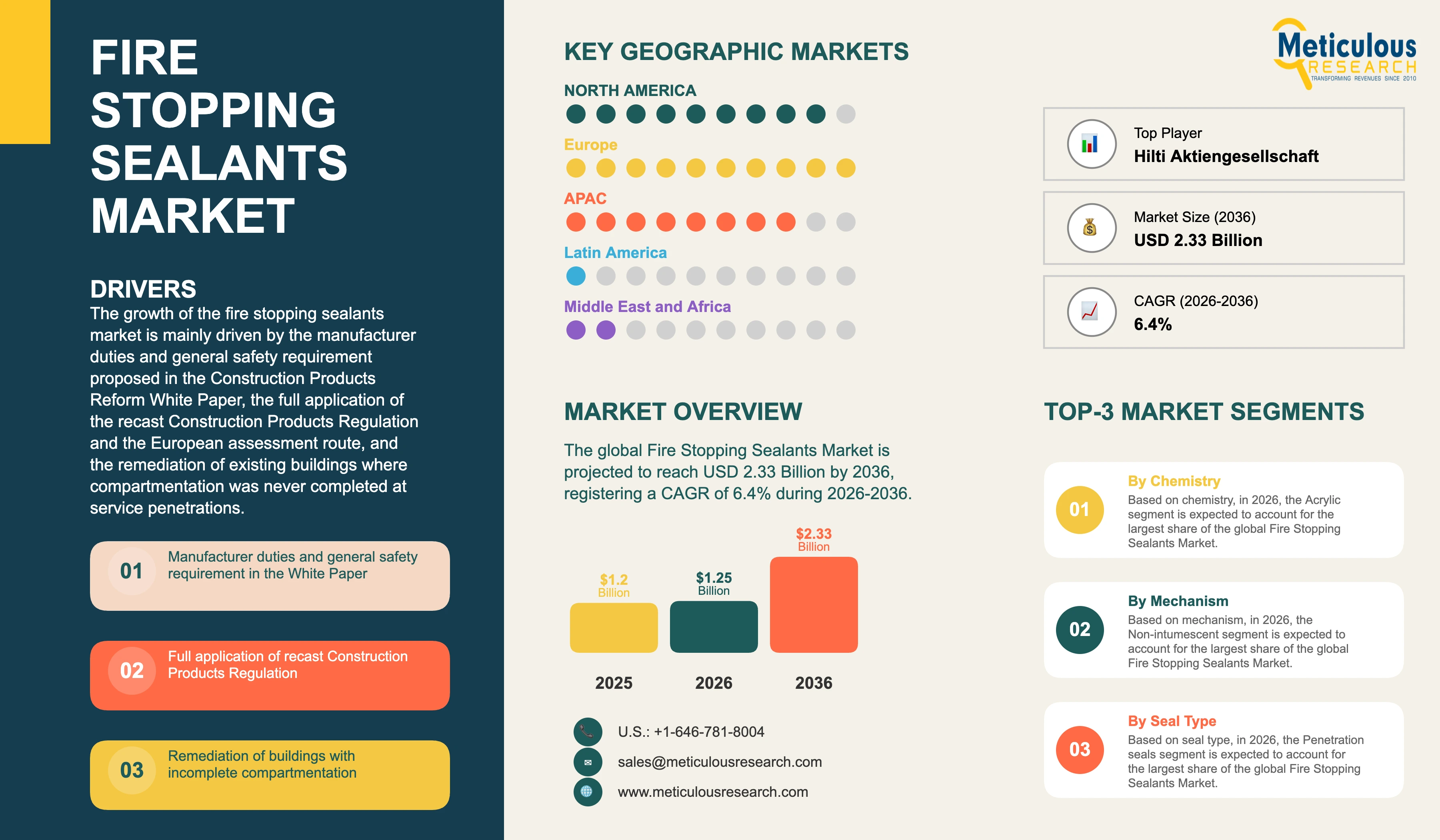
The global fire stopping sealants market was valued at USD 1.20 billion in 2025. This market is expected to reach USD 2.33 billion by 2036 from an estimated USD 1.25 billion in 2026, registering a CAGR of 6.4% during the forecast period (2026-2036).
- Published
- Nov 2026
- Pages
- 280
- Format
- PDF + Excel
- Report ID
- MRCHM - 1042651
- Base year
- 2025
- 2025 · BASELINE
- $1.20B
- 2036
- $2.33B
- CAGR 2026–2036
- 6.4%
2025 baseline · 2026–2036 forecast at 6.4% CAGR · hover a bar for the value
Key highlights
The global fire stopping sealants market is estimated at USD 1.25 billion in 2026 and is projected to reach USD 2.33 billion by 2036.
Market volume is estimated at 112.00 kilotons in 2026 and is projected to reach 228.80 kilotons by 2036 at a CAGR of 7.4%.
The average selling price is estimated at USD 11.20 per kg in 2026 and is projected to reach USD 10.20 per kg by 2036.
Acrylic is expected to account for the largest chemistry share in 2026, while silicone is projected to register the highest CAGR of 7.0%.
Non-intumescent sealants are expected to hold the largest mechanism share in 2026, while intumescent sealants are projected to grow fastest at a CAGR of 8.2%.
Penetration seals are expected to be the largest seal type in 2026, while linear joint seals are projected to register the highest CAGR of 7.2%.
Use condition Type Z is expected to account for the largest share in 2026, while Type X weathering is projected to register the highest CAGR of 8.6%.
Commercial and institutional buildings are expected to be the largest end-use sector in 2026, while residential buildings are projected to grow fastest at a CAGR of 7.8%.
Europe is expected to hold the largest regional share in 2026, while Asia-Pacific is projected to register the highest CAGR of 8.4%.
The Construction Products Reform White Paper was published on 25 February 2026, with a 12-week consultation that closed on 20 May 2026.
That White Paper cites research estimating that only around 37% of the United Kingdom construction products market is regulated under the construction products regulations, within a range of 29% to 61%.
It proposes criminal offences for companies and individuals punishable by unlimited fine or imprisonment, licensing of all United Kingdom conformity assessment bodies, and digital product information as the default.
Regulation (EU) 2024/3110 entered full application on 7 January 2026, and applies to products covered by a harmonised standard or a European assessment document cited in the Official Journal.
EAD 350454-00-1104 assesses twelve essential characteristics for penetration seals, covering reaction to fire, resistance to fire, air and water permeability, dangerous substances, mechanical resistance, impact and movement, adhesion, durability, airborne sound insulation, thermal properties and water vapour permeability.
That assessment document assumes a working life of 25 years when a product is installed correctly, and assesses products containing reactive materials for 10 or 25 years depending on the evidence available.
Hilti publishes volatile organic compound content by product, from 1 g per litre for FS-ONE MAX to 101 g per litre for CP-572.
Report summary
| Particulars | Details |
|---|---|
| Base Year | 2025 |
| Forecast Period | 2026-2036 |
| Market Size in 2025 | USD 1.20 billion |
| Market Size in 2026 | USD 1.25 billion |
| Market Size by 2036 | USD 2.33 billion |
| Value CAGR (2026-2036) | 6.4% |
| Format | PDF, Excel & Cloud Portal · 280 pages |
| Volume in 2026 | 112.00 kilotons |
| Volume by 2036 | 228.80 kilotons |
| Volume CAGR (2026-2036) | 7.4% |
| Average Selling Price in 2026 | USD 11.20 per kg |
| Average Selling Price by 2036 | USD 10.20 per kg |
| Measurement Basis | Gun-applied firestop sealant and mastic consumed in penetration seals and linear joint seals, excluding mortars, foams, boards, coated mineral wool slabs, pillows, putties, collars, wraps and pipe closure devices, firestop sprays and coatings, and intumescent coatings for structural steel |
| Largest Chemistry Segment | Acrylic |
| Fastest-Growing Chemistry Segment | Silicone (CAGR 7.0%) |
| Largest Mechanism Segment | Non-intumescent |
| Fastest-Growing Mechanism Segment | Intumescent (CAGR 8.2%) |
| Largest Seal Type Segment | Penetration seals |
| Fastest-Growing Seal Type Segment | Linear joint seals (CAGR 7.2%) |
| Largest Use Condition Type | Type Z internal conditions |
| Fastest-Growing Use Condition Type | Type X weathering (CAGR 8.6%) |
| Largest End-Use Sector | Commercial and institutional buildings |
| Fastest-Growing End-Use Sector | Residential buildings (CAGR 7.8%) |
| Largest Region | Europe |
| Fastest-Growing Region | Asia-Pacific (CAGR 8.4%) |
| Segments Covered | Chemistry, Mechanism, Seal Type, Use Condition Type, End-Use Sector, and Geography |
| Geographies Covered | Europe, North America, Asia-Pacific, Middle East & Africa, and Latin America |
| Companies Profiled | 12 companies, including Hilti Aktiengesellschaft, 3M Company, RPM International Inc., Sika AG, Etex NV, and Specified Technologies Inc. |
Report overview
Segments covered: chemistry, mechanism, seal type, use condition type, end-use sector.
In volume terms, this market is estimated at 112.00 kilotons in 2026 and is projected to reach 228.80 kilotons by 2036, registering a CAGR of 7.4% during the same period. The average selling price is estimated at USD 11.20 per kg in 2026 and is projected to decline to USD 10.20 per kg by 2036 as regional filling capacity expands and bulk sausage and pail supply displaces cartridge packaging on large remediation contracts.
The growth of this market is mainly driven by the manufacturer duties and general safety requirement proposed in the Construction Products Reform White Paper, the full application of the recast Construction Products Regulation and the European assessment route that governs market access for these products, the twelve essential characteristics that assessment requires beyond fire resistance alone, and the remediation of existing buildings where compartmentation was never completed at service penetrations. However, factors such as the dependence of a seal on installation quality rather than on product performance, and the assessment cost carried per tested system configuration rather than per product, are expected to restrain the growth of this market to some extent.
Acrylic accounts for the largest share of this market because water-based acrylic dispersions carry most cable and metal pipe penetration sealing at the lowest cost per cartridge and the lowest volatile organic compound content. Silicone grows faster because movement capability and water resistance are required at linear joints and at penetrations in semi-exposed positions that an acrylic cannot hold.
Fire stopping sealants are gun-applied sealant and mastic materials used to restore the fire resistance of a wall or floor where services pass through it or where a linear joint interrupts it. Market sizing in this report is on both a value basis in USD and a volume basis in kilotons, with average selling price derived from the two. The measurement basis is gun-applied firestop sealant and mastic consumed in penetration seals and linear joint seals, and it excludes mortars, foams, boards, coated mineral wool slabs, pillows, putties, collars, wraps and pipe closure devices, firestop sprays and coatings, and intumescent coatings for structural steel.
Hilti Aktiengesellschaft organises its firestop offering by type into sealants, sprays, foams and mortars, and filters that range by base material into aerated concrete, concrete, drywall, gypsum, masonry, metal, steel and wood, by application into cables, cable bundles, conduits, pipes, mixed penetration, joints and wall and floor penetrations, and by design condition into acoustics sealing, air and smoke tightness, mould and mildew resistance, thermal insulation and water resistance. The same range names water-based acrylic dispersions, silicones and an intumescent sealant as distinct chemistries. Specification therefore proceeds from the penetration type and the base material before any chemistry is selected, and the secondary performance requirements are selected alongside the fire rating rather than after it.
Assessment reaches well beyond fire performance. EAD 350454-00-1104, Fire Stopping and Fire Sealing Products: Penetration Seals, published by EOTA in September 2017 assesses twelve essential characteristics, covering reaction to fire, resistance to fire, air permeability, water permeability, content and release of dangerous substances, mechanical resistance and stability, resistance to impact and movement, adhesion, durability, airborne sound insulation, thermal properties and water vapour permeability. Resistance to fire is classified under EN 13501-2 following testing to EN 1366-3, reaction to fire under EN 13501-1 with EN 13823 and EN ISO 11925-2, air permeability to EN 1026, sound insulation to EN ISO 10140 and EN ISO 717-1, and emissions to EN 16516. A product carrying a fire rating and nothing else cannot complete the declaration that market access requires.
Use conditions are classified rather than assumed. The same assessment document separates Type X for weathering exposure, Types Y1 and Y2 for conditions below zero degrees Celsius with or without ultraviolet exposure and without rain, and Types Z1 and Z2 for internal conditions above or below 85% relative humidity, with Type X covering all the others. A sealant assessed only for internal dry conditions cannot be specified at a penetration in a car park, a plant room or an external wall, and the external and semi-exposed positions carry the narrowest set of qualified products. Specification consequently turns on the exposure class as much as on the fire rating.
The services permitted through an assessed seal are listed exhaustively rather than left open. Cables and cable carriers, bus bars, metal pipes and trunking with a melting point above 1,000 degrees Celsius, low-melting metal, glass and fibre cement pipes and trunking, and plastic pipes, trunking and conduits are the permitted services, while seals for chimneys, ventilation ducts, shafts, smoke extraction ducts and dampers fall outside the document. Plastic services require an intumescent mechanism because the pipe itself is consumed in a fire and the aperture has to be closed by expansion, while metal services and cables can be sealed by an elastomeric or ablative material. The service mix in a building therefore determines the chemistry mix on the project.
Durability is defined numerically and against a stated working life. The assessment document assumes a working life of 25 years when a product is installed correctly, assesses products containing reactive materials for 10 or 25 years depending on the evidence available, and accepts a change of no more than 15% in the mean value of relevant properties measured before and after exposure for materials not covered by a European standard. Buildings are designed for considerably longer than 25 years, so a seal installed at construction is a maintenance item within the life of the structure. That gap is what creates inspection and replacement demand independently of new construction.
The Construction Products Reform White Paper, published by the United Kingdom government on 25 February 2026 with a 12-week consultation that closed on 20 May 2026 proposes that manufacturers assess safety risks for a product in its intended and reasonably foreseeable conditions of use and take proportionate action, provide clear and accurate labelling and information, disclose third-party certification testing and share information affecting a certificate, and move to digital product information as the default with digital product records and identifiers. It would license all United Kingdom conformity assessment bodies through the national regulator, require those bodies to act in the public interest, place UKAS under regulator oversight, impose minimum transparency requirements on third-party certification schemes and create new public sector testing capacity. Criminal offences would apply to companies and individuals punishable by unlimited fine or imprisonment, with civil monetary penalties consulted on as an alternative.
The regulatory gap the White Paper identifies is the reason the proposals extend beyond tested products. Research cited in it estimates that only around 37% of the United Kingdom construction products market is regulated under the construction products regulations, within a range of 29% to 61%, and a risk-based general safety requirement is proposed for products outside designated standards. Regulation (EU) 2024/3110, the recast Construction Products Regulation, which entered full application on 7 January 2026 applies on the European side to products covered by a harmonised standard or a European assessment document cited in the Official Journal, which is the route firestop sealants take. The White Paper cites the third-party certification and competency model of the Association for Specialist Fire Protection as a practical example, which places installer competence alongside product assessment.
Use condition Type Z, covering internal conditions above and below 85% relative humidity, is expected to account for the largest share in 2026.
Type X weathering is projected to register the highest CAGR of 8.6% during the forecast period.
Commercial and institutional buildings are expected to hold the largest share in 2026.
Residential buildings are projected to register the highest CAGR of 7.8% during the forecast period.
Europe is expected to account for the largest share in 2026, supported by the European assessment framework and by the full application of Regulation (EU) 2024/3110 from 7 January 2026. The United Kingdom is projected to grow at 7.0% and Germany at 5.2%.
Asia-Pacific is projected to register the highest CAGR of 8.4% during the forecast period, with China at 9.2% and India at 10.6%.
Europe is projected to grow at a CAGR of 5.6% and holds the largest regional share, supported by the EAD and EN 1366-3 assessment route and by the enforcement attention the Construction Products Reform White Paper brings to the United Kingdom. The United Kingdom is projected at 7.0% and Germany at 5.2%.
The Middle East & Africa is projected to grow at a CAGR of 7.2%, with the United Arab Emirates at 7.8% as Gulf high-rise programmes specify to European assessments. Latin America is projected to grow at a CAGR of 6.0%, with Mexico the principal market.
Hilti Aktiengesellschaft, 3M Company, RPM International Inc., Sika AG and Etex NV together accounted for an estimated 51.5% of this market in 2026. The 12 companies profiled in this report together accounted for an estimated 78.0%.
Report infographic
Market dynamics
15 factors across 5 forcesManufacturer Duties and the General Safety Requirement Proposed in the Construction Products Reform White Paper
The Construction Products Reform White Paper, published by the United Kingdom government on 25 February 2026 with a 12-week consultation that closed on 20 May 2026 would require manufacturers to assess safety risks across intended and reasonably foreseeable conditions of use, act proportionately on them, label products clearly and accurately, disclose third-party certification testing and share information bearing on a certificate. Research cited in the paper estimates that only around 37% of the United Kingdom market is regulated under the construction products regulations, within a range of 29% to 61%, and a risk-based general safety requirement is proposed for the products outside designated standards. Criminal offences punishable by unlimited fine or imprisonment would apply to companies and individuals, with director disqualification and recovery of proceeds of crime prepared for. Specifiers facing that liability move toward assessed and certified products ahead of any obligation taking effect, which raises demand for the tested systems rather than for sealant generally.
Full Application of the Recast Construction Products Regulation and the Assessment Route
Regulation (EU) 2024/3110, the recast Construction Products Regulation, which entered full application on 7 January 2026 applies to products covered by a harmonised standard or a European assessment document cited in the Official Journal, and firestop sealants reach the market through assessment documents rather than harmonised standards. Environmental declaration and digital documentation become conditions of sale under that framework rather than voluntary additions. A firestop sealant without a European Technical Assessment against the relevant assessment document cannot be declared, and the assessment covers a tested system rather than a tube of material. Suppliers already holding assessments across penetration types and base materials carry that documentation as an existing cost, while entrants face the full programme at current prices.
Twelve Essential Characteristics Requiring Testing Beyond Fire Resistance
EAD 350454-00-1104 assesses reaction to fire, resistance to fire, air permeability, water permeability, content and release of dangerous substances, mechanical resistance and stability, resistance to impact and movement, adhesion, durability, airborne sound insulation, thermal properties and water vapour permeability. Hilti exposes the same breadth commercially by filtering its firestop range on acoustics sealing, air and smoke tightness, mould and mildew resistance, thermal insulation and water resistance alongside the fire function. A product has to carry evidence on each characteristic a project declares, so the test programme behind a competitive sealant spans acoustics, air leakage and emissions laboratories as well as fire. Breadth of declared performance rather than fire rating alone is what allows a single product to be specified across a building. The requirement also separates suppliers able to maintain standing laboratory programmes from those buying tests project by project, because the evidence has to exist before a specification is written rather than be generated in response to one.
Remediation of Buildings Where Compartmentation Was Never Completed
A penetration seal is installed after the services are run and is frequently missed where trades follow one another, so buildings in service contain apertures that were never sealed. The working life of 25 years that EAD 350454-00-1104 assumes is shorter than the design life of the structure, which makes an installed seal a maintenance item rather than a permanent element. The Construction Products Reform White Paper notes enforcement action on external fire doorsets and cites the Association for Specialist Fire Protection certification and competency model, both of which point to inspection of installed passive fire protection rather than of products on a shelf. Remediation consumes sealant at higher cost per penetration than new construction because access is restricted and the work is carried out in occupied buildings, which lifts value faster than volume. Remediation also draws on products assessed for the conditions actually found rather than those designed in, since an existing riser or service void rarely matches the clean configuration a tested system assumes, and that pushes demand toward the broader assessment portfolios.
Table of contents
13 chapters · 153 sections · 280 pages · click to expandSegmental analysis
| Segment | Largest share (2026) | Fastest growth (2026–2036) |
|---|---|---|
| By Chemistry | Acrylic | Silicone |
| By Mechanism | Non-intumescent | Intumescent |
| By Seal Type | Penetration seals | Linear joint seals |
| By Use Condition Type | Use condition Type Z | Type X weathering |
| By End-Use Sector | Commercial and institutional buildings | Residential buildings |
| Other segments | Non-intumescent sealants | Intumescent sealants |
By Chemistry
- Fire Stopping Sealants Market Analysis by Chemistry
- The acrylic segment is expected to account for the largest share of the global fire stopping sealants market.
- The large share of this segment is mainly due to the water-based dispersions that carry most cable and metal pipe penetration sealing, the volatile organic compound content that Hilti publishes as low as 1 g per litre on an intumescent acrylic and 7.9 g per litre on a water-based product, and the overpaintable finish and low cost per cartridge that routine internal work requires.
- Acrylic also accepts the intumescent graphite loading that plastic service penetrations depend on, so the chemistry spans both mechanisms rather than only one.
- However, the silicone segment is projected to register the highest CAGR of 7.0% during the forecast period.
- The rapid growth of this segment is attributed to the movement capability that linear joint seals require and that an acrylic cannot sustain over a building life, the water resistance needed for the Type X weathering and Type Y exposure classes that EAD 350454-00-1104 separates from internal conditions, and the adhesion to metal, glass and coated substrates where an aqueous dispersion performs less predictably.
- Hilti carries silicone grades in both gun-grade and self-levelling forms, which indicates the chemistry is maintained across application methods rather than as a single specialty.
- Hybrid polymer sealants hold positions where paintability and movement are both required and neither acrylic nor silicone satisfies both, and the remaining chemistries occupy narrow positions defined by a single substrate or exposure requirement.
- The chemistry decision in practice follows the exposure class and the movement at the joint rather than the fire rating, since every qualified product carries a fire classification by definition.
- Acrylic is expected to account for the largest share in 2026, supported by water-based dispersions carrying most cable and metal pipe penetration sealing.
- Silicone is projected to register the highest CAGR of 7.0% during the forecast period.
By Mechanism
- Fire Stopping Sealants Market Analysis by Mechanism
- The non-intumescent segment is expected to account for the largest share of the global fire stopping sealants market.
- The large share of this segment is mainly due to the cable, cable bundle and metal pipe penetrations that make up most apertures in a building and that an elastomeric or ablative material seals without needing to close an aperture by expansion, the linear joints where movement rather than expansion governs, and the lower filler loading that keeps cost per cartridge below the intumescent grades.
- However, the intumescent segment is projected to register the highest CAGR of 8.2% during the forecast period.
- The rapid growth of this segment is attributed to the plastic pipes, trunking and conduits that EAD 350454-00-1104 lists among the permitted services and that are consumed in a fire, leaving an aperture that only expansion can close, the growth of plastic pipework in building services relative to metal, and the price premium that graphite and other reactive loadings carry.
- Products containing reactive materials are assessed for 10 or 25 years depending on the evidence available rather than being assumed durable, which adds a test requirement the non-intumescent grades avoid.
By Seal Type
- Fire Stopping Sealants Market Analysis by Seal Type
- The penetration seals segment is expected to account for the largest share of the global fire stopping sealants market.
- The large share of this segment is mainly due to the number of service apertures in a commercial building against the length of linear joints, the exhaustive list of permitted services in EAD 350454-00-1104 covering cables and cable carriers, bus bars, metal pipes and trunking above 1,000 degrees Celsius melting point, low-melting metal, glass and fibre cement pipes and plastic pipework, and the mixed penetrations that Hilti identifies as a distinct application requiring its own tested systems.
- However, the linear joint seals segment is projected to register the highest CAGR of 7.2% during the forecast period.
- The rapid growth of this segment is attributed to the movement joints that taller and longer structures require and that must retain fire separation while accommodating that movement, the head-of-wall and floor-to-wall junctions that are now detailed and inspected rather than left to the drylining trade, and the silicone and hybrid chemistries that command a price premium over the acrylic grades used at static penetrations.
By Use Condition Type
- Fire Stopping Sealants Market Analysis by Use Condition Type
- The use condition Type Z segment is expected to account for the largest share of the global fire stopping sealants market.
- The large share of this segment is mainly due to the internal positions that most penetrations and joints occupy, covered by Types Z1 and Z2 for conditions above and below 85% relative humidity in EAD 350454-00-1104, the availability of every qualified product for those conditions where only some carry higher classes, and the lower assessment cost that keeps internal-grade pricing below the exposure-rated products.
- However, the Type X weathering segment is projected to register the highest CAGR of 8.6% during the forecast period.
- The rapid growth of this segment is attributed to the external wall, balcony, car park and plant room penetrations that cannot accept an internally rated sealant, the statement in EAD 350454-00-1104 that Type X covers all other use condition types and so allows one product across a building, and the small number of products that hold the classification, which Hilti reflects by filtering only two of its sealants on water resistance.
By End-Use Sector
- Fire Stopping Sealants Market Analysis by End-Use Sector
- The commercial and institutional buildings segment is expected to account for the largest share of the global fire stopping sealants market.
- The large share of this segment is mainly due to the density of mechanical, electrical and data services penetrating compartment walls and floors in offices, hospitals, schools and data centres, the compartmentation that fire strategies impose on buildings with high occupancy or critical function, and the fit-out and refurbishment cycle that returns to the same buildings and reopens the same penetrations.
- However, the residential buildings segment is projected to register the highest CAGR of 7.8% during the forecast period.
- The rapid growth of this segment is attributed to the remediation of existing residential stock where compartmentation was never completed at service penetrations, the inspection and enforcement attention that the Construction Products Reform White Paper reflects in noting enforcement action on external fire doorsets, and the higher cost per penetration that work in occupied buildings carries against new construction.
Other segments
- Non-intumescent sealants are expected to hold the largest share in 2026.
- Intumescent sealants are projected to register the highest CAGR of 8.2% during the forecast period.
- Penetration seals are expected to account for the largest share in 2026.
- Linear joint seals are projected to register the highest CAGR of 7.2% during the forecast period.
Geographic analysis
Europe
Largest shareIn 2026, Europe is expected to account for the largest share of the global fire stopping sealants market. The large share of this region is mainly due to the European assessment framework that originates there, with EAD 350454-00-1104 and the EN 1366-3 and EN 13501-2 test and classification route governing how these products reach the market, the full application of Regulation (EU) 2024/3110 from 7 January 2026 to products assessed through that route, and the inspection and enforcement attention that the Construction Products Reform White Paper of 25 February 2026 brings to the United Kingdom market in particular. The United Kingdom is projected to register a CAGR of 7.0% and Germany a CAGR of 5.2% during the forecast period.
Asia-Pacific
Fastest growthHowever, Asia-Pacific is projected to register the highest CAGR of 8.4% during the forecast period. The rapid growth of this region is attributed to the volume of high-rise commercial and residential construction under way across China, India and southeast Asia where compartmentation at service penetrations is designed in from the outset, the adoption of European and American test and classification routes as specification references in markets without a domestic framework, and the data centre construction that concentrates cable penetrations per square metre more than any other building type. China is projected to register a CAGR of 9.2% and India a CAGR of 10.6%.
North America
North America holds the second-largest share, supported by a mature code and listing regime and by a specialist contractor base, and the region is projected to grow at 5.4%, with the United States at 5.3%.
Middle East & Africa
The Middle East & Africa is projected to grow at 7.2%, with the United Arab Emirates at 7.8% as high-rise and mixed-use programmes across the Gulf states specify to European assessments in the absence of a domestic route.
Latin America
Latin America is projected to grow at 6.0%, with Mexico the principal market as commercial construction expands and Brazil holding the industrial demand. Assessment route rather than construction volume explains much of the regional difference in which products compete. European market access runs through a European Technical Assessment against an assessment document cited in the Official Journal, covering a tested system rather than a material, while North American specification works from listed systems under a separate testing and listing regime. Markets without a domestic framework adopt one of the two, which gives suppliers holding both a position that local formulators cannot contest on certified work. Cartridge filling is by contrast a regional operation, since a water-based sealant with limited shelf life and freeze sensitivity is not shipped economically over long distances, and that division keeps filling close to demand while assessment stays centralised.
Competitive landscape
The global fire stopping sealants market is characterised by the presence of fastening and fire protection specialists, diversified construction chemicals and building materials companies, and passive fire protection specialists serving contractors and specialist installers. Competition is contested on the breadth of the tested system portfolio rather than on sealant formulation, since the product is specified as a tested configuration of aperture, base material and service and a project needs that coverage from one supplier. Hilti Aktiengesellschaft, 3M Company, RPM International Inc., Sika AG and Etex NV together accounted for an estimated 51.5% of this market in 2026, while the companies profiled in this report together accounted for an estimated 78.0%.
The Construction Products Reform White Paper published on 25 February 2026 proposed manufacturer duties on risk assessment and labelling, licensing of all United Kingdom conformity assessment bodies, digital product information as the default, and criminal offences punishable by unlimited fine or imprisonment, with the consultation closing on 20 May 2026. Regulation (EU) 2024/3110 entered full application on 7 January 2026 for products assessed through European assessment documents, which is the route these products take. Hilti Aktiengesellschaft publishes volatile organic compound content for every product in its firestop sealant range and filters that range on acoustics sealing, air and smoke tightness, mould and mildew resistance, thermal insulation and water resistance alongside the fire function. Declared performance breadth, emission content and installer certification accounted for most competitive activity through 2026.
Passive fire protection specialists hold positions where the tested system portfolio rather than scale decides the specification, and they compete directly with the diversified suppliers on certified work. Specified Technologies Inc. serves the North American listed system base, while Polyseam Limited, Quelfire Limited and Siderise Insulation Limited supply assessed systems into United Kingdom and European specification. Some of the key players operating in the fire stopping sealants market are Hilti Aktiengesellschaft (Liechtenstein), 3M Company (U.S.), RPM International Inc. (U.S.), Sika AG (Switzerland), Etex NV (Belgium), Rockwool A/S (Denmark), Compagnie de Saint-Gobain S.A. (France), Specified Technologies Inc. (U.S.), Soudal Holding NV (Belgium), Polyseam Limited (U.K.), Quelfire Limited (U.K.), and Siderise Insulation Limited (U.K.), among others.
- —
The United Kingdom government published the Construction Products Reform White Paper on 25 February 2026, proposing manufacturer risk assessment duties, licensing of all conformity assessment bodies, digital product information as the default and criminal offences punishable by unlimited fine or imprisonment, with the consultation closing on 20 May 2026. Regulation (EU) 2024/3110 entered full application on 7 January 2026 for products assessed through European assessment documents.
- Hilti Aktiengesellschaft
- 3M Company
- RPM International Inc.
- Sika AG
- Etex NV
- Specified Technologies Inc
Expert perspectives
Volume grows at 7.4% against 6.4% in value over the forecast period, and the average selling price falls from USD 11.20 per kg in 2026 to USD 10.20 per kg by 2036 as regional filling capacity expands and bulk sausage and pail supply displaces cartridge packaging on large remediation contracts. Packaging rather than formulation carries a material part of the price in this market, so the mix shift toward large contracts reduces price per kilogram without reducing margin on the product.
What is sold here is a tested system, not a sealant. EAD 350454-00-1104 assesses twelve essential characteristics and covers a configuration of aperture, base material, service and sealant at a stated depth, so evidence is generated per configuration across base materials, service types and use condition classes. That cost is fixed per configuration and recovered across cartridges, which is the mechanism concentrating an estimated 51.5% of this market with five suppliers and leaving entrants to compete on uncertified work.
Two regulatory timetables are converging on the same products. Regulation (EU) 2024/3110 entered full application on 7 January 2026 and covers products assessed through European assessment documents, while the Construction Products Reform White Paper of 25 February 2026 proposes manufacturer duties, conformity assessment body licensing, digital product records and criminal liability, with its consultation closed on 20 May 2026. The White Paper estimate that only around 37% of the United Kingdom market is regulated under the construction products regulations explains the general safety requirement proposed for everything outside designated standards, and firestop sealants sit inside the regulated minority rather than outside it.
The working life assumption creates a demand stream that new construction does not. EAD 350454-00-1104 assumes 25 years when correctly installed and assesses reactive materials for 10 or 25 years depending on evidence, against building design lives considerably longer. Every installed seal is therefore a maintenance item within the life of the structure, and the practical obstacle is not the material but knowing where the seal is and which tested system applied, which is precisely what the digital product record proposals would supply.
Exposure classification is the narrowest gate in this market and the least visible. A product assessed only to Type Z cannot be used at a car park, plant room, balcony or external wall penetration, Type X covers every other class, and Hilti filters only two of its sealants on water resistance. A Type X assessment lets one product serve every position in a building and removes the stocking and training cost of a second material, which is worth more to a contractor than the price difference between grades.
The secondary functions are becoming the commercial argument. Sound insulation, air permeability, water vapour permeability and thermal properties are essential characteristics in their own right, Hilti declares acoustics sealing on 13 products and air and smoke tightness on 10, and air tightness is tested on the completed building. One product with three declared performances replaces three trades sealing the same aperture, which raises price per cartridge while reducing the materials on site.
Customer perspectives
Specification turns on the tested configuration and the exposure class rather than on the material, and mixed penetrations are the condition that most often has no matching tested system.
The gap between a 25-year assessed working life and a much longer building life makes installed seals a recurring liability, and the record of what was installed rather than the material is what discharges it.
Installer certification narrows the product choice before the project reaches tender, and multi-attribute products and low emission content are valued for the site conditions they create rather than for the fire performance they share with every qualified product.
“We specify a tested system, not a sealant, because the rating belongs to the configuration and not to the tube. The hard cases are mixed penetrations where cables and pipes share an aperture, since that is what happens on site and it is the least likely thing to match a test. We also have to cover the exposure class, so a product rated only for internal dry conditions is no use to us in a car park or on an external wall.”
“Our problem is not buying sealant, it is knowing what was installed and where. These seals sit behind ceilings and in risers, the assessment assumes twenty-five years and our buildings are designed for far longer, so we will be revisiting them. Without a record of the original system we cannot reinstate it to the same configuration, and an inspector will not accept that we think it was right.”
“We are certified on particular systems, so the specification follows what we are certified on rather than the other way round. One product that covers fire, acoustic and air sealing saves us carrying three materials and stops a later trade cutting through our seal. Volatile organic compound content matters more than people expect, because we work in risers and confined voids for whole shifts.”
Frequently asked questions
This market was valued at USD 1.14 billion in 2024 and USD 1.20 billion in 2025, and is estimated at USD 1.25 billion in 2026. In volume terms it is estimated at 112.00 kilotons in 2026.
Cite this report
Meticulous Research. (2026). Fire Stopping Sealants Market - Global Opportunity Analysis and Industry Forecast (2026-2036) (Report No. MRCHM - 1042651). Meticulous Market Research Pvt. Ltd. https://www.meticulousresearch.com/product/fire-stopping-sealants-market-7334