
Hydrogen Fuel Cell Stack Modules Market (2025-2035)
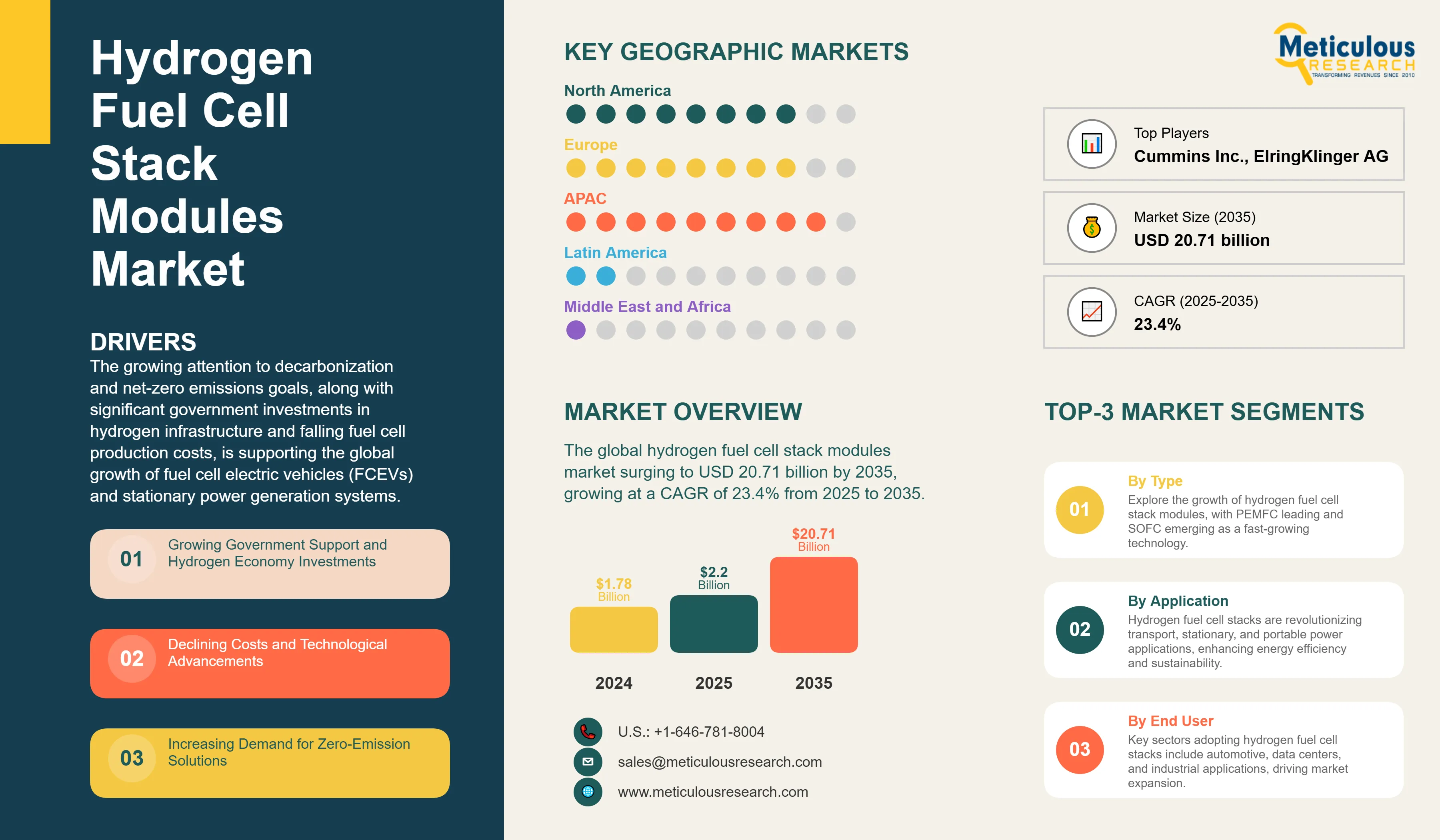
The global hydrogen fuel cell stack modules market size was valued at USD 1.78 billion in 2024 and is expected to increase to approximately USD 2.20 billion in 2025, then expand to around USD 20.71 billion by 2035, growing at a CAGR of 23.4% from 2025 to 2035.
- Published
- Sep 2025
- Pages
- 220
- Format
- PDF + Excel
- Report ID
- MR-1595
- Base year
- 2024
- 2024 · BASELINE
- $1.78B
- 2035
- $20.71B
- CAGR 2025–2035
- 23.4%
2024 baseline · 2025–2035 forecast at 23.4% CAGR · hover a bar for the value
Key highlights
In terms of revenue, the global hydrogen fuel cell stack modules market is valued at USD 2.2 billion in 2025 and is projected to reach USD 20.71 billion by 2035.
The market is expected to grow at a CAGR of 23.4% from 2025 to 2035.
Asia Pacific dominates the global hydrogen fuel cell stack modules market with the largest market share of 40-45% in 2025.
Europe is expected to witness the fastest CAGR during the forecast period.
By power output, the 10-100kW segment holds the largest market share of 30-35% in 2025.
By power output, the above 100kW segment is expected to witness the fastest CAGR during the forecast period.
By technology, the PEMFC (Proton Exchange Membrane Fuel Cell) segment contributes the highest market share of 60-70% in 2025.
By technology, the SOFC (Solid Oxide Fuel Cell) segment is expected to witness the fastest CAGR during the forecast period.
By application, the transport segment holds the largest market share of 60-65% in 2025.
By application, the stationary power segment is expected to witness the fastest CAGR during the forecast period.
By end user, the automotive segment holds the largest share of 30-40% in 2025.
By end user, the data centers segment is expected to witness the fastest CAGR during the forecast period.
Report summary
| Particulars | Details |
|---|---|
| Report Coverage | Details |
| Market Size by 2035 | USD 20.71 Billion |
| Market Size in 2025 | USD 2.2 Billion |
| Market Size in 2024 | USD 1.78 Billion |
| Market Growth Rate from 2025 to 2035 | CAGR of 23.4% |
| Format | PDF, Excel & Cloud Portal · 220 pages |
| Dominating Region | Asia Pacific |
| Fastest Growing Region | Europe |
| Base Year | 2024 |
| Forecast Period | 2025 to 2035 |
| Segments Covered | Power Output, Technology, Application, End User, and Region |
| Regions Covered | North America, Europe, Asia-Pacific, Latin America, and Middle East & Africa |
Report overview
Segments covered: power output, technology, application, end user.
The growing attention to decarbonization and net-zero emissions goals, along with significant government investments in hydrogen infrastructure and falling fuel cell production costs, is supporting the global growth of fuel cell electric vehicles (FCEVs) and stationary power generation systems.
The hydrogen fuel cell stack modules market involves the design, development, manufacturing, and deployment of integrated fuel cell stack systems. These systems convert hydrogen and oxygen into electricity through an electrochemical reaction. The modules contain multiple individual fuel cells connected in series. They include membrane electrode assemblies (MEAs), bipolar plates, gaskets, current collectors, and end plates that create the main power generation unit.
Unlike traditional combustion engines, fuel cell stacks produce electricity, with only water and heat as byproducts. This results in zero-emission power generation. The market is driven by global efforts to reduce carbon emissions, government subsidies and incentives for clean energy, improvements in stack efficiency and durability, the growth of hydrogen refueling infrastructure, and increasing demand from transportation, stationary power, and portable applications in residential, commercial, and industrial sectors.
Artificial intelligence is changing the dynamics of the hydrogen fuel cell stack modules market. It is enabling predictive maintenance, improving stack performance with real-time monitoring and control, enhancing quality control in manufacturing, and speeding up material discovery for better catalyst and membrane development. AI algorithms look at operational data to forecast degradation patterns, optimize hydrogen use, manage thermal dynamics, and extend stack life with smart load management. Machine learning models aid diagnostics by spotting performance issues, predicting failures, and suggesting maintenance schedules, which lowers downtime and operational costs. AI-based simulation tools speed up the design of new stack architectures, enhance flow field designs, and predict performance in different operating conditions. This makes fuel cell systems more efficient, reliable, and cost-effective for commercial use.
A major trend in the hydrogen fuel cell stack modules market is the growing integration with green hydrogen production from renewable energy sources. This creates a completely carbon-free energy chain from production to consumption. Fuel cell manufacturers are creating stacks that are optimized for green hydrogen purity levels and are working closely with electrolyzer manufacturers to ensure compatibility. This trend supports circular economy principles and boosts the environmental value of fuel cell systems.
Another key trend driving market growth is the development of modular, scalable fuel cell stack designs that can be easily configured for different power needs. Manufacturers are building standardized components that can be combined to achieve power outputs ranging from kilowatts to megawatts. This approach cuts development costs and speeds up time-to-market for new applications while also improving serviceability and simplifying inventory management.
Europe is expected to witness the fastest growth rate from 2025 to 2035. This growth is driven by the European Green Deal and Hydrogen Strategy, which aim for climate neutrality by 2050. Fuel cells are essential for reducing emissions in transportation and industry. Significant funding from initiatives like the Clean Hydrogen Partnership, which offers €2 billion, as well as national hydrogen strategies in Germany, France, the Netherlands, and other countries, supports the development and use of this technology. The region's strong automotive industry, with companies such as Daimler, BMW, Stellantis, and Bosch investing in fuel cell technology for commercial vehicles, creates strong demand. Moreover, Europe's emphasis on producing green hydrogen from renewable energy and developing hydrogen valleys that connect production, distribution, and consumption fosters a good environment for using fuel cell stacks in various applications.
This stage focuses on advancing fuel cell technology through materials research, stack design optimization, and performance improvement, developing next-generation catalysts, membranes, and bipolar plates for enhanced efficiency and durability.
Key Players: Ballard Power Systems, Toyota Motor Corporation, Hyundai Motor Company, Bosch
This stage involves producing critical components including membrane electrode assemblies, bipolar plates, gas diffusion layers, and other specialized parts requiring precision manufacturing and quality control.
Key Players: ElringKlinger AG, Freudenberg, Dana Incorporated, Advent Technologies
This stage encompasses assembling individual components into complete fuel cell stacks, including quality testing, conditioning, and system integration with balance of plant components.
Market dynamics
11 factors across 3 forcesGovernment Policies and Hydrogen Economy Investments
A key factor driving the growth of the hydrogen fuel cell stack modules market is the significant government support and investment in developing the hydrogen economy worldwide. Countries are putting together hydrogen strategies with large funding programs. For example, the EU has a hydrogen strategy that aims for 40GW of electrolyzer capacity by 2030. Japan has a Basic Hydrogen Strategy, and South Korea has a Hydrogen Economy Roadmap. The U.S. Infrastructure Investment and Jobs Act has allocated $9.5 billion for clean hydrogen projects. These policies offer incentives for purchasing fuel cell vehicles, subsidies for stationary fuel cell installations, funding for hydrogen refueling infrastructure, and support for research and development. This creates a positive environment for manufacturers of fuel cell stack modules to increase production and lower costs through economies of scale.
Table of contents
13 chapters · 156 sections · 220 pages · click to expandGeographic analysis
North America
The U.S. hydrogen fuel cell stack modules market is projected to be worth around USD 3.68 billion by 2035, growing at a CAGR of 24% from 2025 to 2035. U.S. Hydrogen Fuel Cell Stack Modules Market Size and Growth 2025 to 2035 North America
Asia-Pacific
Largest shareAsia Pacific holds the largest market share of nearly 40-45% in 2025. The region's strength comes from strong government support in Japan, South Korea, and China for developing a hydrogen economy. This support includes national strategies and significant funding programs. Japan leads in fuel cell technology, with the largest fleet of residential fuel cells through the ENE-FARM program and growing adoption of fuel cell electric vehicles (FCEVs). South Korea has an ambitious hydrogen economy plan aiming for 6.2 million FCEVs and 1,200 refueling stations by 2040. Major companies like Hyundai, POSCO, and SK Group are investing heavily in fuel cell technology, which boosts the region's position further. China's focus on fuel cell buses and trucks for commercial use, alongside generous subsidies and local content rules, increases demand for stack modules. By Region Asia-Pacific
Competitive landscape
- —
Feb 2025 — Toyota Motor Corporation unveiled its 3rd-generation fuel-cell (FC) system (new stack/system roadmap and technology improvements) at the H2 & FC EXPO; part of Toyota’s technology roadmap for advancing fuel-cell performance and commercialization.
- —
Apr 2025 — Hyundai Motor Company introduced the new XCIENT Fuel Cell Class-8 heavy-duty truck at ACT Expo 2025.
- —
May 2024 — Plug Power received major U.S. federal backing (conditional loan guarantee up to $1.66 billion announced by government sources) to build clean hydrogen plants — a strategic development strengthening upstream hydrogen supply
- Ballard Power Systems Inc.
- Plug Power Inc.
- Bloom Energy Corporation
- Cummins Inc.
- Toyota Motor Corporation
- Robert Bosch GmbH
- SFC Energy AG
- PowerCell Sweden AB
- Doosan Fuel Cell Co. Ltd.
- Fuel Cell Technologies ElringKlinger AG
- FuelCell Energy Inc.
- AFC Energy plc
- Loop Energy Inc.
Frequently asked questions
The hydrogen fuel cell stack modules market size is expected to increase from USD 2.2 billion in 2025 to USD 20.71 billion by 2035.
Cite this report
Meticulous Research. (2025). Hydrogen Fuel Cell Stack Modules Market - Global Opportunity Analysis And Industry Forecast (2025-2035) (Report No. MR-1595). Meticulous Market Research Pvt. Ltd. https://www.meticulousresearch.com/product/hydrogen-fuel-cell-stack-modules-market-6278