Hydrogen Compressor Market (2026-2036)
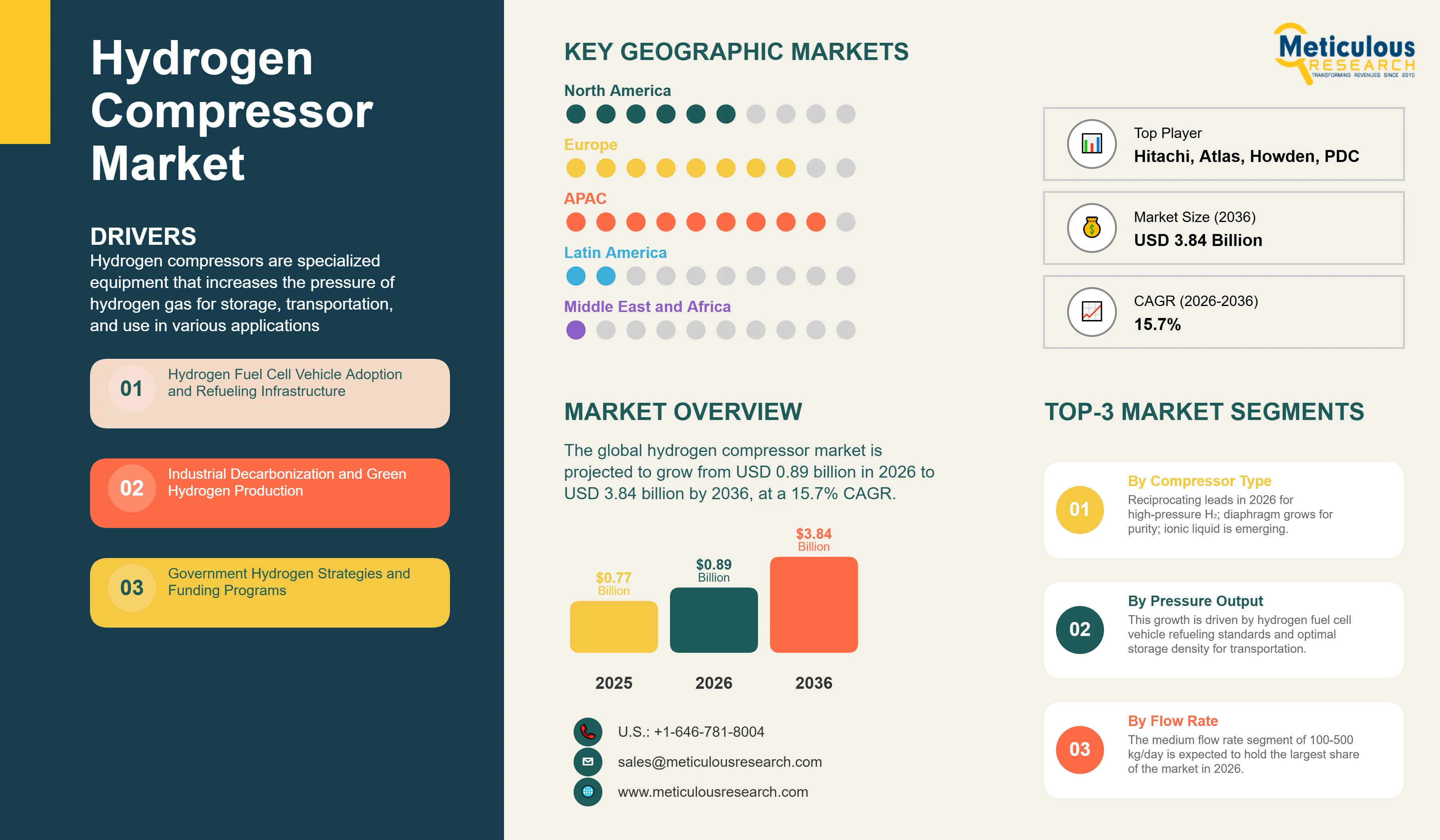
The global hydrogen compressor market is expected to reach USD 3.84 billion by 2036 from USD 0.89 billion in 2026, at a CAGR of 15.7% from 2026 to 2036.
- Published
- Jan 2026
- Pages
- 284
- Format
- PDF + Excel
- Report ID
- MREP - 1041689
- Base year
- 2025
- 2026 · ESTIMATED
- $890.0M
- 2036
- $3.84B
- CAGR 2026–2036
- 15.7%
2025 baseline · 2026–2036 forecast at 15.7% CAGR · hover a bar for the value
Key highlights
In 2026, Asia-Pacific is estimated to account for the largest share of the global hydrogen compressor market, driven by government hydrogen strategies in Japan and South Korea, China's massive green hydrogen initiatives, early fuel cell vehicle deployment, and industrial hydrogen demand.
Europe is projected to register significant growth during the forecast period, fueled by EU Hydrogen Strategy targets, automotive OEM fuel cell investments, green hydrogen project pipeline, and industrial decarbonization mandates.
Based on compressor type, the reciprocating compressor segment is estimated to hold the largest share of the market in 2026, driven by proven technology for high-pressure applications, suitability for refueling stations, and established supply chains.
Based on pressure output, the 700-900 bar segment is estimated to dominate refueling applications in 2026, owing to fuel cell vehicle standard pressure requirements and optimal energy density for mobile applications.
Based on application, the refueling station segment is expected to witness highest growth during the forecast period, driven by fuel cell vehicle adoption, hydrogen infrastructure buildout, and government support programs.
Based on hydrogen type, the green hydrogen segment is expected to grow at the highest CAGR, fueled by renewable energy integration, decarbonization targets, falling electrolyzer costs, and policy incentives.
The ionic liquid compressor segment is expected to experience significant growth, driven by superior efficiency, reduced maintenance, oil-free operation, and suitability for distributed applications.
The U.S. hydrogen compressor market is projected to grow at a CAGR of around 14% during the forecast period 2026 to 2036, driven by Inflation Reduction Act hydrogen incentives, heavy-duty vehicle targets, and industrial decarbonization.
Japan is expected to lead hydrogen mobility adoption in Asia-Pacific, driven by national hydrogen strategy, extensive refueling network, Toyota/Honda fuel cell vehicle leadership, and government subsidies.
In 2026, Germany is projected to account for the largest share of the European hydrogen compressor market, driven by automotive industry fuel cell development, ambitious green hydrogen targets, and industrial hydrogen demand.
Report summary
| Particulars | Details |
|---|---|
| Market Size Value in 2026 | USD 0.89 Billion |
| Revenue Forecast in 2036 | USD 3.84 Billion |
| Growth Rate | CAGR of 15.7% from 2026 to 2036 |
| Format | PDF, Excel & Cloud Portal · 284 pages |
| Base Year for Estimation | 2025 |
| Historical Data | 2021–2025 |
| Forecast Period | 2026–2036 |
| Quantitative Units | Revenue in USD Billion and CAGR from 2026 to 2036 |
| Report Coverage | Revenue forecast, company ranking, competitive landscape, growth factors, and trends |
| Segments Covered | Compressor Type, Pressure Output, Flow Rate, Application, Hydrogen Type, End-User, Efficiency Class, Region |
| Regional Scope | North America, Europe, Asia-Pacific, Latin America, Middle East & Africa |
| Countries Covered | U.S., Canada, Germany, U.K., France, Netherlands, Japan, South Korea, China, Australia, Saudi Arabia, UAE, Brazil, Chile |
| Key Companies Profiled | NEL Hydrogen ASA, PDC Machines, Howden Group, Atlas Copco AB, Burckhardt Compression Holding AG, Hitachi Ltd., Sundyne LLC, HAUG Sauer Kompressoren AG, Linde Engineering, Air Liquide S.A., Ariel Corporation, Galileo Technologies S.A., HydrogenPro ASA, Haskel (Ingersoll Rand), Bauer Compressors Inc., Gardner Denver (Ingersoll Rand), Kobe Steel Ltd., Chart Industries Inc., Nikkiso Co. Ltd., Cummins Inc. |
Report overview
Segments covered: compressor type, pressure output, flow rate, application, efficiency.
Hydrogen compressors are specialized equipment that increases the pressure of hydrogen gas for storage, transportation, and use in various applications. These include refueling fuel cell vehicles, injecting into pipelines, processing in industries, and energy storage systems. Their main goals are to allow safe and efficient handling of hydrogen, reach target storage pressures—350-700 bar for vehicles and over 900 bar for specialized uses—reduce hydrogen loss and contamination, ensure reliable operation given hydrogen's unique properties, and support the growing hydrogen economy infrastructure.
These systems employ various technologies. They include reciprocating pistons with special seals compatible with hydrogen, ionic liquid compression using electrochemical or hydraulic methods, diaphragm compression that keeps hydrogen separate from lubricants, and centrifugal compression for high-volume needs. They also utilize advanced control systems to manage different compression stages and cooling.
Hydrogen compressors can reach pressures from 200 bar for industrial uses to over 900 bar for high-pressure storage. They handle flow rates ranging from small refueling stations (dozens of kg per day) to large industrial facilities (tons per hour). These systems operate efficiently to reduce energy use, provide oil-free compression to avoid contamination, and ensure safety with materials that work well with hydrogen and leak detection systems.
The system acts as a critical link between hydrogen production and end-use. It allows for practical hydrogen storage in reasonable amounts, supports the rollout of fuel cell vehicle infrastructure, assists in transporting and distributing hydrogen, and helps make hydrogen energy cost-effective. This supports the hydrogen economy, aids in decarbonizing transportation, offers long-lasting energy storage, contributes to industrial decarbonization, and helps meet climate goals.
Hydrogen compressors are essential technology for the growing hydrogen economy. They tackle the main issue that hydrogen's low density requires significant compression for effective storage and transport. At atmospheric pressure, hydrogen holds very little energy per unit volume, so compression is necessary. Compressing hydrogen to 700 bar increases its density 700-fold, making it practical for vehicle onboard storage. Hydrogen's unique properties create specific compression challenges. These include its small molecular size, which causes permeation and leakage issues; its wide flammability range, which demands safety measures; the embrittlement of many materials, limiting component options; its low viscosity, which affects seal performance; and its high specific heat, requiring extensive cooling. These traits necessitate compressors designed specifically for hydrogen rather than adapted industrial models. Hydrogen compressors enable important applications such as refueling fuel cell vehicles quickly to 700 bar, compressing hydrogen for storage in tube trailers or underground, ensuring proper pressure for pipeline injection, meeting industrial process pressures, and helping power-to-gas systems store renewable energy. As hydrogen moves from a niche industrial gas to a main energy source, compression technology becomes a crucial part of infrastructure, similar to electrical transformers or natural gas compressor stations.
Several key trends are transforming the hydrogen compressor market. These trends include the development of new compression technologies, like ionic liquid and electrochemical compressors, which offer better efficiency and reliability. There is also a push to scale manufacturing to lower costs and meet infrastructure needs. Additionally, integrating with renewable energy and electrolyzer systems is creating complete hydrogen production solutions. Standardizing refueling protocols and pressures is making interoperability possible. The emergence of hydrogen hubs and corridors is increasing the need for large-scale compression capacity. Strong government strategies for hydrogen, the automotive industry's commitment to fuel cell vehicles for heavy-duty uses, falling green hydrogen production costs nearing fossil fuel prices, recognition of hydrogen's role in decarbonizing difficult sectors, and advancements in technology that enhance compressor performance and costs have elevated hydrogen compression from specialized equipment to vital clean energy infrastructure.
Report infographic
Market dynamics
7 factors across 3 forcesFuel Cell Vehicle Adoption and Refueling Infrastructure Deployment
The increasing use of fuel cell electric vehicles (FCEVs), especially in heavy-duty transport, is driving significant demand for hydrogen refueling infrastructure and related compression equipment. Battery electric vehicles lead in light-duty transportation, but fuel cells have benefits for heavy-duty uses such as long-haul trucking, buses, trains, ships, and eventually aviation where factors like weight, range, and refueling time make hydrogen a better choice. Major car and commercial vehicle makers, including Toyota, Hyundai, Nikola, and Daimler Truck, are working to launch fuel cell vehicles with plans for mass production. These vehicles need refueling infrastructure similar to gasoline or diesel with fast refueling (3-5 minutes), many stations, and dependable operation. Each refueling station requires compression equipment to fill vehicles to 700 bar for passenger vehicles or 350 bar for heavy-duty vehicles from storage or production at lower pressures. The requirements for compressors at these stations vary by volume—small stations serving dozens of vehicles daily need a capacity of 50-100 kg/day, while high-volume heavy-duty stations may require tons of hydrogen per day. Government programs worldwide are funding this refueling infrastructure. California aims for 200 stations, Germany 1,000 stations, Japan and South Korea are developing extensive networks, and China is building hydrogen city clusters. This growth in infrastructure will create a direct need for thousands of compressors globally over the forecast period.
Green Hydrogen Production Scaling and Renewable Energy Storage
The rapid growth of green hydrogen production from renewable energy-powered electrolyzers is increasing the demand for compression in hydrogen handling and storage. The capacity for green hydrogen production is expanding quickly, jumping from gigawatts now to hundreds of gigawatts by 2030 as costs move closer to fossil hydrogen prices. Electrolyzer systems typically generate hydrogen at low pressures (10-30 bar), necessitating compression for many uses including tube trailer transport needing 200-500 bar, specific pressures for pipeline injection, and storage facilities requiring anywhere from 100 to over 900 bar depending on the technology. Large green hydrogen projects, at the hundreds of megawatts to gigawatts scale, will need large compressors that can handle tons of hydrogen per hour. Additionally, hydrogen offers a way to store renewable energy over long periods—storing excess power as hydrogen through electrolysis, compressing it for storage, and using it in fuel cells or turbines for power generation during times when renewable generation dips. This power-to-gas-to-power cycle needs compression both for storage and possible final use. The growth of the green hydrogen economy will create ongoing demand for compression equipment in all areas: production, storage, transport, and usage.
Table of contents
16 chapters · 201 sections · 284 pages · click to expandGeographic analysis
Asia-Pacific
Largest shareIn 2026, Asia-Pacific is expected to hold the largest share of the global hydrogen compressor market. This leadership comes from significant government hydrogen programs in China, Japan, and South Korea, which together fund over $30 billion for hydrogen infrastructure development. These countries lead the automotive industry's hydrogen vehicle sector, with Toyota, Hyundai, and Honda at the forefront of fuel cell technology. There is also high industrial hydrogen consumption in the petrochemical and refining sectors, along with competitive products from local compressor manufacturers. China aims for 1 million fuel cell vehicles by 2030, which will need extensive refueling infrastructure. Japan continues to lead in the hydrogen economy, supported by a well-established refueling network and strong participation from industry. The South Korean government invests heavily in hydrogen infrastructure and vehicle incentives. Industrial hydrogen demand remains strong across regional refineries and chemical plants, as well as in new applications like pilot projects for steel manufacturing. The region prioritizes domestic technology development, with government support for local compressor companies. Chinese firms, including Sichuan Jinxing, are working on compression technology to lessen reliance on Western imports. Japanese companies like Kobe Steel and Mitsubishi are leveraging their existing capabilities. Cost competitiveness influences technology decisions, with regional suppliers providing alternatives to the established Western brands. Applications include all segments, such as refueling infrastructure for automotive programs, industrial hydrogen for traditional uses, and projects focused on energy storage. The region's combination of government commitment, industrial capability, and large potential markets positions it as a leader in the global hydrogen economy.
Europe
Europe is expected to see significant growth during the forecast period, fueled by the European Union's Green Deal hydrogen objectives and the need for industrial decarbonization. The EU Hydrogen Strategy aims for 40 gigawatts of electrolyzer capacity by 2030, producing 10 million tons of renewable hydrogen annually. Member states are implementing their own national hydrogen plans, with Germany pledging €9 billion, France €7 billion, and the Netherlands, UK, and others developing substantial programs. Refueling infrastructure is expanding rapidly, especially in Germany, which maintains European leadership with several hundred stations. The Netherlands, France, UK, and Scandinavia are also seeing growth. Industrial decarbonization is driving hydrogen use in steel manufacturing, with major projects from companies like SSAB, ThyssenKrupp, and ArcelorMittal. The chemical industry, including BASF and others, is exploring hydrogen feedstocks. The refining sector is adjusting to stricter emission regulations. Several countries are piloting hydrogen for seasonal renewable energy storage. Regional factors include strong environmental regulations pushing for decarbonization, carbon pricing mechanisms that make clean hydrogen more appealing, and research programs advancing technology. European compressor manufacturers like Burckhardt, Howden, Neuman & Esser, and Atlas Copco lead in hydrogen compression technology. The regional market benefits from established industrial infrastructure supporting the transition to a hydrogen economy and solid policy frameworks offering investment stability. Applications focus on green hydrogen from renewable sources, setting Europe's approach apart from industrial hydrogen use in other regions.
Competitive landscape
- NEL Hydrogen ASA · Norway
- PDC Machines (U.S.)
- Howden Group (UK)
- Atlas Copco AB · Sweden
- Burckhardt Compression Holding AG · Switzerland
- Hitachi Ltd. · Japan
- Sundyne LLC (U.S.)
- HAUG Sauer Kompressoren AG · Germany
- Linde Engineering · Germany
- Air Liquide S.A. · France
- Ariel Corporation (U.S.)
- Galileo Technologies S.A. · Argentina
- HydrogenPro ASA · Norway
- Haskel (Ingersoll Rand) (U.S.)
- Bauer Compressors Inc. (Germany/U.S.)
- Gardner Denver (Ingersoll Rand) (U.S.)
- Kobe Steel Ltd. · Japan
- Chart Industries Inc. (U.S.)
- Nikkiso Co. Ltd. · Japan
- Cummins Inc. (U.S.)
Frequently asked questions
The hydrogen compressor market is expected to grow from USD 0.89 billion in 2026 to USD 3.84 billion by 2036.
Cite this report
Meticulous Research. (2026). Hydrogen Compressor Market - Global Opportunity Analysis and Industry Forecast (2026-2036) (Report No. MREP - 1041689). Meticulous Market Research Pvt. Ltd. https://www.meticulousresearch.com/product/hydrogen-compressor-market-6372