Hydrogen Blending Infrastructure Market (2026-2036)
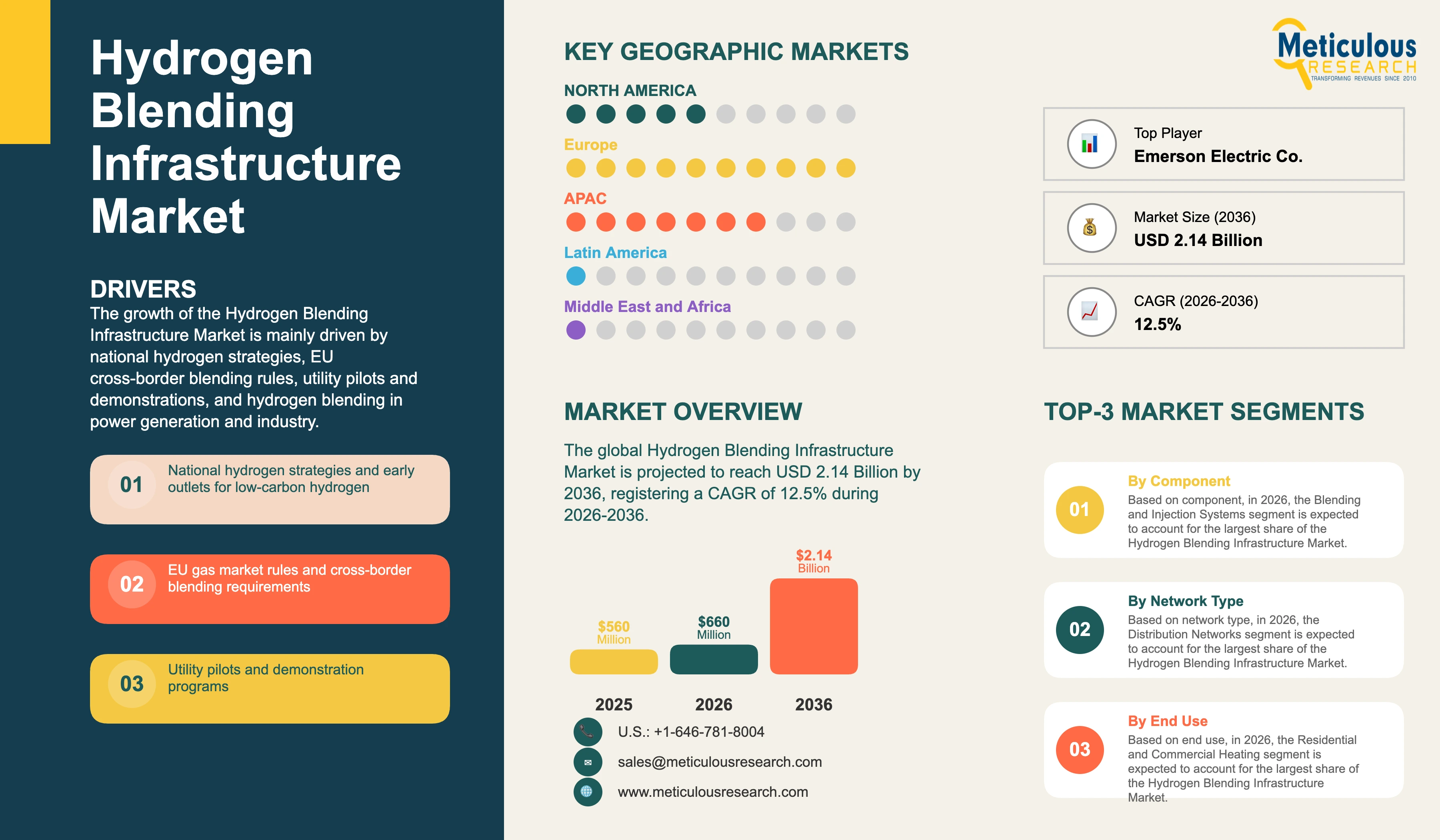
The global hydrogen blending infrastructure market was valued at USD 560.0 million in 2025. This market is expected to reach USD 2.14 billion by 2036 from an estimated USD 660.0 million in 2026, registering a CAGR of 12.5% during the forecast period (2026-2036).
- Published
- Nov 2026
- Pages
- 251
- Format
- PDF + Excel
- Report ID
- MREP - 1042715
- Base year
- 2025
- 2025 · BASELINE
- $560.0M
- 2036
- $2.14B
- CAGR 2026–2036
- 12.5%
2025 baseline · 2026–2036 forecast at 12.5% CAGR · hover a bar for the value
Key highlights
The EU Hydrogen and Decarbonised Gas Market Package, adopted in August 2024, sets a 2% hydrogen blending limit by volume in natural gas at interconnection points between Member States, and Member States had until August 2026 to implement the package.
In May 2026, Shandong province in China launched the Weifang Hydrogen Blending Pilot, which will inject up to 10% hydrogen into an existing natural gas network serving about 100,000 homes.
India's Petroleum and Natural Gas Regulatory Board has operationalized six hydrogen blending pilot projects across five locations, Indore, Kawas, Jorhat, Ahmedabad, and Gorakhpur, testing blending levels of 2% to 5% in city gas distribution networks. GAIL's Indore pilot, cleared in June 2021, blended 2% hydrogen into the entire charge area and was completed with no adverse reports.
In Chile, gas distributor GasValpo is blending 10% green hydrogen into the natural gas distribution network supplying La Serena and Coquimbo, described as the first residential hydrogen blending scheme in South America, with plans to raise the share to 15% in 2026 and to 20% over the long term.
New Zealand's first hydrogen blending pilot, run by Firstgas at Te Horo, was completed in October 2026 after blending hydrogen incrementally from 3.5% up to a maximum of 15%.
In the U.K., National Gas injected a 2% blend of green hydrogen into the national transmission system, which was used at Centrica's Brigg Power Station to generate electricity, one of the first transmission-level blending trials in Europe.
In the U.S., California currently allows hydrogen at only about 0.1% in the gas system, and the California Public Utilities Commission is considering five hydrogen blending pilot proposals from SoCalGas, SDG&E, PG&E, and Southwest Gas. About 20 utilities in the U.S. are piloting programs to blend hydrogen into natural gas.
By component, blending and injection systems account for the largest share of 26.0% in 2026, while hydrogen deblending and separation systems register the highest CAGR.
By network type, distribution networks account for the largest share in 2026, while transmission networks register the highest CAGR.
By blend level, low-level blends (up to 5 percent by volume) accounts for the largest share in 2026, while high-level blends (above 20 percent by volume) registers the highest CAGR.
By end use, residential and commercial heating accounts for the largest share of 40.0% in 2026, while power generation registers the highest CAGR.
By geography, Europe accounts for the largest share of 42.0% in 2026, while Asia-Pacific registers the highest CAGR of 14.9%.
Report summary
| Particulars | Details |
|---|---|
| Forecast Period | 2026-2036 |
| Base Year | 2025 |
| Estimated Year | 2026 |
| CAGR (Value) | 12.5% |
| Format | PDF, Excel & Cloud Portal · 251 pages |
| Market Size (Value) in 2025 | USD 560.0 million |
| Market Size (Value) in 2026 | USD 660.0 million |
| Market Size (Value) by 2036 | USD 2.14 billion |
| Largest Segment by Component (2026) | Blending and Injection Systems (26.0%) |
| Largest Segment by End Use (2026) | Residential and Commercial Heating (40.0%) |
| Largest Region (2026) | Europe (42.0%) |
| Fastest-Growing Region | Asia-Pacific (CAGR 14.9%) |
| Segments Covered | Component, Network Type, Blend Level, End Use, Geography |
| Countries Covered | U.K., Germany, France, Italy, Netherlands, Spain, Belgium, Rest of Europe, China, India, Australia, Japan, South Korea, New Zealand, Rest of Asia-Pacific, U.S., Canada, Middle East, Africa, Chile, Brazil, Rest of Latin America |
| Key Companies | 14 companies and other companies |
Report overview
Segments covered: component, network type, blend level, end use.
The growth of this market is mainly driven by national hydrogen strategies that use blending into existing natural gas networks as an early outlet for low-carbon hydrogen, the EU Hydrogen and Decarbonised Gas Market Package, which requires transmission operators to accept blends of up to 2% hydrogen at cross-border interconnection points, the growing number of blending pilots and demonstrations by gas utilities in China, India, Europe, North America, Australia, New Zealand, and Chile, the need to prepare gas networks, meters, and end-user equipment for hydrogen, the use of hydrogen blends in gas-fired power plants and industrial boilers, and growing investment in gas quality measurement, deblending, and integrity assessment technologies. However, factors such as the limited emissions reductions from low blend levels, the high cost and limited availability of low-carbon hydrogen, regulatory uncertainty and opposition to blending in some jurisdictions, and policy priority for pure hydrogen networks in Europe are expected to restrain the growth of this market to some extent.
Hydrogen blending is the injection of hydrogen into existing natural gas pipelines and distribution networks, where it is mixed with natural gas and delivered to homes, businesses, industrial users, and power plants. Blending allows low-carbon hydrogen to use existing natural gas infrastructure without building new dedicated pipelines, and it can reduce the carbon intensity of gas supplied to end users. Because hydrogen has a lower energy content per unit volume than natural gas, a 20% blend by volume reduces carbon dioxide emissions from combustion by only about 6 to 7%, but blending is seen by many utilities and governments as a practical first step toward larger hydrogen use. Blending also allows utilities, regulators, and equipment makers to build practical experience with hydrogen in real networks, which is valuable for any future conversion of networks to pure hydrogen.
This report covers global revenue from hydrogen blending infrastructure, including blending and injection systems, gas quality measurement and metering equipment, upgrades of pipeline and network components such as valves, seals, regulators, compressors, and meters to make them suitable for hydrogen blends, hydrogen deblending and separation systems, and engineering, integrity assessment, and testing services. Electrolyzers and other hydrogen production equipment, dedicated pure hydrogen pipelines and repurposed hydrogen backbones, and hydrogen-ready gas turbines and appliances sold as end-user equipment are excluded from the scope of this report.
Hydrogen blending requires a range of specialized equipment, software, and engineering services across the gas value chain. Blending and injection stations measure and control the flow of hydrogen into the gas stream to achieve a precise and stable blend. Gas chromatographs, hydrogen sensors, and calorific value analyzers measure gas composition and energy content for safety and billing. Network components must be assessed for compatibility with hydrogen, since hydrogen can cause embrittlement in some steels and can leak more easily through some seals and materials. Deblending systems using membranes or pressure swing adsorption can separate hydrogen from blended gas for users that need pure hydrogen or that cannot accept hydrogen. Digital monitoring and control systems tie these elements together, allowing operators to track hydrogen content across the network in real time.
Gas utilities in many countries across several continents have now tested hydrogen blending in their distribution networks. The HyDeploy trials in the U.K. supplied blends of up to 20% hydrogen to homes, Australia has operated several blending projects, and pilots are under way or completed in India, China, Chile, New Zealand, Canada, the U.S., Germany, France, the Netherlands, Italy, and other countries. In transmission networks, operators such as National Gas in the U.K. have tested blends of 2% hydrogen supplied to power stations.
Regulatory limits on hydrogen content in natural gas vary widely between countries, from very low limits in some U.S. states to several percent in some European countries. The EU's 2% cap at interconnection points aims to prevent gas quality differences from restricting cross-border flows, while India's current regulations allow up to 5% hydrogen in city gas distribution. Standards for hydrogen-blended gas, appliances, and pipeline materials are being developed by national and international standards bodies. Harmonizing these limits and standards across borders is one of the main tasks facing regulators and network operators.
The market includes suppliers of blending skids and control systems, gas analyzers and meters, compressors, valves, and regulators, membrane and separation technologies, and engineering, testing, and inspection services. Leading companies in this market include Emerson, Honeywell, Siemens Energy, ABB, Baker Hughes, Linde, Air Liquide, Evonik, Pietro Fiorentini, Itron, SICK, DNV, ROSEN Group, and Kiwa.
Over the forecast period, the hydrogen blending infrastructure market is expected to grow rapidly from a small base, as pilots move toward larger deployments in China, India, and parts of Europe and as network operators prepare their systems for hydrogen. Growth will depend heavily on hydrogen availability and cost, regulatory decisions on blending limits, and the role that policymakers assign to blending compared with dedicated hydrogen networks.
Report infographic
Market dynamics
16 factors across 5 forcesNational hydrogen strategies and early outlets for low-carbon hydrogen
Many countries have adopted national hydrogen strategies that include blending into natural gas networks as a way to create early demand for low-carbon hydrogen and to support the scale-up of electrolyzer projects. Blending can absorb hydrogen production in regions where dedicated hydrogen users and pipelines are not yet available, which reduces the risk for early hydrogen projects.
India's National Green Hydrogen Mission includes provisions for green hydrogen in city gas distribution, and the Petroleum and Natural Gas Regulatory Board has cleared five blending pilot geographies, with six pilot projects operating across Indore, Kawas, Jorhat, Ahmedabad, and Gorakhpur. China's provinces are promoting blending pilots such as the Weifang project, which will supply up to 10% hydrogen to about 100,000 homes. Chile's national green hydrogen strategy supports the GasValpo blending project in Coquimbo.
In Australia, New Zealand, the U.K., and parts of continental Europe, gas network operators have developed blending programs as part of their future gas strategies. These programs create demand for blending equipment, gas quality measurement, network assessment, and testing services. In Australia, gas distributors have operated blending projects in South Australia, New South Wales, and Western Australia, and New Zealand's Firstgas completed its Te Horo pilot in October 2026 after reaching a 15% blend.
EU gas market rules and cross-border blending requirements
The EU Hydrogen and Decarbonised Gas Market Package, adopted in August 2024, sets common rules for hydrogen and renewable gases in the EU and requires transmission system operators to accept and facilitate hydrogen blends of up to 2% by volume at cross-border interconnection points. Member States had until August 2026 to implement the package. While the package gives priority to dedicated hydrogen networks, the blending provisions require operators to prepare interconnection points and measurement systems for hydrogen.
European gas transmission and distribution operators are also assessing the hydrogen readiness of their networks as they plan for both blending and repurposing. Gas quality monitoring, metering upgrades, and component assessments carried out for these purposes contribute to the market. Several European countries, including Germany, France, Italy, and the Netherlands, have tested higher blends in distribution networks. National rules in some countries already allow domestic blends above the 2% cross-border cap, and operators in these countries are preparing to inject hydrogen from local electrolyzer projects into their grids.
Utility pilots and demonstration programs in North America and Asia-Pacific
Gas utilities in North America and Asia-Pacific are running blending pilots to test safety, appliance compatibility, and network performance. In the U.S., about 20 utilities are piloting hydrogen blending, including Dominion Energy, National Grid, CenterPoint Energy, and the California utilities. Dominion Energy Utah tested a 5% blend for almost a year before extending blending to its distribution system in Delta, Utah, and CenterPoint is building a pilot in Mankato, Minnesota, with a 1 MW electrolyzer.
In California, the Public Utilities Commission is considering five pilot proposals from SoCalGas, SDG&E, PG&E, and Southwest Gas to test blending above the currently allowable level of about 0.1%. SoCalGas has proposed demonstrations of up to 5% hydrogen in medium-pressure distribution systems. In Canada, ATCO and other utilities have run blending projects, and a Calgary district heating operator tested blends of up to 20% in a 15 MW boiler. These pilots create demand for blending skids, monitoring systems, and engineering services. Federal funding for hydrogen research and demonstration, including national laboratory programs on blending, has also supported material testing and appliance studies in the U.S.
Hydrogen blending in power generation and industry
Gas-fired power plants and industrial users are testing hydrogen blends to reduce emissions and prepare for future hydrogen supply. Turbine manufacturers have developed hydrogen-capable combustion systems, and power plant operators in the U.S., Europe, and Asia have tested blends in gas turbines. In the U.K., National Gas injected a 2% green hydrogen blend into the national transmission system to supply Centrica's Brigg Power Station.
Industrial users such as steel, glass, ceramics, and chemical plants are also testing hydrogen blends in furnaces and boilers. These applications require blending and injection systems, gas quality monitoring, and assessments of on-site piping and equipment, which supports demand for blending infrastructure at end-user facilities as well as in networks. In India, hydrogen-enriched compressed natural gas is also being tested for vehicles, adding a mobility dimension to blending.
Table of contents
12 chapters · 132 sections · 251 pages · click to expandSegmental analysis
| Segment | Largest share (2026) | Fastest growth (2026–2036) |
|---|---|---|
| By Component | Distribution networks | Transmission networks |
By Component
- The distribution networks segment is expected to account for the largest share of the hydrogen blending infrastructure market, while the transmission networks segment is projected to register the highest CAGR during the forecast period.
Geographic analysis
Europe
Largest shareIn 2026, Europe is expected to account for the largest share of 42.0% of the global hydrogen blending infrastructure market. The large share of this region is mainly due to the EU Hydrogen and Decarbonised Gas Market Package, which requires transmission operators to accept blends of up to 2% at interconnection points, extensive hydrogen readiness programs by gas transmission and distribution operators, blending trials in the U.K., Germany, France, Italy, the Netherlands, and other countries, and the strong presence of suppliers of blending equipment, analyzers, meters, separation technologies, and testing services such as Siemens Energy, Linde, Air Liquide, Evonik, Pietro Fiorentini, SICK, DNV, ROSEN Group, and Kiwa. The U.K. has been one of the most active countries in blending trials, while Germany's gas industry has developed technical rules for higher hydrogen content in distribution networks.
Asia-Pacific
Asia-Pacific is the second-largest market and is projected to register the highest CAGR of 14.9% during the forecast period. The rapid growth of this region is mainly due to new large-scale blending pilots in China, such as the Weifang project for about 100,000 homes, India's six city gas blending pilots and the regulator's hydrogen roadmap, Australia's blending programs, New Zealand's Te Horo pilot, and the rapid growth of renewable energy and hydrogen production capacity in the region. China's large city gas networks and provincial hydrogen programs are the main source of this growth.
North America
North America accounts for a significant share of the global market, with about 20 U.S. utilities piloting hydrogen blending, including Dominion Energy, National Grid, CenterPoint Energy, and the California utilities, and with blending projects in Canada. However, regulatory uncertainty and opposition in some states are expected to limit growth compared with Asia-Pacific. Utilities in states with supportive policies, such as Minnesota and Utah, are expected to continue their programs. Canada's federal hydrogen strategy also supports blending projects in Alberta and other provinces.
Latin America
Latin America and the Middle East & Africa currently account for small shares of the global market, but they include notable projects such as GasValpo's 10% blending project in Chile. Countries with large, low-cost renewable energy resources and ambitious national hydrogen strategies, such as Chile, Brazil, Oman, and Saudi Arabia, could adopt blending as part of their broader hydrogen development plans.
Competitive landscape
The global hydrogen blending infrastructure market is fragmented, with the top five players estimated to account for about 30% of the market in 2025. The market includes suppliers of blending and injection systems, process control systems, gas analyzers and meters, compressors, valves, and regulators, membrane and separation technologies, and engineering, inspection, and testing services.
Emerson, Honeywell, ABB, Siemens Energy, and Baker Hughes supply blending systems, analyzers, meters, compressors, valves, and control systems for hydrogen blending projects. Pietro Fiorentini supplies blending stations, regulators, and hydrogen-ready meters for gas distributors, while Itron and SICK supply smart meters, ultrasonic meters, and other measurement solutions for blended gas. Linde, Air Liquide, and Evonik supply hydrogen and deblending and separation technologies.
DNV, ROSEN Group, and Kiwa provide pipeline integrity assessment, inspection, testing, and certification services for hydrogen blending in pipelines, networks, and appliances. Many specialized engineering companies, gas utilities, universities, and research institutions also play important roles in designing and delivering blending projects. Chinese and Indian equipment suppliers are increasingly active in their domestic markets, supported by local pilot programs. Gas utilities themselves often act as system integrators for pilots, selecting equipment from several suppliers and managing safety assessments and customer engagement.
Companies in this market compete mainly on technical expertise, product certification for hydrogen service, measurement accuracy, safety, project experience, and the ability to deliver integrated solutions. Key strategies include developing and certifying hydrogen-ready products, building dedicated hydrogen test facilities, obtaining certifications, participating in pilot projects with utilities, partnering with engineering companies and research institutions, and expanding into fast-growing markets in Asia-Pacific.
The competitive landscape is expected to evolve as blending projects grow in size and number. Suppliers with proven hydrogen-ready products, strong relationships with gas network operators, and the ability to support projects from assessment through operation will be best positioned, while local suppliers in China and India are expected to gain share in their domestic markets. Certification of products for hydrogen service by recognized bodies is becoming a key requirement in tenders, which favors suppliers with established testing programs. Partnerships with research institutions and national laboratories also help suppliers demonstrate product performance.
Some of the key players operating in the hydrogen blending infrastructure market are Emerson Electric Co., Honeywell International Inc., Siemens Energy AG, ABB Ltd., Baker Hughes Company, Linde plc, Air Liquide S.A., Evonik Industries AG, Pietro Fiorentini S.p.A., Itron, Inc., SICK AG, DNV AS, ROSEN Group, and Kiwa N.V., among others.
- —
China launched the Weifang blending pilot for about 100,000 homes in May 2026, GasValpo reached a 10% blend in Chile, Firstgas completed New Zealand's first blending pilot in October 2026, India's regulator operated six city gas pilots, and California regulators reviewed five utility pilot proposals.
- Emerson Electric Co.
- Honeywell International Inc.
- Siemens Energy AG
- ABB Ltd.
- Baker Hughes Company
- Linde plc
- Air Liquide S.A.
- Evonik Industries AG
- Pietro Fiorentini S.p.A
- Itron, Inc.
- SICK AG
- DNV AS
- ROSEN Group
- Kiwa N.V.
Expert perspectives
The hydrogen blending infrastructure market is small but growing quickly, driven by pilots and demonstrations that are moving toward larger deployments in some countries. We see blending as playing mainly a transitional role for hydrogen in gas networks, with its importance varying widely between regions depending on policy, hydrogen availability, and the structure of gas networks.
Over the forecast period, the hydrogen blending infrastructure market is expected to grow at a CAGR of 12.5%, from USD 660.0 million in 2026 to USD 2.14 billion in 2036. Growth will be supported mainly by national hydrogen strategies, EU cross-border blending rules, utility pilots, and blending in power generation and industry, while limited emissions benefits, high hydrogen costs, regulatory uncertainty, and the policy priority for pure hydrogen networks will moderate growth.
In terms of segments, blending and injection systems remain the largest component, while deblending and separation systems grow fastest. Distribution networks remain the largest network type, while transmission networks grow fastest. Low-level blends remain the largest blend category, while high-level blends grow fastest. Residential and commercial heating remains the largest end use, while power generation grows fastest. Europe remains the largest region, while Asia-Pacific grows fastest at a CAGR of 14.9%.
For hydrogen blending infrastructure suppliers, the key priorities over the forecast period are to develop and certify hydrogen-ready products, to participate in pilots and demonstrations that build references, to offer integrated solutions from assessment through operation, and to position for larger programs in China and India. Gas quality measurement, metering, and network integrity services are, in our view, the most resilient parts of the market, because they are needed for both blending and future repurposing.
We see significant uncertainty in the long-term size of the hydrogen blending infrastructure market. In our view, the outcome depends mainly on whether China and India scale up blending in city gas networks and on how European and North American regulators treat blending relative to dedicated hydrogen networks. If large-scale programs proceed in China and India, growth could exceed our forecast, while further project cancellations and regulatory opposition could reduce it.
We also expect the market to benefit from investments in hydrogen readiness that are made regardless of blending, such as hydrogen-ready meters and component assessments, which support future repurposing of gas networks to pure hydrogen. Suppliers that position their products for both blending and pure hydrogen are best placed to manage policy uncertainty. Monitoring regulatory decisions in China, India, and the EU will be essential for anticipating market direction.
Customer perspectives
Head of Hydrogen Programs - city gas distribution company, India
Our pilot showed that blending a few percent of hydrogen works safely in our network. The next step is to scale up, which means more injection stations, better gas quality monitoring, and careful assessment of every part of the network.
Network Strategy Manager - gas distribution operator, Europe
We are installing hydrogen-ready meters and assessing our network as part of our long-term plans. Whether we blend or convert parts of the network to pure hydrogen, we need to know our assets are ready.
Plant Manager - gas-fired power station, U.K.
Testing hydrogen blends in our turbines helps us prepare for future low-carbon fuels. Accurate measurement of the blend is critical for safe and efficient operation.
Frequently asked questions
The global hydrogen blending infrastructure market was valued at USD 560.0 million in 2025, up from USD 480.0 million in 2024, and is estimated at USD 660.0 million in 2026. The market includes blending systems, gas quality measurement and metering, network component upgrades, deblending systems, and engineering, integrity assessment, and testing services.
The global hydrogen blending infrastructure market is expected to reach USD 2.14 billion by 2036, supported by national hydrogen strategies, EU blending rules, utility pilots, and larger programs in China and India.
The market is expected to register a CAGR of 12.5% from 2026 to 2036, reflecting rapid growth from a small base as pilots move toward larger deployments.
Because hydrogen has about one-third of the volumetric energy content of natural gas, a 20% blend by volume reduces combustion emissions by only about 6 to 7%, which is why blending is generally seen as a transitional measure.
Market growth is mainly driven by national hydrogen strategies and early outlets for low-carbon hydrogen, EU gas market rules and cross-border blending requirements, utility pilots in North America and Asia-Pacific, and hydrogen blending in power generation and industry.
Limited emissions reductions, the high cost of low-carbon hydrogen, regulatory uncertainty, and policy priority for pure hydrogen networks restrain growth, while hydrogen embrittlement, leakage, safety concerns, and end-user equipment compatibility are key challenges.
Key opportunities include gas quality measurement, metering, and digital monitoring, hydrogen deblending and separation technologies, large-scale blending programs in China and India, and network integrity assessment and hydrogen readiness services.
Blending and injection systems are expected to account for the largest share of 26.0% of the market in 2026, while hydrogen deblending and separation systems are projected to register the highest CAGR.
Residential and commercial heating is expected to account for the largest share of 40.0% of the market in 2026, while power generation is projected to register the highest CAGR.
The EU requires transmission operators to accept up to 2% hydrogen at cross-border interconnection points, India's city gas regulations allow up to 5%, and California currently allows only about 0.1%, while pilots in China, Chile, and New Zealand have tested 10% to 15%.
Europe is expected to account for the largest share of 42.0% of the market in 2026, mainly due to EU gas market rules, network hydrogen readiness programs, and blending trials in several countries.
Asia-Pacific is projected to register the highest CAGR of 14.9% during the forecast period, driven by large-scale pilots in China, India's city gas blending pilots, and programs in Australia and New Zealand.
The report profiles 14 companies, including Emerson Electric Co., Honeywell International Inc., Siemens Energy AG, ABB Ltd., Baker Hughes Company, Linde plc, Air Liquide S.A., Evonik Industries AG, Pietro Fiorentini S.p.A., Itron, Inc., SICK AG, DNV AS, ROSEN Group, and Kiwa N.V.
China launched the Weifang blending pilot for about 100,000 homes in May 2026, GasValpo reached a 10% blend in Chile, Firstgas completed New Zealand's first blending pilot in October 2026, India's regulator operated six city gas pilots, and California regulators reviewed five utility pilot proposals.
In 2026, the distribution networks segment is expected to account for the largest share of the hydrogen blending infrastructure market, while the transmission networks segment is projected to register the highest CAGR during the forecast period.
Cite this report
Meticulous Research. (2026). Hydrogen Blending Infrastructure Market - Global Opportunity Analysis and Industry Forecast (2026-2036) (Report No. MREP - 1042715). Meticulous Market Research Pvt. Ltd. https://www.meticulousresearch.com/product/hydrogen-blending-infrastructure-market-7398