HLA Typing Market (2022-2029)
The HLA Typing Market is expected to grow at a CAGR of 5.6% from 2022 to 2029 to reach $1.90 billion by 2029.
- Published
- Oct 2022
- Pages
- 233
- Format
- PDF + Excel
- Report ID
- MR-625
- Base year
- 2021
- 2029 · FORECAST
- $1.90B
- 2029
- $1.90B
- CAGR 2022–2029
- 5.6%
2021 baseline · 2022–2029 forecast at 5.6% CAGR · hover a bar for the value
Key highlights
The HLA Typing Market is expected to grow at a CAGR of 5.6% from 2022 to 2029 to reach $1.90 billion by 2029.
The Molecular Assay Segment is Estimated to Grow at a CAGR of 5.6% During the Forecast Period
The Consumables Segment is Estimated to Dominate the HLA Typing Market in 2022
The Diagnostic Laboratories Segment is Projected to Register the Highest Growth in the HLA Typing Market by 2029
Report summary
| Particulars | Details |
|---|---|
| Base Year | 2021 |
| Estimated Year | 2022 |
| Forecast Period | 2022–2029 |
| Market Size (2029) | USD 1.90 billion |
| CAGR (2022–2029) | 5.6% |
| Format | PDF, Excel & Cloud Portal · 233 pages |
| Segments Covered | By Product: Consumables, Instruments, Software & Services · By Technology: Molecular Assays PCR-based Molecular Assays Sequence-specific Primers, Sequence-specific Oligonucleotide, RT-PCR, PCR-based Molecular Assays, Sangers Sequencing, Next-generation Sequencing, Other Sequence-based Molecular Assays, Serological Assay, Mixed Lymphocyte Cultural Assay · By Application: Diagnostics Donor Recipient Cross-Matching, Infectious Disease Diagnostics, Cancer Diagnosis, Transfusion Therapy, Other Diagnostic Applications · By End User: Diagnostics Laboratories, Hospitals & Transplant Centers, Academic & Research Institutes |
| Countries Covered | Europe (RoE), Asia-Pacific (RoAPAC), Latin America (RoLA) |
| Key Companies | Thermo Fisher Scientific Inc., Qiagen N.V., Illumina, Inc., Immucor Inc., TBG Diagnostics Limited, BAG Diagnostic GmbH, Omixon Inc., Luminex Corporation, Diagnostik GmbH, California, Inc., Thermo Fisher Scientific, Inc., CareDx Inc., Immucor, Inc., Omixon, Inc. |
Report overview
Segments covered: product, technology, application, end user. Regions: Europe, Asia-Pacific, Latin America.
The increasing number of organ transplants, increasing prevalence of chronic and infectious diseases, and technological advancements in the molecular assays used for HLA typing are expected to propel the global HLA typing market. The availability of funding for HLA typing research is also expected to positively impact the HLA typing market. Furthermore, the increasing awareness amongst people regarding organ donations offers an opportunity for the growth of the HLA typing market.
However, the high costs associated with molecular assays related to HLA typing and the huge gap between organ donations and organs required for transplantation pose a major challenge for the HLA typing market.
Human leukocyte antigen (HLA) molecules are expressed in almost all nucleated cells. These molecules trigger an immune response responsible for the rejection of transplanted grafts. The ideal condition for a successful transplant is that the HLA genes in both the donor and recipient match as closely as possible. Hence, HLA matching is an essential test to ensure a successful transplant and reduce the possibility of graft rejection. The demand for organ transplants has increased over the last decade. For instance, in 2021, organ transplants increased to 33.25 per million people from 20.49 transplants in 2019 (Source: Global Observatory on Donation and Transplantation).
This demand can be attributed to the increasing incidence of organ failure and the high success rate of transplants due to new immunosuppressants, robot-assisted organ transplantation, organ-specific solutions (reagents) for preservation, and logistics management in organ procurement. As HLA matching is an essential aspect of transplant diagnostics in checking the compatibility between the donor’s and recipient’s HLA genes, the need for high organ transplantation success rates is expected to drive the global HLA typing market.
Before 1990, serotyping was critical in HLA typing for organ transplants. However, most of the HLA antisera are polyclonal in nature and result in cross-reactions, making it complicated to differentiate antigens with subtle differences, which may result in incorrect identification. In addition, numerous factors, such as the time required to transport blood samples and the excessive number of immature cells, affect the serotyping results. These limitations of serotyping for HLA drove the adoption of molecular assays.
Molecular technologies have substituted conventionally used serological assays. Molecular technologies provide higher resolution, accuracy, sensitivity, and specificity in HLA typing. Non-molecular techniques utilize polyclonal antisera that lead to cross-reactions, which makes it difficult to differentiate antigens with subtle differences, leading to inaccuracy. Serological methods are used only for low-resolution typing, whereas molecular methods are used for high-resolution typing.
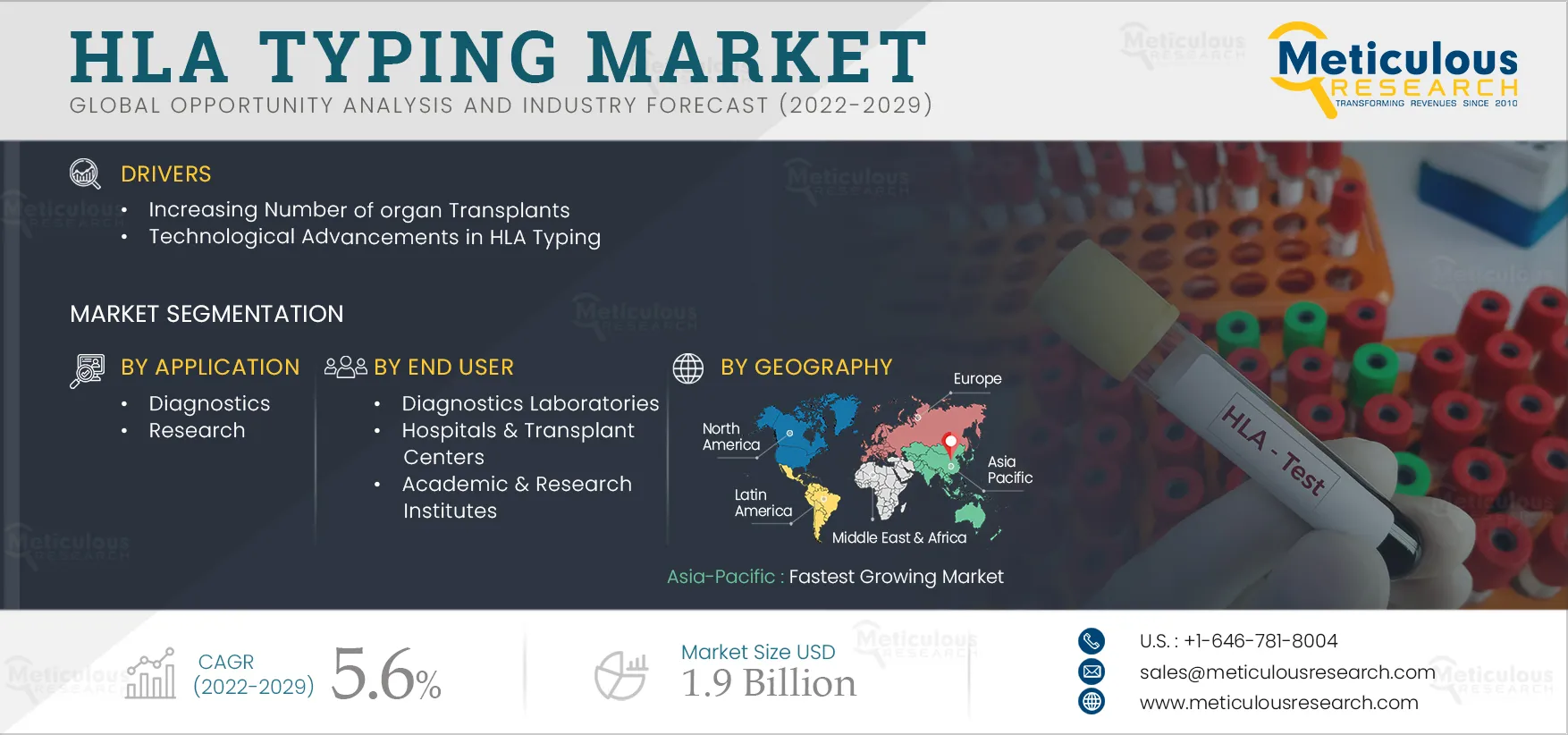
Table of contents
12 chapters · 93 sections · 233 pages · click to expandSegmental analysis
| Segment | Largest share (2022) | Fastest growth (2022–2029) |
|---|---|---|
| By Technology | — | — |
| By Product | Consumables | — |
| By End User | — | — |
By Technology
- The Molecular Assay Segment is Estimated to Grow at a CAGR of 5.6% During the Forecast Period
- The growth of the molecular assay segment is attributed to advancements in molecular technologies, companies focusing on developing and launching products based on new technologies, and the benefits of molecular technologies compared to non-molecular technologies.
- The molecular assay techniques, such as next-generation sequencing, provide high-resolution HLA genotyping.
- The combination of HLA sequencing (for increased sequence length) and advanced bioinformatics tools has enabled the accurate HLA genotyping of variants and full-length HLA haplotypes without phase ambiguity.
- Moreover, HLA genotyping overcomes many of the disadvantages of using conventional technologies, such as the inability to distinguish between different alleles at a locus and the need for multiple endonucleases to break down nucleotide chains in two or more fragments.
By Product
- The Consumables Segment is Estimated to Dominate the HLA Typing Market in 2022
- Recurrent use of the consumables, availability of diverse tests, and companies focused on launching new assays contribute to the large share of this segment.
- For instance, in 2021, Versiti, Inc. (U.S.) launched a test for the detection of loss of heterozygosity in the HLA region.
- This test is useful to gain information on patients with post-transplant relapse.
- Test kits & assays offered by major players operating in the HLA typing market are based on several technologies and are designed to be used with specific platforms.
- For instance, HLA SSP kits offered by Bio-Rad Laboratories (U.S.) are based on PCR systems.
- Similarly, NGSgo-MX-11-3 amplification kits are designed to be used with next-generation sequencing NGS platforms.
By End User
- The Diagnostic Laboratories Segment is Projected to Register the Highest Growth in the HLA Typing Market by 2029
- The factors propelling this segment's growth include outsourcing laboratory services by hospitals and transplant centers and a consolidation trend among diagnostics laboratories.
- Transplant centers and hospitals partner with diagnostic laboratories to undertake diagnostic procedures.
- For instance, SBC’s Histocompatibility & Immunogenetics Laboratory (HLA LAB) (U.S.) carries out testing for the Stanford Hospital (U.S.) and Lucile Packard Children’s Hospital (U.S.).
- Owing to the outsourcing of laboratory services, the diagnostics centers perform HLA typing, contributing to a higher revenue share.
Competitive landscape
- Thermo Fisher Scientific Inc.
- Qiagen N.V.
- Illumina, Inc.
- Immucor Inc.
- TBG Diagnostics Limited
- BAG Diagnostic GmbH
- Omixon Inc.
- Luminex Corporation
- Diagnostik GmbH
- California, Inc.
- Thermo Fisher Scientific, Inc.
- CareDx Inc.
- Immucor, Inc.
- Omixon, Inc.
Frequently asked questions
The HLA Typing Market covers the market size & forecasts of the consumables, instruments, and software & services used for HLA typing. The HLA typing market studied in this report involves the value analysis of various segments and sub-segments of the HLA typing market at regional and country levels.
Cite this report
Meticulous Research. (2022). HLA Typing Market - Global Opportunity Analysis And Industry Forecast (2022-2029) (Report No. MR-625). Meticulous Market Research Pvt. Ltd. https://meticulousresearch.com/reports/hla-typing-market-5311