Highly Potent APIs (HPAPI) Market (2026-2036)
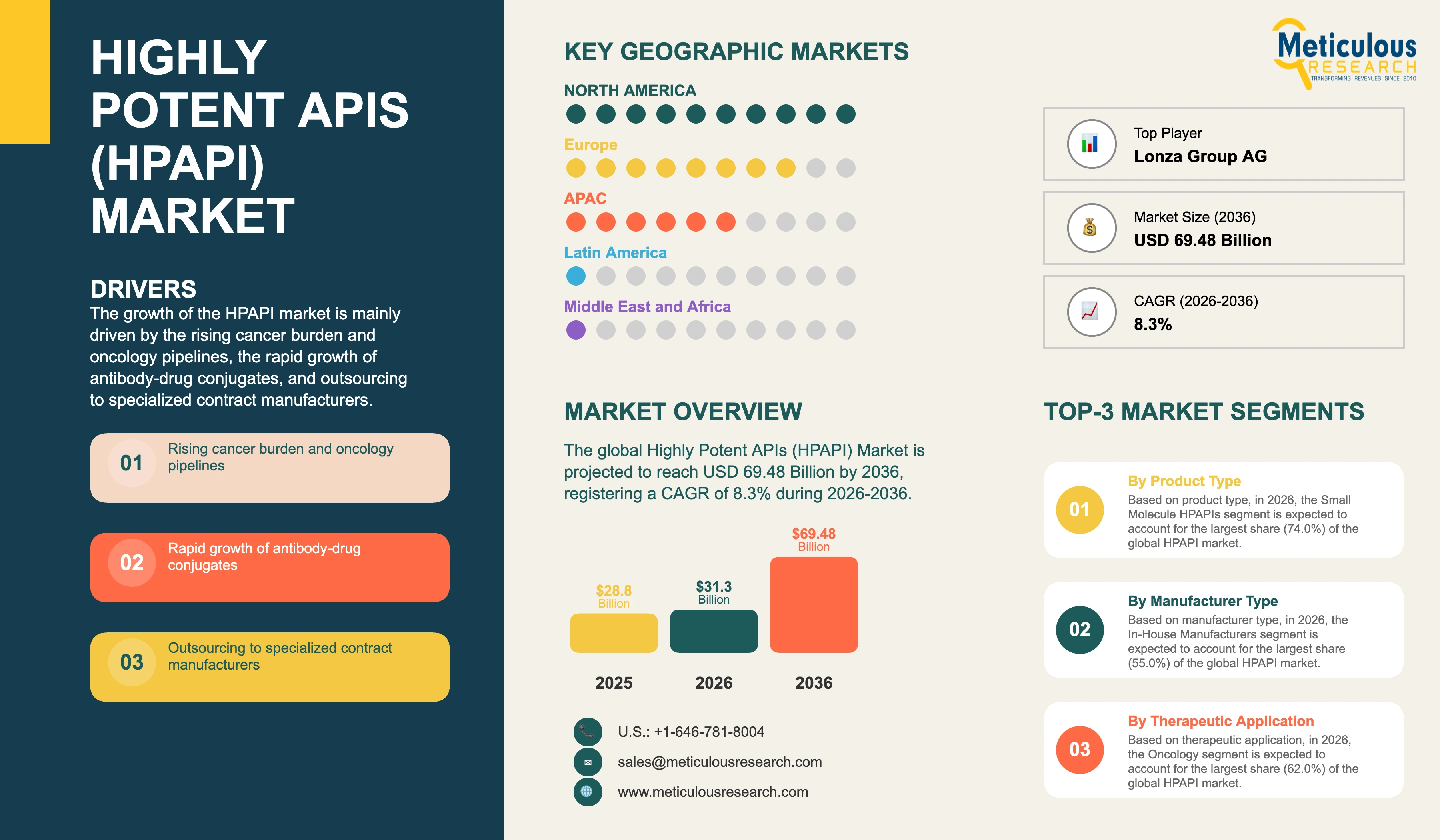
The global highly potent active pharmaceutical ingredients (HPAPI) market was valued at USD 28.80 billion in 2025. This market is expected to reach USD 69.48 billion by 2036 from an estimated USD 31.30 billion in 2026, registering a CAGR of 8.3% during the forecast period (2026-2036).
- Published
- Nov 2026
- Pages
- 295
- Format
- PDF + Excel
- Report ID
- MRHC - 1042538
- Base year
- 2025
- 2025 · BASELINE
- $28.80B
- 2036
- $69.48B
- CAGR 2026–2036
- 8.3%
2025 baseline · 2026–2036 forecast at 8.3% CAGR · hover a bar for the value
Key highlights
The International Agency for Research on Cancer, the specialized cancer agency of the World Health Organization, estimated that there were about 20 million new cancer cases and 9.7 million cancer deaths worldwide in 2022, and it projects that new cases will rise to more than 35 million by 2050, which supports long-term demand for potent oncology drugs and their APIs.
The U.S. Food and Drug Administration has approved more than a dozen antibody-drug conjugates, including recent approvals such as AstraZeneca and Daiichi Sankyo's Datroway in January 2025 and AbbVie's Emrelis in May 2025, and hundreds of ADC candidates are in clinical development, each requiring highly potent cytotoxic payloads and linker-payloads.
Large pharmaceutical companies have signed many multibillion-dollar ADC licensing and acquisition deals in recent years, including Pfizer's acquisition of Seagen, AbbVie's acquisition of ImmunoGen, and Genmab's acquisition of ProfoundBio, which has increased demand for specialized HPAPI and bioconjugation capacity.
Contract development and manufacturing organizations, such as Lonza, Siegfried, CordenPharma, Piramal Pharma Solutions, Sterling Pharma Solutions, and WuXi AppTec, have invested in new high-containment and ADC payload facilities to meet rising demand from pharmaceutical and biotechnology clients.
Regulators and occupational safety bodies require HPAPIs to be handled under strict containment, typically defined by occupational exposure limits below 10 micrograms per cubic meter of air, and the EU's revised Good Manufacturing Practice Annex 1 and guidelines on shared facilities have raised expectations for contamination control.
Generic manufacturers in India and China are expanding high-containment capacity as patents expire on potent oncology drugs such as kinase inhibitors and hormone therapies, which is increasing competition and supply in the generic HPAPI segment.
Many contract manufacturers now report that ADC-related projects account for a growing share of their HPAPI revenue, and several have announced new or expanded payload, linker, and bioconjugation facilities in Switzerland, the U.K., the U.S., India, and China to keep pace with demand from ADC developers.
By product type, small molecule HPAPIs account for the largest share of 74.0% in 2026, while ADC payloads and linker-payloads register the highest CAGR.
By manufacturer type, in-house manufacturers account for the largest share in 2026, while merchant and contract manufacturers register the higher CAGR.
By therapeutic application, oncology accounts for the largest share of 62.0% in 2026, while immunology and autoimmune diseases register the highest CAGR.
By geography, North America accounts for the largest share of 38.0% in 2026, while Asia-Pacific registers the highest CAGR of 10.4%.
Report summary
| Particulars | Details |
|---|---|
| Forecast Period | 2026-2036 |
| Base Year | 2025 |
| Estimated Year | 2026 |
| CAGR (2026-2036) | 8.3% |
| Format | PDF, Excel & Cloud Portal · 295 pages |
| Market Size in 2025 | USD 28.80 billion |
| Market Size in 2026 | USD 31.30 billion |
| Market Size by 2036 | USD 69.48 billion |
| Segments Covered | Product Type, Drug Type, Manufacturer Type, Therapeutic Application, and Geography |
| Geographic Scope | North America, Europe, Asia-Pacific, Latin America, and Middle East and Africa |
| Key Companies Profiled | Lonza, Cambrex, Siegfried, CordenPharma, Piramal Pharma Solutions, WuXi AppTec, Merck KGaA, Pfizer CentreOne, Teva api, Olon, Sterling Pharma Solutions, CARBOGEN AMCIS, Axplora, Asymchem, and Recipharm |
| Largest Segment by Product Type (2026) | Small Molecule HPAPIs (74.0%) |
| Largest Segment by Therapeutic Application (2026) | Oncology (62.0%) |
| Largest Region (2026) | North America (38.0%) |
| Fastest-Growing Region | Asia-Pacific (CAGR 10.4%) |
Report overview
Segments covered: product type, drug type, manufacturer type, therapeutic application.
The growth of this market is mainly driven by the rising global burden of cancer and the large share of oncology drugs in pharmaceutical pipelines, the rapid growth of antibody-drug conjugates (ADCs), which rely on extremely potent cytotoxic payloads, the increasing number of targeted therapies that are effective at very low doses, the growing outsourcing of HPAPI development and manufacturing to specialized contract manufacturers with high-containment facilities, the patent expiry of potent oncology and hormonal drugs that creates demand for generic HPAPIs, and investment in containment technologies such as isolators and closed processing systems. However, factors such as the high capital cost of building and maintaining high-containment facilities, strict occupational health and safety requirements, the limited number of skilled workers able to handle potent compounds, and the risk of cross-contamination in multi-product facilities are expected to restrain the growth of this market to some extent.
Highly potent active pharmaceutical ingredients (HPAPIs) are drug substances that have a pharmacological effect at very low doses, typically 10 milligrams per day or less, or that have occupational exposure limits of 10 micrograms per cubic meter of air or lower over an eight-hour working day. They include cytotoxic and targeted cancer drugs, hormones such as steroids and certain peptides, some immunosuppressants, and the extremely potent payloads used in antibody-drug conjugates, which can have exposure limits in the nanogram range. Because even very small amounts can harm workers or contaminate other products, HPAPIs must be developed and manufactured in specially designed facilities with high levels of containment.
This market covers the global sales of HPAPIs, measured in value, including both HPAPIs produced in-house by pharmaceutical companies and those produced by merchant and contract manufacturers for sale to drug companies. It is segmented by product type, drug type, manufacturer type, therapeutic application, and geography. Finished dosage forms, monoclonal antibodies used as carriers in ADCs, conjugation services, and containment equipment are not included, although demand for these is closely linked to the HPAPI market.
Oncology is the main driver of the HPAPI market and accounts for most of its demand. Many modern cancer drugs, including kinase inhibitors, cytotoxic chemotherapies, hormone therapies, and targeted agents, are highly potent, and oncology accounts for the largest share of pharmaceutical research and development pipelines. Antibody-drug conjugates, which combine a monoclonal antibody that targets cancer cells with an extremely potent cytotoxic payload, have become one of the fastest-growing classes of cancer drugs, and their payloads, such as auristatins, maytansinoids, camptothecin derivatives, and pyrrolobenzodiazepines, are among the most potent compounds manufactured in the pharmaceutical industry.
Manufacturing HPAPIs requires a combination of advanced chemical expertise and specialized containment engineering. Facilities use isolators, closed transfer systems, single-pass air handling, pressure cascades, and dedicated equipment to prevent exposure and cross-contamination, and workers use personal protective equipment as a secondary safeguard. Building and qualifying such facilities is expensive and takes several years, and the number of facilities able to handle the most potent compounds, such as ADC payloads, is limited. As a result, many pharmaceutical and biotechnology companies outsource HPAPI development and manufacturing to specialized contract manufacturers.
HPAPIs are usually classified into occupational exposure bands based on their toxicity and potency, with the highest bands requiring the most stringent containment. Many manufacturers describe their capabilities in terms of the lowest exposure limits they can handle, and the ability to handle compounds with limits below 1 microgram or even below 0.1 microgram per cubic meter is a key differentiator, particularly for ADC payloads. HPAPI development also requires analytical methods that can detect very low levels of residues, which is essential for cleaning validation and cross-contamination control in shared facilities.
The market includes pharmaceutical companies that produce HPAPIs in their own facilities for their own drugs, and merchant and contract manufacturers that produce HPAPIs for clients. Leading contract manufacturers include Lonza, Cambrex, Siegfried, CordenPharma, Piramal Pharma Solutions, WuXi AppTec, Merck KGaA through its MilliporeSigma business, Pfizer CentreOne, Olon, Sterling Pharma Solutions, CARBOGEN AMCIS, Axplora, and Asymchem, while Teva's API business is a major supplier of generic HPAPIs. Many of these companies have invested in new containment capacity and ADC capabilities in recent years.
The value chain for HPAPIs includes raw material and intermediate suppliers, HPAPI manufacturers, formulation and fill-finish companies that handle potent finished products, and, for ADCs, antibody producers and conjugation specialists. The growth of ADCs has increased the importance of coordination across this value chain, since payloads, linkers, antibodies, and conjugation must all meet strict quality requirements and timelines.
Over the forecast period, the HPAPI market is expected to grow steadily, supported by cancer drug development, ADCs, outsourcing, and generic launches. North America is expected to remain the largest market, while Asia-Pacific is expected to grow fastest as contract manufacturers in China, India, South Korea, and Singapore expand their high-containment capabilities.
As key cancer drugs come off patent, we need suppliers with proven containment and regulatory approvals.
This explains why generic HPAPIs and Asia-Pacific are growing fast.
For generic manufacturers, the ability of suppliers to pass regulatory inspections is as important as price.
Regulatory compliance history is often checked before price discussions even begin.
This explains why established Indian and European suppliers with strong inspection records are winning generic HPAPI business from companies supplying the U.S. and European markets.
We have added capacity for compounds with exposure limits below 0.1 microgram per cubic meter, and it was booked before it was finished.
This explains why manufacturers are investing in higher containment levels and why merchant and contract manufacturers form the faster-growing manufacturer type.
Head of External Manufacturing - large pharmaceutical company, U.K.
We are qualifying second sources for our most important potent APIs so that one site or one country cannot disrupt supply.
This explains why supply chain diversification is a key opportunity for HPAPI manufacturers in Europe, the U.S., and India.
In-house manufacturers are expected to account for the largest share of the market in 2026, while merchant and contract manufacturers are projected to register the higher CAGR, driven by outsourcing by biotechnology and pharmaceutical companies.
ADC payloads are extremely potent cytotoxic compounds, such as auristatins, maytansinoids, camptothecin derivatives, and pyrrolobenzodiazepines, that are attached to antibodies through chemical linkers to deliver them selectively to cancer cells.
Because HPAPIs are effective at very low doses, even small amounts can harm workers or contaminate other products, so they must be made in facilities with isolators, closed systems, controlled air handling, and validated cleaning, under strict occupational health and safety rules.
Generic HPAPIs are projected to register the higher CAGR than innovative HPAPIs, driven by patent expiries of potent oncology and hormonal drugs and expanding access to generic cancer treatments in emerging markets.
The FDA has approved more than a dozen ADCs and hundreds are in development, which has created strong demand for payload and linker-payload manufacturing capacity, leading contract manufacturers to invest in new high-containment and integrated ADC facilities.
Report infographic
Market dynamics
16 factors across 5 forcesRising cancer burden and oncology pipelines
Cancer is one of the leading causes of death worldwide, and its incidence is rising as populations age and as diagnosis improves in emerging markets. According to the International Agency for Research on Cancer, there were about 20 million new cancer cases and 9.7 million cancer deaths in 2022, and new cases are projected to exceed 35 million by 2050. Oncology accounts for the largest share of pharmaceutical research and development spending and of new drug approvals, and a large proportion of oncology drugs are highly potent, including kinase inhibitors, cytotoxics, hormone therapies, and targeted small molecules.
The growing number of oncology drugs in development and on the market drives demand for HPAPI development and manufacturing capacity. Oncology accounts for the largest share of the HPAPI market by therapeutic application, and small molecule HPAPIs account for the largest share by product type, reflecting the large number of potent small molecule cancer drugs.
Cancer treatment is also shifting toward combinations of targeted therapies and toward longer treatment durations, which increases the volume of potent drugs used per patient. In addition, many oncology drugs receive accelerated approvals and are launched quickly in multiple markets, which requires manufacturers to scale up HPAPI production rapidly and reliably.
Rapid growth of antibody-drug conjugates
Antibody-drug conjugates have become one of the most important new classes of cancer drugs. The FDA has approved more than a dozen ADCs, including Enhertu, Padcev, Trodelvy, Elahere, Datroway, and Emrelis, and hundreds more are in clinical development. Large pharmaceutical companies have made major investments in ADCs through acquisitions and licensing deals, such as Pfizer's USD 43 billion acquisition of Seagen and AbbVie's acquisition of ImmunoGen, and many Chinese biotechnology companies have licensed ADC candidates to global partners.
Each ADC requires an extremely potent payload, often with occupational exposure limits in the nanogram range, as well as a linker that connects the payload to the antibody. Only a limited number of facilities worldwide can produce these payloads safely at commercial scale, and demand has grown rapidly. ADC payloads and linker-payloads form the fastest-growing product type in this market.
The ADC pipeline has expanded rapidly in China, where biotechnology companies have developed many ADC candidates and licensed them to global pharmaceutical companies, and in the U.S. and Europe, where large pharmaceutical companies have built ADC franchises. New ADC formats, such as bispecific ADCs and ADCs with novel payloads, are increasing the variety of payload chemistries required.
Growth of targeted and low-dose therapies
Modern drug discovery increasingly produces molecules that are highly selective and effective at very low doses, not only in oncology but also in immunology, endocrinology, and other areas. Targeted protein degraders, certain peptides, hormone therapies, and immunosuppressants are often classified as highly potent, and their growth adds to demand for containment capacity. Immunology and autoimmune diseases form the fastest-growing therapeutic application in this market, as potent small molecules such as JAK inhibitors and other targeted immunomodulators are developed.
The trend toward precision medicine also means that many new drugs are produced in smaller volumes, which suits the smaller, flexible, high-containment facilities offered by specialized contract manufacturers.
Hormone therapies, such as those used in fertility treatment, contraception, and hormone replacement, and potent steroids also contribute to steady demand for HPAPIs, particularly in the generic segment.
Outsourcing to specialized contract manufacturers
Building and operating high-containment facilities is expensive and requires specialized expertise, and many pharmaceutical companies, especially small and mid-sized biotechnology companies, prefer to outsource HPAPI development and manufacturing to contract manufacturers. Even large pharmaceutical companies use contract manufacturers to add capacity, access specialized capabilities such as ADC payload synthesis, and reduce capital spending.
Contract manufacturers have responded by investing heavily in new high-containment suites, payload and linker facilities, and integrated ADC services that combine payload synthesis, conjugation, and fill-finish. Merchant and contract manufacturers form the faster-growing manufacturer type in this market.
Outsourcing is particularly common among small and mid-sized biotechnology companies, which develop a large share of new oncology drugs and ADCs but typically do not have their own manufacturing facilities. These companies need partners that can support them from early development through clinical supply and commercial launch, which favors contract manufacturers with integrated capabilities and strong regulatory track records.
Table of contents
12 chapters · 117 sections · 295 pages · click to expandSegmental analysis
| Segment | Largest share (2026) | Fastest growth (2026–2036) |
|---|---|---|
| By Product Type | Small molecule HPAPIs | ADC payloads and linker-payloads |
| By Drug Type | Innovative HPAPIs | — |
| By Manufacturer Type | In-house manufacturers | — |
| By Therapeutic Application | Oncology | Immunology and autoimmune diseases |
By Product Type
- The small molecule HPAPIs segment is expected to account for the largest share of 74.0% of the market.
- The large share of this segment is mainly due to the large number of potent small molecule drugs on the market and in development, including kinase inhibitors, cytotoxic chemotherapies, hormone therapies, and other targeted cancer drugs, as well as potent small molecules used in immunology, endocrinology, and other areas.
- Small molecule HPAPIs are produced by chemical synthesis in high-containment facilities by both pharmaceutical companies and contract manufacturers.
- The segment includes both innovative and generic products, and the patent expiry of many potent oncology drugs has increased demand for generic small molecule HPAPIs.
- Small molecule HPAPIs are expected to remain the largest product type over the forecast period.
- The segment includes a wide range of compounds, from kinase inhibitors and antimetabolites to hormone receptor modulators and targeted agents for immunology and other areas.
- Many of these drugs are produced in relatively small volumes, which suits the flexible multi-purpose high-containment facilities operated by contract manufacturers.
- Large pharmaceutical companies produce many of their own small molecule HPAPIs in dedicated facilities but increasingly outsource to add capacity and flexibility.
- The segment is expected to grow steadily as new small molecule oncology and immunology drugs are approved and as generic versions of older potent drugs are launched, although its share is expected to decline as ADC payloads grow faster.
- However, the ADC payloads and linker-payloads segment is projected to register the highest CAGR during the forecast period.
- The rapid growth of this segment is driven by the expanding ADC pipeline and approvals.
- Biotech HPAPIs, such as potent peptides and biologically derived compounds, make up the rest of the market.
- Biotech HPAPIs include potent peptides, such as certain hormone analogues, and other compounds derived from biological processes.
- ADC payloads include auristatins, maytansinoids, camptothecin derivatives such as exatecan and deruxtecan, and pyrrolobenzodiazepines, while linker-payloads combine the payload with the chemical linker used to attach it to the antibody.
- Although ADC payloads are used in very small quantities, their high value and rapid demand growth make them an increasingly important part of the market.
- Demand for ADC payloads is concentrated among a relatively small number of ADC developers with approved products or late-stage programs, but the number of developers and programs is growing rapidly, particularly in China and the U.S. Payload manufacturers must also manage the risk that clinical failures reduce demand for specific payloads, which encourages them to build flexible facilities that can handle multiple payload classes and switch between projects efficiently.
- The growth of new payload types, such as topoisomerase I inhibitors used in Enhertu and Datroway, has shifted demand toward manufacturers with experience in these chemistries.
By Drug Type
- The innovative HPAPIs segment is expected to account for the largest share of the market, due to the large number of branded oncology drugs and ADCs.
- However, the generic HPAPIs segment is projected to register the higher CAGR during the forecast period, driven by patent expiries of potent drugs.
- Innovative HPAPIs include those used in branded oncology drugs, ADCs, and other new therapies, which command high prices and are often produced under long-term supply agreements.
- Generic HPAPIs are produced for generic versions of potent drugs after patent expiry and are growing as more oncology drugs lose exclusivity.
- Pricing for innovative HPAPIs is typically based on long-term contracts with performance and quality commitments, while generic HPAPI pricing is more competitive.
- Innovative HPAPIs are expected to remain the larger segment throughout the forecast period, but generic HPAPIs are expected to grow faster as patents expire on major potent drugs, including several kinase inhibitors and hormone therapies, over the forecast period.
By Manufacturer Type
- The in-house manufacturers segment is expected to account for the largest share of the market, due to production by large pharmaceutical companies in their own facilities.
- However, the merchant and contract manufacturers segment is projected to register the higher CAGR during the forecast period, driven by outsourcing by biotechnology and pharmaceutical companies.
- Large pharmaceutical companies have historically produced many HPAPIs in-house to protect intellectual property and control quality, but the increasing complexity of potent compounds and the cost of high-containment facilities are encouraging more outsourcing.
- Contract manufacturers are expected to gain share as biotechnology companies, which rely heavily on outsourcing, account for a growing share of new drug approvals.
- In-house production remains important for large pharmaceutical companies with established high-containment networks, particularly for high-volume commercial products and compounds with sensitive intellectual property.
- Many large pharmaceutical companies use a hybrid model, producing some HPAPIs in-house and outsourcing others, which gives them flexibility to manage capacity and risk.
- This model is expected to continue, with outsourcing gaining share as pipelines shift toward complex modalities such as ADCs.
By Therapeutic Application
- HPAPI Analysis by Therapeutic Application
- The oncology segment is expected to account for the largest share of 62.0% of the market.
- The large share of this segment is mainly due to the high proportion of potent drugs among cancer therapies, the large number of oncology drugs in development, and the growth of ADCs, which use extremely potent payloads.
- Oncology drugs account for the largest share of new drug approvals and clinical pipelines, and many are highly potent, including targeted therapies, cytotoxics, and hormone therapies for breast and prostate cancer.
- Oncology is expected to remain the largest therapeutic application over the forecast period.
- ADCs, which are used mainly in oncology, are expected to account for a growing share of oncology HPAPI demand, as they are approved for more cancer types and earlier lines of treatment.
- Targeted small molecules, such as kinase inhibitors and protein degraders, also continue to drive demand for potent oncology APIs.
- However, the immunology and autoimmune diseases segment is projected to register the highest CAGR during the forecast period.
- The rapid growth of this segment is driven by potent targeted immunomodulators.
- Hormonal and endocrine disorders, cardiovascular diseases, central nervous system disorders, and other applications make up the rest of the market.
- Hormonal and endocrine disorders include potent hormones and steroids used in fertility, contraception, and hormone replacement therapy.
- Cardiovascular and central nervous system applications include potent compounds such as certain cardiac glycosides and neuroactive drugs, while other applications include potent compounds used in ophthalmology and anti-infectives.
Geographic analysis
North America
Largest shareIn 2026, North America is expected to account for the largest share of 38.0% of the global HPAPI market. The large share of this region is mainly due to the large number of pharmaceutical and biotechnology companies developing oncology drugs and ADCs, high spending on cancer drugs, and the presence of high-containment manufacturing facilities. The U.S. is the largest market for HPAPIs, with many oncology and ADC developers and contract manufacturers such as Cambrex and Pfizer CentreOne. North America is expected to remain the largest region throughout the forecast period. Most of the world's ADC developers are based in the U.S. or have major operations there, and the U.S. accounts for a large share of global spending on cancer drugs. Contract manufacturers have expanded HPAPI capacity in the U.S. in response to demand from biotechnology companies and policies encouraging domestic manufacturing. Canada is a smaller market, with some HPAPI manufacturing and a growing biotechnology sector. Across North America, investment in domestic HPAPI capacity is being supported by policies that encourage reshoring of pharmaceutical manufacturing and by the need for supply chain resilience for critical cancer drugs.
Asia-Pacific
Fastest growthAsia-Pacific is projected to register the highest CAGR of 10.4% during the forecast period. Growth is driven by investment in high-containment and ADC capacity by contract manufacturers in China, India, South Korea, and Singapore. China has become a major center of ADC innovation, and contract manufacturers such as WuXi AppTec and Asymchem have built large HPAPI and ADC capabilities. India has a strong generic HPAPI industry and is attracting global clients seeking supply chain diversification, while South Korea and Singapore are investing in biopharmaceutical manufacturing. Japan is also an important market, home to Daiichi Sankyo, one of the leading ADC developers, and to other oncology-focused pharmaceutical companies that require HPAPI capacity.
Europe
Europe holds a large share, supported by leading contract manufacturers, while Latin America and the Middle East and Africa are smaller markets. Switzerland, Germany, Italy, Ireland, and the U.K. are major HPAPI manufacturing hubs, home to companies such as Lonza, Siegfried, CordenPharma, Olon, CARBOGEN AMCIS, Sterling Pharma Solutions, and Axplora. European manufacturers have invested in new high-containment and ADC payload capacity to meet global demand.
Latin America
Latin America and the Middle East and Africa are smaller markets, with HPAPI demand linked mainly to generic oncology drug production in countries such as Brazil and Mexico and to growing pharmaceutical manufacturing in the Gulf countries.
Competitive landscape
The HPAPI market is fragmented, with large pharmaceutical companies producing in-house and many merchant and contract manufacturers. Leading merchant and contract manufacturers include Lonza, Cambrex, Siegfried, CordenPharma, Piramal Pharma Solutions, WuXi AppTec, Merck KGaA, Pfizer CentreOne, Teva api, Olon, Sterling Pharma Solutions, CARBOGEN AMCIS, Axplora, Asymchem, and Recipharm.
Companies compete on containment capabilities, chemistry expertise, regulatory track record, capacity, integrated services, and price.
Lonza offers integrated ADC services, including payload synthesis and bioconjugation, and has high-containment capacity in Switzerland and other sites. Siegfried, CordenPharma, Olon, CARBOGEN AMCIS, Axplora, and Sterling Pharma Solutions are European contract manufacturers with established HPAPI capabilities. Cambrex and Pfizer CentreOne have HPAPI capacity in the U.S. and Europe, while Piramal Pharma Solutions offers HPAPI and ADC services from sites in India, the U.K., and North America. WuXi AppTec and Asymchem are major Chinese contract manufacturers with HPAPI and ADC capabilities. Merck KGaA, through MilliporeSigma, offers ADC payload and conjugation services, while Teva api is a leading supplier of generic HPAPIs and Recipharm provides development and manufacturing services.
The competitive landscape varies considerably by product type, drug type, and customer segment. For ADC payloads, a small number of manufacturers with the highest containment capabilities and experience in payload chemistry compete for projects, while the market for small molecule HPAPIs includes many more suppliers. Generic HPAPIs are increasingly supplied by Indian and Chinese manufacturers, which compete on price and regulatory approvals.
The top five merchant players are estimated to account for 18.0% of the HPAPI market in 2025.
Players use several strategies to grow in this market, including capacity expansion, acquisitions, and integrated ADC services.
For example, contract manufacturers have opened new high-containment suites, acquired companies with ADC and payload capabilities, and formed partnerships to offer integrated ADC services. Many have signed long-term supply agreements with ADC developers and are investing in automation, flow chemistry, and analytical capabilities.
Competition is expected to center on ADC capabilities and capacity.
Manufacturers that can offer high containment, integrated ADC services, regulatory reliability, and secure supply are expected to gain share, while consolidation is likely as larger companies acquire specialists. Competition from Asian manufacturers is expected to increase, particularly for generic HPAPIs.
Some of the key players operating in the HPAPI market are Lonza Group AG, Cambrex Corporation, Siegfried Holding AG, CordenPharma, Piramal Pharma Solutions, WuXi AppTec Co., Ltd., Merck KGaA (MilliporeSigma), Pfizer CentreOne, Teva api, Olon S.p.A., Sterling Pharma Solutions, CARBOGEN AMCIS AG, Axplora, Asymchem Laboratories, and Recipharm AB.
- —
The FDA approved new ADCs such as Datroway and Emrelis in 2025, and contract manufacturers announced new high-containment and ADC payload facilities.
- Lonza
- Cambrex
- Siegfried
- CordenPharma
- Piramal Pharma Solutions
- WuXi AppTec
- Merck KGaA
- Pfizer CentreOne
- Teva api
- Olon
- Sterling Pharma Solutions
- CARBOGEN AMCIS
- Axplora
- Asymchem
- Recipharm
Expert perspectives
The HPAPI market is closely linked to the growth of oncology and ADCs, which are among the most important areas of pharmaceutical innovation.
The rising global burden of cancer, the growth of targeted therapies, and the rapid expansion of ADCs ensure strong long-term demand for HPAPIs. At the same time, the high cost and complexity of high-containment manufacturing limit the number of suppliers, which supports prices and favors established manufacturers. ADC payloads have become one of the most attractive segments of the pharmaceutical ingredients industry, with demand growing much faster than capacity.
Outsourcing is reshaping the market, as biotechnology companies developing oncology drugs and ADCs rely on contract manufacturers for HPAPI development and supply. Contract manufacturers that have invested in high containment and ADC capabilities are seeing strong demand and long-term contracts, while those without these capabilities face more competition in conventional APIs.
Over the forecast period, the market is expected to grow at about 8.3% per year, supported by cancer drugs, ADCs, outsourcing, and generics.
Growth is expected to be strongest in ADC payloads, contract manufacturing, and Asia-Pacific, while small molecule HPAPIs remain the largest product type. Outsourcing is expected to increase as biotechnology companies account for a growing share of new oncology drugs.
Small molecule HPAPIs are the largest product type, while ADC payloads grow fastest. Oncology is the largest application.
Generic HPAPIs are expected to grow faster than innovative HPAPIs as more potent drugs lose patent protection, while immunology and autoimmune diseases are expected to be the fastest-growing therapeutic application.
The ability to handle compounds at the lowest exposure limits will become an increasingly important differentiator, as new payloads and highly selective drugs push potency to new levels.
North America remains the largest region, while Asia-Pacific is the fastest-growing region at a CAGR of 10.4%.
The main swing factors are the success of ADC programs in clinical trials, the pace of capacity expansion, and trade and regulatory developments affecting suppliers in China and other countries.
Europe is expected to remain a major production hub because of its established contract manufacturers and regulatory reputation, while Asia-Pacific gains share through investment in China, India, and other countries.
For manufacturers, the key priorities are containment, ADC capabilities, and capacity.
For drug developers, the key priorities are to secure capacity early, diversify suppliers, and work with partners that can support programs from development to commercial supply. Overall, HPAPIs are expected to remain one of the most attractive segments of the pharmaceutical ingredients market over the forecast period.
Customer perspectives
Head of CMC - oncology biotechnology company, U.S.
Finding capacity for our ADC payload took months. We now work with a partner that can do payload, conjugation, and fill-finish together.
This explains why ADC payloads are growing fastest and oncology accounts for 62.0% of the market.
For ADC developers, integrated partners reduce development timelines and supply chain risk, which is why integrated service offerings are becoming a key competitive factor for contract manufacturers serving the ADC market.
Frequently asked questions
The market was valued at USD 28.80 billion in 2025 and USD 26.50 billion in 2024, and is estimated at USD 31.30 billion in 2026.
Cite this report
Meticulous Research. (2026). Highly Potent APIs (HPAPI) Market - Global Opportunity Analysis and Industry Forecast (2026-2036) (Report No. MRHC - 1042538). Meticulous Market Research Pvt. Ltd. https://www.meticulousresearch.com/product/highly-potent-apis-hpapi-market-7221