Continuous Pharmaceutical Manufacturing Market (2026-2036)
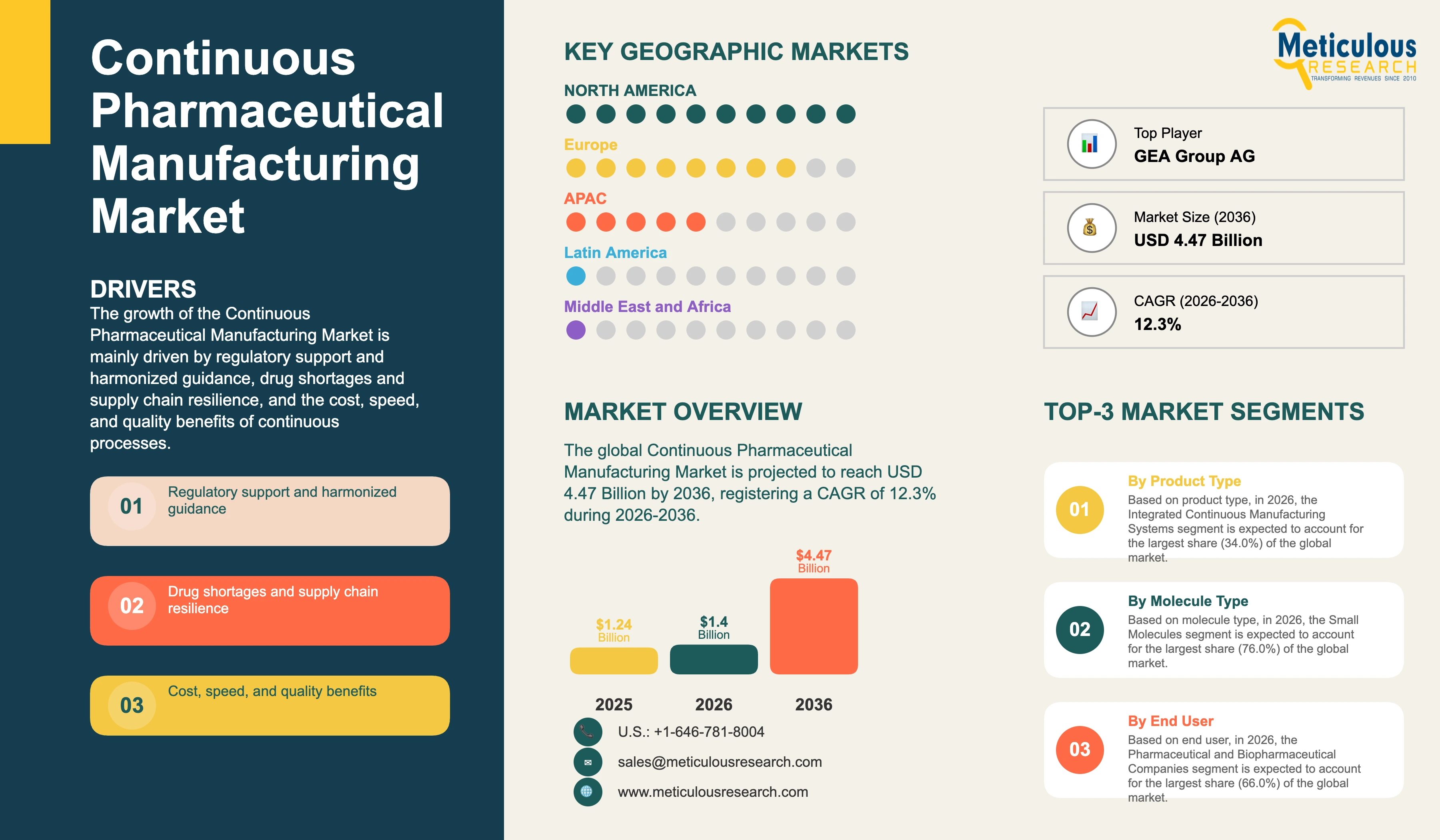
The global continuous pharmaceutical manufacturing market was valued at USD 1.24 billion in 2025. This market is expected to reach USD 4.47 billion by 2036 from an estimated USD 1.40 billion in 2026, registering a CAGR of 12.3% during the forecast period (2026-2036).
- Published
- Nov 2026
- Pages
- 267
- Format
- PDF + Excel
- Report ID
- MRHC - 1042523
- Base year
- 2025
- 2025 · BASELINE
- $1.24B
- 2036
- $4.47B
- CAGR 2026–2036
- 12.3%
2025 baseline · 2026–2036 forecast at 12.3% CAGR · hover a bar for the value
Key highlights
The International Council for Harmonisation adopted its Q13 guideline on continuous manufacturing of drug substances and drug products in November 2022, and the U.S. Food and Drug Administration published it as final guidance in March 2023, giving companies a common international framework for developing, validating, and registering continuously manufactured products.
The FDA issued final guidance for its Advanced Manufacturing Technologies (AMT) Designation Program in December 2024, published on 2 January 2025, which offers early engagement and expedited assessment for drugs made with qualifying advanced manufacturing technologies, including continuous manufacturing.
In January 2025, the FDA also issued draft guidance on considerations for complying with batch uniformity requirements in advanced manufacturing, which supports the use of real-time process monitoring, process analytical technology, and continuous manufacturing systems.
The ICH Q13 guideline and the growing number of approved continuous products have reduced the regulatory risk of adopting continuous manufacturing, and regulators in the U.S., Europe, and Japan have established dedicated teams to support companies using advanced manufacturing technologies.
The FDA has approved a growing number of products made with continuous manufacturing since its first approval of a continuously manufactured drug, Vertex's Orkambi, in 2015, including products from Janssen, Eli Lilly, Pfizer, and other companies, and the agency has repeatedly cited continuous manufacturing as a way to reduce drug shortages and improve quality.
Pharmaceutical companies announced large investments in new manufacturing capacity in the U.S. and Europe in 2025 and 2026 in response to tariffs and supply chain concerns, and many new facilities are being designed to use continuous and modular processes from the start.
Equipment and bioprocessing suppliers continue to expand their continuous offerings, including integrated oral solid dosage lines, continuous twin-screw granulation, flow chemistry reactors, perfusion systems, and continuous chromatography, while CDMOs such as Thermo Fisher Scientific's Patheon business, Lonza, Cambrex, and Asymchem are adding continuous and flow chemistry capacity for clients.
By product type, integrated continuous manufacturing systems account for the largest share of 34.0% in 2026, while continuous bioprocessing systems register the highest CAGR.
By molecule type, small molecules account for the largest share in 2026, while biologics register the higher CAGR.
By end user, pharmaceutical and biopharmaceutical companies account for the largest share of 66.0% in 2026, while contract development and manufacturing organizations register the highest CAGR.
By geography, North America accounts for the largest share of 40.0% in 2026, while Asia-Pacific registers the highest CAGR of 14.9%.
Report summary
| Particulars | Details |
|---|---|
| Base Year | 2025 |
| Estimated Year | 2026 |
| Forecast Period | 2026-2036 |
| Market Size in 2025 | USD 1.24 billion |
| Market Size in 2026 | USD 1.40 billion |
| Market Size by 2036 | USD 4.47 billion |
| CAGR (2026-2036) | 12.3% |
| Format | PDF, Excel & Cloud Portal · 267 pages |
| Largest Segment by Product Type (2026) | Integrated Continuous Manufacturing Systems (34.0%) |
| Largest Segment by End User (2026) | Pharmaceutical and Biopharmaceutical Companies (66.0%) |
| Largest Region (2026) | North America (40.0%) |
| Fastest-Growing Region | Asia-Pacific (CAGR 14.9%) |
| Segments Covered | Product Type, Molecule Type, Application, End User, and Geography |
| Geographic Scope | North America, Europe, Asia-Pacific, Latin America, and Middle East and Africa |
| Key Companies Profiled | GEA, Thermo Fisher Scientific, Siemens, Glatt, L.B. Bohle, Coperion, Gericke, Fette Compacting, Korsch, Hosokawa Micron, Corning, Sartorius, Cytiva, Repligen, and Merck KGaA |
Report overview
Segments covered: product type, molecule type, application, end user.
The growth of this market is mainly driven by strong support from regulators, including the International Council for Harmonisation's Q13 guideline on continuous manufacturing and the U.S. Food and Drug Administration's Advanced Manufacturing Technologies Designation Program, the need to reduce drug shortages and strengthen domestic supply chains, the lower cost, smaller footprint, and faster development timelines that continuous processes offer compared with batch production, the growth of high-value and high-potency drugs that benefit from contained and consistent processing, the adoption of continuous bioprocessing for biologics, and advances in process analytical technology and digital process control. However, factors such as high upfront investment and the cost of replacing existing batch facilities, the technical complexity of developing and validating continuous processes, the shortage of skilled engineers, and the limited flexibility of dedicated lines for low-volume products are expected to restrain the growth of this market to some extent.
Continuous pharmaceutical manufacturing is a production approach in which raw materials are fed into a process and products are removed from it continuously, rather than being made in separate batches with stops between each step. In drug product manufacturing, continuous lines connect feeding, blending, granulation, drying, compression, and coating into a single integrated process for tablets and capsules. In drug substance manufacturing, flow chemistry reactors carry out chemical reactions in continuously flowing streams, which allows better control of temperature, mixing, and hazardous reactions. In biologics manufacturing, continuous bioprocessing uses perfusion cell culture and continuous chromatography to produce proteins and antibodies with higher productivity in smaller facilities. Continuous processes are monitored in real time with process analytical technology (PAT) and controlled by advanced software, which allows quality to be built into the process rather than tested at the end.
This market covers the global revenue from equipment, systems, and software used for continuous pharmaceutical manufacturing, measured in value. It includes integrated continuous manufacturing systems, continuous unit operation equipment such as loss-in-weight feeders, continuous blenders, twin-screw granulators, and continuous dryers, continuous bioprocessing systems, process analytical technology and control software, and flow chemistry reactors. It is segmented by product type, molecule type, application, end user, and geography. Batch manufacturing equipment, general laboratory instruments, and contract manufacturing service revenue are not included.
The pharmaceutical industry has relied on batch manufacturing for decades, and most existing plants are built around it. In batch processes, each step is carried out separately, materials are held and tested between steps, and products are released only after laboratory testing of finished batches. This approach is well understood and flexible, but it requires large facilities, long cycle times, and large inventories, and scaling up from development to commercial production often requires new equipment and additional validation. Quality problems in batch processes can lead to rejected batches, recalls, and drug shortages.
Continuous manufacturing offers several important advantages over traditional batch production for both drug substances and drug products. Production can be scaled by running the process for longer rather than building larger equipment, which shortens development timelines and reduces the risk of scale-up problems. Continuous facilities are much smaller than batch facilities, which reduces capital and operating costs. Real-time monitoring and control improve product consistency and allow real-time release testing in some cases. Continuous processes also reduce the amount of material in process at any time, which improves safety when handling hazardous reactions or highly potent compounds, and they reduce waste and energy use.
The economics of continuous manufacturing have been studied extensively by industry and academic groups, and published analyses have found that continuous processes can reduce capital costs, operating costs, and facility footprints significantly compared with equivalent batch facilities, depending on the product and process. These savings, combined with faster development and more consistent quality, are the main reasons why large pharmaceutical companies have built continuous capabilities.
Regulators in the U.S., Europe, and Japan have strongly supported the adoption of continuous manufacturing. The FDA has encouraged its adoption for more than a decade through its Emerging Technology Program, and the ICH Q13 guideline, adopted in 2022, provides a harmonized framework for continuous manufacturing across the U.S., Europe, Japan, and other regions. The FDA's Advanced Manufacturing Technologies Designation Program, finalized in 2025, offers additional support. Governments also see continuous and advanced manufacturing as a way to bring drug production back to domestic markets and reduce dependence on overseas suppliers.
The market includes a range of equipment, bioprocessing, and technology suppliers with different areas of focus. GEA, Glatt, L.B. Bohle, Fette Compacting, Korsch, Gericke, Coperion, and Hosokawa Micron supply continuous oral solid dosage equipment and integrated lines. Thermo Fisher Scientific offers continuous processing equipment, such as twin-screw granulators and extruders. Corning supplies flow chemistry reactors, while Sartorius, Cytiva, Repligen, and Merck KGaA supply continuous bioprocessing systems. Siemens supplies process control and PAT software that integrates continuous lines.
Over the forecast period, the continuous pharmaceutical manufacturing market is expected to grow strongly, supported by regulatory incentives, supply chain investment, and technology advances. North America is expected to remain the largest market, while Asia-Pacific is expected to grow fastest as manufacturers in China, India, Japan, and South Korea invest in advanced manufacturing.
Perfusion and continuous purification let us produce more antibody in a smaller plant, which is essential when we compete on price.
This explains why continuous bioprocessing systems form the fastest-growing product type and why biologics are growing faster than small molecules.
Continuous lines make sense for our high-volume products, but the investment and regulatory work mean we move one product at a time.
This shows why converting existing products remains slow and why most demand comes from new facilities and new products, while generic manufacturers adopt continuous processes selectively for their highest-volume medicines.
Small molecules are expected to account for the largest share of the market in 2026, while biologics are projected to register the higher CAGR, driven by continuous bioprocessing.
ICH Q13 is an international guideline adopted in November 2022 that describes the scientific and regulatory considerations for developing, implementing, and registering continuous manufacturing processes for drug substances and drug products. The FDA published it as final guidance in March 2023.
Drug product manufacturing is expected to account for the largest share of the market in 2026, while API and drug substance manufacturing is projected to register the higher CAGR, driven by flow chemistry and continuous biologics production.
Continuous manufacturing can reduce facility size and costs, shorten development and production times, improve product consistency through real-time monitoring and control, reduce waste and energy use, and improve safety when handling hazardous or highly potent materials.
It is an FDA program, with final guidance published in January 2025, that allows qualifying advanced manufacturing technologies, such as some continuous processes, to receive designation, which provides early engagement with the FDA and expedited assessment of applications that use them.
Report infographic
Market dynamics
16 factors across 5 forcesRegulatory support and harmonized guidance
Regulatory support is one of the most important drivers of continuous manufacturing. The ICH Q13 guideline, adopted in November 2022 and published as final FDA guidance in March 2023, describes how to develop, implement, and register continuous manufacturing processes for drug substances and drug products, and it provides a common framework for regulators in the U.S., Europe, Japan, and other ICH members. This reduces uncertainty for companies that want to use the same continuous process for products sold in many markets.
The FDA's Advanced Manufacturing Technologies Designation Program, whose final guidance was published in January 2025, allows companies and technology developers to obtain designation for qualifying technologies, which provides early engagement with the agency and expedited assessment of applications that use them. The FDA's Emerging Technology Program and the European Medicines Agency's Quality Innovation Group also support companies adopting continuous manufacturing. These programs encourage pharmaceutical companies to invest in continuous equipment and systems.
In January 2025, the FDA also issued draft guidance on how manufacturers using advanced manufacturing, including continuous processes, can comply with batch uniformity and drug product integrity requirements, emphasizing the role of real-time monitoring, process models, and in-process testing. The European Medicines Agency and Japan's Pharmaceuticals and Medical Devices Agency have also built experience reviewing continuous processes, which gives companies greater confidence that continuous products can be approved in all major markets.
Drug shortages and supply chain resilience
Drug shortages remain a major concern in the U.S., Europe, and other regions, and many shortages are caused by quality problems and limited manufacturing capacity, particularly for generic drugs produced at low margins in a small number of overseas facilities. Continuous manufacturing can improve quality, reduce the cost and footprint of production, and make it more economical to produce drugs closer to patients, which supports efforts to strengthen domestic supply chains.
Governments are encouraging domestic production of essential medicines and active pharmaceutical ingredients through funding, procurement policies, and trade measures, and pharmaceutical companies announced large investments in new U.S. and European manufacturing capacity in 2025 and 2026. Many of these new facilities are being designed to use continuous and modular processes, which supports demand for continuous equipment.
Continuous manufacturing is particularly attractive for domestic production because its smaller facilities, lower labor needs, and higher efficiency can help offset the higher labor and construction costs of the U.S. and Europe compared with traditional manufacturing hubs. Programs funded by the U.S. government have supported continuous manufacturing of essential medicines and APIs, and several companies have built continuous API facilities in the U.S. with public support.
Cost, speed, and quality benefits
Continuous manufacturing can reduce the cost of producing drugs by shrinking facility footprints, cutting cycle times, reducing inventories and waste, and lowering labor requirements. Development can be faster because the same equipment can be used from clinical supply to commercial production by running for longer periods, which reduces the time and cost of scale-up and technology transfer. These benefits are particularly valuable for new drugs, where speed to market is critical.
Real-time monitoring and control improve product consistency and reduce the risk of batch failures and recalls. Integrated continuous manufacturing systems account for the largest share of the market by product type, reflecting the demand for complete lines that deliver these benefits.
Continuous processes also reduce environmental impacts by using less energy, solvent, and water and generating less waste, which supports the sustainability goals of pharmaceutical companies. Flow chemistry in particular can reduce solvent use and improve reaction yields, while continuous drug product lines reduce material losses during start-up and changeover compared with large batch equipment.
Growth of biologics and continuous bioprocessing
Biologics, such as monoclonal antibodies, are a growing share of new drugs, and manufacturers are under pressure to reduce production costs and increase flexibility. Continuous bioprocessing, which uses perfusion cell culture and continuous or connected downstream purification, can significantly increase productivity and reduce facility size compared with traditional fed-batch processes. Several companies have adopted intensified and continuous processes for commercial production, and suppliers such as Sartorius, Cytiva, Repligen, and Merck KGaA offer perfusion systems, continuous chromatography, and connected processing solutions.
Continuous bioprocessing systems form the fastest-growing product type in this market, and biologics form the faster-growing molecule type, supported by the expanding pipeline of antibodies, biosimilars, and other protein therapeutics.
Biosimilar manufacturers, in particular, are adopting intensified and continuous processes to lower costs and compete on price, and several companies have built facilities designed around perfusion and connected downstream processing.
Table of contents
12 chapters · 122 sections · 267 pages · click to expandSegmental analysis
| Segment | Largest share (2026) | Fastest growth (2026–2036) |
|---|---|---|
| By Product Type | Integrated continuous manufacturing systems | Continuous bioprocessing systems |
| By Molecule Type | Small molecules | — |
| By Application | Drug product manufacturing | — |
| By End User | Pharmaceutical and biopharmaceutical companies | Contract development and manufacturing organizations |
By Product Type
- Continuous Pharmaceutical Manufacturing Market Analysis by Product Type
- The integrated continuous manufacturing systems segment is expected to account for the largest share of 34.0% of the market.
- The large share of this segment is mainly due to the adoption of complete continuous oral solid dosage lines by large pharmaceutical companies and CDMOs for new products, the high value of integrated systems that combine feeding, blending, granulation, drying, compression, and coating with PAT and control software, and the preference of manufacturers for proven, pre-validated platforms from a single supplier.
- Integrated systems, such as GEA's ConsiGma platform, Glatt's continuous lines, L.B.
- Bohle's QbCon system, and integrated lines offered with Fette Compacting, Korsch, and Gericke equipment, allow manufacturers to move from development to commercial production on the same equipment by running for longer periods.
- These systems are used for both wet and dry granulation and direct compression processes and are often designed with containment for potent compounds.
- Large pharmaceutical companies, such as Janssen, Eli Lilly, Pfizer, and Vertex, have used integrated continuous lines for commercial products, and CDMOs are adding them to attract clients.
- Integrated continuous manufacturing systems are expected to remain the largest product type over the forecast period.
- The integrated systems segment benefits from the construction of new oral solid dosage facilities in the U.S., Europe, and Asia, where companies choose continuous lines to reduce footprint and development time.
- Suppliers are adding features such as integrated PAT, automated start-up and shutdown, material diversion, and digital process control, which increase the value of each system.
- Development-scale versions of integrated lines allow companies to develop processes with small amounts of API, which is important in early development when material is scarce.
- Integrated continuous systems also support regulatory flexibility, since changes in production volume can be made by adjusting run time rather than changing equipment, which reduces the need for post-approval submissions.
- Large pharmaceutical companies often standardize on a single platform across sites, which creates long-term relationships with suppliers and recurring revenue from spare parts, upgrades, and services.
- CDMOs are adding integrated lines to offer continuous development and manufacturing services to clients that lack their own capabilities.
- However, the continuous bioprocessing systems segment is projected to register the highest CAGR during the forecast period.
- The rapid growth of this segment is driven by the adoption of perfusion and continuous purification for biologics.
- Continuous unit operation equipment, process analytical technology and control software, and flow chemistry reactors make up the rest of the market.
- Continuous unit operation equipment includes loss-in-weight feeders, continuous blenders, twin-screw granulators, continuous dryers, and tablet presses, which are sold to companies building their own lines or upgrading batch processes.
- Process analytical technology and control software include spectroscopy tools, process models, and control platforms that monitor and control continuous processes.
- Flow chemistry reactors are used for continuous API synthesis and are growing rapidly as companies adopt flow chemistry for complex and hazardous reactions.
By Molecule Type
- Continuous Pharmaceutical Manufacturing Market Analysis by Molecule Type
- The small molecules segment is expected to account for the largest share of the market, due to the large number of oral solid dosage products and APIs suitable for continuous manufacturing and the maturity of continuous drug product technology.
- However, the biologics segment is projected to register the higher CAGR during the forecast period, driven by continuous bioprocessing and the growth of the biologics pipeline.
- Small molecules include oral solid dosage forms, such as tablets and capsules, which were the first products to be made commercially with continuous processes, and APIs made by flow chemistry.
- Biologics include monoclonal antibodies, biosimilars, and other proteins produced with perfusion and continuous purification.
- Small molecules are expected to remain the largest molecule type because most new drugs and the vast majority of medicines by volume are small molecules, and continuous drug product and flow chemistry technologies are mature for many of these products.
By Application
- Continuous Pharmaceutical Manufacturing Market Analysis by Application
- The drug product manufacturing segment is expected to account for the largest share of the market, due to the wide adoption of continuous oral solid dosage manufacturing.
- However, the API and drug substance manufacturing segment is projected to register the higher CAGR during the forecast period, driven by the adoption of flow chemistry and continuous biologics production.
- Drug product manufacturing includes continuous blending, granulation, compression, and coating of oral solid dosage forms, while API and drug substance manufacturing includes flow chemistry and continuous crystallization, filtration, and drying for small molecules and upstream and downstream processing for biologics.
- Drug product manufacturing accounts for the largest share because continuous oral solid dosage lines are the most widely adopted continuous technology and are used for many approved products, while drug substance manufacturing is growing faster as flow chemistry and continuous biologics processes are adopted.
By End User
- Continuous Pharmaceutical Manufacturing Market Analysis by End User
- The pharmaceutical and biopharmaceutical companies segment is expected to account for the largest share of 66.0% of the market.
- The large share of this segment is mainly due to investment by large pharmaceutical companies in continuous manufacturing for new products, their in-house process development capabilities, and the construction of new facilities in the U.S., Europe, and Asia.
- Large companies such as Eli Lilly, Pfizer, Johnson & Johnson, Vertex, Novartis, and others have built continuous manufacturing capabilities and use them for commercial products, and many new facilities announced in 2025 and 2026 include continuous processes.
- Pharmaceutical and biopharmaceutical companies are expected to remain the largest end user over the forecast period.
- Large pharmaceutical companies have the resources to invest in process development, PAT, and control systems, and they can use continuous manufacturing across many products.
- Several have established global continuous manufacturing networks and use common platforms across sites, which supports repeat purchases from equipment suppliers.
- However, the contract development and manufacturing organizations segment is projected to register the highest CAGR during the forecast period.
- The rapid growth of this segment is driven by outsourcing and CDMO investment in continuous capabilities.
- Research and academic institutes make up the rest of the market.
- Research and academic institutes, such as university research centers and government laboratories, use continuous equipment for process research and training and play an important role in developing new continuous technologies.
- CDMOs are investing in continuous oral solid dosage lines, flow chemistry, and continuous bioprocessing to differentiate their services and attract clients seeking faster development and lower costs.
Geographic analysis
North America
Largest shareIn 2026, North America is expected to account for the largest share of 40.0% of the global continuous pharmaceutical manufacturing market. The large share of this region is mainly due to strong FDA support for continuous manufacturing, the presence of large pharmaceutical companies that have adopted the technology, government funding for advanced manufacturing, and large investments in new U.S. manufacturing capacity. The U.S. is the largest single country market for continuous pharmaceutical manufacturing equipment and systems. The FDA approved the first continuously manufactured drug in 2015 and has since approved many more, and its Advanced Manufacturing Technologies Designation Program and Emerging Technology Program encourage adoption. North America is expected to remain the largest region throughout the forecast period. Pharmaceutical companies announced large investments in new U.S. manufacturing facilities in 2025 and 2026, partly in response to tariffs and government policies encouraging domestic production, and many of these facilities include continuous processes. U.S. universities and research centers, such as those supported by government funding for advanced pharmaceutical manufacturing, have also contributed to the development of continuous technologies. Canada is a smaller market but has research and manufacturing capabilities in continuous processing.
Asia-Pacific
Fastest growthAsia-Pacific is projected to register the highest CAGR of 14.9% during the forecast period. Growth is driven by investment in advanced manufacturing by pharmaceutical companies and CDMOs in China, India, Japan, South Korea, and Singapore. India and China are major producers of APIs and generic drugs, and leading companies in both countries are investing in flow chemistry and continuous manufacturing to improve efficiency and meet regulatory expectations in export markets. Japan and South Korea have strong biopharmaceutical industries and are adopting continuous bioprocessing, while Singapore is a hub for advanced pharmaceutical manufacturing. Government programs in India, such as production-linked incentives for pharmaceuticals and APIs, and China's policies to upgrade pharmaceutical manufacturing are encouraging investment in advanced technologies.
Europe
Europe holds a large share, supported by strong pharmaceutical and equipment industries, while Latin America and the Middle East and Africa are smaller markets. Europe is home to many leading continuous manufacturing equipment suppliers, including GEA, Glatt, L.B. Bohle, Gericke, Fette Compacting, Korsch, Coperion, and Sartorius, and to major pharmaceutical manufacturing hubs in Ireland, Switzerland, Germany, Belgium, and the U.K. The EU's pharmaceutical strategy and proposed Critical Medicines Act aim to strengthen European production of essential medicines, which supports investment in efficient manufacturing.
Competitive landscape
The continuous pharmaceutical manufacturing market is moderately consolidated, with large equipment and life sciences companies and specialists. Leading companies include GEA Group, Thermo Fisher Scientific, Siemens, Glatt, L.B. Bohle, Coperion, Gericke, Fette Compacting, Korsch, Hosokawa Micron, Corning, Sartorius, Cytiva, Repligen, and Merck KGaA.
Companies compete on process expertise, integration, PAT and control capabilities, regulatory support, containment, flexibility, and service.
GEA, Glatt, L.B. Bohle, Fette Compacting, Korsch, and Gericke offer integrated continuous oral solid dosage lines and unit equipment, often in partnership with each other and with PAT and control suppliers. Coperion and Hosokawa Micron supply feeders, mixers, and powder processing equipment. Thermo Fisher Scientific offers twin-screw granulators and extruders as well as CDMO services. Siemens provides process control and PAT data management software used in many continuous lines. Corning is a leading supplier of flow chemistry reactors. Sartorius, Cytiva, Repligen, and Merck KGaA supply perfusion systems, continuous chromatography, and connected bioprocessing solutions.
Most suppliers focus on specific parts of the continuous manufacturing process, and integrated lines often combine equipment from several suppliers with a common control system. As a result, partnerships and interoperability are important, and suppliers that can coordinate complete solutions and take responsibility for integration have an advantage. Service, training, and process development support are also important factors in purchasing decisions, since many customers have limited experience with continuous processes.
The top five players are estimated to account for 40.0% of the continuous pharmaceutical manufacturing market in 2025.
Players use several strategies to grow in this market, including partnerships, new product launches, and investment in process development centers.
For example, equipment suppliers are partnering with pharmaceutical companies, CDMOs, and universities to develop and demonstrate continuous processes, launching development-scale and modular systems, and adding digital process control and PAT integration. Bioprocessing suppliers are expanding their portfolios through acquisitions and product launches in perfusion and continuous purification.
Competition is expected to center on integration and flexibility.
Suppliers that can offer complete, integrated solutions with strong process and regulatory support, together with flexible systems for lower-volume products, are expected to gain share. Partnerships between equipment suppliers, software providers, and CDMOs are likely to become more important as customers seek turnkey solutions.
Some of the key players operating in the continuous pharmaceutical manufacturing market are GEA Group AG, Thermo Fisher Scientific Inc., Siemens AG, Glatt GmbH, L.B. Bohle Maschinen und Verfahren GmbH, Coperion GmbH (Hillenbrand, Inc.), Gericke AG, Fette Compacting GmbH, Korsch AG, Hosokawa Micron Corporation, Corning Incorporated, Sartorius AG, Cytiva (Danaher Corporation), Repligen Corporation, and Merck KGaA.
- —
The FDA finalized guidance for its Advanced Manufacturing Technologies Designation Program, issued draft guidance on batch uniformity in advanced manufacturing, and pharmaceutical companies announced large investments in new manufacturing capacity.
- GEA
- Thermo Fisher Scientific
- Siemens
- Glatt
- L.B. Bohle
- Coperion
- Gericke
- Fette Compacting
- Korsch
- Hosokawa Micron
- Corning
- Sartorius
- Cytiva
- Repligen
- Merck KGaA
Expert perspectives
Continuous manufacturing is moving from early adoption toward mainstream use in pharmaceutical production, supported by regulators and supply chain priorities.
The market is supported by a rare combination of regulatory encouragement, economic benefits, and policy priorities. ICH Q13 and the FDA's Advanced Manufacturing Technologies Designation Program have reduced regulatory uncertainty, while concerns about drug shortages and supply chain resilience have increased government and industry interest in efficient domestic manufacturing. At the same time, the technology has matured, with many commercial products now made continuously.
Despite this progress, continuous manufacturing still accounts for a small share of total pharmaceutical production, which leaves significant room for growth. Most of this growth is expected to come from new products and new facilities, while existing batch production will continue to dominate for older products. The pace of adoption will depend on the investment decisions of large pharmaceutical companies and CDMOs, the availability of skilled staff, and continued regulatory support.
Over the forecast period, the market is expected to grow at about 12.3% per year, supported by new facilities, CDMO investment, and bioprocessing.
Growth is expected to be strongest in continuous bioprocessing, PAT and control software, and flow chemistry, while integrated oral solid dosage systems remain the largest product type. New facilities, particularly in the U.S. and Asia, are expected to account for most demand, since converting existing products remains slow.
Software and digital tools are expected to become increasingly important, as companies use data, process models, and AI to develop and operate continuous processes more efficiently.
Integrated systems are the largest product type, while continuous bioprocessing grows fastest. Pharmaceutical companies are the largest end user, while CDMOs grow fastest.
CDMOs are expected to play a growing role in making continuous manufacturing available to smaller companies, and biologics are expected to account for a rising share of demand as continuous bioprocessing matures.
Small molecules will remain the largest molecule type, while drug substance manufacturing is expected to grow faster than drug product manufacturing as flow chemistry is adopted more widely.
North America remains the largest region, while Asia-Pacific is the fastest-growing region at a CAGR of 14.9%.
The main swing factors are the pace of new facility investment, the adoption of continuous processes by generic manufacturers, and the progress of continuous bioprocessing. Europe is expected to remain a major market, supported by its strong equipment industry and pharmaceutical manufacturing base.
For suppliers, the key priorities are integration, flexibility, and regulatory support.
For pharmaceutical companies, the key priorities are to build continuous capabilities for new products, invest in skills and PAT, and work with regulators early. Overall, continuous manufacturing is expected to become a standard option for new pharmaceutical products over the forecast period.
Customer perspectives
Vice President of Manufacturing Science - large pharmaceutical company, U.S.
Our new oral solid dose plant is fully continuous. We develop on the same line we use for commercial supply, which saves us months.
This explains why integrated continuous manufacturing systems account for 34.0% of the market and pharmaceutical and biopharmaceutical companies account for 66.0%.
For large pharmaceutical companies, the ability to develop and manufacture on the same continuous platform reduces scale-up risk and speeds up launches.
This explains why CDMOs and Asia-Pacific are growing fastest.
For Indian CDMOs, continuous and flow chemistry capabilities help them compete for complex projects from global clients.
This explains why Asia-Pacific is the fastest-growing region, as Indian and Chinese CDMOs invest in advanced capabilities to serve global clients.
“Clients increasingly ask for flow chemistry and continuous options. Offering them helps us win projects.”
Frequently asked questions
The market was valued at USD 1.24 billion in 2025 and USD 1.10 billion in 2024, and is estimated at USD 1.40 billion in 2026.
Cite this report
Meticulous Research. (2026). Continuous Pharmaceutical Manufacturing Market - Global Opportunity Analysis and Industry Forecast (2026-2036) (Report No. MRHC - 1042523). Meticulous Market Research Pvt. Ltd. https://www.meticulousresearch.com/product/continuous-pharmaceutical-manufacturing-market-7206