Enhanced Oil Recovery Market (2026-2036)
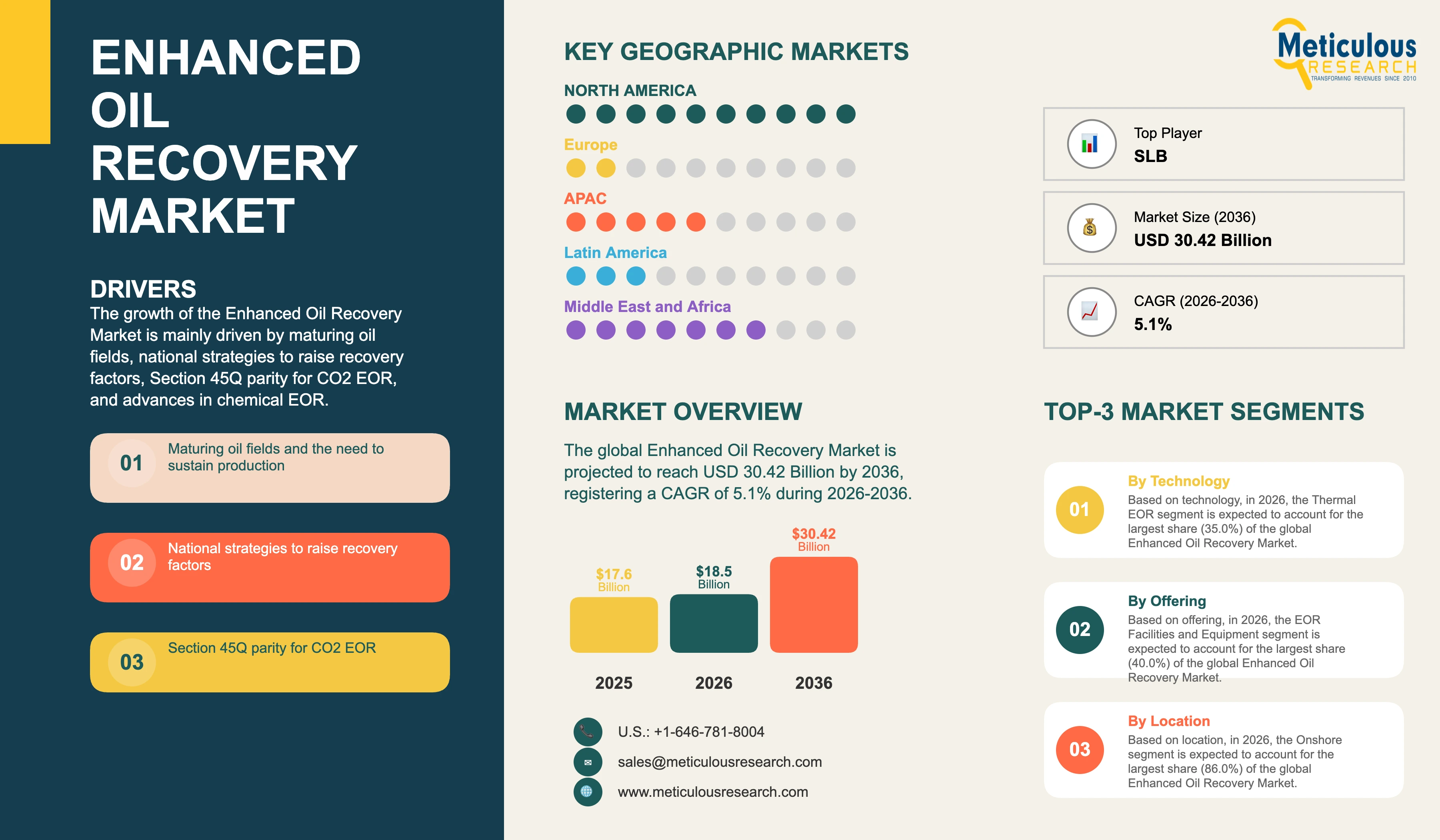
The global enhanced oil recovery market was valued at USD 17.60 billion in 2025. This market is expected to reach USD 30.42 billion by 2036 from an estimated USD 18.50 billion in 2026, registering a CAGR of 5.1% during the forecast period (2026-2036).
- Published
- Nov 2026
- Pages
- 269
- Format
- PDF + Excel
- Report ID
- MREP - 1042706
- Base year
- 2025
- 2025 · BASELINE
- $17.60B
- 2036
- $30.42B
- CAGR 2026–2036
- 5.1%
2025 baseline · 2026–2036 forecast at 5.1% CAGR · hover a bar for the value
Key highlights
Under the One Big Beautiful Bill Act signed in July 2025, the U.S. Section 45Q tax credit for carbon dioxide used in enhanced oil recovery was raised from USD 60 to USD 85 per metric ton for point-source capture, giving enhanced oil recovery parity with permanent geological storage, and from USD 130 to USD 180 per metric ton for direct air capture.
In August 2026, the U.S. Treasury Department and the IRS issued Notice 2026-50, which expanded the Section 45Q safe harbor for verifying stored volumes to qualifying enhanced oil recovery projects, giving operators a clearer compliance pathway.
Occidental signed long-term agreements in November 2026 with two companies to secure carbon dioxide captured from third-party natural gas processing facilities in the Delaware Basin for its Permian enhanced oil recovery operations, with the potential to expand to up to 4 million metric tons per year combined and initial shipments expected in 2029. Occidental has also outlined plans for three shale carbon dioxide enhanced oil recovery projects.
Petroleum Development Oman reported that enhanced oil recovery accounted for 19% of its crude oil production in 2025, up from 5% in 2014 and 12% in 2020, and projected that this share will rise to about 28% by 2031. In February 2026, the company sought interest for polymer flooding facilities across five oil producing assets in its Block 6 concession.
ADNOC and SNF signed an agreement in May 2026 to evaluate expanded enhanced oil recovery activity in the UAE, including potential local manufacturing of enhanced oil recovery chemicals and additional polymer flooding applications, while ZL EOR Chemicals is building a USD 300 million polymer plant at Sohar Port and Freezone in Oman.
ExxonMobil is expanding its carbon dioxide enhanced oil recovery business following its 2023 acquisition of Denbury, which operated about 1,300 miles of carbon dioxide pipelines in the U.S.
By technology, thermal EOR accounts for the largest share of 35.0% in 2026, while chemical EOR registers the highest CAGR.
By offering, EOR facilities and equipment accounts for the largest share of 40.0% in 2026, while reservoir studies, monitoring, and digital solutions register the highest CAGR.
By location, onshore accounts for the larger share in 2026, while offshore registers the higher CAGR.
By geography, North America accounts for the largest share of 38.0% in 2026, while Middle East & Africa registers the highest CAGR of 6.4%.
Report summary
| Particulars | Details |
|---|---|
| Base Year | 2025 |
| Estimated Year | 2026 |
| Forecast Period | 2026-2036 |
| Market Size in 2025 | USD 17.60 billion |
| Market Size in 2026 | USD 18.50 billion |
| Market Size by 2036 | USD 30.42 billion |
| CAGR (2026-2036) | 5.1% |
| Format | PDF, Excel & Cloud Portal · 269 pages |
| Largest Segment by Technology (2026) | Thermal EOR (35.0%) |
| Largest Segment by Offering (2026) | EOR Facilities and Equipment (40.0%) |
| Largest Region (2026) | North America (38.0%) |
| Fastest-Growing Region | Middle East & Africa (CAGR 6.4%) |
| Companies Profiled | 12 companies and other companies |
| Segments Covered | Technology, Offering, Location, Geography |
| Countries Covered | U.S., Canada, Oman, UAE, Kuwait, Saudi Arabia, Rest of Middle East & Africa, China, Indonesia, India, Malaysia, Rest of Asia-Pacific, Venezuela, Brazil, Argentina, Colombia, Rest of Latin America, Norway, Russia, Rest of Europe |
Report overview
Segments covered: technology, offering, location.
The growth of this market is mainly driven by the need to sustain production from mature oil fields, which account for a large share of global oil supply, national strategies in the Middle East to raise recovery factors and maintain production capacity, improved economics of carbon dioxide enhanced oil recovery in the U.S. following the 2025 changes to the Section 45Q tax credit, which gave enhanced oil recovery the same credit value as permanent storage, the expansion of polymer flooding and other chemical methods, and the growing availability of captured carbon dioxide from industrial sources. However, factors such as high capital and operating costs, oil price volatility, the limited availability of affordable carbon dioxide and injection infrastructure in many regions, and declining thermal enhanced oil recovery activity in some mature heavy oil fields are expected to restrain the growth of this market to some extent.
Enhanced oil recovery refers to techniques that increase the amount of oil that can be recovered from a reservoir beyond what is possible with primary production, which relies on natural reservoir pressure, and secondary recovery, which uses water or gas injection to maintain pressure. Typically, primary and secondary recovery together produce only about a third of the oil originally in place, leaving most of the oil in the reservoir. Enhanced oil recovery methods change the properties of the oil, the rock, or the injected fluids to mobilize some of this remaining oil, and they can increase recovery by an additional 5% to 20% of the original oil in place.
The main enhanced oil recovery methods are thermal methods, which inject steam or use heat to reduce the viscosity of heavy oil, gas injection methods, which inject carbon dioxide, hydrocarbon gas, or nitrogen that mixes with or displaces the oil, and chemical methods, which inject polymers, surfactants, or alkalis to improve the sweep of injected water or reduce the forces that trap oil in the rock. Other methods, such as microbial enhanced oil recovery and low-salinity water injection, are used on a smaller scale.
This report covers global annual spending on enhanced oil recovery, including enhanced oil recovery facilities and equipment such as steam generators, carbon dioxide recycle and gas injection compressors, polymer and chemical preparation and injection units, and associated surface facilities, injectants and chemicals, including carbon dioxide purchased for injection, polymers, surfactants, and other chemicals, injection gas, and fuel for steam generation, enhanced oil recovery wells and field services, and reservoir studies, monitoring, and digital solutions. The value of oil produced by enhanced oil recovery is not included. Conventional waterflooding and secondary gas injection for pressure maintenance, in-situ oil sands bitumen recovery such as steam-assisted gravity drainage, carbon capture plants, long-distance carbon dioxide pipelines, and produced water treatment are excluded from the scope of this report, as they are covered in separate studies or represent distinct markets.
Enhanced oil recovery is practiced at commercial scale in a relatively small number of countries. The U.S. is a leader in carbon dioxide enhanced oil recovery, particularly in the Permian Basin, where operators such as Occidental have used naturally sourced and captured carbon dioxide for decades, and in the Gulf Coast and Rocky Mountain regions. Thermal enhanced oil recovery is used in California, Oman, Kuwait, Indonesia, China, Venezuela, and other countries with heavy oil. Chemical enhanced oil recovery is used in China, Oman, India, Argentina, and other countries, and gas injection is widely used in the Middle East, Norway, Alaska, and other regions.
The Middle East is a key growth region, as national oil companies seek to raise recovery factors and sustain production capacity from mature fields. Petroleum Development Oman reported that enhanced oil recovery accounted for 19% of its crude oil production in 2025, using thermal, miscible gas injection, and chemical methods, and expects this share to reach about 28% by 2031. ADNOC, Kuwait Oil Company, and Saudi Aramco are also investing in enhanced oil recovery pilots and projects, including carbon dioxide injection and polymer flooding.
The market includes oilfield service companies that provide enhanced oil recovery studies, well services, and project management, chemical manufacturers that supply polymers and surfactants, carbon dioxide suppliers and transport companies, equipment manufacturers, and operators that develop and supply carbon dioxide for enhanced oil recovery. Leading companies include SLB, Halliburton, Baker Hughes, Weatherford, Core Laboratories, SNF, ZL EOR Chemicals, Kinder Morgan, ExxonMobil, Occidental, Linde, and Babcock & Wilcox.
Over the forecast period, the market is expected to grow steadily, driven by mature field redevelopment, national oil company programs, carbon dioxide enhanced oil recovery supported by Section 45Q, and chemical enhanced oil recovery. Chemical enhanced oil recovery is expected to be the fastest-growing technology, while thermal enhanced oil recovery remains the largest. North America remains the largest region, and the Middle East & Africa is expected to grow fastest.
Report infographic
Market dynamics
18 factors across 5 forcesMaturing oil fields and the need to sustain production
A large share of global oil production comes from mature fields that have been producing for decades and are in decline. As primary and secondary recovery become less effective, enhanced oil recovery offers a way to increase recovery from existing reservoirs using existing wells and infrastructure, which can be cheaper and less risky than exploring for new fields. With most of the oil originally in place still remaining in many reservoirs, the potential additional recovery from enhanced oil recovery is very large.
National oil companies and international oil companies are increasingly focused on maximizing recovery from their existing assets, particularly in regions with limited new exploration opportunities. Enhanced oil recovery can also extend the life of fields and associated infrastructure, delaying the cost of decommissioning. Because enhanced oil recovery uses existing wells, pipelines, and processing facilities, it can often add reserves at lower cost and risk than new field developments, particularly in regions where new exploration is limited. The growing contribution of enhanced oil recovery to production at companies such as Petroleum Development Oman, where it rose from 5% of crude output in 2014 to 19% in 2025, shows how important enhanced oil recovery has become for mature field operators.
National strategies to raise recovery factors in the Middle East
Middle Eastern oil producers have set targets to sustain or increase production capacity, and raising recovery factors from their large, mature reservoirs is a key part of their strategies. Oman has been a pioneer in enhanced oil recovery, with large thermal projects such as Qarn Alam and Amal, miscible gas injection at Harweel, and one of the world's first full-field polymer floods at Marmul, and Petroleum Development Oman plans new polymer flooding facilities across five assets in Block 6.
ADNOC operates the Al Reyadah carbon capture facility, which supplies carbon dioxide for enhanced oil recovery, and it signed an agreement with SNF in May 2026 to evaluate expanded polymer flooding and local chemical manufacturing. Kuwait and Saudi Arabia are also testing and developing enhanced oil recovery methods, including thermal recovery in heavy oil fields and carbon dioxide injection. These national programs create large, long-term demand for enhanced oil recovery facilities, chemicals, and services.
Section 45Q tax credit parity for carbon dioxide enhanced oil recovery
In the U.S., the One Big Beautiful Bill Act signed in July 2025 raised the Section 45Q tax credit for carbon dioxide used in enhanced oil recovery from USD 60 to USD 85 per metric ton for point-source capture and from USD 130 to USD 180 per metric ton for direct air capture, giving enhanced oil recovery parity with permanent geological storage. In August 2026, the Treasury Department and the IRS expanded the Section 45Q safe harbor to cover qualifying enhanced oil recovery projects, providing a clearer pathway for verifying stored volumes.
These changes significantly improve the economics of using captured carbon dioxide for enhanced oil recovery, because emitters can earn the same credit whether the carbon dioxide is stored permanently or used in enhanced oil recovery, and enhanced oil recovery operators can obtain carbon dioxide at a lower cost. Occidental's November 2026 agreements to secure up to 4 million metric tons per year of captured carbon dioxide from gas processing plants in the Delaware Basin illustrate how the credit is encouraging new carbon dioxide supply for enhanced oil recovery.
Advances in chemical enhanced oil recovery
Chemical enhanced oil recovery, particularly polymer flooding, has become more widely used as polymer products have improved and costs have fallen. Polymer flooding adds water-soluble polymers, mainly polyacrylamide, to injected water to increase its viscosity and improve the sweep of the reservoir, which can significantly increase oil recovery from waterflooded fields. Polymers that can tolerate higher temperatures and salinity are extending the range of reservoirs where polymer flooding can be applied, including some reservoirs in the Middle East.
Petroleum Development Oman's Marmul polymer flood has achieved a cumulative polymer utilization of about 2.3 kilograms of polymer per barrel of incremental oil, according to the polymer supplier, which shows the efficiency of mature polymer floods. New local polymer manufacturing capacity in Oman, including ZL EOR Chemicals' USD 300 million plant at Sohar and SNF's planned plant, is expected to support further growth in the region.
Table of contents
11 chapters · 128 sections · 269 pages · click to expandSegmental analysis
| Segment | Largest share (2026) | Fastest growth (2026–2036) |
|---|---|---|
| By Technology | Thermal EOR | Chemical EOR |
By Technology
- The onshore segment is expected to account for the larger share of the enhanced oil recovery market, while the offshore segment is projected to register the higher CAGR during the forecast period.
Geographic analysis
North America
Largest shareIn 2026, North America is expected to account for the largest share of 38.0% of the global enhanced oil recovery market. The large share of this region is mainly due to the large carbon dioxide enhanced oil recovery industry in the U.S. Permian Basin, Gulf Coast, and Rocky Mountains, supported by an extensive carbon dioxide pipeline network and the Section 45Q tax credit, as well as thermal enhanced oil recovery in California and gas injection in Alaska. Companies such as Occidental, ExxonMobil, and Kinder Morgan operate large carbon dioxide supply and enhanced oil recovery businesses. Canada also has enhanced oil recovery projects, including carbon dioxide injection in Saskatchewan, where carbon dioxide from a coal-fired power plant and a synthetic fuels plant has been used for enhanced oil recovery. The U.S. Gulf Coast is expected to see growing carbon dioxide enhanced oil recovery as captured carbon dioxide from industrial facilities becomes available through pipelines.
Middle East & Africa
The Middle East & Africa is the second-largest market and is projected to register the highest CAGR of 6.4% during the forecast period. The rapid growth of this region is mainly due to national strategies to raise recovery factors and sustain production capacity in Oman, the UAE, Kuwait, Saudi Arabia, and other countries, the expansion of polymer flooding, thermal, and gas injection projects, carbon dioxide enhanced oil recovery projects such as ADNOC's Al Reyadah, and new local polymer manufacturing in Oman. Petroleum Development Oman expects enhanced oil recovery to account for about 28% of its crude production by 2031. Kuwait is developing thermal recovery for its heavy oil fields, and Saudi Aramco has conducted carbon dioxide enhanced oil recovery demonstrations.
Asia-Pacific
Asia-Pacific is the third-largest market, driven by China's large chemical and thermal enhanced oil recovery projects in the Daqing, Shengli, Liaohe, and Xinjiang fields, thermal enhanced oil recovery in Indonesia, and polymer flooding in India. China's national oil companies are also expanding carbon dioxide enhanced oil recovery projects linked to carbon capture.
Latin America
Latin America is supported by thermal projects in Venezuela, polymer flooding in Argentina and Colombia, and gas and carbon dioxide reinjection in Brazil's pre-salt fields.
Europe
Europe is a small market, with gas injection in Norway and limited projects in other countries, and its share is expected to decline over the forecast period.
Competitive landscape
The global enhanced oil recovery market is fragmented, with the top five players estimated to account for about 25% of the market in 2025. The market includes oilfield service companies, chemical manufacturers, carbon dioxide suppliers and transport companies, equipment manufacturers, and engineering companies, as well as operators that supply carbon dioxide to third parties.
SLB, Halliburton, Baker Hughes, and Weatherford provide enhanced oil recovery studies, well services, chemicals, compression equipment, and project management, and Core Laboratories provides reservoir description and enhanced oil recovery laboratory services. SNF is the world's largest producer of polyacrylamide and a leading supplier of polymers for enhanced oil recovery, with a long history in Oman beginning with the Marmul polymer project, and ZL EOR Chemicals is a major supplier of enhanced oil recovery polymers with a new plant in Oman.
Kinder Morgan, ExxonMobil, and Occidental operate large carbon dioxide supply and transport networks for enhanced oil recovery in the U.S., and Linde supplies carbon dioxide and nitrogen and builds gas processing facilities. Babcock & Wilcox supplies once-through steam generators used in thermal enhanced oil recovery projects in California, the Middle East, and other heavy oil regions.
Companies compete on technical expertise, reservoir knowledge, product performance, cost, and the ability to deliver integrated solutions. Key strategies include developing improved polymers and chemicals, building local manufacturing in key markets, securing carbon dioxide supply, and offering integrated enhanced oil recovery services from screening to full-field implementation.
The competitive landscape is expected to evolve as chemical enhanced oil recovery and carbon dioxide supply grow. Polymer suppliers with local manufacturing and strong technical support will be well positioned in the Middle East, while companies with carbon dioxide transport networks and access to captured carbon dioxide will benefit in the U.S. Chinese oilfield service companies and chemical suppliers are strong in China's domestic market and are expanding internationally. Partnerships between national oil companies and international suppliers, such as the ADNOC-SNF agreement, are also expected to shape the market. Long-term supply contracts for polymers and carbon dioxide give established suppliers a strong position, as switching suppliers during a flood involves technical risk and requires new laboratory and field testing.
Some of the key players operating in the enhanced oil recovery market are SLB, Halliburton Company, Baker Hughes Company, Weatherford International plc, Core Laboratories Inc., SNF Group, ZL EOR Chemicals Ltd., Kinder Morgan, Inc., Exxon Mobil Corporation, Occidental Petroleum Corporation, Linde plc, and Babcock & Wilcox Enterprises, Inc., among others.
- —
Occidental signed agreements in November 2026 to secure up to 4 million metric tons per year of captured carbon dioxide, the IRS expanded its Section 45Q safe harbor to enhanced oil recovery in August 2026, ADNOC and SNF agreed to evaluate expanded polymer flooding in May 2026, and Petroleum Development Oman sought interest for polymer flooding across five assets in February 2026.
- Kinder Morgan
- ExxonMobil
- Occidental
Expert perspectives
The enhanced oil recovery market is supported by a strong structural need: most of the oil in existing reservoirs remains in the ground after conventional recovery, and operators are under pressure to sustain production from mature fields. We expect steady growth over the forecast period, led by chemical and carbon dioxide methods.
Over the forecast period, the market is expected to grow at a CAGR of 5.1%, from USD 18.50 billion in 2026 to USD 30.42 billion in 2036. Growth will be supported by mature field redevelopment, national oil company programs, Section 45Q parity, and chemical enhanced oil recovery, while high costs, oil price volatility, limited carbon dioxide supply, and climate policy will moderate growth.
In terms of segments, thermal enhanced oil recovery remains the largest technology, while chemical enhanced oil recovery grows fastest. Enhanced oil recovery facilities and equipment remain the largest offering, while reservoir studies, monitoring, and digital solutions grow fastest. Onshore projects remain dominant, while offshore projects grow fastest. North America remains the largest region, while the Middle East & Africa grows fastest at a CAGR of 6.4%.
For suppliers, the key priorities are to develop polymers and chemicals for harsh reservoir conditions, to build local manufacturing and service capabilities in the Middle East, to secure carbon dioxide supply and transport capacity, and to offer digital monitoring and verification services. Integrated offerings that combine reservoir studies, chemicals, facilities, and monitoring will be increasingly valuable.
We note that our estimates measure spending on enhanced oil recovery rather than the value of oil produced, and they exclude in-situ oil sands recovery and conventional waterflooding. In our view, the success of shale carbon dioxide enhanced oil recovery is the most important uncertainty for the long-term size of the market.
Our estimates are based on enhanced oil recovery production volumes and costs per barrel by method, carbon dioxide and polymer consumption, announced capital projects in North America, the Middle East, and Asia, and the enhanced oil recovery-related activity of leading service and chemical companies. We expect the Middle East to account for a growing share of global spending, while North America remains the largest market because of its large carbon dioxide enhanced oil recovery industry. Oil prices will remain a key factor for the timing of new projects, but national oil company programs provide a stable base of demand. We also expect monitoring and verification services to become a standard part of carbon dioxide enhanced oil recovery projects in the U.S. as operators claim Section 45Q credits.
Customer perspectives
Head of Enhanced Oil Recovery - national oil company, Middle East
Enhanced oil recovery is now a core part of our production strategy for mature fields. Polymer flooding has delivered good results, and local polymer supply will help us expand it further.
Reservoir Engineering Manager - independent producer, U.S. Permian Basin
The 45Q parity has made captured carbon dioxide much more attractive for our floods. Securing reliable carbon dioxide supply is now our main priority.
Field Development Manager - heavy oil operator, Asia-Pacific
Steamflooding remains essential for our heavy oil fields, but fuel costs and emissions are pushing us to optimize steam use and consider alternatives.
Frequently asked questions
The global enhanced oil recovery market was valued at USD 17.60 billion in 2025, up from USD 16.80 billion in 2024, and is estimated at USD 18.50 billion in 2026. The market measures annual spending on enhanced oil recovery facilities and equipment, injectants and chemicals, wells and field services, and reservoir studies and monitoring.
The global enhanced oil recovery market is expected to reach USD 30.42 billion by 2036, supported by mature field redevelopment, national oil company programs, and carbon dioxide and chemical enhanced oil recovery.
The market is expected to register a CAGR of 5.1% from 2026 to 2036, with the fastest growth in chemical enhanced oil recovery and in the Middle East & Africa.
The One Big Beautiful Bill Act raised the Section 45Q credit for carbon dioxide used in enhanced oil recovery from USD 60 to USD 85 per metric ton for point-source capture, giving it parity with permanent storage, and the IRS expanded its safe harbor to qualifying enhanced oil recovery projects in August 2026.
Market growth is mainly driven by maturing oil fields and the need to sustain production, national strategies to raise recovery factors in the Middle East, Section 45Q parity for carbon dioxide enhanced oil recovery, and advances in chemical enhanced oil recovery.
High capital and operating costs, oil price volatility, and limited carbon dioxide supply and infrastructure restrain growth, while reservoir complexity, technical risk, climate policy, and public scrutiny are key challenges.
Key opportunities include carbon dioxide enhanced oil recovery combined with carbon storage, carbon dioxide enhanced oil recovery in shale reservoirs, polymer flooding expansion in the Middle East and Asia, and digital reservoir management and monitoring.
Thermal enhanced oil recovery is expected to account for the largest share of 35.0% of the market in 2026, while chemical enhanced oil recovery is projected to register the highest CAGR.
Enhanced oil recovery facilities and equipment are expected to account for the largest share of 40.0% of the market in 2026, while reservoir studies, monitoring, and digital solutions are projected to register the highest CAGR.
Petroleum Development Oman reported that enhanced oil recovery accounted for 19% of its crude production in 2025, up from 5% in 2014, and expects the share to reach about 28% by 2031.
North America is expected to account for the largest share of 38.0% of the market in 2026, mainly due to the large carbon dioxide enhanced oil recovery industry in the U.S.
The Middle East & Africa is projected to register the highest CAGR of 6.4% during the forecast period, driven by national programs to raise recovery factors and the expansion of polymer flooding.
The report profiles 12 companies, including SLB, Halliburton Company, Baker Hughes Company, Weatherford International plc, Core Laboratories Inc., SNF Group, ZL EOR Chemicals Ltd., Kinder Morgan, Inc., Exxon Mobil Corporation, Occidental Petroleum Corporation, Linde plc, and Babcock & Wilcox Enterprises, Inc.
Occidental signed agreements in November 2026 to secure up to 4 million metric tons per year of captured carbon dioxide, the IRS expanded its Section 45Q safe harbor to enhanced oil recovery in August 2026, ADNOC and SNF agreed to evaluate expanded polymer flooding in May 2026, and Petroleum Development Oman sought interest for polymer flooding across five assets in February 2026.
In 2026, the onshore segment is expected to account for the larger share of the enhanced oil recovery market, while the offshore segment is projected to register the higher CAGR during the forecast period.
Cite this report
Meticulous Research. (2026). Enhanced Oil Recovery Market - Global Opportunity Analysis and Industry Forecast (2026-2036) (Report No. MREP - 1042706). Meticulous Market Research Pvt. Ltd. https://www.meticulousresearch.com/product/enhanced-oil-recovery-market-7389