Combined Heat and Power Systems Market (2026-2036)
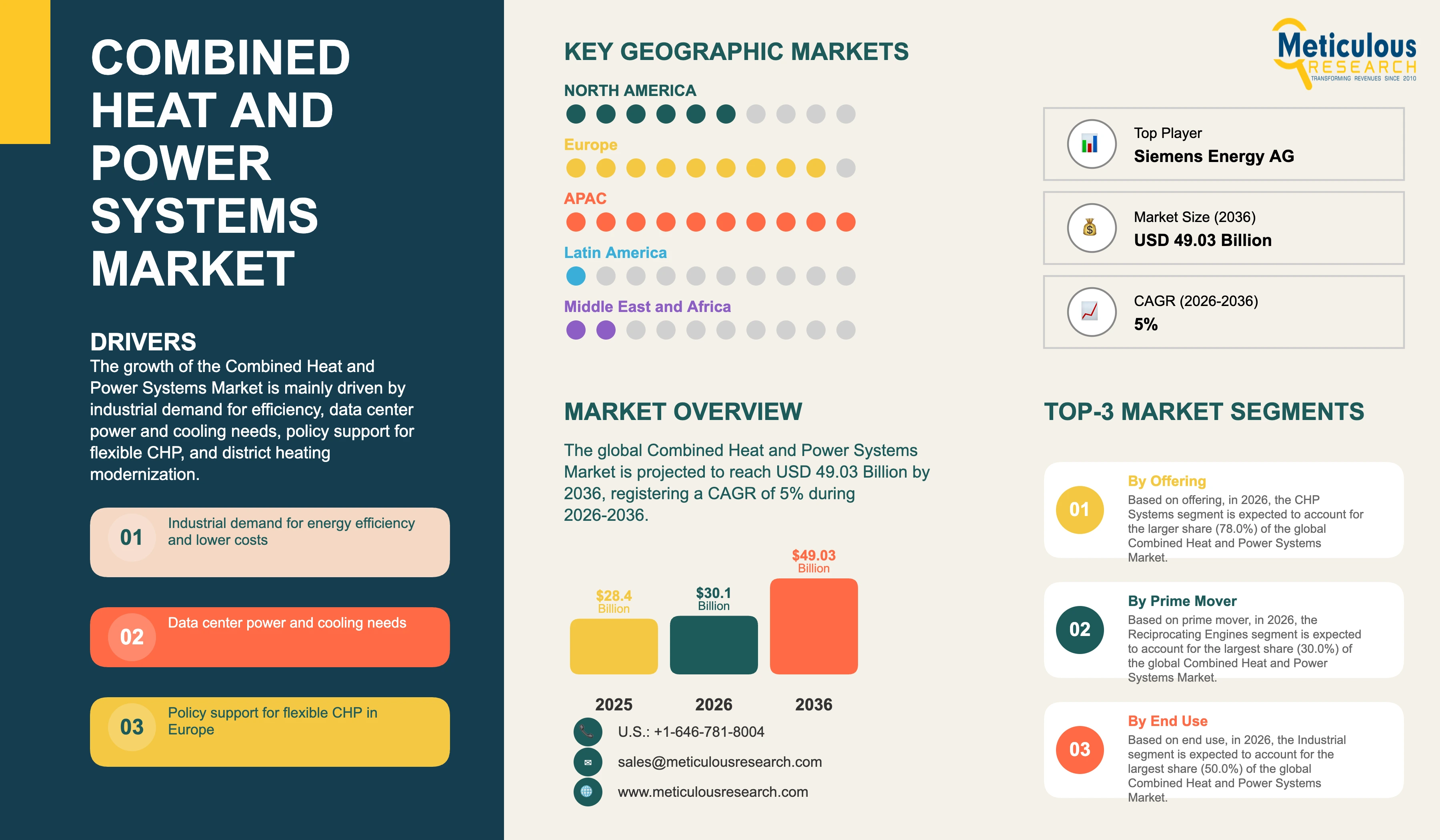
The global combined heat and power systems market was valued at USD 28.40 billion in 2025. This market is expected to reach USD 49.03 billion by 2036 from an estimated USD 30.10 billion in 2026, registering a CAGR of 5.0% during the forecast period (2026-2036).
- Published
- Nov 2026
- Pages
- 270
- Format
- PDF + Excel
- Report ID
- MREP - 1042698
- Base year
- 2025
- 2025 · BASELINE
- $28.40B
- 2036
- $49.03B
- CAGR 2026–2036
- 5.0%
2025 baseline · 2026–2036 forecast at 5.0% CAGR · hover a bar for the value
Key highlights
According to the U.S. Department of Energy's CHP Installation Database, as summarized by Oak Ridge National Laboratory, the U.S. has nearly 80 GW of combined heat and power capacity in use at more than 4,000 facilities, representing about 7% of U.S. generating capacity and about 13% of annual electricity generation.
Germany's gas and hydrogen industry association notes that CHP plants supply around 22% of the country's electricity and 17% of its heat. The Bundestag extended support under the Combined Heat and Power Act (KWKG) to plants commissioned by the end of 2030 in January 2025, and in September 2026 the Federal Ministry for Economic Affairs and Energy published key points for a reform that would extend support until 2035 and reward flexible operation alongside wind and solar.
INNIO announced in July 2026 an order for about 1.1 GW of Jenbacher J624 gas engine capacity, more than 200 engines, to provide behind-the-meter prime power for a developer of mega-scale data center campuses in the U.S., one of the largest orders in the company's history.
Wärtsilä received several large U.S. data center orders in 2026, including 412 MW of 34SG engines for a hyperscale project in Ohio, which brought its total engine capacity sold into the U.S. data center market to over 1.6 GW, and a 790 MW off-grid power solution with 42 Wärtsilä 50SG engines for a data center in Texas.
POWER Magazine reported that Caterpillar is collaborating with Joule Capital Partners to provide 4 GW of total energy capacity to a data center campus in Utah using G3520K generator sets together with combined cooling, heat, and power systems and a liquid cooling architecture designed for high-density servers.
German innovative CHP tenders have combined CHP units with large heat pumps, solar thermal, or geothermal heat and electric boilers under a shared controller, and the last scheduled CHP tender round in December 2025 saw the regular CHP segment oversubscribed, which shows continued interest in new CHP capacity in Europe's largest market.
By offering, CHP systems account for the larger share in 2026, while CHP services register the higher CAGR.
By prime mover, reciprocating engines account for the largest share of 30.0% in 2026, while fuel cells and microturbines register the highest CAGR.
By fuel, natural gas account for the largest share in 2026, while biomass and biogas register the highest CAGR.
By capacity, above 50 MW accounts for the largest share in 2026, while up to 1 MW registers the highest CAGR.
By end use, industrial accounts for the largest share of 50.0% in 2026, while data centers register the highest CAGR.
By geography, Asia-Pacific accounts for the largest share of 36.0% in 2026, while North America registers the highest CAGR of 6.5%.
Report summary
| Particulars | Details |
|---|---|
| Base Year | 2025 |
| Estimated Year | 2026 |
| Forecast Period | 2026-2036 |
| Market Size in 2025 | USD 28.40 billion |
| Market Size in 2026 | USD 30.10 billion |
| Market Size by 2036 | USD 49.03 billion |
| CAGR (2026-2036) | 5.0% |
| Format | PDF, Excel & Cloud Portal · 270 pages |
| Largest Segment by Prime Mover (2026) | Reciprocating Engines (30.0%) |
| Largest Segment by End Use (2026) | Industrial (50.0%) |
| Largest Region (2026) | Asia-Pacific (36.0%) |
| Fastest-Growing Region | North America (CAGR 6.5%) |
| Companies Profiled | 16 companies and other companies |
| Segments Covered | Offering, Prime Mover, Fuel, Capacity, End Use, Geography |
| Countries Covered | U.S., Canada, Germany, Italy, U.K., Netherlands, Poland, Czech Republic, France, Spain, Nordic Countries, Rest of Europe, China, Japan, India, South Korea, Australia, Indonesia, Thailand, Rest of Asia-Pacific, Brazil, Mexico, Argentina, Chile, Rest of Latin America, Saudi Arabia, U.A.E., Qatar, Turkey, South Africa, Rest of Middle East & Africa |
Report overview
Segments covered: offering, prime mover, fuel, capacity, end use.
The growth of this market is mainly driven by the need of industrial companies to reduce energy costs and carbon dioxide emissions by producing electricity and heat from a single fuel source, the rapid growth of on-site power generation and combined cooling, heat, and power systems for data centers in the U.S. and other markets, policy support for flexible combined heat and power in Germany and other European countries that are integrating large amounts of wind and solar power, the expansion and modernization of district heating networks in Europe and China, the growing use of biogas, biomass, and hydrogen-ready engines and turbines, and the value of on-site generation for resilience against grid outages. However, factors such as volatile natural gas prices, decarbonization policies that limit new fossil-fueled plants, the high upfront cost of CHP systems for smaller users, and complex grid interconnection and permitting processes are expected to restrain the growth of this market to some extent.
Combined heat and power (CHP) systems, also called cogeneration systems, generate electricity and useful heat at the same time from a single fuel source, typically at or near the site where the energy is used. By capturing heat that would be wasted in a conventional power plant and using it for industrial processes, space heating, hot water, or cooling through absorption chillers, CHP systems can achieve total efficiencies of 65% to 85% or more, compared with about 45% to 55% for separate production of electricity and heat. This report covers global revenue from new CHP systems, including prime movers, heat recovery equipment, controls, and installation, and from CHP services such as operation and maintenance and long-term service agreements, across reciprocating engines, gas turbines, steam turbines, combined cycle plants, fuel cells, and microturbines.
CHP systems are used in a wide range of applications and sizes. Large industrial plants in the chemicals, refining, pulp and paper, food, steel, and pharmaceutical industries use gas turbine, combined cycle, and boiler and steam turbine systems with capacities of tens to hundreds of megawatts. District heating utilities in Europe and China use large CHP plants to supply heat networks, while hospitals, universities, airports, hotels, and commercial buildings use smaller engine-based systems of a few hundred kilowatts to several megawatts. Micro-CHP systems based on fuel cells and small engines are used in homes, especially in Japan and Germany.
The CHP market is changing in important ways as power and heating systems decarbonize and add more renewable generation. In countries with large shares of wind and solar power, CHP plants are increasingly expected to operate flexibly, producing electricity when renewable output is low and storing heat in thermal storage tanks when it is high. Germany's planned reform of the KWKG explicitly aims to reward CHP plants for responding to wholesale electricity prices and covering residual load, rather than running continuously. CHP plants are also being combined with heat pumps, electric boilers, and solar thermal systems in hybrid district heating systems.
A major new market for engine and turbine-based on-site generation, including CHP and CCHP, has emerged in data centers. Developers of large AI and cloud data centers in the U.S. face long waits for grid connections, and many are installing on-site gas engine and turbine plants to supply prime power. Some of these projects use combined cooling, heat, and power systems, in which waste heat drives absorption chillers that provide cooling for the data center, which improves overall efficiency. INNIO, Wärtsilä, and Caterpillar have announced gigawatt-scale engine orders for data center projects in 2026.
Business models include sales of complete CHP systems and packaged CHP units, engineering, procurement, and construction contracts for large plants, energy-as-a-service and build-own-operate arrangements in which a provider owns the CHP system and sells electricity and heat to the user, and long-term service agreements that cover maintenance and parts. The U.S. Department of Energy has promoted packaged CHP systems, which have been shown to reduce installed costs and installation times compared with custom-engineered systems.
The market is served by manufacturers of gas engines, gas turbines, steam turbines, fuel cells, and microturbines, by packagers and integrators, and by engineering and service companies. Leading companies include Siemens Energy, GE Vernova, Mitsubishi Heavy Industries, Kawasaki Heavy Industries, Baker Hughes, INNIO (Jenbacher), Wärtsilä, Caterpillar (including Solar Turbines), Rolls-Royce Power Systems, Cummins, Everllence, 2G Energy, Capstone Green Energy, Bloom Energy, Doosan Fuel Cell, and Panasonic.
Over the forecast period, the CHP systems market is expected to grow steadily, supported by industrial demand for efficient energy, data center power and cooling, flexible CHP in district heating, renewable fuels, and resilience needs. The market is expected to shift toward engine-based and fuel cell systems, data center and commercial applications, biogas and hydrogen-ready fuels, and flexible operation, while coal-fired CHP declines in most regions. Digital controls that optimize CHP operation against electricity and heat prices are also expected to become standard.
Report infographic
Market dynamics
16 factors across 5 forcesIndustrial demand for energy efficiency and lower costs
Industrial companies use large amounts of both electricity and heat, and producing them together in a CHP system can significantly reduce total fuel use and energy costs compared with buying electricity from the grid and producing steam in boilers. Chemical plants, refineries, pulp and paper mills, food and beverage plants, pharmaceutical plants, and steel mills are among the largest users of CHP, and many new industrial projects in the U.S., China, India, and the Middle East include CHP systems from the start.
Rising electricity prices in many regions and the growing cost of carbon emissions under schemes such as the EU Emissions Trading System increase the value of efficient on-site generation. CHP also reduces exposure to grid outages and transmission constraints, which is important for continuous-process industries where interruptions can cause expensive damage and lost production. In the U.S., where CHP accounts for about 13% of annual electricity generation according to DOE data, industrial facilities hold most of the installed capacity. Industrial decarbonization targets are also encouraging companies to replace older coal and oil-fired boilers with gas, biomass, or biogas CHP systems, which reduce emissions while improving efficiency, and to prepare their CHP systems for future use of hydrogen and other low-carbon fuels.
Data center power and cooling needs
The rapid growth of data centers for artificial intelligence has created a shortage of grid power in key U.S. markets, and many developers are turning to on-site generation using gas engines and turbines. In 2026, INNIO received an order for about 1.1 GW of Jenbacher engines for data center campuses, Wärtsilä's data center engine sales in the U.S. passed 1.6 GW and it won a further 790 MW order in Texas, and Caterpillar announced a 4 GW collaboration for a Utah data center campus that includes combined cooling, heat, and power systems.
Data centers need large amounts of cooling, and capturing engine or turbine waste heat to drive absorption chillers can reduce the electricity needed for cooling and improve overall efficiency. Combined cooling, heat, and power configurations are also attractive where waste heat can be supplied to nearby buildings or district heating networks. Although many data center power plants operate as electricity-only prime power, the share that uses CHP or CCHP configurations is expected to grow as developers seek higher efficiency and lower emissions.
Policy support for flexible CHP in Europe
Several European countries support CHP through feed-in premiums, tenders, and capacity mechanisms because CHP improves fuel efficiency and can provide flexible capacity when wind and solar output is low. Germany, where CHP plants supply about 22% of electricity and 17% of heat, extended KWKG support to plants commissioned by the end of 2030 in early 2025, and the economy ministry has proposed extending it to 2035 with incentives for flexible operation and avoidance of generation during negative price periods.
Poland, the Czech Republic, Italy, the Netherlands, and other countries also support CHP as part of their efforts to replace coal-fired heating plants and maintain secure power and heat supplies. Innovative CHP schemes that combine CHP units with heat pumps, electric boilers, and renewable heat are creating demand for advanced controls and hybrid system integration. Germany's planned reform is also intended to give investors greater certainty, which should help municipal utilities move forward with replacement projects that were delayed by uncertainty about support after 2026.
Expansion and modernization of district heating
District heating networks supply heat to millions of buildings in Europe, China, Russia, and other regions, and CHP plants are the main heat source for many of these networks. Coal phase-out policies in Germany, Poland, the Czech Republic, and China are leading utilities to replace coal-fired CHP plants with gas engines, gas turbines, and biomass CHP plants, often combined with heat pumps and thermal storage.
New district heating networks are also being built in cities in Europe, China, and other regions to decarbonize heating. These projects create demand for CHP units, heat recovery equipment, and integration services, and they support the use of engine-based CHP plants that can start quickly and operate flexibly. China's clean heating programs in northern regions have also replaced many small coal boilers with gas-fired CHP and heating systems. Heat network expansion plans in Germany, Denmark, the Netherlands, and the U.K. are expected to support CHP alongside large heat pumps and other heat sources.
Table of contents
13 chapters · 167 sections · 270 pages · click to expandSegmental analysis
| Segment | Largest share (2026) | Fastest growth (2026–2036) |
|---|---|---|
| By Offering | Above 50 MW | — |
By Offering
- The above 50 MW segment is expected to account for the largest share of the combined heat and power systems market, while the up to 1 MW segment is projected to register the highest CAGR during the forecast period.
Geographic analysis
Asia-Pacific
Largest shareIn 2026, Asia-Pacific is expected to account for the largest share of 36.0% of the global combined heat and power systems market. The large share of this region is mainly due to the very large number of CHP plants that supply industrial parks and district heating networks in northern China, the growing use of gas-fired CHP in Chinese cities as part of clean heating programs, the large industrial CHP base in Japan, South Korea, and India, Japan's residential fuel cell market, and the presence of manufacturers such as Mitsubishi Heavy Industries, Kawasaki Heavy Industries, Panasonic, and Doosan Fuel Cell. Industrial expansion in India and Southeast Asia is also creating demand for CHP, especially in chemicals, food processing, and textiles.
Europe
Europe is the second-largest market, supported by strong policy support for CHP in Germany, where CHP supplies about 22% of electricity and 17% of heat, and in Italy, the Netherlands, Poland, the Czech Republic, and other countries, the large district heating networks of Northern and Eastern Europe, the replacement of coal-fired CHP plants, and the widespread use of biogas CHP. Europe is also the leading region for flexible CHP with thermal storage and hybrid systems that combine CHP with heat pumps and electric boilers.
North America
Fastest growthNorth America is projected to register the highest CAGR of 6.5% during the forecast period. The rapid growth of this region is mainly driven by the very rapid growth of on-site gas engine and turbine power for data centers, including INNIO's 1.1 GW order, Wärtsilä's data center orders of more than 1.6 GW, and Caterpillar's 4 GW collaboration in Utah, the large industrial CHP base in the U.S. Gulf Coast and Midwest, resilience and microgrid projects at hospitals, universities, and military bases, and new chemical, LNG, and manufacturing projects that include CHP. The U.S. already has nearly 80 GW of CHP capacity at more than 4,000 facilities.
Middle East & Africa
The Middle East & Africa is expected to show moderate growth, supported by industrial CHP in the petrochemical, refining, and aluminum sectors in the Gulf countries and by CHP plants for desalination and district cooling.
Latin America
Latin America accounts for a smaller share of the market, with demand from sugar and ethanol mills in Brazil that use bagasse-fired CHP, pulp and paper mills, and industrial gas-fired CHP in Mexico and Argentina, where industrial users seek to reduce exposure to grid outages.
Competitive landscape
The global combined heat and power systems market is moderately fragmented, with the top five players estimated to account for about 35% of the market in 2025. The market includes gas engine manufacturers, gas and steam turbine manufacturers, fuel cell and microturbine manufacturers, CHP packagers and integrators, and engineering and service companies.
INNIO (Jenbacher), Wärtsilä, Caterpillar, Rolls-Royce Power Systems (mtu), Cummins, Everllence, and 2G Energy are leading manufacturers of gas engines for CHP, with strong positions in commercial, industrial, district heating, biogas, and data center applications. Siemens Energy, GE Vernova, Mitsubishi Heavy Industries, Kawasaki Heavy Industries, Baker Hughes, and Caterpillar's Solar Turbines supply gas turbines and steam turbines for larger industrial and district heating CHP plants.
Bloom Energy, Doosan Fuel Cell, and Panasonic are leading suppliers of fuel cell CHP systems, while Capstone Green Energy is a leading supplier of microturbines. Many regional packagers and engineering firms integrate these prime movers into complete CHP systems and offer installation, operation, and maintenance services. Energy service companies and utilities also play an important role as developers and owners of CHP projects under energy-as-a-service contracts.
Companies compete on electrical and total efficiency, flexibility, emissions performance, fuel flexibility including biogas and hydrogen, reliability, delivery time, price, and service capability. Several engine manufacturers have announced investments to expand engine production in 2025 and 2026 in response to data center demand. Key strategies include expanding manufacturing capacity to meet data center demand, developing hydrogen-ready engines and turbines, offering integrated power and cooling solutions, expanding long-term service agreements and energy-as-a-service offerings, and partnering with data center developers and energy service companies.
The competitive landscape is being reshaped by the data center boom, which has brought very large orders to engine manufacturers and increased competition for production capacity. Engine manufacturers with large production capacity and experience in multi-unit plants are gaining share, while fuel cell suppliers are building positions in data centers and commercial buildings. Consolidation among packagers and service providers is also expected as the market grows and customers seek larger, more capable partners.
Some of the key players operating in the combined heat and power systems market are Siemens Energy AG, GE Vernova Inc., Mitsubishi Heavy Industries, Ltd., Kawasaki Heavy Industries, Ltd., Baker Hughes Company, INNIO N.V. (Jenbacher), Wärtsilä Corporation, Caterpillar Inc. (including Solar Turbines), Rolls-Royce Power Systems AG, Cummins Inc., Everllence SE, 2G Energy AG, Capstone Green Energy Holdings, Inc., Bloom Energy Corporation, Doosan Fuel Cell Co., Ltd., and Panasonic Holdings Corporation, among others.
- —
INNIO won a 1.1 GW data center engine order in 2026, Wärtsilä's U.S. data center engine sales passed 1.6 GW and it won a 790 MW Texas order, Caterpillar announced a 4 GW Utah data center collaboration including combined cooling, heat, and power, and Germany published key points for extending CHP support to 2035.
- Siemens Energy AG
- GE Vernova Inc.
- Mitsubishi Heavy Industries, Ltd.
- Kawasaki Heavy Industries, Ltd.
- Baker Hughes Company
- INNIO N.V. · Jenbacher
- Wärtsilä Corporation
- Rolls-Royce Power Systems AG
- Cummins Inc.
- Everllence SE
- 2G Energy AG
- Capstone Green Energy Holdings, Inc.
- Bloom Energy Corporation
- Doosan Fuel Cell Co., Ltd.
- Panasonic Holdings Corporation
Expert perspectives
The combined heat and power systems market is being reshaped by two strong forces: the rapid growth of on-site power for data centers and the shift toward flexible, low-carbon CHP in Europe. We see CHP moving from a mature efficiency technology into a key part of new energy systems, where it provides firm power, heat, and cooling alongside renewables, storage, and electrification.
Over the forecast period, the market is expected to grow at a CAGR of 5.0%, from USD 30.10 billion in 2026 to USD 49.03 billion in 2036. Growth will be supported by industrial demand, data center power and cooling, flexible CHP in district heating, biogas and hydrogen-ready systems, and resilience needs, while gas price volatility, decarbonization policies, and competition from heat pumps and electric boilers will moderate growth.
In terms of segments, CHP systems remain the larger offering, while CHP services grow faster. Reciprocating engines remain the largest prime mover, while fuel cells and microturbines grow fastest. Natural gas remains the largest fuel, while biomass and biogas grow fastest. Industrial users remain the largest end use, while data centers grow fastest. Asia-Pacific remains the largest region, and North America is the fastest-growing region at a CAGR of 6.5%.
For suppliers, the key priorities are to expand engine and turbine production to meet data center and utility demand, to offer integrated combined cooling, heat, and power solutions, to develop hydrogen-ready and biogas-optimized products, to provide controls that allow CHP plants to operate flexibly with renewables and storage, and to grow long-term service and energy-as-a-service businesses.
We expect data centers to become one of the most important and fastest-growing new markets for CHP within the forecast period, especially if developers increasingly use waste heat for cooling or supply it to nearby users. In our view, the long-term success of CHP in Europe will depend on its ability to operate flexibly and to switch to renewable and low-carbon fuels, and suppliers that lead in these areas will be best positioned. Services will also become a more important source of profit as the installed base of engine-based CHP plants grows.
Energy prices and policy will remain the key factors for this market. Stable gas prices and supportive policies such as Germany's planned KWKG extension to 2035 would encourage new investment by utilities and industry, while sharp gas price increases or policies that favor full electrification could slow it significantly. A diversified portfolio across regions, applications, and fuels is the best protection against these uncertainties for suppliers.
Customer perspectives
Vice President of Energy - Data center developer, U.S.
We cannot wait years for a grid connection, so we are building our own gas engine plant. Using the waste heat to drive absorption chillers improves our efficiency and lowers our cooling costs, which matters a lot at this scale.
“Our CHP plant supplies most of our steam and a large part of our electricity, and it saves us a great deal of money compared with buying from the grid. We are preparing it for hydrogen blending and using thermal storage so it can run more flexibly.”
“We are replacing our old coal heating plant with gas engines, a heat pump, and an electric boiler. The engines give us power and heat when wind and solar are low, and the system as a whole is much cleaner and more flexible.”
Frequently asked questions
The global combined heat and power systems market was valued at USD 28.40 billion in 2025, up from USD 26.80 billion in 2024, and is estimated at USD 30.10 billion in 2026. The market includes new CHP systems based on reciprocating engines, gas turbines, steam turbines, combined cycle plants, fuel cells, and microturbines, together with CHP services.
Cite this report
Meticulous Research. (2026). Combined Heat and Power Systems Market - Global Opportunity Analysis and Industry Forecast (2026-2036) (Report No. MREP - 1042698). Meticulous Market Research Pvt. Ltd. https://www.meticulousresearch.com/product/combined-heat-and-power-systems-market-7381