Healthcare Virtual Assistant Market (2018-2025)
The Healthcare Virtual Assistant Market is expected to grow at a CAGR of 24.7% from 2018 to 2025 to reach $1.7 billion by 2025.
- Published
- Jan 2019
- Pages
- 103
- Format
- PDF + Excel
- Report ID
- MRHC - 104141
- Base year
- 2017
- 2025 · FORECAST
- $1.70B
- 2025
- $1.70B
- CAGR 2018–2025
- 24.7%
2017 baseline · 2018–2025 forecast at 24.7% CAGR · hover a bar for the value
Key highlights
The Healthcare Virtual Assistant Market is expected to grow at a CAGR of 24.7% from 2018 to 2025 to reach $1.7 billion by 2025.
Providers segment dominates the market in 2018
North America commanded the highest share in the global healthcare Virtual assistant market in 2018, followed by Europe and Asia Pacific.
Asia Pacific is expected to be the fastest growing region with countries such as India and China being the largest contributors to the growth of the market due to the factors such as cheap labor, low production cost, and increasing awareness of virtual assistant solution among the consumers.
Report summary
| Particulars | Details |
|---|---|
| Base Year | 2017 |
| Estimated Year | 2018 |
| Forecast Period | 2018–2025 |
| Market Size (2025) | USD 1.70 billion |
| CAGR (2018–2025) | 24.7% |
| Format | PDF, Excel & Cloud Portal · 103 pages |
| Segments Covered | By Product: Chatbots, Smart Speakers · By Technology: ASR/Speech Recognition, Text Based, Text-to-Speech · By End User: Providers, Payers, Others |
| Countries Covered | North America (Canada), Europe (Germany, UK, France, Rest of Europe), Asia-Pacific (China, Japan, Rest of Asia Pacific) |
Report overview
Segments covered: product, technology, end user. Regions: North America, Europe, Asia-Pacific.
Virtual assistants provided significant solutions to the healthcare industry to fulfill the need of the customers. Increasing adoption of IoT, growing internet connectivity and smart phone devices, increasing focus on patient engagement, shortage of healthcare professionals, and increasing burden of lifestyle diseases and need of reducing healthcare costs are the major factors driving the growth of the healthcare Virtual assistant market .
Rising internet connectivity and the growing adoption of smartphones and mobile platforms play a key role in ensuring the adoption and use of chatbots. This has ensured growing number of consumers to access healthcare services, and also greatly broadened the reach of said services. According to data published by Anthem Insurance Companies, Inc., in May 2017, around 52% of the smartphone users gather health information using mobile apps; 26% of doctors say apps are the most effective ways to engage with patients, and nearly 93% of doctors believe mobile apps can improve outcomes of care delivery. Smart devices equipped with advanced technologies such as virtual assistants can enable critical communications among different stakeholders in the healthcare industry, including doctor-patient interactions. Thus, an increasing use of smartphones among patients and among medical professionals is expected to assist the growth of the Virtual assistant market in the healthcare industry.
Virtual assistants with the incorporation of various advanced technologies have significantly increased their demand in the healthcare industry across the globe. The Virtual assistant market for healthcare applications is poised for a significant growth over the years, primarily owing to its capability of taking patient engagement to the next level. It will also facilitate healthcare organizations to reallocate their information technology and human resources to overcome the soaring cost of care. Other than the developed countries, emerging countries are also focusing on incorporating and promoting adoption of virtual assistants in respective healthcare systems. Many of these developing economies are increasingly looking for technologies to address the increasing demand for healthcare services and at the same time contain the cost of care delivery. This has led to increasing focus of healthcare providers in such economies to explore and exploit potential of healthcare virtual assistants. With this, a number of virtual assistant technology providers are also increasingly focusing on increasing their presence in the developing economies. Several large technology companies are also investing in the development of AI-driven smart clinics such as AI-powered chatbots to interact with the patients, provide medical advice, and conduct online training for health workers in the hospitals. For instance, in May 2018, Carevoice (China), an insurTech company, launched a virtual health assistant coupled with AI and based on voice. This product would help the insurers and the employers to improve the workflow.
Artificial intelligence (AI) in healthcare is primarily the use of algorithms and software to provide the analysis for the complex medical data without direct human input. Recent advancement in the AI technologies accelerated the progress in an extensive range of Natural Language Processing (NLP) applications for healthcare, including digital assistants for healthcare professionals, services for patients, and digital scribes to streamline the documentation process. With this, healthcare professionals are increasingly exploring the potential of AI technology for various applications to accelerate and improve operational and clinical workflows in the healthcare systems. According to a report from CB Insights (2016), almost 86% of healthcare providers, life science companies, and technology vendors to healthcare are currently using the AI technology.
AI technology has the potential to improve health care outcomes by cutting the treatment cost. The applications of AI in virtual assistants not only help in clinical settings, but also in facilitating medical diagnostics, improving pharmaceutical marketing, and reducing medication non-adherence. AI has helped the healthcare industry to raise the patient engagement to the next level. The health monitors and virtual assistants incorporated with AI help in reminding patients to take their medicines and doctor appointments, providing medical suggestions, and allowing virtual interaction with the doctors. Chatbots help in advising the caregivers to provide timely and appropriate primary healthcare to patients who need help during medical emergency. Voice or text-based virtual assistant also play an important role to increase patient engagement.
The report includes competitive landscape based on extensive assessment of the key strategic developments adopted by leading market participants in the industry over the past 4 years (2015-2018). The key players profiled in the global healthcare virtual assistant market research report are Microsoft Corporation (U.S.), Nuance Communications, Inc. (Ireland), Next IT Corp. (U.S.), Medrespond (U.S.), Welltok, Inc. (U.S.), CSS Corp (U.S.), Egain (U.S.), Kognito (U.S.), idAvatars (U.S.), and True Image Interactive, Inc. (US) among others.
Which companies have recently merged/acquired and how will these unions affect the competitive landscape of the healthcare virtual assistant market?
Which companies have created partnerships and how will these partnerships promote a competitive advantage?
Who are the major players in the global healthcare virtual assistant market and what share of the market do they hold?
hat are the local emerging players in the global healthcare virtual assistant market and how do they compete with the global players?
Report infographic
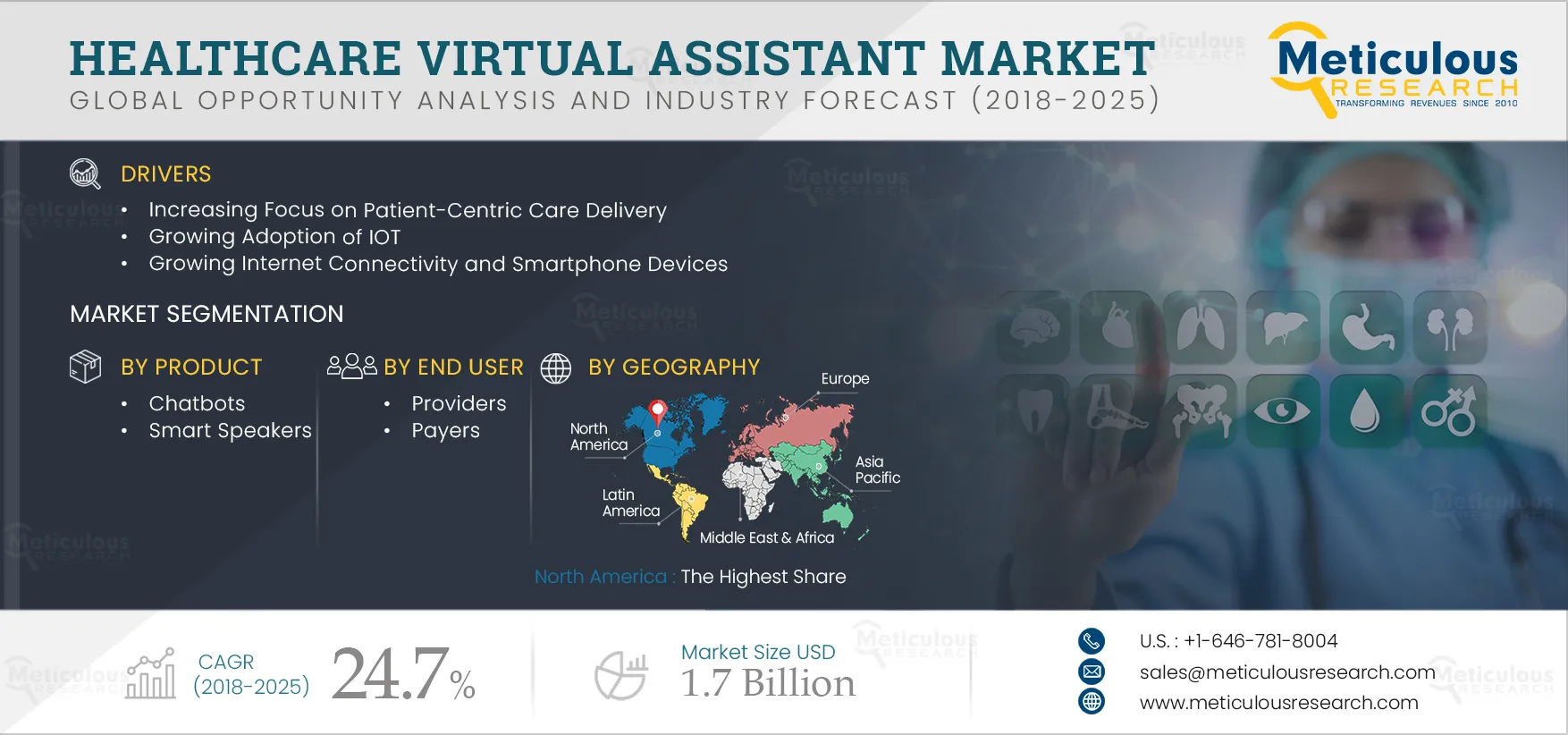
Table of contents
11 chapters · 83 sections · 103 pages · click to expandSegmental analysis
| Segment | Largest share (2018) | Fastest growth (2018–2025) |
|---|---|---|
| By End User | Providers | — |
By End User
- Providers segment dominates the market in 2018
- The providers segment is expected to grow at a significant CAGR during the forecast period.
- The growth of this segment is owing to the increasing adoption of artificial intelligence by the healthcare professionals to improve the clinical workflow and work efficiency in less time.
Geographic analysis
North America
Fastest growthNorth America commanded the highest share in the global healthcare Virtual assistant market in 2018, followed by Europe and Asia Pacific. The highest share of North American region in the virtual assistant market is primarily attributed to the growing healthcare sector, increasing need to reduce healthcare cost, rising demand of the technological advancements by the healthcare facilities, and growing demand of the healthcare industry to maintain a balance between the patient engagement and clinical workflow. North America is the largest and Asia Pacific the fastest growing regional market North America favors both global and local manufacturers that compete in multiple segments What strategies should new companies looking to enter this market use to compete effectively
Asia-Pacific
Asia Pacific is expected to be the fastest growing region with countries such as India and China being the largest contributors to the growth of the market due to the factors such as cheap labor, low production cost, and increasing awareness of virtual assistant solution among the consumers. Additionally, growing R&D investments and rising healthcare infrastructure are expected to equally influence the overall growth of the healthcare Virtual assistant market during the forecast period.
Cite this report
Meticulous Research. (2019). Healthcare Virtual Assistant Market - Global Opportunity Analysis And Industry Forecast (2018-2025) (Report No. MRHC - 104141). Meticulous Market Research Pvt. Ltd. https://www.meticulousresearch.com/product/healthcare-virtual-assistant-market-4930