Headless CMS Market (2026-2036)
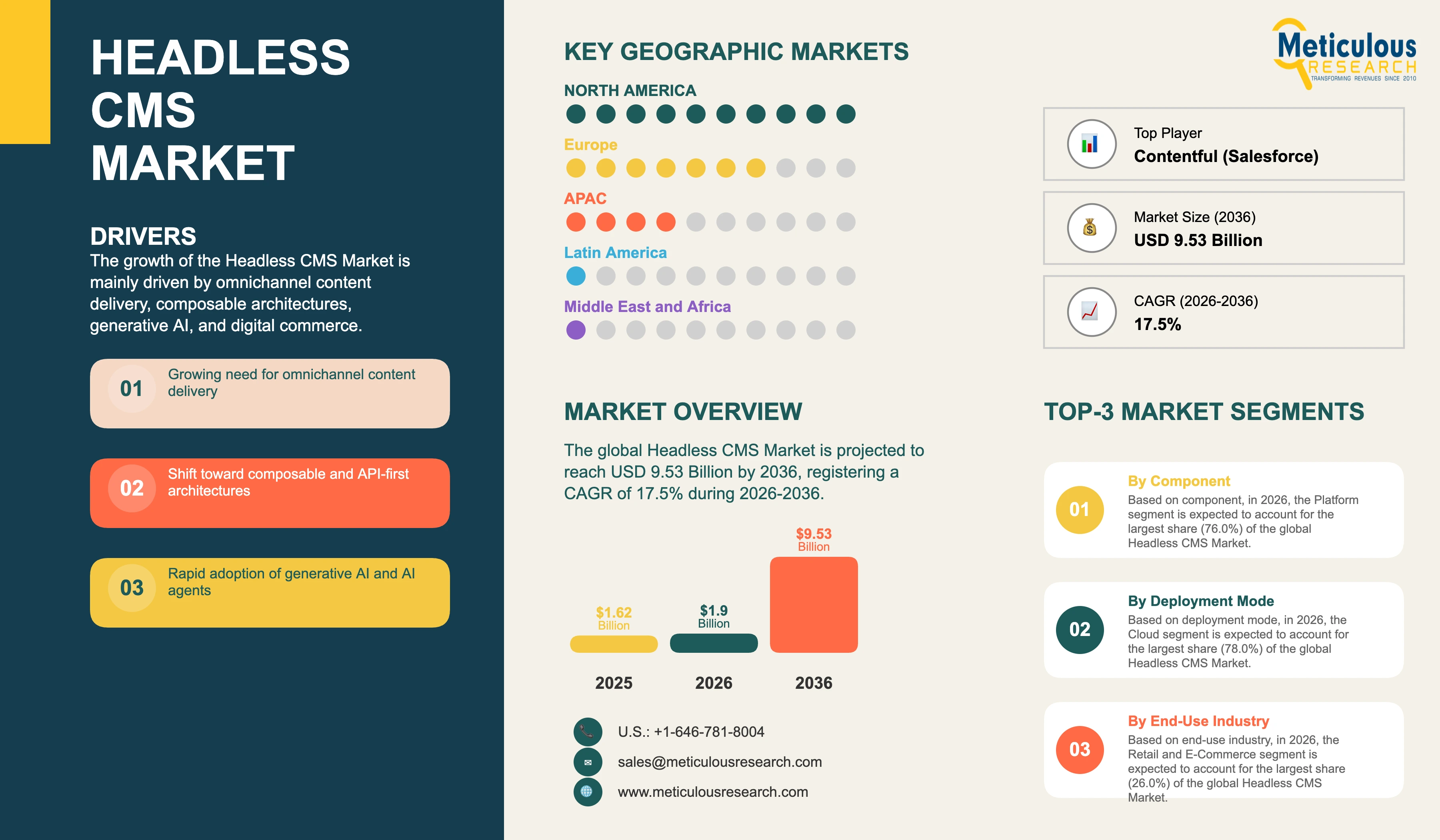
The global headless CMS market was valued at USD 1.62 billion in 2025. This market is expected to reach USD 9.53 billion by 2036 from an estimated USD 1.90 billion in 2026, registering a CAGR of 17.5% during the forecast period (2026-2036).
- Published
- Nov 2026
- Pages
- 256
- Format
- PDF + Excel
- Report ID
- MRICT - 1042617
- Base year
- 2025
- 2025 · BASELINE
- $1.62B
- 2036
- $9.53B
- CAGR 2026–2036
- 17.5%
2025 baseline · 2026–2036 forecast at 17.5% CAGR · hover a bar for the value
Key highlights
Salesforce announced on June 1, 2026 that it had signed a definitive agreement to acquire Contentful, a composable content platform used by more than 4,800 brands, including nearly 30% of the Fortune 500, to add a native, headless content layer to its Customer 360, Headless 360, and Agentforce platforms; Salesforce completed the acquisition on September 1, 2026, according to Salesforce, Demand Gen Report, and Shopifreaks.
The Information reported that Salesforce paid between USD 1 billion and USD 1.5 billion for Contentful, below the USD 3 billion valuation that Contentful announced after its USD 175 million Series F in July 2021, and Contentful had raised USD 333.5 million in total funding, according to Dealroom.
Sanity raised a USD 85 million Series C in May 2025 led by Bullhound Capital, and its lead investor reported that the company passed USD 40 million in annual recurring revenue in 2024, according to FocusReactive.
Storyblok raised a USD 80 million Series C led by Brighton Park Capital to bring intelligent content management to the enterprise, and the company has described its revenue as eight-figure annual recurring revenue with a stated goal of reaching USD 100 million in annual recurring revenue, according to Storyblok and FocusReactive.
Storyblok was named a Leader in the IDC MarketScape for AI-enabled headless CMS in 2025 and a Strong Performer in the Forrester Wave for content management systems in the first quarter of 2025, which reflects the growing recognition of headless platforms by industry analysts, according to FocusReactive.
Constellation Research noted that Contentful customers are using its AI capabilities to structure organization-wide taxonomies to optimize content for answer engines and generative engines, which reflects the growing importance of structured content for AI-driven search and discovery. Contentful acquired Ninetailed, a personalization and A/B testing platform, in August 2024 and rebranded it as Ninetailed by Contentful, adding personalization capabilities to its headless platform before the Salesforce acquisition, according to CMSWire. Salesforce Ventures had been an investor in Contentful since its Series D round in 2018, according to Dealroom and Constellation Research.
By component, platform accounts for the larger share of 76.0% in 2026 and also registers the higher CAGR.
By deployment mode, cloud accounts for the larger share in 2026 and also registers the higher CAGR.
By organization size, large enterprises account for the larger share in 2026, while small and medium-sized enterprises register the higher CAGR.
By end-use industry, retail and e-commerce accounts for the largest share of 26.0% in 2026, while healthcare and life sciences register the highest CAGR.
By geography, North America accounts for the largest share of 44.0% in 2026, while Asia-Pacific registers the highest CAGR of 20.7%.
Report summary
| Particulars | Details |
|---|---|
| Base Year | 2025 |
| Estimated Year | 2026 |
| Forecast Period | 2026-2036 |
| Market Size in 2025 | USD 1.62 billion |
| Market Size in 2026 | USD 1.90 billion |
| Market Size by 2036 | USD 9.53 billion |
| CAGR (2026-2036) | 17.5% |
| Format | PDF, Excel & Cloud Portal · 256 pages |
| Largest Segment by Component (2026) | Platform (76.0%) |
| Largest Segment by End-Use Industry (2026) | Retail and E-Commerce (26.0%) |
| Largest Region (2026) | North America (44.0%) |
| Fastest-Growing Region | Asia-Pacific (CAGR 20.7%) |
| Companies Profiled | 16 companies and other companies |
| Segments Covered | Component, Deployment Mode, Organization Size, End-Use Industry, Geography |
| Countries Covered | U.S., Canada, Germany, U.K., France, Italy, Spain, Netherlands, Switzerland, Belgium, Sweden, Denmark, Norway, Finland, Austria, Poland, Ireland, Rest of Europe, China, Japan, India, South Korea, Australia, Indonesia, Thailand, Singapore, Malaysia, Vietnam, Philippines, Taiwan, New Zealand, Rest of Asia-Pacific, Brazil, Mexico, Argentina, Colombia, Chile, Peru, Rest of Latin America, Saudi Arabia, U.A.E., Israel, South Africa, Turkey, Egypt, Rest of Middle East & Africa |
Report overview
Segments covered: component, deployment mode, organization size, end-use industry.
The growth of this market is mainly driven by the growing need for organizations to deliver consistent content across websites, mobile apps, e-commerce storefronts, digital displays, and other channels, the shift from monolithic digital experience platforms to composable, API-first architectures, the rapid adoption of generative AI and AI agents that require well-structured content, the growth of digital commerce, and the strong preference of developers for modern frameworks and cloud-native tools. However, factors such as the complexity of implementing headless architectures, the dependence on developers for building front-end experiences, the cost of integrating multiple best-of-breed tools, and the difficulty some marketing teams face in using headless systems without visual editing tools are expected to restrain the growth of this market to some extent. Nevertheless, the large number of organizations still using legacy content management systems offers significant room for growth.
A headless content management system is a content platform that separates the back-end, where content is created, stored, and managed, from the front-end presentation layer, where content is displayed to users. Instead of producing web pages directly, a headless CMS stores content as structured data and delivers it through APIs, such as REST and GraphQL, to any channel, including websites, mobile apps, e-commerce storefronts, smart devices, digital signage, voice assistants, and AI applications. Developers can build front-end experiences using modern frameworks of their choice, while content teams manage content once and reuse it across channels.
This report covers the global headless CMS market, including API-first and headless content platforms delivered as cloud services or deployed on-premises or self-hosted, and related professional services, such as implementation, integration, migration, and support. The market is analyzed by component, deployment mode, organization size, end-use industry, and geography. The market is measured on a revenue basis. Traditional coupled content management systems, digital asset management systems, and e-commerce platforms are not included, except for their headless content modules. Free open-source usage that does not generate vendor revenue is also not included.
Headless CMS has moved from a developer-focused niche to a mainstream choice for enterprise digital teams. Organizations need to deliver content across a growing number of channels and to update digital experiences quickly, which is difficult with traditional systems that tie content to web page templates. Headless platforms allow teams to model content as structured, reusable components and deliver it anywhere, which supports faster development, better performance, and consistent brand experiences.
The headless CMS market has seen significant investment and consolidation over the past two years. Salesforce acquired Contentful, one of the pioneers of the headless CMS category, completing the acquisition in September 2026 to add a native content layer to its Customer 360 and Agentforce platforms. Sanity raised a USD 85 million Series C in 2025, and Storyblok raised a USD 80 million Series C to expand its enterprise offering. Established digital experience platform vendors, such as Adobe, Sitecore, Optimizely, and Acquia, have also added headless and composable capabilities to their platforms.
Generative AI is reshaping the headless CMS market and the way organizations think about content. AI agents and generative AI applications need well-structured, accurate, and governed content to answer questions, personalize experiences, and assemble content dynamically. Salesforce has said that Contentful will allow Agentforce to dynamically assemble and deliver personalized experiences across channels. Headless CMS vendors are adding AI features for content creation, translation, tagging, and optimization, as well as tools that structure content for AI-driven search and answer engines.
The composable architecture movement, in which organizations combine best-of-breed services for content, commerce, search, and personalization through APIs, is also supporting the market. Industry groups such as the MACH Alliance promote microservices-based, API-first, cloud-native, and headless approaches, and many retailers and media companies have adopted composable stacks. At the same time, vendors are adding visual editing, page building, and workflow tools to make headless platforms easier for marketers to use.
In 2026, the platform segment accounts for the largest share of the market by component and is also the faster-growing component. Cloud deployment accounts for the larger share by deployment mode and is also the faster-growing mode. Large enterprises account for the larger share by organization size, while small and medium-sized enterprises are the faster-growing group. Retail and e-commerce is the largest end-use industry, while healthcare and life sciences is the fastest-growing industry. North America accounts for the largest share of the market, while Asia-Pacific is the fastest-growing region.
Over the forecast period, the headless CMS market is expected to grow strongly, supported by omnichannel content delivery, composable architectures, AI, digital commerce, and the replacement of legacy content management systems. However, vendors will need to make their platforms easier for non-technical users and reduce the complexity of composable implementations to reach a broader group of customers. Buying decisions for headless platforms increasingly involve both technology and marketing leaders. Developers evaluate APIs, performance, and flexibility, while marketing leaders focus on usability, speed to market, and personalization. Vendors that serve both groups well are gaining share, and many platforms now offer combined developer and marketer experiences, including visual editors, live previews, and collaboration tools.
North America is expected to account for the largest share of 44.0% of the market in 2026, mainly due to early adoption of headless and composable architectures, high spending on digital customer experience, and the presence of major vendors.
Asia-Pacific is projected to register the highest CAGR of 20.7% during the forecast period, driven by the rapid growth of e-commerce, mobile apps, digital banking, and digital media, and the expansion of vendors and partners in the region.
The report profiles 16 companies, including Contentful (Salesforce), Contentstack, Sanity, Storyblok, Strapi, Hygraph, Kontent.ai, Magnolia, Amplience, Sitecore, Optimizely, Acquia, Adobe, Builder.io, dotCMS, and Prismic.
A headless CMS is a content management system that separates content management from presentation. Content is stored as structured data and delivered through APIs to any channel, such as websites, mobile apps, e-commerce storefronts, smart devices, and AI applications, while developers build front-end experiences using their preferred tools.
AI agents and AI-driven search engines need structured, accurate, and governed content, which headless CMS platforms provide. At the same time, vendors are adding AI features for content creation, translation, tagging, and optimization, which help content teams produce content for more channels.
In 2026, the large enterprises segment is expected to account for the larger share of the headless CMS market, while the small and medium-sized enterprises segment is projected to register the higher CAGR during the forecast period.
Report infographic
Market dynamics
18 factors across 5 forcesGrowing need for omnichannel content delivery
Organizations need to deliver consistent content and experiences across a growing number of digital channels, including websites, mobile apps, e-commerce storefronts, social media, email, kiosks, smart devices, and in-store displays. Traditional content management systems were designed to publish web pages and make it difficult to reuse content across channels. Headless CMS platforms store content as structured data that can be delivered to any channel through APIs, which allows organizations to manage content once and publish it everywhere.
Omnichannel delivery is particularly important for retailers, media companies, financial institutions, and travel and hospitality companies, which interact with customers across many touchpoints. Contentful's platform is used by more than 4,800 brands, according to Salesforce, and Salesforce has said that the acquisition will give enterprises a single content layer across email, web, and mobile and across marketing, commerce, and sales use cases. Demand for omnichannel content delivery is the most important driver of the headless CMS market.
Shift toward composable and API-first architectures
Many organizations are moving away from monolithic digital experience platforms, which bundle content management, commerce, personalization, and analytics into a single system, toward composable architectures that combine best-of-breed services through APIs. Composable architectures allow organizations to choose the best tool for each function, replace components without rebuilding the entire stack, and innovate faster. The headless CMS is a core component of composable architectures, as it provides the content layer that connects to commerce, search, personalization, and front-end frameworks.
Industry groups such as the MACH Alliance and vendors of headless commerce, search, and front-end hosting platforms are promoting composable approaches. Constellation Research has noted that Salesforce's acquisition of Contentful brings the idea of a headless, composable content layer into the Salesforce ecosystem. The shift toward composable architectures is expected to continue to drive demand for headless CMS platforms over the forecast period.
Rapid adoption of generative AI and AI agents
Generative AI and AI agents are creating new demand for structured, well-governed content. AI agents that answer customer questions, recommend products, and assemble personalized experiences need access to accurate and well-organized content, and structured content stored in a headless CMS is easier for AI systems to use than unstructured web pages. Salesforce has said that Contentful's composable APIs will allow Agentforce to dynamically assemble and deliver personalized experiences across every channel in real time.
At the same time, headless CMS vendors are using AI to help content teams create, translate, tag, and optimize content more efficiently. Storyblok was named a Leader in the IDC MarketScape for AI-enabled headless CMS in 2025, and Contentful customers are using AI to structure taxonomies for answer engine and generative engine optimization, according to Constellation Research. As AI-driven search and discovery change how customers find information, demand for structured content platforms is expected to increase.
Growth of digital commerce
The continued growth of online shopping and digital commerce is increasing demand for headless CMS platforms that deliver rich product content, campaign content, and editorial content to e-commerce storefronts and mobile apps. Retailers use headless CMS platforms to create content-rich shopping experiences, launch campaigns quickly, and integrate content with headless commerce platforms. Fast-loading pages built with modern front-end frameworks also improve conversion rates and search rankings, which is important for e-commerce businesses.
Retail and e-commerce is the largest end-use industry in the headless CMS market, and many leading retail and consumer brands have adopted headless architectures. Salesforce's acquisition of Contentful also strengthens the link between content and commerce in its Commerce Cloud, which is expected to support adoption among retailers using Salesforce.
Developer preference for modern frameworks and cloud-native tools
Developers increasingly prefer to build digital experiences with modern JavaScript frameworks, such as React and Next.js, static site generators, and cloud-native front-end hosting platforms, which offer better performance, flexibility, and developer productivity than traditional CMS templates. Headless CMS platforms allow developers to use their preferred tools while content teams manage content separately. Sanity's developer ecosystem grew rapidly in 2025 and 2026, according to FocusReactive, which reflects the strong developer interest in headless platforms. This developer preference has made headless CMS the default choice for many new digital projects, particularly at digital agencies and technology-led companies. Faster development cycles also allow organizations to test, learn, and improve their digital experiences more often.
Table of contents
12 chapters · 166 sections · 256 pages · click to expandSegmental analysis
| Segment | Largest share (2026) | Fastest growth (2026–2036) |
|---|---|---|
| By Component | Platform | — |
| By Deployment Mode | — | — |
| By Organization Size | — | Rapid growth of this |
| By End-Use Industry | Retail and e-commerce | Healthcare and life sciences |
By Component
- The platform segment is expected to account for the largest share of 76.0% of the global headless CMS market.
- The large share of this segment is mainly due to the subscription-based pricing models of headless CMS vendors, which generate recurring revenue based on users, content volume, API usage, and features, the growing adoption of headless platforms by enterprises for omnichannel content delivery, the expansion of platforms into AI, personalization, and visual editing capabilities, and the strong growth of leading vendors, such as Contentful, Sanity, and Storyblok.
- The platform segment is also projected to register the higher CAGR during the forecast period, driven by AI adoption, composable architectures, and the replacement of legacy content management systems.
- Headless CMS platforms include content modeling, content creation and editing, workflow and governance, localization, media management, API delivery, and AI capabilities.
- Leading platforms include Contentful, Contentstack, Sanity, Storyblok, Strapi, Hygraph, Kontent.ai, Magnolia, Amplience, Prismic, and dotCMS, as well as headless capabilities offered by Adobe Experience Manager, Sitecore XM Cloud, Optimizely, and Acquia.
- The services segment includes implementation, integration, migration, content modeling, consulting, training, and support services provided by vendors, digital agencies, and systems integrators.
- Services are important because headless implementations require custom front-end development and integration with other systems, and many organizations rely on digital agencies to build and maintain their headless experiences.
- The services segment is expected to grow steadily as more organizations migrate from legacy systems and adopt composable architectures.
- Usage-based pricing tied to API calls and content delivery volumes is also expected to support revenue growth as organizations deliver content to more channels.
- Services revenue is expected to grow steadily, supported by migrations from legacy systems and the increasing complexity of composable implementations.
- Implementation partners also provide content strategy and governance services that help organizations design reusable content models, taxonomies, and editorial workflows for multiple brands, languages, and markets.
By Deployment Mode
- The cloud segment is expected to account for the larger share of the global headless CMS market.
- The large share of this segment is mainly due to the software-as-a-service delivery model of most leading headless CMS vendors, such as Contentful, Contentstack, Sanity, and Storyblok, the scalability and global content delivery networks that cloud platforms provide, the lower maintenance burden for customers, and the ease of integrating cloud-based headless platforms with other cloud services in composable architectures.
- The cloud segment is also projected to register the higher CAGR during the forecast period, driven by the growth of cloud-native digital experiences and AI features delivered as cloud services.
- The on-premises and self-hosted segment includes headless CMS platforms deployed in customers' own data centers or private clouds, including open-source platforms, such as Strapi, and enterprise platforms that offer self-hosted options, such as Magnolia and dotCMS.
- This segment is important for organizations with strict data sovereignty, security, or customization requirements, such as government agencies, financial institutions, and some European organizations.
- Self-hosted open-source platforms will remain important for organizations that require full control over their infrastructure and code, and many open-source vendors now offer managed cloud versions of their platforms to capture revenue from these users.
- Many customers also use hybrid models, in which content is managed in the cloud while some delivery or storage takes place in private environments.
By Organization Size
- Headless CMS Analysis by Organization Size
- The large enterprises segment is expected to account for the larger share of the global headless CMS market.
- The large share of this segment is mainly due to the complex omnichannel content needs of large enterprises, which manage content across many brands, markets, languages, and channels, their larger budgets for digital transformation, their adoption of composable architectures, and the focus of leading vendors on enterprise customers.
- Contentful's customers include a large number of Fortune 500 companies, according to Salesforce and Shopifreaks.
- However, the small and medium-sized enterprises segment is projected to register the higher CAGR during the forecast period.
- The rapid growth of this segment is driven by the availability of affordable cloud-based headless platforms with free tiers and usage-based pricing, the popularity of open-source headless platforms, the growing use of headless architectures by digital agencies serving smaller clients, and the growth of digital commerce among small and medium-sized businesses.
- Templates, starter kits, and visual editing tools are also making headless platforms more accessible to smaller organizations.
- Large enterprises will continue to drive the largest contracts, particularly for multi-brand and multi-market implementations that require advanced governance, localization, and integration capabilities.
- Startups and digital-native companies are also important early adopters, as they often build their digital products on headless architectures from the start.
By End-Use Industry
- Headless CMS Analysis by End-Use Industry
- The retail and e-commerce segment is expected to account for the largest share of 26.0% of the global headless CMS market.
- The large share of this segment is mainly due to the need of retailers and consumer brands to deliver rich product and campaign content across e-commerce websites, mobile apps, marketplaces, and in-store channels, the adoption of headless commerce and composable architectures by retailers, the importance of fast-loading pages for conversion rates and search rankings, and the frequent content updates required for promotions and seasonal campaigns.
- Brands such as Spotify, Vodafone, and Urban Outfitters use Contentful, according to Dealroom.
- However, the healthcare and life sciences segment is projected to register the highest CAGR during the forecast period.
- The rapid growth of this segment is driven by the digitization of patient engagement, the growth of telehealth and patient-facing apps, the need for pharmaceutical and medical device companies to manage compliant content across many markets and languages, and the use of structured content to support AI-powered patient and healthcare professional engagement.
- The media and publishing segment accounts for a significant share of the market, supported by the need of publishers and broadcasters to deliver content across websites, apps, connected TVs, and social channels.
- The banking, financial services, and insurance segment uses headless platforms for digital banking experiences and compliant content, while the IT and telecommunications, travel and hospitality, education and government, and other industries segments are also adopting headless platforms as they modernize their digital experiences.
- Industries with complex regulatory requirements, such as healthcare and financial services, are expected to invest in governance and approval workflows, while retail and media companies will focus on speed, personalization, and omnichannel delivery.
- Travel and hospitality companies, for example, use headless platforms to deliver destination, booking, and loyalty content across websites, apps, and partner channels in many languages, while education and government organizations use them to modernize public websites and digital services.
- The retail and e-commerce segment is expected to account for the largest share of 26.0% of the headless CMS market, while the healthcare and life sciences segment is projected to register the highest CAGR during the forecast period.
Geographic analysis
North America
Largest shareIn 2026, North America is expected to account for the largest share of 44.0% of the global headless CMS market. The large share of this region is mainly due to the early adoption of headless and composable architectures by U.S. enterprises, retailers, and media companies, the large number of digital agencies and developers familiar with modern front-end frameworks, high spending on digital customer experience and e-commerce, and the presence of major software vendors and platforms, such as Salesforce, Adobe, Contentstack, Sanity, Optimizely, and Acquia. Salesforce's acquisition of Contentful is expected to further strengthen adoption among Salesforce customers in the region. The U.S. is also home to many of the front-end hosting and composable commerce vendors that form part of headless technology stacks.
Asia-Pacific
Fastest growthAsia-Pacific is projected to register the highest CAGR of 20.7% during the forecast period. The rapid growth of this region is mainly driven by the rapid growth of e-commerce, mobile apps, digital banking, and digital media in India, China, Japan, Australia, South Korea, and Southeast Asia, increasing investment in digital customer experiences by enterprises in the region, the growing number of developers using modern frameworks, and the expansion of global headless CMS vendors and their partners in the region. Multilingual content needs across Asia-Pacific markets also favor headless platforms with strong localization capabilities, while India's large technology services sector provides implementation capacity for headless projects worldwide.
Europe
Europe accounts for a significant share of the market, supported by strong demand from retailers, media companies, manufacturers, and financial institutions in Germany, the U.K., France, the Netherlands, and the Nordic countries, and by the presence of several leading headless vendors founded in Europe, such as Contentful, Storyblok, Strapi, Hygraph, Kontent.ai, Magnolia, Prismic, and Amplience. Europe's multilingual and multi-market environment makes headless platforms with strong localization capabilities particularly attractive. Data protection and digital sovereignty requirements influence platform and hosting choices in the region, particularly for public-sector customers.
Latin America
Latin America and the Middle East & Africa account for smaller shares of the market but are growing quickly. In Latin America, retailers, banks, and media companies in Brazil, Mexico, Colombia, and Chile are investing in digital commerce and mobile experiences, which is driving demand for headless platforms.
Middle East & Africa
In the Middle East & Africa, digital transformation programs in Saudi Arabia and the U.A.E., the growth of e-commerce, and investments by airlines, retailers, and government organizations in digital services are creating demand for headless CMS platforms. Growing developer communities and digital agency networks are expected to support adoption in both regions. Regional differences in digital commerce growth, developer availability, spending on digital customer experience, data protection rules, and the presence of digital agencies shape the demand for headless CMS platforms around the world. Regions with fast-growing digital economies are expected to grow fastest, while mature markets grow through the replacement of legacy systems, the adoption of AI, and the expansion of composable commerce. Local digital agencies and implementation partners play a key role in driving adoption in each region.
Competitive landscape
The global headless CMS market is moderately fragmented, with the top five players estimated to account for about 40% of the market in 2025. The market includes pure-play headless vendors, established digital experience platform vendors with headless capabilities, and open-source platforms.
Contentful, now part of Salesforce, is one of the largest headless CMS vendors, with more than 4,800 brand customers, including nearly 30% of the Fortune 500. Contentstack, Sanity, and Storyblok are other leading pure-play vendors, with Sanity surpassing USD 40 million in annual recurring revenue in 2024, according to its lead investor, and Storyblok reporting eight-figure annual recurring revenue. Strapi offers a popular open-source headless CMS, while Hygraph, Kontent.ai, Prismic, dotCMS, Magnolia, and Amplience serve specific segments and use cases. Adobe, Sitecore, Optimizely, and Acquia offer headless capabilities within their digital experience platforms, and Builder.io offers visual development tools for headless architectures.
Companies in this market compete on ease of use for developers and marketers, content modeling flexibility, API performance and scalability, AI capabilities, visual editing, localization, integration with commerce and other systems, security and compliance, pricing, and partner ecosystems. Key strategies include adding AI features, improving visual editing, building partnerships with digital agencies and technology vendors, expanding enterprise sales, and targeting specific industries.
Recent competitive activity in the headless CMS market has included major funding rounds, acquisitions, and AI product launches. Salesforce announced its agreement to acquire Contentful in June 2026 and completed the deal in September 2026, Sanity raised a USD 85 million Series C, and Storyblok raised a USD 80 million Series C. Vendors have also continued to launch AI features for content creation and optimization.
We expect competition to intensify as large software vendors integrate headless capabilities into their ecosystems and pure-play vendors expand into enterprise markets. Independent vendors are expected to emphasize openness and neutrality as a differentiator.
Some of the key players operating in the headless CMS market are Contentful GmbH (Salesforce, Inc.), Contentstack Inc., Sanity Inc., Storyblok GmbH, Strapi Solutions SAS, Hygraph GmbH, Kontent.ai, Magnolia International Ltd., Amplience Ltd., Sitecore Holding II A/S, Optimizely, Inc., Acquia Inc., Adobe Inc., Builder.io, Inc., dotCMS Inc., and Prismic Ltd., among others. Partnerships with digital agencies, systems integrators, and front-end hosting platforms remain important channels for all vendors. Pricing transparency and flexible licensing are also becoming important differentiators, as customers compare total costs across composable and suite-based approaches. The quality of customer support and partner enablement also matters significantly in vendor selection.
- —
Salesforce announced its agreement to acquire Contentful in June 2026 and completed the acquisition in September 2026, Sanity raised a USD 85 million Series C, and Storyblok raised a USD 80 million Series C and was named a Leader in the IDC MarketScape for AI-enabled headless CMS.
- Contentful GmbH (Salesforce, Inc.)
- Contentstack Inc.
- Sanity Inc.
- Storyblok GmbH
- Strapi Solutions SAS
- Hygraph GmbH
- Kontent.ai
- Magnolia International Ltd.
- Amplience Ltd.
- Sitecore Holding II A/S
- Optimizely, Inc.
- Acquia Inc.
- Adobe Inc.
- Builder.io, Inc.
- Prismic Ltd.
Expert perspectives
The headless CMS market has matured from a developer-focused niche into a core component of enterprise digital experience and AI strategies. Salesforce's acquisition of Contentful in 2026, strong funding for Sanity and Storyblok, and the adoption of headless capabilities by established digital experience platform vendors show that structured, API-first content has become central to how organizations deliver digital experiences.
Over the forecast period, the market is expected to grow at a CAGR of 17.5%, from USD 1.90 billion in 2026 to USD 9.53 billion in 2036. Growth will be supported by omnichannel content delivery, composable architectures, generative AI and AI agents, digital commerce, developer preferences, and the replacement of legacy content management systems.
Among the market segments, the platform segment is the largest and faster-growing component, and cloud is the larger and faster-growing deployment mode. Large enterprises account for the larger share by organization size, while small and medium-sized enterprises grow faster. Retail and e-commerce is the largest end-use industry, while healthcare and life sciences grows fastest. North America is the largest region, and Asia-Pacific is the fastest-growing region at a CAGR of 20.7%.
In our view, the most important factor for the market over the forecast period will be the role of structured content in AI. As AI agents and AI-driven search change how customers find and interact with information, organizations will need well-structured, governed content that AI systems can use reliably. Headless CMS vendors that position their platforms as the content foundation for AI will be able to expand their role and capture new budgets.
We also expect ease of use to remain a key competitive factor. The early growth of headless CMS was driven by developers, but broader adoption requires platforms that marketers and content teams can use without constant developer support. Vendors that combine headless flexibility with strong visual editing and workflow tools will be best positioned. The integration of headless platforms into larger ecosystems, such as Salesforce, will also influence buying decisions, with some customers preferring integrated suites and others preferring independent vendors.
Overall, we believe the headless CMS market will grow strongly over the forecast period, with cloud deployment, small and medium-sized enterprises, healthcare and life sciences, and Asia-Pacific providing the fastest growth. Vendors that combine developer flexibility, marketer usability, and AI capabilities will be best positioned to capture this growth. We also expect pricing models to evolve, with more vendors combining platform subscriptions with usage-based charges for API calls, AI features, and content delivery. Vendors will need to balance growth in usage-based revenue with customers' desire for predictable costs.
Customer perspectives
Customers in the headless CMS market include digital, marketing, and content teams, developers and architects, e-commerce teams, and the digital agencies and systems integrators that build and manage digital experiences for them. Developers focus on API performance, flexibility, content modeling, support for modern frameworks, and developer tools, while marketers and content teams focus on ease of use, visual editing, workflows, localization, and the ability to launch content quickly without developer support. Business leaders focus on total cost of ownership, time to market, scalability, security, compliance, and the ability to support AI and personalization. Digital agencies strongly influence platform selection through their expertise and recommendations, and many organizations choose platforms that their preferred agencies know well. Organizations also consider the long-term independence and roadmap of vendors. Reference customers and case studies also strongly influence platform selection.
Head of Digital - Global Retail Brand, U.S.
We manage product and campaign content once and publish it to our website, apps, and stores. It has cut our launch times significantly.
This comment explains why retail and e-commerce accounts for 26.0% of the market, why the platform segment accounts for 76.0% of the market, and why North America accounts for 44.0% of the market.
This comment explains why healthcare and life sciences is the fastest-growing end-use industry and why localization is an important buying factor in Europe.
This comment explains why small and medium-sized enterprises are the faster-growing organization size segment and why Asia-Pacific is the fastest-growing region.
“We need compliant content in many languages and markets, and a structured content platform makes approvals and reuse much easier.”
“More of our small and mid-sized clients now ask for headless builds, because cloud plans have made them affordable.”
Frequently asked questions
The global headless CMS market was valued at USD 1.62 billion in 2025, up from USD 1.38 billion in 2024, and is estimated at USD 1.90 billion in 2026. The market includes headless content platforms and related professional services.
The global headless CMS market is expected to reach USD 9.53 billion by 2036, supported by omnichannel content delivery, composable architectures, generative AI and AI agents, digital commerce, and the replacement of legacy content management systems.
The market is expected to register a CAGR of 17.5% from 2026 to 2036.
Market growth is mainly driven by the growing need for omnichannel content delivery, the shift toward composable and API-first architectures, the rapid adoption of generative AI and AI agents, the growth of digital commerce, and developer preference for modern frameworks and cloud-native tools.
Implementation complexity and dependence on developers and the cost of integrating multiple best-of-breed tools restrain growth, while intense competition and market consolidation and content governance, security, and data sovereignty requirements are key challenges.
Key growth opportunities include structured content for AI agents and answer engines, visual editing and tools for marketers, the replacement of legacy content management systems, and expansion in Asia-Pacific and among small and medium-sized enterprises.
The platform segment is expected to account for the largest share of 76.0% of the market in 2026 and is also projected to register the higher CAGR.
Cloud deployment is expected to account for the larger share of the market in 2026 and is also projected to register the higher CAGR, supported by the software-as-a-service model of most leading vendors.
In 2026, the retail and e-commerce segment is expected to account for the largest share of 26.0% of the headless CMS market, while the healthcare and life sciences segment is projected to register the highest CAGR during the forecast period.
In 2026, the large enterprises segment is expected to account for the larger share of the headless CMS market, while the small and medium-sized enterprises segment is projected to register the higher CAGR during the forecast period.
North America is expected to account for the largest share of 44.0% of the market in 2026, mainly due to early adoption of headless and composable architectures, high spending on digital customer experience, and the presence of major vendors.
Asia-Pacific is projected to register the highest CAGR of 20.7% during the forecast period, driven by the rapid growth of e-commerce, mobile apps, digital banking, and digital media, and the expansion of vendors and partners in the region.
The report profiles 16 companies, including Contentful (Salesforce), Contentstack, Sanity, Storyblok, Strapi, Hygraph, Kontent.ai, Magnolia, Amplience, Sitecore, Optimizely, Acquia, Adobe, Builder.io, dotCMS, and Prismic.
Salesforce announced its agreement to acquire Contentful in June 2026 and completed the acquisition in September 2026, Sanity raised a USD 85 million Series C, and Storyblok raised a USD 80 million Series C and was named a Leader in the IDC MarketScape for AI-enabled headless CMS.
A headless CMS is a content management system that separates content management from presentation. Content is stored as structured data and delivered through APIs to any channel, such as websites, mobile apps, e-commerce storefronts, smart devices, and AI applications, while developers build front-end experiences using their preferred tools.
AI agents and AI-driven search engines need structured, accurate, and governed content, which headless CMS platforms provide. At the same time, vendors are adding AI features for content creation, translation, tagging, and optimization, which help content teams produce content for more channels.
Cite this report
Meticulous Research. (2026). Headless CMS Market - Global Opportunity Analysis and Industry Forecast (2026-2036) (Report No. MRICT - 1042617). Meticulous Market Research Pvt. Ltd. https://www.meticulousresearch.com/product/headless-cms-market-7300