Sovereign Cloud Market (2026-2036)
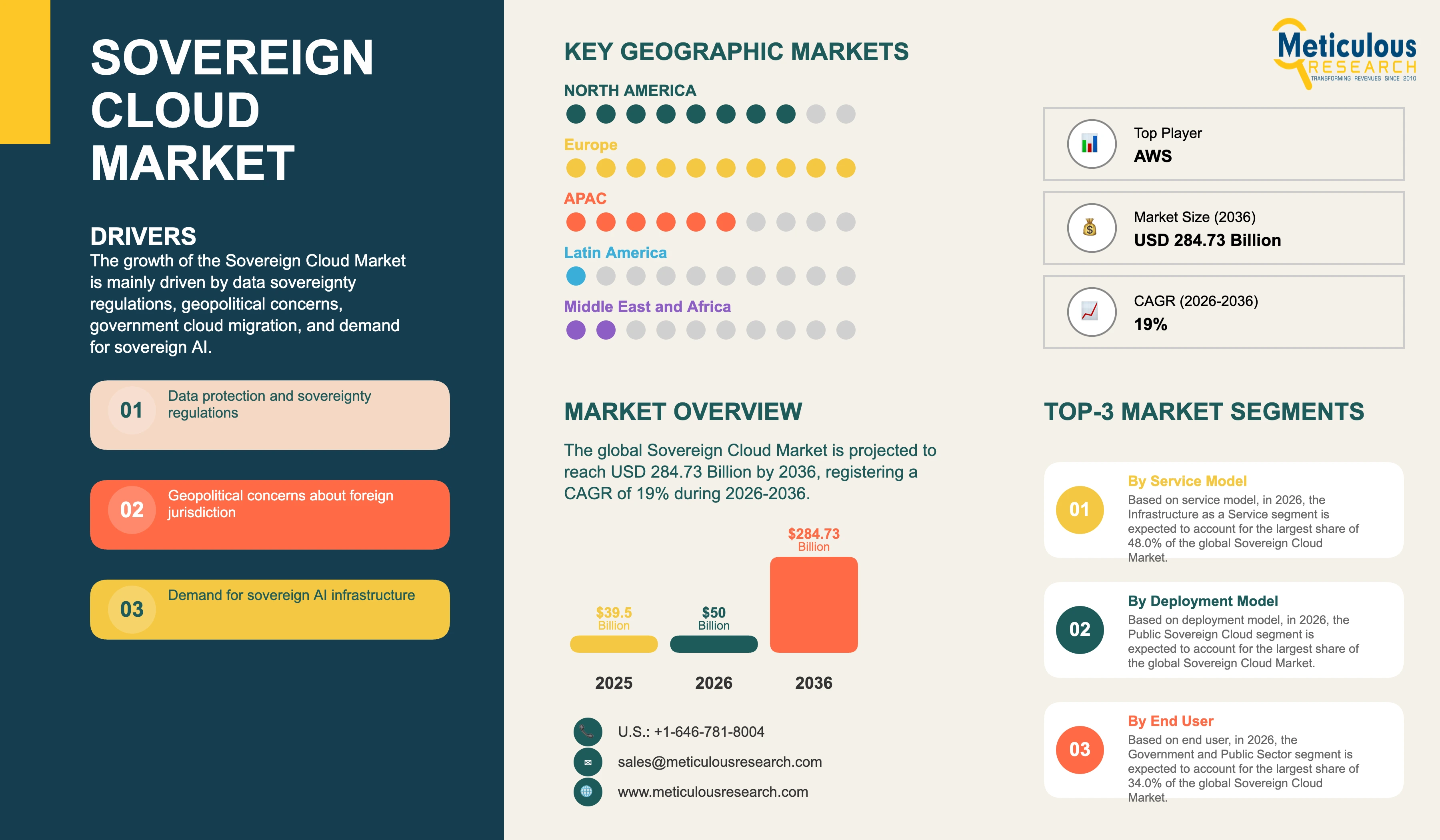
The global sovereign cloud market was valued at USD 39.50 billion in 2025. This market is expected to reach USD 284.73 billion by 2036 from an estimated USD 50.00 billion in 2026, registering a CAGR of 19.0% during the forecast period (2026-2036).
- Published
- Nov 2026
- Pages
- 257
- Format
- PDF + Excel
- Report ID
- MRICT - 1042639
- Base year
- 2025
- 2025 · BASELINE
- $39.50B
- 2036
- $284.7B
- CAGR 2026–2036
- 19.0%
2025 baseline · 2026–2036 forecast at 19.0% CAGR · hover a bar for the value
Key highlights
Amazon Web Services made the AWS European Sovereign Cloud generally available on January 15, 2026, with its first region in Brandenburg, Germany, operating independently from existing AWS regions. AWS said the sovereign cloud will be operated exclusively by EU residents located in the EU and is backed by a EUR 7.8 billion investment that is expected to contribute EUR 17.2 billion to the European economy through 2040.
AWS plans to expand the European Sovereign Cloud with sovereign Local Zones in Belgium, the Netherlands, and Portugal, and services available at launch include Amazon SageMaker and Amazon Bedrock for artificial intelligence and machine learning workloads, according to AWS. The AWS European Sovereign Cloud has its own contracting entity, Amazon Web Services EMEA SARL, with pricing in euros, and AWS appointed Stefan Hoechbauer as a managing director alongside Stéphane Israel in January 2026.
In September 2025, SAP announced plans to invest more than EUR 20 billion over ten years to expand its sovereign cloud offering in Europe, including SAP Cloud Infrastructure operated in its European data centers, SAP Sovereign Cloud On-Site at customer locations, and Delos Cloud for the German public sector, according to The Register and CNBC reports. SAP said the investment covers infrastructure, research and development, operating personnel, and compliance, and that its sovereign cloud is targeted at the public sector, regulated industries, and defense.
In June 2025, Microsoft introduced its sovereign public cloud offering for all European data center regions, following the completion of its EU Data Boundary in February 2025, and in May 2025 Google Cloud announced a data boundary service that lets customers control where their content is stored and processed, according to PYMNTS.
Delos Cloud, the joint project of T-Systems, SAP, and Microsoft for the German public sector, has been in productive operation since January 2026, according to Cloudmagazin, which also noted that Microsoft has offered Azure Local as an on-premises option with sovereign controls since December 2025.
By service model, infrastructure as a service accounts for the largest share of 48.0% in 2026, while platform as a service registers the highest CAGR.
By deployment model, public sovereign cloud accounts for the largest share in 2026 and also registers the highest CAGR.
By organization size, large enterprises and public bodies account for the larger share in 2026, while small and medium-sized enterprises register the higher CAGR.
By end user, government and public sector accounts for the largest share of 34.0% in 2026, while defense and intelligence registers the highest CAGR.
By geography, Europe accounts for the largest share of 38.0% in 2026, while Asia-Pacific registers the highest CAGR of 21.4%.
Report summary
| Particulars | Details |
|---|---|
| Base Year | 2025 |
| Estimated Year | 2026 |
| Forecast Period | 2026-2036 |
| Market Size in 2025 | USD 39.50 billion |
| Market Size in 2026 | USD 50.00 billion |
| Market Size by 2036 | USD 284.73 billion |
| CAGR (2026-2036) | 19.0% |
| Format | PDF, Excel & Cloud Portal · 257 pages |
| Largest Segment by Service Model (2026) | Infrastructure as a Service (48.0%) |
| Largest Segment by End User (2026) | Government and Public Sector (34.0%) |
| Largest Region (2026) | Europe (38.0%) |
| Fastest-Growing Region | Asia-Pacific (CAGR 21.4%) |
| Companies Profiled | 15 companies and other companies |
| Segments Covered | Service Model, Deployment Model, Organization Size, End User, Geography |
| Countries Covered | Germany, France, U.K., Italy, Spain, Netherlands, Belgium, Switzerland, Poland, Sweden, Denmark, Norway, Finland, Austria, Ireland, Rest of Europe, U.S., Canada, Rest of North America, China, Japan, India, South Korea, Australia, Indonesia, Singapore, Thailand, Malaysia, Vietnam, Philippines, Taiwan, New Zealand, Rest of Asia-Pacific, Saudi Arabia, U.A.E., Qatar, South Africa, Israel, Turkey, Egypt, Rest of Middle East & Africa, Brazil, Mexico, Chile, Argentina, Colombia, Peru, Rest of Latin America |
Report overview
Segments covered: service model, deployment model, organization size, end user.
The growth of this market is mainly driven by stricter data protection, data residency, and cybersecurity regulations in Europe and other regions, growing geopolitical concerns about foreign jurisdiction over data held by global cloud providers, the migration of government and public sector workloads to the cloud, the adoption of cloud services by regulated industries such as banking, healthcare, and defense, the need for sovereign infrastructure to support artificial intelligence and national AI strategies, and large investments by hyperscalers, software companies, and national cloud providers in sovereign cloud regions and services. However, factors such as the higher cost of sovereign cloud services compared with standard public cloud, the limited range of services available in some sovereign environments, the complexity of meeting different national requirements, and the shortage of local skills and capacity are expected to restrain the growth of this market to some extent.
A sovereign cloud is a cloud computing environment designed to ensure that data, operations, and control remain subject to the laws and oversight of a specific country or region. Sovereign cloud services typically keep data within national or regional borders, are operated by locally based personnel or legal entities, restrict access by foreign governments and providers, give customers control over encryption keys, and comply with local certification schemes and regulations. Sovereignty is often described in three dimensions: data sovereignty, which concerns where data is stored and who can access it, operational sovereignty, which concerns who operates and supports the infrastructure, and technical sovereignty, which concerns the ability to run workloads independently of foreign technology providers.
This report covers the global sovereign cloud market, including infrastructure as a service, platform as a service, and software as a service delivered through sovereign public cloud regions, dedicated and private sovereign clouds, and hybrid and on-premises sovereign cloud deployments that meet defined sovereignty requirements. The market is analyzed by service model, deployment model, organization size, end user, and geography. Standard public cloud services without sovereignty controls, traditional on-premises IT infrastructure, and data center construction are analyzed in separate reports. The market is measured on a revenue basis.
Sovereign cloud has moved from a niche requirement for government agencies to a mainstream concern for governments and regulated industries, particularly in Europe. Managed service providers and system integrators play an important role in bringing sovereign cloud services to smaller companies. Concerns about foreign laws that may allow access to data held by global providers, such as the U.S. CLOUD Act, together with geopolitical tensions, have led European governments and companies to seek cloud services that keep data and operations under European control. Regulations such as the General Data Protection Regulation, the NIS2 Directive, the Digital Operational Resilience Act for financial services, and national schemes such as France's SecNumCloud and Germany's C5 have increased requirements for data protection, security, and resilience.
Global hyperscalers have responded to these concerns with major investments in dedicated sovereign offerings. AWS launched the AWS European Sovereign Cloud in January 2026 with a region in Brandenburg, Germany, backed by a EUR 7.8 billion investment, operated by EU residents, and planned expansion to Belgium, the Netherlands, and Portugal. Microsoft introduced its sovereign public cloud for all European regions in June 2025 and works with partners such as Delos Cloud in Germany and Bleu in France, while Google Cloud works with partners such as S3NS, a joint venture with Thales, in France. Oracle and IBM also offer sovereign cloud solutions.
European cloud providers and enterprise software companies are also expanding their sovereign offerings. SAP announced plans to invest more than EUR 20 billion over ten years in its sovereign cloud portfolio, OVHcloud, T-Systems, Orange, and Schwarz Digits with STACKIT offer European sovereign cloud services, and national cloud providers are growing in many countries. Outside Europe, sovereign cloud demand is growing in the Middle East, India, Japan, South Korea, Australia, and other countries, driven by data localization rules, national AI strategies, and government digital transformation programs.
Artificial intelligence is becoming an important driver of sovereign cloud demand across all regions. Governments and companies want to train and run AI models on sensitive data without exposing it to foreign jurisdiction, and many countries are developing national AI infrastructure. Sovereign cloud providers are adding graphics processing unit capacity and AI services, such as Amazon SageMaker and Amazon Bedrock in the AWS European Sovereign Cloud, which expands the market beyond traditional infrastructure workloads.
Infrastructure as a service accounts for the largest share of the market by service model, while platform as a service is the fastest-growing service model. Public sovereign cloud is the largest and fastest-growing deployment model. Large enterprises and public bodies account for the largest share by organization size, while small and medium-sized enterprises are the fastest-growing segment. Government and the public sector is the largest end user, while defense and intelligence is the fastest-growing end user. Europe accounts for the largest share of the market, while Asia-Pacific is the fastest-growing region.
Over the forecast period, the sovereign cloud market is expected to grow rapidly, supported by regulation, geopolitics, government cloud migration, regulated industries, AI, and large investments by providers. At the same time, the market's growth will depend on narrowing the cost and capability gaps with standard public cloud, harmonizing requirements across countries, and building local skills and capacity.
We need modern cloud services for our applications, but the data and operations must remain under German and European control. Platforms built for the public sector with local operators give us both.
This comment explains why Europe accounts for 38.0% of the market and why government and the public sector account for 34.0% of the market.
Operational resilience rules and concerns about foreign jurisdiction mean we are moving sensitive workloads to sovereign cloud regions, while keeping less sensitive applications on standard public cloud.
This comment explains the growth of sovereign cloud adoption in financial services and why public sovereign cloud is the largest deployment model.
Our national AI program requires that citizen data and AI models stay in the country, so we are building on sovereign cloud infrastructure with local providers and global partners.
This comment explains why Asia-Pacific is the fastest-growing region and why sovereign AI is becoming a major driver of the market. It also explains why infrastructure as a service accounts for 48.0% of the market.
Government and the public sector are expected to account for the largest share of 34.0% of the market in 2026, while defense and intelligence is projected to register the highest CAGR.
Europe is expected to account for the largest share of 38.0% of the market in 2026, mainly due to strict regulations, national certification schemes, strong political focus on digital sovereignty, and major investments by AWS, SAP, and other providers.
Asia-Pacific is projected to register the highest CAGR of 21.4% during the forecast period, driven by data localization rules, government cloud programs, national AI strategies, and investments in local cloud regions.
The report profiles 15 companies, including AWS, Microsoft, Google, Oracle, IBM, SAP (including Delos Cloud), OVHcloud, T-Systems, Bleu, S3NS, Schwarz Digits (STACKIT), Alibaba Cloud, Huawei Cloud, Fujitsu, and NTT DATA.
AI is increasing demand for sovereign cloud because governments and regulated organizations want to train and run AI models on sensitive data within their jurisdiction, which is leading providers to add GPU capacity, AI platforms, and model services to sovereign environments.
What comes next: Sovereign and Regional Cloud Business Models and Sovereign AI and the Future of National Compute, Meticulous Next™ foresight briefs.
Report infographic
Market dynamics
18 factors across 5 forcesStricter data protection, residency, and cybersecurity regulations
Data protection, residency, and cybersecurity regulations are the most important driver of the sovereign cloud market. In Europe, the General Data Protection Regulation sets strict rules for the protection and transfer of personal data, the NIS2 Directive raises cybersecurity requirements for essential and important entities, and the Digital Operational Resilience Act requires financial institutions to manage risks from information and communication technology providers, including cloud providers. National certification schemes, such as France's SecNumCloud and Germany's C5, define requirements for cloud services used by government and critical sectors, and some require immunity from non-European laws.
Outside Europe, many countries have adopted data localization rules that require certain types of data, such as government, financial, health, or personal data, to be stored and processed within national borders. These regulations make it difficult for organizations in regulated sectors to use standard public cloud services for sensitive workloads and create demand for sovereign cloud services that are designed to comply.
Regulatory requirements are also expanding to cover artificial intelligence, with rules such as the EU AI Act adding obligations for the governance of AI systems, which increases the importance of controlled environments for sensitive AI workloads.
Geopolitical concerns about foreign jurisdiction over data
Geopolitical tensions and concerns about foreign government access to data have made digital sovereignty a strategic priority for governments and companies, particularly in Europe. Many organizations are concerned that laws such as the U.S. CLOUD Act could allow foreign authorities to access data held by U.S. cloud providers, even if it is stored in Europe, and that political decisions could disrupt access to essential cloud services. These concerns increased in 2025 and 2026, and AWS's launch of its European Sovereign Cloud was widely reported as a response to European fears about potential access to or disruption of U.S. cloud services.
Governments are responding by developing national and European cloud strategies, supporting domestic cloud providers, and requiring sovereign controls for sensitive workloads. Companies in critical sectors are also reviewing their dependence on foreign providers and seeking sovereign options to reduce risk.
Migration of government and public sector workloads to the cloud
Governments around the world are modernizing their IT systems and migrating workloads to the cloud to improve efficiency, security, and citizen services. However, government data is often highly sensitive and subject to strict security and sovereignty requirements, which makes sovereign cloud the preferred option for many public sector workloads. Dedicated sovereign platforms for the public sector, such as Delos Cloud in Germany, which has been in productive operation since January 2026, and Bleu in France, are designed to meet these requirements while providing access to modern cloud services.
Government cloud programs in Europe, the Middle East, Asia-Pacific, and North America are expected to drive significant demand for sovereign cloud services over the forecast period, as more agencies move from legacy data centers to cloud environments.
Adoption of cloud services by regulated industries
Banks, insurers, healthcare providers, pharmaceutical companies, telecommunications operators, energy companies, and defense contractors are increasingly adopting cloud services to modernize their operations, but they must comply with strict regulations on data protection, security, and operational resilience. Sovereign cloud services allow these organizations to benefit from cloud scalability and innovation while meeting regulatory requirements and reducing concentration and jurisdiction risks.
Financial services firms in Europe, in particular, must comply with the Digital Operational Resilience Act, which requires them to manage risks from critical third-party providers, and healthcare organizations must protect sensitive patient data. These requirements are driving adoption of sovereign cloud services across regulated industries.
Demand for sovereign AI infrastructure
Artificial intelligence is creating significant new demand for sovereign cloud services among public and private organizations. Governments and companies want to use AI on sensitive data, such as citizen records, health data, financial data, and defense information, without exposing it to foreign jurisdiction or providers. Many countries have national AI strategies that include building sovereign AI infrastructure and supporting domestic AI models. Sovereign cloud providers are adding graphics processing unit capacity, AI platforms, and model services to meet this demand.
The availability of AI services such as Amazon SageMaker and Amazon Bedrock in the AWS European Sovereign Cloud and SAP's plans to offer AI capabilities in sovereign environments show how AI is becoming a central part of sovereign cloud offerings. As AI adoption grows, demand for sovereign AI infrastructure is expected to increase significantly.
Table of contents
12 chapters · 164 sections · 257 pages · click to expandSegmental analysis
| Segment | Largest share (2026) | Fastest growth (2026–2036) |
|---|---|---|
| By Service Model | Infrastructure as a service | Sovereign graphics processing unit capacity |
| By Deployment Model | Public sovereign cloud | Public sovereign cloud |
| By Organization Size | Large enterprises and public bodies | Small and medium-sized enterprises |
| By End User | Government and public sector | Defense and intelligence |
By Service Model
- Sovereign Cloud Market Analysis by Service Model
- The infrastructure as a service segment is expected to account for the largest share of 48.0% of the global sovereign cloud market.
- The large share of this segment is mainly due to the focus of early sovereign cloud investments on infrastructure, the need for governments and regulated organizations to host data, applications, and workloads in sovereign compute and storage environments, the migration of legacy government and enterprise data centers to sovereign infrastructure, and growing demand for sovereign graphics processing unit capacity for AI.
- Hyperscalers, national cloud providers, and telecom operators all offer sovereign infrastructure services, and infrastructure is the foundation on which platform and software services are built.
- Sovereign infrastructure services include compute, storage, networking, and security services delivered from sovereign regions and dedicated environments, and they are offered by providers such as AWS, Microsoft, Google through partners, Oracle, IBM, OVHcloud, T-Systems, STACKIT, and national providers in many countries.
- Sovereign graphics processing unit capacity is the fastest-growing part of infrastructure services, as governments and companies seek to train and run AI models within their jurisdiction.
- However, the platform as a service segment is projected to register the highest CAGR during the forecast period.
- The rapid growth of this segment is driven by demand for sovereign AI and machine learning platforms, databases, analytics, and application development services, the modernization of government and enterprise applications using cloud-native platforms, and the expansion of the services available in sovereign environments.
- The software as a service segment forms the second-largest segment, supported by the availability of enterprise applications, collaboration tools, and industry solutions in sovereign environments, as shown by SAP's plans to deliver its full software suite through sovereign infrastructure.
- Platform services are particularly important for AI, since organizations need managed machine learning platforms, model hosting, and data services to develop and run AI applications efficiently.
- As providers expand the platform services available in sovereign environments, organizations will be able to modernize their applications without leaving sovereign control, which will accelerate adoption.
- Software as a service is also moving into sovereign environments as governments and regulated companies require productivity, collaboration, and business applications to run in local data centers under local control.
- Platform as a service is the fastest-growing service model because organizations need sovereign platforms for data analytics, AI model development, and application development that keep sensitive data within national borders.
By Deployment Model
- Sovereign Cloud Market Analysis by Deployment Model
- The public sovereign cloud segment is expected to account for the largest share of the global sovereign cloud market.
- The large share of this segment is mainly due to the launch of large sovereign public cloud regions by hyperscalers, such as the AWS European Sovereign Cloud and Microsoft's sovereign public cloud for European regions, the broad range of services available in these environments, the scalability and cost advantages of shared sovereign infrastructure, and the adoption of sovereign public cloud by regulated enterprises and public sector organizations.
- This segment is also projected to register the highest CAGR during the forecast period, driven by the expansion of hyperscaler sovereign regions to new countries, the addition of AI and platform services, and the growing acceptance of sovereign public cloud for sensitive workloads.
- The private and dedicated sovereign cloud segment forms the second-largest segment, supported by government and defense organizations that require dedicated infrastructure and partner-operated platforms such as Delos Cloud and Bleu.
- The hybrid and on-premises sovereign cloud segment accounts for the remaining share and is growing with solutions such as SAP Sovereign Cloud On-Site and Azure Local with sovereign controls.
- Many organizations are expected to use multiple deployment models, placing the most sensitive workloads in dedicated or on-premises environments and less sensitive workloads in sovereign public cloud regions.
- Consistent management across these environments will be an important selection criterion.
- Customers also value the option to move workloads between models.
- Private and dedicated sovereign clouds are preferred by defense, intelligence, and critical infrastructure organizations that need physical isolation and strict control over operations, while hybrid deployments allow organizations to keep sensitive workloads in sovereign environments and use public cloud services for less sensitive workloads.
- The public sovereign cloud segment is expected to account for the largest share of the sovereign cloud market, and it is also projected to register the highest CAGR during the forecast period.
- The large enterprises and public bodies segment is expected to account for the larger share of the sovereign cloud market, while the small and medium-sized enterprises segment is projected to register the higher CAGR during the forecast period.
By Organization Size
- Sovereign Cloud Market Analysis by Organization Size
- The large enterprises and public bodies segment is expected to account for the largest share of the global sovereign cloud market.
- The large share of this segment is mainly due to the large IT budgets of governments, public agencies, banks, insurers, healthcare systems, telecom operators, and multinational companies, their strict regulatory and security requirements, and their early adoption of sovereign cloud services for sensitive workloads.
- However, the small and medium-sized enterprises segment is projected to register the highest CAGR during the forecast period.
- The rapid growth of this segment is driven by the extension of sovereignty requirements to suppliers of governments and regulated industries, the availability of sovereign cloud services through public regions and partners at lower cost, and growing awareness of data protection and sovereignty among smaller companies, particularly in Europe.
- Smaller organizations typically access sovereign services through local providers.
By End User
- Sovereign Cloud Market Analysis by End User
- The government and public sector segment is expected to account for the largest share of 34.0% of the global sovereign cloud market.
- The large share of this segment is mainly due to the large volume of sensitive citizen and government data, strict security and sovereignty requirements for public sector workloads, government cloud migration programs, and national strategies that prioritize sovereign cloud for public administration.
- Platforms such as Delos Cloud in Germany and Bleu in France have been developed specifically for public sector use.
- Government demand covers a wide range of workloads, including tax and social security systems, health records, justice and law enforcement systems, and citizen services.
- Many governments have adopted cloud-first or sovereign-cloud-first policies, which require agencies to use certified sovereign services for sensitive workloads, and these policies are expected to drive steady growth in government demand.
- However, the defense and intelligence segment is projected to register the highest CAGR during the forecast period.
- The rapid growth of this segment is driven by increased defense spending in Europe and other regions, the digitization of defense operations, the need for secure cloud and AI capabilities for classified and sensitive workloads, and requirements for operational independence from foreign providers.
- Banking, financial services, and insurance forms the second-largest segment, supported by regulations such as the Digital Operational Resilience Act, followed by healthcare and life sciences, telecommunications and IT, energy and utilities, and other end users.
- Critical infrastructure operators in energy, utilities, and transportation are also adopting sovereign cloud services to meet cybersecurity requirements under the NIS2 Directive and national regulations.
- Healthcare organizations are adopting sovereign cloud to protect patient data and support digital health records, research, and AI-based diagnostics.
- Banking, financial services, and insurance, healthcare, telecommunications, and energy and utilities companies are also major users of sovereign cloud because they handle sensitive personal and operational data and face strict regulatory requirements.
- Defense and intelligence is the fastest-growing end user, driven by national security priorities, secure AI programs, and the need for classified cloud environments operated by cleared personnel.
Geographic analysis
Europe
Largest shareIn 2026, Europe is expected to account for the largest share of 38.0% of the global sovereign cloud market. The large share of this region is mainly due to strict regulations such as the General Data Protection Regulation, the NIS2 Directive, and the Digital Operational Resilience Act, national certification schemes such as SecNumCloud and C5, strong political focus on digital sovereignty, concerns about foreign jurisdiction over data, and major investments by providers, including AWS's EUR 7.8 billion investment in its European Sovereign Cloud in Germany and SAP's plan to invest more than EUR 20 billion over ten years. Germany and France are the largest markets, supported by public sector platforms such as Delos Cloud and Bleu, while the U.K., the Netherlands, Italy, Spain, the Nordic countries, and Belgium are also important markets.
Asia-Pacific
Fastest growthAsia-Pacific is projected to register the highest CAGR of 21.4% during the forecast period. The rapid growth of this region is mainly driven by data localization rules and government cloud programs in India, Indonesia, Vietnam, China, Japan, South Korea, and Australia, national AI strategies that include sovereign AI infrastructure, rapid growth in digital government services, and investments by hyperscalers, telecom operators, and national providers in local cloud regions. Japan and South Korea are developing sovereign AI and cloud capabilities with domestic companies such as Fujitsu and NTT DATA, while China's cloud market is served mainly by domestic providers such as Alibaba Cloud and Huawei Cloud under national regulations.
North America
North America accounts for a significant share of the market, supported by sovereign and government cloud services for U.S. federal, defense, and intelligence agencies and for Canadian government and regulated sectors. Canada is also developing its own sovereign cloud policies.
Middle East & Africa
The Middle East & Africa is growing rapidly, supported by large investments in digital infrastructure and AI in Saudi Arabia and the U.A.E. and strict data localization requirements, while Latin America accounts for the smallest share, with growing demand in Brazil, Mexico, and Chile driven by data protection rules and government digital programs. Regional differences in regulation, geopolitical priorities, and digital investment shape the adoption of sovereign cloud around the world. Regions with strict data localization rules and national AI strategies are expected to see the fastest growth over the forecast period. Local partnerships between global providers and domestic companies are expected to be the main route to market in many countries. Saudi Arabia and the U.A.E. require certain government and critical data to be stored within national borders and have attracted large cloud and AI infrastructure investments from global and local providers.
Latin America
Latin America and the Middle East & Africa account for smaller shares of the market, but sovereign cloud demand is growing rapidly in Saudi Arabia, the U.A.E., Israel, Turkey, Brazil, Mexico, and South Africa. Brazil and Mexico are strengthening data protection rules and government cloud strategies, which is expected to support adoption of sovereign cloud services in the public sector and regulated industries.
Competitive landscape
The global sovereign cloud market is moderately consolidated, with the top five players estimated to account for about 45% of the market in 2025. The market includes global hyperscalers with sovereign offerings, enterprise software companies, European and national cloud providers, telecom operators, joint ventures between hyperscalers and local companies, and IT services companies that design and operate sovereign environments.
AWS launched the AWS European Sovereign Cloud in January 2026, Microsoft offers sovereign public and private cloud options and partners with Delos Cloud and Bleu, and Google Cloud offers sovereign solutions through partners such as S3NS with Thales and T-Systems. Oracle offers sovereign cloud regions and dedicated cloud solutions, and IBM offers sovereign cloud capabilities for regulated industries. SAP is investing more than EUR 20 billion in its sovereign cloud portfolio, including Delos Cloud. OVHcloud, T-Systems, Orange with Capgemini through Bleu, and Schwarz Digits with STACKIT are leading European providers. Alibaba Cloud and Huawei Cloud serve China and other markets, while Fujitsu and NTT DATA offer sovereign cloud services in Japan and other countries.
Companies in this market compete on the strength of their sovereignty guarantees, compliance with national certifications, range of services, AI capabilities, performance, price, local presence and partnerships, operational independence, and trust. Key strategies include building sovereign regions and dedicated environments, forming joint ventures and partnerships with local companies, establishing local operating entities and staff, adding AI services, offering customer-controlled encryption, and expanding into new countries.
We expect competition to intensify as hyperscalers expand their sovereign offerings and European and national providers grow with government support. Hyperscalers will compete on the breadth of their services and investment scale, while local providers will compete on trust, jurisdiction, and alignment with national policies. Partnerships between hyperscalers and local companies are likely to remain an important model, and sovereign AI capabilities will become a key differentiator over the forecast period. Software companies that make their applications available in sovereign environments will also gain importance. Trust and long-term commitment to local markets will be decisive for winning government contracts. Certifications such as SecNumCloud will also influence which providers can bid for sensitive public sector work.
Some of the key players operating in the sovereign cloud market are Amazon Web Services, Inc., Microsoft Corporation, Google LLC, Oracle Corporation, IBM Corporation, SAP SE (including Delos Cloud), OVHcloud, T-Systems International GmbH, Bleu (Orange and Capgemini), S3NS (Thales and Google Cloud), Schwarz Digits (STACKIT), Alibaba Cloud, Huawei Cloud, Fujitsu Limited, and NTT DATA Group Corporation, among others.
- —
AWS made the AWS European Sovereign Cloud generally available in January 2026 with a EUR 7.8 billion investment, Delos Cloud entered productive operation in January 2026, SAP announced a EUR 20 billion sovereign cloud investment in September 2025, and Microsoft launched its sovereign public cloud for Europe in June 2025.
- Amazon Web Services, Inc.
- Microsoft Corporation
- Google LLC
- Oracle Corporation
- IBM Corporation
- OVHcloud
- T-Systems International GmbH
- Bleu (Orange and Capgemini)
- S3NS (Thales and Google Cloud)
- Schwarz Digits (STACKIT)
- Alibaba Cloud
- Huawei Cloud
- Fujitsu Limited
- NTT DATA Group Corporation
Expert perspectives
Sovereign cloud has become one of the most important developments in the cloud computing industry. Regulation, geopolitics, and AI have turned data sovereignty from a compliance detail into a strategic priority for governments and regulated industries, and providers are responding with major investments in sovereign infrastructure, operations, and services.
Over the forecast period, the market is expected to grow at a CAGR of 19.0%, from USD 50.00 billion in 2026 to USD 284.73 billion in 2036. Growth will be supported by regulation, geopolitical concerns, government cloud migration, regulated industries, sovereign AI, and provider investment.
Among the market segments, infrastructure as a service is the largest service model, while platform as a service grows fastest. Public sovereign cloud is the largest and fastest-growing deployment model, large enterprises and public bodies are the largest organization size, while small and medium-sized enterprises grow fastest, and government and the public sector is the largest end user, while defense and intelligence grows fastest. Europe is the largest region, and Asia-Pacific is the fastest-growing region at a CAGR of 21.4%.
In our view, the most important development in the market over the forecast period will be the convergence of sovereignty and AI. As governments and companies adopt AI for sensitive applications, they will require sovereign environments for training and running models, which will significantly increase demand for sovereign graphics processing unit capacity and AI platforms. Providers that can offer advanced AI capabilities with strong sovereignty guarantees will capture the largest share of growth.
We also expect the competitive landscape to evolve as hyperscalers and European and national providers compete for sovereign workloads. Hyperscalers' investments, such as AWS's European Sovereign Cloud, will expand the availability of sovereign services, but many governments will continue to support domestic providers for their most sensitive workloads. Partnerships and joint ventures will play an important role in bridging global capabilities and local control. Pricing and service breadth will also determine how quickly sovereign cloud expands beyond the most sensitive workloads. We expect sovereign options to become a standard part of every major provider's portfolio.
Overall, we believe the sovereign cloud market will grow strongly over the forecast period, with Europe remaining the largest market and Asia-Pacific and the Middle East growing fastest. The definition of sovereignty is likely to become broader and more demanding, covering operations, software, and AI, which will favor providers that can demonstrate genuine independence and control. Organizations that plan their sovereign cloud strategies early will be better positioned to adopt AI securely and meet future regulatory requirements. Sovereign AI infrastructure is likely to be the largest new source of demand.
Customer perspectives
Buyers of sovereign cloud services include national and regional governments, public agencies, defense and intelligence organizations, banks and insurers, healthcare providers, pharmaceutical companies, telecommunications operators, energy and utility companies, and suppliers to these sectors. Their purchase decisions depend mainly on sovereignty guarantees, compliance with national certifications and regulations, control over encryption keys and operations, range of services and AI capabilities, performance, cost, provider trust and jurisdiction, and the ability to migrate and operate workloads efficiently. Buyers also evaluate operational sovereignty, including where support staff are located and who can access systems, as well as certifications, pricing, and the availability of advanced services such as AI and analytics within sovereign environments.
Frequently asked questions
The global sovereign cloud market was valued at USD 39.50 billion in 2025, up from USD 31.00 billion in 2024, and is estimated at USD 50.00 billion in 2026. The market includes infrastructure, platform, and software services delivered through sovereign public, private, dedicated, hybrid, and on-premises cloud environments.
The global sovereign cloud market is expected to reach USD 284.73 billion by 2036, supported by data protection and cybersecurity regulations, geopolitical concerns, government cloud migration, adoption by regulated industries, sovereign AI, and large provider investments.
The market is expected to register a CAGR of 19.0% from 2026 to 2036.
A sovereign cloud is a cloud environment designed to keep data, operations, and control subject to the laws and oversight of a specific country or region, typically with local data storage, local operations, customer-controlled encryption, restrictions on foreign access, and compliance with national certifications.
Market growth is mainly driven by stricter data protection, residency, and cybersecurity regulations, geopolitical concerns about foreign jurisdiction over data, migration of government workloads to the cloud, adoption by regulated industries, and demand for sovereign AI infrastructure.
The higher cost of sovereign cloud services and the limited range of services in some sovereign environments restrain growth, while fragmented and evolving sovereignty requirements and shortages of local skills, capacity, and energy are key challenges.
Key growth opportunities include sovereign AI platforms and GPU infrastructure, sovereign SaaS and enterprise applications, hybrid and on-premises sovereign cloud solutions, and expansion in the Middle East, Asia-Pacific, and Latin America.
Infrastructure as a service is expected to account for the largest share of 48.0% of the market in 2026, while platform as a service is projected to register the highest CAGR.
In 2026, the public sovereign cloud segment is expected to account for the largest share of the sovereign cloud market, and it is also projected to register the highest CAGR during the forecast period.
In 2026, the large enterprises and public bodies segment is expected to account for the larger share of the sovereign cloud market, while the small and medium-sized enterprises segment is projected to register the higher CAGR during the forecast period.
Government and the public sector are expected to account for the largest share of 34.0% of the market in 2026, while defense and intelligence is projected to register the highest CAGR.
Europe is expected to account for the largest share of 38.0% of the market in 2026, mainly due to strict regulations, national certification schemes, strong political focus on digital sovereignty, and major investments by AWS, SAP, and other providers.
Asia-Pacific is projected to register the highest CAGR of 21.4% during the forecast period, driven by data localization rules, government cloud programs, national AI strategies, and investments in local cloud regions.
The report profiles 15 companies, including AWS, Microsoft, Google, Oracle, IBM, SAP (including Delos Cloud), OVHcloud, T-Systems, Bleu, S3NS, Schwarz Digits (STACKIT), Alibaba Cloud, Huawei Cloud, Fujitsu, and NTT DATA.
AWS made the AWS European Sovereign Cloud generally available in January 2026 with a EUR 7.8 billion investment, Delos Cloud entered productive operation in January 2026, SAP announced a EUR 20 billion sovereign cloud investment in September 2025, and Microsoft launched its sovereign public cloud for Europe in June 2025.
AI is increasing demand for sovereign cloud because governments and regulated organizations want to train and run AI models on sensitive data within their jurisdiction, which is leading providers to add GPU capacity, AI platforms, and model services to sovereign environments.
Cite this report
Meticulous Research. (2026). Sovereign Cloud Market - Global Opportunity Analysis and Industry Forecast (2026-2036) (Report No. MRICT - 1042639). Meticulous Market Research Pvt. Ltd. https://www.meticulousresearch.com/product/sovereign-cloud-market-7322