Observability Platforms Market (2026-2036)
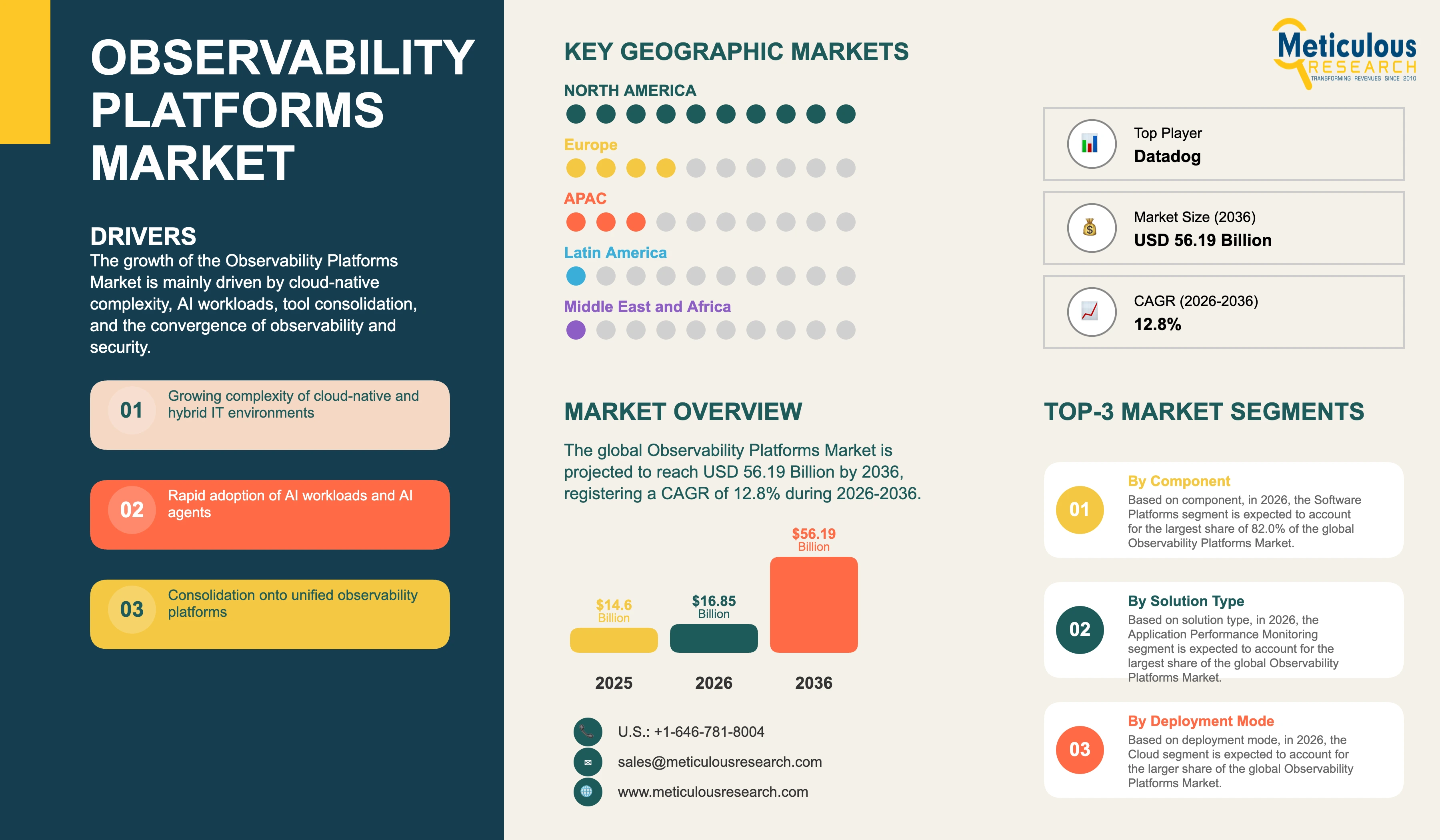
The global observability platforms market was valued at USD 14.60 billion in 2025. This market is expected to reach USD 56.19 billion by 2036 from an estimated USD 16.85 billion in 2026, registering a CAGR of 12.8% during the forecast period (2026-2036).
- Published
- Nov 2026
- Pages
- 237
- Format
- PDF + Excel
- Report ID
- MRICT - 1042619
- Base year
- 2025
- 2025 · BASELINE
- $14.60B
- 2036
- $56.19B
- CAGR 2026–2036
- 12.8%
2025 baseline · 2026–2036 forecast at 12.8% CAGR · hover a bar for the value
Key highlights
Datadog reported full-year 2025 revenue of USD 3.43 billion, up 28%, and fourth-quarter revenue of USD 953 million, up 29%, with record bookings of USD 1.63 billion and 603 customers with annual recurring revenue of USD 1 million or more, and guided to 2026 revenue of USD 4.06 billion to USD 4.10 billion, according to the company's results reported in February 2026.
Dynatrace reported annual recurring revenue of USD 2.054 billion as of March 31, 2026, up 18%, and full-year fiscal 2026 revenue of USD 2.018 billion, up 19%, and said that log management remained its fastest-growing major product category, with fourth-quarter consumption growing more than 100% year over year, according to the company.
Palo Alto Networks completed its USD 3.35 billion acquisition of observability company Chronosphere in early 2026, which reported annual recurring revenue of more than USD 160 million as of September 2025 with triple-digit growth, and plans to integrate it with its Cortex AgentiX platform, according to Palo Alto Networks and Channel Insider.
Snowflake closed its acquisition of observability company Observe for about USD 600 million, which it expects to contribute about one percentage point of product revenue growth in fiscal 2027, marking its entry into the observability market, according to the company's fourth-quarter fiscal 2026 earnings call.
Dynatrace acquired feature management company DevCycle and telemetry pipeline company Bindplane as it entered fiscal 2027, and guided to fiscal 2027 annual recurring revenue of USD 2.38 billion to USD 2.40 billion, according to the company.
Datadog said that its AI observability capabilities serve more than 1, 000 customers and that more than 5,500 customers use its AI integrations, reflecting the rapid growth of demand for monitoring AI applications and agents, according to the company and Zacks. Datadog also reported that customers with USD 100,000 or more in annual recurring revenue grew 19% to 4,310, and that growth excluding AI-native customers accelerated to 23% in the fourth quarter of 2025, which shows broad-based demand, according to TIKR and Zacks.
By component, software platforms account for the larger share of 82.0% in 2026 and also register the higher CAGR.
By solution type, application performance monitoring accounts for the largest share in 2026, while AI and LLM observability registers the highest CAGR.
By deployment mode, Cloud accounts for the larger share in 2026 and also registers the higher CAGR.
By end-use industry, IT and telecommunications account for the largest share of 26.0% in 2026, while healthcare and life sciences register the highest CAGR.
By geography, North America accounts for the largest share of 52.0% in 2026, while Asia-Pacific registers the highest CAGR of 15.8%.
Report summary
| Particulars | Details |
|---|---|
| Base Year | 2025 |
| Estimated Year | 2026 |
| Forecast Period | 2026-2036 |
| Market Size in 2025 | USD 14.60 billion |
| Market Size in 2026 | USD 16.85 billion |
| Market Size by 2036 | USD 56.19 billion |
| CAGR (2026-2036) | 12.8% |
| Format | PDF, Excel & Cloud Portal · 237 pages |
| Largest Segment by Component (2026) | Software Platforms (82.0%) |
| Largest Segment by End-Use Industry (2026) | IT and Telecommunications (26.0%) |
| Largest Region (2026) | North America (52.0%) |
| Fastest-Growing Region | Asia-Pacific (CAGR 15.8%) |
| Companies Profiled | 16 companies and other companies |
| Segments Covered | Component, Solution Type, Deployment Mode, End-Use Industry, Geography |
| Countries Covered | U.S., Canada, Germany, U.K., France, Italy, Spain, Netherlands, Switzerland, Belgium, Sweden, Denmark, Norway, Finland, Austria, Poland, Ireland, Rest of Europe, China, Japan, India, South Korea, Australia, Indonesia, Thailand, Singapore, Malaysia, Vietnam, Philippines, Taiwan, New Zealand, Rest of Asia-Pacific, Brazil, Mexico, Argentina, Colombia, Chile, Peru, Rest of Latin America, Saudi Arabia, U.A.E., Israel, South Africa, Turkey, Egypt, Rest of Middle East & Africa |
Report overview
Segments covered: component, solution type, deployment mode, end-use industry.
The growth of this market is mainly driven by the growing complexity of cloud-native and hybrid IT environments, the rapid adoption of AI workloads and AI agents that require new forms of monitoring, the rising cost of downtime and the need to protect digital customer experiences, the consolidation of monitoring tools onto unified observability platforms, the growing volume of telemetry data from logs, metrics, and traces, and the convergence of observability and security. However, factors such as the high and unpredictable cost of observability platforms as data volumes grow, the complexity of implementing observability across large and legacy environments, the shortage of skilled site reliability and DevOps engineers, and data privacy and sovereignty requirements are expected to restrain the growth of this market to some extent. Nevertheless, the strong need for reliable digital services is expected to support sustained investment.
Observability platforms are software tools that collect, analyze, and visualize telemetry data, such as metrics, logs, traces, events, and user experience data, to help organizations understand the health and performance of their applications, infrastructure, networks, and digital services. Unlike traditional monitoring tools, which track known problems with predefined dashboards and alerts, observability platforms allow teams to investigate unknown problems by exploring detailed data across the entire technology stack. They are used by IT operations, site reliability engineering, DevOps, development, and security teams to detect, diagnose, and resolve problems quickly.
This report covers the global observability platforms market, including software platforms for application performance monitoring, infrastructure monitoring, log management and analytics, digital experience monitoring, AI and LLM observability, and other solutions, such as network monitoring, telemetry pipelines, and security observability, as well as professional and managed services related to these platforms. The market is analyzed by component, solution type, deployment mode, end-use industry, and geography. The market is measured on a revenue basis. Standalone security information and event management, IT service management, and general data analytics platforms are not included, except for their observability modules.
The observability market has grown rapidly as organizations move applications to the cloud, adopt microservices, containers, and Kubernetes, and deliver more services digitally. These modern architectures generate large volumes of telemetry data and make it harder to find the cause of problems, and leading vendors have grown strongly as a result. Datadog reported 2025 revenue of USD 3.43 billion, up 28%, and Dynatrace surpassed USD 2 billion in annual recurring revenue in March 2026.
AI is reshaping the observability market in two important ways that affect both demand and product development. First, organizations deploying AI models, large language models, and AI agents need new tools to monitor their performance, cost, accuracy, and safety, which has created a new category of AI and LLM observability. Datadog said its AI observability capabilities serve more than 1,000 customers. Second, observability vendors are using AI to automate the detection, diagnosis, and remediation of problems, moving from passive dashboards toward autonomous operations, as shown by Palo Alto Networks' plan to integrate Chronosphere with its Cortex AgentiX platform.
The observability market is also consolidating as security, data, and networking companies acquire observability capabilities. Cisco acquired Splunk in 2024, Palo Alto Networks acquired Chronosphere for USD 3.35 billion, completing the deal in early 2026, and Snowflake acquired Observe for about USD 600 million. These deals show the convergence of observability with security and data platforms, as telemetry data becomes valuable for security detection, business analytics, and AI. Customers are also consolidating their tools onto fewer platforms to reduce cost and complexity, which favors vendors with broad platforms.
Cost management has become an important issue for customers, as the volume of telemetry data grows faster than budgets. Vendors are responding with telemetry pipelines that filter and route data, tiered storage, and new pricing models. Open standards, such as OpenTelemetry, are giving customers more flexibility to collect data once and send it to different tools, which increases competition between vendors.
In 2026, software platforms account for the largest share of the market by component and are also the faster-growing component. Application performance monitoring is the largest solution type, while AI and LLM observability is the fastest-growing solution type. Cloud deployment accounts for the larger share by deployment mode and is also the faster-growing mode. IT and telecommunications is the largest end-use industry, while healthcare and life sciences is the fastest-growing industry. North America accounts for the largest share of the market, while Asia-Pacific is the fastest-growing region.
Over the forecast period, the observability platforms market is expected to grow strongly, supported by cloud adoption, AI workloads, tool consolidation, the convergence of observability and security, and the growth of digital services in all industries. However, growth will depend on vendors' ability to manage data costs for customers and deliver measurable value through automation. Observability is also expanding beyond IT teams to other parts of the organization. Business leaders use observability data to understand how system performance affects revenue and customer experience, while security teams use the same data to detect threats. Platform engineering teams are building internal developer platforms with built-in observability, which makes observability a standard part of software development rather than an afterthought.
North America is expected to account for the largest share of 52.0% of the market in 2026, mainly due to early cloud adoption, many technology and AI-native companies, high IT spending, and the presence of leading observability vendors.
Asia-Pacific is projected to register the highest CAGR of 15.8% during the forecast period, driven by accelerating cloud adoption, rapid growth of digital services, AI investment, and the expansion of vendors in the region.
The report profiles 16 companies, including Datadog, Dynatrace, Cisco (Splunk), New Relic, Grafana Labs, Elastic, Palo Alto Networks (Chronosphere), Snowflake (Observe), IBM (Instana), Microsoft, Amazon Web Services, Google Cloud, ServiceNow, SolarWinds, LogicMonitor, and Honeycomb.
Monitoring tracks known problems using predefined metrics, dashboards, and alerts, while observability allows teams to investigate unknown problems by exploring detailed telemetry data, such as metrics, logs, and traces, across the entire technology stack. Observability platforms are designed for complex, distributed, and cloud-native systems.
AI and LLM observability refers to monitoring the performance, cost, token usage, accuracy, safety, and behavior of AI models, large language models, and AI agents in production, as well as the infrastructure that supports them. It helps organizations detect problems such as slow responses, high costs, and hallucinations.
Report infographic
Market dynamics
18 factors across 5 forcesGrowing complexity of Cloud-native and hybrid IT environments
Organizations are running applications across public clouds, private data centers, edge locations, and software-as-a-service platforms, using microservices, containers, Kubernetes, and serverless functions. These distributed architectures have many more components and dependencies than traditional applications, which makes it much harder to understand how systems behave and to find the cause of problems. A single user transaction may pass through dozens of services, databases, and external APIs.
Observability platforms help teams manage this complexity by collecting and correlating metrics, logs, and traces across the entire stack and providing a unified view of system health. As more organizations migrate workloads to the cloud and adopt cloud-native architectures, demand for observability platforms is expected to grow. Datadog's core business growth, excluding AI-native customers, accelerated to 23% in the fourth quarter of 2025, according to Zacks, which reflects broad demand from cloud migration.
Rapid adoption of AI workloads and AI agents
The rapid adoption of generative AI, large language models, and AI agents is creating new demand for observability. Organizations need to monitor the performance, latency, cost, accuracy, and safety of AI applications, track token usage and GPU utilization, detect hallucinations and harmful outputs, and trace the actions of AI agents across tools and systems. Datadog said that its AI observability capabilities serve more than 1,000 customers and that more than 5,500 customers use its AI integrations.
AI workloads also generate large volumes of telemetry and run on expensive GPU infrastructure, which increases the value of monitoring and optimization. AI-native companies have become large customers of observability vendors. AI and LLM observability is the fastest-growing solution type in the market, and vendors are rapidly adding capabilities for monitoring AI models, agents, and infrastructure. Datadog also reported that tool calls to its MCP server grew elevenfold quarter over quarter in the fourth quarter of 2025, which shows growing use of observability data by AI agents.
Rising cost of downtime and importance of digital experience
Digital services, such as online banking, e-commerce, streaming, and mobile applications, have become essential for businesses and their customers, and outages or slow performance can cause significant revenue losses and damage to reputation. Regulators in financial services and other industries are also requiring organizations to demonstrate operational resilience, such as under the European Union's Digital Operational Resilience Act. These factors increase the importance of detecting and resolving problems quickly.
Observability platforms help organizations reduce the time needed to detect and resolve incidents, monitor the experience of real users, and prevent problems before they affect customers. Digital experience monitoring tools that track the performance of websites and mobile apps from the user's perspective are growing as companies focus on customer experience. Faster incident resolution also reduces the workload of on-call engineers, reduces burnout, and improves the productivity of development teams, who can spend more time building new features.
Consolidation onto unified observability platforms
Many organizations use multiple monitoring tools for different teams, applications, and data types, which creates data silos, increases costs, and makes it harder to find the cause of problems. Organizations are increasingly consolidating these tools onto unified observability platforms that cover applications, infrastructure, logs, user experience, and security. Dynatrace has said that its platform subscription licensing model represents more than 75% of its annual recurring revenue.
Tool consolidation benefits vendors with broad platforms by increasing the number of products used per customer and the size of contracts. Dynatrace closed a record 22 deals in the fourth quarter of fiscal 2026 with more than USD 1 million in annual contract value, according to Market Chameleon. Platform consolidation is expected to continue to drive growth for leading vendors over the forecast period.
Convergence of observability and security
Telemetry data collected for observability, such as logs, traces, and network data, is also valuable for detecting and investigating security threats. Security and observability teams increasingly share data and tools, and vendors are combining observability and security capabilities in single platforms. Cisco's acquisition of Splunk, Palo Alto Networks' acquisition of Chronosphere, and Datadog's expansion into cloud security reflect this convergence. Combining observability and security can reduce costs and improve the speed of incident response, which supports investment in unified platforms. Security teams also benefit from the rich context provided by application and infrastructure data during investigations. This convergence is expected to continue as more organizations combine their operations and security teams.
Table of contents
12 chapters · 175 sections · 237 pages · click to expandSegmental analysis
| Segment | Largest share (2026) | Fastest growth (2026–2036) |
|---|---|---|
| By Component | — | Healthcare and life sciences |
By Component
- The IT and telecommunications segment is expected to account for the largest share of 26.0% of the observability platforms market, while the healthcare and life sciences segment is projected to register the highest CAGR during the forecast period.
- The Cloud segment is expected to account for the larger share of the observability platforms market, and it is also projected to register the higher CAGR during the forecast period.
Geographic analysis
North America
Largest shareIn 2026, North America is expected to account for the largest share of 52.0% of the global observability platforms market. The large share of this region is mainly due to the early and widespread adoption of cloud computing, cloud-native architectures, and DevOps practices in the U.S. and Canada, the large number of technology companies, AI-native companies, and digital businesses, high IT spending, and the presence of leading observability vendors, such as Datadog, Dynatrace, Cisco's Splunk and AppDynamics, New Relic, Grafana Labs, Palo Alto Networks, and the major cloud providers. North America is also the leading market for AI deployment, which is driving demand for AI and LLM observability.
Asia-Pacific
Fastest growthAsia-Pacific is projected to register the highest CAGR of 15.8% during the forecast period. The rapid growth of this region is mainly driven by accelerating cloud adoption and digital transformation in India, Japan, China, Australia, South Korea, and Southeast Asia, the rapid growth of digital banking, e-commerce, gaming, super apps, and telecommunications services, increasing investment in AI, and the expansion of global observability vendors and cloud providers in the region through new data centers, partnerships, and local sales teams. India's large technology services sector and growing number of digital-native companies are particularly important sources of demand, while Japan and Australia have mature enterprise markets that are modernizing their IT environments.
Europe
Europe accounts for a significant share of the market and is the second-largest region after North America, supported by strong demand from financial services, telecommunications, retail, and manufacturing companies in the U.K., Germany, France, the Netherlands, and the Nordic countries, and by regulatory requirements for operational resilience, such as the European Union's Digital Operational Resilience Act, which applies to financial institutions. Data protection and sovereignty requirements in Europe also influence deployment choices, and vendors are expanding their European data centers to meet these needs.
Latin America
Latin America and the Middle East & Africa account for smaller shares of the market but are growing steadily. In Latin America, Brazil, Mexico, Colombia, and Chile are adopting observability platforms as banks, retailers, and digital companies move to the cloud, and Datadog has noted large deals with Latin American financial services customers.
Middle East & Africa
In the Middle East & Africa, digital transformation programs in Saudi Arabia, the U.A.E., Israel, and South Africa, and new cloud data center investments in the Gulf region are driving demand for observability. Growing cloud adoption, new local cloud regions, and the expansion of digital services are expected to support continued growth in these regions over the forecast period. Regional differences in cloud adoption, digital service growth, IT spending, regulation, data sovereignty requirements, and the availability of skilled engineers shape the demand for observability platforms around the world. Regions with rapid cloud adoption and fast-growing digital economies are expected to grow fastest, while mature markets continue to grow steadily through tool consolidation, AI adoption, and modernization of legacy systems. Local systems integrators and cloud partners also support adoption in these markets.
Competitive landscape
The global observability platforms market is moderately consolidated, with the top five players estimated to account for about 50% of the market in 2025. The market is led by Datadog, Dynatrace, Cisco (Splunk and AppDynamics), Microsoft, and Amazon Web Services, followed by New Relic, Grafana Labs, Elastic, Palo Alto Networks, IBM, Google Cloud, ServiceNow, and a large number of specialized vendors and start-ups.
Datadog is the largest specialist observability vendor, with 2025 revenue of USD 3.43 billion and a broad platform covering infrastructure monitoring, application performance monitoring, logs, digital experience, security, and AI observability. Dynatrace reported fiscal 2026 revenue of USD 2.018 billion and offers an AI-powered observability platform for large enterprises. Cisco offers Splunk and AppDynamics, Microsoft offers Azure Monitor, Amazon Web Services offers CloudWatch, and Google Cloud offers its Cloud Operations suite. New Relic, Grafana Labs, Elastic, IBM Instana, ServiceNow Cloud Observability, SolarWinds, LogicMonitor, and Honeycomb are other important vendors in the market, while Palo Alto Networks entered the market through its acquisition of Chronosphere and Snowflake through its acquisition of Observe.
Companies in this market compete on platform breadth, data scale and performance, AI capabilities, ease of use, integration with cloud and development tools, support for OpenTelemetry, cost and pricing models, security and compliance, and customer support. Key strategies include expanding into AI observability and security, acquiring complementary technologies, developing AI agents for operations, offering telemetry pipelines and cost controls, and moving to platform-based licensing.
Recent competitive activity in the observability platforms market has included several major acquisitions and partnerships. Palo Alto Networks completed its USD 3.35 billion acquisition of Chronosphere in early 2026, Snowflake acquired Observe, Dynatrace acquired DevCycle and Bindplane, and Datadog announced a partnership with Sakana AI in February 2026. These moves reflect the convergence of observability with security, data, and AI.
We expect consolidation to continue as security vendors, data platforms, and cloud providers seek observability capabilities, and as specialist vendors expand their platforms. Competition is expected to focus increasingly on AI capabilities, data scale, and cost efficiency.
Some of the key players operating in the observability platforms market are Datadog, Inc., Dynatrace, Inc., Cisco Systems, Inc. (Splunk), New Relic, Inc., Grafana Labs, Elastic N.V., Palo Alto Networks, Inc. (Chronosphere), Snowflake Inc. (Observe), IBM Corporation (Instana), Microsoft Corporation, Amazon Web Services, Inc., Google LLC (Google Cloud), ServiceNow, Inc., SolarWinds Corporation, LogicMonitor, Inc., and Honeycomb.io, among others. Partnerships with cloud providers and their marketplaces will remain important sales channels for vendors.
- —
Palo Alto Networks completed its USD 3.35 billion acquisition of Chronosphere in early 2026, Snowflake acquired Observe, Dynatrace acquired DevCycle and Bindplane and surpassed USD 2 billion in annual recurring revenue, and Datadog guided to 2026 revenue of up to USD 4.10 billion.
- Datadog, Inc.
- Dynatrace, Inc.
- Cisco Systems, Inc. · Splunk
- New Relic, Inc.
- Grafana Labs
- Elastic N.V.
- Palo Alto Networks, Inc. · Chronosphere
- Snowflake Inc. · Observe
- IBM Corporation · Instana
- Microsoft Corporation
- Amazon Web Services, Inc.
- Google LLC · Google Cloud
- ServiceNow, Inc.
- SolarWinds Corporation
- LogicMonitor, Inc.
- Honeycomb.io
Expert perspectives
The observability platforms market has become one of the most important segments of enterprise software, as organizations depend on complex cloud-native and AI-powered digital services. Leading vendors have continued to grow strongly, with Datadog reporting 28% revenue growth in 2025 and Dynatrace surpassing USD 2 billion in annual recurring revenue, while major acquisitions by Palo Alto Networks and Snowflake show the strategic value of observability.
Over the forecast period, the market is expected to grow at a CAGR of 12.8%, from USD 16.85 billion in 2026 to USD 56.19 billion in 2036. Growth will be supported by cloud adoption, AI workloads and agents, tool consolidation, the convergence of observability and security, AI-driven automation, and digital transformation in all industries and regions.
Among the market segments, software platforms are the largest and faster-growing component. Application performance monitoring is the largest solution type, while AI and LLM observability grows fastest, and cloud is the larger and faster-growing deployment mode. IT and telecommunications is the largest end-use industry, while healthcare and life sciences grows fastest. North America is the largest region, and Asia-Pacific is the fastest-growing region at a CAGR of 15.8%.
In our view, the most important factor for the market over the forecast period will be AI, both as a source of demand and as a capability. Monitoring AI applications and agents will create a large new category of demand, while AI-driven automation will change how observability platforms deliver value, moving from dashboards toward autonomous operations. Vendors that lead in both areas are expected to gain share.
We also expect cost to remain a central issue for customers throughout the forecast period. As telemetry data volumes grow, customers will demand more predictable pricing and better tools to control costs, and vendors that help customers get more value from their data at lower cost will be best positioned. The convergence of observability with security and data platforms will continue to reshape the competitive landscape. Open standards such as OpenTelemetry will increase competition but also expand the overall market by making it easier to adopt observability.
Overall, we believe the observability platforms market will grow strongly over the forecast period, with AI and LLM observability, cloud deployment, healthcare and life sciences, and Asia-Pacific providing the fastest growth. Vendors that combine broad platforms, strong AI capabilities, and efficient cost models will be best positioned to capture this growth. We also expect regulated industries, such as financial services and healthcare, to increase their investment in observability as regulators place greater emphasis on operational resilience and the reliability of critical digital services.
Customer perspectives
Customers in the observability platforms market include IT operations teams, site reliability engineers, DevOps and platform engineering teams, software developers, security teams, and business leaders responsible for digital services. They choose observability platforms based on the breadth of capabilities, ease of use, speed of troubleshooting, scalability, AI features, integration with existing tools and cloud platforms, support for open standards, security and compliance, and total cost. Large enterprises often seek to consolidate multiple tools onto a single platform, while smaller organizations look for simple and affordable solutions. Finance and procurement teams increasingly scrutinize observability spending as data volumes and costs grow, and many organizations now track observability costs as a separate budget line. Developers also value tools that integrate with their existing workflows. Engineers also prefer tools that support OpenTelemetry and open-source standards.
Head of Site Reliability Engineering - U.S.
We replaced five monitoring tools with one platform and cut our time to resolve incidents significantly. Our biggest challenge now is controlling the cost of logs.
This comment explains why software platforms account for 82.0% of the market, why IT and telecommunications accounts for 26.0% of the market, and why North America accounts for 52.0% of the market.
AI Platform Lead - Financial Services, U.K.
Once our AI assistants went into production, we needed to monitor accuracy, latency, and cost for every request, which our traditional tools could not do.
This comment explains why AI and LLM observability is the fastest-growing solution type and why financial services companies are investing in observability.
This comment explains why healthcare and life sciences is the fastest-growing end-use industry and why Asia-Pacific is the fastest-growing region.
“Our patients expect our app and telehealth services to work all the time, so we invest in observability from day one.”
Frequently asked questions
The global observability platforms market was valued at USD 14.60 billion in 2025, up from USD 12.65 billion in 2024, and is estimated at USD 16.85 billion in 2026. The market includes observability software platforms and related professional and managed services.
The global observability platforms market is expected to reach USD 56.19 billion by 2036, supported by cloud adoption, AI workloads and agents, tool consolidation, the convergence of observability and security, and AI-driven automation.
The market is expected to register a CAGR of 12.8% from 2026 to 2036.
Market growth is mainly driven by the growing complexity of cloud-native and hybrid IT environments, the rapid adoption of AI workloads and agents, the rising cost of downtime and importance of digital experience, consolidation onto unified platforms, and the convergence of observability and security.
The high and unpredictable cost of observability and implementation complexity and skills shortages restrain growth, while intense competition and pricing pressure and data privacy, sovereignty, and security requirements are key challenges.
Key growth opportunities include AI and LLM observability, AI-driven automation and autonomous remediation, telemetry pipelines and cost optimization, and expansion in Asia-Pacific and among mid-market organizations.
Software platforms are expected to account for the largest share of 82.0% of the market in 2026 and are also projected to register the higher CAGR.
Application performance monitoring is expected to account for the largest share of the market in 2026, while AI and LLM observability is projected to register the highest CAGR.
In 2026, the IT and telecommunications segment is expected to account for the largest share of 26.0% of the observability platforms market, while the healthcare and life sciences segment is projected to register the highest CAGR during the forecast period.
In 2026, the Cloud segment is expected to account for the larger share of the observability platforms market, and it is also projected to register the higher CAGR during the forecast period.
North America is expected to account for the largest share of 52.0% of the market in 2026, mainly due to early cloud adoption, many technology and AI-native companies, high IT spending, and the presence of leading observability vendors.
Asia-Pacific is projected to register the highest CAGR of 15.8% during the forecast period, driven by accelerating cloud adoption, rapid growth of digital services, AI investment, and the expansion of vendors in the region.
The report profiles 16 companies, including Datadog, Dynatrace, Cisco (Splunk), New Relic, Grafana Labs, Elastic, Palo Alto Networks (Chronosphere), Snowflake (Observe), IBM (Instana), Microsoft, Amazon Web Services, Google Cloud, ServiceNow, SolarWinds, LogicMonitor, and Honeycomb.
Palo Alto Networks completed its USD 3.35 billion acquisition of Chronosphere in early 2026, Snowflake acquired Observe, Dynatrace acquired DevCycle and Bindplane and surpassed USD 2 billion in annual recurring revenue, and Datadog guided to 2026 revenue of up to USD 4.10 billion.
Monitoring tracks known problems using predefined metrics, dashboards, and alerts, while observability allows teams to investigate unknown problems by exploring detailed telemetry data, such as metrics, logs, and traces, across the entire technology stack. Observability platforms are designed for complex, distributed, and cloud-native systems.
AI and LLM observability refers to monitoring the performance, cost, token usage, accuracy, safety, and behavior of AI models, large language models, and AI agents in production, as well as the infrastructure that supports them. It helps organizations detect problems such as slow responses, high costs, and hallucinations.
Cite this report
Meticulous Research. (2026). Observability Platforms Market - Global Opportunity Analysis and Industry Forecast (2026-2036) (Report No. MRICT - 1042619). Meticulous Market Research Pvt. Ltd. https://www.meticulousresearch.com/product/observability-platforms-market-7302