Grid Edge Intelligence & Analytics Market (2026-2036)
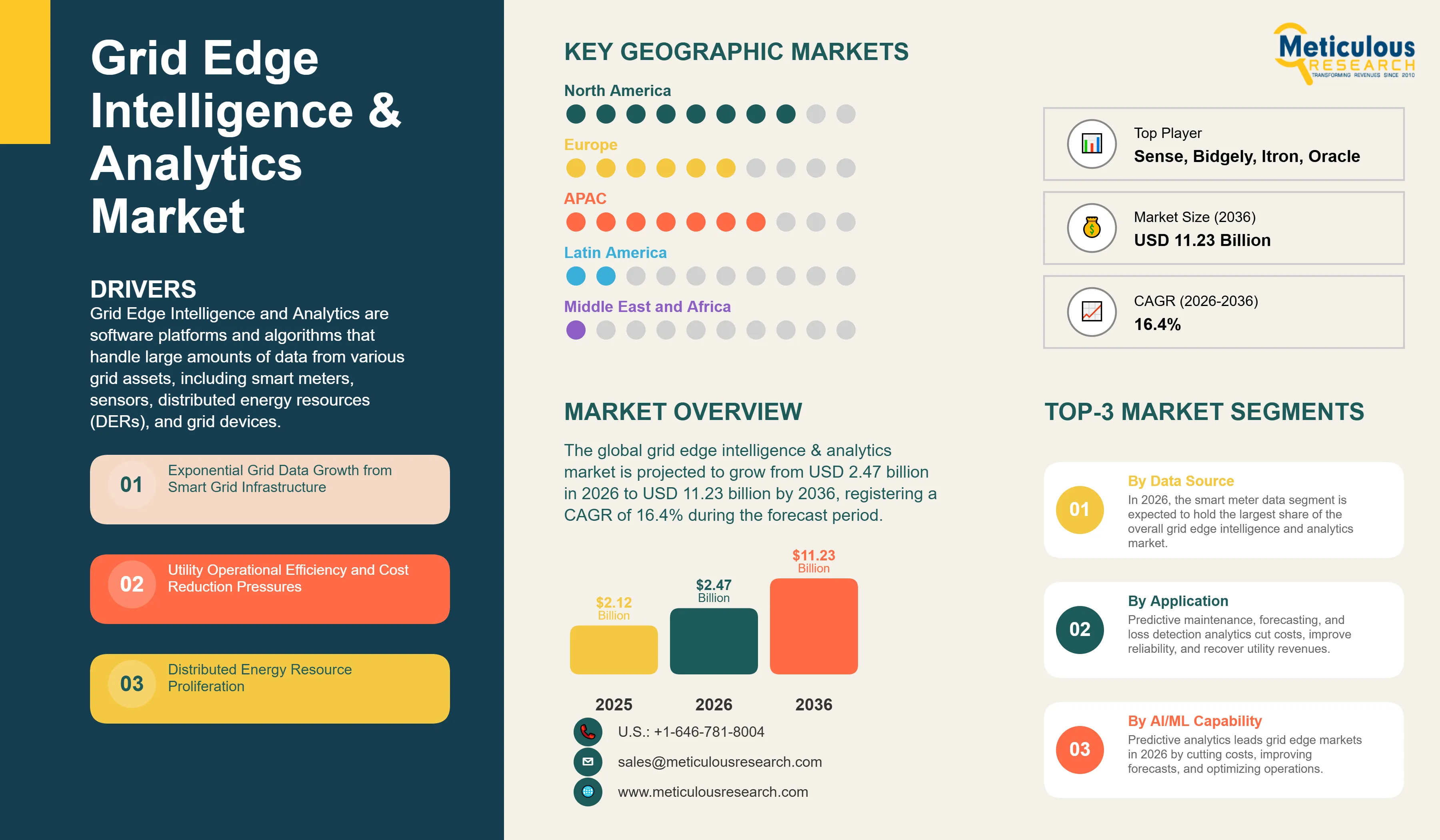
The global grid edge intelligence & analytics market is expected to reach USD 11.23 billion by 2036 from USD 2.47 billion in 2026, at a CAGR of 16.4% from 2026 to 2036.
- Published
- Jan 2026
- Pages
- 277
- Format
- PDF + Excel
- Report ID
- MREP - 1041685
- Base year
- 2025
- 2026 · ESTIMATED
- $2.47B
- 2036
- $11.23B
- CAGR 2026–2036
- 16.4%
2025 baseline · 2026–2036 forecast at 16.4% CAGR · hover a bar for the value
Key highlights
In 2026, North America is estimated to account for the largest share of the global grid edge intelligence & analytics market, driven by mature smart grid infrastructure generating massive data volumes, advanced utility analytics adoption, vendor ecosystem leadership, and utility focus on data-driven operations.
Asia-Pacific is projected to register the highest CAGR during the forecast period, fueled by massive smart meter deployments in China and India, grid modernization creating data infrastructure, AI technology development, and utility digital transformation initiatives.
Based on data source, the smart meter data segment is estimated to hold the largest share of the market in 2026, driven by billions of smart meters deployed globally, granular consumption data generation, and proven analytics use cases for operations and customer engagement.
Based on AI/ML capability, the predictive analytics segment is estimated to dominate the market in 2026, owing to high-value use cases including equipment failure prediction, load forecasting, and maintenance optimization delivering clear ROI.
Based on application, the asset health monitoring and predictive maintenance segment is expected to witness significant growth during the forecast period, driven by aging infrastructure requiring proactive management and maintenance cost reduction pressures.
Based on deployment model, the cloud-based analytics segment is expected to account for the largest share of the market in 2026, fueled by scalability requirements for massive data volumes, advanced AI/ML capabilities, and cost-effective infrastructure.
The distributed energy resource optimization segment is expected to grow at a significant CAGR during the forecast period, driven by renewable integration challenges, grid flexibility requirements, and DER proliferation requiring intelligent coordination.
The U.S. grid edge intelligence & analytics market is projected to grow at a CAGR of around 15% during the forecast period 2026 to 2036, driven by utility digital transformation strategies, aging infrastructure analytics needs, and competitive analytics vendor ecosystem.
China is expected to lead the Asia-Pacific grid edge intelligence & analytics market, driven by State Grid Corporation's advanced analytics initiatives, massive smart meter data availability, domestic AI technology capabilities, and government smart grid policies.
In 2026, Germany is projected to account for the largest share of the European grid edge intelligence & analytics market, driven by Energiewende data analytics requirements, renewable integration complexity, utility innovation culture, and advanced metering infrastructure.
Report summary
| Particulars | Details |
|---|---|
| Market Size Value in 2026 | USD 2.47 Billion |
| Revenue Forecast in 2036 | USD 11.23 Billion |
| Growth Rate | CAGR of 16.4% from 2026 to 2036 |
| Format | PDF, Excel & Cloud Portal · 277 pages |
| Base Year for Estimation | 2025 |
| Historical Data | 2021–2025 |
| Forecast Period | 2026–2036 |
| Quantitative Units | Revenue in USD Billion and CAGR from 2026 to 2036 |
| Report Coverage | Revenue forecast, company ranking, competitive landscape, growth factors, and trends |
| Segments Covered | Data Source, AI/ML Capability, Application, Deployment Model, Analytics Type, Utility Function, Region |
| Regional Scope | North America, Europe, Asia-Pacific, Latin America, Middle East & Africa |
| Countries Covered | U.S., Canada, Mexico, Germany, U.K., France, Italy, Spain, Netherlands, China, India, Japan, South Korea, Australia, Singapore, Brazil, Chile, Saudi Arabia, UAE, South Africa |
| Key Companies Profiled | C3.ai Inc., Oracle Corporation, Itron Inc., Landis+Gyr Group AG, AutoGrid Systems Inc., Bidgely Inc., Sense (Sense Labs Inc.), Grid4C (Innowatts), Space-Time Insight (Nokia), Uplight Inc., Copper Labs Inc., OhmConnect Inc., Whisker Labs Inc., Open Systems International Inc. (Emerson), General Electric Company, Siemens AG, Schneider Electric SE, ABB Ltd., Hitachi Energy Ltd., Eaton Corporation |
Report overview
Segments covered: data source, ai/ml capability, application.
Grid Edge Intelligence and Analytics are software platforms and algorithms that handle large amounts of data from various grid assets, including smart meters, sensors, distributed energy resources (DERs), and grid devices. They provide real-time insights, predictions, and automated actions to optimize grid operations, increase reliability, and allow for new utility services. These systems aim to turn raw grid data into useful intelligence. They help manage the grid proactively, predict equipment failures before they happen, optimize the use of distributed energy resources, detect anomalies and fraud, and support better decision-making.
These AI-driven systems use various technologies, such as machine learning for recognizing patterns and making predictions, big data analytics to process billions of data points, and artificial intelligence for making independent decisions. They also employ edge computing for local real-time processing, predictive analytics to forecast grid conditions and failures, deep learning for identifying complex patterns, and cloud-based data lakes for storing historical grid information. Grid edge intelligence systems can spot early signs of equipment failures days or weeks in advance, identify energy theft and non-technical losses, accurately forecast renewable generation and load, optimize volt-VAR control for efficiency, enable predictive maintenance to cut costs, and offer actionable insights from large data sets.
These systems give utilities better situational awareness, help reduce operational costs, improve reliability metrics, optimize asset use, and create new revenue opportunities. This shift allows utilities to move from reactive to proactive operations. They can better manage the complexities of distributed energy, enhance customer service, decrease operational costs, and maximize the value from smart grid investments.
Grid Edge Intelligence and Analytics platforms act as the "brain" that extracts value from significant investments in smart grid data infrastructure. Utilities have installed hundreds of millions of smart meters, thousands of grid sensors, and extensive monitoring equipment, producing petabytes of data each year. However, data by itself offers limited value. The real benefits come from analyzing this data, which leads to operational improvements, cost savings, and new capabilities. Grid edge analytics turns raw data into actionable insights. These insights include indicators of equipment health that predict failures, consumption patterns that allow for demand forecasting, anomaly detection that identifies theft and meter issues, predictions of distributed resource outputs that aid integration, grid state estimation for operational visibility, and customer segmentation to enable targeted programs. By combining analytics algorithms, machine learning models, big data processing infrastructure, and specialized knowledge, grid edge intelligence platforms help utilities see a return on their smart grid investments, optimize operations, improve reliability, and offer better customer experiences.
Several key trends are changing the grid edge intelligence and analytics market. These trends include the rapid advancement of artificial intelligence and machine learning that allows for more sophisticated analysis, a shift from centralized cloud analytics to distributed edge computing for real-time processing, integration of analytics with operational systems enabling automated actions, a broader focus from utility operations to customer-facing analytics and engagement, and the rise of analytics-as-a-service business models that make these capabilities available to smaller utilities. The combination of rapid data growth from grid digitization, the maturation of AI technology for practical use, pressure on utilities to improve operational efficiency, the complexity of distributed energy requiring intelligence, and proven returns on analytics investments has sped up the shift from pilot projects to mainstream utility operations across different regions and utility sizes.
Report infographic
Market dynamics
7 factors across 3 forcesExponential Grid Data Growth from Smart Grid Infrastructure
The rise of smart meters, sensors, and grid monitoring devices is creating huge amounts of operational data that overwhelm traditional utility analytics. This growth drives the demand for better intelligence platforms. Modern utilities generate massive data volumes. Large utilities with millions of smart meters collecting 15-minute interval data produce terabytes each month. Distribution grid sensors monitor voltage, current, power factor, and harmonics, adding significant data streams. Distributed energy resources report generation, consumption, and status, creating millions of data points. Grid equipment equipped with condition monitoring sensors generate continuous health data. Traditional utility IT systems, designed for monthly billing data and periodic readings, struggle to process, store, or analyze these data volumes. Advanced grid edge intelligence platforms that use big data architectures, distributed processing, machine learning algorithms, and cloud infrastructure are vital for extracting value from these data streams. The growth of data is speeding up as utilities deploy more sensors, upgrade to next-generation smart meters with higher data resolution, and add monitoring to previously unmonitored grid assets. This rapid data growth creates essential needs for advanced analytics, ensuring ongoing market expansion.
Utility Operational Efficiency and Cost Reduction Pressures
Utilities face constant pressure to cut operational costs while maintaining or improving service quality. This situation drives the adoption of analytics platforms that optimize operations and encourage proactive management. Utilities encounter various cost pressures: an aging workforce that needs efficiency improvements to maintain service with fewer experienced staff, capital constraints limiting infrastructure development that require optimization of existing assets, regulatory pressures for cost control amid rate case scrutiny and performance-based regulation, competition from distributed resources that push for operational excellence, and public expectations for reliable service with minimal rate increases. Grid edge analytics help address these pressures by enabling predictive maintenance that reduces emergency repair costs by 20-40% through proactive intervention. Load forecasting optimization reduces peak capacity needs and energy costs. Non-technical loss detection recovers 1-3% of revenue lost to theft and meter errors. Optimizing asset utilization can delay capital investment through better management, and operational automation reduces manual tasks and labor costs. These operational advantages create a strong return on investment, often achieving payback in 2-4 years, making analytics investments appealing, even for cost-constrained utilities. The proven benefits of cost reduction ensure ongoing utility investments in grid edge intelligence platforms.
Table of contents
15 chapters · 195 sections · 277 pages · click to expandGeographic analysis
North America
Largest shareIn 2026, North America is expected to have the largest share of the global grid edge intelligence and analytics market. This leadership comes from a well-developed smart grid infrastructure with a wide deployment of smart meters, sensors, and monitoring equipment that generate large amounts of data. Many major utilities are adopting advanced analytics by implementing complete platforms. The region also has a strong vendor ecosystem that includes Oracle, Itron, C3.ai, AutoGrid, and specialized startups. Utilities are focusing on data-driven operations, which is highlighted in their strategic plans, supported by regulatory frameworks that encourage grid modernization and innovation. U.S. utilities, in particular, lead in analytics adoption. This trend is driven by competitive pressure for operational efficiency, aging infrastructure that needs predictive management, regulatory incentives for improving reliability, and venture capital that backs analytics startups. Major deployments feature utilities using comprehensive platforms for operational, customer, and grid analytics. These efforts create reference implementations and use case libraries.
Asia-Pacific
Fastest growthAsia-Pacific is expected to grow the fastest during this period. This growth is driven by extensive smart meter deployments in China and India, which create a vast data infrastructure. Grid modernization initiatives require advanced analytics. There is also significant development of AI and analytics technology, especially in China. Government smart grid policies mandate intelligence features, and utility digital transformation strategies are in place. China leads regional growth, thanks to State Grid Corporation and Southern Power Grid deploying advanced analytics platforms. Government policies require intelligent grid management. Domestic analytics vendors are developing competitive solutions, and analytics are being integrated with a complete smart grid infrastructure. In India, the Smart Grid Mission, utility modernization programs, and significant planned smart meter deployments offer substantial analytics opportunities. Utilities in Japan, South Korea, and Singapore are focusing on innovation and adopting analytics.
Europe
Europe represents a significant market characterized by the need for renewable integration analytics. The high penetration of solar and wind energy calls for sophisticated forecasting and optimization, along with managing the complexity of distributed energy resources. The Energiewende and the broader energy transition require grid intelligence. A culture of utility innovation, especially in Northern Europe, supports this market, along with advanced metering infrastructure maturity. Germany leads the European market, with utilities implementing comprehensive analytics for renewable integration, grid optimization, and customer engagement. Nordic utilities focus on advanced analytics for managing distributed generation and automating the grid. UK utilities are deploying analytics for innovation projects and meeting regulatory requirements.
Competitive landscape
- C3.ai Inc. (U.S.)
- Oracle Corporation (U.S.)
- Itron Inc. (U.S.)
- Landis+Gyr Group AG · Switzerland
- AutoGrid Systems Inc. (U.S.)
- Bidgely Inc. (U.S.)
- Sense (Sense Labs Inc.) (U.S.)
- Grid4C (Innowatts) (Israel/U.S.)
- Space-Time Insight (Nokia) (U.S./Finland)
- Uplight Inc. (U.S.)
- Copper Labs Inc. (U.S.)
- OhmConnect Inc. (U.S.)
- Whisker Labs Inc. (U.S.)
- Open Systems International Inc. (Emerson) (U.S.)
- General Electric Company (U.S.)
- Siemens AG · Germany
- Schneider Electric SE · France
- ABB Ltd. · Switzerland
- Hitachi Energy Ltd. · Switzerland
- Eaton Corporation (Ireland/U.S.)
Frequently asked questions
The grid edge intelligence & analytics market is expected to grow from USD 2.47 billion in 2026 to USD 11.23 billion by 2036.
Cite this report
Meticulous Research. (2026). Grid Edge Intelligence & Analytics Market - Global Opportunity Analysis and Industry Forecast (2026-2036) (Report No. MREP - 1041685). Meticulous Market Research Pvt. Ltd. https://www.meticulousresearch.com/product/grid-edge-intelligence-and-analytics-market-6368