Advanced Conductors Market (2026-2036)
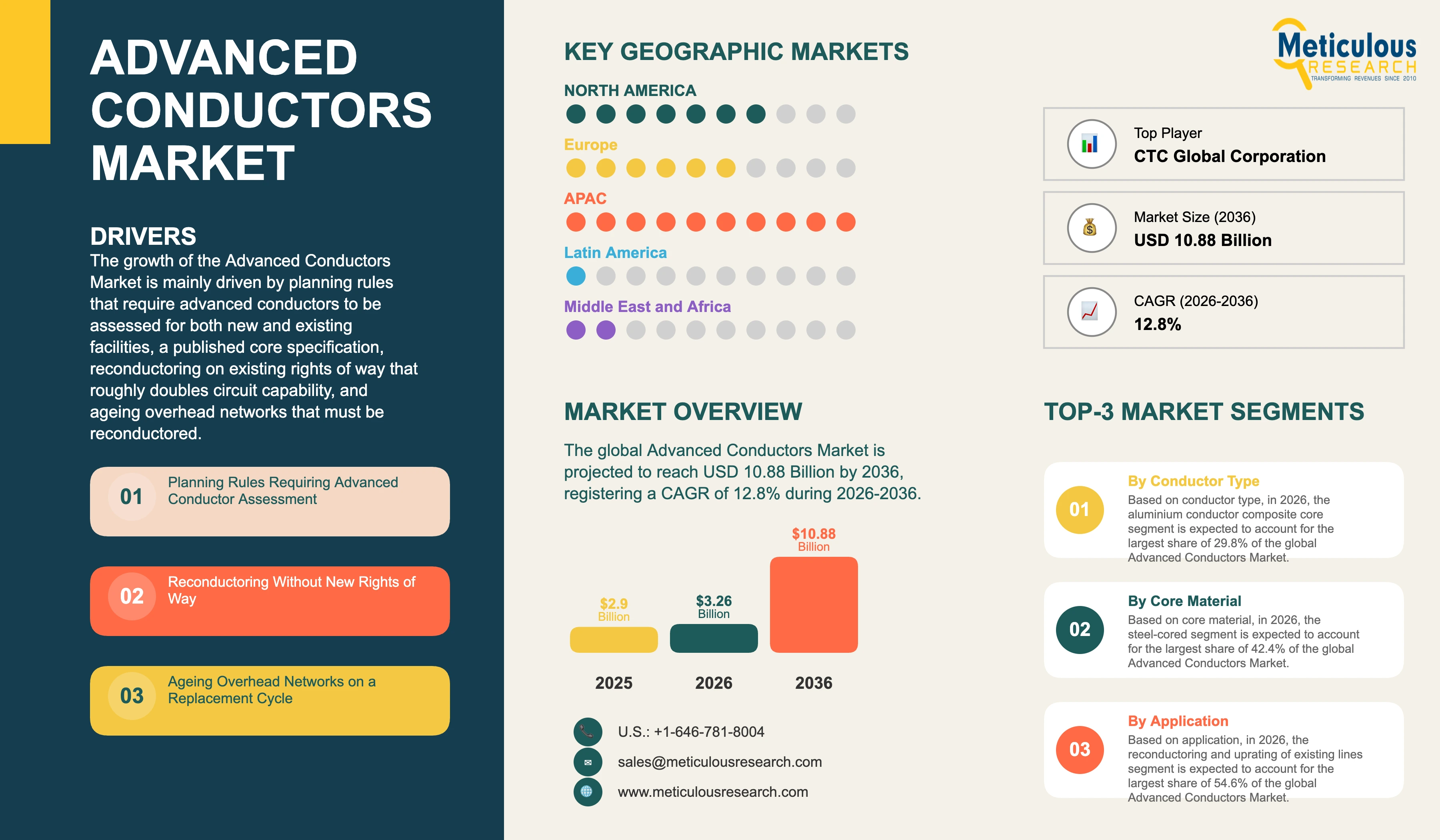
The global Advanced Conductors Market was valued at USD 2.90 billion in 2025. This market is expected to reach USD 10.88 billion by 2036 from an estimated USD 3.26 billion in 2026, registering a CAGR of 12.8% during the forecast period (2026-2036).
- Published
- Nov 2026
- Pages
- 285
- Format
- PDF + Excel
- Report ID
- MREP - 1042460
- Base year
- 2025
- 2025 · BASELINE
- $2.90B
- 2036
- $10.88B
- CAGR 2026–2036
- 12.8%
2025 baseline · 2026–2036 forecast at 12.8% CAGR · hover a bar for the value
Key highlights
The market is valued at USD 3.26 billion in 2026 and is projected to reach USD 10.88 billion by 2036.
Volume grows faster than value, at a CAGR of 15.9% against 12.8%, as the price per circuit km falls from USD 47,700 to USD 36,400.
Advanced conductors must now be considered in long-term transmission planning for existing as well as new facilities.
A published core specification, with its 2025 version active, defines the properties and tests a utility can require before a composite core is accepted.
Composite-cored conductors are the fastest-growing core material at a CAGR of 15.6%, on roughly double the capacity of conventional conductor on the same towers.
Reconductoring of existing lines accounts for 54.6% of the market, since capacity is added without new easements, permits or towers.
Renewable interconnection is the fastest-growing application at a CAGR of 14.6%, and developers the fastest-growing buyer group at 15.4%.
By conductor type, ACCC forms the largest segment and ACCR the fastest growing.
By core material, steel-cored conductors form the largest segment and composite-cored the fastest growing.
By voltage, 132 kV to 345 kV forms the largest segment and above 345 kV the fastest growing.
By application, reconductoring and uprating forms the largest segment and renewable interconnection the fastest growing.
By end user, transmission utilities and system operators form the largest segment and independent power producers and renewable developers the fastest growing.
By geography, Asia-Pacific forms the largest regional market and the Middle East & Africa the fastest growing.
Report summary
| Particulars | Details |
|---|---|
| Base Year | 2025 |
| Forecast Period | 2026-2036 |
| Market Size (2025) | USD 2.90 billion (59.3 thousand circuit km) |
| Estimated Market Size (2026) | USD 3.26 billion (68.4 thousand circuit km) |
| Forecast Market Size (2036) | USD 10.88 billion (298.9 thousand circuit km) |
| CAGR (2026-2036) | 12.8% by value and 15.9% by volume |
| Format | PDF, Excel & Cloud Portal · 285 pages |
| Average Selling Price | USD 47,700 per circuit km in 2026, declining to USD 36,400 per circuit km by 2036 |
| Units | Value (USD million/billion) and Volume (thousand circuit km) |
| Segments Covered | Conductor Type, Core Material, Voltage, Application, End User, and Geography |
| Geographies Covered | Asia-Pacific (China, India, Japan, South Korea, Australia, Rest of Asia-Pacific), North America (U.S., Canada), Europe (Germany, U.K., France, Spain, Italy, Nordic Countries, Rest of Europe), Middle East & Africa (Saudi Arabia, UAE, South Africa, Rest of Middle East & Africa), Latin America (Brazil, Chile, Mexico, Rest of Latin America) |
| Scope Inclusions | Bare overhead electrical conductors that provide higher current-carrying capability than conventional steel-reinforced aluminium conductor of equivalent diameter, comprising aluminium conductor composite core, aluminium conductor composite reinforced, aluminium conductor steel supported and its trapezoidal variant, GAP-type construction, invar-reinforced conductor and other advanced constructions including trapezoidal and thermal-resistant alloy and high-conductivity aluminium designs; by core material across steel-cored, composite-cored, metal-matrix and alloy-cored and all-aluminium alloy and other cores; at voltages above 345 kV, 132 kV to 345 kV and below 132 kV; applied to reconductoring and uprating of existing lines, new transmission lines and renewable interconnection and collector lines; and across transmission utilities and system operators, distribution utilities, independent power producers and renewable developers, and industrial, rail and other end users |
| Scope Exclusions | Conventional steel-reinforced aluminium and all-aluminium conductor without a capacity-enhancing design, underground and submarine power cables and their conductors, optical ground wire and communication cables, insulated and covered overhead conductor supplied for contact safety rather than capacity, towers, foundations, insulators, fittings and stringing hardware, conductor accessories supplied separately from the conductor, structural assessment, tower remediation and line construction services, dynamic line rating, power flow control and topology optimisation technologies, and aluminium rod, billet and raw material supply |
| Key Companies | CTC Global Corporation, Southwire Company, LLC, Prysmian S.p.A., Nexans S.A., 3M Company, TS Conductor Corp., Sumitomo Electric Industries, Ltd., Fujikura Ltd., LS Cable & System Ltd., Taihan Cable & Solution Co., Ltd., Apar Industries Limited, Jiangsu Zhongtian Technology Co., Ltd., Far East Cable Co., Ltd., Midal Cables Ltd., Elsewedy Electric Company S.A.E., Lumpi-Berndorf Draht- und Seilwerk GmbH, Lamifil NV, and De Angeli Prodotti S.r.l. |
Report overview
Market value is measured in USD million/billion) and volume (thousand circuit km. Segments covered: conductor type, core material, voltage, application, end user. Regions: Asia-Pacific, North America, Europe, Middle East & Africa, Latin America.
In volume terms, shipments are expected to reach 298.9 thousand circuit km by 2036 from an estimated 68.4 thousand circuit km in 2026 and 59.3 thousand circuit km in 2025, registering a CAGR of 15.9% during the forecast period, with the average selling price declining from USD 47,700 per circuit km in 2026 to USD 36,400 per circuit km by 2036 as composite core manufacturing capacity expands and the premium over conventional conductor narrows.
The growth of this market is mainly driven by planning rules that require advanced conductors to be assessed for both new and existing facilities rather than merely permitted, by a published core specification that gives utilities a defined set of properties and tests to require before a composite core is accepted onto a line, by reconductoring on existing rights of way that roughly doubles circuit capability without new easements, permits or towers, by ageing overhead networks that must be reconductored on a replacement cycle regardless of capacity need, and by renewable capacity reaching corridors designed for a different generation pattern. Replacing the conductor on an existing line is capital expenditure that enters the rate base in the ordinary way, which is why this technology has advanced further than the sensor and software alternatives that deliver capacity at lower cost.
However, factors such as installation practice that differs from conventional conductor and requires trained crews, controlled tension and specific dead-end and splice hardware, a purchase price several times that of the conventional product which places the decision against a capital budget rather than against the avoided cost of a new line, structural assessment of existing towers that must confirm they can carry the revised loading and clearances, and outage windows on heavily loaded circuits that are difficult to obtain are expected to restrain the growth of this market to some extent. The conductor is rarely the obstacle, and the schedule of a reconductoring project is set by the tower assessment and the outage rather than by the cable itself.
An advanced conductor carries more current than a conventional steel-reinforced aluminium conductor of the same diameter, either by operating at a higher temperature without the sag that would breach clearances or by carrying more aluminium in the same cross section. A composite core of carbon fibre in a thermoset matrix has a far lower coefficient of thermal expansion than steel and carries a larger share of the tension, which allows the aluminium to be fully annealed and trapezoidally shaped, and the result is roughly double the current-carrying capability on the same towers at the same sag. Steel-cored designs achieve part of the same effect through annealed aluminium or a gap construction, and metal-matrix and invar cores occupy the range between them.
What a utility can require of a core is now defined rather than negotiated. Under ASTM B987/B987M, the Standard Specification for Carbon Fiber Thermoset Polymer Matrix Composite Core for use in Overhead Electrical Conductors, of which B987/B987M-25 is the active version, which covers carbon-fiber-reinforced thermoset composite core strength members used to reinforce or support overhead conductors in core diameters from 4.57 to 12.7 mm and specifies requirements for materials and manufacture including tensile strength, glass transition temperature and minimum bending diameter, core classes and test classifications, actual core density, the minimum thickness of the galvanic protection barrier layer, and requirements for joints, workmanship, finish and appearance. Further, the same specification sets out the qualification regime through tensile and glass transition temperature tests, bending tests, dye penetrant inspection after bending, tensile testing after bending, heat exposure and heat and stress testing, together with inspection, certification and packaging requirements, which together establish what a utility can require a composite core to demonstrate before it is accepted onto a line. The commercial effect of a published specification is that a utility can qualify a core against a standard rather than against a supplier datasheet, which has opened tenders that were previously single-source and is the reason the composite core category now has more than one credible manufacturer.
Planning rules have moved the product from an alternative to an obligation to assess. Under Order No. 1920 of the Federal Energy Regulatory Commission on long-term regional transmission planning, under which transmission providers must develop at least three distinct long-term scenarios on a planning horizon of at least 20 years, reviewed and updated at least once every five years, with each scenario incorporating seven factors and a sensitivity for uncertain operational outcomes such as sustained outages during extreme weather, and must evaluate facilities using seven benefits, and that rule requires the consideration of advanced conductors, power flow control devices, dynamic line ratings and switching for both new and existing facilities, which places advanced conductors inside the planning process as an option that must be assessed rather than one a planner may choose to examine. Extending that requirement to existing facilities matters more than extending it to new ones, because reconductoring had no place in a planning cycle built around new build, and a planner who must compare an advanced conductor against a new circuit has to obtain a cost, a rating and a structural assessment for it.
The commercial position of this product differs from the rest of the capacity-enhancing technology set in one respect that explains its scale. An advanced conductor is installed during a reconductoring project, so it is capital expenditure that enters the rate base and earns an authorised return in the ordinary way, while sensors and software deliver capacity at far lower cost and earn a return on correspondingly little capital. Ageing overhead networks also require reconductoring on a replacement cycle whatever the capacity need, which reduces the incremental decision to which conductor to install rather than whether to invest at all, and the capacity gain arrives as a by-product of asset renewal.
A composite core has a minimum bending diameter, requires controlled tension and specific stringing, dead-end and splice hardware, and is damaged by practices that a conventional conductor tolerates, so crews must be trained and qualified before work begins. Existing towers must be assessed to confirm they can carry the revised loading and meet clearances at the higher operating temperature, and an outage window must be secured on a circuit that is frequently loaded precisely because it is constrained. The schedule of a reconductoring project is therefore set by the structural assessment and the outage rather than by conductor delivery.
Supply divides between global cable groups and regional conductor specialists, with the composite core itself supplied by a smaller set again. Core manufacture is the differentiated step, since the qualification regime applies to the core rather than to the stranding, and conductor makers either produce their own core or buy it under licence and strand aluminium around it. That structure means a core supplier can reach many markets through conductor partners without owning stranding capacity, and it is why the installed reference base rather than manufacturing scale is the decisive competitive asset here.
Geographic distribution follows transmission build volume rather than regulatory pressure, which separates this market from the sensor and software technologies it is grouped with. Asia-Pacific holds the largest share on Chinese and Indian transmission programmes that add and reconductor more circuit kilometres than the rest of the world combined, with Indian utilities having adopted high-temperature low-sag conductor for uprating at national scale. North America grows faster on reconductoring driven by planning obligations and interconnection backlogs, Europe on connection queues and ageing networks, and the Middle East & Africa fastest on new-build programmes specified with advanced conductor from the outset.
ASTM B987/B987M, the Standard Specification for Carbon Fiber Thermoset Polymer Matrix Composite Core for use in Overhead Electrical Conductors, of which B987/B987M-25 is the active version, covers carbon-fiber-reinforced thermoset composite core strength members in core diameters from 4.57 to 12.7 mm. It specifies requirements for materials and manufacture including tensile strength, glass transition temperature and minimum bending diameter, core classes and test classifications, actual core density, the minimum thickness of the galvanic protection barrier layer, and requirements for joints, workmanship, finish and appearance, with qualification through tensile and glass transition temperature tests, bending tests, dye penetrant inspection after bending, tensile testing after bending, heat exposure and heat and stress testing.
Order No. 1920 of the Federal Energy Regulatory Commission on long-term regional transmission planning requires transmission providers to develop at least three distinct long-term scenarios on a planning horizon of at least 20 years, reviewed and updated at least once every five years, with each scenario incorporating seven factors and a sensitivity for uncertain operational outcomes such as sustained outages during extreme weather, and to evaluate facilities using seven benefits. It requires the consideration of advanced conductors, power flow control devices, dynamic line ratings and switching for both new and existing facilities.
Asia-Pacific is expected to account for the largest share of 38.6% of the market in 2026, valued at USD 1,259.5 million, on Chinese and Indian transmission programmes and on Indian adoption of high-temperature low-sag conductor for uprating at national scale.
The Middle East & Africa is projected to record the highest CAGR of 14.4% during the forecast period, accounting for a share of 6.8% of the market in 2026, valued at USD 221.9 million, on very large new-build transmission programmes in Saudi Arabia and the United Arab Emirates specified with advanced conductor from the outset.
The European advanced conductors market is valued at USD 711.3 million in 2026 and is projected to grow at a CAGR of 12.8% during the forecast period. Germany and the United Kingdom are the largest country markets, with Germany weighted toward reconductoring volume on a large installed base and the United Kingdom toward uprating constrained corridors, and demand across the region is led by connection queues, by corridors that cannot be duplicated and by ageing networks requiring renewal.
North America is expected to account for 27.4% of the market in 2026, valued at USD 894.1 million, at a CAGR of 13.6%, with the U.S. at USD 802.7 million, led by planning obligations, interconnection backlogs and a large proportion of the overhead base built between the 1950s and the 1970s now reaching the end of its serviceable life. Latin America is expected to account for 5.4% of the market in 2026, valued at USD 176.2 million, at a CAGR of 13.2%, with Brazil and Chile carrying most of the activity on long transmission distances and auction procurement that allows uprating to compete against new build on cost.
Some of the key players operating in the advanced conductors market are CTC Global Corporation, Southwire Company, LLC, Prysmian S.p.A., Nexans S.A., 3M Company, TS Conductor Corp., Sumitomo Electric Industries, Ltd., Fujikura Ltd., LS Cable & System Ltd., Taihan Cable & Solution Co., Ltd., Apar Industries Limited, Jiangsu Zhongtian Technology Co., Ltd., Far East Cable Co., Ltd., Midal Cables Ltd., Elsewedy Electric Company S.A.E., Lumpi-Berndorf Draht- und Seilwerk GmbH, Lamifil NV, and De Angeli Prodotti S.r.l., among others. In 2025, the eighteen profiled companies accounted for an estimated 74.6% of the market, and the five largest for 38.4%.
Report infographic
Market dynamics
15 factors across 5 forcesPlanning Rules That Require Advanced Conductors to Be Assessed
Under Order No. 1920 of the Federal Energy Regulatory Commission on long-term regional transmission planning, under which transmission providers must develop at least three distinct long-term scenarios on a planning horizon of at least 20 years, reviewed and updated at least once every five years, with each scenario incorporating seven factors and a sensitivity for uncertain operational outcomes such as sustained outages during extreme weather, and must evaluate facilities using seven benefits, and that rule requires the consideration of advanced conductors, power flow control devices, dynamic line ratings and switching for both new and existing facilities, which places advanced conductors inside the planning process as an option that must be assessed rather than one a planner may choose to examine. A planner obliged to compare an advanced conductor against a new circuit must obtain a cost, a thermal rating and a structural assessment for it, which gives suppliers access to a process they were previously outside and establishes a comparison the new circuit frequently loses on cost per megawatt of capacity added and on time to delivery. Extending the obligation to existing facilities is the more consequential part, because reconductoring had no place in a planning cycle built around new build and now has one. The twenty-year horizon, the three scenarios and the five-yearly review also mean the assessment recurs rather than occurring once, so a conductor qualified in one cycle remains in the comparison for the next.
A Published Core Specification That Opened Single-Source Tenders
Through ASTM B987/B987M, the Standard Specification for Carbon Fiber Thermoset Polymer Matrix Composite Core for use in Overhead Electrical Conductors, of which B987/B987M-25 is the active version, which covers carbon-fiber-reinforced thermoset composite core strength members used to reinforce or support overhead conductors in core diameters from 4.57 to 12.7 mm and specifies requirements for materials and manufacture including tensile strength, glass transition temperature and minimum bending diameter, core classes and test classifications, actual core density, the minimum thickness of the galvanic protection barrier layer, and requirements for joints, workmanship, finish and appearance, and the same specification sets out the qualification regime through tensile and glass transition temperature tests, bending tests, dye penetrant inspection after bending, tensile testing after bending, heat exposure and heat and stress testing, together with inspection, certification and packaging requirements, which together establish what a utility can require a composite core to demonstrate before it is accepted onto a line. Before a published specification existed, a utility evaluating a composite core had only a supplier datasheet and its own testing to rely on, which in practice meant qualifying a product rather than a product class and left tenders effectively single-source. A standard that defines core diameters from 4.57 to 12.7 mm, sets the tensile, glass transition temperature and bending requirements, fixes the minimum galvanic barrier thickness and prescribes the test sequence including dye penetrant inspection after bending allows a utility to specify a class and accept any core that meets it. The result has been competitive tendering, more than one credible core manufacturer and a narrowing price premium, all of which raise volume faster than they raise value.
Reconductoring That Adds Capacity Without New Rights of Way
Replacing the conductor on an existing line roughly doubles its current-carrying capability on the same towers at the same sag, which adds capacity without an easement, a permit, a route consultation or a new structure, and therefore inside a timescale a new circuit cannot approach. Permitting and land acquisition are the longest and least predictable elements of a transmission project in almost every jurisdiction, and avoiding them entirely is worth more to a utility than the difference in conductor price. The driver strengthens as corridors become harder to obtain, and it is why reconductoring accounts for the majority of this market while new line construction grows more slowly.
Ageing Overhead Networks on a Replacement Cycle
A large proportion of the overhead transmission base in North America, Europe and Japan was built between the 1950s and the 1970s and is reaching the end of its serviceable life, so conductor replacement is required for asset condition reasons whether or not additional capacity is needed. Where the work is happening in any case, the incremental decision reduces to which conductor to install, and the capacity gain arrives as a by-product of renewal at a marginal cost far below the cost of obtaining the same capacity any other way. That logic places the decision with asset management rather than with system planning, gives this market a demand floor independent of load growth, and explains why its growth is steadier and less dependent on regulatory reform than that of the other capacity-enhancing technologies.
Table of contents
13 chapters · 158 sections · 285 pages · click to expandSegmental analysis
| Segment | Largest share (2026) | Fastest growth (2026–2036) |
|---|---|---|
| By Conductor Type | Aluminium conductor composite core | Rapid growth of this |
| By Core Material | Steel-cored | Rapid growth of this |
| By Voltage | 132 kV to 345 kV | Rapid growth of this |
| By Application | Reconductoring and uprating of existing lines | Rapid growth of this |
| By End User | Transmission utilities and system operators | Rapid growth of this |
| Other segments | 132 kV to 345 kV | Above 345 kV |
By Conductor Type
- Advanced Conductors Market Analysis by Conductor Type
- The aluminium conductor composite core segment is expected to account for the largest share of 29.8% of the global advanced conductors market, valued at USD 972.4 million.
- The large share of this segment is mainly due to the combination of a carbon fibre thermoset core with fully annealed trapezoidal aluminium, which delivers roughly double the current-carrying capability on the same towers at the same sag and is the largest single increase available from a conductor change, and to a published core specification that allows a utility to qualify a core class rather than a named product.
- However, the aluminium conductor composite reinforced segment, valued at USD 450.3 million in 2026 and accounting for a share of 13.8%, is projected to register the highest CAGR of 16.0% during the forecast period.
- The rapid growth of this segment is attributed to a metal-matrix core that tolerates higher continuous operating temperatures than a polymer-matrix core and is specified where fire exposure, extreme ambient conditions or very long spans govern, which are the conditions arising most often on the new corridors now being built in hot climates.
- Aluminium conductor steel supported and its trapezoidal variant account for USD 860.6 million in 2026 at a CAGR of 11.4%, the volume workhorse of the category because fully annealed aluminium on a conventional steel core delivers a substantial uprate at a modest premium and installs with familiar practice.
- GAP-type construction accounts for USD 313.0 million at 10.2% and invar-reinforced conductor for USD 267.3 million at 12.6%, both concentrated in Japanese, Korean and Indian networks where they were developed and qualified first.
- Other advanced conductors, covering trapezoidal and thermal-resistant alloy constructions and high-conductivity aluminium designs, account for USD 397.7 million at 9.8%, the slowest growth in this dimension because the capacity gain they offer is the smallest in the set.
- The aluminium conductor composite reinforced segment is projected to record the highest CAGR of 16.0% during the forecast period, accounting for a share of 13.8% of the market in 2026, valued at USD 450.3 million, with aluminium conductor composite core next at 14.8% and invar-reinforced conductor at 12.6%.
By Core Material
- Advanced Conductors Market Analysis by Core Material
- The steel-cored segment is expected to account for the largest share of 42.4% of the global advanced conductors market, valued at USD 1,383.5 million.
- The large share of this segment is mainly due to the cost position of a conventional steel core combined with annealed or trapezoidal aluminium, which delivers a real uprate at a price utilities approve without a capacity business case, and to installation practice that is unchanged from conventional conductor and therefore requires no crew requalification.
- However, the composite-cored segment, valued at USD 1,096.4 million in 2026 and accounting for a share of 33.6%, is projected to register the highest CAGR of 15.6% during the forecast period.
- The rapid growth of this segment is attributed to a coefficient of thermal expansion far below that of steel, which is what allows the sag penalty of high-temperature operation to be avoided and the aluminium content to be maximised, and to competitive tendering following the publication of a core specification against which any manufacturer can certify.
- Metal-matrix and alloy-cored conductors account for USD 496.0 million in 2026 at a CAGR of 14.4%, covering aluminium-matrix and invar constructions specified where continuous operating temperature, fire exposure or span length exceeds what a polymer matrix is accepted for.
- All-aluminium alloy and other cores account for USD 287.1 million at 9.6%, used where corrosion rather than capacity governs the choice, principally in coastal and industrial environments, and growing well below the market rate because the capacity gain is incidental to the reason for selection.
- The aluminium conductor composite core segment is expected to account for the largest share of 29.8% of the market in 2026, valued at USD 972.4 million, followed by aluminium conductor steel supported and its trapezoidal variant at 26.4% and USD 860.6 million and aluminium conductor composite reinforced at 13.8% and USD 450.3 million.
- The steel-cored segment is expected to account for the largest share of 42.4% of the market in 2026, valued at USD 1,383.5 million, with composite-cored at 33.6% and USD 1,096.4 million, metal-matrix and alloy-cored at 15.2% and USD 496.0 million and all-aluminium alloy and other at 8.8% and USD 287.1 million.
- The composite-cored segment is projected to record the highest CAGR of 15.6% during the forecast period, accounting for a share of 33.6% of the market in 2026, valued at USD 1,096.4 million, with metal-matrix and alloy-cored next at 14.4% and steel-cored at 10.7%.
By Voltage
- Advanced Conductors Market Analysis by Voltage
- The 132 kV to 345 kV segment is expected to account for the largest share of 42.8% of the global advanced conductors market, valued at USD 1,396.6 million.
- The large share of this segment is mainly due to the size of the installed circuit population at these voltages, which is where most reconductoring work occurs, and to the concentration of interconnection constraints on sub-transmission and regional circuits rather than on bulk transfer paths.
- However, the above 345 kV segment, valued at USD 1,129.0 million in 2026 and accounting for a share of 34.6%, is projected to register the highest CAGR of 13.6% during the forecast period.
- The rapid growth of this segment is attributed to interregional corridors being built and uprated to move renewable output over long distances, where conductor cost is a small proportion of project cost and the capacity gain per circuit is largest, and to extra high voltage routes that cannot be duplicated and must therefore be used harder.
- The below 132 kV segment accounts for USD 737.4 million in 2026 at a CAGR of 11.4%, driven by distributed generation and electrification loads reaching circuits designed for neither and by urban networks where no new route is obtainable.
- Growth here runs below the market rate because the capacity released on any single circuit is small relative to the fixed cost of a reconductoring project, so the work is justified more often by asset condition than by capacity.
By Application
- Advanced Conductors Market Analysis by Application
- The reconductoring and uprating of existing lines segment is expected to account for the largest share of 54.6% of the global advanced conductors market, valued at USD 1,781.6 million.
- The large share of this segment is mainly due to capacity being added without an easement, a permit, a route consultation or a new structure, which places the work inside a timescale a new circuit cannot approach, and to ageing overhead networks that require conductor replacement on a replacement cycle whatever the capacity need.
- However, the renewable interconnection and collector lines segment, valued at USD 456.8 million in 2026 and accounting for a share of 14.0%, is projected to register the highest CAGR of 14.6% during the forecast period.
- The rapid growth of this segment is attributed to generation projects held in interconnection queues by thermal constraints on circuits they do not own, which gives developers a quantified interest in funding uprating work, and to collector networks sized for maximum output on routes that are themselves difficult to expand.
- New transmission lines account for USD 1, 024.6 million in 2026 at a CAGR of 11.2%, where advanced conductor is specified to reduce the number of circuits or the tower height required for a given transfer capability, which lowers total project cost even at a higher conductor price.
- Growth in this application runs below the market rate because new line construction is itself constrained by permitting and land acquisition, so the volume of new route available is limited regardless of what conductor is chosen.
- The reconductoring and uprating of existing lines segment is expected to account for the largest share of 54.6% of the market in 2026, valued at USD 1,781.6 million, with new transmission lines at 31.4% and USD 1,024.6 million and renewable interconnection and collector lines at 14.0% and USD 456.8 million.
- The renewable interconnection and collector lines segment is projected to record the highest CAGR of 14.6% during the forecast period, accounting for a share of 14.0% of the market in 2026, valued at USD 456.8 million, with reconductoring and uprating next at 13.3% and new transmission lines at 11.2%.
By End User
- Advanced Conductors Market Analysis by End User
- The transmission utilities and system operators segment is expected to account for the largest share of 62.4% of the global advanced conductors market, valued at USD 2,036.1 million.
- The large share of this segment is mainly due to ownership of the circuits on which the conductor is installed and to the planning and asset renewal obligations that fall on transmission providers directly, which makes both the capacity assessment and the replacement programme their responsibility.
- However, the independent power producers and renewable developers segment, valued at USD 404.6 million in 2026 and accounting for a share of 12.4%, is projected to register the highest CAGR of 15.4% during the forecast period.
- The rapid growth of this segment is attributed to interconnection queue positions in which a thermal constraint delays a connection date by years, which routes the purchase around the capital approval cycle of the asset owner and brings a buyer with a shorter decision horizon into the market.
- Distribution utilities account for USD 606.9 million in 2026 at a CAGR of 11.8%, uprating sub-transmission and distribution feeders where electrification loads have outgrown the original design and where no new route is available.
- Industrial, rail and other end users account for USD 215.4 million at 12.2%, covering electrified rail traction feeders, mining and smelter supply and large industrial connections where the supply route is fixed and additional capacity must come from the existing corridor.
Other segments
- The 132 kV to 345 kV segment is expected to account for the largest share of 42.8% of the market in 2026, valued at USD 1,396.6 million, with above 345 kV at 34.6% and USD 1,129.0 million and below 132 kV at 22.6% and USD 737.4 million.
- The above 345 kV segment is projected to record the highest CAGR of 13.6% during the forecast period, accounting for a share of 34.6% of the market in 2026, valued at USD 1,129.0 million, with 132 kV to 345 kV next at 12.8% and below 132 kV at 11.4%.
- The transmission utilities and system operators segment is expected to account for the largest share of 62.4% of the market in 2026, valued at USD 2,036.1 million, followed by distribution utilities at 18.6% and USD 606.9 million.
- The independent power producers and renewable developers segment is projected to record the highest CAGR of 15.4% during the forecast period, accounting for a share of 12.4% of the market in 2026, valued at USD 404.6 million, with distribution utilities next at 11.8%.
Geographic analysis
Asia-Pacific
Largest shareIn 2026, Asia-Pacific is expected to account for the largest share of 38.6% of the global advanced conductors market, valued at USD 1,259.5 million. The large share of this region is mainly due to Chinese and Indian transmission programmes that add and reconductor more circuit kilometres than the rest of the world combined, and to Indian utilities that adopted high-temperature low-sag conductor for uprating at national scale earlier than any other market and now specify it routinely for capacity augmentation. Japan and South Korea contribute both demand and manufacturing capability, having developed and qualified GAP-type and invar-reinforced constructions domestically, and Australian demand is concentrated on long radial corridors carrying renewable output.
North America
North America is expected to account for 27.4% of the market in 2026, valued at USD 894.1 million, of which the U.S. accounts for USD 802.7 million and Canada for USD 91.4 million, at a CAGR of 13.6% during the forecast period. Demand is led by planning rules that require advanced conductors to be considered for both new and existing facilities, by interconnection backlogs that are the most severe in the world and by a large proportion of the overhead base built between the 1950s and the 1970s now reaching the end of its serviceable life, which funds conductor replacement on asset condition grounds and reduces the incremental decision to conductor selection.
Europe
Europe is expected to account for 21.8% of the market in 2026, valued at USD 711.3 million, at a CAGR of 12.8% during the forecast period. Demand is led by connection queues that have become the limiting factor on renewable deployment in several countries, by corridors across protected landscapes and dense urban areas that cannot be duplicated at any reasonable cost and must therefore be used harder, and by ageing networks requiring renewal. Germany and the United Kingdom are the largest country markets, with Germany weighted toward reconductoring volume on a large installed base and the United Kingdom toward uprating constrained corridors, and Nordic and Iberian demand concentrated on routes carrying high renewable output.
Middle East & Africa
Fastest growthThe Middle East & Africa is expected to account for 6.8% of the market in 2026, valued at USD 221.9 million, and is projected to register the highest CAGR of 14.4% during the forecast period. The rapid growth of this region is attributed to very large new-build transmission programmes in Saudi Arabia and the United Arab Emirates specified with advanced conductor from the outset rather than retrofitted, to ambient temperatures that make thermal rating the governing design constraint and favour high-temperature constructions, and to South African transmission expansion where corridor capacity rather than generation has become the limiting factor.
Latin America
Latin America is expected to account for 5.4% of the market in 2026, valued at USD 176.2 million, at a CAGR of 13.2%, with Brazil and Chile carrying most of the activity on long transmission distances and auction procurement that allows uprating to compete against new build on cost.
Competitive landscape
Core manufacture rather than stranding is the differentiated step in this market, because qualification applies to the core. CTC Global Corporation established the composite core category, holds the deepest installed reference base and reaches markets through a licence network of conductor makers that strand aluminium around its core rather than through its own stranding capacity. TS Conductor Corp. competes on an alternative carbon core construction, and 3M Company supplies the aluminium metal-matrix core specified where continuous operating temperature or fire exposure exceeds what a polymer matrix is accepted for.
Global cable and conductor groups supply the stranded product and the project delivery around it. Prysmian S.p.A., Nexans S.A. and Southwire Company, LLC hold the largest positions across advanced and conventional ranges and compete against their own conventional products as much as against each other, while Sumitomo Electric Industries, Ltd. and Fujikura Ltd. hold the GAP-type and invar-reinforced constructions they developed and LS Cable & System Ltd. and Taihan Cable & Solution Co., Ltd. serve Korean and export demand. Apar Industries Limited, Jiangsu Zhongtian Technology Co., Ltd. and Far East Cable Co., Ltd. supply the Asian volume base, and Sterlite Electric, which also manufactures high-temperature low-sag conductor in India, competes in the same tenders.
Midal Cables Ltd. and Elsewedy Electric Company S.A.E. serve Middle Eastern and African programmes from local manufacturing, and Lumpi-Berndorf Draht- und Seilwerk GmbH, Lamifil NV and De Angeli Prodotti S.r.l. serve European utilities that require short lead times, local qualification and conductor sizes matched to their own tower families. Competition across the market is decided by the installed reference base rather than by manufacturing scale, because a utility accepting a conductor for a forty-year asset life relies on field experience that accelerated testing does not replace, and the move to specification by core class is the one development capable of loosening that advantage. Pricing pressure consequently arrives through tender structure rather than through capacity additions, and share has moved toward suppliers able to certify quickly rather than toward those with the lowest cost per circuit kilometre, which is a reversal of how this market priced a decade ago.
- —
Recent developments include the separation of core manufacture from conductor stranding, with core suppliers reaching markets through licence networks of conductor makers rather than by building stranding capacity, the move by utilities from naming an approved product to specifying a core class and test regime, which has turned effectively single-source tenders into competitive ones and narrowed the price premium, and the tendering of reconductoring as a package covering the structural assessment, tower remediation, outage plan and conductor together rather than the conductor alone.
- CTC Global Corporation
- Southwire Company, LLC
- Prysmian S.p.A
- Nexans S.A.
- 3M Company
- TS Conductor Corp.
- Sumitomo Electric Industries, Ltd.
- Fujikura Ltd.
- LS Cable & System Ltd.
- Taihan Cable & Solution Co., Ltd.
- Apar Industries Limited
- Jiangsu Zhongtian Technology Co., Ltd.
- Far East Cable Co., Ltd.
- Midal Cables Ltd.
- Elsewedy Electric Company S.A.E
- Lumpi-Berndorf Draht- und Seilwerk GmbH
- Lamifil NV
- De Angeli Prodotti S.r.l
Expert perspectives
Advanced conductors are the one capacity-enhancing technology whose economics already work, and that is what separates this market from the sensor and software alternatives it is grouped with. A conductor installed during reconductoring is rate-based capital earning an authorised return in the ordinary way, while the technologies that deliver capacity more cheaply earn a return on correspondingly little capital. The binding constraint is therefore shifting from the business case to delivery capacity, since the funding and the planning obligation are in place while trained crews, tower assessments and outage windows are not.
Spending will move toward composite and metal-matrix cores and toward volume rather than value. Composite-cored conductors grow fastest among core materials at 15.6%, because a published core specification has turned single-source tenders into competitive ones and brought a second credible manufacturer into the category. Metal-matrix cores grow fastest among conductor types at 16.0%, specified where continuous temperature, fire exposure or span length exceeds what a polymer matrix is accepted for, which are the conditions on the hot-climate corridors now being built. Volume grows at 15.9% against 12.8% by value, as the price per circuit kilometre falls from USD 47,700 to USD 36,400 and the premium over conventional conductor narrows.
For companies planning entry or expansion, the question is whether to make the core or to strand around one. Core manufacture is the qualified step and reaches many geographies through licence partners without local plant, which is why the licence network rather than factory scale measures supplier reach. Stranding is widely available and competes on delivery, local qualification and project execution. The defensible positions are a certified core, an installed reference base on operating lines, and the ability to tender reconductoring as a package covering the structural assessment, tower remediation and outage plan alongside the conductor.
Four qualifications bear directly on how the growth in this market should be read. First, the conductor is rarely the obstacle, and project schedules are set by tower assessment and outage availability rather than by supply, so order books convert to revenue more slowly than in comparable equipment markets. Second, realised capacity is often below conductor capability, because the structural assessment identifies spans, crossarms or foundations requiring work first. Third, procurement frequently compares the price against conventional conductor rather than against the avoided cost of a new line, because the two sit in different budgets. Fourth, a forty-year asset life cannot yet be demonstrated from field experience for composite cores, which keeps conservative asset owners on steel-cored designs.
Overall, this market grows because corridors cannot be duplicated at the pace capacity is now required and ageing networks must be reconductored in any case, and the participants that capture the growth will be those holding a certified core and an operating reference base rather than the lowest price per circuit kilometre.
Customer perspectives
Conductor replacement funded as asset renewal reduces the decision to conductor selection against a budget that already exists, which is why reconductoring and uprating accounts for 54.6% of this market in 2026 while new line construction grows more slowly at 11.2% and why the decision sits with asset management rather than system planning.
Specification by core class rather than by named product has opened tenders that were effectively single-source, which underpins the 15.6% CAGR projected for composite-cored conductors and explains why volume grows at 15.9% against 12.8% by value.
A connection date delayed by a constraint on a third-party asset is a loss a developer can put a figure on, which underpins the 15.4% CAGR projected for independent power producers and renewable developers and the 14.6% CAGR projected for renewable interconnection and collector lines.
“We are replacing conductor on these lines anyway because of their age, so the money is already in the plan. The only question is which conductor goes back up, and if the better one doubles the capacity for a marginal cost, that is an easy decision. It is far harder when we have to justify it as a capacity project on its own.”
“For years the composite core meant one supplier and one price. Now we can write the class and the tests into the tender and let three of them bid. The price has come down and we are buying more kilometres for the same budget.”
“The line holding up our connection is not ours and will never be ours, but every year we wait costs us a year of revenue. Paying for the uprate is cheaper than waiting for someone else to find the budget for it.”
Frequently asked questions
The global advanced conductors market is valued at USD 3.26 billion in 2026, up from USD 2.90 billion in 2025 and USD 2.58 billion in 2024. In volume terms it is estimated at 68.4 thousand circuit km in 2026, up from 59.3 thousand circuit km in 2025.
Cite this report
Meticulous Research. (2026). Advanced Conductors Market - Global Opportunity Analysis and Industry Forecast (2026-2036) (Report No. MREP - 1042460). Meticulous Market Research Pvt. Ltd. https://www.meticulousresearch.com/product/advanced-conductors-market-7143