Green Methanol Market (2026-2036)
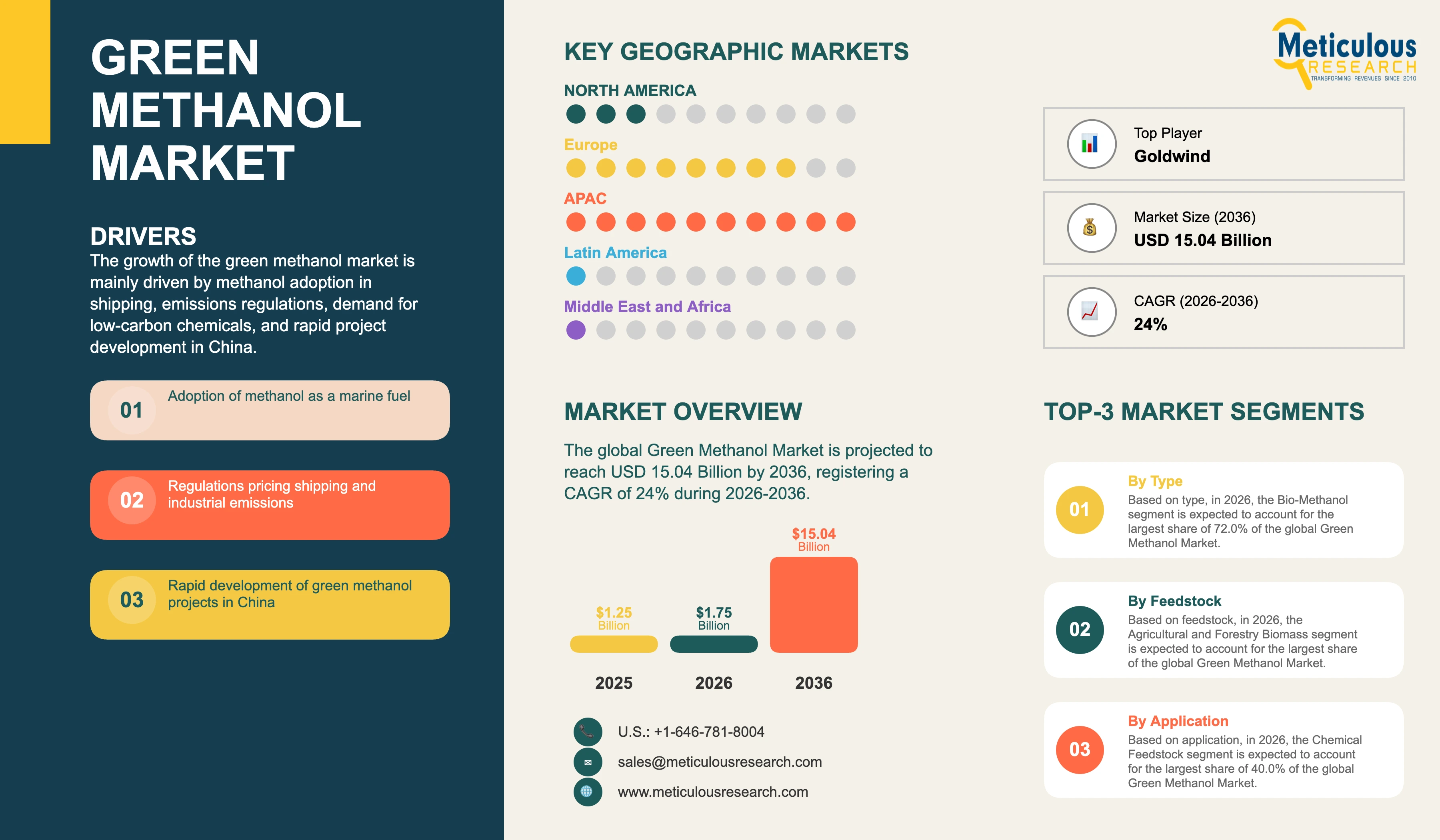
The global green methanol market was valued at USD 1.25 billion in 2025. This market is expected to reach USD 15.04 billion by 2036 from an estimated USD 1.75 billion in 2026, registering a CAGR of 24.0% during the forecast period (2026-2036).
- Published
- Nov 2026
- Pages
- 233
- Format
- PDF + Excel
- Report ID
- MRCHM - 1042583
- Base year
- 2025
- 2025 · BASELINE
- $1.25B
- 2036
- $15.04B
- CAGR 2026–2036
- 24.0%
2025 baseline · 2026–2036 forecast at 24.0% CAGR · hover a bar for the value
Key highlights
The world's first commercial-scale e-methanol plant, the EUR 150 million Kassø facility in Denmark, was inaugurated in May 2025 as a joint venture of European Energy (51%) and Mitsui & Co. (49%), with a capacity of 42,000 tonnes per year and offtakers including A.P. Moller - Maersk, the LEGO Group, and Novo Nordisk. The plant combines power from the adjacent 304 MW Kassø solar park with biogenic carbon dioxide and produces e-methanol with up to 97% lower carbon emissions than fossil methanol.
Goldwind shipped the first commercial cargo of green methanol from its Hinggan League project in Inner Mongolia on September 10, 2026; the project, which combines wind-powered hydrogen with biomass, is being developed in three phases toward a capacity of 1.45 million tonnes per year by the end of 2027 and has supply agreements for 750,000 to 850,000 tonnes with shipping lines including Maersk and Hapag-Lloyd. The first phase alone, with a capacity of 250,000 tonnes per year, involved investment of about CNY 2.3 billion.
China had 173 green methanol projects with a combined planned capacity of 53.46 million tonnes per year by August 2025, according to Xinhua, and Shanghai's first locally developed green methanol project, which converts biogas from urban food waste into methanol, began operations in January 2026.
Maersk's offtake agreements with Goldwind, for 500,000 tonnes per year of bio- and e-methanol from 2026, and with LONGi Green Energy Technology for bio-methanol cover more than 50% of the green methanol needed to operate its fleet of 24 dual-fuel vessels in 2027, according to State of Green.
Member states of the International Maritime Organization postponed adoption of the Net-Zero Framework, which would set a global fuel standard and emissions pricing for shipping, by one year in October 2025, while nearly 360 methanol-capable ships remained on order books through 2030, which highlights both the strong underlying demand for methanol fuel and the regulatory uncertainty facing producers.
By type, bio-methanol accounts for the larger share of 72.0% in 2026, while e-methanol registers the higher CAGR.
By feedstock, agricultural and forestry biomass accounts for the largest share in 2026, while renewable hydrogen and captured CO2 registers the highest CAGR.
By application, chemical feedstock accounts for the largest share of 40.0% in 2026, while marine fuel registers the highest CAGR.
By geography, Asia-Pacific accounts for the largest share of 44.0% in 2026, while Asia-Pacific registers the highest CAGR of 26.8%.
Report summary
| Particulars | Details |
|---|---|
| Base Year | 2025 |
| Estimated Year | 2026 |
| Forecast Period | 2026-2036 |
| Market Size in 2025 | USD 1.25 billion |
| Market Size in 2026 | USD 1.75 billion |
| Market Size by 2036 | USD 15.04 billion |
| CAGR (2026-2036) | 24.0% |
| Format | PDF, Excel & Cloud Portal · 233 pages |
| Largest Segment by Type (2026) | Bio-Methanol (72.0%) |
| Largest Segment by Application (2026) | Chemical Feedstock (40.0%) |
| Largest Region (2026) | Asia-Pacific (44.0%) |
| Fastest-Growing Region | Asia-Pacific (CAGR 26.8%) |
| Companies Profiled | 15 companies and other companies |
| Segments Covered | Type, Feedstock, Application, Geography |
| Countries Covered | China, Japan, South Korea, Singapore, India, Australia, Rest of Asia-Pacific, Denmark, Netherlands, Germany, Sweden, Finland, Norway, Spain, Belgium, France, U.K., Rest of Europe, U.S., Canada, Saudi Arabia, Oman, U.A.E., Egypt, Morocco, Rest of Middle East & Africa, Chile, Brazil, Uruguay, Rest of Latin America |
Report overview
Segments covered: type, feedstock, application.
The growth of this market is mainly driven by the adoption of methanol as a low-emission marine fuel and the growing fleet of methanol dual-fuel ships, regulations that put a price on shipping and industrial emissions, such as FuelEU Maritime and the EU Emissions Trading System, demand from chemical, plastics, and consumer goods companies for low-carbon feedstocks, the rapid construction of large green methanol projects in China, and falling costs of renewable electricity and electrolysers for e-methanol production. However, factors such as the high production cost of green methanol compared with fossil methanol, limited availability of sustainable biomass and biogenic carbon dioxide, policy uncertainty following the postponement of the International Maritime Organization's Net-Zero Framework, and the slow pace of final investment decisions for large projects are expected to restrain the growth of this market to some extent.
Green methanol refers to methanol produced from renewable or recycled sources with significantly lower life-cycle greenhouse gas emissions than conventional methanol made from natural gas or coal. It includes bio-methanol, produced from biomass, biogas, municipal solid waste, black liquor, and other biogenic feedstocks, and e-methanol, produced by combining hydrogen made with renewable electricity and carbon dioxide captured from biogenic sources, industrial processes, or the air. Green methanol is chemically identical to conventional methanol and can be used as a chemical feedstock for formaldehyde, acetic acid, olefins, and other products, as a marine fuel, as a road transport fuel and blending component, and in other energy applications. This report covers the sales of bio-methanol and e-methanol to end users. Conventional methanol, low-carbon methanol produced from fossil sources with carbon capture, and methanol production equipment are analyzed in separate reports. The market is measured on a revenue basis.
Methanol is one of the world's most widely used chemicals, with global demand of more than 100 million tonnes per year, almost all of it produced from natural gas and coal. The chemical industry uses methanol to make formaldehyde, acetic acid, olefins, methyl tertiary-butyl ether, and many other products, and methanol is used as a fuel in China and other countries. Producing methanol from renewable sources offers a way to reduce emissions in both the chemical industry and transport, since green methanol can replace fossil methanol without changes to downstream processes.
Shipping has become the most important new source of demand for green methanol. Methanol is liquid at ambient temperature, can be handled with relatively minor modifications to existing infrastructure, and can be used in dual-fuel engines that also run on conventional marine fuels. A.P. Moller - Maersk was the first major shipping company to order large methanol dual-fuel container ships, and other shipping lines, including Hapag-Lloyd, CMA CGM, COSCO, Evergreen, and others, have followed. Nearly 360 methanol-capable ships were on order books through 2030 as of late 2025, which will create large demand for green methanol if the fuel is available at acceptable prices. FuelEU Maritime, which took effect in January 2025, and the inclusion of shipping in the EU Emissions Trading System create financial incentives for ships calling at European ports to use low-emission fuels.
Bio-methanol currently accounts for most green methanol production, since it can be produced at lower cost than e-methanol using established gasification, biogas reforming, and other technologies. Producers include Södra and others in the Nordic pulp and paper industry, OCI's former bio-methanol business now owned by Methanex, Enerkem, and a fast-growing number of Chinese projects that use agricultural residues, forestry waste, and biogas. E-methanol is at an earlier stage but is growing rapidly, supported by the Kassø plant in Denmark, Carbon Recycling International's plants in Iceland and China, and projects combining wind and solar power with biomass-derived carbon in China.
China has become the global center of green methanol project development in terms of both announced and operating capacity. By August 2025, there were 173 green methanol projects in China with a combined planned capacity of 53.46 million tonnes per year, according to Xinhua. Goldwind's project in Hinggan League, Inner Mongolia, shipped its first commercial cargo in September 2026 and is expanding toward 1.45 million tonnes per year by the end of 2027. Other Chinese developers are following with similar integrated projects in Inner Mongolia, Jilin, and Heilongjiang. Chinese capacity is expected to dominate global supply growth. Other Chinese developers, including Shanghai Electric, LONGi, State Power Investment Corporation, China Energy Engineering, and many provincial companies, are building projects in Inner Mongolia, Jilin, Heilongjiang, Hebei, and other regions with abundant wind, solar, and biomass resources.
Chemical feedstock applications account for the largest share of the market, as chemical companies, plastics producers, and consumer goods companies such as the LEGO Group and Novo Nordisk use green methanol to reduce the carbon footprint of their products. Marine fuel is the fastest-growing application, as methanol dual-fuel ships enter service and shipping lines secure long-term supplies. Asia-Pacific is the largest and fastest-growing regional market, led by China, while Europe is the second-largest market, supported by strong regulation and early e-methanol projects.
The market faces significant cost, policy, and investment challenges in the near term. Green methanol costs two to four times as much as fossil methanol in many cases, and the cost gap must be covered by regulation, carbon pricing, or customer willingness to pay. The International Maritime Organization's postponement of its Net-Zero Framework in October 2025 increased uncertainty for producers and shipping companies, and some European projects, such as Ørsted's FlagshipONE in Sweden, were canceled due to weak demand. As a result, the pace of market growth will depend on policy support, cost reductions, and the conversion of offtake agreements into firm long-term contracts.
Over the forecast period, the green methanol market is expected to grow strongly from a small base, supported by shipping demand, regulation, chemical industry decarbonization, and Chinese project development. At the same time, costs, feedstock availability, certification, and policy decisions will determine how quickly production capacity is built and used.
Asia-Pacific is expected to account for the largest share of 44.0% of the market in 2026, mainly due to China's leadership in green methanol project development, the start of large-scale production, China's large methanol industry, and demand from Asian shipping lines and ports.
Asia-Pacific is also projected to register the highest CAGR of 26.8% during the forecast period, driven by the expansion of Chinese production capacity, methanol bunkering in major Asian ports, and demand from shipping and chemical companies in Japan, South Korea, and Singapore.
The report profiles 15 companies, including Goldwind, Methanex, European Energy, Mitsui & Co., Carbon Recycling International, Enerkem, Södra, HIF Global, Proman, BASF, Mitsubishi Gas Chemical, Shanghai Electric, LONGi, State Power Investment Corporation, and Liquid Wind.
Bio-methanol is produced from biomass, biogas, and waste feedstocks, while e-methanol is produced by combining green hydrogen made with renewable electricity and captured carbon dioxide; bio-methanol is currently cheaper, while e-methanol has greater potential to scale.
Report infographic
Market dynamics
18 factors across 5 forcesAdoption of methanol as a marine fuel
The shipping industry is under growing pressure to reduce greenhouse gas emissions, and methanol has emerged as one of the leading alternative fuels for new ships. Methanol dual-fuel engines are commercially available from Everllence, formerly MAN Energy Solutions, Wärtsilä, WinGD, and other engine makers, and Everllence alone has more than 220 orders for its ME-LGIM methanol dual-fuel engines for newbuilds. Shipping lines including Maersk, Hapag-Lloyd, CMA CGM, COSCO, Evergreen, ONE, and others have ordered methanol dual-fuel container ships, and nearly 360 methanol-capable ships were on order books through 2030 as of late 2025.
These ships require secure supplies of green methanol to deliver their emissions benefits, and shipping lines are signing long-term offtake agreements with producers. Maersk's agreements with Goldwind and LONGi cover more than half of the green methanol needed to operate its 24 dual-fuel vessels in 2027, and Hapag-Lloyd has secured 250,000 tonnes per year from Goldwind. Bunkering infrastructure for methanol is also expanding in major ports such as Singapore, Rotterdam, Shanghai, and Antwerp-Bruges.
Retrofits of existing ships to run on methanol are also beginning, as shown by the conversion of a large two-stroke engine on the COSCO Shipping Libra to methanol dual-fuel operation, which could expand demand beyond newbuilds.
Regulations pricing shipping and industrial emissions
Regulations are increasingly putting a price on carbon emissions from shipping and industry. FuelEU Maritime, which took effect in January 2025, requires ships calling at EU ports to reduce the greenhouse gas intensity of the energy they use, with multipliers that reward renewable fuels of non-biological origin such as e-methanol. Shipping was included in the EU Emissions Trading System from 2024, and the EU's Renewable Energy Directive sets targets for the use of renewable fuels of non-biological origin in industry and transport. These rules make green methanol more competitive with fossil fuels for ships and industrial users in Europe.
The International Maritime Organization's Net-Zero Framework, approved in April 2025 but postponed for one year in October 2025, would introduce a global fuel standard and emissions pricing for shipping if adopted, which would significantly strengthen demand for green methanol worldwide.
National policies in China, Japan, South Korea, and other countries are also supporting green methanol production and use, including through industrial policy, subsidies, and pilot programs for green fuels.
Demand for low-carbon chemical feedstocks
Chemical companies, plastics producers, and consumer goods companies are under pressure to reduce Scope 3 emissions and offer lower-carbon products, and green methanol provides a drop-in feedstock for formaldehyde resins, acetic acid, olefins, plastics, and other products. The LEGO Group uses e-methanol from Kassø to replace fossil methanol in some plastic components, and Novo Nordisk uses it in the production of injection pens. BASF, Mitsubishi Gas Chemical, and other chemical companies offer renewable methanol and products made from it, often using mass balance certification such as ISCC PLUS.
As consumer brands commit to reducing emissions across their supply chains, demand for certified green methanol and its derivatives is expected to grow, especially in Europe, Japan, and North America.
Rapid development of green methanol projects in China
China has the world's largest methanol industry and is now leading the development of green methanol production. Abundant wind and solar resources in northern and western China, large volumes of agricultural residues, government support for green hydrogen and green fuels, and strong demand from shipping lines have led to a surge in project announcements. By August 2025, there were 173 green methanol projects in China with a combined planned capacity of 53.46 million tonnes per year, according to Xinhua, and several large projects, including Goldwind's Hinggan League project, have started production.
Chinese projects benefit from low-cost renewable electricity, domestic electrolyser and equipment manufacturing, and large-scale construction capabilities, which could make China a major exporter of green methanol to international shipping and chemical markets.
Falling costs of renewable power and electrolysers
The cost of solar and wind power has fallen dramatically over the past decade, and electrolyser costs are declining as manufacturing scales up, particularly in China. These trends are reducing the cost of producing green hydrogen, which is the largest cost component of e-methanol. Improvements in methanol synthesis catalysts, carbon capture technologies, and process integration are also reducing costs. Although e-methanol remains more expensive than fossil methanol, cost reductions are expected to narrow the gap over the forecast period.
Integrated projects that combine renewable power, hydrogen production, biomass gasification, and methanol synthesis, such as those in Inner Mongolia, are also improving the economics of green methanol by sharing infrastructure and optimizing the use of carbon and hydrogen.
Table of contents
11 chapters · 145 sections · 233 pages · click to expandSegmental analysis
| Segment | Largest share (2026) | Fastest growth (2026–2036) |
|---|---|---|
| By Type | Bio-methanol | Rapid growth of this |
| By Feedstock | Agricultural and forestry biomass | Renewable hydrogen and captured CO2 |
| By Application | Chemical feedstock | Marine fuel |
By Type
- The bio-methanol segment is expected to account for the largest share of 72.0% of the global green methanol market.
- The large share of this segment is mainly due to the lower production cost of bio-methanol compared with e-methanol, the availability of established production technologies such as biomass gasification and biogas reforming, existing production by Nordic pulp and paper companies, Methanex's former OCI bio-methanol operations in the Netherlands, and Enerkem, and the rapid start-up of Chinese projects that use agricultural residues, forestry waste, and biogas, such as Goldwind's Hinggan League project and Shanghai's food waste-based project.
- Bio-methanol is also widely accepted by shipping lines and chemical users as a low-emission fuel and feedstock, and it is the main source of green methanol for current offtake agreements, including Maersk's agreement with LONGi for bio-methanol produced from agricultural and forestry residues.
- Bio-methanol produced from waste and residues also qualifies for favorable treatment under many regulatory frameworks, provided that sustainability criteria are met.
- The availability of low-cost biomass residues in China, such as corn stalks in Inner Mongolia, which produces more than 7 million tonnes of collectable stalks annually in Hinggan League alone according to Chinese media, supports large-scale bio-methanol production.
- However, the e-methanol segment is projected to register the higher CAGR during the forecast period.
- The rapid growth of this segment is driven by falling costs of renewable electricity and electrolysers, EU rules that reward renewable fuels of non-biological origin, the limited availability of sustainable biomass, which constrains bio-methanol growth, and large e-methanol projects in China, Europe, and other regions, such as Kassø in Denmark and Carbon Recycling International's projects.
- E-methanol also offers greater potential for scaling, since it can be produced wherever renewable power and carbon dioxide are available.
- Its share is expected to rise steadily as large e-methanol projects in China and Europe reach commercial operation and as electrolyser costs decline.
- The relative importance of bio-methanol and e-methanol will also depend on regulation.
- EU rules that set specific targets and multipliers for renewable fuels of non-biological origin favor e-methanol in Europe, while Chinese policy supports both pathways, and shipping lines generally accept both types as long as life-cycle emissions reductions are certified.
- Hybrid projects that combine biomass and green hydrogen may produce both bio-methanol and e-methanol at the same site.
By Feedstock
- Green Methanol Market Analysis by Feedstock
- The agricultural and forestry biomass segment is expected to account for the largest share of the global green methanol market.
- The large share of this segment is mainly due to the use of agricultural residues, such as corn stalks and straw, and forestry by-products in large Chinese bio-methanol projects, the use of black liquor and other by-products in Nordic pulp mills, and the relatively low cost and wide availability of these feedstocks in agricultural regions.
- Biomass gasification combined with green hydrogen is becoming a common approach in Chinese projects, since adding hydrogen increases the amount of methanol that can be produced from each tonne of biomass.
- Forestry residues and pulp mill by-products remain important feedstocks in the Nordic countries.
- Feedstock choice in the green methanol market is closely linked to the location of each project.
- Projects in northern China rely on corn stalks and wind power, Nordic projects use forestry residues and pulp mill by-products, and projects in Western Europe increasingly use biogas and biogenic carbon dioxide from bioethanol and biogas plants.
- Direct air capture of carbon dioxide remains expensive and is expected to play only a small role during the forecast period.
- However, the renewable hydrogen and captured CO2 segment is projected to register the highest CAGR during the forecast period.
- The rapid growth of this segment is driven by the expansion of e-methanol production, falling green hydrogen costs, regulatory support for renewable fuels of non-biological origin, and the development of carbon capture from biogenic sources such as biogas plants, bioethanol plants, and pulp mills.
- The biogas and municipal waste segment forms the third-largest segment, supported by projects converting biogas and urban waste into methanol, while other feedstocks, such as glycerine and other by-products, account for the remaining share.
- Marine fuel demand is expected to approach the size of chemical feedstock demand by the end of the forecast period as large numbers of methanol dual-fuel ships enter service and bunkering infrastructure expands.
- Projects using municipal solid waste and biogas also benefit from waste management revenues and policies that encourage the recovery of resources from waste, which improves their economics.
- Biogas-based methanol production is also attractive in regions with large volumes of agricultural and food waste, such as China and Europe.
- The agricultural and forestry biomass segment is expected to account for the largest share of the green methanol market, while the renewable hydrogen and captured CO2 segment is projected to register the highest CAGR during the forecast period.
By Application
- Green Methanol Market Analysis by Application
- The chemical feedstock segment is expected to account for the largest share of 40.0% of the global green methanol market.
- The large share of this segment is mainly due to the use of green methanol by chemical companies, plastics producers, and consumer goods companies to reduce the carbon footprint of formaldehyde, acetic acid, olefins, plastics, pharmaceuticals, and other products, the ability to use green methanol as a drop-in replacement for fossil methanol, and the willingness of some brand owners, such as the LEGO Group and Novo Nordisk, to pay premiums for lower-carbon materials.
- Mass balance certification allows chemical companies to blend green methanol into existing production and sell certified low-carbon products, which makes it easier for them to start using green methanol without dedicated supply chains.
- Chemical industry demand is also relatively stable, since it is driven by long-term corporate decarbonization commitments rather than by shipping cycles.
- Green methanol is also used to produce lower-carbon formaldehyde resins for wood products and construction materials, where customers increasingly seek certified low-carbon inputs.
- However, the marine fuel segment is projected to register the highest CAGR during the forecast period.
- The rapid growth of this segment is driven by the entry into service of methanol dual-fuel ships, long-term offtake agreements between shipping lines and producers, FuelEU Maritime and the EU Emissions Trading System, the potential adoption of the International Maritime Organization's Net-Zero Framework, and the expansion of methanol bunkering infrastructure in major ports.
- Road transport fuel forms the third-largest segment, supported by methanol vehicles and fuel blending in China, while other energy applications, such as dimethyl ether, power generation, hydrogen carriers, and methanol-to-jet fuel, account for the remaining share.
Geographic analysis
Asia-Pacific
Largest shareIn 2026, Asia-Pacific is expected to account for the largest share of 44.0% of the global green methanol market. The large share of this region is mainly due to China's leadership in green methanol project development, with 173 projects and a combined planned capacity of 53.46 million tonnes per year by August 2025, the start of production at large projects such as Goldwind's Hinggan League plant and Shanghai's food waste-based plant, China's large methanol industry and methanol vehicle programs, and demand from Asian shipping lines and ports. China is the largest market in the region, followed by Japan, South Korea, Singapore, India, and Australia. Asia-Pacific is also projected to register the highest CAGR of 26.8% during the forecast period. The rapid growth of this region is driven by the expansion of Chinese production capacity toward export markets, methanol bunkering development in Singapore, Shanghai, Ningbo-Zhoushan, and Ulsan, demand from shipping lines in China, Japan, South Korea, and Singapore, and green methanol projects in India and Australia. Japanese and South Korean chemical and shipping companies are also securing supplies of green methanol. Singapore, the world's largest bunkering hub, has launched programs to develop methanol bunkering supply chains, and South Korean shipbuilders are building many of the world's methanol dual-fuel ships.
Europe
Europe accounts for the second-largest share of the market, supported by FuelEU Maritime, the inclusion of shipping in the EU Emissions Trading System, targets for renewable fuels of non-biological origin, early e-methanol projects such as Kassø in Denmark, bio-methanol production in the Netherlands, Sweden, and Finland, and demand from shipping lines such as Maersk, Hapag-Lloyd, and CMA CGM and from chemical and consumer goods companies. Denmark, the Netherlands, Germany, Sweden, Finland, Norway, Spain, Belgium, and France are important markets, although some European projects have been delayed or canceled.
North America
North America, the Middle East & Africa, and Latin America account for smaller shares of the market. Enerkem in Canada produces methanol from waste, and HIF Global and others are developing e-fuels projects in the U.S. and Latin America, although changes in U.S. policy have reduced support for some clean fuel projects.
Latin America
Chile, Brazil, Uruguay, Morocco, Egypt, Oman, and Saudi Arabia have potential to become green methanol exporters based on their renewable energy resources, and several of these countries are developing green hydrogen and e-fuels strategies that include methanol for export to Europe and Asia.
Competitive landscape
The global green methanol market is fragmented and at an early stage, with the top five players estimated to account for about 35% of the market in 2025. The market includes renewable energy developers, conventional methanol producers, chemical companies, waste-to-chemicals companies, pulp and paper companies, and e-fuels developers.
Goldwind is one of the largest green methanol producers following the start of production at its Hinggan League project, and other Chinese companies, including Shanghai Electric, LONGi, and State Power Investment Corporation, are developing large projects. Methanex, the world's largest methanol producer, owns bio-methanol operations in the Netherlands acquired from OCI. European Energy, in partnership with Mitsui & Co., operates the Kassø e-methanol plant, Carbon Recycling International provides e-methanol technology and operates plants in Iceland and China, Enerkem produces methanol from waste in Canada, and Södra produces bio-methanol from pulp mill by-products in Sweden. BASF and Mitsubishi Gas Chemical offer renewable methanol and derivatives, HIF Global and Liquid Wind are developing e-methanol projects, and Proman is a major methanol producer investing in low-carbon methanol.
Companies in this market compete on production cost, scale, feedstock security, certification of emissions reductions, location relative to bunkering hubs and chemical customers, ability to sign long-term offtake agreements, and financing capabilities. Key strategies include long-term offtake agreements with shipping lines and chemical companies, partnerships between renewable energy developers and chemical companies, integration of renewable power, hydrogen, and methanol synthesis, and expansion of production capacity in China and other renewable-rich regions.
Chinese producers benefit from low-cost renewable power, domestic equipment manufacturing, government support, and fast construction, while European producers benefit from strong regulation and customer demand but face higher costs. We expect Chinese producers to account for a growing share of global supply during the forecast period.
Partnerships among shipping lines, fuel producers, ports, and governments will be essential for scaling the market, and we expect consolidation as larger companies acquire or partner with smaller developers. Technology licensors such as Topsoe, Johnson Matthey, and thyssenkrupp Uhde also play an important role in supplying methanol synthesis technology to projects.
Some of the key players operating in the green methanol market are Xinjiang Goldwind Science & Technology Co., Ltd., Methanex Corporation, European Energy A/S, Mitsui & Co., Ltd., Carbon Recycling International, Enerkem Inc., Södra Skogsägarna ekonomisk förening, HIF Global, Proman AG, BASF SE, Mitsubishi Gas Chemical Company, Inc., Shanghai Electric Group Co., Ltd., LONGi Green Energy Technology Co., Ltd., State Power Investment Corporation, and Liquid Wind AB, among others.
- —
Goldwind shipped the first commercial green methanol cargo from its Hinggan League project in September 2026, Shanghai's first locally developed green methanol project began operations in January 2026, the Kassø e-methanol plant in Denmark was inaugurated in May 2025, and the IMO postponed adoption of its Net-Zero Framework in October 2025.
- Shanghai Electric
- LONGi
- State Power Investment Corporation
Expert perspectives
Green methanol is one of the most important low-carbon fuels and chemical feedstocks for the energy transition, since it can replace fossil methanol in existing applications and serve as a practical fuel for shipping. The market is at an early stage, but production is scaling up rapidly, particularly in China, and demand from shipping lines and chemical companies is growing.
Over the forecast period, the market is expected to grow at a CAGR of 24.0%, from USD 1.75 billion in 2026 to USD 15.04 billion in 2036. Growth will be supported by marine fuel demand, regulations on shipping and industrial emissions, chemical industry decarbonization, Chinese project development, and falling renewable energy costs.
Among the market segments, bio-methanol is the larger type, while e-methanol grows faster. Agricultural and forestry biomass is the largest feedstock, while renewable hydrogen and captured CO2 grows fastest, and chemical feedstock is the largest application, while marine fuel grows fastest. Asia-Pacific is the largest region and is also the fastest-growing region at a CAGR of 26.8%.
In our view, China will be the decisive factor in the development of the green methanol market. Its ability to build large integrated projects at low cost could make it the world's main supplier of green methanol for shipping and chemicals, and the start of commercial exports from Goldwind's project in 2026 is an important milestone.
Policy remains the main uncertainty for producers, shipping lines, and investors in this market. The postponement of the International Maritime Organization's Net-Zero Framework has slowed investment decisions, and the outcome of future negotiations will significantly affect demand. FuelEU Maritime and the EU Emissions Trading System provide strong support in Europe, but global demand will depend on whether a global framework is adopted.
We expect costs to decline as production scales up and electrolyser and renewable power costs fall, but green methanol will remain more expensive than fossil methanol for much of the forecast period, so regulation and customer premiums will continue to drive demand. Producers that secure low-cost renewable power, reliable feedstock, and long-term offtake agreements will be best placed to succeed. We also expect methanol to compete with ammonia, LNG, and biofuels in shipping, with methanol likely to remain a leading option for container ships and other vessel types where its ease of handling is valued.
Overall, we believe green methanol will grow strongly and become a significant part of the methanol industry and the marine fuel mix by 2036, with the pace of growth closely linked to policy and cost developments.
Customer perspectives
“Our methanol dual-fuel ships need green methanol to deliver their emissions benefits. We are signing long-term contracts with producers in China and elsewhere, but price and regulatory clarity remain our biggest concerns.”
“Using green methanol in our plastic components lets us cut product emissions without changing our production processes, and certified supply is essential for our claims.”
“We combine wind power, green hydrogen, and local biomass to produce green methanol at scale, and long-term contracts with shipping lines allow us to finance new phases.”
Frequently asked questions
The global green methanol market was valued at USD 1.25 billion in 2025, up from USD 0.92 billion in 2024, and is estimated at USD 1.75 billion in 2026. The market includes sales of bio-methanol and e-methanol used as chemical feedstock, marine fuel, road transport fuel, and in other energy applications.
Cite this report
Meticulous Research. (2026). Green Methanol Market - Global Opportunity Analysis and Industry Forecast (2026-2036) (Report No. MRCHM - 1042583). Meticulous Market Research Pvt. Ltd. https://www.meticulousresearch.com/product/green-methanol-market-7266