Battery Pack Adhesives Market (2026-2036)
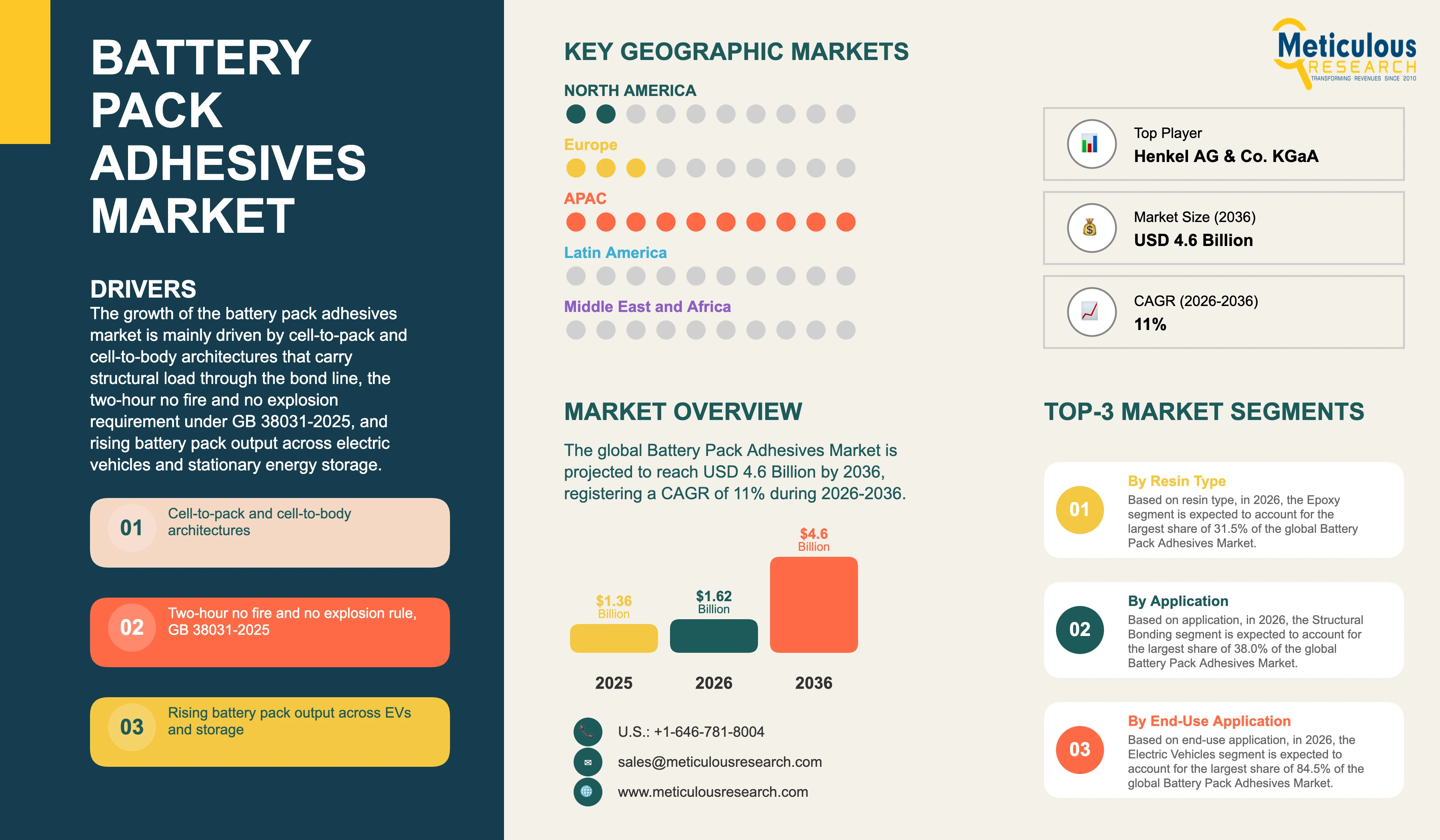
The global battery pack adhesives market was valued at USD 1.36 billion in 2025. This market is expected to reach USD 4.60 billion by 2036 from an estimated USD 1.62 billion in 2026, registering a CAGR of 11.0% during the forecast period (2026-2036).
- Published
- Nov 2026
- Pages
- 263
- Format
- PDF + Excel
- Report ID
- MRCHM - 1042604
- Base year
- 2025
- 2025 · BASELINE
- $1.36B
- 2036
- $4.60B
- CAGR 2026–2036
- 11.0%
2025 baseline · 2026–2036 forecast at 11.0% CAGR · hover a bar for the value
Key highlights
The global battery pack adhesives market is estimated at USD 1.62 billion in 2026 and is projected to reach USD 4.60 billion by 2036.
Market volume is estimated at 102.00 kilotons in 2026 and is projected to reach 350.00 kilotons by 2036 at a CAGR of 13.1%.
The average selling price is estimated at USD 15.85 per kg in 2026 and is projected to reach USD 13.15 per kg by 2036.
Epoxy is expected to account for the largest resin type share of 31.5% in 2026, while polyurethane is projected to register the highest CAGR of 12.4%.
Structural bonding is expected to hold the largest application share of 38.0% in 2026, while thermal interface bonding is projected to grow fastest at a CAGR of 12.9%.
Liquid and paste adhesives are expected to hold the largest form share of 86.5% in 2026, and they are also projected to register the highest CAGR of 11.2%.
Prismatic cells are expected to account for the largest cell format share of 46.5% in 2026, while cylindrical cells are projected to register the highest CAGR of 12.6%.
Electric vehicles are expected to be the largest end-use application with a share of 84.5% in 2026, while stationary energy storage is projected to grow fastest at a CAGR of 14.8%.
Asia-Pacific is expected to hold the largest share of 64.0% in 2026, while the Middle East & Africa is projected to register the highest CAGR of 14.2%.
GB 38031-2025 takes effect on 1 July 2026 and extends the no fire and no explosion period after thermal runaway from 5 minutes to 2 hours, with pack surface temperature held at or below 60 degrees Celsius.
The same standard adds a bottom impact test in which a 30 mm steel ball strikes the pack floor at 150 J, and requires pack safety to hold after 300 ultra-fast charge cycles between 20% and 80% state of charge.
Global electric vehicle battery deployment reached 1.2 TWh in 2025, almost 30% above 2024, with China at 60% of the total, the European Union at almost 15% and the United States at 10%.
Global battery storage capacity additions reached 108 GW in 2025, around 40% above 2024, and the average duration of utility-scale projects commissioned that year was three hours.
Henkel launched Loctite TLB 9270APS, a two-component polyurethane thermally conductive adhesive rated at 2 W/mK for cell-to-pack designs, on 12 May 2026.
Wacker presented a ceramifying ELASTOSIL CM silicone on 8 June 2026 that forms a ceramic barrier above 600 degrees Celsius and cut the radiant heat of a 1,300 degrees Celsius flame to below 150 degrees Celsius in cell thermal runaway tests.
Henkel added a water-based Battery Specialty Tapes range and the Loctite Solve computational formulation platform on 5 May 2026, moving its battery portfolio beyond liquid adhesives.
Report summary
| Particulars | Details |
|---|---|
| Base Year | 2025 |
| Forecast Period | 2026-2036 |
| Market Size in 2025 | USD 1.36 billion |
| Market Size in 2026 | USD 1.62 billion |
| Market Size by 2036 | USD 4.60 billion |
| Value CAGR (2026-2036) | 11.0% |
| Volume in 2026 | 102.00 kilotons |
| Volume by 2036 | 350.00 kilotons |
| Volume CAGR (2026-2036) | 13.1% |
| Average Selling Price in 2026 | USD 15.85 per kg |
| Average Selling Price by 2036 | USD 13.15 per kg |
| Measurement Basis | Adhesive, sealant and encapsulant material consumed in battery module and pack assembly, including thermally conductive adhesives, and excluding non-bonding thermal interface pads, standalone gap fillers and electrode binders |
| Largest Resin Type Segment | Epoxy (31.5% in 2026) |
| Fastest-Growing Resin Type Segment | Polyurethane (CAGR 12.4%) |
| Largest Application Segment | Structural bonding (38.0% in 2026) |
| Fastest-Growing Application Segment | Thermal interface bonding (CAGR 12.9%) |
| Largest Form Segment | Liquid and paste (86.5% in 2026) |
| Largest Cell Format Segment | Prismatic (46.5% in 2026) |
| Fastest-Growing Cell Format Segment | Cylindrical (CAGR 12.6%) |
| Largest End-Use Application | Electric vehicles (84.5% in 2026) |
| Fastest-Growing End-Use Application | Stationary energy storage (CAGR 14.8%) |
| Largest Region | Asia-Pacific (64.0% in 2026) |
| Fastest-Growing Region | Middle East & Africa (CAGR 14.2%) |
| Segments Covered | Resin Type, Application, Form, Cell Format, End-Use Application, and Geography |
| Geographies Covered | Asia-Pacific, Europe, North America, Latin America, and Middle East & Africa |
| Companies Profiled | 19 companies, including Henkel AG & Co. KGaA, Sika AG, H.B. Fuller Company, 3M Company, Dow Inc., Arkema S.A., Wacker Chemie AG, and Nitto Denko Corporation |
Report overview
Segments covered: resin type, application, form, cell format, end-use application.
In volume terms, this market is estimated at 102.00 kilotons in 2026 and is projected to reach 350.00 kilotons by 2036, registering a CAGR of 13.1% during the same period. The average selling price is estimated at USD 15.85 per kg in 2026 and is projected to decline to USD 13.15 per kg by 2036 as formulation volumes rise, dispensed bond lines thin and regional supply builds closer to cell and pack plants.
The growth of this market is mainly driven by cell-to-pack and cell-to-body architectures that carry structural load through the bond line, the two-hour no fire and no explosion requirement introduced by GB 38031-2025, rising battery pack output across electric vehicles and stationary energy storage, and weight and range targets that remove mechanical fasteners from pack designs. However, factors such as the serviceability and repair requirements that conflict with permanent structural bonds, and the dispensing accuracy and cycle time limits that adhesive application places on high-throughput assembly lines, are expected to restrain the growth of this market to some extent.
Epoxy accounts for the largest share of this market because structural bonding of cells, modules and pack enclosures demands the highest shear strength and the lowest creep of the available chemistries. Polyurethane grows faster because two-component thermally conductive polyurethanes are the chemistry of choice where a bond must both carry load and move heat into a cooling plate.
Battery pack adhesives are the structural, thermally conductive, sealing and encapsulating materials dispensed or applied during battery cell, module and pack assembly. Market sizing in this report is on both a value basis in USD and a volume basis in kilotons, with average selling price derived from the two. The measurement basis is adhesive, sealant and encapsulant material consumed in battery module and pack assembly, which includes thermally conductive adhesives that both bond and transfer heat, and excludes non-bonding thermal interface pads, standalone gap fillers and electrode binders.
Hangzhou Zhijiang Silicone Chemicals Co., Ltd. publishes its power battery range under structural bonding of cells to side panels, the pack bottom and brackets, thermally conductive bonding that moves cell heat to external cooling components, sealing of upper and lower covers against liquid and gas ingress, and low-density potting of components. Henkel AG & Co. KGaA, Sika AG and H.B. Fuller Company group their battery offerings the same way, with Sika naming the SikaForce TC, SikaBiresin TC and Sikaflex TC families for thermal interface duty and H.B. Fuller naming EV Bond 775, a one-component polyurethane hot melt, for structural bonding that reduces reliance on mechanical fasteners. Suppliers on three continents sell against the same four functions, and material is therefore specified and purchased by function rather than by chemistry alone.
Pack and module sealing and bonding accounts for more than 40% of adhesive mass in an electrified powertrain on Adhesive and Sealant Council figures, thermal interface bonding for just under 40%, cell encapsulation for about 10% and motor bonding and gasketing for about 10%. Average adhesive and sealant content is about 7 lb for a battery electric powertrain against under 2 lb for a hybrid, and battery electric vehicles were around one third of electrified vehicles in 2018 while consuming nearly two thirds of adhesive volume. Demand therefore scales with the degree of electrification rather than with vehicle output.
Module-based pack designs bond cells into modules and then fasten modules into an enclosure, which leaves the adhesive carrying limited structural duty. Cell-to-pack designs delete the module frame, and stiffness and crash load transfer into the bond line between cell and housing. Cell-to-body designs integrate the pack into the vehicle floor, which makes the adhesive part of the vehicle structure. Henkel positioned Loctite TLB 9270APS for cell-to-pack designs on aluminium and PET film substrates at its launch on 12 May 2026, and its expert programme for The Battery Show Europe 2026 covered cell-to-pack systems and lightweight thermoplastic substrates. Each step along that progression raises both the bonded area and the performance demanded of the adhesive, so adhesive content per kilowatt hour rises with architecture rather than with pack size.
Electric vehicle battery deployment reached 1.2 TWh in 2025 on International Energy Agency figures, almost 30% above the previous year, with China at 60% of the global total, the European Union at almost 15%, the United States at 10% and emerging markets other than China at 6%. Lithium iron phosphate accounted for more than 55% of batteries deployed globally in 2025, up from nearly 50% in 2024, while almost 80% of batteries used outside China were nickel-containing. Global nameplate cell capacity passed 4 TWh by the end of 2025, with China holding over 80% and the European Union and the United States 6% to 7% each. Adhesive is consumed where cells and packs are assembled rather than where vehicles are sold, which concentrates consumption in Asia-Pacific.
Global battery storage capacity additions reached 108 GW in 2025, around 40% above 2024, with China at just over 63 GW, the United States at 19 GW, Europe at about 6.2 GW, Australia at nearly 8 GW and the Middle East at over 3 GW. The average duration of utility-scale projects commissioned in 2025 was three hours, up from around two hours in 2023, and a rising share of projects now offer four hours or more. Longer duration raises the energy content behind each megawatt of capacity, and with it the number of cells, enclosures and bonded joints per project.
GB 38031-2025, Safety Requirements for Power Batteries for Electric Vehicles, published by the Standardization Administration of China and enforced by the Ministry of Industry and Information Technology, which takes effect on 1 July 2026 extends the period during which a pack must neither catch fire nor explode after thermal runaway from 5 minutes to 2 hours, requires pack surface temperature to stay at or below 60 degrees Celsius through that period, and adds a 5-minute alert requirement with zero toxic fumes in the cabin. A bottom impact test using a 30 mm steel ball at 150 J and a requirement that safety hold after 300 ultra-fast charge cycles between 20% and 80% state of charge are introduced by the same standard. Holding a pack below 60 degrees Celsius for two hours while a cell is in runaway changes what is asked of the materials around that cell, and thermal barrier performance becomes a type approval condition rather than a design preference.
Wacker Chemie AG presented a ceramifying silicone from the ELASTOSIL CM line on 8 June 2026 that loses elasticity above 600 degrees Celsius and forms a ceramic barrier which shields the housing and traps particles ejected from a defective cell, reducing the radiant heat of a 1,300 degrees Celsius flame to below 150 degrees Celsius on a coated protective fabric. Henkel added a water-based, low-VOC Battery Specialty Tapes range and the Loctite Solve platform for generating and simulating virtual adhesive formulations on 5 May 2026, alongside debonding-on-demand technologies that separate bonded battery components under thermal trigger. Formats and chemistries are widening as the performance bar rises.
Electric vehicles are expected to hold the largest share of 84.5% in 2026.
Stationary energy storage is projected to register the highest CAGR of 14.8%, from a 7.5% share in 2026.
Asia-Pacific is expected to account for the largest share of 64.0% in 2026, supported by China holding 60% of global battery deployment and over 80% of cell nameplate capacity.
The Middle East & Africa is projected to register the highest CAGR of 14.2% during the forecast period.
Europe is projected to grow at a CAGR of 9.8%, holding a 17.5% share in 2026, supported by cell nameplate capacity growth of about 50% during 2025. Germany is projected to register a CAGR of 9.4%.
The Middle East & Africa is projected to grow at a CAGR of 14.2% from a 2.2% share in 2026, supported by over 3 GW of battery storage additions in 2025. Latin America is projected to grow at a CAGR of 12.1% from a 2.8% share, with Mexico the principal market.
Henkel AG & Co. KGaA, Sika AG, H.B. Fuller Company, 3M Company and Dow Inc. together accounted for an estimated 48.5% of this market in 2026. The 19 companies profiled in this report together accounted for an estimated 79.0%.
Report infographic
Market dynamics
15 factors across 5 forcesCell-to-Pack and Cell-to-Body Architectures That Carry Load Through the Bond Line
Deleting the module frame from a battery pack removes the component that previously carried stiffness and crash load, and the adhesive between cell and housing takes that duty instead. H.B. Fuller Company describes battery pack structural bonding as keeping the pack structurally sound while reducing the need for mechanical fasteners, and lists vibration and shock protection, design flexibility for lightweight materials and management of thermal expansion among the functions a structural adhesive performs. The bonded area in a cell-to-pack design spans the full footprint of every cell rather than a perimeter flange, which multiplies dispensed mass per pack. Henkel targeted cell-to-pack designs with Loctite TLB 9270APS on 12 May 2026, specifying aluminium and PET film substrates and a 40 to 45 minute working time that suits the long dispense paths such designs require. Adhesive content per kilowatt hour therefore rises at every architecture step, and material demand grows ahead of battery output.
The Two-Hour No Fire and No Explosion Requirement Under GB 38031-2025
GB 38031-2025, Safety Requirements for Power Batteries for Electric Vehicles, published by the Standardization Administration of China and enforced by the Ministry of Industry and Information Technology, which takes effect on 1 July 2026 replaces a 5-minute requirement with a 2-hour one, and adds a 60 degrees Celsius ceiling on pack surface temperature through that period. A pack cannot meet that condition by cell chemistry alone, so the materials between cells, around cells and lining the housing must absorb, block and redirect heat for two hours. Wacker Chemie AG reported on 8 June 2026 that a protective fabric coated with its ceramifying ELASTOSIL CM silicone cut the radiant heat of a 1,300 degrees Celsius flame to below 150 degrees Celsius, and noted that Europe currently works to a five-minute evacuation standard while longer times will soon apply in Asia. The bottom impact test the same standard introduces, a 30 mm steel ball at 150 J against the pack floor, places a parallel demand on the structural bond between pack floor and enclosure. China accounted for 60% of global battery deployment in 2025, so a Chinese type approval condition sets the material specification for the majority of global pack output.
Rising Battery Pack Output Across Electric Vehicles and Stationary Energy Storage
Electric vehicle battery deployment of 1.2 TWh in 2025 was almost 30% above 2024, and the International Energy Agency projects almost 3 TWh by 2030 and around 4 to 5 TWh by 2035 depending on policy scenario. Battery storage capacity additions of 108 GW in 2025 were around 40% above the prior year, and the move from around two hours average duration in 2023 to three hours in 2025 means each gigawatt of storage capacity now carries half again as much energy and half again as many cells. Cell nameplate capacity passed 4 TWh by the end of 2025 with China above 80% of it, and year-on-year capacity growth ran at about 50% in both the European Union and the United States against just over 25% in China, which marks where new pack assembly and new adhesive consumption will be added. Bonded cell count determines volume demand in this market, and cell count is rising on both the mobility and the stationary side at once.
Weight and Range Targets That Remove Mechanical Fasteners From Pack Designs
Bolted joints add mass at every fixing point and demand flange material to bolt into, while a bonded joint distributes load across an area and needs no flange. H.B. Fuller Company lists design flexibility that allows lightweight materials and fewer bulky fasteners as a direct function of battery pack adhesives, and notes that epoxy and polyurethane adhesives also provide the electrical insulation needed to prevent short circuits, which a metal fastener cannot. Henkel framed its 5 May 2026 battery announcements around lightweight battery architectures including thermoplastic substrates, substrates that cannot be reliably bolted and must be bonded. Mass removed from a pack enclosure converts into range at constant energy content, or into reduced cell count at constant range, and both outcomes favour adhesive over mechanical fastening across premium and cost-driven platforms alike.
Table of contents
13 chapters · 162 sections · 263 pages · click to expandSegmental analysis
| Segment | Largest share (2026) | Fastest growth (2026–2036) |
|---|---|---|
| By Resin Type | Epoxy | Rapid growth of this |
| By Application | Structural bonding | Rapid growth of this |
| By Form | Liquid and paste | Large share and rapid growth of this |
| By Cell Format | Prismatic | Rapid growth of this |
| By End-Use Application | Electric vehicles | Rapid growth of this |
| Other segments | Structural bonding | Thermal interface bonding |
By Resin Type
- Battery Pack Adhesives Market Analysis by Resin Type
- The epoxy segment is expected to account for the largest share of 31.5% of the global battery pack adhesives market.
- The large share of this segment is mainly due to the shear strength and creep resistance that structural bonding of cells, modules and enclosures requires, the position epoxy holds in non-serviceable pack designs where the Adhesive and Sealant Council assigns it alongside structural polyurethane and methyl methacrylate, and the electrical insulation it provides in place of a metal fastener.
- Epoxy is also established in thermal interface bonding, which the same source places at just under 40% of adhesive mass in an electrified powertrain, giving the chemistry a position in both of the largest functions.
- However, the polyurethane segment, accounting for a share of 27.0% in 2026, is projected to register the highest CAGR of 12.4% during the forecast period.
- The rapid growth of this segment is attributed to the suitability of two-component polyurethanes for bonds that must carry load and conduct heat at the same time, demonstrated by the 2 W/mK rating Henkel gave Loctite TLB 9270APS for cell-to-pack designs in May 2026, and by the four polyurethane grades Hangzhou Zhijiang Silicone Chemicals Co., Ltd. lists in its thermally conductive bonding range.
- Polyurethane also spans both sides of the serviceability split, appearing as structural polyurethane in non-serviceable packs and as flexible polyurethane in serviceable ones, which widens its addressable base relative to epoxy.
- Epoxy is expected to account for the largest share of 31.5% in 2026.
- Polyurethane is projected to register the highest CAGR of 12.4%, from a 27.0% share in 2026.
By Application
- Battery Pack Adhesives Market Analysis by Application
- The structural bonding segment is expected to account for the largest share of 38.0% of the global battery pack adhesives market.
- The large share of this segment is mainly due to the load the bond line carries once the module frame is deleted, the bonded area in a cell-to-pack design spanning the full cell footprint rather than a perimeter flange, and the bottom impact requirement GB 38031-2025 places on the joint between pack floor and enclosure from July 2026.
- Pack and module sealing and bonding already accounts for more than 40% of adhesive mass in an electrified powertrain on Adhesive and Sealant Council figures, and the structural share of that mass rises with each architecture step toward cell-to-body integration.
- However, the thermal interface bonding segment, accounting for a share of 32.5% in 2026, is projected to register the highest CAGR of 12.9% during the forecast period.
- The rapid growth of this segment is attributed to the dual-function materials that replace a separate gap pad and a separate bonding operation, the 60 degrees Celsius pack surface ceiling GB 38031-2025 imposes for two hours after thermal runaway, and the fast-charge heat loads behind the 300 ultra-fast charge cycles the same standard requires a pack to survive.
- Suppliers have built dedicated families for this duty, including SikaForce TC, SikaBiresin TC and Sikaflex TC at Sika AG and the Bergquist and Loctite thermal ranges at Henkel.
By Form
- Battery Pack Adhesives Market Analysis by Form
- The liquid and paste segment is expected to account for the largest share of 86.5% of the global battery pack adhesives market, and it is also projected to register the highest CAGR of 11.2% during the forecast period.
- The large share and rapid growth of this segment are mainly due to the conformability a dispensed material provides across the irregular gaps between cell and housing in cell-to-pack designs, the structural strength achievable only with a cured two-component system, and the thermal path a dispensed bond creates by filling rather than bridging a gap.
- Film and tape formats grow from a smaller base in cell encapsulation and cell connection systems, where the Adhesive and Sealant Council places foams and tapes at around 10% of adhesive mass.
By Cell Format
- Battery Pack Adhesives Market Analysis by Cell Format
- The prismatic segment is expected to account for the largest share of 46.5% of the global battery pack adhesives market.
- The large share of this segment is mainly due to the flat bonded faces a prismatic cell presents to both the adjacent cell and the cooling plate, the position of prismatic formats in the lithium iron phosphate packs that accounted for more than 55% of batteries deployed globally in 2025, and the cell-to-pack architectures built predominantly around prismatic cells.
- However, the cylindrical segment, accounting for a share of 25.5% in 2026, is projected to register the highest CAGR of 12.6% during the forecast period.
- The rapid growth of this segment is attributed to the large-format cylindrical cells designed to be bonded into structural packs, the adhesive volume required to fill the interstitial gaps a cylindrical array leaves, and the potting and encapsulation those gaps demand for mechanical support and thermal propagation control.
By End-Use Application
- Battery Pack Adhesives Market Analysis by End-Use Application
- The electric vehicles segment is expected to account for the largest share of 84.5% of the global battery pack adhesives market.
- The large share of this segment is mainly due to electric vehicle battery deployment of 1.2 TWh in 2025 against a far smaller energy content in stationary storage, the higher adhesive intensity per kilowatt hour that crash, vibration and weight requirements impose on a vehicle pack, and the concentration of cell-to-pack and cell-to-body architectures in automotive applications.
- However, the stationary energy storage segment, accounting for a share of 7.5% in 2026, is projected to register the highest CAGR of 14.8% during the forecast period.
- The rapid growth of this segment is attributed to storage capacity additions of 108 GW in 2025 growing around 40% year on year against almost 30% for vehicle batteries, the rise in average utility-scale duration from around two hours in 2023 to three hours in 2025 which raises cell count per megawatt, and the twenty-year outdoor service life that makes enclosure sealing and gasketing a warranty condition rather than a design choice.
Other segments
- Structural bonding is expected to hold the largest share of 38.0% in 2026.
- Thermal interface bonding is projected to register the highest CAGR of 12.9%, from a 32.5% share in 2026.
- Liquid and paste adhesives are expected to hold the largest share of 86.5% in 2026, and they are also projected to register the highest CAGR of 11.2%.
- Prismatic cells are expected to account for the largest share of 46.5% in 2026.
- Cylindrical cells are projected to register the highest CAGR of 12.6%, from a 25.5% share in 2026.
Geographic analysis
Asia-Pacific
Largest shareIn 2026, Asia-Pacific is expected to account for the largest share of 64.0% of the global battery pack adhesives market. The large share of this region is mainly due to China holding 60% of global electric vehicle battery deployment in 2025 and over 80% of global cell nameplate capacity by the end of that year, the concentration of pack assembly alongside cell manufacturing which places adhesive consumption where cells are built rather than where vehicles are sold, and the 1 July 2026 effective date of GB 38031-2025 which raises the material specification for the majority of global pack output. China also added just over 63 GW of the 108 GW of global battery storage capacity commissioned in 2025. A domestic supplier base has formed around that demand, with Hangzhou Zhijiang Silicone Chemicals Co., Ltd., Chengdu Guibao Science and Technology Co., Ltd. and Guangzhou Baiyun Chemical Industry Co., Ltd. supplying structural, thermally conductive, sealing and potting grades to local cell and pack producers. China is projected to register a CAGR of 11.4% and India a CAGR of 15.6% during the forecast period.
Middle East & Africa
Fastest growthHowever, the Middle East & Africa is projected to register the highest CAGR of 14.2% during the forecast period. The rapid growth of this region is attributed to the over 3 GW of battery storage capacity added in 2025, the utility-scale storage programmes commissioned alongside large solar build-out where storage is the condition for dispatchable supply, and the absence of an installed pack assembly base which makes new capacity additive rather than replacement demand.
Europe
Europe holds the second-largest share, supported by cell nameplate capacity growth of about 50% during 2025 and a pack assembly base being built close to vehicle plants, and the region is projected to grow at 9.8%. Germany is projected to register a CAGR of 9.4% and the United States a CAGR of 10.2% during the forecast period. Almost 80% of batteries used outside China in 2025 were nickel-containing while the remainder were almost entirely lithium iron phosphate, which changes the cell formats and bonded geometries behind regional adhesive demand.
North America
North America is projected to grow at 10.3% on comparable cell capacity growth of about 50% in 2025 and 19 GW of battery storage additions, the largest storage market after China. European and North American cell capacity each grew about 50% during 2025 from a base of 6% to 7% of the global total, against just over 25% growth in China from above 80%, so incremental consumption is being added faster outside Asia-Pacific than inside it while absolute consumption stays concentrated there. A two-component adhesive with a 40 to 45 minute working time cannot be shipped economically over long distances, so supply localises alongside cell plants, and average selling price declines through the forecast period as a result.
Latin America
Latin America is projected to grow at 12.1%, with Mexico the principal market as pack assembly follows vehicle production into the region and Chile approaching 1 GW of storage additions in 2025.
Competitive landscape
The global battery pack adhesives market is characterised by the presence of diversified specialty chemical companies, silicone producers, adhesive tape manufacturers and regional formulators serving cell and pack assembly plants. Competition is contested on function rather than chemistry, with suppliers assembling ranges that cover structural bonding, thermally conductive bonding, sealing and potting so that a single position can be defended across a pack. Henkel AG & Co. KGaA, Sika AG, H.B. Fuller Company, 3M Company and Dow Inc. together accounted for an estimated 48.5% of this market in 2026, while the companies profiled in this report together accounted for an estimated 79.0%.
Henkel launched Bergquist TGF 2030APS and Loctite TLB 9270APS on 12 May 2026, a silicone-free two-component gap filler at 1.7 W/mK and a two-component polyurethane thermally conductive adhesive at 2 W/mK for cell-to-pack designs, and on 5 May 2026 added a water-based Battery Specialty Tapes range, the Loctite Solve computational formulation platform, Bonderite coatings and debonding-on-demand technologies. Wacker Chemie AG presented a ceramifying ELASTOSIL CM silicone for thermal barrier duty on 8 June 2026. Dow Inc. launched the VOLTRICELL battery cell materials platform, and Arkema S.A. presented its battery material ranges for electric vehicle and stationary storage production at The Battery Show North America in October 2026. Avery Dennison Corporation introduced tapes for electric vehicle battery cell connection systems. Thermal performance, format expansion and digital formulation accounted for most competitive activity through 2026.
Hangzhou Zhijiang Silicone Chemicals Co., Ltd. publishes a battery range spanning polyurethane and epoxy structural grades, four polyurethane thermally conductive grades, a removable thermally conductive silicone gel, and polyurethane and silicone sealing and potting grades, matching the functional breadth of the global suppliers within the Chinese market. Regional formulators hold positions where qualification sits with local cell producers. Some of the key players operating in the battery pack adhesives market are Henkel AG & Co. KGaA (Germany), Sika AG (Switzerland), H.B. Fuller Company (U.S.), 3M Company (U.S.), Dow Inc. (U.S.), Arkema S.A. (France), DuPont de Nemours, Inc. (U.S.), Huntsman Corporation (U.S.), Parker-Hannifin Corporation (U.S.), Wacker Chemie AG (Germany), Elkem ASA (Norway), Shin-Etsu Chemical Co., Ltd. (Japan), ThreeBond Holdings Co., Ltd. (Japan), Nitto Denko Corporation (Japan), Avery Dennison Corporation (U.S.), Lohmann GmbH & Co. KG (Germany), Chengdu Guibao Science and Technology Co., Ltd. (China), Hangzhou Zhijiang Silicone Chemicals Co., Ltd. (China), and Guangzhou Baiyun Chemical Industry Co., Ltd. (China), among others.
- —
Henkel launched Bergquist TGF 2030APS at 1.7 W/mK and Loctite TLB 9270APS at 2 W/mK on 12 May 2026, and added a water-based Battery Specialty Tapes range, the Loctite Solve computational formulation platform and debonding-on-demand technologies on 5 May 2026. Wacker Chemie AG presented a ceramifying ELASTOSIL CM silicone on 8 June 2026 that reduced a 1,300 degrees Celsius radiant flame to below 150 degrees Celsius. Arkema S.A. presented its battery material ranges at The Battery Show North America in October 2026.
- Henkel AG & Co. KGaA
- Sika AG
- H.B. Fuller Company
- 3M Company
- Dow Inc.
- Arkema S.A.
- Wacker Chemie AG
- Nitto Denko Corporation
Expert perspectives
Volume grows at 13.1% against 11.0% in value over the forecast period, and the average selling price falls from USD 15.85 per kg in 2026 to USD 13.15 per kg by 2036 as formulation volumes rise, bond lines thin and supply localises alongside cell plants. The kilograms required rise half again as fast as the revenue they generate, so capacity built against the value line alone falls short of the material requirement.
The two-hour no fire and no explosion period in GB 38031-2025, with pack surface temperature held at or below 60 degrees Celsius, cannot be met by cell chemistry alone, and it applies from 1 July 2026 in the country that accounted for 60% of global battery deployment in 2025. Wacker reported a ceramifying silicone in June 2026 that cut a 1,300 degrees Celsius radiant flame to below 150 degrees Celsius. Structural and thermal interface positions are now specified together with a thermal barrier position, which disadvantages suppliers holding no barrier chemistry on new platform awards.
The progression from module-based to cell-to-pack to cell-to-body raises bonded area at every step, and adhesive content per kilowatt hour rises with it. Henkel qualified a thermally conductive adhesive specifically for cell-to-pack designs on aluminium and PET film substrates, and substrate-specific qualification rather than bulk adhesive performance decides awards on that basis. The serviceability split cuts across this, since the Adhesive and Sealant Council assigns different chemistry sets to serviceable and non-serviceable packs, and debonding-on-demand would collapse the two specification bases into one.
Stationary energy storage holds a 7.5% share in 2026 and is projected at a CAGR of 14.8%, ahead of every other end-use application. It grew faster than vehicle batteries in 2025, its duration is lengthening, and its functional mix favours sealing and gasketing over structural epoxy, which places it within reach of formulators not qualified on automotive platforms. Vehicle programme qualification runs to a platform life, so storage opens sooner than an automotive award for a supplier entering this market.
Henkel described its Battery Specialty Tapes range as a step beyond liquid adhesives in May 2026, which places a supplier holding an established liquid adhesive position in competition with it. Tapes carry a higher price per kilogram of applied material and generate less waste than dispensed liquid, so format conversion supports value even where it reduces applied mass, and it partly offsets the price decline that volume growth imposes.
Henkel sells Bonderite coatings alongside its adhesives, and Hangzhou Zhijiang Silicone Chemicals Co., Ltd. publishes structural, thermally conductive, sealing and potting ranges within one battery portfolio. A supplier of one chemistry into one function faces requalification at every architecture change, while a supplier covering four functions is consulted on the architecture itself, so portfolio breadth holds a position over the forecast period where a single product does not.
Customer perspectives
Platform-life lock-in concentrates share with suppliers covering several functions on the same pack, and it moves material selection earlier into the design phase while substrate and bond line are still open.
Line compatibility, open time and contamination control decide material selection at plant level, and suppliers state dispense rates and silicone-free formulation as headline properties for that reason.
Storage demand weights toward sealing, gasketing and serviceable chemistries rather than structural epoxy, and lengthening project duration raises the number of sealed joints per megawatt of installed capacity.
“Once we deleted the module frame, the adhesive became a structural component and our approval evidence changed with it. We now qualify the bond against crash and bottom impact, not just against shear, and we hold the material for the platform life because requalifying means repeating the whole programme. What we need from a supplier is a range that covers structural, thermal and sealing duty on our actual substrates, because mixing suppliers across those functions multiplies our validation work.”
“Dispensing governs what we can run. A material that needs a long cure holds the pack in fixture and costs us floor space, and one that cures fast strands product in the mix head. We also keep silicone out of lines that feed coating operations, because migration contaminates everything downstream. The bond data sheet matters less to us than throughput, open time and whether the chemistry is compatible with the rest of the plant.”
“Our enclosures sit outdoors for twenty years, so sealing and ingress protection carry our warranty in a way structural bonding never will. We also need to open a container and replace a module without destroying it, which rules out the permanent structural chemistries the vehicle side uses. Our duration is getting longer, so each project now holds more cells and more sealed joints than the one before it.”
Frequently asked questions
This market was valued at USD 1.14 billion in 2024 and USD 1.36 billion in 2025, and is estimated at USD 1.62 billion in 2026. In volume terms it is estimated at 102.00 kilotons in 2026.
Cite this report
Meticulous Research. (2026). Battery Pack Adhesives Market - Global Opportunity Analysis and Industry Forecast (2026-2036) (Report No. MRCHM - 1042604). Meticulous Market Research Pvt. Ltd. https://www.meticulousresearch.com/product/battery-pack-adhesives-market-7287