Cold Chain Packaging Market (2026-2036)
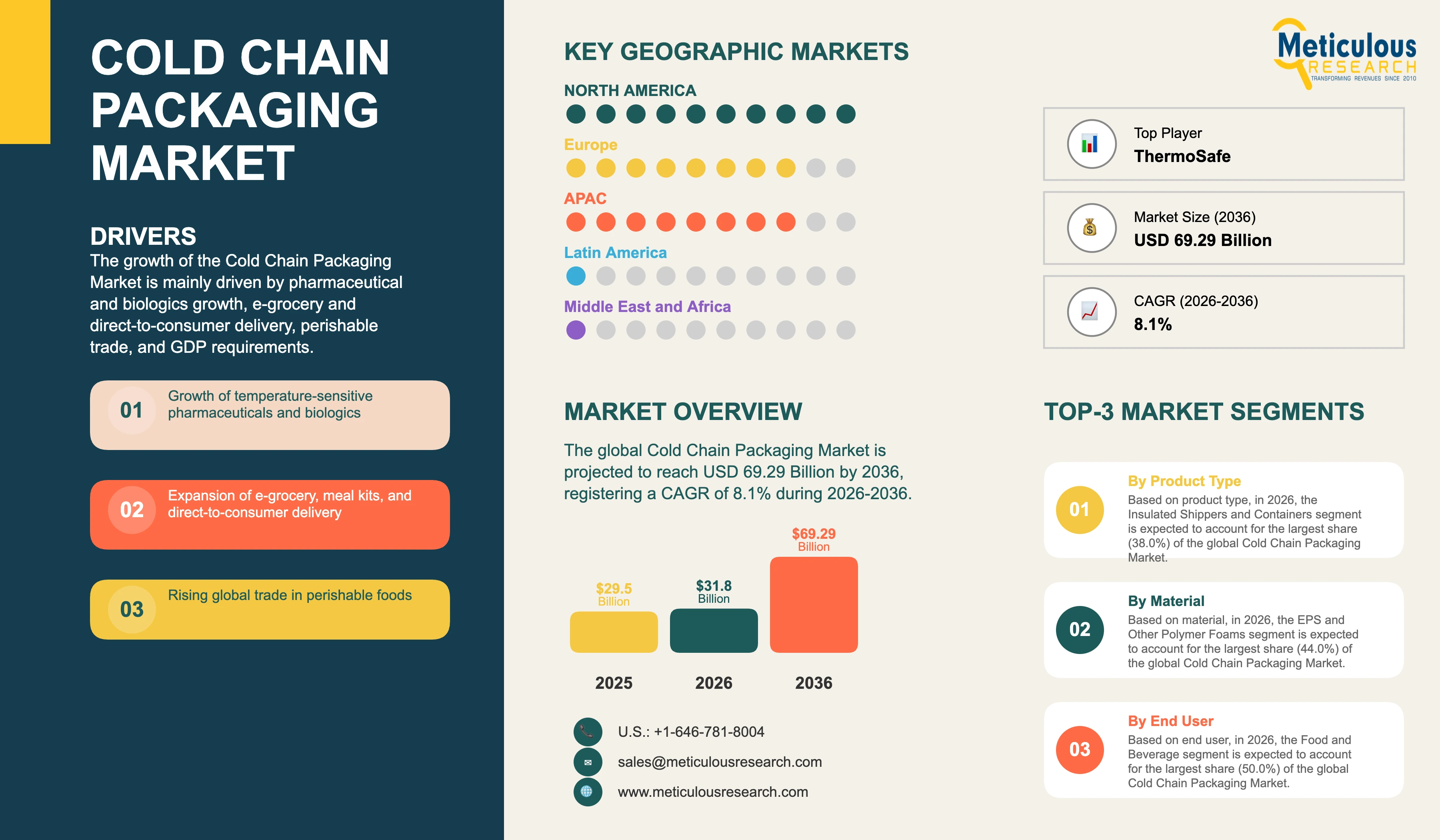
The global cold chain packaging market was valued at USD 29.50 billion in 2025. This market is expected to reach USD 69.29 billion by 2036 from an estimated USD 31.80 billion in 2026, registering a CAGR of 8.1% during the forecast period (2026-2036).
- Published
- Nov 2026
- Pages
- 275
- Format
- PDF + Excel
- Report ID
- MRCHM - 1042595
- Base year
- 2025
- 2025 · BASELINE
- $29.50B
- 2036
- $69.29B
- CAGR 2026–2036
- 8.1%
2025 baseline · 2026–2036 forecast at 8.1% CAGR · hover a bar for the value
Key highlights
The European Union's Packaging and Packaging Waste Regulation (PPWR), Regulation (EU) 2025/40, which entered into force in February 2025 and generally applies from August 12, 2026, requires that all packaging be recyclable in an economically viable way by 2030, limits empty space in grouped, transport, and e-commerce packaging to 50%, and sets reuse targets for transport packaging, including at least 40% reusable transport packaging within the EU from 2030, which will significantly affect insulated shippers, gel packs, and cold chain packaging design for products sold in Europe.
Peli BioThermal, a provider of temperature-controlled packaging and services for the life sciences industry, acquired Evo from BioLife Solutions in October 2025, adding cryogenic shippers and the evoIS real-time tracking platform to support cell and gene therapy logistics, and it announced a partnership with PAXAFE in July 2026 to combine its cold chain packaging with AI-powered monitoring and predictive analytics.
CSafe, a provider of active and passive temperature-controlled container solutions for the pharmaceutical industry, launched the Silverskin RE reusable thermal cover in October 2025, reflecting the industry's shift toward reusable and more sustainable cold chain packaging, and it operates a combined active and passive portfolio following its acquisition of Softbox Systems.
Cold Chain Technologies, a provider of thermal packaging and digital monitoring solutions for temperature-sensitive life sciences products, acquired Global Cold Chain Solutions, a provider of passive cold chain solutions in Australia and India, expanding its presence and manufacturing capabilities in Asia-Pacific.
Packaging suppliers serving Europe are evaluating changes to expanded polystyrene shippers, gel pack films, and vacuum insulated panels to meet PPWR recyclability, recycled content, and empty-space requirements, and many are developing paper and fiber-based insulation and reusable systems as alternatives to conventional foam shippers.
By product type, insulated shippers and containers account for the largest share of 38.0% in 2026, while temperature monitoring labels and indicators register the highest CAGR.
By usage, single-use accounts for the larger share in 2026, while reusable registers the higher CAGR.
By material, EPS and other polymer foams account for the largest share in 2026, while paper and fiber-based materials register the highest CAGR.
By end user, food and beverage accounts for the largest share of 50.0% in 2026, while pharmaceuticals and life sciences register the highest CAGR.
By geography, North America accounts for the largest share of 36.0% in 2026, while Asia-Pacific registers the highest CAGR of 10.0%.
Report summary
| Particulars | Details |
|---|---|
| Base Year | 2025 |
| Estimated Year | 2026 |
| Forecast Period | 2026-2036 |
| Market Size in 2025 | USD 29.50 billion |
| Market Size in 2026 | USD 31.80 billion |
| Market Size by 2036 | USD 69.29 billion |
| CAGR (2026-2036) | 8.1% |
| Format | PDF, Excel & Cloud Portal · 275 pages |
| Largest Segment by Product Type (2026) | Insulated Shippers and Containers (38.0%) |
| Largest Segment by End User (2026) | Food and Beverage (50.0%) |
| Largest Region (2026) | North America (36.0%) |
| Fastest-Growing Region | Asia-Pacific (CAGR 10.0%) |
| Companies Profiled | 14 companies and other companies |
| Segments Covered | Product Type, Usage, Material, End User, Geography |
| Countries Covered | U.S., Canada, Germany, U.K., France, Switzerland, Ireland, Belgium, Italy, Spain, Netherlands, Denmark, Sweden, Rest of Europe, China, Japan, India, South Korea, Australia, Singapore, Indonesia, Thailand, Vietnam, Philippines, Rest of Asia-Pacific, Brazil, Mexico, Chile, Argentina, Colombia, Peru, Rest of Latin America, Saudi Arabia, U.A.E., Israel, South Africa, Rest of Middle East & Africa |
Report overview
Segments covered: product type, usage, material, end user.
The growth of this market is mainly driven by the rapid growth of temperature-sensitive pharmaceuticals, biologics, vaccines, GLP-1 medications, and cell and gene therapies, the expansion of online grocery, meal kit, and direct-to-consumer food delivery, rising global trade in perishable foods such as seafood, meat, and fresh produce, stricter good distribution practice requirements for pharmaceutical shipping, the growth of clinical trials and direct-to-patient delivery, and the adoption of high-performance insulation, phase change materials, and integrated temperature monitoring. However, factors such as the cost of high-performance and reusable packaging systems, environmental concerns and regulations on single-use plastics and foam packaging, complex reverse logistics for reusable systems, and the need for extensive validation and qualification of packaging are expected to restrain the growth of this market to some extent.
Cold chain packaging refers to packaging products and systems designed to maintain temperature-sensitive products within specified temperature ranges during storage and transportation. It includes insulated shippers and containers, refrigerants such as gel packs, ice packs, phase change materials, and dry ice, pallet shippers and bulk systems, active temperature-controlled containers with powered heating and cooling, temperature monitoring labels and indicators, and liners, thermal blankets, and other protective products. This report covers cold chain packaging across product types, usage models, materials, end users, and regions, including both single-use and reusable systems and the rental revenue of reusable and active container systems. Refrigerated warehouses, refrigerated vehicles, and cold chain logistics services are analyzed in separate reports. The market is measured on a revenue basis.
Cold chain packaging plays a critical and growing role in two major industries: food and beverage, and pharmaceuticals and life sciences. In food and beverage, cold chain packaging is used to ship seafood, meat, poultry, dairy, fresh produce, frozen foods, meal kits, and online grocery orders, often in expanded polystyrene boxes, insulated liners, and gel packs. In pharmaceuticals and life sciences, it is used to ship vaccines, biologics, insulin, GLP-1 medications, clinical trial materials, blood products, diagnostic samples, and cell and gene therapies, often in validated systems that maintain temperatures such as 2 to 8 degrees Celsius, controlled room temperature, frozen, or cryogenic conditions for specified durations.
Insulated shippers and containers account for the largest share of the market. These range from simple expanded polystyrene boxes used for food and parcels to high-performance shippers with vacuum insulated panels and phase change materials that can maintain pharmaceutical temperatures for several days. Pallet shippers and bulk systems are used for larger pharmaceutical shipments by air and road, while active containers, which use batteries, compressors, or heaters to maintain temperature, are used for high-value air cargo shipments and are typically rented from providers such as Envirotainer and CSafe.
Refrigerants and phase change materials are essential components of passive systems, since they provide the cooling or heating capacity that insulation alone cannot. Gel packs and ice packs are widely used for food and pharmaceutical shipments, while engineered phase change materials provide precise temperature control at specific points such as 5 degrees Celsius or 20 degrees Celsius. Dry ice and liquid nitrogen dry shippers are used for frozen and cryogenic shipments. Temperature monitoring labels and indicators, including data loggers, electronic indicators, and connected sensors, provide evidence that products remained within required temperature ranges and are increasingly integrated with digital platforms that provide real-time visibility and automated documentation.
Single-use packaging accounts for the largest share of the market, since it is simple to use and widely adopted for food, e-commerce, and many pharmaceutical shipments. Reusable packaging is the fastest-growing usage model, supported by sustainability goals, cost savings over multiple trips, rental and pooling services, and regulations such as the EU PPWR that set reuse targets for transport packaging.
Expanded polystyrene and other polymer foams remain the most widely used insulation materials in the market due to their low cost, light weight, and good thermal performance, but polyurethane and vacuum insulated panels are used for high-performance pharmaceutical shippers, and paper and fiber-based materials are growing rapidly as alternatives to foam for food and e-commerce shipments.
The market includes specialized cold chain packaging companies, packaging manufacturers, foam and insulation producers, active container providers, and temperature monitoring companies. Leading companies include ThermoSafe, Peli BioThermal, CSafe Global, Envirotainer, Cold Chain Technologies, va-Q-tec, Cryopak, Sofrigam, Intelsius, Tempack, Nordic Cold Chain Solutions, Cryoport, BEWI, and Sealed Air.
Over the forecast period, the cold chain packaging market is expected to grow strongly, supported by pharmaceutical and biologics growth, e-grocery and direct-to-consumer delivery, global perishable trade, and innovation in sustainable and reusable packaging and connected monitoring. Asia-Pacific is expected to be the fastest-growing region, supported by growing pharmaceutical production and consumption, expanding online grocery, and rising seafood and food exports.
We are moving more of our lanes to reusable shippers with real-time monitoring to meet our sustainability targets and reduce excursions, and we are preparing for the new EU packaging rules that apply to transport packaging.
Our domestic and export volumes are growing quickly, and we need qualified passive shippers that work in very hot conditions and are available locally.
North America is expected to account for the largest share of 36.0% of the market in 2026, mainly due to the large pharmaceutical industry, high biologics and GLP-1 consumption, large online grocery and direct-to-consumer markets, and leading cold chain packaging companies.
Asia-Pacific is projected to register the highest CAGR of 10.0% during the forecast period, driven by pharmaceutical and vaccine growth, online grocery and quick commerce, seafood exports, and expansion by international packaging companies.
The report profiles 14 companies, including ThermoSafe, Peli BioThermal, CSafe Global, Envirotainer, Cold Chain Technologies, va-Q-tec, Cryopak, Sofrigam, Intelsius, Tempack, Nordic Cold Chain Solutions, Cryoport, BEWI, and Sealed Air.
Report infographic
Market dynamics
19 factors across 5 forcesGrowth of temperature-sensitive pharmaceuticals and biologics
The pharmaceutical industry is shifting toward temperature-sensitive products, including biologics, monoclonal antibodies, vaccines, insulin, GLP-1 medications, and cell and gene therapies. Many of these products must be stored and shipped at 2 to 8 degrees Celsius, and some require frozen, deep-frozen, or cryogenic temperatures. The rapid growth of GLP-1 medications for diabetes and weight management has significantly increased the volume of refrigerated pharmaceutical shipments, including direct-to-patient deliveries. Cell and gene therapies require highly specialized cryogenic packaging and tracking, as shown by Peli BioThermal's acquisition of Evo in 2025 to strengthen its cryogenic shipping capabilities.
Pharmaceutical companies require validated packaging that can maintain temperature for specified durations under different ambient conditions, and they increasingly use high-performance passive shippers, pallet systems, and active containers to protect high-value products. Losses due to temperature excursions can be very costly, which encourages investment in reliable packaging. A single shipment of biologics or cell therapy can be worth hundreds of thousands of dollars or more, and losing it can delay patient treatment, so pharmaceutical companies place a high value on packaging performance.
The growing number of clinical trials, especially for biologics and advanced therapies, also increases demand for cold chain packaging for investigational products and patient samples.
Expansion of e-grocery, meal kits, and direct-to-consumer delivery
Online grocery shopping, meal kit services, and direct-to-consumer sales of meat, seafood, dairy, frozen foods, and specialty foods have grown significantly, and these channels require insulated packaging and refrigerants to keep products cold during parcel delivery. Each order typically uses an insulated box or liner and gel packs or dry ice, which creates large volumes of demand for cold chain packaging. Direct-to-consumer delivery of pharmaceuticals and specialty medications is also growing, especially for chronic conditions, further increasing parcel-level cold chain packaging.
Consumers and retailers increasingly prefer recyclable or compostable insulation, such as paper-based liners and recyclable foam, which is driving innovation in sustainable packaging for these channels.
Packaging suppliers are developing right-sized shippers and refrigerant configurations for different seasons and delivery routes to reduce material use and cost while maintaining product temperature, and some online grocers are testing reusable insulated totes for home delivery in dense urban areas.
Rising global trade in perishable foods
International trade in seafood, meat, poultry, dairy, fresh fruits, and vegetables continues to grow, supported by rising incomes and changing diets in Asia, the Middle East, and other regions. Many perishable foods are shipped in insulated boxes, liners, and with refrigerants, especially for air freight of seafood and premium produce. Expanded polystyrene boxes are widely used for fresh fish and seafood, and demand for insulated packaging grows with seafood production and exports.
Food safety regulations and quality requirements in importing countries also encourage the use of effective temperature-controlled packaging and monitoring.
Air freight of premium seafood, such as fresh salmon from Norway and Chile and live and chilled seafood to Asia, relies heavily on insulated boxes and ice or gel packs, and growth in these trade flows directly supports demand for cold chain packaging. Fresh produce exporters also use insulated liners and pallet covers to protect high-value fruits during air and sea transport.
Stricter good distribution practice and quality requirements
Regulators in the U.S., Europe, and other regions require pharmaceutical companies to maintain product quality throughout distribution, under good distribution practice guidelines and related standards. These requirements mean that pharmaceutical companies must use qualified packaging, monitor temperatures, and document compliance, which supports demand for validated packaging systems and temperature monitoring devices. Air cargo industry certification programs for pharmaceutical handling also encourage the use of reliable packaging and monitoring.
Packaging must be tested under standard protocols to demonstrate performance under different conditions, and suppliers that offer qualified systems and testing support have an advantage.
Pharmaceutical companies are also increasing their focus on supply chain risk management, which includes standardizing packaging across lanes, using more robust systems for long or high-risk routes, and increasing the use of monitoring devices on shipments.
Innovation in high-performance insulation, PCMs, and connected monitoring
Advances in vacuum insulated panels, phase change materials, and thermal design have improved the performance of passive packaging, allowing longer durations and lighter, smaller shippers. Connected monitoring devices and digital platforms allow real-time tracking of temperature and location, and AI-based analytics can predict and prevent temperature excursions. Partnerships such as Peli BioThermal's collaboration with PAXAFE in 2026 show how packaging providers are integrating digital intelligence into their offerings.
Innovation is also focused on reducing the weight and volume of shippers, which lowers freight costs and carbon emissions, and on extending the duration of passive systems so that they can replace active containers on some routes.
Table of contents
12 chapters · 163 sections · 275 pages · click to expandSegmental analysis
| Segment | Largest share (2026) | Fastest growth (2026–2036) |
|---|---|---|
| By Product Type | Insulated shippers and containers | Temperature monitoring labels and indicators |
By Product Type
- The single-use segment is expected to account for the larger share of the cold chain packaging market, while the reusable segment is projected to register the higher CAGR during the forecast period.
- The EPS and other polymer foams segment is expected to account for the largest share of the cold chain packaging market, while the paper and fiber-based materials segment is projected to register the highest CAGR during the forecast period.
Geographic analysis
North America
Largest shareIn 2026, North America is expected to account for the largest share of 36.0% of the global cold chain packaging market. The large share of this region is mainly due to the large pharmaceutical and biotechnology industry, high consumption of biologics and GLP-1 medications, the large market for online grocery, meal kits, and direct-to-consumer food and pharmaceutical delivery, large seafood and meat trade, and the presence of leading cold chain packaging companies such as ThermoSafe, Peli BioThermal, CSafe, Cold Chain Technologies, Cryopak, Cryoport, and Sealed Air. The U.S. is the largest market in the region, followed by Canada. The U.S. also has some of the largest online grocery and meal kit markets in the world, and several states have introduced restrictions on certain foam packaging, which is encouraging the use of alternative materials.
Asia-Pacific
Fastest growthAsia-Pacific is projected to register the highest CAGR of 10.0% during the forecast period. The rapid growth of this region is mainly driven by growing pharmaceutical and vaccine production and consumption in China, India, Japan, South Korea, and Southeast Asia, rapid expansion of online grocery and quick commerce, large seafood production and exports, government immunization programs, and expansion by international packaging companies. China, Japan, India, South Korea, Australia, Singapore, Indonesia, Thailand, Vietnam, and the Philippines are important markets, and India is a major exporter of vaccines and generic medicines that require cold chain packaging.
Europe
Europe accounts for a significant share of the global market, supported by a large pharmaceutical industry, strict good distribution practice requirements, large food trade, and leading companies such as Envirotainer, va-Q-tec, Sofrigam, Intelsius, Tempack, Nordic Cold Chain Solutions, and BEWI. The EU PPWR, which applies from August 2026, is expected to significantly reshape the European market by driving adoption of recyclable and reusable packaging. Germany, the U.K., France, Switzerland, Ireland, Belgium, Italy, Spain, the Netherlands, Denmark, and Sweden are important markets, with Switzerland, Ireland, and Belgium serving as major pharmaceutical export hubs.
Latin America
Latin America and the Middle East & Africa account for smaller shares of the market but are growing steadily, supported by pharmaceutical market growth, food exports from Brazil, Chile, Argentina, Mexico, and other countries, food imports in the Gulf countries, and expanding e-commerce in Saudi Arabia, the U.A.E., and South Africa. Brazil and Chile are also major global exporters of meat, seafood, and fruit, which require insulated packaging for air and sea shipments.
Competitive landscape
The global cold chain packaging market is fragmented, with the top five players estimated to account for about 20% of the market in 2025. The market includes specialized pharmaceutical cold chain packaging companies, active container providers, foam and insulation manufacturers, general packaging companies, temperature monitoring companies, and many regional manufacturers of insulated boxes and refrigerants for food.
In pharmaceutical cold chain packaging, ThermoSafe, Peli BioThermal, CSafe Global, Cold Chain Technologies, va-Q-tec, Cryopak, Sofrigam, Intelsius, Tempack, and Nordic Cold Chain Solutions offer passive shippers, pallet systems, refrigerants, and services. Envirotainer and CSafe are leading providers of active temperature-controlled containers for air cargo, and va-Q-tec and Peli BioThermal offer reusable high-performance containers and rental services. Cryoport specializes in cryogenic shipping and temperature-controlled supply chain solutions for cell and gene therapies.
In food and general cold chain packaging, BEWI is a major Nordic and European producer of expanded polystyrene boxes for seafood and other foods, and Sealed Air offers insulated packaging for food and e-commerce. Many regional manufacturers produce foam boxes, insulated liners, and gel packs for local food and e-commerce markets.
Competition in food and e-commerce packaging is largely regional because insulated boxes are bulky and costly to transport, which favors local production close to customers. In pharmaceutical packaging, by contrast, global networks for manufacturing, qualification, rental, and return logistics are important competitive advantages, since pharmaceutical companies ship products across many countries and prefer standardized solutions.
Companies in this market compete on thermal performance, qualification and regulatory support, reliability, sustainability, cost, global network for rental and reverse logistics, digital monitoring capabilities, and customer service. Key strategies include acquisitions of complementary businesses, launches of sustainable and reusable products, expansion of rental networks, integration of IoT monitoring and analytics, and expansion in Asia-Pacific.
The market is consolidating, especially in pharmaceutical cold chain packaging, as private equity-backed companies acquire complementary businesses, as shown by Peli BioThermal's acquisition of Evo and Cold Chain Technologies' acquisition of Global Cold Chain Solutions. We expect this trend to continue.
We also expect packaging companies to expand into adjacent services, such as qualification testing, rental, reverse logistics, and data services, to differentiate their offerings and build recurring revenue.
Some of the key players operating in the cold chain packaging market are ThermoSafe, Peli BioThermal, CSafe Global, Envirotainer AB, Cold Chain Technologies, va-Q-tec AG, Cryopak, Sofrigam, Intelsius, Tempack Packaging Solutions, Nordic Cold Chain Solutions, Cryoport, Inc., BEWI ASA, and Sealed Air Corporation, among others.
- —
Peli BioThermal acquired Evo from BioLife Solutions in October 2025 and partnered with PAXAFE on AI-powered monitoring in July 2026, CSafe launched the Silverskin RE reusable thermal cover in October 2025, and the EU PPWR began to apply in August 2026.
- ThermoSafe
- Peli BioThermal
- CSafe Global
- Envirotainer AB
- Cold Chain Technologies
- Cryopak
- Sofrigam
- Intelsius
- Tempack Packaging Solutions
- Nordic Cold Chain Solutions
- Cryoport, Inc.
- BEWI ASA
- Sealed Air Corporation
Expert perspectives
Cold chain packaging is an essential part of food and healthcare supply chains, and demand is supported by strong long-term growth in temperature-sensitive pharmaceuticals, online food delivery, and perishable trade. At the same time, the market is being reshaped by sustainability regulations and the shift toward reusable and connected packaging.
Over the forecast period, the market is expected to grow at a CAGR of 8.1%, from USD 31.80 billion in 2026 to USD 69.29 billion in 2036. Growth will be supported by pharmaceutical and biologics growth, e-grocery and direct-to-consumer delivery, perishable trade, good distribution practice requirements, and innovation in insulation and monitoring.
Among the market segments, insulated shippers and containers are the largest product type, while temperature monitoring labels and indicators grow fastest. Single-use packaging is the larger usage model, while reusable packaging grows faster. EPS and other polymer foams are the largest material, while paper and fiber-based materials grow fastest. Food and beverage is the largest end user, while pharmaceuticals and life sciences grow fastest. North America is the largest region, and Asia-Pacific is the fastest-growing region at a CAGR of 10.0%.
In our view, sustainability regulation, especially the EU PPWR, will be the most important force reshaping the market over the next five years. Suppliers will need to redesign foam and mixed-material shippers, increase recycled content, reduce empty space, and expand reusable systems, while maintaining performance and qualification. Companies that move early will gain a competitive advantage.
Pharmaceutical cold chain packaging will remain the most valuable and fastest-growing segment, supported by biologics, GLP-1 medications, and advanced therapies. We expect strong demand for high-performance, reusable, and connected solutions in this segment.
Growth in GLP-1 medications in particular is expected to support strong demand for parcel-size refrigerated shippers for pharmacy and direct-to-patient deliveries.
Food and e-commerce packaging will grow steadily with online grocery and perishable trade, but competition and price pressure will remain strong, and suppliers will need to differentiate through sustainable materials, right-sized designs, and local service.
We also expect the line between packaging and services to blur, as packaging companies offer rental, reverse logistics, qualification, and data services, and as digital monitoring becomes a standard part of pharmaceutical shipments.
Finally, we believe that Asia-Pacific will be a key growth region, and international companies are likely to expand through acquisitions and local manufacturing to serve growing pharmaceutical and food markets.
Overall, we expect cold chain packaging to remain one of the fastest-growing segments of the packaging industry, supported by structural growth in temperature-sensitive pharmaceuticals and online food delivery.
Customer perspectives
Packaging Manager - online grocery company, U.S.
We ship millions of chilled and frozen grocery orders each year, so insulated boxes and gel packs are a major cost. Customers also expect packaging they can put in their recycling bin.
Frequently asked questions
The global cold chain packaging market was valued at USD 29.50 billion in 2025, up from USD 27.40 billion in 2024, and is estimated at USD 31.80 billion in 2026. The market includes insulated shippers and containers, refrigerants and phase change materials, pallet shippers and bulk systems, active temperature-controlled containers, temperature monitoring labels and indicators, and liners and other products.
Cite this report
Meticulous Research. (2026). Cold Chain Packaging Market - Global Opportunity Analysis and Industry Forecast (2026-2036) (Report No. MRCHM - 1042595). Meticulous Market Research Pvt. Ltd. https://www.meticulousresearch.com/product/cold-chain-packaging-market-7278