Germanium Market (2026-2036)
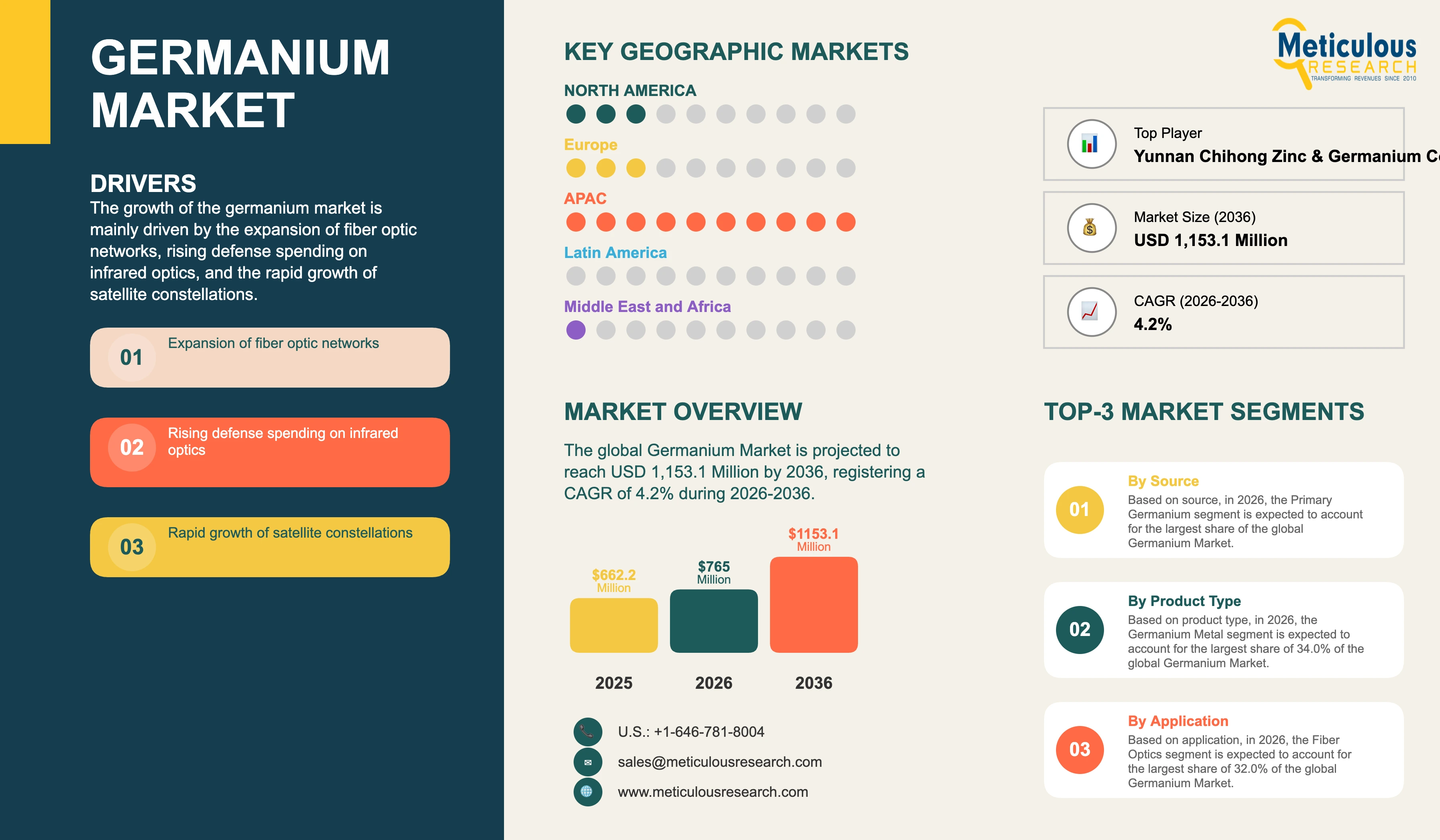
The global germanium market was valued at USD 662.2 million in 2025. This market is expected to reach USD 1,153.1 million by 2036 from an estimated USD 765.0 million in 2026, registering a CAGR of 4.2% during the forecast period (2026-2036). In terms of volume, this market is expected to reach 349 tons by 2036 from an estimated 225 tons in 2026, registering a CAGR of 4.5% during the forecast period.
- Published
- Nov 2026
- Pages
- 258
- Format
- PDF + Excel
- Report ID
- MRCHM - 1042488
- Base year
- 2025
- 2025 · BASELINE
- $662.2M
- 2036
- $1.15B
- CAGR 2026–2036
- 4.2%
2025 baseline · 2026–2036 forecast at 4.2% CAGR · hover a bar for the value
Key highlights
According to the U.S. Geological Survey (USGS), germanium was known to be produced or recycled commercially in only a few countries, including China, Belgium, Canada, Germany, Russia, and the U.S., and China is the world's largest producer of refined germanium.
China placed export controls on germanium in August 2023, banned germanium exports to the U.S. in December 2024, and in November 2025 suspended the U.S. ban until 27 November 2026, although exporters still need licenses for every shipment.
The USGS reported that U.S. prices for germanium metal reached about USD 4, 100 per kilogram in 2025, the highest in several years, while U.S. imports of germanium metal fell by about two-thirds from 2024 as supply from China became scarce.
Chinese domestic germanium ingot prices rose from about 13, 500 yuan per kilogram in January 2026 to an average of about 17,250 yuan per kilogram in April 2026, while China's exports of wrought germanium fell sharply after export controls tightened.
Germanium is recovered mainly as a by-product of zinc smelting and from coal fly ash, and recycling of manufacturing scrap from optics, fiber, and wafer production provides about 30% of supply.
Producers outside China are expanding supply, including Umicore's partnership with Gécamines to process germanium-bearing material from the DRC, Teck Resources' germanium production at Trail in Canada, and plans by Nyrstar and Korea Zinc to produce germanium.
Fiber optics, infrared optics, semiconductor applications and solar cells, and radiation detectors were the major end uses of germanium in the U.S. in 2025, in descending order, according to the USGS.
Demand for optical fiber has grown strongly with the construction of AI data centers and broadband networks, while the rapid growth of satellite constellations has increased demand for germanium wafers used in space solar cells.
The U.S. Defense Logistics Agency holds germanium in the National Defense Stockpile, and governments in the U.S., the EU, Japan, and South Korea have listed germanium as a critical or strategic material.
By source, primary germanium accounts for the largest share in 2026, while secondary germanium registers the highest CAGR.
By product type, germanium metal accounts for the largest share of 34.0% in 2026, while germanium tetrachloride registers the highest CAGR.
By application, fiber optics account for the largest share of 32.0% in 2026, while solar cells register the highest CAGR.
By geography, Asia-Pacific accounts for the largest share of 60.0% in 2026, while North America registers the highest CAGR of 5.4%.
Report summary
| Particulars | Details |
|---|---|
| Base Year | 2025 |
| Estimated Year | 2026 |
| Forecast Period | 2026-2036 |
| Market Size in 2025 | USD 662.2 million |
| Market Size in 2026 | USD 765.0 million |
| Market Size by 2036 | USD 1,153.1 million |
| CAGR (2026-2036), Value | 4.2% |
| Format | PDF, Excel & Cloud Portal · 258 pages |
| Market Volume (2026 to 2036) | 225 tons to 349 tons of contained germanium (CAGR 4.5%) |
| Largest Segment by Product Type (2026) | Germanium Metal (34.0%) |
| Largest Segment by Application (2026) | Fiber Optics (32.0%) |
| Largest Region (2026) | Asia-Pacific (60.0%) |
| Fastest-Growing Region | North America (CAGR 5.4%) |
| Segments Covered | Source, Product Type, Application, and Geography |
| Geographic Scope | Asia-Pacific, North America, Europe, Middle East and Africa, and Latin America |
| Key Companies Profiled | Yunnan Chihong Zinc & Germanium, Yunnan Lincang Xinyuan Germanium Industry, Umicore, Teck Resources, JSC Germanium, PPM Pure Metals, 5N Plus, AXT, Nyrstar, Korea Zinc, Gécamines, and Indium Corporation |
Report overview
Segments covered: source, product type, application.
The growth of this market is mainly driven by the expansion of fiber optic networks for AI data centers, 5G, and broadband, rising defense spending on infrared optics and thermal imaging, the rapid growth of satellite constellations that use germanium-based solar cells, and growing use of germanium in silicon photonics and semiconductors. However, China's export controls, the concentration of supply in a few countries, high prices, and the substitution of germanium in infrared lenses and PET catalysts are expected to restrain the growth of this market to some extent. Value is expected to grow slightly more slowly than volume because prices reached high levels in 2025 and 2026 and are expected to ease gradually as new supply from outside China comes online.
Germanium is a hard, grayish-white metalloid that is transparent to infrared light and has useful semiconductor and optical properties. It is used in germanium tetrachloride for the production of optical fibers, where it raises the refractive index of the fiber core, in lenses and windows for infrared cameras and thermal imaging systems, in substrates for high-efficiency solar cells used on satellites, in silicon-germanium chips and photodetectors, in high-purity radiation detectors, and as a catalyst in the production of PET plastic.
This market covers the global consumption of germanium in its main products, measured in value and in tons of contained germanium, including germanium metal, germanium tetrachloride, germanium dioxide, and germanium wafers and crystals. It includes germanium produced from zinc ores, coal, and other primary sources and germanium recovered from scrap, and is segmented by source, product type, application, and geography. Finished infrared lenses, optical fibers, and solar cells are not included.
Germanium is not mined on its own, as it occurs in very small amounts in zinc ores, some copper and lead ores, and certain coal deposits. It is recovered from zinc smelter residues and coal fly ash, and then refined into germanium dioxide, germanium tetrachloride, and high-purity germanium metal. China is the largest producer of refined germanium, with major producers in Yunnan and Inner Mongolia, while Belgium, Canada, Germany, Russia, and the U.S. have smaller production and recycling operations. Global refined production is estimated at only a few hundred tons per year, which makes germanium one of the smallest but most strategically important metal markets. Because germanium is a by-product, its supply cannot be increased quickly in response to higher prices, as it depends on how much zinc and coal is processed and whether producers have installed recovery circuits.
China introduced export licensing for germanium in August 2023, together with gallium, and banned exports to the U.S. in December 2024. Chinese exports fell sharply, and prices outside China rose to their highest levels in more than a decade, while Chinese domestic prices also increased because of tighter supply and lower output. Users in the U.S., Europe, Japan, and South Korea were forced to draw down inventories, pay higher prices, and look for new suppliers. Defense contractors, which depend on germanium for thermal imaging, were among the most affected, and governments responded by supporting new supply projects and stockpiling. Chinese producers also reduced output in early 2026 because of tighter raw material supply, which pushed domestic prices higher.
Recycling plays a major role in germanium supply, because much of the germanium used in manufacturing infrared optics, optical fibers, and wafers ends up as scrap that can be recovered and refined. Umicore, Teck, and other producers operate large recycling and refining operations, and recycling of old infrared lenses and other end-of-life products is also growing as prices rise. In some manufacturing processes, such as the grinding and polishing of infrared lenses, more than half of the germanium used can end up as scrap, which makes closed-loop recycling between producers and users very important for both cost and supply security.
Over the forecast period, germanium demand is expected to grow steadily, supported by fiber optic networks, infrared optics for defense and automotive applications, satellite solar cells, and semiconductors. Governments in the U.S., the EU, Japan, South Korea, and Canada have listed germanium as a critical or strategic material and are supporting new supply from zinc smelters, coal, and recycling, as well as stockpiling. These efforts are expected to reduce dependence on China gradually, although China is likely to remain the largest producer throughout the forecast period. Demand is also shifting toward higher-value products, such as space solar wafers, high-purity germanium for semiconductors, and germanium tetrachloride for high-performance fiber, while demand for germanium in PET catalysts is expected to remain flat. As a result, germanium is expected to remain a high-value, low-volume market with strong links to defense, telecommunications, and space.
Report infographic
Market dynamics
15 factors across 5 forcesExpansion of fiber optic networks
Germanium tetrachloride is used in the production of optical fibers to increase the refractive index of the fiber core, which allows light signals to travel long distances with very low loss. Optical fibers are the backbone of telecommunications networks, the internet, and data centers, and fiber optics is the largest use of germanium in the U.S. and many other countries, according to the USGS.
Demand for optical fiber is growing strongly because of the construction of AI data centers, which use large amounts of fiber to connect servers and buildings, the rollout of 5G and fiber-to-the-home broadband, and the construction of new undersea and long-distance cables. Leading fiber makers, such as Corning, Prysmian, Sumitomo Electric, Fujikura, YOFC, and Hengtong, are expanding production, which supports demand for germanium tetrachloride. Fiber optics accounts for the largest share of the market by application, and germanium tetrachloride is the fastest-growing product type. AI data centers, in particular, use many times more fiber per rack than traditional data centers, because GPU clusters require large numbers of high-speed optical connections, and hyperscalers have signed multi-year supply agreements with fiber makers to secure capacity.
Rising defense spending on infrared optics
Germanium is the most widely used material for lenses and windows in infrared cameras and thermal imaging systems, because it transmits infrared light well and can be machined into precise shapes. These systems are used in military targeting, surveillance, night vision, missile guidance, and drones, as well as in firefighting, security, industrial inspection, and automotive night vision.
Defense spending has risen sharply in Europe, the U.S., and Asia because of the war in Ukraine and other geopolitical tensions, and the widespread use of drones and thermal imaging in modern warfare has increased demand for infrared optics. Infrared optics is one of the largest applications of germanium, and defense demand is one of the main reasons North America is the fastest-growing region in this market. Thermal imaging is also used widely in border security, police and firefighting equipment, and industrial monitoring, and governments are buying large numbers of drones and counter-drone systems that use infrared sensors. European defense programs are also expanding production of thermal sights and targeting systems, which increases demand for germanium lenses and windows.
Rapid growth of satellite constellations
Germanium wafers are used as the substrate for multi-junction gallium arsenide solar cells, which are the most efficient solar cells available and power most satellites. The number of satellites launched each year has increased sharply because of low Earth orbit constellations, such as SpaceX's Starlink and Amazon's Project Kuiper, as well as government and defense satellite programs.
Each satellite requires solar arrays, and many use germanium-based multi-junction cells, which has made space solar one of the fastest-growing uses of germanium. Producers such as Umicore, AXT, and 5N Plus supply germanium wafers for space solar cells. Solar cells form the fastest-growing application in this market. Satellite operators, such as SpaceX and Amazon, are also launching larger satellites with more powerful solar arrays, and defense agencies are building constellations for communications, missile warning, and Earth observation, which further increases demand. Although some low-cost satellites use silicon solar cells, germanium-based multi-junction cells remain the preferred choice for most satellites because of their efficiency and radiation resistance.
Growing use in semiconductors and silicon photonics
Germanium is used in silicon-germanium transistors for high-frequency chips in wireless communications, radar, and automotive applications, and in germanium photodetectors in silicon photonics chips, which convert light signals into electrical signals in optical transceivers for data centers. As AI data centers adopt faster optical connections and co-packaged optics, demand for silicon photonics is growing rapidly.
Germanium is also being studied for use in advanced transistors and quantum computing devices. These applications use small amounts of germanium but require very high purity, which increases the value of the material. Optical transceiver makers, such as Coherent, InnoLight, and Broadcom, are expanding silicon photonics production to meet AI data center demand. Electronics and semiconductors form one of the fastest-growing applications in this market. Silicon-germanium chips, which combine the speed of germanium with the low cost of silicon manufacturing, are also widely used in automotive radar, satellite communications, and 5G equipment, and chipmakers such as GlobalFoundries, Tower Semiconductor, and Infineon offer silicon-germanium technologies for these markets.
Table of contents
11 chapters · 122 sections · 258 pages · click to expandSegmental analysis
| Segment | Largest share (2026) | Fastest growth (2026–2036) |
|---|---|---|
| By Source | Primary germanium | Secondary germanium |
| By Product Type | Germanium metal | Germanium tetrachloride |
| By Application | Fiber optics | Solar cells |
By Source
- The primary germanium segment is expected to account for the largest share of the market.
- The large share of this segment is mainly due to the large volume of germanium recovered from zinc smelter residues and coal fly ash, mainly in China.
- Primary germanium is recovered from zinc concentrates during smelting, as germanium concentrates in residues and dusts, and from coal fly ash in China and Russia.
- Chinese producers, such as Yunnan Chihong Zinc & Germanium and Yunnan Lincang Xinyuan Germanium Industry, recover germanium from zinc ores and lignite deposits in Yunnan, and producers in Inner Mongolia recover germanium from coal.
- Outside China, Teck recovers germanium at Trail in Canada, Umicore processes germanium-bearing materials in Belgium, and JSC Germanium in Russia produces germanium.
- Primary germanium is expected to remain the largest source over the forecast period, although its share will decline as recycling grows.
- The DRC is becoming an important new source of primary germanium, as Umicore and Gécamines process germanium-bearing material from the Big Hill tailings in Lubumbashi, and zinc smelters in South Korea and the U.S., operated by Korea Zinc and Nyrstar, are planning germanium recovery.
- New primary supply outside China is expected to grow faster than primary supply within China over the forecast period.
- However, these projects will take time to reach full production, and Chinese primary producers are expected to remain the largest suppliers.
- Russia's supply, mainly from coal, is largely directed to domestic and friendly markets because of sanctions.
- However, the secondary germanium segment is projected to register the highest CAGR during the forecast period.
- The rapid growth of this segment is driven by high germanium prices, which make recovery more profitable, the growth of manufacturing scrap from optics, fiber, and wafer production, and government policies that support recycling to reduce dependence on China.
- Recycling rates for germanium in infrared optics and wafer production are already high in Europe and North America, and producers are offering closed-loop recycling services to their customers.
- Secondary germanium is particularly important for Western producers, such as Umicore and PPM Pure Metals, which rely heavily on recycled material.
By Product Type
- Germanium Market Analysis by Product Type
- The germanium metal segment is expected to account for the largest share of 34.0% of the market.
- The large share of this segment is mainly due to its use in infrared optics, where germanium ingots and blanks are cut and polished into lenses and windows, and as the starting material for germanium wafers and crystals.
- Germanium metal is produced by reducing germanium dioxide with hydrogen and then refining it by zone refining to high purity, often 99.999% or higher for optical and electronic uses.
- It is supplied as ingots, zone-refined bars, and optical blanks, and its largest users are infrared optics makers, such as Umicore, Teledyne FLIR, Leonardo DRS, and Chinese producers, as well as makers of germanium wafers and radiation detectors.
- Defense demand for thermal imaging has increased demand for germanium metal outside China, while high prices have encouraged optics makers to improve material yields and recycling.
- Germanium metal is expected to remain the largest product type over the forecast period.
- Demand for large-diameter germanium blanks for long-range defense optics and for high-purity germanium crystals for radiation detectors adds value to this segment, and producers are investing in crystal growth and machining capacity outside China.
- Prices of germanium metal outside China reached record levels in 2025, which increased the value of this segment.
- However, the germanium tetrachloride segment is projected to register the highest CAGR during the forecast period.
- The rapid growth of this segment is driven by the growth of optical fiber production for AI data centers, 5G, and broadband networks.
- Germanium dioxide and germanium wafers and crystals make up the rest of the market.
- Germanium dioxide is used as a catalyst in PET production, mainly in Japan, and as an intermediate for producing germanium metal and other compounds, while germanium wafers are used for space solar cells and some optoelectronic devices.
- Germanium wafers and crystals are one of the faster-growing product types, supported by satellite demand.
- Germanium tetrachloride producers include Umicore, Chinese producers, and Teck, and high-purity grades are required to avoid impurities that would reduce fiber performance.
By Application
- The fiber optics segment is expected to account for the largest share of 32.0% of the market.
- The large share of this segment is mainly due to the large volume of germanium tetrachloride used in optical fiber production for telecommunications networks, data centers, and broadband.
- Optical fiber makers use germanium tetrachloride in chemical vapor deposition processes to make the core of the fiber preform, which is then drawn into fiber.
- China is the world's largest producer of optical fiber, with companies such as YOFC, Hengtong, and FiberHome, while Corning, Prysmian, Sumitomo Electric, Fujikura, and Furukawa Electric are major producers in the U.S., Europe, and Japan.
- Demand for fiber has grown strongly with AI data center construction, which uses large amounts of fiber within and between buildings, and with government broadband programs, such as the U.S. Broadband Equity, Access, and Deployment program.
- Fiber optics is expected to remain the largest application over the forecast period.
- New fiber plants are being built in the U.S., India, and Europe, which is increasing demand for germanium tetrachloride outside China.
- Each kilometer of optical fiber contains only a very small amount of germanium, but the large volumes of fiber produced each year make fiber optics the largest single application.
- However, the solar cells segment is projected to register the highest CAGR during the forecast period.
- The rapid growth of this segment is driven by the growth of satellite constellations and space programs that use germanium-based multi-junction solar cells.
- Infrared optics, electronics and semiconductors, PET polymerization catalysts, and radiation detectors and other applications make up the rest of the market.
- Infrared optics is the second-largest application, supported by defense, security, and automotive demand, while electronics and semiconductors are one of the fastest-growing applications, supported by silicon photonics and silicon-germanium chips.
- PET polymerization catalysts are expected to show little growth because most PET producers use antimony or titanium catalysts.
- Germanium-based catalysts are mainly used in Japan for high-clarity PET bottles and films.
Geographic analysis
Asia-Pacific
Largest shareIn 2026, Asia-Pacific is expected to account for the largest share of 60.0% of the global germanium market. The large share of this region is mainly due to China's dominant position as the world's largest producer and consumer of germanium, along with large fiber, optics, electronics, and PET industries in Japan, South Korea, and Taiwan. China uses germanium in optical fiber, infrared optics, solar cells, and electronics, and it is home to the world's largest germanium producers. Its domestic prices are lower than international prices because of export controls, which gives Chinese users a cost advantage. Japan is a major user of germanium in PET catalysts, optical fiber, and electronics, while South Korea and Taiwan use germanium in semiconductors and optical components. India is emerging as a growing market, supported by fiber network expansion, defense programs, and electronics manufacturing. Asia-Pacific is expected to remain the dominant region throughout the forecast period. Chinese fiber makers, such as YOFC and Hengtong, are among the largest users of germanium tetrachloride in the world, and Chinese infrared optics makers supply thermal cameras for domestic and export markets.
North America
Fastest growthNorth America is projected to register the highest CAGR of 5.4% during the forecast period. Growth is driven by rising defense spending on infrared optics, the growth of satellite constellations, the construction of AI data centers, government support for domestic germanium recovery, refining, and stockpiling, and germanium production at Teck's Trail operations in Canada. The U.S. has a large defense and space industry that uses germanium in infrared optics and solar cells, and fiber makers such as Corning are expanding production to meet data center demand. U.S. government programs have also funded germanium recovery and refining projects to reduce dependence on imports. Canada, through Teck and 5N Plus, plays a key role in North American germanium supply.
Europe
Europe holds a significant share of the market, led by Germany, France, and the U.K., supported by its defense, optics, fiber, and space industries, and by germanium refining and recycling in Belgium and Germany.
Latin America
Latin America and the Middle East and Africa hold smaller shares, although the DRC is becoming an important source of germanium through new recovery projects.
Middle East & Africa
Israel has a strong defense optics industry, and Brazil and Mexico use germanium in fiber, electronics, and solar products. Saudi Arabia and the UAE are also increasing defense spending.
Competitive landscape
The germanium market is moderately concentrated, with Chinese producers accounting for most primary supply and a small number of companies in Belgium, Canada, Germany, Russia, and the U.S. producing and recycling germanium. Leading companies, several of which are vertically integrated, include Yunnan Chihong Zinc & Germanium, Yunnan Lincang Xinyuan Germanium Industry, Umicore, Teck Resources, and JSC Germanium.
Many germanium producers are integrated across recovery, refining, and production of germanium products, such as optical blanks, wafers, and tetrachloride. Umicore, for example, produces germanium tetrachloride for fiber, germanium wafers for space solar cells, and infrared optics, and it operates a large recycling business. Chinese producers benefit from access to domestic resources and low costs, while producers outside China compete on quality, recycling services, and secure supply. Infrared optics makers, fiber producers, and solar cell makers are major buyers, and some, such as Umicore, are also producers. New entrants, such as Korea Zinc and Nyrstar, could increase competition outside China.
The top five players are estimated to account for 45.0% of the germanium market in 2025, reflecting the concentration of supply among a small number of Chinese and Western producers. Concentration is even higher for specific products, such as space solar wafers and germanium tetrachloride for fiber, where only a few companies supply most of the market.
Players use several strategies to grow in this market, including developing new recovery projects at zinc smelters and from coal and tailings, expanding refining and recycling capacity, signing long-term supply agreements with defense and fiber customers, and developing high-value products, such as space solar wafers and high-purity germanium for semiconductors. Umicore's partnership with Gécamines, Korea Zinc's germanium plans, and Nyrstar's proposed facility in Tennessee are examples of efforts to build supply outside China.
Competition is expected to center on access to secure raw material, refining and recycling capabilities, product quality, and the ability to meet the traceability requirements of defense and space customers. Companies that can offer non-Chinese germanium at competitive prices are expected to gain market share outside China. Chinese producers are expected to remain dominant in primary supply.
Some of the key players operating in the germanium market are Yunnan Chihong Zinc & Germanium Co., Ltd., Yunnan Lincang Xinyuan Germanium Industry Co., Ltd., Umicore N.V., Teck Resources Limited, JSC Germanium, PPM Pure Metals GmbH, 5N Plus Inc., AXT, Inc., Nyrstar NV, Korea Zinc Co., Ltd., La Générale des Carrières et des Mines (Gécamines), and Indium Corporation.
- —
China suspended its germanium export ban to the U.S. until November 2026, Umicore began processing germanium-bearing material from the DRC with Gécamines, and Korea Zinc and Nyrstar announced plans to produce germanium.
- Yunnan Chihong Zinc & Germanium
- Yunnan Lincang Xinyuan Germanium Industry
- Umicore
- Teck Resources
- JSC Germanium
- PPM Pure Metals
- 5N Plus
- AXT
- Nyrstar
- Korea Zinc
- Gécamines
- Indium Corporation
Expert perspectives
The germanium market is small in volume but strategically important because germanium is essential for fiber optics, infrared optics, space solar cells, and semiconductors. China's position as the largest producer and its use of export controls have made germanium one of the most closely watched critical minerals, and prices outside China rose to their highest levels in more than a decade in 2025.
Over the forecast period, germanium volume is expected to grow at about 4.5% per year, and value at about 4.2% per year, supported by fiber optics for AI data centers, infrared optics for defense, satellite solar cells, and semiconductors. Prices are expected to remain higher outside China than within China while export controls remain in place, and new supply from the DRC, Canada, the U.S., and South Korea is expected to ease prices gradually. However, prices are expected to remain well above pre-2023 levels because of export controls, limited supply, and the higher costs of production outside China.
Secondary germanium is the fastest-growing source, germanium tetrachloride is the fastest-growing product type, and solar cells is the fastest-growing application, reflecting the importance of recycling, fiber, and space. Primary germanium, germanium metal, and fiber optics remain the largest segments.
Asia-Pacific remains the dominant region, while North America is the fastest-growing region at a CAGR of 5.4%, supported by defense, space, and data center investment. The main swing factors that could change this outlook are China's export policies, including the expiry of its U.S. export ban suspension in November 2026, the pace of new supply outside China, defense spending, and the growth of fiber and satellite markets.
For germanium users, such as fiber makers, optics producers, and solar cell makers, the key decisions are how to secure supply from diverse sources, how to improve recycling, and whether to switch to alternative materials where possible. For producers outside China, success depends on low-cost recovery, high-quality refining, and long-term contracts with customers that value supply security. Government support through funding, stockpiling, and offtake agreements is likely to remain important for these producers. Producers that combine primary recovery, refining, recycling, and production of high-value products, such as wafers and optics, are expected to be best positioned.
Overall, germanium is expected to remain one of the most strategically important minor metals, with its market shaped by technology growth, defense demand, and government policy over the forecast period. Fiber optics for AI data centers and space solar cells, in particular, could become the most important sources of new demand.
Customer perspectives
Procurement Director - optical fiber manufacturer, Europe
Data center and broadband projects are driving record fiber demand, and germanium tetrachloride is a critical input for us. Since China's export controls, we have shifted most of our supply to European and North American producers and increased our recycling.
Fiber makers outside China are willing to pay more for secure germanium supply, which supports investment in refining and recycling capacity in Europe and North America. Long-term supply agreements are becoming standard in this industry.
Strong demand from fiber makers is why fiber optics account for 32.0% of the market and germanium tetrachloride is the fastest-growing product type.
Supply Chain Manager - defense thermal imaging company, U.S.
Every thermal camera and targeting system we build needs germanium lenses, and we need secure, non-Chinese supply, so we have signed long-term agreements and are recycling all of our machining scrap.
Defense demand for infrared optics is why germanium metal accounts for 34.0% of the market and North America is the fastest-growing region.
Head of Procurement - space solar cell manufacturer, Europe
Satellite constellations have multiplied our orders for multi-junction solar cells, and germanium wafers are the foundation of every cell. We work closely with our wafer suppliers to secure capacity years in advance.
Space solar cell makers are expanding capacity in Europe and the U.S., which is expected to keep demand for germanium wafers growing quickly over the forecast period.
The growth of satellite constellations is why solar cells form the fastest-growing application in this market and germanium wafers are one of the faster-growing product types.
Frequently asked questions
The market was valued at USD 662.2 million in 2025 and USD 484.0 million in 2024, and is estimated at USD 765.0 million in 2026, reflecting higher prices after China's export controls.
The market is expected to reach USD 1,153.1 million by 2036, supported by demand from fiber optics, infrared optics, space solar cells, and semiconductors.
The market is expected to register a CAGR of 4.2% from 2026 to 2036 in value terms and 4.5% in volume terms, with volume rising from 225 tons in 2026 to 349 tons of contained germanium in 2036.
Germanium prices reached high levels in 2025 and 2026 after China's export controls, and they are expected to ease gradually as new supply from outside China and recycling grow, which reduces value growth slightly compared with volume growth.
Growth is driven by the expansion of fiber optic networks, rising defense spending on infrared optics, the rapid growth of satellite constellations, and growing use of germanium in semiconductors and silicon photonics.
China's export controls and concentrated supply and substitution at high prices restrain growth, while limited supply data and price transparency and the challenges of by-product recovery remain key challenges.
Key opportunities include new supply from zinc smelters, coal, and the DRC, recycling and secondary supply, automotive and commercial thermal imaging, and quantum computing and advanced semiconductors.
China introduced export licensing for germanium in August 2023, banned exports to the U.S. in December 2024, and suspended the U.S. ban in November 2025 until 27 November 2026, while licenses remain required for all destinations.
The USGS reported that U.S. germanium metal prices reached about USD 4,100 per kilogram in 2025, the highest in several years, and Chinese domestic prices also rose in early 2026.
Recycling of manufacturing scrap from infrared optics, optical fiber, and wafer production provides about 30% of germanium supply, and recycling of end-of-life infrared lenses and solar cells is growing as prices rise.
Producers outside China include Umicore in Belgium, Teck Resources in Canada, PPM Pure Metals in Germany, and JSC Germanium in Russia, while Korea Zinc and Nyrstar have announced plans to produce germanium.
Secondary germanium recovered from scrap is projected to register the highest CAGR, while primary germanium holds the largest share.
Germanium metal is expected to account for the largest share of 34.0% of the market in 2026, while germanium tetrachloride is projected to register the highest CAGR.
Fiber optics are expected to account for the largest share of 32.0% of the market in 2026, while solar cells are projected to register the highest CAGR.
Asia-Pacific is expected to account for the largest share of 60.0% of the market in 2026, led by China.
North America is projected to register the highest CAGR of 5.4% during the forecast period.
The report profiles 12 companies, including Yunnan Chihong Zinc & Germanium, Yunnan Lincang Xinyuan Germanium Industry, Umicore, Teck Resources, and JSC Germanium. The top five players account for an estimated 45.0% of the market in 2025.
China suspended its germanium export ban to the U.S. until November 2026, Umicore began processing germanium-bearing material from the DRC with Gécamines, and Korea Zinc and Nyrstar announced plans to produce germanium.
Cite this report
Meticulous Research. (2026). Germanium Market - Global Opportunity Analysis and Industry Forecast (2026-2036) (Report No. MRCHM - 1042488). Meticulous Market Research Pvt. Ltd. https://www.meticulousresearch.com/product/germanium-market-7171