Gene Editing Tools Market (2026-2036)
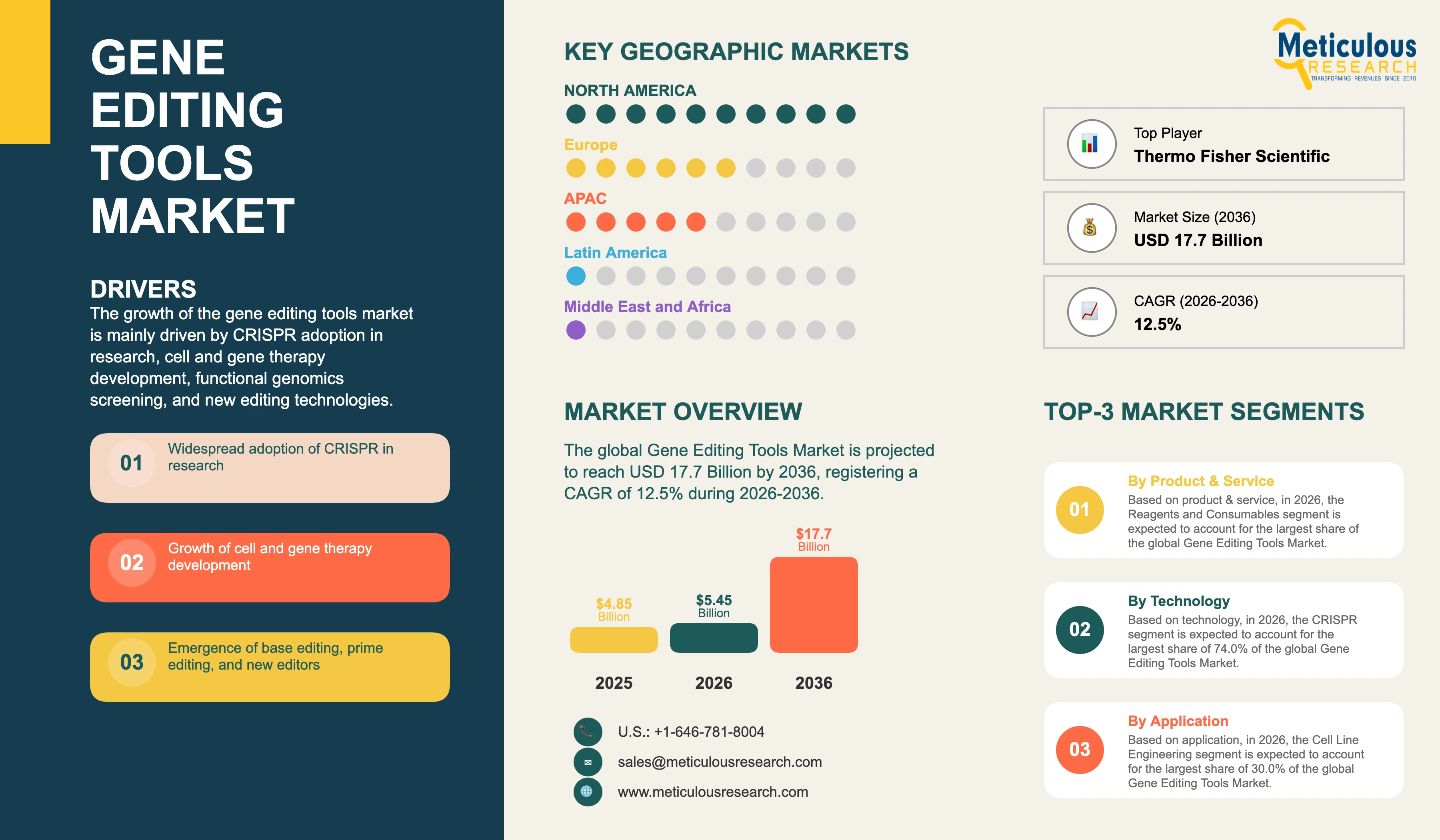
The global gene editing tools market was valued at USD 4.85 billion in 2025. This market is expected to reach USD 17.70 billion by 2036 from an estimated USD 5.45 billion in 2026, registering a CAGR of 12.5% during the forecast period (2026-2036).
- Published
- Nov 2026
- Pages
- 249
- Format
- PDF + Excel
- Report ID
- MRHC - 1042585
- Base year
- 2025
- 2025 · BASELINE
- $4.85B
- 2036
- $17.70B
- CAGR 2026–2036
- 12.5%
2025 baseline · 2026–2036 forecast at 12.5% CAGR · hover a bar for the value
Key highlights
The U.S. FDA approved Casgevy, developed by Vertex Pharmaceuticals and CRISPR Therapeutics, on December 8, 2023, as the first CRISPR-Cas9 therapy, which has encouraged a large number of cell and gene therapy developers to use gene editing tools and created growing demand for GMP-grade guide RNAs, nucleases, and editing services.
In May 2025, physicians at the Children's Hospital of Philadelphia and the University of Pennsylvania reported treating an infant with CPS1 deficiency with the first personalized in vivo base editing therapy, developed in about six months with editing components manufactured by Danaher companies Integrated DNA Technologies and Aldevron, which demonstrated the importance of rapid, high-quality supply of editing reagents. The case has encouraged discussion of platform approaches in which the same editor and delivery system are reused with different guide RNAs for patients with different mutations.
Synthego, a leading supplier of synthetic guide RNAs and CRISPR solutions, completed a financial restructuring and was acquired by Perceptive Advisors in July 2025, and it announced its entry into molecular biology and clinical diagnostic reagents in January 2026, reflecting both the competitive pressures and the diversification of gene editing tool suppliers; earlier, in January 2025, Synthego had licensed its eSpOT-ON CRISPR enzyme to AstraZeneca.
Synthego announced that a U.S. Supreme Court order on April 1, 2026 finalized the invalidation of Agilent CRISPR patents that had been the subject of litigation between the two companies, showing the continuing importance of intellectual property disputes in the gene editing tools market.
Base Therapeutics and KACTUS announced a partnership with Synthego in October 2025 to distribute the AccuBase cytosine base editor, described as the only GMP-grade base editing proteins available, while Integrated DNA Technologies and Aldevron launched research-grade Cas9 mRNA in wild-type and high-fidelity formats to support ex vivo and in vivo editing workflows.
By product & service, reagents and consumables account for the largest share in 2026, while software and design tools register the highest CAGR.
By technology, CRISPR accounts for the largest share of 74.0% in 2026, while base and prime editing registers the highest CAGR.
By application, cell line engineering accounts for the largest share of 30.0% in 2026, while therapeutic development registers the highest CAGR.
By end user, pharmaceutical and biotechnology companies account for the largest share in 2026, while CROs and CDMOs register the highest CAGR.
By geography, North America accounts for the largest share of 44.0% in 2026, while Asia-Pacific registers the highest CAGR of 15.4%.
Report summary
| Particulars | Details |
|---|---|
| Base Year | 2025 |
| Estimated Year | 2026 |
| Forecast Period | 2026-2036 |
| Market Size in 2025 | USD 4.85 billion |
| Market Size in 2026 | USD 5.45 billion |
| Market Size by 2036 | USD 17.70 billion |
| CAGR (2026-2036) | 12.5% |
| Format | PDF, Excel & Cloud Portal · 249 pages |
| Largest Segment by Technology (2026) | CRISPR (74.0%) |
| Largest Segment by Application (2026) | Cell Line Engineering (30.0%) |
| Largest Region (2026) | North America (44.0%) |
| Fastest-Growing Region | Asia-Pacific (CAGR 15.4%) |
| Companies Profiled | 15 companies and other companies |
| Segments Covered | Product & Service, Technology, Application, End User, Geography |
| Countries Covered | U.S., Canada, U.K., Germany, France, Switzerland, Netherlands, Sweden, Denmark, Italy, Spain, Belgium, Rest of Europe, China, Japan, South Korea, India, Australia, Singapore, Rest of Asia-Pacific, Brazil, Argentina, Mexico, Rest of Latin America, Israel, Saudi Arabia, U.A.E., South Africa, Rest of Middle East & Africa |
Report overview
Segments covered: product & service, technology, application, end user.
The growth of this market is mainly driven by the widespread adoption of CRISPR in academic and industrial research, the growth of cell and gene therapy development, which requires research-grade and GMP-grade editing components, the expansion of functional genomics screening for drug discovery, the emergence of precise editing technologies such as base editing and prime editing, and the use of gene editing in agricultural and industrial biotechnology. However, factors such as concerns over off-target effects and editing safety, complex intellectual property and licensing requirements, the high cost of GMP-grade reagents and specialized services, and pressure on research funding in some countries are expected to restrain the growth of this market to some extent.
Gene editing tools are the reagents, consumables, delivery systems, instruments, software, and services used to make targeted changes to the DNA of cells and organisms. They include guide RNAs, Cas9 and other nucleases supplied as proteins, mRNA, or plasmids, base editors and prime editors, TALEN and zinc finger nuclease reagents, donor templates, CRISPR libraries for genetic screening, delivery reagents and electroporation systems, editing analysis kits, design and analysis software, and services such as guide RNA synthesis, cell line engineering, and animal model generation. This report covers gene editing tools sold for research, drug discovery, therapeutic development, and agricultural and industrial biotechnology applications, including research-use-only and GMP-grade products. Revenues from gene editing therapies themselves, such as sales of approved CRISPR-based medicines, and licensing income of therapeutic developers are analyzed in separate reports. The market is measured on a revenue basis.
Gene editing has transformed biological research since the development of CRISPR-Cas9 as a programmable editing tool in 2012. Earlier technologies, such as zinc finger nucleases and TALENs, required complex protein engineering for each target, while CRISPR uses a short guide RNA to direct the Cas9 nuclease to almost any location in the genome, which makes editing faster, cheaper, and easier. As a result, CRISPR has become a standard tool in academic laboratories, pharmaceutical and biotechnology companies, and agricultural research worldwide, and it is used to create knockout and knock-in cell lines, study gene function, develop disease models, and screen for drug targets.
The approval of Casgevy, the first CRISPR-based therapy, by the U.S. FDA in December 2023 marked the transition of gene editing from a research tool to a therapeutic modality. Many companies are now developing ex vivo and in vivo gene editing therapies for blood disorders, cancer, genetic liver diseases, cardiovascular diseases, eye diseases, and other conditions, and CAR-T and other cell therapy developers use gene editing to engineer immune cells. These developers require GMP-grade guide RNAs, nucleases, mRNA, and other components, as well as specialized services, which creates a high-value segment of the tools market.
New editing technologies are rapidly expanding what researchers and therapeutic developers can achieve with gene editing. Base editors, which change single DNA letters without cutting both strands of DNA, and prime editors, which can make all types of small edits, offer greater precision and potentially lower risk of unwanted changes than conventional nuclease editing. The first personalized in vivo base editing therapy, given to an infant with CPS1 deficiency in 2025, showed how quickly custom editing components can now be designed and manufactured. Other emerging technologies, such as epigenetic editors, bridge recombinases, and AI-designed editors, are also being developed.
CRISPR accounts for the large majority of the gene editing tools market by technology, while base and prime editing is the fastest-growing technology. Reagents and consumables account for the largest share by product and service, and cell line engineering is the largest application, while therapeutic development is the fastest-growing application. Pharmaceutical and biotechnology companies are the largest end users, followed by academic and research institutes, CROs and CDMOs, and agricultural biotechnology companies.
The market is served by large life science tools companies, such as Thermo Fisher Scientific, Merck KGaA, Danaher through Integrated DNA Technologies and Aldevron, Revvity, Agilent Technologies, Lonza, Takara Bio, and New England Biolabs, and by specialized companies, such as Synthego, GenScript, OriGene Technologies, Twist Bioscience, Cellecta, Applied StemCell, and Cyagen Biosciences, which offer guide RNAs, libraries, cell line engineering, and animal model services. Intellectual property plays an important role, since key CRISPR patents are held by the Broad Institute and the University of California and its partners, and tool suppliers must obtain licenses for many applications.
North America is the largest regional market, supported by large research funding, a large biotechnology industry, and the presence of most leading tool suppliers, while Asia-Pacific is the fastest-growing region, supported by rapid growth of biotechnology and gene editing research in China, Japan, South Korea, and India, and by large contract research and animal model service providers in China.
Over the forecast period, the gene editing tools market is expected to grow strongly, supported by continued research adoption, therapeutic development, new editing technologies, and functional genomics. At the same time, safety concerns, intellectual property, research funding, and competition will shape the market.
CRISPR knockout cell lines and pooled screens are now standard in our target validation work, and we outsource complex cell line engineering to specialized providers.
This comment explains why CRISPR accounts for 74.0% of the market and why cell line engineering accounts for 30.0% of the market. It also shows the role of service providers. Outsourcing saves time. It also reduces internal workload.
Gene editing is used across almost every project in our institute, and local suppliers now offer guide RNAs and services at very competitive prices.
This comment explains why Asia-Pacific is the fastest-growing region and why price competition is a key challenge for suppliers. It also shows the strength of local suppliers. Quality is improving quickly.
North America is expected to account for the largest share of 44.0% of the market in 2026, mainly due to large research funding, the world's largest biotechnology industry, many gene editing therapy developers, and the presence of leading tool suppliers and research institutions.
Asia-Pacific is projected to register the highest CAGR of 15.4% during the forecast period, driven by rapid growth of biotechnology research and gene editing therapy development in China, government research funding, contract research growth in India, and agricultural gene editing research.
The report profiles 15 companies, including Thermo Fisher Scientific, Merck KGaA, Danaher (Integrated DNA Technologies and Aldevron), Revvity, Agilent, GenScript, Synthego, Lonza, Takara Bio, New England Biolabs, OriGene, Twist Bioscience, Cellecta, Applied StemCell, and Cyagen Biosciences.
Conventional CRISPR nuclease editing cuts both strands of DNA and relies on the cell's repair processes, while base editing chemically changes a single DNA letter without a double-strand break, which offers greater precision and potentially fewer unwanted changes.
Report infographic
Market dynamics
18 factors across 5 forcesWidespread adoption of CRISPR in research
CRISPR has become one of the most widely used tools in biological research. Academic laboratories, pharmaceutical and biotechnology companies, and agricultural research organizations use CRISPR to knock out, insert, or modify genes in cell lines, primary cells, stem cells, and model organisms, which allows them to study gene function and disease mechanisms. Commercial suppliers offer synthetic guide RNAs, Cas9 and Cas12 proteins, ready-to-use kits, and editing analysis tools that make CRISPR experiments faster and more reliable, and the cost of these products has fallen significantly, which has broadened adoption.
The large and growing number of scientific publications, research grants, and laboratories using CRISPR creates steady recurring demand for guide RNAs, nucleases, and related consumables, which form the largest part of the market.
Training programs, online design tools, and ready-to-use kits have also lowered the barriers for laboratories that are new to gene editing, which further expands the user base.
Growth of cell and gene therapy development
The approval of Casgevy in December 2023 and the growing pipeline of gene editing therapies have created strong demand for gene editing tools for therapeutic development. Developers of ex vivo therapies edit patients' or donors' cells outside the body, for example to create CAR-T cells or to correct blood disorders, while developers of in vivo therapies deliver editing components directly into patients, often using lipid nanoparticles. These developers require GMP-grade guide RNAs, nucleases, mRNA, and base editors, along with analytical tools to measure editing efficiency and off-target effects, and they often work with suppliers and CDMOs to scale up production.
The first personalized in vivo base editing therapy, developed in 2025 with components manufactured by Integrated DNA Technologies and Aldevron, demonstrated the ability of tool suppliers to provide rapid, high-quality custom editing components, and regulators have signaled openness to new approaches for bespoke therapies, which could further increase demand for GMP-grade tools.
Gene editing is also increasingly used to engineer allogeneic cell therapies, for example by removing genes that cause immune rejection, which requires multiple simultaneous edits and creates demand for high-performance editing reagents.
Expansion of functional genomics screening
Pharmaceutical and biotechnology companies and academic researchers use CRISPR libraries to perform genome-wide and targeted screens that identify genes involved in disease, drug response, and resistance. These screens help identify and validate new drug targets and biomarkers, and they are increasingly combined with single-cell sequencing, imaging, and artificial intelligence to generate large datasets. CRISPR activation and interference screens, which turn genes on or off without cutting DNA, further expand the applications of screening.
The growing use of functional genomics in drug discovery creates demand for pooled and arrayed CRISPR libraries, screening services, and analysis software from suppliers such as Revvity, Cellecta, Synthego, and others.
Emergence of base editing, prime editing, and new editors
Base editing and prime editing offer more precise editing than conventional nuclease-based CRISPR, since they can change single DNA letters or make small insertions and deletions without creating double-strand breaks, which reduces the risk of unwanted changes. These technologies are increasingly used in research and therapeutic development, and suppliers are introducing research-grade and GMP-grade base editors, such as the AccuBase cytosine base editor distributed by Synthego. Other new editors, including compact nucleases such as Cas12 variants, epigenetic editors, and AI-designed editors, are expanding the toolbox.
The introduction of new editing technologies creates demand for new reagents, delivery systems, and analytical tools, and allows suppliers to offer higher-value products.
Use of gene editing in agricultural and industrial biotechnology
Gene editing is widely used in agricultural research to develop crops with higher yields, improved nutritional quality, disease resistance, and tolerance to drought and heat, and in livestock to improve disease resistance and productivity. Several countries, including the U.S., Japan, Argentina, Brazil, the U.K., and others, have adopted regulations that treat some gene-edited plants differently from conventional genetically modified organisms, and the EU has been developing rules for plants produced with new genomic techniques. Gene editing is also used in industrial biotechnology to engineer microorganisms for the production of chemicals, enzymes, and food ingredients.
These applications create demand for gene editing reagents, services, and licenses from agricultural biotechnology companies, seed companies, and research institutions. Gene-edited crops are already being commercialized in Japan, the U.S., and other countries.
Table of contents
12 chapters · 157 sections · 249 pages · click to expandSegmental analysis
| Segment | Largest share (2026) | Fastest growth (2026–2036) |
|---|---|---|
| By Product & Service | Reagents and consumables | Software and design tools |
By Product & Service
- The reagents and consumables segment is expected to account for the largest share of the gene editing tools market, while the software and design tools segment is projected to register the highest CAGR during the forecast period.
- The pharmaceutical and biotechnology companies segment is expected to account for the largest share of the gene editing tools market, while the CROs and CDMOs segment is projected to register the highest CAGR during the forecast period.
Geographic analysis
North America
Largest shareIn 2026, North America is expected to account for the largest share of 44.0% of the global gene editing tools market. The large share of this region is mainly due to large public and private research funding, the world's largest biotechnology and pharmaceutical industries, the large number of gene editing therapy developers, including the developers of Casgevy, the presence of leading tool suppliers such as Thermo Fisher Scientific, Integrated DNA Technologies, Aldevron, Agilent, Synthego, New England Biolabs, OriGene, and Twist Bioscience, and leading research institutions such as the Broad Institute and the University of California. The U.S. is the largest market in the region, followed by Canada. Changes in U.S. federal research funding could affect academic demand, but industrial demand remains strong.
Asia-Pacific
Fastest growthAsia-Pacific is projected to register the highest CAGR of 15.4% during the forecast period. The rapid growth of this region is mainly driven by rapid growth of biotechnology research and gene editing therapy development in China, which has a large number of gene editing clinical trials, large government research funding in China, Japan, South Korea, and Singapore, growing pharmaceutical research and contract research in India, the presence of large contract research and animal model service providers such as GenScript and Cyagen Biosciences, and growing agricultural gene editing research. China, Japan, South Korea, India, Australia, and Singapore are important markets. Chinese researchers have also been among the most active in agricultural gene editing, and China has issued guidelines for the safety evaluation of gene-edited plants.
Europe
Europe accounts for a significant share of the global market, supported by strong academic research, a large pharmaceutical industry, growing gene editing therapy development, and leading suppliers such as Merck KGaA and Lonza. The U.K., Germany, France, Switzerland, the Netherlands, Sweden, Denmark, Italy, Spain, and Belgium are important markets. The development of EU rules for plants produced with new genomic techniques could support growth in agricultural applications.
Latin America
Latin America and the Middle East & Africa account for smaller shares of the market but are growing, supported by agricultural gene editing research in Brazil and Argentina, which have adopted favorable regulations for gene-edited crops, and growing biotechnology research in Israel, Saudi Arabia, and the U.A.E. Brazil and Argentina are also among the leading adopters of gene-edited crops.
Middle East & Africa
Israel has an active gene editing research community and several biotechnology companies developing editing-based technologies.
Competitive landscape
The global gene editing tools market is moderately consolidated, with the top five players estimated to account for about 45% of the market in 2025. The market includes large life science tools companies, specialized gene editing reagent and service providers, contract research organizations, and software providers.
Thermo Fisher Scientific offers a broad portfolio of CRISPR reagents, nucleases, guide RNAs, delivery systems, and cell line engineering services. Merck KGaA offers CRISPR reagents, libraries, and GMP manufacturing support. Danaher, through Integrated DNA Technologies and Aldevron, offers guide RNAs, nucleases, mRNA, and GMP manufacturing, and its companies supplied components for the first personalized base editing therapy. Revvity offers CRISPR libraries and screening tools through its Horizon Discovery business, Agilent offers CRISPR reagents and analysis tools, and Lonza, Takara Bio, and New England Biolabs offer delivery systems, reagents, and enzymes. Synthego, GenScript, OriGene Technologies, Twist Bioscience, Cellecta, Applied StemCell, and Cyagen Biosciences offer specialized guide RNAs, libraries, cell line engineering, and animal model services.
Companies in this market compete on editing efficiency and specificity, product quality and consistency, the availability of GMP-grade products, breadth of portfolio, technical support, turnaround time, price, and intellectual property position. Key strategies include launches of new editors and formats, expansion of GMP manufacturing capacity, partnerships and licensing agreements with technology developers, acquisitions, and integration of design software and analysis tools.
Price competition is intense for standard research products, particularly from suppliers in China, while competition for GMP-grade products and specialized services is based more on quality, regulatory support, and reliability. Intellectual property and licensing also influence competition, since suppliers must secure rights to key technologies.
We expect continued consolidation, as large life science tools companies acquire specialized suppliers and as smaller companies seek partners or diversify. Suppliers that can support customers from research through clinical and commercial manufacturing will have an advantage. Partnerships between tool suppliers and therapeutic developers, such as supply agreements for GMP-grade editors, are also becoming more common. Synthego's licensing of eSpOT-ON to AstraZeneca is one example. Such deals provide steady revenues. They also validate new technologies.
Some of the key players operating in the gene editing tools market are Thermo Fisher Scientific Inc., Merck KGaA, Danaher Corporation (Integrated DNA Technologies and Aldevron), Revvity, Inc., Agilent Technologies, Inc., GenScript Biotech Corporation, Synthego Corporation, Lonza Group AG, Takara Bio Inc., New England Biolabs, Inc., OriGene Technologies, Inc., Twist Bioscience Corporation, Cellecta, Inc., Applied StemCell, Inc., and Cyagen Biosciences Inc., among others.
- —
Synthego was acquired by Perceptive Advisors in July 2025 and entered diagnostic reagents in January 2026, a U.S. Supreme Court order in April 2026 finalized the invalidation of Agilent CRISPR patents, and the first personalized in vivo base editing therapy was developed in 2025 with components from Integrated DNA Technologies and Aldevron.
- Thermo Fisher Scientific Inc.
- Merck KGaA
- Danaher Corporation (Integrated DNA Technologies and Aldevron)
- Revvity, Inc.
- Agilent Technologies, Inc.
- GenScript Biotech Corporation
- Synthego Corporation
- Lonza Group AG
- Takara Bio Inc.
- New England Biolabs, Inc.
- OriGene Technologies, Inc.
- Twist Bioscience Corporation
- Cellecta, Inc.
- Applied StemCell, Inc.
- Cyagen Biosciences Inc.
Expert perspectives
Gene editing has become a fundamental technology in life sciences research and an increasingly important therapeutic modality. The tools market is growing steadily, supported by broad research adoption, and its fastest growth is coming from therapeutic development, precision editing technologies, and software.
Over the forecast period, the market is expected to grow at a CAGR of 12.5%, from USD 5.45 billion in 2026 to USD 17.70 billion in 2036. Growth will be supported by research adoption of CRISPR, cell and gene therapy development, functional genomics, new editing technologies, and agricultural and industrial applications.
Among the market segments, reagents and consumables are the largest product and service, while software and design tools grow fastest. CRISPR is the largest technology, while base and prime editing grow fastest, cell line engineering is the largest application, while therapeutic development grows fastest, and pharmaceutical and biotechnology companies are the largest end users, while CROs and CDMOs grow fastest. North America is the largest region, and Asia-Pacific is the fastest-growing region at a CAGR of 15.4%.
In our view, the most important change over the forecast period will be the growing share of high-value GMP-grade products and services for therapeutic development. As gene editing therapies advance and personalized therapies emerge, suppliers that can provide consistent, well-documented, and rapidly manufactured editing components will capture an increasing share of market value.
We also expect base editing, prime editing, and other precision technologies to gain share from conventional nuclease editing, particularly in therapeutic applications, and AI to become an important part of editor design and experimental planning.
Research funding pressures and price competition in standard products will remain challenges, particularly for smaller suppliers, and consolidation is likely to continue. Intellectual property will continue to influence which suppliers can serve therapeutic customers. The resolution of patent disputes could open new opportunities for some suppliers. We also expect Asia-Pacific, particularly China, to become an increasingly important source of both demand and supply, with Chinese suppliers competing strongly on price in research products and gradually moving into GMP-grade products. Agricultural gene editing could also become a larger part of the market as regulations become more favorable in the EU and other regions. Chinese and Indian service providers will also continue to gain share in outsourced cell line engineering and screening work for global clients. Demand from industry will remain resilient.
Overall, we believe the gene editing tools market will grow strongly over the forecast period, with value shifting toward precision editors, GMP-grade products, delivery technologies, and integrated workflows.
Customer perspectives
Head of Genome Engineering - gene therapy company, U.S.
We started with research-grade guide RNAs and base editors and now need the same components at GMP grade with full documentation. Consistency between research and clinical material is essential for us.
This comment explains why therapeutic development is the fastest-growing application and why GMP-grade reagents are an important source of value.
Frequently asked questions
The global gene editing tools market was valued at USD 4.85 billion in 2025, up from USD 4.30 billion in 2024, and is estimated at USD 5.45 billion in 2026. The market includes reagents and consumables, gene editing services, delivery reagents and instruments, and software and design tools based on CRISPR, base and prime editing, TALEN, ZFN, and other technologies.
Cite this report
Meticulous Research. (2026). Gene Editing Tools Market - Global Opportunity Analysis and Industry Forecast (2026-2036) (Report No. MRHC - 1042585). Meticulous Market Research Pvt. Ltd. https://www.meticulousresearch.com/product/gene-editing-tools-market-7268