Gene-Edited Livestock Market (2026-2036)
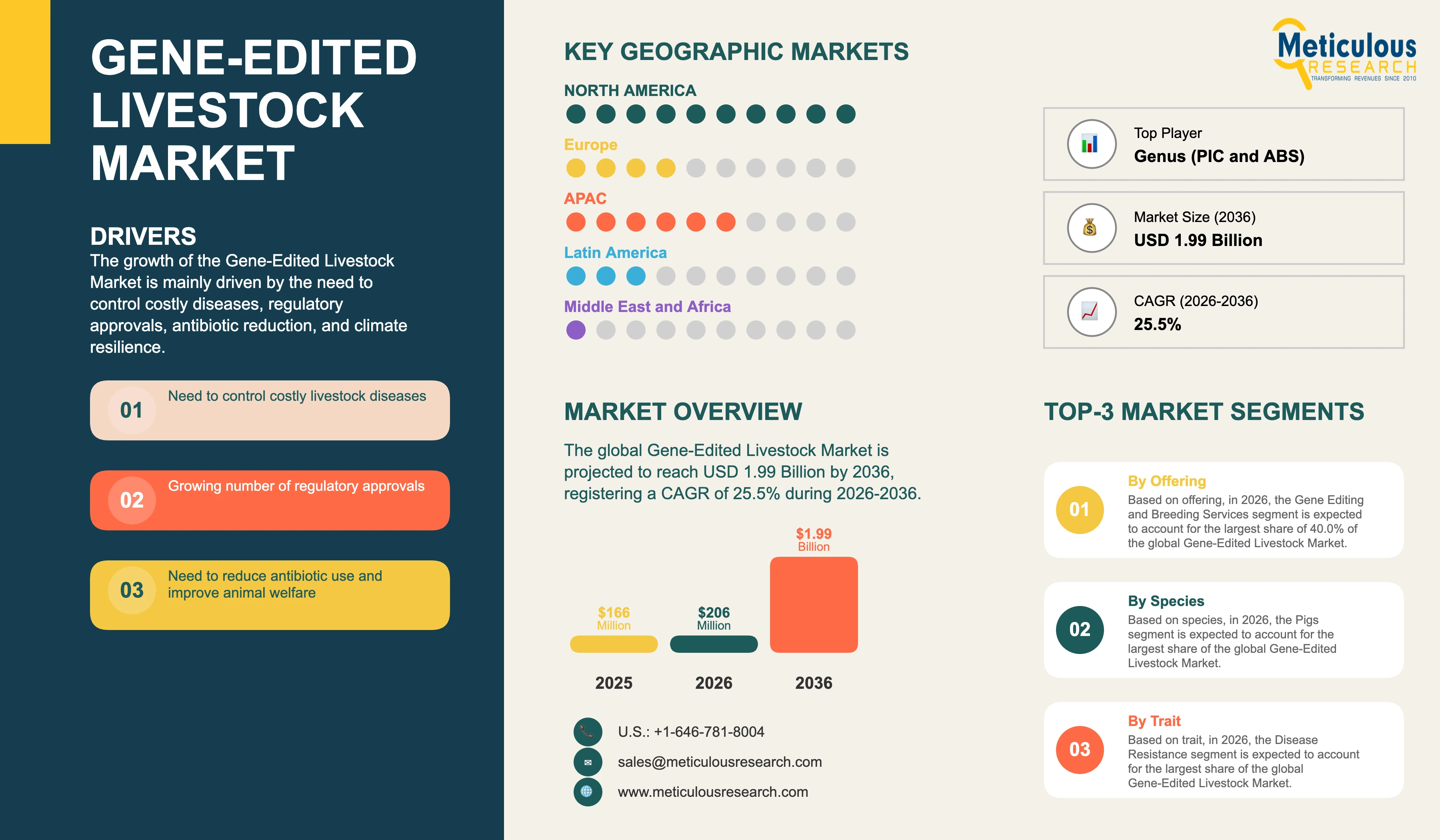
The global gene-edited livestock market was valued at USD 166.0 million in 2025. This market is expected to reach USD 1.99 billion by 2036 from an estimated USD 206.0 million in 2026, registering a CAGR of 25.5% during the forecast period (2026-2036).
- Published
- Nov 2026
- Pages
- 245
- Format
- PDF + Excel
- Report ID
- MRAGR - 1042620
- Base year
- 2025
- 2025 · BASELINE
- $166.0M
- 2036
- $1.99B
- CAGR 2026–2036
- 25.5%
2025 baseline · 2026–2036 forecast at 25.5% CAGR · hover a bar for the value
Key highlights
On April 30, 2025, the U.S. Food and Drug Administration approved the gene edit used in PIC's porcine reproductive and respiratory syndrome (PRRS)-resistant pig, determining that the technology is safe and effective, which made PIC among the first companies to gain approval for gene editing in commercial livestock in the U.S., according to PIC.
On January 23, 2026, Genus announced that Canada had approved the use of its PRRS-resistant pig gene edit, following reviews by Health Canada and the Canadian Food Inspection Agency, and said that successful commercialization in North America requires further approvals in key export markets, particularly Mexico and Japan, while it continues to work with other regulators, including China, according to Genus.
Colombia, Brazil, the Dominican Republic, and Argentina have issued positive determinations for PIC's PRRS-resistant pigs, which means that these countries regulate the pigs in the same way as conventionally bred pigs, according to PIC and 3tres3.
Genus has cited a study estimating the cost of PRRS to the U.S. pork industry at USD 1.2 billion per year and a separate study showing that PRRS increased antibiotic use by more than 200%, while an Iowa State University study found that injectable and water antimicrobial use in nursery pigs increased 379% during a PRRS outbreak, according to Genus and Feedstuffs.
Research conducted by Circana and commissioned by PIC in late 2025 found that 90% of Canadian consumers are open to purchasing pork from gene-edited pigs, with responsibly reducing the need for antibiotics ranked as the top motivator, according to PIC and 3tres3.
In England, the Genetic Technology (Precision Breeding) Act 2023 covers both plants and vertebrate animals, but the 2025 regulations implemented only the plant provisions, and as of spring 2026 no precision-bred animal had been authorized for sale as food or feed in England, according to the U.K. government and the Genetic Literacy Project. Genus sells its genetics in more than 75 countries under the PIC and ABS brands, which gives it a large global distribution network for future gene-edited genetics.
By offering, gene editing and breeding services account for the largest share of 40.0% in 2026, while gene-edited Genetics and licensing registers the highest CAGR.
By species, pigs account for the largest share in 2026 and also register the highest CAGR.
By trait, disease resistance accounts for the largest share in 2026 and also registers the highest CAGR.
By end user, animal Genetics and breeding companies account for the largest share of 55.0% in 2026, while livestock and aquaculture producers register the highest CAGR.
By geography, North America accounts for the largest share of 42.0% in 2026, while Asia-Pacific registers the highest CAGR of 30.0%.
Report summary
| Particulars | Details |
|---|---|
| Forecast Period | 2026-2036 |
| Base Year | 2025 |
| Estimated Year | 2026 |
| CAGR (Value) | 25.5% |
| Format | PDF, Excel & Cloud Portal · 245 pages |
| Market Size in 2025 | USD 166.0 million |
| Market Size in 2026 | USD 206.0 million |
| Market Size by 2036 | USD 1.99 billion |
| Largest Segment by Offering (2026) | Gene Editing and Breeding Services (40.0%) |
| Largest Segment by End User (2026) | Animal Genetics and Breeding Companies (55.0%) |
| Largest Region (2026) | North America (42.0%) |
| Fastest-Growing Region | Asia-Pacific (CAGR 30.0%) |
| Key Companies | 13 companies and other companies |
| Segments Covered | Offering, Species, Trait, End User, Geography |
| Countries Covered | U.S., Canada, China, Japan, India, South Korea, Australia, Indonesia, Thailand, Singapore, Malaysia, Vietnam, Philippines, Taiwan, New Zealand, Rest of Asia-Pacific, Germany, U.K., France, Italy, Spain, Netherlands, Switzerland, Belgium, Sweden, Denmark, Norway, Finland, Austria, Poland, Ireland, Rest of Europe, Brazil, Mexico, Argentina, Colombia, Chile, Peru, Rest of Latin America, Saudi Arabia, U.A.E., Israel, South Africa, Turkey, Egypt, Rest of Middle East & Africa |
Report overview
Segments covered: offering, specy, trait, end user.
The growth of this market is mainly driven by the need to control costly livestock diseases, such as porcine reproductive and respiratory syndrome, the growing number of regulatory approvals and favorable determinations for gene-edited animals in the U.S., Canada, Latin America, and Japan, the need to reduce antibiotic use and improve animal welfare in livestock production, the pressure to improve productivity and climate resilience in livestock and aquaculture, and continued advances in CRISPR and other gene editing technologies. However, factors such as the long and uncertain regulatory approval process in many countries, the need for approvals in key export markets before commercial launch, consumer and retailer concerns about gene-edited food, and animal welfare concerns raised by some groups are expected to restrain the growth of this market to some extent. Nevertheless, the first commercial launches of gene-edited pigs are expected to accelerate market growth.
Gene-edited livestock are farm animals and fish whose DNA has been changed in a precise way using gene editing tools, such as CRISPR-Cas systems, TALENs, and base editors. Unlike traditional genetically modified organisms, most gene-edited livestock do not contain foreign DNA. Instead, gene editing is used to make small changes to an animal's own genes, such as deleting a small part of a gene, to introduce desirable traits, such as resistance to disease, tolerance to heat, absence of horns, or improved growth. These traits can then be passed to offspring through conventional breeding.
This report covers the global gene-edited livestock market, including gene editing and breeding services provided to animal genetics companies, producers, and research institutes, gene-edited genetics, such as breeding animals, semen, and embryos, and related technology licensing, and gene editing tools and reagents used in livestock and aquaculture research and breeding programs. The market is analyzed by offering, species, trait, end user, and geography. The market is measured on a revenue basis. The value of meat, milk, and fish produced from gene-edited animals and the use of gene editing for biomedical research or xenotransplantation are not included.
The most important development in the market is the approval of PIC's PRRS-resistant pig. PRRS is one of the most devastating and costly diseases in pig production worldwide, causing respiratory problems, reproductive failure, and death. PIC, a subsidiary of Genus, used gene editing to remove a small part of the CD163 gene that the PRRS virus uses to enter pig cells, making the pigs resistant to the disease. The technology was based on research by the University of Missouri and the University of Edinburgh's Roslin Institute. The FDA approved the gene edit in April 2025, and Canada approved it in January 2026.
Other gene-edited livestock and aquaculture products are also moving toward the market. In the U.S., the FDA has made low-risk determinations for gene-edited cattle with a short, slick hair coat that improves heat tolerance, developed by Acceligen, and in Japan, gene-edited fish, such as red sea bream and tiger puffer developed by Regional Fish Institute, have been notified to regulators and sold commercially. Researchers are also developing gene-edited animals with resistance to avian influenza, bovine respiratory disease, and other diseases, as well as hornless cattle and animals with improved feed efficiency.
Regulation is the most important factor shaping the gene-edited livestock market, and countries are taking very different approaches to gene-edited animals. The U.S. regulates gene edits in animals through the FDA, while Argentina, Brazil, Colombia, Japan, and several other countries have adopted product-based approaches that do not regulate gene-edited animals without foreign DNA as genetically modified organisms. England's Precision Breeding Act covers animals, but regulations for animals have not yet been implemented, and the European Union continues to regulate gene-edited animals under its genetically modified organism rules. Because livestock products are traded internationally, companies often need approvals in export markets before launching gene-edited animals commercially.
In 2026, gene editing and breeding services account for the largest share of the market by offering, while gene-edited genetics and licensing are the fastest-growing offering. Pigs are the largest species and also the fastest-growing species. Disease resistance is the largest trait and also the fastest-growing trait. Animal genetics and breeding companies are the largest end user, while livestock and aquaculture producers are the fastest-growing end user. North America accounts for the largest share of the market, while Asia-Pacific is the fastest-growing region.
Over the forecast period, the gene-edited livestock market is expected to grow rapidly from a small base, supported by the commercial launch of PRRS-resistant pigs, new regulatory approvals, the development of new traits for cattle, poultry, and aquaculture, and the growing need to improve animal health, reduce antibiotic use, and adapt livestock production to climate change. However, the pace of growth will depend heavily on regulatory decisions in key markets and on acceptance by processors, retailers, and consumers. The value chain for gene-edited livestock includes tool suppliers, research institutes, gene editing service providers, breeding companies that multiply and distribute genetics, producers, processors, and retailers. Because breeding companies sit at the top of the breeding pyramid, a trait introduced into their nucleus herds can reach millions of commercial animals over several years, which makes them central to commercialization.
North America is expected to account for the largest share of 42.0% of the market in 2026, mainly due to the approval of the PRRS-resistant pig in the U.S. and Canada, large livestock industries, and the presence of leading breeding companies and gene editing service providers.
Asia-Pacific is projected to register the highest CAGR of 30.0% during the forecast period, driven by Japan's product-based regulation and gene-edited fish, very large livestock and aquaculture industries, and growing investment in agricultural biotechnology.
The report profiles 13 companies, including Genus (PIC and ABS), Acceligen, Regional Fish Institute, URUS (Trans Ova Genetics), Hendrix Genetics, Topigs Norsvin, Benchmark Genetics, Thermo Fisher Scientific, Merck KGaA, Integrated DNA Technologies, GenScript, Synthego, and Neogen.
The PRRS-resistant pig, developed by PIC, a subsidiary of Genus, has a small part of the CD163 gene removed so that the PRRS virus cannot enter the pig's cells. The trait is inherited by offspring through conventional breeding. No foreign DNA is added.
Gene editing makes precise changes to an animal's own genes, often by deleting or changing a small part of a gene, and usually does not introduce foreign DNA. Traditional genetic modification typically inserts DNA from another species. Many countries regulate gene-edited animals without foreign DNA differently from genetically modified organisms.
Report infographic
Market dynamics
18 factors across 5 forcesNeed to control costly livestock diseases
Livestock diseases cause significant economic losses, animal suffering, and food security risks around the world. PRRS alone is estimated to cost the U.S. pork industry USD 1.2 billion per year, according to a study cited by Genus, and the disease is endemic in most pig-producing regions. Other diseases, such as avian influenza, African swine fever, bovine respiratory disease, and bovine tuberculosis, also cause major losses. Vaccines and biosecurity measures have not been able to fully control many of these diseases.
Gene editing offers a new way to protect animals by making them resistant to specific diseases, as shown by PIC's PRRS-resistant pig, which prevents the virus from entering pig cells. Because the resistance trait is inherited, it can provide long-term protection across generations. The need to control costly diseases is the most important driver of the gene-edited livestock market, and disease resistance is the largest trait segment. Producers are particularly interested in traits that reduce mortality, improve growth, and lower veterinary costs at the same time.
Growing number of regulatory approvals and favorable determinations
Regulatory progress in North America, Latin America, and Asia is opening the path to commercialization of gene-edited livestock. The FDA approved PIC's PRRS-resistant pig gene edit in April 2025, Canada approved it in January 2026, and Colombia, Brazil, the Dominican Republic, and Argentina issued positive determinations. The FDA has also made low-risk determinations for other gene-edited animals, such as heat-tolerant slick-coat cattle, and Japan has allowed the sale of several gene-edited fish.
Each approval increases confidence among companies, investors, and producers that gene-edited animals can reach the market. Genus has said that it continues to make progress with regulators in Mexico, Japan, and China, which are key markets for the commercial launch of PRRS-resistant pigs. As more countries adopt clear, science-based regulatory frameworks for gene-edited animals, investment in new traits and species is expected to increase.
Need to reduce antibiotic use and improve animal welfare
Reducing antibiotic use in livestock is a priority for governments, food companies, and consumers because of concerns about antimicrobial resistance. Disease outbreaks often lead to increased antibiotic use to treat secondary infections. An Iowa State University study found that injectable and water antimicrobial use in nursery pigs increased 379% during a PRRS outbreak, according to Feedstuffs, and Genus has cited a study showing that PRRS increased antibiotic use by more than 200%.
Gene-edited animals that are resistant to disease can reduce the need for antibiotics and improve animal welfare by preventing suffering and premature death. Other welfare traits, such as hornless cattle that do not need dehorning, are also being developed. Circana research commissioned by PIC found that reducing the need for antibiotics was the top motivator for Canadian consumers who are open to buying pork from gene-edited pigs, which shows that these benefits can support consumer acceptance.
Pressure to improve productivity and climate resilience
Livestock and aquaculture producers face pressure to produce more food with fewer resources while adapting to rising temperatures, extreme weather, and new disease threats linked to climate change. Gene editing can introduce traits that improve productivity, feed efficiency, and resilience, such as heat tolerance in cattle through the slick-coat trait, faster growth in fish, and improved meat yield. These traits can help producers maintain productivity in hot climates and reduce the environmental footprint of livestock production.
Aquaculture is a particularly promising area, as fish have short generation times and high reproductive rates, which allows gene-edited traits to be introduced into production quickly. Japan's Regional Fish Institute has developed gene-edited red sea bream and tiger puffer with improved growth and meat yield, which shows how quickly gene-edited traits can reach consumers in aquaculture. Heat tolerance and climate resilience traits are expected to grow rapidly over the forecast period, particularly in tropical and subtropical regions.
Advances in gene editing technologies
Advances in CRISPR-Cas systems, base editing, prime editing, and delivery methods have made gene editing in livestock more precise, efficient, and affordable. Improvements in embryo editing, cloning, and reproductive technologies, such as in vitro fertilization and embryo transfer, allow edited traits to be introduced into breeding populations more quickly. Genomic selection and sequencing technologies also help breeders identify target genes and verify edits. The declining cost of gene editing tools and services is enabling more companies and research institutes to develop gene-edited animals. Base and prime editing, which change single DNA letters without cutting both DNA strands, are expected to further improve precision and reduce unintended changes.
Table of contents
12 chapters · 168 sections · 245 pages · click to expandSegmental analysis
| Segment | Largest share (2026) | Fastest growth (2026–2036) |
|---|---|---|
| By Offering | Animal Genetics and breeding companies | Livestock and aquaculture producers |
By Offering
- The animal Genetics and breeding companies segment is expected to account for the largest share of 55.0% of the gene-edited livestock market, while the livestock and aquaculture producers segment is projected to register the highest CAGR during the forecast period.
- The disease resistance segment is expected to account for the largest share of the gene-edited livestock market, and it is also projected to register the highest CAGR during the forecast period.
Geographic analysis
North America
Largest shareIn 2026, North America is expected to account for the largest share of 42.0% of the global gene-edited livestock market. The large share of this region is mainly due to the FDA's approval of PIC's PRRS-resistant pig gene edit in April 2025 and Canada's approval in January 2026, the FDA's low-risk determinations for other gene-edited animals, such as heat-tolerant cattle, the large pig and cattle industries in the U.S. and Canada, the presence of leading breeding companies, gene editing service providers, and tool suppliers, such as Genus PIC, Acceligen, Trans Ova Genetics, and Thermo Fisher Scientific, and strong research programs at universities and research institutes. However, commercialization in the region depends on approvals in key export markets, such as Mexico and Japan. Mexico's approval of PRRS-resistant pigs is a key requirement for commercialization in North America, which makes regulatory progress in the country particularly important.
Asia-Pacific
Fastest growthAsia-Pacific is projected to register the highest CAGR of 30.0% during the forecast period. The rapid growth of this region is mainly driven by Japan's product-based regulatory framework, which has allowed the commercial sale of gene-edited fish, such as red sea bream and tiger puffer developed by Regional Fish Institute, the very large pig, poultry, and aquaculture industries in China, Vietnam, Indonesia, and other countries, the high cost of diseases such as African swine fever and avian influenza in the region, and the growing investment in agricultural biotechnology in China, Japan, Australia, and South Korea. Approvals of PRRS-resistant pigs in Japan and China would significantly accelerate growth in the region.
Latin America
Latin America accounts for a significant share of the market and is one of the faster-growing regions, supported by product-based regulatory frameworks in Argentina, Brazil, and Colombia, which have issued positive determinations for PIC's PRRS-resistant pigs, the large cattle, pig, and poultry industries in Brazil, Argentina, and Mexico, and the strong interest in heat tolerance traits for cattle in tropical regions.
Europe
Europe and the Middle East & Africa account for smaller shares of the market. In Europe, the European Union regulates gene-edited animals as genetically modified organisms, and England has not yet implemented its Precision Breeding Act for animals, which limits commercialization in the region, although research at institutes such as the Roslin Institute and breeding companies such as Hendrix Genetics and Topigs Norsvin remains strong. Policy changes in Europe could significantly increase demand for gene-edited genetics over the forecast period. Regional differences in regulatory frameworks, the size of livestock and aquaculture industries, disease pressure, trade relationships, and public attitudes toward gene editing shape the development of the gene-edited livestock market around the world. Countries with product-based regulation, large livestock sectors, and high disease pressure are expected to adopt gene-edited animals fastest over the forecast period.
Middle East & Africa
In the Middle East & Africa, interest in gene-edited livestock is growing, particularly for heat tolerance and disease resistance traits, but regulatory frameworks are still developing in most countries.
Competitive landscape
The global gene-edited livestock market is at an early stage and is relatively concentrated, with a small number of breeding companies and gene editing specialists leading commercialization, supported by tool suppliers and research institutes. The top five players are estimated to account for about 45% of the market in 2025.
Genus, through PIC and ABS, is the leading company in gene-edited livestock, with its PRRS-resistant pig approved in the U.S. and Canada and positive determinations in several Latin American countries. Acceligen, part of Recombinetics, develops gene-edited cattle with traits such as heat tolerance and hornlessness, and URUS's Trans Ova Genetics provides reproductive and breeding services. Regional Fish Institute has commercialized gene-edited fish in Japan, while Hendrix Genetics, Topigs Norsvin, and Benchmark Genetics are major breeding companies with research programs in genetics and genomics. Thermo Fisher Scientific, Merck KGaA, Integrated DNA Technologies, GenScript, and Synthego supply gene editing tools and reagents, and Neogen provides genomic testing services used in livestock breeding.
Companies in this market compete on the commercial value of their traits, the strength of their intellectual property, regulatory approvals, breeding and distribution networks, technical expertise in gene editing and reproduction, and relationships with producers, processors, and regulators. Key strategies include pursuing regulatory approvals in key markets, licensing gene editing technologies and traits, partnering with research institutes, and building market acceptance among processors and retailers.
Recent competitive activity has focused on regulatory approvals for the PRRS-resistant pig. Genus received FDA approval in April 2025 and Canadian approval in January 2026, while positive determinations were issued in Colombia, Brazil, the Dominican Republic, and Argentina. Genus is pursuing approvals in Mexico, Japan, and China, and PIC is working with stakeholders across the pork value chain to prepare for commercialization.
We expect competition to increase as more companies develop gene-edited traits for cattle, poultry, and aquaculture and as regulatory frameworks become clearer. Intellectual property and licensing agreements will play an important role in shaping competition.
Some of the key players operating in the gene-edited livestock market are Genus plc (PIC and ABS), Acceligen (Recombinetics, Inc.), Regional Fish Institute, Ltd., URUS Group LP (Trans Ova Genetics), Hendrix Genetics BV, Topigs Norsvin, Benchmark Genetics (Benchmark Holdings plc), Thermo Fisher Scientific Inc., Merck KGaA, Integrated DNA Technologies (Danaher Corporation), GenScript Biotech Corporation, Synthego Corporation, and Neogen Corporation, among others. Collaboration across the value chain, including processors and retailers, will also be essential for market acceptance. New entrants are likely to focus on aquaculture and specialty traits.
- —
The FDA approved PIC's PRRS-resistant pig gene edit in April 2025, Canada approved it in January 2026, and Colombia, Brazil, the Dominican Republic, and Argentina issued positive determinations, while Genus is pursuing approvals in Mexico, Japan, and China.
- Genus plc (PIC and ABS)
- Acceligen (Recombinetics, Inc.)
- Regional Fish Institute, Ltd.
- URUS Group LP (Trans Ova Genetics)
- Hendrix Genetics BV
- Topigs Norsvin
- Benchmark Genetics (Benchmark Holdings plc)
- Thermo Fisher Scientific Inc.
- Merck KGaA
- Integrated DNA Technologies · Danaher Corporation
- GenScript Biotech Corporation
- Synthego Corporation
- Neogen Corporation
Expert perspectives
The gene-edited livestock market is at a turning point as the first major products move from research toward commercial use. After many years of research, the first major gene-edited livestock product, PIC's PRRS-resistant pig, has received approval in the U.S. and Canada and positive determinations in several Latin American countries. Its commercial launch, once approvals are obtained in key export markets, would mark the beginning of large-scale commercialization of gene-edited livestock.
Over the forecast period, the market is expected to grow at a CAGR of 25.5%, from USD 206.0 million in 2026 to USD 1.99 billion in 2036. Growth will be supported by the commercial launch of PRRS-resistant pigs, new regulatory approvals, gene-edited aquaculture species, heat tolerance and other climate resilience traits, and the need to reduce disease losses and antibiotic use.
Among the market segments, gene editing and breeding services are the largest offering, while gene-edited genetics and licensing grow fastest. Pigs are the largest and fastest-growing species, disease resistance is the largest and fastest-growing trait, and animal genetics and breeding companies are the largest end user, while livestock and aquaculture producers grow fastest. North America is the largest region, and Asia-Pacific is the fastest-growing region at a CAGR of 30.0%.
In our view, the most important factor for the market over the forecast period will be regulatory decisions in key countries, particularly Mexico, Japan, and China for PRRS-resistant pigs, and the European Union and England for gene-edited animals more broadly. Positive decisions would allow commercialization to proceed and encourage investment in new traits, while delays would slow market growth and keep revenues concentrated in research services and tools.
We also expect consumer and retailer acceptance to be critical for the commercial success of gene-edited livestock. Traits that clearly improve animal welfare and reduce antibiotic use, such as disease resistance, are more likely to gain acceptance than traits focused only on productivity. Companies that communicate transparently and work closely with the food value chain will be best positioned to succeed. Aquaculture is likely to be a fast-moving area, as gene-edited fish can be developed and commercialized more quickly than many land animals.
Overall, we believe the gene-edited livestock market will grow rapidly over the forecast period from a small base, with gene-edited genetics, pigs, disease resistance, livestock producers, and Asia-Pacific providing the fastest growth. Companies with valuable traits, strong intellectual property, and global breeding networks will be best positioned to capture this growth. We also expect companies to focus on traits that combine clear economic benefits for producers with clear welfare and sustainability benefits for society, as these traits have the best chance of gaining regulatory approval and public support.
Customer perspectives
Pork Producer - U.S.
PRRS has cost us more than any other disease over the years. If resistant pigs are approved in our export markets, we would want them in our herd as soon as possible.
“Gene editing allows us to add traits that would take decades through conventional breeding, but we need clear regulation and acceptance from the food chain before we can commercialize.”
“Gene-edited fish can reach the market quickly because of short generation times, and consumers here have been willing to try them.”
Frequently asked questions
The global gene-edited livestock market was valued at USD 166.0 million in 2025, up from USD 132.0 million in 2024, and is estimated at USD 206.0 million in 2026. The market includes gene editing and breeding services, gene-edited genetics and licensing, and gene editing tools and reagents for livestock and aquaculture.
Cite this report
Meticulous Research. (2026). Gene-Edited Livestock Market - Global Opportunity Analysis and Industry Forecast (2026-2036) (Report No. MRAGR - 1042620). Meticulous Market Research Pvt. Ltd. https://www.meticulousresearch.com/product/gene-edited-livestock-market-7303