Gallium Market (2026-2036)
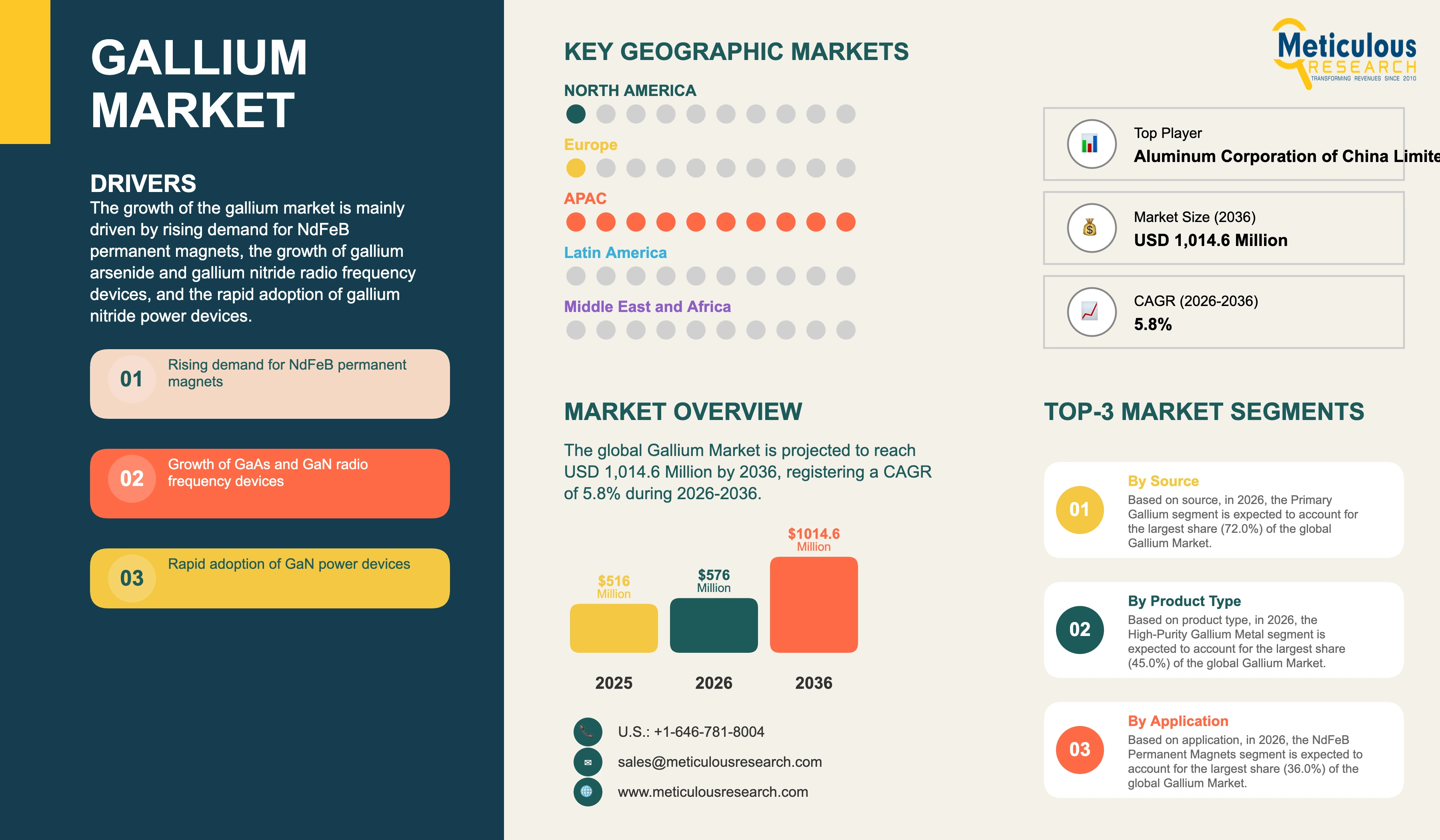
The global gallium market was valued at USD 516.0 million in 2025. This market is expected to reach USD 1,014.6 million by 2036 from an estimated USD 576.0 million in 2026, registering a CAGR of 5.8% during the forecast period (2026-2036). In terms of volume, this market is expected to reach 1,537 tons by 2036 from an estimated 900 tons in 2026, registering a CAGR of 5.5% during the forecast period.
- Published
- Nov 2026
- Pages
- 279
- Format
- PDF + Excel
- Report ID
- MRCHM - 1042489
- Base year
- 2025
- 2025 · BASELINE
- $516.0M
- 2036
- $1.01B
- CAGR 2026–2036
- 5.8%
2025 baseline · 2026–2036 forecast at 5.8% CAGR · hover a bar for the value
Key highlights
According to the U.S. Geological Survey (USGS), world primary low-purity gallium production was about 900,000 kilograms in 2025, up from about 848,000 kilograms in 2024, and China accounted for 99% of worldwide primary output, with Japan and Russia producing small volumes.
China placed export controls on gallium in August 2023, banned gallium exports to the U.S. in December 2024, and in November 2025 suspended the U.S. ban until 27 November 2026, although exporters still need licenses for every shipment to any destination.
The USGS reported that the average unit value of U.S. gallium metal imports rose from about USD 439 per kilogram in 2024 to about USD 580 per kilogram in 2025, while gallium in Rotterdam traded above USD 570 per kilogram in early 2025, more than double the level before China's export controls.
No primary gallium has been recovered in the U.S. since 1987, and Germany, Hungary, and Kazakhstan stopped primary production in the 2010s, leaving most countries dependent on Chinese supply or recycled gallium.
Several new gallium projects have been announced outside China, including projects in Australia, Canada, Greece, Kazakhstan, South Korea, and the U.S., such as Rio Tinto's gallium recovery work in Quebec and Metlen Energy & Metals' planned gallium production in Greece.
China's primary gallium production capacity is much larger than its actual output, which allows Chinese producers to increase supply quickly, while capacity outside China is very limited and is concentrated in Japan and Russia.
Gallium nitride power device makers, such as Infineon, are moving to 300-millimeter gallium nitride-on-silicon wafers, which is expected to lower costs and increase demand for gallium precursors in data centers, electric vehicles, and consumer electronics.
Most primary gallium is recovered as a by-product of alumina production from bauxite, with smaller volumes from zinc processing, and large volumes of gallium are also recovered from scrap generated in gallium arsenide and gallium nitride wafer production.
By source, primary gallium accounts for the largest share in 2026, while secondary gallium registers the highest CAGR.
By product type, high-purity gallium metal accounts for the largest share of 45.0% in 2026, while gallium compounds and precursors register the highest CAGR.
By application, NdFeB permanent magnets account for the largest share of 36.0% in 2026, while power electronics register the highest CAGR.
By geography, Asia-Pacific accounts for the largest share of 78.0% in 2026, while North America registers the highest CAGR of 7.2%.
Report summary
| Particulars | Details |
|---|---|
| Base Year | 2025 |
| Estimated Year | 2026 |
| Forecast Period | 2026-2036 |
| Market Size in 2025 | USD 516.0 million |
| Market Size in 2026 | USD 576.0 million |
| Market Size by 2036 | USD 1,014.6 million |
| CAGR (2026-2036), Value | 5.8% |
| Format | PDF, Excel & Cloud Portal · 279 pages |
| Market Volume (2026 to 2036) | 900 tons to 1,537 tons of contained gallium (CAGR 5.5%) |
| Largest Segment by Product Type (2026) | High-Purity Gallium Metal (45.0%) |
| Largest Segment by Application (2026) | NdFeB Permanent Magnets (36.0%) |
| Largest Region (2026) | Asia-Pacific (78.0%) |
| Fastest-Growing Region | North America (CAGR 7.2%) |
| Segments Covered | Source, Product Type, Application, and Geography |
| Geographic Scope | Asia-Pacific, North America, Europe, Middle East and Africa, and Latin America |
| Key Companies Profiled | Aluminum Corporation of China, Vital Materials, AXT, Dowa Holdings, Sumitomo Chemical, 5N Plus, Indium Corporation, Rio Tinto, Metlen Energy & Metals, Nyrstar, Nouryon, and Umicore |
Report overview
Segments covered: source, product type, application.
The growth of this market is mainly driven by rising demand for gallium in neodymium-iron-boron permanent magnets for electric vehicles, wind turbines, and robotics, the growth of gallium arsenide and gallium nitride devices for 5G, satellite communications, radar, and defense electronics, the rapid adoption of gallium nitride power devices in fast chargers, data centers, and electric vehicles, and efforts by the U.S., Europe, Japan, and other countries to build gallium supply outside China. However, China's export controls, the extreme concentration of primary supply in one country, and price volatility are expected to restrain the growth of this market to some extent.
Gallium is a soft, silvery metal that melts just above room temperature and is used mainly in compound semiconductors, such as gallium arsenide, gallium nitride, and gallium oxide, and as an additive in neodymium-iron-boron permanent magnets. Gallium arsenide is used in radio frequency chips for mobile phones, Wi-Fi, satellite communications, and radar, as well as in solar cells for satellites and in laser diodes and LEDs. Gallium nitride is used in blue and white LEDs, laser diodes, radar, 5G base stations, and a fast-growing range of power devices. Gallium is also used in copper indium gallium selenide solar cells, medical imaging, research, and specialty alloys.
This market covers the global consumption of gallium in its main products, measured in value and in tons of contained gallium, including low-purity gallium metal of around 99.99% purity, high-purity gallium metal of 99.9999% purity and above, gallium compounds and precursors, such as trimethylgallium, gallium oxide, and gallium chloride, and gallium alloys and other products. It includes gallium produced as a by-product of alumina and zinc processing and gallium recovered from scrap, and is segmented by source, product type, application, and geography. Gallium wafers, epitaxial wafers, and finished devices are not included, although their production trends are used to estimate demand for gallium.
Gallium is not mined on its own, since it occurs in very small amounts in bauxite and zinc ores, and primary gallium is recovered mainly from the Bayer liquor in alumina refineries, where it is extracted and processed into low-purity metal. This low-purity metal is then refined into high-purity gallium for the semiconductor industry. Because gallium is a by-product, its supply depends on alumina and zinc production, and on whether refiners choose to install gallium recovery circuits. China, the world's largest alumina producer, built large gallium recovery capacity over the past two decades, and according to the USGS, it accounted for 99% of world primary low-purity gallium production in 2025.
Low prices from Chinese producers forced gallium producers in Germany, Hungary, Kazakhstan, and Ukraine to close their plants in the 2010s and early 2020s, which left the rest of the world dependent on China for primary gallium. This dependence became a major concern when China introduced export controls on gallium in August 2023 and banned exports to the U.S. in December 2024. Prices outside China rose to their highest levels in more than a decade, while prices within China remained much lower, creating a large gap between the two markets.
Secondary gallium is an important part of supply, because large amounts of gallium are lost as scrap during the growth and processing of gallium arsenide and gallium nitride crystals and wafers, and this new scrap is collected and refined back into high-purity gallium by refiners in Japan, China, Germany, Canada, the U.S., and other countries. Recycling of gallium from old devices is very limited because the amounts used in each device are tiny and are difficult to separate from other materials, so most secondary gallium comes from manufacturing scrap rather than end-of-life products.
Over the forecast period, gallium demand is expected to grow strongly, supported by permanent magnets for electric vehicles and robotics, radio frequency devices for 5G, satellites, and defense, LEDs and lasers, and especially gallium nitride power devices. Governments in the U.S., the EU, Japan, South Korea, Canada, and Australia have listed gallium as a critical or strategic material and are supporting new primary recovery projects at alumina and zinc refineries, more recycling, and stockpiling. These projects are expected to reduce dependence on China gradually, although China is likely to remain the dominant supplier throughout the forecast period. Demand is also shifting toward higher-value products, as gallium nitride epitaxy, gallium oxide development, and advanced radio frequency devices require high-purity gallium and specialty precursors, while magnet makers in China mainly use lower-purity gallium. As a result, the value of the market is expected to grow slightly faster than its volume over the forecast period.
Report infographic
Market dynamics
15 factors across 5 forcesRising demand for NdFeB permanent magnets
Gallium is added in small amounts to neodymium-iron-boron magnets to improve their resistance to demagnetization at high temperatures and their corrosion resistance, which allows magnet makers to reduce their use of expensive heavy rare earths, such as dysprosium and terbium. NdFeB magnets are used in electric vehicle motors, wind turbine generators, industrial motors, robots, drones, consumer electronics, and many other products, and their production has grown rapidly, particularly in China.
China produces about 90% of the world's NdFeB magnets, and magnet production is one of the largest uses of gallium in the country. As production of electric vehicles, wind turbines, humanoid and industrial robots, and energy-efficient motors continues to grow, demand for gallium in magnets is expected to grow steadily. New magnet plants in the U.S., Europe, Japan, South Korea, and Vietnam are also expected to add gallium demand outside China. NdFeB permanent magnets account for the largest share of the market by application. Magnet makers are also working to reduce heavy rare earth use further in response to Chinese export controls on dysprosium and terbium, which could increase the amount of gallium used per ton of magnet.
Growth of gallium arsenide and gallium nitride radio frequency devices
Gallium arsenide chips are used in power amplifiers and switches in almost every mobile phone, as well as in Wi-Fi equipment, satellite communications terminals, and automotive radar. Gallium nitride radio frequency devices are used in 5G base stations, satellite communications, military radar, electronic warfare, and other high-power, high-frequency applications, because they can handle much higher power and frequencies than silicon devices.
The rollout of 5G and planned 6G networks, the rapid growth of low Earth orbit satellite constellations, such as SpaceX's Starlink and Amazon's Project Kuiper, and the modernization of military radar systems are driving demand for these devices. Defense programs in the U.S., Europe, and Asia increasingly use gallium nitride radar, which has made gallium a key material for national security. Integrated circuits and RF devices are one of the largest applications in this market, and these devices use high-purity gallium metal and gallium precursors. Gallium arsenide is also used in vertical-cavity surface-emitting lasers for 3D sensing in smartphones and optical connections in data centers, which adds to demand.
Rapid adoption of gallium nitride power devices
Gallium nitride power transistors switch faster and lose less energy than silicon transistors, which allows smaller and more efficient power supplies. They are already widely used in fast chargers for phones and laptops, and they are increasingly used in data center power supplies, solar inverters, electric vehicle on-board chargers, motor drives, and humanoid robots. AI data centers, in particular, are adopting gallium nitride power devices to reduce energy losses in high-density server racks.
Leading semiconductor companies, such as Infineon, Texas Instruments, STMicroelectronics, Navitas Semiconductor, Innoscience, Renesas, and others, are expanding gallium nitride production, and the move to larger 300-millimeter gallium nitride-on-silicon wafers is expected to lower costs and accelerate adoption. Power electronics form the fastest-growing application in this market, and the growth of gallium nitride epitaxy is driving demand for gallium precursors, such as trimethylgallium, which form the fastest-growing product type. Many industry observers expect gallium nitride to capture a significant share of the power semiconductor market for voltages below about 650 volts over the next decade.
Efforts to build gallium supply outside China
China's export controls have pushed governments and companies in the U.S., Europe, Japan, South Korea, Canada, and Australia to invest in gallium supply outside China. Governments are supporting new gallium recovery circuits at alumina refineries and zinc smelters, expanding recycling, and building stockpiles, and many users are signing long-term contracts with non-Chinese suppliers. The U.S. government has also supported domestic gallium recovery and refining through defense funding, and Japan and South Korea maintain national stockpiles of gallium.
Projects include Rio Tinto's gallium recovery work at its alumina operations in Quebec, Canada, Metlen Energy & Metals' planned gallium production at its alumina refinery in Greece, which has been supported by the EU, Nyrstar's plans for germanium and gallium production in Tennessee, U.S., and projects in Australia, Kazakhstan, and South Korea. These efforts are expected to support investment across the gallium supply chain and contribute to the fast growth of North America in this market.
Table of contents
11 chapters · 119 sections · 279 pages · click to expandSegmental analysis
| Segment | Largest share (2026) | Fastest growth (2026–2036) |
|---|---|---|
| By Source | Primary gallium | Secondary gallium |
| By Product Type | High-purity gallium metal | Gallium compounds and precursors |
| By Application | NdFeB permanent magnets | Power electronics |
By Source
- The primary gallium segment is expected to account for the largest share of the market.
- The large share of this segment is mainly due to the large volume of gallium recovered as a by-product of alumina production in China, which accounted for 99% of world primary low-purity gallium output in 2025, according to the USGS.
- Primary gallium is recovered at concentrations of only a few hundred grams per ton from the sodium aluminate solution, known as Bayer liquor, in alumina refineries, using ion exchange or other extraction processes, and smaller amounts are recovered from zinc processing residues.
- China has a large number of alumina refineries with gallium recovery circuits, operated by companies such as Aluminum Corporation of China and other producers, and its production capacity is far larger than its output, which allows it to increase supply quickly when demand or prices rise.
- Outside China, only Japan and Russia produced small amounts of primary gallium in 2025, although new projects in Canada, Greece, Australia, Kazakhstan, South Korea, and the U.S. are expected to add supply.
- Primary gallium is expected to remain the largest source over the forecast period, although its share will decline as recycling grows and as more scrap is generated by expanding wafer production.
- Low-purity gallium from China is mainly used by Chinese magnet makers and refiners, while exports are limited by licensing requirements, which has reduced the volume of Chinese primary gallium reaching international markets since 2023.
- Primary producers outside China, such as those in Japan and Russia, operate on a small scale, and new projects will need several years to reach meaningful production.
- However, the secondary gallium segment is projected to register the highest CAGR during the forecast period.
- The rapid growth of this segment is driven by the growth of gallium arsenide and gallium nitride wafer production, which generates large amounts of scrap, high prices outside China, which make recovery more profitable, and government policies that support recycling to reduce dependence on China.
- Recycling rates for gallium in wafer production are already high in Japan and Europe, and new recycling plants in North America and Asia are expected to increase secondary supply.
By Product Type
- The high-purity gallium metal segment is expected to account for the largest share of 45.0% of the market.
- The large share of this segment is mainly due to its essential role in producing gallium arsenide and gallium nitride crystals, wafers, and devices for radio frequency, optoelectronic, and power applications, which require gallium of 99.9999% purity or higher.
- High-purity gallium is produced by refining low-purity gallium or scrap through processes such as electrolysis, vacuum distillation, and zone refining or fractional crystallization, and each additional level of purity requires more processing and testing, which increases its value.
- Leading refiners include Dowa Holdings and Sumitomo Chemical in Japan, 5N Plus in Canada, Indium Corporation in the U.S., AXT's joint ventures and Vital Materials in China, and other producers.
- High-purity gallium is used by compound semiconductor wafer makers, such as Sumitomo Electric, Freiberger Compound Materials, and AXT, to grow gallium arsenide crystals, and it is also used to make gallium precursors and other compounds.
- High-purity gallium metal is expected to remain the largest product type over the forecast period.
- Demand for 7N gallium, which has a purity of 99.99999%, is growing for advanced radio frequency and optoelectronic devices, and producers are investing in better refining and analytical equipment to meet tighter specifications.
- Refiners outside China have also benefited from export controls, as wafer makers in Europe, the U.S., and Japan look for secure, non-Chinese high-purity gallium.
- However, the gallium compounds and precursors segment is projected to register the highest CAGR during the forecast period.
- The rapid growth of this segment is driven by the growth of gallium nitride epitaxy for power, radio frequency, and LED devices, which uses trimethylgallium and other precursors, and by the development of gallium oxide semiconductors.
- Low-purity gallium metal and gallium alloys and other products make up the rest of the market.
- Leading precursor suppliers include Nouryon, Sumitomo Chemical, Umicore, and Chinese producers, and demand for electronic-grade trimethylgallium is growing quickly with gallium nitride production for power and LED devices.
By Application
- The NdFeB permanent magnets segment is expected to account for the largest share of 36.0% of the market.
- The large share of this segment is mainly due to the large and growing production of neodymium-iron-boron magnets in China, which use gallium to improve high-temperature performance and reduce the use of heavy rare earths.
- NdFeB magnets, which typically contain small amounts of gallium in high-performance grades, are used in electric vehicle traction motors, wind turbines, industrial motors, robots, drones, consumer electronics, and many other products, and their production has grown rapidly with the electrification of transportation and industry.
- Chinese magnet makers, such as JL Mag Rare-Earth, Ningbo Yunsheng, Zhong Ke San Huan, and Baotou Tianhe, are among the largest users of gallium.
- Magnet production outside China is also expanding in the U.S., Europe, Japan, South Korea, and Vietnam, which is expected to increase gallium demand in those regions.
- NdFeB permanent magnets are expected to remain the largest application over the forecast period, supported by electric vehicles, wind energy, and robotics.
- However, its growth rate is expected to be lower than that of power electronics, as some magnet makers reduce gallium use when prices rise and as magnet production growth slows in mature applications.
- However, the power electronics segment is projected to register the highest CAGR during the forecast period.
- The rapid growth of this segment, which starts from a small base, is driven by the adoption of gallium nitride power devices in fast chargers, data center power supplies, solar inverters, electric vehicles, and robots.
- Integrated circuits and RF devices, LEDs, lasers, and optoelectronics, photovoltaics, and medical, research, and other applications make up the rest of the market.
- Integrated circuits and RF devices are the second-largest application and are expected to grow steadily, supported by smartphones, 5G infrastructure, satellite communications, and defense radar.
- LEDs, lasers, and optoelectronics remain important, although the LED market has matured, and growth is now driven mainly by micro-LEDs, automotive lighting, and laser diodes.
Geographic analysis
Asia-Pacific
Largest shareIn 2026, Asia-Pacific is expected to account for the largest share of 78.0% of the global gallium market. The large share of this region is mainly due to China's dominant position as the world's largest producer and consumer of gallium, along with large semiconductor, LED, and magnet industries in Japan, South Korea, and Taiwan. China uses gallium in NdFeB magnets, LEDs, gallium arsenide and gallium nitride devices, and many other products, and it is home to the world's largest gallium producers and refiners. Its domestic prices are much lower than international prices because of export controls and excess production capacity, which gives Chinese users a cost advantage. Japan is a major refiner and recycler of gallium and a leading producer of gallium arsenide and gallium nitride wafers and devices, with companies such as Dowa Holdings, Sumitomo Chemical, Sumitomo Electric, and Nichia. Taiwan has large gallium arsenide foundries, such as WIN Semiconductors, and gallium nitride power device production at TSMC and other foundries, while South Korea uses gallium in LEDs, displays, and semiconductors and is developing domestic primary production. Asia-Pacific is expected to remain the dominant region throughout the forecast period. India and Vietnam are also emerging as users of gallium, supported by growing electronics, LED, and magnet production.
North America
Fastest growthNorth America is projected to register the highest CAGR of 7.2% during the forecast period. Growth is driven by rising defense spending, the growth of gallium nitride and gallium arsenide device production, government support for domestic gallium recovery, recycling, and stockpiling, and new magnet plants in the U.S. The U.S. has several gallium arsenide and gallium nitride device makers, such as Qorvo, Wolfspeed, and Skyworks, and defense contractors use large numbers of gallium nitride radar and communications devices. Canada has gallium refining through 5N Plus and primary recovery development through Rio Tinto, which strengthens the regional supply chain.
Europe
Europe holds a significant share of the market, led by Germany, France, and the U.K., and is supported by its semiconductor, automotive, and defense industries, gallium arsenide wafer production in Germany, and planned primary gallium production in Greece.
Latin America
Latin America and the Middle East and Africa hold smaller shares of the market, although alumina refineries in Brazil, Saudi Arabia, and other countries could recover gallium in the future.
Middle East & Africa
Israel also has a strong compound semiconductor and defense electronics industry that uses gallium.
Competitive landscape
The gallium market is highly concentrated at the primary production level, with Chinese alumina producers accounting for almost all primary supply, while refining and recycling are more widely distributed among companies in China, Japan, Canada, the U.S., and Europe. Leading companies include Aluminum Corporation of China, Vital Materials, AXT, Dowa Holdings, Sumitomo Chemical, 5N Plus, and Indium Corporation, along with precursor suppliers such as Nouryon and Umicore.
Chinese producers benefit from large primary capacity and low costs, while refiners outside China compete on product purity, consistency, recycling services, and the ability to offer secure, non-Chinese supply. Some refiners, particularly in Japan and Canada, provide closed-loop recycling, in which they recover gallium from a customer's scrap and return it as high-purity metal. New entrants, such as Rio Tinto, Metlen Energy & Metals, and Nyrstar, are developing primary gallium production outside China.
The top five players are estimated to account for 38.0% of the gallium market in 2025, reflecting the large number of Chinese primary producers and the role of refiners and recyclers. Concentration is much higher in primary production, where China controls almost all capacity.
Players use several strategies to grow in this market, including developing new recovery circuits at alumina and zinc refineries, expanding refining and recycling capacity, signing long-term supply agreements with semiconductor and defense customers, and developing new gallium compounds and precursors for gallium nitride and gallium oxide devices. Partnerships between alumina producers, refiners, and governments are also becoming more common. Refiners are also expanding capacity for 7N gallium and electronic-grade precursors.
Competition is expected to center on access to secure and traceable raw material, refining technology, product quality, recycling capabilities, and the ability to meet the traceability requirements of defense and semiconductor customers. Companies that can offer non-Chinese gallium at competitive prices are expected to gain market share outside China. Chinese producers are expected to remain dominant in primary supply, but refiners and recyclers in Japan, Canada, the U.S., and Europe are expected to strengthen their positions in high-purity gallium and precursors. Mergers, partnerships, and government-backed projects are likely to reshape the supply chain outside China over the forecast period.
Some of the key players operating in the gallium market are Aluminum Corporation of China Limited, Vital Materials Co., Ltd., AXT, Inc., Dowa Holdings Co., Ltd., Sumitomo Chemical Co., Ltd., 5N Plus Inc., Indium Corporation, Rio Tinto Group, Metlen Energy & Metals S.A., Nyrstar NV, Nouryon, and Umicore N.V.
- —
China suspended its gallium export ban to the U.S. until November 2026, new gallium projects were announced in Canada, Greece, Australia, Kazakhstan, South Korea, and the U.S., and gallium nitride power device makers are moving to 300-millimeter wafers.
- Aluminum Corporation of China
- Vital Materials
- AXT
- Dowa Holdings
- Sumitomo Chemical
- 5N Plus
- Indium Corporation
- Rio Tinto
- Metlen Energy & Metals
- Nyrstar
- Nouryon
- Umicore
Expert perspectives
The gallium market is small in value but strategically important because gallium is essential for compound semiconductors, defense electronics, and permanent magnets. China's near-complete control of primary production and its use of export controls have made gallium one of the most closely watched critical minerals, and prices outside China remain well above pre-2023 levels.
Over the forecast period, gallium volume is expected to grow at about 5.5% per year, and value at about 5.8% per year, supported by magnets, radio frequency devices, LEDs, and especially gallium nitride power devices. Prices are expected to remain higher, and more volatile, outside China than within China while export controls remain in place, and new supply from Canada, Greece, the U.S., and other countries is expected to reduce the gap gradually, although not fully, during the forecast period.
Secondary gallium is the fastest-growing source, gallium compounds and precursors are the fastest-growing product type, and power electronics is the fastest-growing application, reflecting the importance of recycling and gallium nitride technology. Primary gallium, high-purity gallium metal, and NdFeB permanent magnets remain the largest segments.
Asia-Pacific remains the dominant region, while North America is the fastest-growing region at a CAGR of 7.2%, supported by defense spending, semiconductor investment, and domestic supply projects. The main swing factors are China's export policies, including the expiry of its U.S. export ban suspension in November 2026, the pace of new recovery projects outside China, gallium nitride adoption, and magnet production.
For gallium users, the key decisions are how to secure supply from diverse sources, how to improve scrap recovery, and how to manage price risk. Device makers are also expected to use more long-term contracts and to qualify additional suppliers, even at higher cost, to reduce the risk of supply disruptions. For new producers outside China, success depends on low-cost recovery at existing refineries, refining to semiconductor-grade purity, and long-term contracts with customers that value supply security. Government support through funding, stockpile purchases, and offtake agreements is likely to be critical for these projects, because they must compete with large, low-cost producers in China. Producers that combine primary recovery, refining, and recycling are expected to be best positioned.
Overall, gallium is expected to remain one of the most strategically important minor metals, with its market shaped by technology growth and government policy over the forecast period. Gallium nitride power electronics, in particular, could become the most important source of new demand, as AI data centers, electric vehicles, and consumer devices seek more efficient power conversion.
Customer perspectives
Head of Materials Sourcing - compound semiconductor wafer manufacturer, Germany
After China introduced export licenses, our gallium costs more than doubled and deliveries became unpredictable. We now recycle more of our own scrap and buy from refiners in Japan and North America to reduce our risk.
Wafer makers outside China are willing to pay more for secure supply, which supports investment in refining and recycling capacity in Japan, Canada, the U.S., and Europe.
Strong demand from wafer makers is why high-purity gallium metal accounts for 45.0% of the market, and recycling of process scrap is driving the fast growth of secondary gallium.
Vice President of Power Products - GaN power semiconductor company, U.S.
Demand for our GaN power devices from data centers and fast chargers keeps growing, and the move to larger wafers will bring costs down further. Securing precursors from reliable suppliers is a key part of our expansion plans.
The rapid adoption of gallium nitride power devices is why power electronics form the fastest-growing application in this market.
Magnet makers outside China are also starting to buy gallium as they build new plants in the U.S., Europe, and Asia, which supports demand outside China.
Large magnet production in China is why NdFeB permanent magnets account for 36.0% of the market and Asia-Pacific accounts for 78.0%.
“Gallium helps us reduce dysprosium use in high-temperature magnets for electric vehicle motors. Our output keeps increasing with EV and robot demand, so our gallium purchases are growing every year.”
Frequently asked questions
The market was valued at USD 516.0 million in 2025 and USD 426.4 million in 2024, and is estimated at USD 576.0 million in 2026.
The market is expected to reach USD 1,014.6 million by 2036, supported by demand from permanent magnets, radio frequency devices, LEDs, and gallium nitride power devices.
The market is expected to register a CAGR of 5.8% from 2026 to 2036 in value terms and 5.5% in volume terms, with volume rising from 900 tons in 2026 to 1,537 tons of contained gallium in 2036.
Growth is driven by rising demand for NdFeB permanent magnets, the growth of gallium arsenide and gallium nitride radio frequency devices, the rapid adoption of gallium nitride power devices, and efforts to build gallium supply outside China.
China's export controls and concentrated supply and price volatility restrain growth, while the technical and economic challenges of by-product recovery and long qualification times for semiconductor customers remain key challenges.
Key opportunities include new primary recovery at alumina and zinc refineries, recycling and secondary supply, gallium oxide and next-generation semiconductors, and growth in defense and space applications.
According to the USGS, China accounted for 99% of world primary low-purity gallium production in 2025, when total output was about 900,000 kilograms.
China introduced export licensing for gallium in August 2023, banned exports to the U.S. in December 2024, and suspended the U.S. ban in November 2025 until 27 November 2026, while licenses remain required for all destinations.
The USGS reported that the average unit value of U.S. gallium metal imports rose from about USD 439 per kilogram in 2024 to about USD 580 per kilogram in 2025, and prices outside China remain much higher than prices within China.
Gallium arsenide and gallium nitride devices are essential for military radar, electronic warfare, satellite communications, and missile systems, and almost all primary gallium is produced in China, which is why governments have listed gallium as a critical material and are supporting new supply and stockpiles.
Secondary gallium recovered from scrap is projected to register the highest CAGR, while primary gallium holds the largest share.
High-purity gallium metal is expected to account for the largest share of 45.0% of the market in 2026, while gallium compounds and precursors are projected to register the highest CAGR.
NdFeB permanent magnets are expected to account for the largest share of 36.0% of the market in 2026, while power electronics are projected to register the highest CAGR.
Asia-Pacific is expected to account for the largest share of 78.0% of the market in 2026, led by China.
North America is projected to register the highest CAGR of 7.2% during the forecast period.
The report profiles 12 companies, including Aluminum Corporation of China, Vital Materials, AXT, Dowa Holdings, Sumitomo Chemical, and 5N Plus. The top five players account for an estimated 38.0% of the market in 2025.
China suspended its gallium export ban to the U.S. until November 2026, new gallium projects were announced in Canada, Greece, Australia, Kazakhstan, South Korea, and the U.S., and gallium nitride power device makers are moving to 300-millimeter wafers.
Cite this report
Meticulous Research. (2026). Gallium Market - Global Opportunity Analysis and Industry Forecast (2026-2036) (Report No. MRCHM - 1042489). Meticulous Market Research Pvt. Ltd. https://www.meticulousresearch.com/product/gallium-market-7172