Furfural and Derivatives Market (2026-2036)
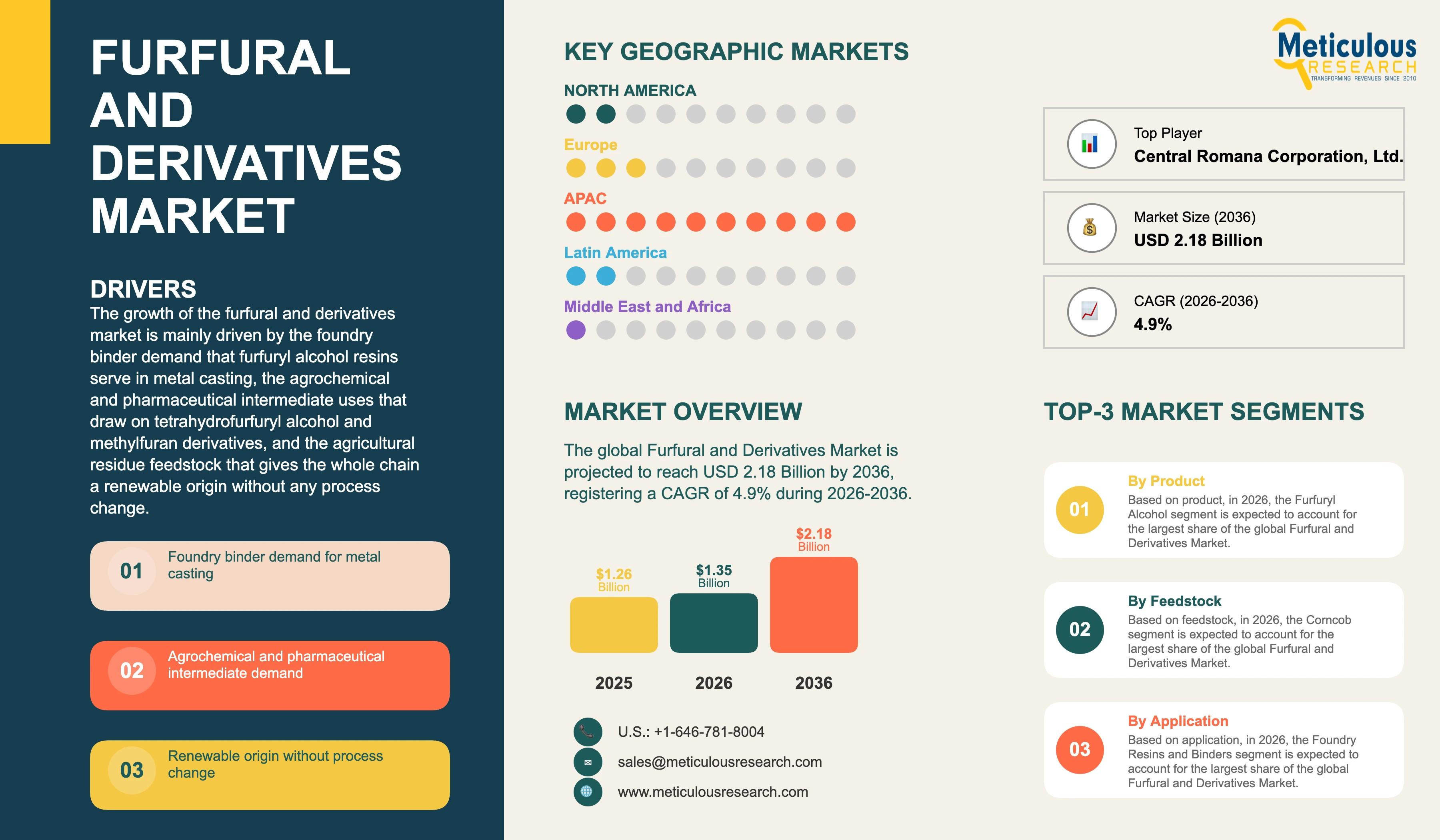
The global furfural and derivatives market was valued at USD 1.26 billion in 2025. This market is expected to reach USD 2.18 billion by 2036 from an estimated USD 1.35 billion in 2026, registering a CAGR of 4.9% during the forecast period (2026-2036).
- Published
- Nov 2026
- Pages
- 260
- Format
- PDF + Excel
- Report ID
- MRCHM - 1042689
- Base year
- 2025
- 2025 · BASELINE
- $1.26B
- 2036
- $2.18B
- CAGR 2026–2036
- 4.9%
2025 baseline · 2026–2036 forecast at 4.9% CAGR · hover a bar for the value
Key highlights
The global furfural and derivatives market is estimated at USD 1.35 billion in 2026 and is projected to reach USD 2.18 billion by 2036.
Market volume is estimated at 690.00 kilotons in 2026 and is projected to reach 982.01 kilotons by 2036 at a CAGR of 3.6%, measured as products supplied to third parties.
The average selling price is estimated at USD 1.95 per kg in 2026 and is projected to reach USD 2.22 per kg by 2036 on mix shift toward higher-value derivatives.
Furfuryl alcohol is expected to account for the largest product share in 2026, while other derivatives including methylfuran and furoic acid are projected to register the highest CAGR of 8.0%.
Corncob is expected to hold the largest feedstock share in 2026, while sugarcane bagasse is projected to grow fastest at a CAGR of 6.6%.
Foundry resins and binders are expected to be the largest application in 2026, while agrochemical and pharmaceutical intermediates are projected to register the highest CAGR of 7.6%.
Asia-Pacific is expected to hold the largest regional share in 2026, while Latin America is projected to register the highest CAGR of 7.4%.
The United States International Trade Commission determined on 7 February 2023 that revoking the antidumping duty order on furfuryl alcohol from China would be likely to lead to continuation or recurrence of material injury within a reasonably foreseeable time.
The vote was unanimously affirmative, with Chairman David S. Johanson and Commissioners Rhonda K. Schmidtlein, Jason E. Kearns, Randolph J. Stayin and Amy A. Karpel all voting in the affirmative.
The determination was made in investigation number 731-TA-703, the fifth five-year review of the order.
As a result of that determination, the existing order on imports from China remains in place.
The Commission report was issued as USITC Publication 5407, dated February 2023, and was to be available by 15 March 2023.
The Commission press release does not state when the order was originally imposed or how long it will continue before the next review.
The United States Department of Commerce published the final results of the expedited fifth sunset review of the antidumping duty order on furfuryl alcohol from China in the Federal Register on 2 November 2022, under case number A-570-835.
A fifth five-year review indicates that the order has been maintained through four earlier review cycles before this one.
This market measures products supplied to third parties and excludes furfural converted captively into derivatives, so furfural and its derivatives are not double counted.
Report summary
| Particulars | Details |
|---|---|
| Base Year | 2025 |
| Forecast Period | 2026-2036 |
| Market Size in 2025 | USD 1.26 billion |
| Market Size in 2026 | USD 1.35 billion |
| Market Size by 2036 | USD 2.18 billion |
| Value CAGR (2026-2036) | 4.9% |
| Format | PDF, Excel & Cloud Portal · 260 pages |
| Volume in 2026 | 690.00 kilotons |
| Volume by 2036 | 982.01 kilotons |
| Volume CAGR (2026-2036) | 3.6% |
| Volume Basis | Products supplied to third parties, excluding furfural converted captively into derivatives by the same producer |
| Average Selling Price in 2026 | USD 1.95 per kg |
| Average Selling Price by 2036 | USD 2.22 per kg |
| Price Direction | Average selling price rises across the forecast period as higher-value derivatives take a larger share of the tonnage, rather than on any increase in residue or energy cost |
| Double Counting Note | Because the great majority of furfural is hydrogenated to furfuryl alcohol by integrated producers, counting both the furfural and the alcohol made from it would value the same pentose twice and inflate this market by well over half, which is why merchant furfural appears smaller here than total furfural production |
| Measurement Basis | Merchant furfural, furfuryl alcohol, tetrahydrofurfuryl alcohol and other furan derivatives supplied to third parties, and excluding captively converted furfural, the agricultural residue feedstocks, furandicarboxylic acid and hydroxymethylfurfural which derive from hexose rather than pentose sugars, and the cured foundry resins, castings and formulated products downstream |
| Relationship to Adjacent Markets | This market is not additive to the furandicarboxylic acid market, which derives from hexose sugars and serves polymer applications despite sharing the furan ring, nor to the foundry resin, casting and formulated product markets downstream of it |
| Largest Product | Furfuryl alcohol |
| Fastest-Growing Product | Other derivatives including methylfuran and furoic acid (CAGR 8.0%) |
| Largest Feedstock | Corncob |
| Fastest-Growing Feedstock | Sugarcane bagasse (CAGR 6.6%) |
| Largest Application | Foundry resins and binders |
| Fastest-Growing Application | Agrochemical and pharmaceutical intermediates (CAGR 7.6%) |
| Largest Region | Asia-Pacific |
| Fastest-Growing Region | Latin America (CAGR 7.4%) |
| Segments Covered | Product, Feedstock, Application, and Geography |
| Geographies Covered | Asia-Pacific, Europe, North America, Latin America, and Middle East & Africa |
| Companies Profiled | 7 companies, including Central Romana Corporation, Ltd., International Furan Chemicals B.V., Silvateam S.p.A., TransFurans Chemicals bvba, Penn A Kem LLC, and Tanin Sevnica d.d. |
Report overview
Segments covered: product, feedstock, application.
In volume terms, this market is estimated at 690.00 kilotons in 2026 and is projected to reach 982.01 kilotons by 2036, registering a CAGR of 3.6% during the same period, measured as products supplied to third parties and excluding furfural converted captively into derivatives by the same producer. The average selling price is estimated at USD 1.95 per kg in 2026 and is projected to rise to USD 2.22 per kg by 2036 as higher-value derivatives take a larger share of the tonnage.
The growth of this market is mainly driven by the foundry binder demand that furfuryl alcohol resins serve in castings for vehicles, machinery and construction, the agrochemical and pharmaceutical intermediate uses that draw on tetrahydrofurfuryl alcohol and methylfuran derivatives, the agricultural residue feedstock that gives the whole chain a renewable origin, and the corrosion-resistant resins used where polyester and epoxy systems fail. However, factors such as the persistent trade protection illustrated by the antidumping duty order on furfuryl alcohol from China that the United States International Trade Commission voted unanimously to maintain on 7 February 2023, the batch acid hydrolysis process whose yields have improved little, the carcinogenicity classification of furfuryl alcohol that constrains its handling, and the metal casting cycle to which the largest application is tied are expected to restrain the growth of this market to some extent.
Furfuryl alcohol accounts for the largest share of this market because foundry resins consume the great majority of furfural converted downstream and because it is the only derivative made at comparable scale. Other derivatives including methylfuran, methyltetrahydrofuran and furoic acid grow fastest because they serve pharmaceutical, agrochemical and specialty solvent applications that pay several times the furfuryl alcohol price.
Furfural is made by acid hydrolysis of the pentosan fraction of agricultural residues, and most of it is hydrogenated to furfuryl alcohol, which in turn is cured into furan resins. Market sizing in this report is on both a value basis in USD and a volume basis in kilotons measured as products supplied to third parties, with average selling price derived from the two. The measurement basis covers merchant furfural, furfuryl alcohol, tetrahydrofurfuryl alcohol and other furan derivatives, and it excludes furfural converted captively into derivatives by the same producer, the agricultural residue feedstocks, furandicarboxylic acid and hydroxymethylfurfural which derive from hexose rather than pentose sugars, and the cured foundry resins, castings and formulated products further downstream.
Excluding captive furfural is the decision that makes this market measurable at all. Because the great majority of furfural is hydrogenated to furfuryl alcohol by integrated producers, counting both the furfural and the alcohol made from it would value the same pentose twice and inflate the market by well over half. Measuring at the point of sale to a third party reflects what actually trades, and it is why merchant furfural appears as a smaller segment than total furfural production would suggest.
Separating this market from furandicarboxylic acid matters because both are furan chemicals and the two are often discussed together. Furfural derives from the pentose sugars in agricultural residues, while hydroxymethylfurfural and furandicarboxylic acid derive from hexose sugars, which means they draw on different feedstocks, use different processes and serve different applications. A furan chemicals aggregate would combine a century-old residue-based industry with a start-up polymer monomer.
The United States International Trade Commission determined on 7 February 2023, in investigation number 731-TA-703, that revoking the antidumping duty order on furfuryl alcohol from China would be likely to lead to continuation or recurrence of material injury within a reasonably foreseeable time, with Chairman David S. Johanson and Commissioners Rhonda K. Schmidtlein, Jason E. Kearns, Randolph J. Stayin and Amy A. Karpel all voting in the affirmative, so the existing order on imports from China remains in place. The report was issued as USITC Publication 5407, dated February 2023, and the press release does not state when the order was originally imposed or when the next review falls due.
That this was a fifth five-year review is the most informative fact in the determination. An order maintained through four earlier review cycles before this one has been in force for a very long period, and a unanimous Commission continues to find that removing it would be likely to cause injury, which describes a market where Chinese cost advantage is persistent rather than cyclical and where the remaining producers outside China depend on the protection. The Department of Commerce published the final results of the expedited fifth sunset review on 2 November 2022 under case number A-570-835.
Furfural production has a structural peculiarity that explains the trade position. The process is a batch acid hydrolysis of agricultural residues whose yields are well below theoretical and have improved relatively little, so cost is dominated by residue collection, steam and labour rather than by technology, and a plant must sit where pentosan-rich residue is abundant and cheap. That favours locations with large corn or sugarcane processing industries and low operating costs, which is why capacity migrated toward China and the Dominican Republic and away from Europe and North America.
Feedstock logistics rather than chemistry set the scale of a plant. Corncobs and bagasse are bulky, low in density and expensive to transport relative to their value, so a furfural plant draws on a catchment measured in tens of kilometres and its size is limited by how much residue that catchment yields in a season. Seasonality compounds the problem, since residue arrives at harvest and must be stored. Plants are therefore numerous and small rather than few and large, which is unusual for a commodity chemical.
Foundry resins are the application that gives this market its size and its cycle. Furfuryl alcohol is cured with an acid catalyst to bind sand into moulds and cores for metal casting, where it offers fast cure, good dimensional accuracy and clean break-down after pouring, and demand follows casting output for vehicles, machinery, pipe and construction components. The application is mature and the dose per tonne of sand is optimised, so volume moves with industrial production rather than with any change in formulation.
The carcinogenicity classification of furfuryl alcohol is the regulatory pressure that bears on the largest application. The substance is classified for carcinogenicity in major jurisdictions, which drives exposure controls, ventilation requirements and substitution pressure in foundries, and it strengthens the case for alternative binder systems where casting quality permits. The effect is to raise the cost of using the material rather than to prohibit it. Foundry demand therefore grows more slowly than casting output alone would imply.
The derivatives beyond furfuryl alcohol are where the value is, and they behave as specialty chemicals. Tetrahydrofurfuryl alcohol serves agrochemical formulation and as a solvent, methylfuran and methyltetrahydrofuran serve pharmaceutical synthesis and specialty solvents, and furoic acid and furfurylamine serve pharmaceutical and agrochemical intermediates, each at several times the furfuryl alcohol price and in far smaller quantity. Other derivatives consequently register the highest product CAGR at 8.0%.
Renewable origin is an attribute this market has always had and rarely monetised. Every molecule in the chain derives from agricultural residue rather than from petrochemical feedstock, which gives furfural derivatives a bio-based content claim without any process change, and the residues involved are waste streams rather than crops grown for the purpose, so the land use objection does not arise. Buyers managing renewable content across a formulation can count the material toward it. That argument has become more valuable as brands and regulators have begun to ask for it.
Supply outside China is concentrated in a very small number of operations, which is what the trade case reflects. A handful of plants in the Dominican Republic, Europe, Africa and the Americas account for most non-Chinese capacity, with marketing in some cases handled by a separate trading company, while Chinese capacity is dispersed across many producers whose registered legal names are not readily established. Published share figures for this market therefore describe identified suppliers rather than the whole industry.
Asia-Pacific is expected to account for the largest share in 2026, on the concentration of furfural and furfuryl alcohol capacity in China, the maize processing that supplies feedstock, and the foundry industry that consumes the resins. India is projected to grow at 6.6% and China at 5.0%.
Latin America is projected to register the highest CAGR of 7.4% during the forecast period, with Brazil at 7.6% and the Dominican Republic at 7.2%.
Europe is projected to grow at a CAGR of 3.8%, with Germany at 3.6%, on foundry and specialty derivative demand served largely by imports and by a small number of derivative producers rather than by local furfural capacity, with the remaining European positions concentrated in specialty products rather than commodity furfural.
The Middle East & Africa is projected to grow at a CAGR of 7.0%, with South Africa at 6.8%, on sugar industry integration. Latin America is the fastest-growing region at a CAGR of 7.4%, with Brazil at 7.6% and the Dominican Republic at 7.2%, on bagasse availability and mill integration.
Central Romana Corporation, Ltd., International Furan Chemicals B.V., Silvateam S.p.A., TransFurans Chemicals bvba and Penn A Kem LLC together accounted for an estimated 38.6% of this market in 2026. The 7 companies profiled in this report together accounted for an estimated 44.2%, with the balance held by a large number of Chinese producers whose registered legal names could not be established.
Other derivatives, covering methylfuran, methyltetrahydrofuran, furoic acid and furfurylamine, are projected to register the highest CAGR of 8.0% during the forecast period.
Report infographic
Market dynamics
15 factors across 5 forcesFoundry Binder Demand for Metal Casting
Furfuryl alcohol cured with an acid catalyst binds sand into moulds and cores for metal casting, offering fast cure, dimensional accuracy and clean break-down after pouring, and demand follows casting output for vehicles, machinery, pipe and construction components. The application consumes the great majority of furfural converted downstream and is the reason this market has its present size. Growth follows industrial production rather than any change in formulation, since the dose per tonne of sand is already optimised.
Growth follows industrial production rather than any change in formulation, since the dose per tonne of sand is already optimised and no reformulation is in prospect.
Casting output is also shifting toward larger and more complex components in energy and heavy machinery, which favours binder systems with good dimensional accuracy and therefore supports the application even where total casting tonnage is flat.
Casting output is also shifting toward larger and more complex components in energy and heavy machinery, which favours binder systems with good dimensional accuracy and supports the application even where total casting tonnage is flat.
Agrochemical and Pharmaceutical Intermediate Demand
Tetrahydrofurfuryl alcohol, methylfuran, methyltetrahydrofuran, furoic acid and furfurylamine serve agrochemical formulation and pharmaceutical synthesis at several times the furfuryl alcohol price and in far smaller quantity, and the furan ring they carry is difficult to construct from petrochemical feedstocks at comparable cost. Demand follows active ingredient pipelines rather than industrial production. Agrochemical and pharmaceutical intermediates register the highest application CAGR at 7.6%.
Demand follows active ingredient pipelines rather than industrial production, which makes these volumes less cyclical than the foundry business and far more valuable per tonne.
Renewable Origin Without Process Change
Every molecule in this chain derives from agricultural residue rather than petrochemical feedstock, and the residues are waste streams rather than crops grown for the purpose, so the material carries a bio-based content claim with no land use objection and no reformulation required of the user. Buyers managing renewable content across a formulation can count it toward their target immediately. The attribute has always existed and has only recently become commercially valuable.
Buyers managing renewable content across a formulation can count it toward their target immediately, which has converted a long-standing attribute into a commercial argument without any investment by the producer.
Corrosion-Resistant Resins Where Other Systems Fail
Furan resins cured from furfuryl alcohol resist strong acids, alkalis and solvents at elevated temperature better than polyester and epoxy systems, which suits linings, grouts, mortars and pipework in chemical processing, mining and flue gas handling. The applications are small in tonnage but specified on performance rather than price, and substitution risk is low because the alternatives fail the duty. Corrosion-resistant construction resins grow at 6.4% across the forecast period.
Substitution risk in these applications is low because the alternatives fail the duty rather than merely costing more, which gives a supplier unusually secure volume at a price set by performance.
A fifth driver is the absence of a petrochemical equivalent. The furan ring is difficult and expensive to construct from petrochemical feedstocks, so these molecules face no drop-in fossil competitor and their price is set by their own supply and demand rather than by an oil-linked alternative, which is unusual for a chemical of this age and scale.
A sixth driver is the breadth of the derivative tree from a single intermediate. Furfural leads to furfuryl alcohol, tetrahydrofurfuryl alcohol, furan, methylfuran, methyltetrahydrofuran, furoic acid and furfurylamine, which lets a producer serve foundry, refining, agrochemical, pharmaceutical and construction customers from one feedstock stream and spread its exposure across unrelated demand cycles, which is a resilience few single-feedstock chemical businesses have.
Table of contents
11 chapters · 130 sections · 260 pages · click to expandSegmental analysis
| Segment | Largest share (2026) | Fastest growth (2026–2036) |
|---|---|---|
| By Product | Furfuryl alcohol | Rapid growth of this |
| By Feedstock | Corncob | Sugarcane bagasse |
| By Application | Foundry resins and binders | Agrochemical and pharmaceutical intermediates |
| Other segments | Corncob | Sugarcane bagasse |
By Product
- Furfural and Derivatives Market Analysis by Product
- The furfuryl alcohol segment is expected to account for the largest share of the global furfural and derivatives market.
- The large share of this segment is mainly due to foundry resins consuming the great majority of furfural converted downstream, the scale at which hydrogenation capacity has been built alongside furfural plants, and the absence of any other derivative produced at comparable volume.
- However, the other derivatives segment, covering methylfuran, methyltetrahydrofuran, furoic acid and furfurylamine, is projected to register the highest CAGR of 8.0% during the forecast period.
- The rapid growth of this segment is attributed to pharmaceutical, agrochemical and specialty solvent applications that pay several times the furfuryl alcohol price, qualify a supplier rather than tender on price, and use furan chemistry difficult to reproduce from petrochemical feedstocks.
- Merchant furfural supplies lubricant and petrochemical refining as an extraction solvent and serves as an intermediate sold to third-party converters, and it appears smaller here than total furfural output because captive conversion is excluded.
- Tetrahydrofurfuryl alcohol occupies the middle position in both price and volume.
- Product mix determines whether a producer competes on cost or on qualification, which is the central commercial question in this market.
- Furfuryl alcohol is expected to account for the largest share in 2026, on foundry resins consuming the great majority of furfural converted downstream and the absence of any other derivative produced at comparable volume.
- Foundry resins and binders are expected to account for the largest share in 2026, on furfuryl alcohol resins binding sand into moulds and cores across the metal casting industry.
By Feedstock
- Furfural and Derivatives Market Analysis by Feedstock
- The corncob segment is expected to account for the largest share of the global furfural and derivatives market.
- The large share of this segment is mainly due to the high pentosan content of corncobs, the concentration of maize processing in the regions where furfural capacity is located, and the established collection networks that supply existing plants.
- Product mix also determines a producer exposure to the trade position.
- Furfuryl alcohol is the product under antidumping order in the United States and the one competing most directly against low-cost imports, while specialty derivatives face no equivalent competition, so a portfolio weighted to derivatives is insulated from the dynamic that the fifth sunset review describes.
- However, the sugarcane bagasse segment is projected to register the highest CAGR of 6.6% during the forecast period.
- The rapid growth of this segment is attributed to bagasse arriving at a sugar mill already collected and processed, the steam available from the same boiler, and the avoidance of the residue collection cost that dominates corncob-based production, which together give a mill-integrated plant a cost position a standalone plant cannot match.
- Oat and rice hulls serve plants located near milling operations that generate them, with pentosan content and silica levels differing from corncob and affecting yield and equipment wear.
- Other residues cover cottonseed hulls, olive and nut shells and similar streams used locally.
- Feedstock determines where a plant can sit and how large it can be, because residues are bulky and costly to transport, so the feedstock decision and the location decision are effectively the same decision.
By Application
- Furfural and Derivatives Market Analysis by Application
- The foundry resins and binders segment is expected to account for the largest share of the global furfural and derivatives market.
- The large share of this segment is mainly due to furfuryl alcohol resins binding sand into moulds and cores across the metal casting industry, the fast cure and dimensional accuracy they provide, and the scale of casting output for vehicles, machinery, pipe and construction components.
- Feedstock also determines the silica and ash burden a plant handles, since rice hulls in particular carry high silica that accelerates equipment wear, so the choice affects maintenance cost and equipment life as well as yield and location, and a plant built for one residue cannot always run another without modification.
- However, the agrochemical and pharmaceutical intermediates segment is projected to register the highest CAGR of 7.6% during the forecast period.
- The rapid growth of this segment is attributed to tetrahydrofurfuryl alcohol, methylfuran and furoic acid serving formulation and synthesis applications that follow active ingredient pipelines rather than industrial production, and to the prices those applications support.
- Lubricant and petrochemical refining uses merchant furfural as an extraction solvent for separating aromatics from lubricating oil base stocks, a mature application whose volume follows refinery configuration rather than growing.
- Corrosion-resistant construction resins serve linings, grouts and pipework where polyester and epoxy systems fail.
- Flavour, fragrance and other applications take small quantities at high value.
- Application mix spans a large cyclical use, a declining solvent use and several growing specialty uses in one market.
- Applications also differ in how a supplier is selected and therefore in what protects a position.
- Foundry and refining customers tender on price and availability, while agrochemical, pharmaceutical and corrosion-resistant resin customers qualify a supplier against specification and documentation, so a producer serving both competes in two entirely different ways from one plant, and its sales organisation has to be built for both.
- Product mix also determines where in the world a producer can profitably sit.
- Commodity furfuryl alcohol must be made where residue and steam are cheap, while specialty derivatives can be made anywhere a producer holds qualification and documentation, which is why European and North American positions have concentrated in derivatives while commodity capacity has moved away.
- Feedstock also sets the seasonal shape of the business.
- Corncob supply follows the maize harvest and bagasse follows the cane campaign, so a plant runs hard for part of the year and relies on stored residue for the rest, and the resulting inventory and working capital requirement is part of the cost structure rather than an operational detail.
Other segments
- Corncob is expected to hold the largest share in 2026, on its high pentosan content, the concentration of maize processing where furfural capacity sits, and the established collection networks supplying existing plants.
- Sugarcane bagasse is projected to register the highest CAGR of 6.6% during the forecast period.
- Agrochemical and pharmaceutical intermediates are projected to register the highest CAGR of 7.6% during the forecast period.
Geographic analysis
Asia-Pacific
Largest shareIn 2026, Asia-Pacific is expected to account for the largest share of the global furfural and derivatives market. The large share of this region is mainly due to the concentration of furfural and furfuryl alcohol capacity in China, the maize processing that supplies corncob feedstock, the foundry and casting industry that consumes the resins, and the low operating costs that the persistence of the antidumping order on Chinese furfuryl alcohol reflects. China is projected to register a CAGR of 5.0%, India a CAGR of 6.6% and Japan a CAGR of 2.6% during the forecast period.
Latin America
Fastest growthHowever, Latin America is projected to register the highest CAGR of 7.4% during the forecast period. The rapid growth of this region is attributed to sugarcane bagasse available at mills already collecting and processing it, the steam and permits those mills hold, the large single furfural operation established in the Caribbean, and the sugar and ethanol industry alongside which new capacity would most plausibly be built. The Dominican Republic is projected to register a CAGR of 7.2% and Brazil a CAGR of 7.6%.
Europe
Europe is projected to grow at 3.8%, with Germany at 3.6%, on foundry and specialty derivative demand served largely by imports and by a small number of derivative producers rather than by local furfural capacity.
North America
North America is projected to grow at 3.6%, with the United States at 3.6%, where the antidumping order on furfuryl alcohol from China remains in place following the determination of 7 February 2023.
Middle East & Africa
The Middle East & Africa is projected to grow at 7.0%, with South Africa at 6.8%, on sugar industry integration. Regional growth also reflects which part of the chain a region holds. Regions with residue hold furfural and furfuryl alcohol capacity and grow with commodity demand, while regions with pharmaceutical and agrochemical industries hold derivative capacity and grow faster from a smaller base, so the same market grows at different rates for different reasons in each region, and a single regional CAGR conceals two unrelated businesses. This market is unusual among chemicals in that production must sit near its feedstock while consumption sits near its industry, and the two rarely coincide. Residues are too bulky to ship, so plants are located in maize and sugarcane regions, while foundries and refineries are located near metal and oil industries, which means the product travels and the residue does not. Regional share therefore describes where residue and low-cost operation coincide rather than where the resins are used. A further consideration is that the three axes interact tightly in any real project. A bagasse plant integrated with a sugar mill in Latin America will make merchant furfural and furfuryl alcohol for regional foundries, while a European derivative producer buys furfural on the market and converts it to pharmaceutical intermediates, so feedstock, product and application combine into a small number of recognisable business models rather than varying freely across the segments.
Competitive landscape
The global furfural and derivatives market is characterised by a large number of Chinese producers competing on cost, a small number of substantial operations elsewhere, and several specialists supplying high-value derivatives into qualified applications. Competition in furfural and furfuryl alcohol is contested on residue cost, steam cost and freight, while derivatives compete on qualification and regulatory documentation. Central Romana Corporation, Ltd., International Furan Chemicals B.V., Silvateam S.p.A., TransFurans Chemicals bvba and Penn A Kem LLC together accounted for an estimated 38.6% of this market in 2026, while the companies profiled in this report together accounted for an estimated 44.2%. Those figures describe identified suppliers, and the balance is held by a large number of Chinese producers whose registered legal names could not be established.
The United States International Trade Commission determined unanimously on 7 February 2023 in investigation 731-TA-703 that revoking the antidumping duty order on furfuryl alcohol from China would be likely to lead to continuation or recurrence of material injury within a reasonably foreseeable time, so the order remains in place following the fifth five-year review, with the report issued as USITC Publication 5407 and the Department of Commerce final results of the expedited review published on 2 November 2022 under case number A-570-835. Extension into specialty derivatives, integration with sugar and ethanol mills, and documentation of renewable content accounted for most competitive activity through 2026.
Position in this market rests on residue access and operating cost in the commodity products and on qualification in the derivatives, which are effectively two different businesses. Central Romana Corporation, Ltd. competes from a large integrated operation with its own cane supply and International Furan Chemicals B.V. from marketing that output, Silvateam S.p.A. and Tanin Sevnica d.d. from European furfural and derivative production, and TransFurans Chemicals bvba, Penn A Kem LLC and Nova Molecular Technologies, Inc. from specialty derivative portfolios serving pharmaceutical, agrochemical and solvent customers. Some of the key players operating in the furfural and derivatives market are Central Romana Corporation, Ltd. (Dominican Republic), International Furan Chemicals B.V. (Netherlands), Silvateam S.p.A. (Italy), TransFurans Chemicals bvba (Belgium), Penn A Kem LLC (U.S.), Tanin Sevnica d.d. (Slovenia), and Nova Molecular Technologies, Inc. (U.S.), among others.
- —
The United States International Trade Commission determined on 7 February 2023, in investigation number 731-TA-703, that revoking the antidumping duty order on furfuryl alcohol from China would be likely to lead to continuation or recurrence of material injury within a reasonably foreseeable time. The vote was unanimously affirmative, with Chairman David S. Johanson and Commissioners Rhonda K. Schmidtlein, Jason E. Kearns, Randolph J. Stayin and Amy A. Karpel all voting in the affirmative, and as a result the existing order on imports from China remains in place. The determination was made in the fifth five-year review of the order, which indicates that it had been maintained through four earlier review cycles before this one. The Commission report was issued as USITC Publication 5407, dated February 2023, and was to be available by 15 March 2023, and the press release does not state when the order was originally imposed or how long it will continue before the next review. The United States Department of Commerce published the final results of the expedited fifth sunset review of the order in the Federal Register on 2 November 2022, under case number A-570-835.
- Central Romana Corporation, Ltd.
- International Furan Chemicals B.V.
- Silvateam S.p.A
- TransFurans Chemicals bvba
- Penn A Kem LLC
- Tanin Sevnica d.d
Expert perspectives
Value grows at 4.9% against 3.6% in volume over the forecast period, and the average selling price rises from USD 1.95 per kg in 2026 to USD 2.22 per kg by 2036. The increase is mix rather than inflation, as higher-value derivatives take a larger share of the tonnage while furfuryl alcohol and merchant furfural grow slowly, so a tonnage reading understates this market.
The fifth sunset review is the fact that describes this industry most economically. An antidumping order on furfuryl alcohol from China maintained through four earlier review cycles, with a unanimous Commission finding on 7 February 2023 that revocation would be likely to lead to continuation or recurrence of material injury, is a market where cost advantage is structural rather than cyclical and where producers outside the low-cost region depend on protection or on specialty positions.
The reason that advantage is durable sits in the process. Batch acid hydrolysis of agricultural residues at yields well below theoretical, with cost dominated by residue collection, steam and labour, leaves very little room for a producer to engineer an advantage, and plant scale is capped by what a local catchment yields in a season. A new entrant cannot out-engineer a low-cost incumbent in this chemistry.
Where the money is made is downstream of furfuryl alcohol. Methylfuran, methyltetrahydrofuran, furoic acid and furfurylamine command several times the price in far smaller quantity and are sold to customers who qualify a supplier rather than tender, which is why other derivatives grow at 8.0% and agrochemical and pharmaceutical intermediates at 7.6% while the market as a whole grows at 4.9%.
The demand risk a supplier cannot manage is the classification of its own largest product. Furfuryl alcohol is classified for carcinogenicity in major jurisdictions, which drives exposure controls and substitution pressure in foundries and raises the cost of use rather than prohibiting it, and that pressure falls on the customer. Foundry demand therefore grows more slowly than casting output alone would imply.
Two measurement points matter when reading any figure for this market. Furfural converted captively into derivatives is excluded here, because counting both would value the same pentose twice and inflate the market by well over half, and furandicarboxylic acid is excluded because it derives from hexose rather than pentose sugars and belongs to a different industry despite sharing the furan ring.
Customer perspectives
The carcinogenicity classification of furfuryl alcohol drives exposure controls and ventilation requirements that fall on the foundry rather than the producer, raising the cost of use without removing the performance advantage.
Substitution pressure in foundries therefore builds through handling cost rather than through performance, and it advances fastest where casting tolerances allow an alternative binder to be used.
Specialty derivatives are purchased on qualification and documentation rather than on price, which makes them a different business from the commodity furfural and furfuryl alcohol trade.
Qualification also makes those positions durable, since changing a documented source in an agrochemical or pharmaceutical formulation requires regulatory filing work the buyer would rather avoid.
Mill integration provides residue, steam, permits and staff that a furfural plant requires, which avoids most of the capital and the collection cost a standalone plant carries and is the most plausible route to new capacity outside the lowest-cost regions.
Taken together the three perspectives describe one chemistry supporting two businesses, a commodity one competing on residue and steam cost and a specialty one competing on qualification, with the customer in each barely aware of the other.
“The binder works and nothing matches it for dimensional accuracy on our bigger cores. What has changed is the handling regime around it, and that cost sits with us rather than with the resin supplier.”
“For our solvent grades we are not buying a commodity, we are buying a qualified source with the documentation behind it. That is a different conversation from the one the foundry people are having about price per tonne.”
“We already collect the bagasse, we already raise the steam and we already hold the permits. Adding a furfural unit turns a disposal problem into a product, which is not something a standalone plant can say.”
Frequently asked questions
This market was valued at USD 1.20 billion in 2024 and USD 1.26 billion in 2025, and is estimated at USD 1.35 billion in 2026. In volume terms it is estimated at 690.00 kilotons in 2026 as products supplied to third parties.
This market is projected to reach USD 2.18 billion by 2036 in value and 982.01 kilotons in volume.
This market is projected to register a value CAGR of 4.9% and a volume CAGR of 3.6% during the forecast period 2026-2036. The average selling price is projected to move from USD 1.95 per kg in 2026 to USD 2.22 per kg by 2036 on mix shift toward higher-value derivatives.
Growth is driven by foundry binder demand for metal casting, agrochemical and pharmaceutical intermediate demand for tetrahydrofurfuryl alcohol and methylfuran derivatives, the renewable agricultural residue origin that requires no process change, and corrosion-resistant resins used where polyester and epoxy systems fail.
Trade protection has persisted through five review cycles, with the United States International Trade Commission voting unanimously on 7 February 2023 to maintain the antidumping duty order on furfuryl alcohol from China. Batch acid hydrolysis offers little scope for yield improvement, furfuryl alcohol is classified for carcinogenicity, and the largest application is tied to the metal casting cycle.
High-value derivatives beyond furfuryl alcohol escape commodity competition. Sugarcane bagasse offers a cost position in sugar-producing regions, integration with sugar and ethanol mills avoids most greenfield capital and residue collection cost, and renewable content claims convert an inherent attribute into a commercial argument.
Furfuryl alcohol is expected to account for the largest share in 2026, on foundry resins consuming the great majority of furfural converted downstream and the absence of any other derivative produced at comparable volume.
Other derivatives, covering methylfuran, methyltetrahydrofuran, furoic acid and furfurylamine, are projected to register the highest CAGR of 8.0% during the forecast period.
Corncob is expected to hold the largest share in 2026, on its high pentosan content, the concentration of maize processing where furfural capacity sits, and the established collection networks supplying existing plants.
Sugarcane bagasse is projected to register the highest CAGR of 6.6% during the forecast period.
Foundry resins and binders are expected to account for the largest share in 2026, on furfuryl alcohol resins binding sand into moulds and cores across the metal casting industry.
Agrochemical and pharmaceutical intermediates are projected to register the highest CAGR of 7.6% during the forecast period.
Asia-Pacific is expected to account for the largest share in 2026, on the concentration of furfural and furfuryl alcohol capacity in China, the maize processing that supplies feedstock, and the foundry industry that consumes the resins. India is projected to grow at 6.6% and China at 5.0%.
Latin America is projected to register the highest CAGR of 7.4% during the forecast period, with Brazil at 7.6% and the Dominican Republic at 7.2%.
Europe is projected to grow at a CAGR of 3.8%, with Germany at 3.6%, on foundry and specialty derivative demand served largely by imports and a small number of derivative producers rather than by local furfural capacity.
The Middle East & Africa is projected to grow at a CAGR of 7.0%, with South Africa at 6.8%, on sugar industry integration. Latin America is the fastest-growing region at a CAGR of 7.4%, on bagasse availability and mill integration.
Central Romana Corporation, Ltd., International Furan Chemicals B.V., Silvateam S.p.A., TransFurans Chemicals bvba and Penn A Kem LLC together accounted for an estimated 38.6% of this market in 2026. The 7 companies profiled together accounted for an estimated 44.2%, with the balance held by many Chinese producers.
The United States International Trade Commission determined unanimously on 7 February 2023, in investigation number 731-TA-703, that revoking the antidumping duty order on furfuryl alcohol from China would be likely to lead to continuation or recurrence of material injury, so the order remains in place. The Department of Commerce published the final results of the expedited fifth sunset review on 2 November 2022 under case number A-570-835.
Cite this report
Meticulous Research. (2026). Furfural and Derivatives Market - Global Opportunity Analysis and Industry Forecast (2026-2036) (Report No. MRCHM - 1042689). Meticulous Market Research Pvt. Ltd. https://www.meticulousresearch.com/product/furfural-and-derivatives-market-7372