Foul Release Coatings Market (2026-2036)
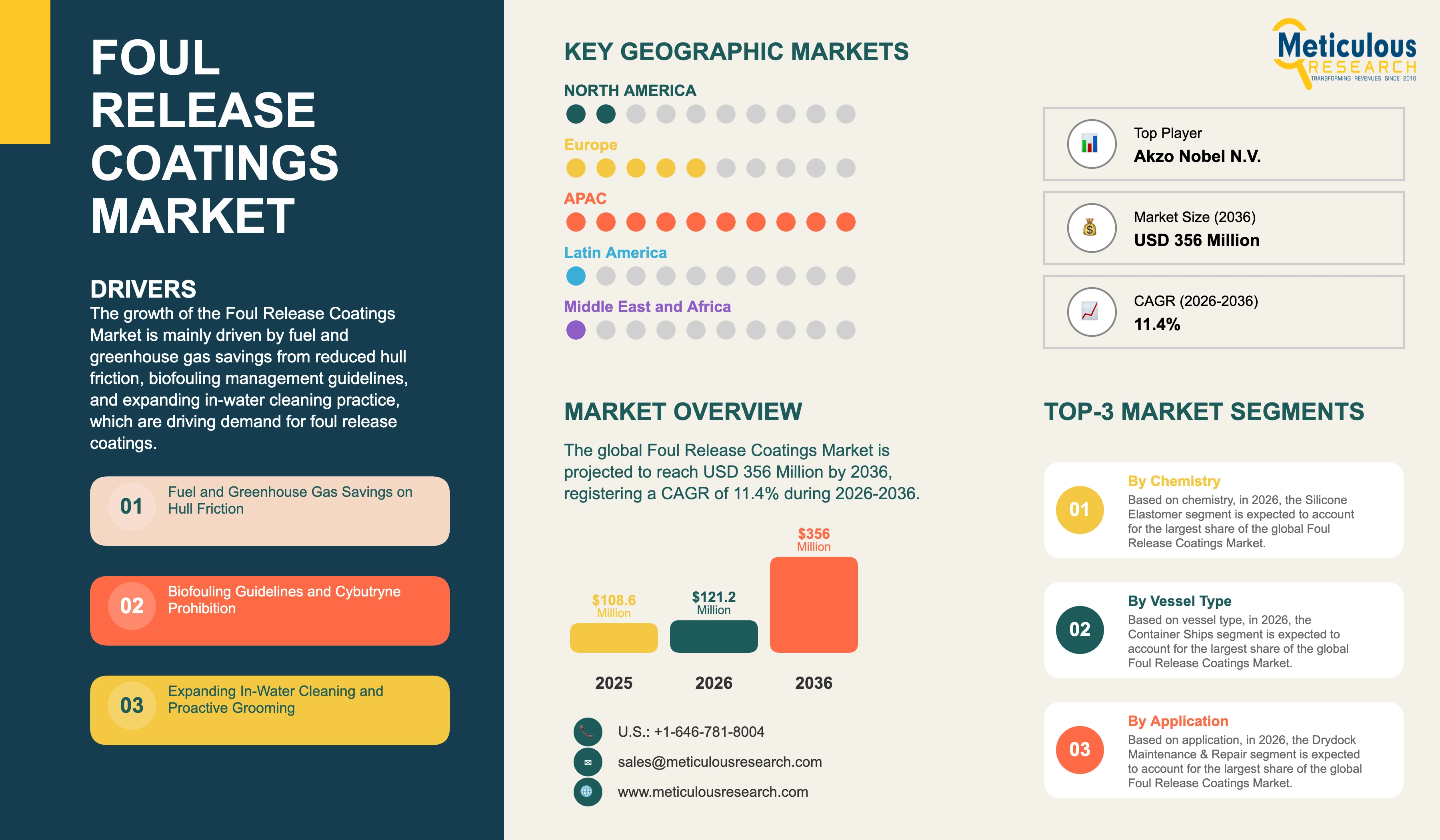
The global Foul Release Coatings Market was valued at USD 108.6 million in 2025. This market is expected to reach USD 356.0 million by 2036 from an estimated USD 121.2 million in 2026, registering a CAGR of 11.4% during the forecast period (2026-2036).
- Published
- Nov 2026
- Pages
- 261
- Format
- PDF + Excel
- Report ID
- MRCHM - 1042782
- Base year
- 2025
- 2025 · BASELINE
- $108.6M
- 2036
- $356.0M
- CAGR 2026–2036
- 11.4%
2025 baseline · 2026–2036 forecast at 11.4% CAGR · hover a bar for the value
Key highlights
The global Foul Release Coatings Market is projected to reach USD 356.0 million by 2036, driven by fuel and emissions savings, biofouling management guidelines, the cybutryne prohibition, and expanding in-water cleaning practice.
Asia-Pacific is expected to account for the largest market share in 2026 and is also projected to register the fastest growth during the forecast period, supported by the concentration of global newbuilding and drydock capacity in the region, where coating is applied rather than where the vessel is owned or flagged.
By chemistry, Silicone Elastomer systems are expected to account for the largest market share, whereas Other Non-Biocidal Systems are projected to witness the fastest growth through 2036.
By vessel type, Container Ships are expected to account for the largest market share, whereas Cruise, Ferry & Roll-On Roll-Off Vessels are projected to witness the fastest growth through 2036.
By application, Drydock Maintenance & Repair applications are expected to account for the largest market share, whereas In-Water Maintenance & Touch-Up applications are projected to witness the fastest growth through 2036.
The International Maritime Organization adopted revised biofouling management guidelines on 7 July 2023, replacing the guidelines adopted on 15 July 2011, and issued guidance on in-water cleaning on 29 April 2025, although both instruments are recommendatory rather than mandatory.
The prohibition on cybutryne in antifouling systems entered into force on 1 January 2023 for vessels of 400 gross tonnage and above, requiring removal or barrier coating at the first scheduled renewal and no later than 60 months after the last application.
One fouling release system is reported to deliver up to 9% fuel and carbon dioxide savings against biocidal self-polishing copolymer coatings, with a single full coat lasting five years, more than 5,500 recorded applications and 19 months of static immersion tolerance.
A competing system launched on 6 March 2023 is reported to deliver up to 20% power saving, 35% lower carbon dioxide emissions and under 1% speed loss, with 150 idle days tolerated and a service life above 10 years, with third-party evidence developed following established hull performance and towing tank methods.
Flume testing at 0, 2, 6, 9 and 12 knots for one minute each showed near-complete slime removal below 6 knots, which confirms that the release mechanism depends on the vessel moving through the water rather than on chemical action.
In-Water Maintenance & Touch-Up is projected to register the fastest application growth at 15.4%, supported by the 2025 in-water cleaning guidance and by the compatibility of smooth, non-biocidal surfaces with proactive grooming.
Reported savings between leading suppliers differ by more than a factor of two, from up to 9% fuel and carbon dioxide reduction to up to 20% power saving, which places the burden of verification on the shipowner rather than on the coating supplier.
Report summary
| Particulars | Details |
|---|---|
| Forecast Period | 2026-2036 |
| Base Year | 2025 |
| Estimated Year | 2026 |
| CAGR (Value) | 11.4% |
| Format | PDF, Excel & Cloud Portal · 261 pages |
| CAGR (Volume) | 9.7% |
| Market Size (Value) in 2026 | USD 121.2 million |
| Market Size (Value) in 2036 | USD 356.0 million |
| Market Size (Volume) in 2026 | 7.50 kilotons of coating as supplied |
| Market Size (Volume) in 2036 | 19.00 kilotons |
| Average Selling Price, 2026 | USD 16,160 per ton |
| Average Selling Price, 2036 | USD 18,740 per ton |
| Segments Covered | By Chemistry: Silicone Elastomer, Silicone Hydrogel & Amphiphilic Silicone, Fluoropolymer, Other Non-Biocidal Systems. By Vessel Type: Container Ships, Tankers, Bulk Carriers, Cruise, Ferry & Roll-On Roll-Off Vessels, Liquefied Natural Gas, Offshore & Other Vessels. By Application: Drydock Maintenance & Repair, Newbuilding, In-Water Maintenance & Touch-Up. By Component: Fouling Release Topcoat, Tie Coat & Anchoring Primer. |
| Countries Covered | Asia-Pacific: China, South Korea, Japan, Singapore, India, Rest of Asia-Pacific. Europe: Germany, Netherlands, Norway, Greece, Rest of Europe. North America: U.S., Canada. Middle East & Africa: U.A.E., Rest of Middle East & Africa. Latin America: Brazil, Rest of Latin America. |
| Key Companies | Akzo Nobel N.V., PPG Industries, Inc., Hempel A/S, Jotun A/S, Chugoku Marine Paints, Ltd., Nippon Paint Holdings Co., Ltd., KCC Corporation, and Kansai Paint Co., Ltd. |
Report overview
Segments covered: chemistry, vessel type, application, component.
In volume terms, the market is estimated at 7.50 kilotons of coating as supplied in 2026 and is expected to reach 19.00 kilotons by 2036, registering a CAGR of 9.7% during the forecast period. The average selling price is estimated at USD 16,160 per ton in 2026 and USD 18,740 per ton in 2036.
The growth of this market is mainly driven by fuel and greenhouse gas savings of up to 20% in power demand reported against biocidal alternatives, International Maritime Organization biofouling management guidelines adopted on 7 July 2023, the prohibition on cybutryne in force since 1 January 2023, and growing in-water cleaning practice supported by guidance issued on 29 April 2025. However, factors such as performance that depends on the vessel maintaining speed through the water, reported savings claims that differ between suppliers by more than a factor of two, a higher initial cost than biocidal antifouling, and the absence of any regulation requiring a biocide-free hull are expected to restrain the growth of this market to some extent.
Among vessel types, Container Ships are expected to account for the largest market share in 2026, while Cruise, Ferry & Roll-On Roll-Off Vessels are projected to register the highest CAGR during the forecast period. Geographically, Asia-Pacific is expected to account for the largest share of this market in 2026 and is also expected to register the highest CAGR during the forecast period.
The Foul Release Coatings Market comprises non-biocidal hull coatings that resist the settlement and adhesion of marine fouling organisms through surface chemistry rather than through the release of a biocide. The market includes silicone elastomer, silicone hydrogel and amphiphilic silicone, fluoropolymer and other non-biocidal systems, supplied as fouling release topcoats together with the tie coats and anchoring primers that bond them to the underlying anticorrosive scheme. The market ecosystem extends from silicone and fluoropolymer suppliers through marine coating formulators and certified applicators to shipyards, drydocks, in-water cleaning contractors and the shipowners and charterers that carry the fuel cost.
The commercial case rests on hull friction rather than on fouling prevention alone. A smooth, low-surface-energy hull reduces frictional resistance and therefore the power required to maintain a given speed, and because fuel is the largest operating cost of a merchant vessel the saving is measured directly in consumption and in emissions. One system is reported to deliver up to 9% fuel and carbon dioxide savings against biocidal self-polishing copolymer coatings, while a competing system launched on 6 March 2023 is reported to deliver up to 20% power saving, 35% lower carbon dioxide emissions and under 1% speed loss.
The release mechanism is mechanical and speed-dependent, which defines where the technology performs. Flume testing at 0, 2, 6, 9 and 12 knots for one minute each showed near-complete slime removal below 6 knots, confirming that hydrodynamic shear rather than chemical action detaches settled organisms. A vessel that maintains steady service speed therefore keeps itself clean, while a vessel spending extended periods at anchor or in port accumulates fouling that the coating cannot shed until it is moving again, and suppliers quote static immersion tolerances of 19 months and 150 idle days to address that exposure.
Service life and application economics differ materially from biocidal antifouling. One fouling release system is applied as a single full coat lasting five years with more than 5,500 recorded applications, while a competing system is specified for a service life above 10 years, so although the initial cost per square meter exceeds that of a self-polishing copolymer the cost per year of service can be lower. The topcoat accounts for the majority of coating value in the scheme at 72.0%, with the tie coat and anchoring primer required to bond a low-surface-energy silicone to the anticorrosive layers beneath it.
The regulatory framework encourages management of biofouling without mandating a biocide-free hull. The International Maritime Organization adopted revised biofouling management guidelines on 7 July 2023, replacing those adopted on 15 July 2011, and issued guidance on in-water cleaning on 29 April 2025, but both instruments are recommendatory. The one binding measure is substance specific: the prohibition on cybutryne entered into force on 1 January 2023 for vessels of 400 gross tonnage and above, requiring removal or barrier coating at the first scheduled renewal and no later than 60 months after the last application.
In-water maintenance is becoming a complementary practice rather than a competing one. Smooth, non-biocidal surfaces tolerate proactive grooming far better than self-polishing copolymers, which are designed to erode, and the 2025 in-water cleaning guidance supports regular light cleaning in preference to infrequent aggressive removal. In-Water Maintenance & Touch-Up is accordingly the fastest-growing application segment at 15.4%, and the combination of a fouling release hull with a grooming program is increasingly presented as a single performance package.
Supply is concentrated among the global marine coatings groups, with the top five accounting for 78.0% of the market and profiled companies for 92.0%, because a hull coating must be supported by worldwide drydock service, certified applicators and warranty coverage across trading routes. Verification is the principal commercial friction in the category, since reported savings between leading suppliers differ by more than a factor of two, from up to 9% fuel and carbon dioxide reduction to up to 20% power saving, which leaves shipowners to validate claims against their own hull performance data.
Asia-Pacific is expected to account for the largest regional share at 56.0% in 2026, reflecting the concentration of global newbuilding and drydock capacity in the region, since hull coating is applied where the vessel is built or repaired rather than where it is owned.
Europe is expected to hold the second-largest share at 26.0% and to grow at 10.4%. The region holds the largest concentration of beneficial ownership and charter decision-making, where fouling release specification is determined even when application takes place in Asia, and it leads adoption of combined coating and grooming performance contracts.
The Middle East & Africa is expected to grow fastest of all regions at 13.0% from a 6.0% share, supported by Gulf repair capacity and tanker and offshore vessel activity. Latin America is expected to grow at 9.8% from a 3.0% share, with Brazil carrying offshore support and coastal trading demand.
Some of the key players operating in the foul release coatings market are Akzo Nobel N.V., PPG Industries, Inc., Hempel A/S, Jotun A/S, Chugoku Marine Paints, Ltd., Nippon Paint Holdings Co., Ltd., KCC Corporation, and Kansai Paint Co., Ltd., among others.
Leading companies are focusing on chemistries that improve idle-period performance, extended service life schemes specified above ten years, third-party verification of savings claims following established hull performance methods, and packaging of coating with grooming schedules and performance monitoring, while expanding certified applicator coverage at Asian newbuilding and repair yards.
What comes next: Biocide-Free Antifouling Coatings and Foul-Release Hulls, a Meticulous Next™ foresight brief.
Report infographic
Market dynamics
10 factors across 4 forcesFuel and Greenhouse Gas Savings on Hull Friction
Reduced hull friction is a major factor driving the Foul Release Coatings Market, because fuel is the largest operating cost of a merchant vessel and a smooth, low-surface-energy hull reduces the power required to maintain a given speed. One fouling release system is reported to deliver up to 9% fuel and carbon dioxide savings against biocidal self-polishing copolymer coatings, while a competing system launched on 6 March 2023 is reported to deliver up to 20% power saving, 35% lower carbon dioxide emissions and under 1% speed loss. As emissions reporting and efficiency indexing make vessel performance commercially visible to charterers as well as owners, hull coating has moved from a maintenance line into the fuel and emissions budget, and demand is expected to continue growing on that basis through the forecast period.
Biofouling Management Guidelines and the Cybutryne Prohibition
Regulatory attention to biofouling is significantly increasing specification of non-biocidal hull systems. The International Maritime Organization adopted revised biofouling management guidelines on 7 July 2023, replacing those adopted on 15 July 2011, and issued guidance on in-water cleaning on 29 April 2025, establishing an expectation that hull condition is actively managed and documented. Alongside these recommendatory instruments, the prohibition on cybutryne entered into force on 1 January 2023 for vessels of 400 gross tonnage and above, requiring removal or barrier coating at the first scheduled renewal and no later than 60 months after the last application, which has brought a substantial population of hulls into drydock for recoating and created a direct opportunity for non-biocidal replacement schemes.
Expanding In-Water Cleaning and Proactive Grooming Practice
The growth of in-water maintenance is creating demand for coatings that tolerate repeated light cleaning. Smooth, non-biocidal surfaces withstand proactive grooming far better than self-polishing copolymers, which are designed to erode and lose film with each pass, and the in-water cleaning guidance issued on 29 April 2025 supports regular light cleaning in preference to infrequent aggressive removal. Because fouling release relies on hydrodynamic shear, with flume testing at 0, 2, 6, 9 and 12 knots showing near-complete slime removal below 6 knots, grooming complements the coating mechanism rather than substituting for it. In-Water Maintenance & Touch-Up is accordingly projected to register the fastest application growth in this market at 15.4%.
Table of contents
12 chapters · 132 sections · 261 pages · click to expandSegmental analysis
| Segment | Largest share (2026) | Fastest growth (2026–2036) |
|---|---|---|
| By Chemistry | Silicone Elastomer systems | Other Non-Biocidal Systems |
| By Vessel Type | Container Ships | Cruise, Ferry & Roll-On Roll-Off Vessels |
| By Application | Drydock Maintenance & Repair | In-Water Maintenance & Touch-Up |
| By Component | Fouling Release Topcoats | Fouling Release Topcoats |
| Other segments | Container Ships | In-Water Maintenance & Touch-Up |
By Chemistry
- Foul Release Coatings Analysis by Chemistry
- Silicone Elastomer systems are expected to account for the largest share of the global Foul Release Coatings Market.
- The large share of this segment is mainly due to the lowest surface energy of any commercially established non-biocidal chemistry and the longest recorded service history, with more than 5,500 applications on one system alone.
- However, Other Non-Biocidal Systems are projected to register the highest CAGR during the forecast period.
- The rapid growth of this segment is attributed to chemistries developed specifically to address performance during idle periods, where pure silicone elastomers are weakest despite tolerances of 19 months static immersion and 150 idle days.
- Silicone Elastomer systems are expected to account for the largest market share in 2026.
- Other Non-Biocidal Systems are projected to register the highest CAGR during the forecast period, owing to chemistries developed specifically to address performance during idle periods, where pure silicone elastomers are weakest despite tolerances of 19 months static immersion and 150 idle days.
- Cruise, Ferry & Roll-On Roll-Off Vessels are projected to register the highest CAGR during the forecast period, owing to fixed schedules at steady service speeds that suit a shear-dependent release mechanism, strong incentives to demonstrate emissions performance, and predictable drydock intervals.
- Fouling Release Topcoats are projected to register the highest CAGR during the forecast period, owing to extension of the installed fouling release area across drydock, newbuilding and in-water touch-up applications.
By Vessel Type
- Foul Release Coatings Analysis by Vessel Type
- Container Ships are expected to account for the largest market share.
- The large share of this segment is mainly due to high service speeds and high fuel consumption that make frictional resistance savings most valuable, combined with large wetted surface areas per vessel.
- However, Cruise, Ferry & Roll-On Roll-Off Vessels are projected to register the highest CAGR during the forecast period.
- The rapid growth of this segment is attributed to fixed schedules at steady service speeds that suit a shear-dependent release mechanism, strong incentives to demonstrate emissions performance, and predictable drydock intervals.
By Application
- Foul Release Coatings Analysis by Application
- Drydock Maintenance & Repair applications are expected to account for the largest market share.
- The large share of this segment is mainly due to the size of the existing fleet relative to annual newbuilding deliveries and the recoating required by the cybutryne prohibition in force since 1 January 2023.
- However, In-Water Maintenance & Touch-Up applications are projected to register the highest CAGR during the forecast period.
- The rapid growth of this segment is attributed to in-water cleaning guidance issued on 29 April 2025 and the tolerance of smooth non-biocidal surfaces for repeated light grooming that eroding self-polishing copolymers cannot withstand.
By Component
- Foul Release Coatings Analysis by Component
- Fouling Release Topcoats are expected to account for the largest market share.
- The large share of this segment is mainly due to the topcoat carrying the functional surface chemistry and accounting for 72.0% of coating value in the scheme.
- However, Fouling Release Topcoats are projected to register the highest CAGR during the forecast period.
- The rapid growth of this segment is attributed to extension of the installed fouling release area across drydock, newbuilding and in-water touch-up applications.
Other segments
- Container Ships are expected to account for the largest market share in 2026.
- Drydock Maintenance & Repair applications are expected to account for the largest market share in 2026.
- In-Water Maintenance & Touch-Up applications are projected to register the highest CAGR during the forecast period, owing to in-water cleaning guidance issued on 29 April 2025 and the tolerance of smooth non-biocidal surfaces for repeated light grooming that eroding self-polishing copolymers cannot withstand.
- Fouling Release Topcoats are expected to account for the largest market share in 2026.
Geographic analysis
Asia-Pacific
Largest shareIn 2026, Asia-Pacific is expected to account for the largest share of the global Foul Release Coatings Market at 56.0% and is also projected to register a high rate of growth during the forecast period. The region holds the overwhelming majority of global newbuilding capacity and a substantial share of drydock capacity, and because hull coating is applied where the vessel is built or repaired rather than where it is owned or flagged, consumption is recorded in the region irrespective of the beneficial owner. China holds the largest country position across newbuilding and repair, South Korea carries high-specification newbuilding including liquefied natural gas carriers, Singapore is the principal repair and in-water service hub, and India is projected to register the fastest country growth at 14.2% on expanding repair capacity. Japan is expected to record the slowest country growth at 8.4%. India is the fastest-growing country at 14.2% and Japan the slowest at 8.4%.
Europe
Europe is expected to account for the second-largest share of the market at 26.0%. The region holds the largest concentration of beneficial ownership and charter decision-making, which is where fouling release specification is actually determined even when application takes place in Asia, and it is also where emissions reporting and efficiency disclosure exert the strongest commercial pressure. Germany, the Netherlands, Norway and Greece carry the principal positions across container, tanker, offshore and bulk ownership, and the region leads adoption of combined coating and grooming performance contracts.
North America
North America is expected to account for 9.0% of the market, with the United States holding most of the regional position across coastal, offshore support and passenger vessel operations. Demand is weighted toward in-water maintenance and toward vessels operating in waters where biofouling transfer and invasive species concerns are most actively regulated at state and federal level.
Middle East & Africa
The Middle East & Africa region is expected to record the highest regional CAGR at 13.0% from a 6.0% share, supported by repair capacity in the Gulf and by tanker and offshore vessel activity, with the United Arab Emirates carrying the regional position. The Middle East & Africa is expected to register the highest regional CAGR at 13.0% on Gulf repair capacity and tanker and offshore activity, while Asia-Pacific grows at 12.0% from the largest base.
Latin America
Latin America is expected to grow at 9.8% from a 3.0% share, with Brazil carrying offshore support and coastal trading demand.
Competitive landscape
The global Foul Release Coatings Market is highly consolidated, with competition among global marine coatings groups with worldwide drydock service networks, certified applicator organizations and in-water cleaning service providers. Market participants compete primarily on verified fuel and power savings against a biocidal baseline, static immersion and idle period tolerance, service life and recoat interval, global drydock and applicator coverage, compatibility with in-water grooming, and performance warranty terms.
Leading companies are investing in chemistries that improve performance during idle periods, quoting static immersion tolerances of 19 months and 150 idle days, and extending service life claims from a single full coat lasting five years to systems specified above ten years. Suppliers are developing third-party evidence following established hull performance and towing tank methods in order to substantiate savings claims that currently range from up to 9% fuel and carbon dioxide reduction to up to 20% power saving, and are packaging coating with grooming schedules and performance monitoring into multi-year arrangements. Expanding certified applicator coverage at Asian newbuilding and repair yards, and positioning non-biocidal schemes as the replacement route for hulls affected by the cybutryne prohibition, remain key strategies adopted by major vendors.
The report provides a comprehensive competitive assessment of the leading companies operating in the global Foul Release Coatings Market. The key players profiled in the report include Akzo Nobel N.V. (Netherlands), PPG Industries, Inc. (U.S.), Hempel A/S (Denmark), Jotun A/S (Norway), Chugoku Marine Paints, Ltd. (Japan), Nippon Paint Holdings Co., Ltd. (Japan), KCC Corporation (South Korea), and Kansai Paint Co., Ltd. (Japan).
- Akzo Nobel N.V.
- PPG Industries, Inc.
- Hempel A/S
- Jotun A/S
- Chugoku Marine Paints, Ltd.
- Nippon Paint Holdings Co., Ltd.
- KCC Corporation
- Kansai Paint Co., Ltd
Expert perspectives
The Foul Release Coatings Market is driven by fuel economics rather than by regulation, and that distinction matters for how the opportunity should be read. No instrument requires a biocide-free hull: the biofouling management guidelines adopted on 7 July 2023 and the in-water cleaning guidance issued on 29 April 2025 are both recommendatory, and the one binding measure is the cybutryne prohibition in force since 1 January 2023, which bans a specific substance rather than the biocidal approach. What sells the category is hull friction, with reported savings of up to 9% fuel and carbon dioxide against self-polishing copolymers and up to 20% power saving with 35% lower carbon dioxide on a competing system.
The width of that range is the central commercial problem, because figures differing by more than a factor of two cannot both describe the same benefit, and the shipowner carries the verification burden against its own hull performance data. The technical boundary is equally specific: flume testing at 0, 2, 6, 9 and 12 knots showed near-complete slime removal below 6 knots, which confirms that the mechanism is hydrodynamic shear and that the coating keeps a moving vessel clean but cannot shed fouling at rest. Static tolerances of 19 months and 150 idle days exist precisely because that exposure is real.
For companies planning entry or expansion, the most attractive positions over the forecast period are likely to be found in cruise, ferry and roll-on roll-off fleets growing at 12.6% where scheduled steady-speed operation suits the mechanism, in-water maintenance growing at 15.4% where non-biocidal surfaces tolerate grooming that eroding coatings cannot, non-elastomer chemistries growing at 13.6% that address idle-period performance, and cybutryne replacement work arising from the renewal requirement. The principal risk is verification rather than performance, since a premium justified by a savings claim the owner cannot reproduce will not survive a second drydocking.
Customer perspectives
“The payback is in fuel, so the only number that matters to us is the one we can see in our own noon reports after a year. One supplier tells us nine percent, another tells us twenty percent power, and those cannot both be describing our ships. We now insist on a monitoring period against the sister vessel on the same route before we commit the rest of the fleet.”
“Most of what we are recoating now is cybutryne removal, and that opens the whole hull up anyway, so the owner has a real choice of scheme rather than a patch repair. The fouling release systems take more care in the tie coat than a self-polishing copolymer does, and if the anchoring layer is wrong the topcoat will not hold, so we are as much a part of the performance as the paint is.”
“Our trading pattern includes a lot of waiting. The coating is excellent once we are at sea, but we can sit at anchor for weeks, and that is where the comparison with a biocidal system gets harder. The static immersion figures the suppliers publish are what we actually negotiate on, more than the speed loss numbers.”
Frequently asked questions
The global Foul Release Coatings Market is estimated at USD 121.2 million in 2026.
The market is projected to reach USD 356.0 million by 2036.
The market is expected to grow at a CAGR of 11.4% during 2026-2036.
The market is driven by fuel and greenhouse gas savings arising from reduced hull friction, biofouling management guidelines adopted on 7 July 2023, the cybutryne prohibition in force since 1 January 2023, and expanding in-water cleaning practice supported by guidance issued on 29 April 2025.
Reported savings vary significantly between systems. One system is reported to deliver up to 9% fuel and carbon dioxide savings against biocidal self-polishing copolymer coatings, while a competing system launched on 6 March 2023 is reported to deliver up to 20% power saving, 35% lower carbon dioxide emissions and under 1% speed loss.
Release is hydrodynamic rather than chemical: a low-surface-energy surface prevents strong adhesion, and hydrodynamic shear detaches settled organisms as the vessel moves. Flume testing showed near-complete slime removal below 6 knots, so the coating keeps a moving vessel clean but cannot shed fouling at rest.
No. The biofouling management guidelines adopted on 7 July 2023 and the in-water cleaning guidance issued on 29 April 2025 are recommendatory. The one binding measure is the cybutryne prohibition in force since 1 January 2023 for vessels of 400 gross tonnage and above, requiring removal or barrier coating at the first scheduled renewal and no later than 60 months after the last application.
Performance dependent on the vessel maintaining speed through the water, reported savings claims differing between suppliers by more than a factor of two, higher initial cost than biocidal antifouling, the absence of any regulation mandating a biocide-free hull, and tie coat application quality determining in-service performance remain the major challenges.
Silicone hydrogel and amphiphilic silicone systems addressing idle-period performance, fluoropolymer surfaces, extended service life schemes specified above ten years, third-party hull performance verification methods, and proactive in-water grooming systems are transforming the market.
Suppliers must comply with the prohibition on cybutryne in antifouling systems in force since 1 January 2023 for vessels of 400 gross tonnage and above, support biofouling management planning under the guidelines adopted on 7 July 2023, align with in-water cleaning guidance issued on 29 April 2025, and meet national and port-state requirements on biofouling transfer and discharge from hull cleaning operations.
Silicone Elastomer systems are expected to account for the largest market share in 2026.
Other Non-Biocidal Systems are projected to register the highest CAGR during the forecast period, owing to chemistries developed specifically to address performance during idle periods, where pure silicone elastomers are weakest despite tolerances of 19 months static immersion and 150 idle days.
Container Ships are expected to account for the largest market share in 2026.
Cruise, Ferry & Roll-On Roll-Off Vessels are projected to register the highest CAGR during the forecast period, owing to fixed schedules at steady service speeds that suit a shear-dependent release mechanism, strong incentives to demonstrate emissions performance, and predictable drydock intervals.
Drydock Maintenance & Repair applications are expected to account for the largest market share in 2026.
In-Water Maintenance & Touch-Up applications are projected to register the highest CAGR during the forecast period, owing to in-water cleaning guidance issued on 29 April 2025 and the tolerance of smooth non-biocidal surfaces for repeated light grooming that eroding self-polishing copolymers cannot withstand.
Fouling Release Topcoats are expected to account for the largest market share in 2026.
Fouling Release Topcoats are projected to register the highest CAGR during the forecast period, owing to extension of the installed fouling release area across drydock, newbuilding and in-water touch-up applications.
Asia-Pacific is expected to account for the largest regional share at 56.0% in 2026, reflecting the concentration of global newbuilding and drydock capacity in the region, since hull coating is applied where the vessel is built or repaired rather than where it is owned.
The Middle East & Africa is expected to register the highest regional CAGR at 13.0% on Gulf repair capacity and tanker and offshore activity, while Asia-Pacific grows at 12.0% from the largest base. India is the fastest-growing country at 14.2% and Japan the slowest at 8.4%.
Europe is expected to hold the second-largest share at 26.0% and to grow at 10.4%. The region holds the largest concentration of beneficial ownership and charter decision-making, and it leads adoption of combined coating and grooming performance contracts.
The Middle East & Africa is expected to grow fastest of all regions at 13.0% from a 6.0% share, supported by Gulf repair capacity and tanker and offshore vessel activity. Latin America is expected to grow at 9.8% from a 3.0% share, with Brazil carrying offshore support and coastal trading demand.
Some of the key players operating in the foul release coatings market are Akzo Nobel N.V., PPG Industries, Inc., Hempel A/S, Jotun A/S, Chugoku Marine Paints, Ltd., Nippon Paint Holdings Co., Ltd., KCC Corporation, and Kansai Paint Co., Ltd., among others.
Leading companies are focusing on chemistries that improve idle-period performance, extended service life schemes, third-party verification of savings claims, and packaging of coating with grooming schedules and performance monitoring, while expanding certified applicator coverage at Asian newbuilding and repair yards.
Cite this report
Meticulous Research. (2026). Foul Release Coatings Market - Global Opportunity Analysis and Industry Forecast (2026-2036) (Report No. MRCHM - 1042782). Meticulous Market Research Pvt. Ltd. https://www.meticulousresearch.com/product/foul-release-coatings-market-7465