Controlled Release Fertilizer Coatings Market (2026-2036)
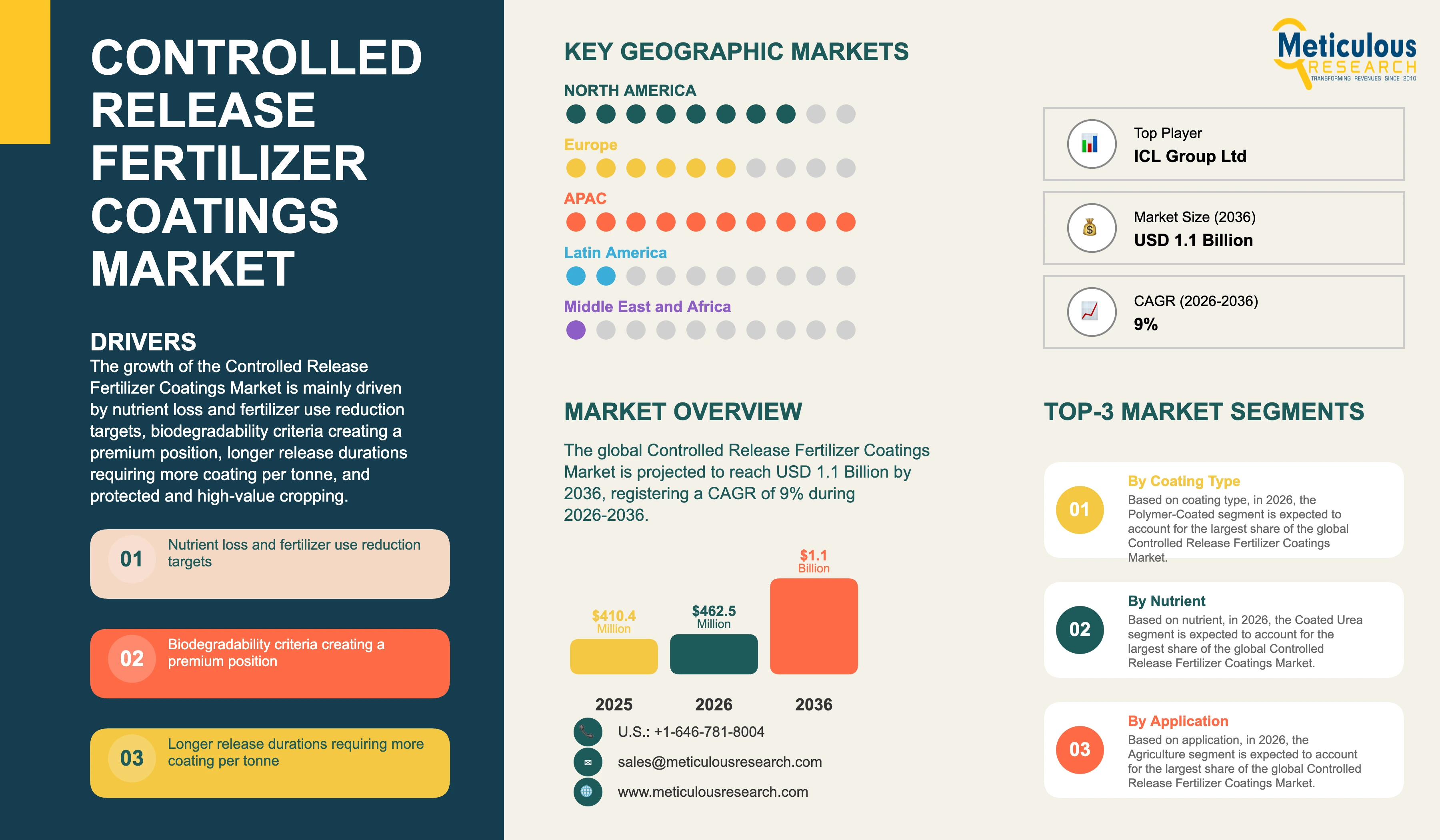
The controlled release fertilizer coatings market is valued at USD 462.5 million in 2026 and is projected to reach USD 1.10 billion by 2036, at a CAGR of 9.0% during the forecast period. The market was valued at USD 410.4 million in 2025 and at USD 364.6 million in 2024.
- Published
- Nov 2026
- Pages
- 258
- Format
- PDF + Excel
- Report ID
- MRCHM - 1042771
- Base year
- 2025
- 2024 · HISTORICAL
- $364.6M
- 2036
- $1.10B
- CAGR 2026–2036
- 9.0%
2024–2025 baseline · 2026–2036 forecast at 9.0% CAGR · hover a bar for the value
Key highlights
This market measures coating materials applied to fertilizer granules and prills to control nutrient release, taken at the coating material supplier gate on a tonne basis as supplied.
Excluded are the fertilizer nutrient itself, nitrification and urease inhibitors applied without a coating, anti-caking and dust suppression treatments, bulk blending and granulation, coating drums and fluidised bed equipment, and seed coatings.
Commission Regulation (EU) 2023/2055 entered into force on 17 October 2023, inserting a restriction on synthetic polymer microparticles into Annex XVII to the chemicals regulation.
That entry defines synthetic polymer microparticles as solid polymers contained in particles or forming a continuous surface coating on them where the size conditions are met, which brings a controlled release fertilizer coating within the definition by construction.
The restriction applies at 0.01% by weight where the particles confer a sought-after characteristic, and where concentrations cannot be determined only particles of at least 0.1 microns in any dimension or 0.3 microns of fibre length are counted.
Polymers that are natural and not chemically modified, degradable, soluble above 2 grams a litre or free of carbon atoms fall outside the designation, with solubility proved under Appendix 16 to that annex.
European fertilising products within Regulation (EU) 2019/1009 are exempt from the restriction, while fertilising products that do not carry the conformity marking are restricted from 17 October 2028, as are other agricultural and horticultural products not otherwise covered.
Appendix 15 to that annex provides that for polymers acting as coating agents, or increasing water retention or wettability, in fertilising products outside the conformity marking regime, degradability must be demonstrated under delegated acts adopted under Article 42(6) of Regulation (EU) 2019/1009.
In the absence of those delegated acts, such polymers may not be placed on the market in those products after 17 October 2028.
Group 1 to 3 screening tests in that appendix are sufficient on their own, while group 4 and 5 tests must be passed in three compartments for non-agricultural uses.
Suppliers must provide polymer identity information to authorities on request within 30 days, with downstream users required to ask their own supplier within 7 days, and information proving degradability or solubility must be provided without delay on request.
Commission Delegated Regulation (EU) 2024/2788 of 23 July 2024, published on 31 October 2024, amends Annex II to Regulation (EU) 2019/1009 as regards the polymers in component material category 11 and applies from 17 October 2028.
That amendment replaces the relevant point so that it covers polymers other than those that are natural and not chemically modified, degradable under Appendix 15, soluble above 2 grams a litre under Appendix 16, or free of carbon atoms, and inserts a new point for polymers covered by component material categories 8 and 9.
The recitals record that the Commission was required to assess biodegradability criteria for coating agents and for water retention polymers by 16 July 2024, and that European fertilising products are excluded from the general chemicals restriction while that assessment remains pending.
The application date of 17 October 2028 was aligned with the date applying to national fertilising products under Regulation (EU) 2023/2055 for coherence and to allow time for adaptation.
Sulphur coatings contain no polymer and therefore fall outside the synthetic polymer microparticle designation altogether, which gives the oldest coating technology in this market the only position with no polymer exposure.
Polymer-coated products are expected to hold the largest coating type share of this market in 2026 at 34.0%, while biodegradable and bio-based polymer coatings grow fastest at 16.4% and sulphur-coated products slowest at 5.2%.
Coated urea is expected to account for the largest nutrient share of this market in 2026 at 48.0% and to grow slowest at 8.0%, while coated micronutrient and specialty products grow fastest at 12.8%.
Report summary
| Particulars | Details |
|---|---|
| Base Year | 2025 |
| Actual Years | 2024-2025 |
| Forecast Period | 2026-2036 |
| Market Size in 2024 | USD 364.6 million |
| Market Size in 2025 | USD 410.4 million |
| Market Size in 2026 | USD 462.5 million |
| Market Size in 2036 | USD 1.10 billion |
| Value CAGR (2026-2036) | 9.0% |
| Volume in 2025 | 228.00 kilotons |
| Volume in 2026 | 246.00 kilotons |
| Volume in 2036 | 428.00 kilotons |
| Volume CAGR (2026-2036) | 5.7% |
| Average Selling Price, 2026 | USD 1,880 per tonne |
| Average Selling Price, 2036 | USD 2,560 per tonne |
| Units | Value in USD million; volume in kilotons of coating material as supplied; price in USD per tonne |
| Measurement Basis | Coating materials applied to fertilizer granules and prills to control nutrient release, taken at the coating material supplier gate on a tonne basis as supplied |
| Historical Value Growth | Value grew at 12.6% a year between 2024 and 2026 on volume growth of 7.7% a year and price growth of 4.5% a year; the forecast of 9.0% carries volume growth of 5.7% and price growth of 3.1%, with value growing well ahead of volume throughout because longer durations carry more coating a tonne of product and because the coating mix shifts toward higher-value chemistries |
| Price Increase Note | The average selling price rises on mix rather than on repricing, because sulphur is a commodity priced in hundreds of dollars a tonne while polymer coating systems are priced in thousands, so a shift of share between them moves the blended figure without either repricing, and the biodegradable premium accelerates the same effect |
| Microplastic Restriction Basis | Commission Regulation (EU) 2023/2055 entered into force on 17 October 2023, inserting a restriction on synthetic polymer microparticles into Annex XVII to the chemicals regulation; the entry defines them as solid polymers contained in particles or forming a continuous surface coating on them where the size conditions are met, applies at 0.01% by weight where the particles confer a sought-after characteristic, and counts only particles of at least 0.1 microns in any dimension or 0.3 microns of fibre length where concentrations cannot be determined |
| Exclusion Criteria Note | Polymers that are natural and not chemically modified, degradable, soluble above 2 grams a litre under Appendix 16, or free of carbon atoms fall outside the designation |
| Fertilising Product Dates Basis | European fertilising products within Regulation (EU) 2019/1009 are exempt from the restriction; fertilising products that do not carry the conformity marking are restricted from 17 October 2028, as are other agricultural and horticultural products not otherwise covered |
| Degradability Requirement Basis | Appendix 15 provides that for polymers acting as coating agents, or increasing water retention or wettability, in fertilising products outside the conformity marking regime, degradability must be demonstrated under delegated acts adopted under Article 42(6) of Regulation (EU) 2019/1009, and in the absence of those delegated acts such polymers may not be placed on the market in those products after 17 October 2028; group 1 to 3 screening tests are sufficient on their own, while group 4 and 5 tests must be passed in three compartments for non-agricultural uses |
| Delegated Regulation Basis | Commission Delegated Regulation (EU) 2024/2788 of 23 July 2024, published on 31 October 2024, amends Annex II to Regulation (EU) 2019/1009 as regards the polymers in component material category 11 and applies from 17 October 2028; it replaces the relevant point so that it covers polymers other than those that are natural and not chemically modified, degradable under Appendix 15, soluble above 2 grams a litre under Appendix 16, or free of carbon atoms, and inserts a new point for polymers covered by component material categories 8 and 9 |
| Pending Assessment Note | The recitals to that delegated regulation record that the Commission was required to assess biodegradability criteria for coating agents and for water retention polymers by 16 July 2024, and that European fertilising products are excluded from the general chemicals restriction while that assessment remains pending; the application date of 17 October 2028 was aligned with the date applying to national fertilising products for coherence and to allow time for adaptation |
| Information Obligation Note | Suppliers must provide polymer identity information to authorities on request within 30 days, downstream users must ask their own supplier within 7 days, and information proving degradability or solubility must be provided without delay on request |
| Non-Polymer Position Note | Sulphur coatings contain no polymer and therefore fall outside the synthetic polymer microparticle designation altogether, which gives the oldest coating technology in this market the only position with no polymer exposure; release from a sulphur shell nonetheless depends on microbial oxidation and on cracks formed in handling rather than on diffusion through an engineered membrane, so the release curve is less predictable and the segment grows slowest at 5.2% |
| Overlap Note | The fertilizer nutrient itself is counted in the Controlled-Release Fertilizers Market title and nitrification and urease inhibitors in the relevant inhibitor titles, so those titles are non-additive with this one on the products they share |
| Exclusions | The fertilizer nutrient itself; nitrification and urease inhibitors applied without a coating; anti-caking, dust suppression and conditioning treatments; bulk blending, granulation and prilling; coating drums, fluidised bed and spray equipment; seed coatings and seed treatments; soil conditioners, water retention polymers and superabsorbents sold separately |
| Segments: Coating Type | Polymer-Coated; Sulphur-Coated; Polymer-Sulphur Coated; Biodegradable and Bio-Based Polymer; Other Coating Types |
| Segments: Nutrient | Coated Urea; Coated NPK and Compound; Coated Potash; Coated Micronutrient and Specialty; Other Coated Nutrients |
| Segments: Release Duration | Up to 3 Months; 3 to 6 Months; 6 to 12 Months; Above 12 Months |
| Segments: Application | Agriculture; Turf and Ornamental; Horticulture and Nursery; Other Applications |
| Largest Segment by Coating Type, 2026 | Polymer-Coated, at 34.0% |
| Fastest-Growing Segment by Coating Type | Biodegradable and Bio-Based Polymer, at 16.4% |
| Slowest-Growing Segment by Coating Type | Sulphur-Coated, at 5.2% |
| Largest Segment by Nutrient, 2026 | Coated Urea, at 48.0% |
| Fastest-Growing Segment by Nutrient | Coated Micronutrient and Specialty, at 12.8% |
| Slowest-Growing Segment by Nutrient | Coated Urea, at 8.0% |
| Largest Segment by Release Duration, 2026 | Up to 3 Months, at 38.0% |
| Fastest-Growing Segment by Release Duration | Above 12 Months, at 12.0% |
| Largest Segment by Application, 2026 | Agriculture, at 44.0% |
| Fastest-Growing Segment by Application | Horticulture and Nursery, at 11.0% |
| Slowest-Growing Segment by Application | Turf and Ornamental, at 6.8% |
| Largest Region, 2026 | Asia-Pacific, at 38.0% |
| Fastest-Growing Region | Europe, at 10.4% |
| Fastest-Growing Country | Netherlands, at 11.8% |
| Slowest-Growing Country | Canada, at 6.8% |
| Regions Covered | Asia-Pacific; North America; Europe; Latin America; Middle East & Africa |
| Countries Covered | China; Japan; India; Australia; U.S.; Canada; Germany; Netherlands; France; Spain; Brazil; Mexico |
| Key Players | ICL Group Ltd; Nutrien Ltd.; Yara International ASA; Haifa Group; Kingenta Ecological Engineering Group Co., Ltd.; Sociedad Quimica y Minera de Chile S.A.; The Andersons, Inc. |
| Supply Structure Note | Supply sits mainly with integrated fertilizer producers rather than with independent coating formulators, because the coating is applied in the fertilizer plant on the producer own granule and the release specification is sold as a finished product rather than as a coating; independent coating technology licensors and toll coaters serve regional blenders and specialty producers without coating capability of their own |
| Top Five Share, 2026 | 54.0% |
| Profiled Companies Share, 2026 | 68.0% |
| Currency | USD |
Report overview
Market value is measured in in USD million; volume in kilotons of coating material as supplied; price in USD per tonne. Segments covered: coating type, nutrient, release duration, application.
In volume terms, the market is estimated at 246.00 kilotons of coating material in 2026, rising to 428.00 kilotons by 2036, at a CAGR of 5.7%. The average selling price is estimated at USD 1,880 per tonne in 2026 and USD 2,560 per tonne in 2036, the increase reflecting a mix shift from low-cost sulphur toward polymer and biodegradable polymer coatings rather than any repricing of either.
The growth of this market is mainly driven by nutrient loss and fertilizer use reduction targets that a coated product meets more readily than an uncoated one, biodegradability criteria that create a premium position for compliant coatings, release durations above 12 months growing at 12.0%, and horticulture and nursery demand growing at 11.0%. However, factors such as a continuous polymer coating on a particle falling within the definition of a synthetic polymer microparticle, an exemption for European fertilising products that holds only while a pending assessment is unresolved, a restriction date of 17 October 2028 applying to coating polymers in national fertilising products, and sulphur coatings that carry no polymer exposure but grow at only 5.2% are expected to restrain the growth of this market to some extent.
Among applications, agriculture is expected to hold the largest share of this market in 2026, while horticulture and nursery are expected to record the highest CAGR during the forecast period. Geographically, Asia-Pacific is expected to account for the largest share of this market in 2026, while Europe is expected to register the highest CAGR during the forecast period.
A controlled release fertilizer is an ordinary granule with a membrane around it. Water diffuses through the membrane, dissolves the nutrient inside, and the dissolved nutrient diffuses back out at a rate set by the thickness, permeability and integrity of the coating. The coating therefore does the whole job, and the fertilizer underneath is a commodity.
That membrane is what the market measures, and the physics of it sets a requirement that is internally contradictory. It has to resist breakdown for the 3 to 12 months over which the nutrient is metered out, survive handling, blending and spreading without cracking, and then disappear. A coating that degrades early dumps the nutrient; one that never degrades remains in the soil.
The named demand driver for this title is nutrient use efficiency rules, and those rules exist. Nutrient loss and fertilizer use reduction targets are met more readily by a product that releases over a season than by one that releases on contact with water, and the agronomic case for coating has never been in dispute.
What has changed is that the same regulator has defined the coating as a microplastic. Commission Regulation (EU) 2023/2055, in force since 17 October 2023, defines synthetic polymer microparticles as solid polymers contained in particles or forming a continuous surface coating on them where the size conditions are met, which describes a polymer-coated fertilizer granule exactly.
European fertilising products carrying the conformity marking are exempt from that restriction, and the exemption is conditional rather than permanent. The recitals to Commission Delegated Regulation (EU) 2024/2788 record that those products are excluded while the Commission assessment of biodegradability criteria for coating agents remains pending, and that the assessment was required by 16 July 2024.
Outside the conformity marking regime the position is already fixed. Fertilising products that do not carry the marking are restricted from 17 October 2028, and Appendix 15 provides that where degradability of a coating polymer has not been demonstrated under delegated acts adopted under Article 42(6) of Regulation (EU) 2019/1009, such polymers may not be placed on the market in those products after that date.
Delegated Regulation (EU) 2024/2788 applies from the same day, 17 October 2028, and the recitals state that the date was chosen for coherence with the national fertilising products position and to allow time for adaptation. Two instruments and one date therefore govern the technology of this market.
Satisfying both requirements at once is the technical problem. The degradability routes recognised in Appendix 15 run from group 1 to 3 screening tests, which are sufficient on their own, to group 4 and 5 tests that must be passed in three compartments for non-agricultural uses, and a polyurethane or alkyd membrane engineered to hold back water for a year is not designed to pass any of them.
That is why biodegradable and bio-based polymer coatings record the highest coating type CAGR in this market at 16.4% from a 14.0% share in 2026. The growth is not agronomic preference but regulatory necessity, and the premium those coatings carry is what lifts the average selling price of this market.
Sulphur occupies the position nobody expected to matter again. A sulphur coating contains no polymer and therefore falls outside the synthetic polymer microparticle designation altogether, so the oldest technology in the market is the only one with no polymer exposure at all.
It is also the crudest. Release from a sulphur shell depends on microbial oxidation and on cracks formed in handling rather than on diffusion through an engineered membrane, so the release curve is less predictable, and sulphur-coated products grow slowest among coating types at 5.2% despite that regulatory advantage.
Polymer-sulphur systems split the difference by applying a thin polymer layer over a sulphur base, reducing the polymer mass per tonne of product while recovering part of the release control, and they grow at 7.8% from an 18.0% share.
Price in this market rises 3.1% a year across the forecast period, from USD 1,880 per tonne in 2026 to USD 2,560 per tonne in 2036, and the rise is almost entirely mix. Sulphur is a commodity priced in hundreds of dollars a tonne while polymer coating systems are priced in thousands, so a shift of share between them moves the blended figure without either repricing.
Demand by nutrient is dominated by urea, at 48.0% of this market in 2026, because urea has the highest nitrogen content and the worst volatilisation and leaching behaviour of the common nitrogen sources, so it gains the most from being metered. It is also the slowest-growing nutrient position at 8.0%, since the coating cost has to be recovered from a commodity.
Release duration is where the specification is moving. Durations up to 3 months hold 38.0% of this market in 2026 and grow slowest at 7.4%, while durations above 12 months grow fastest at 12.0%, because a longer duration requires a thicker or less permeable membrane and therefore more coating material per tonne of product.
Application mix separates regulatory exposure from volume. Agriculture holds 44.0% of this market in 2026 and grows at 9.3%, horticulture and nursery grow fastest at 11.0% on high-value protected cropping, and turf and ornamental work grows slowest at 6.8% on a mature base in which the professional lawn care market is no longer expanding.
Asia-Pacific holds 38.0% of this market in 2026 on Chinese coated fertilizer production and on Japanese coated urea in rice, where the agronomic case is strongest. Europe holds 21.0% and grows fastest at 10.4%, not because it consumes the most but because it is the only region in which the coating chemistry itself is being legislated.
Report infographic
Market dynamics
17 factors across 5 forcesNutrient Loss and Fertilizer Use Reduction Targets
A coated granule releases nutrient over a season rather than on contact with water, which reduces leaching, runoff and volatilisation losses and allows the same crop response from a lower applied rate.
That is the mechanism by which a nutrient loss or fertilizer use reduction target is met without reducing yield, and it is the reason the agronomic case for coating has never been in dispute even while the chemistry of the coating has come under challenge.
Agriculture holds the largest application share of this market in 2026 at 44.0% and grows at 9.3%, with coated urea the largest nutrient position at 48.0% because urea has the highest nitrogen content and the worst volatilisation and leaching behaviour of the common nitrogen sources.
Biodegradability Criteria Creating a Premium Position
Appendix 15 to Annex XVII of the chemicals regulation provides that where degradability of a coating polymer has not been demonstrated under delegated acts adopted under Article 42(6) of Regulation (EU) 2019/1009, such polymers may not be placed on the market in fertilising products outside the conformity marking regime after 17 October 2028.
Group 1 to 3 screening tests in that appendix are sufficient on their own while group 4 and 5 tests must be passed in three compartments for non-agricultural uses, so a coating that can demonstrate degradability holds a position that a conventional membrane cannot.
Biodegradable and bio-based polymer coatings accordingly record the highest coating type CAGR in this market at 16.4% from a 14.0% share in 2026, and the premium those coatings carry is what lifts the average selling price of this market by 3.1% a year.
Longer Release Durations Requiring More Coating per Tonne
A release duration is set by the thickness and permeability of the membrane, so extending release from three months to twelve requires more coating material on the same granule rather than a different fertilizer underneath.
Longer durations also command a higher price per tonne of finished product, because the agronomic value of a single application replacing three is captured in the price of the coated fertilizer rather than in the nutrient.
Release durations above 12 months record the highest CAGR in this market at 12.0% and durations of 6 to 12 months at 10.6%, against 7.4% for durations up to 3 months on the largest share at 38.0%.
Protected and High-Value Cropping
A horticultural or nursery crop grown under protection carries a crop value per hectare an order of magnitude above field agriculture, so the cost of a coating is recovered from a far larger revenue base and the specification is written on performance rather than on price.
Container-grown nursery stock also depends on controlled release almost absolutely, because a soluble fertilizer applied to a free-draining container substrate leaves with the first irrigation and cannot be held by the growing medium.
Horticulture and nursery record the highest application CAGR in this market at 11.0% from an 18.0% share in 2026, and coated micronutrient and specialty products grow fastest among nutrients at 12.8%.
Protected cropping also concentrates in a small number of countries rather than spreading with agricultural area, which is why the Netherlands is the fastest-growing country in this market at 11.8% on a land area that carries almost none of the fertilizer tonnage.
Table of contents
12 chapters · 132 sections · 258 pages · click to expandSegmental analysis
| Segment | Largest share (2026) | Fastest growth (2026–2036) |
|---|---|---|
| By Coating Type | Polymer-coated products | Biodegradable and bio-based polymer coatings |
| By Nutrient | Coated urea | Coated micronutrient and specialty products |
| By Release Duration | Durations up to 3 months | Durations above 12 months |
| By Application | Agriculture | Horticulture and nursery |
By Coating Type
- Controlled Release Fertilizer Coatings Market Analysis by Coating Type
- This market is segmented into polymer-coated, sulphur-coated, polymer-sulphur coated, biodegradable and bio-based polymer, and other coating types.
- Polymer-coated products are expected to account for the largest share of this market in 2026.
- A polyurethane or alkyd membrane applied in a rotating drum or fluidised bed gives diffusion-controlled release that can be engineered to a target duration, which is the performance standard against which every other construction in this market is measured.
- Sulphur-coated products hold the second position and are the slowest-growing coating type in this market.
- A sulphur shell contains no polymer and therefore falls outside the synthetic polymer microparticle designation altogether, but release depends on microbial oxidation and on cracks formed in handling rather than on diffusion through an engineered membrane, so the release curve is less predictable.
- Polymer-sulphur coated products grow below the market rate, applying a thin polymer layer over a sulphur base to reduce polymer mass per tonne of product while recovering part of the diffusion-controlled release, which is now a compliance strategy as much as a cost one.
- Biodegradable and bio-based polymer coatings are projected to register the highest CAGR among coating types during the forecast period, because a coating able to demonstrate degradability holds a position that a conventional membrane cannot occupy in fertilising products outside the conformity marking regime after 17 October 2028.
- Other coating types grow above the market rate from the smallest base, covering soluble, inorganic and mineral-based systems, and polymers soluble above 2 grams a litre fall outside the designation altogether, which makes solubility a design target rather than a research problem.
By Nutrient
- Controlled Release Fertilizer Coatings Market Analysis by Nutrient
- This market is segmented into coated urea, coated NPK and compound, coated potash, coated micronutrient and specialty, and other coated nutrients.
- Coated urea is expected to account for the largest share of this market in 2026 and is also the slowest-growing nutrient position.
- Urea carries the highest nitrogen content and the worst volatilisation and leaching behaviour of the common nitrogen sources, so it gains the most from being metered, but the coating cost has to be recovered from a nutrient priced globally per unit of nitrogen.
- Coated NPK and compound products hold the second position and grow above the market rate, where a single coated granule delivers a balanced nutrient ratio over a season and the coating cost is spread across three nutrients rather than one.
- Coated potash grows close to the market rate, applied where chloride or salt index has to be moderated as much as release timing, and used extensively in turf and in salt-sensitive horticultural crops.
- Coated micronutrient and specialty products are projected to register the highest CAGR among nutrients during the forecast period, because micronutrients are applied at low rates where placement and timing matter more than cost per unit, and the coating is a larger proportion of a smaller and higher-value product.
By Release Duration
- Controlled Release Fertilizer Coatings Market Analysis by Release Duration
- This market is segmented into up to 3 months, 3 to 6 months, 6 to 12 months, and above 12 months.
- Durations up to 3 months are expected to hold the largest share of this market in 2026 and are also the slowest-growing duration class.
- A short release suits a single crop cycle in field agriculture and requires the thinnest membrane and therefore the least coating material a tonne of finished product.
- Durations of 3 to 6 months hold the second position and grow close to the market rate, matched to a full growing season in temperate agriculture and to container nursery stock turned over within a year.
- Durations of 6 to 12 months grow above the market rate, used in perennial horticulture, plantation crops and professional turf where a single application has to carry a whole season or longer, and requiring a thicker or less permeable membrane.
- Durations above 12 months are projected to register the highest CAGR among duration classes during the forecast period from the smallest base, carrying the most coating material a tonne of product and the highest exposure to coating damage in handling, storage and application.
By Application
- Controlled Release Fertilizer Coatings Market Analysis by Application
- This market is segmented into agriculture, turf and ornamental, horticulture and nursery, and other applications.
- Agriculture is expected to account for the largest share of this market in 2026 and grows above the market rate.
- Nutrient loss and fertilizer use reduction targets apply to field cropping before any other land use, and a coated product meets them without reducing the applied nutrient the crop actually takes up.
- Turf and ornamental work holds the second position and is the slowest-growing application in this market, built on golf, sports surface and professional lawn care demand where controlled release has been standard practice for decades and where the installed base is no longer expanding.
- Horticulture and nursery are projected to register the highest CAGR among applications during the forecast period.
- A protected or container crop carries a crop value per hectare an order of magnitude above field agriculture, and a soluble fertilizer applied to a free-draining container substrate leaves with the first irrigation and cannot be held by the growing medium.
- Other applications grow above the market rate, covering forestry establishment, land reclamation, landscaping and specialty substrate work where a single application has to serve an unattended site over an extended period.
Geographic analysis
Asia-Pacific
Largest shareAsia-Pacific is expected to account for the largest share of this market in 2026. China carries the largest coated fertilizer production base in the world, Japan has used coated urea in rice for decades where the agronomic case for metering nitrogen into flooded paddy is strongest, and India is adding capacity against nutrient use efficiency objectives in its own fertilizer policy. China holds the largest country position on both production and consumption, with Japan carrying the highest-specification position in long-duration coated urea and in coating technology, Australia growing on horticulture and plantation crops, and India growing ahead of the regional average from a smaller base.
Europe
Fastest growthEurope is projected to register the highest CAGR among regions during the forecast period. The region is not the largest consumer, but it is the only one in which the coating chemistry itself is being legislated, through the synthetic polymer microparticle restriction in force since 17 October 2023 and the delegated amendment applying from 17 October 2028. The Netherlands holds the fastest-growing country position in this market on protected horticulture and nursery production, with Germany and France carrying the broadest agricultural and professional turf base and Spain growing on fruit, vegetable and plantation cropping under irrigation.
North America
North America holds the second regional position and grows below the market rate, with the U.S. carrying almost all of the regional position across agriculture, professional turf and nursery production on a mature base, and Canada the slowest-growing country in this market where polymer coated urea for broadacre agriculture is already an established practice.
Latin America
Latin America grows close to the market rate on sugarcane, coffee, citrus and plantation cropping in Brazil and on protected horticulture in Mexico, while the Middle East & Africa holds the smallest regional share on irrigated horticulture and landscaping where water scarcity makes nutrient retention valuable.
Competitive landscape
Supply in this market sits mainly with integrated fertilizer producers rather than with independent coating formulators, because the coating is applied in the fertilizer plant on the producer own granule and the release specification is sold as a finished product rather than as a coating.
The top five participants in this market account for a combined share of 54.0% in 2026 and the companies profiled in this report account for 68.0%, with concentration highest in long-duration and horticultural grades where the coating technology rather than the nutrient is the point of difference.
Competitive position therefore rests on coating technology held in-house and on the agronomic data behind a release curve, since a release duration claim has to be supported across soil temperatures, moisture regimes and crop cycles rather than demonstrated in a laboratory.
The microplastic restriction has changed the basis of that competition for the first time in decades, because a producer that can demonstrate degradability of its coating under Appendix 15 holds a position its competitors cannot occupy in fertilising products outside the conformity marking regime after 17 October 2028.
Independent coating technology licensors and toll coaters hold a smaller but durable position, serving regional blenders and specialty producers that lack coating capability of their own and that cannot justify a coating line against their own volume.
Chinese producers hold the largest coated fertilizer capacity in the world and compete on cost into domestic agriculture and export markets, while Japanese, Israeli and European participants hold the long-duration and horticultural positions where the release specification rather than the price a tonne decides the sale.
The documentation obligations that follow the restriction also favour scale, since polymer identity information must be provided to authorities within 30 days of a request and proof of degradability or solubility without delay, and a regional blender buying a coating from a third party carries that duty without the technical file to discharge it.
Some of the key players operating in the controlled release fertilizer coatings market are ICL Group Ltd, Nutrien Ltd., Yara International ASA, Haifa Group, Kingenta Ecological Engineering Group Co., Ltd., Sociedad Quimica y Minera de Chile S.A., and The Andersons, Inc., among others.
- ICL Group Ltd
- Nutrien Ltd.
- Yara International ASA
- Haifa Group
- Kingenta Ecological Engineering Group Co., Ltd.
- Sociedad Quimica y Minera de Chile S.A.
- Andersons, Inc
Expert perspectives
The named demand driver for this title is nutrient use efficiency rules, and those rules exist and favour coated fertilizer. A product that releases over a season rather than on contact with water reduces leaching, runoff and volatilisation and allows the same crop response from a lower applied rate, and the agronomic case has never been in dispute.
The complication is that the same regulator has defined the mechanism as a microplastic. Commission Regulation (EU) 2023/2055, in force since 17 October 2023, defines synthetic polymer microparticles as solid polymers contained in particles or forming a continuous surface coating on them where the size conditions are met, which describes a polymer-coated granule exactly.
European fertilising products carrying the conformity marking are exempt, and the recitals to Commission Delegated Regulation (EU) 2024/2788 record that the exclusion holds while the Commission assessment of biodegradability criteria for coating agents remains pending, an assessment that was required by 16 July 2024.
Outside that regime the date is already set. Fertilising products without the conformity marking are restricted from 17 October 2028, Appendix 15 bars coating polymers whose degradability has not been demonstrated under delegated acts after the same date, and the delegated regulation itself applies from 17 October 2028.
Meeting that requirement contradicts the function of the product. A membrane has to resist breakdown for the 3 to 12 months over which nutrient is metered, survive handling, blending and spreading without cracking, and then degrade, and no single chemistry optimises all three. Sulphur escapes the problem by containing no polymer, which is why the crudest technology in the market now has the cleanest regulatory position and still grows slowest at 5.2%.
That is the structure of the forecast. Value compounds at 9.0% against volume at 5.7%, because the growth is in longer durations carrying more coating a tonne and in chemistries carrying a compliance premium: biodegradable and bio-based coatings at 16.4%, micronutrient and specialty grades at 12.8%, durations above 12 months at 12.0%, horticulture at 11.0% and Europe at 10.4% on only 21.0% of the volume.
Customer perspectives
A fertilizer producer buys a coating system and a release specification together, because the coating is applied on its own granule in its own plant and the claim it then makes to the market is a duration rather than a chemistry.
That buyer treats coating mass a tonne of product as the cost variable and release accuracy as the performance variable, and a longer duration raises both at once.
A European producer now buys a regulatory position as well, since a coating whose degradability can be demonstrated under Appendix 15 can be placed on the market in fertilising products outside the conformity marking regime after 17 October 2028 and one whose degradability cannot be demonstrated cannot.
Documentation travels with the purchase, because polymer identity information must be given to authorities within 30 days of a request, a downstream user must ask its own supplier within 7 days, and proof of degradability or solubility must be provided without delay.
A field crop grower compares cost per unit of nitrogen and adopts coating where a nutrient loss rule or a single-pass application saving justifies it, which is why coated urea is the largest and slowest-growing nutrient position in this market.
A container nursery has no realistic alternative, because a soluble fertilizer applied to a free-draining substrate leaves with the first irrigation and the growing medium cannot hold it, so the specification is written on release accuracy rather than on price.
A golf course or sports surface manager buys predictability of growth rather than nutrient efficiency, on a mature base where controlled release has been standard practice for decades.
A bulk blender buys coating durability through handling above everything else, because a membrane abraded in conveying, bagging or spreading converts a six-month product into a six-week one and the damage is not visible on inspection.
A plantation or perennial crop buyer wants the longest duration available and accepts the highest coating cost a tonne, which is why durations above 12 months grow fastest despite remaining the smallest duration class.
Across every buyer the purchase is of a release curve rather than of a coating, and the regulatory question is now part of that curve rather than separate from it.
Frequently asked questions
The market is valued at USD 462.5 million in 2026 and is projected to reach USD 1.10 billion by 2036, at a CAGR of 9.0%. It was valued at USD 410.4 million in 2025 and USD 364.6 million in 2024.
It measures coating materials applied to fertilizer granules and prills to control nutrient release, at the coating material supplier gate on a tonne basis as supplied. Excluded are the fertilizer nutrient itself, inhibitors applied without a coating, anti-caking and conditioning treatments, blending and granulation, coating and spray equipment, and seed coatings.
It holds, and it now runs against a second rule from the same regulator. A coated product reduces leaching, runoff and volatilisation, but Commission Regulation (EU) 2023/2055 defines synthetic polymer microparticles as solid polymers forming a continuous surface coating on particles, so the mechanism that delivers the efficiency is itself restricted.
It entered into force on 17 October 2023 and applies at 0.01% by weight where the particles confer a sought-after characteristic. Polymers that are natural and not chemically modified, degradable, soluble above 2 grams a litre or free of carbon atoms fall outside the designation.
Only in part, and conditionally. European fertilising products within Regulation (EU) 2019/1009 are exempt, but the exclusion holds while the Commission assessment of biodegradability criteria for coating agents remains pending, and products without the conformity marking are restricted from 17 October 2028.
Under delegated acts adopted pursuant to Article 42(6) of Regulation (EU) 2019/1009, against the test framework in Appendix 15. Group 1 to 3 screening tests are sufficient on their own, while group 4 and 5 tests must be passed in three compartments for non-agricultural uses.
Because it contradicts the function of the product. The membrane has to resist breakdown for the 3 to 12 months over which nutrient is metered out, survive handling, blending and spreading, and then degrade in soil, and no single chemistry optimises all three requirements.
Sulphur, which contains no polymer and therefore falls outside the synthetic polymer microparticle designation altogether. It is also the crudest, with a less predictable release curve, and grows slowest among coating types at 5.2%.
Biodegradable and bio-based polymer coatings, at 16.4% from a 14.0% share in 2026. A coating able to demonstrate degradability holds a position a conventional membrane cannot occupy outside the conformity marking regime after 17 October 2028.
On mix rather than on repricing. Sulphur is priced in hundreds of dollars a tonne while polymer coating systems are priced in thousands, so a shift of share moves the blended figure, and price rises 3.1% a year against 4.5% between 2024 and 2026.
Because longer release durations carry more coating material a tonne of finished product and a higher-value coating. Durations above 12 months grow fastest at 12.0% and 6 to 12 months at 10.6%, against 7.4% for durations up to 3 months.
Coated urea, at 48.0% of this market in 2026 and 8.0% growth. It gains most from being metered, but the coating cost has to be recovered from a nutrient priced globally per unit of nitrogen; coated micronutrient and specialty products grow fastest at 12.8%.
Horticulture and nursery grow fastest at 11.0% from an 18.0% share in 2026. Turf and ornamental work grows slowest at 6.8% on a mature base where controlled release has been standard practice for decades.
Asia-Pacific holds the largest share in 2026 at 38.0%, on Chinese coated fertilizer production and Japanese coated urea in rice. Europe grows fastest at 10.4% from 21.0%, and the Netherlands is the fastest-growing country at 11.8%.
Key players include ICL Group Ltd, Nutrien Ltd., Yara International ASA, Haifa Group, Kingenta Ecological Engineering Group Co., Ltd., Sociedad Quimica y Minera de Chile S.A., and The Andersons, Inc. Supply sits mainly with integrated fertilizer producers that coat their own granule, with the top five at 54.0% in 2026.
A continuous polymer coating falls within the microplastic definition by construction, the European exemption holds only while a pending assessment is unresolved, and a degradation requirement contradicts a function built on resisting breakdown. Coating cost on the largest nutrient position also has to be recovered from a commodity.
Cite this report
Meticulous Research. (2026). Controlled Release Fertilizer Coatings Market - Global Opportunity Analysis and Industry Forecast (2026-2036) (Report No. MRCHM - 1042771). Meticulous Market Research Pvt. Ltd. https://www.meticulousresearch.com/product/controlled-release-fertilizer-coatings-market-7454