Floating Solar Market (2026-2036)
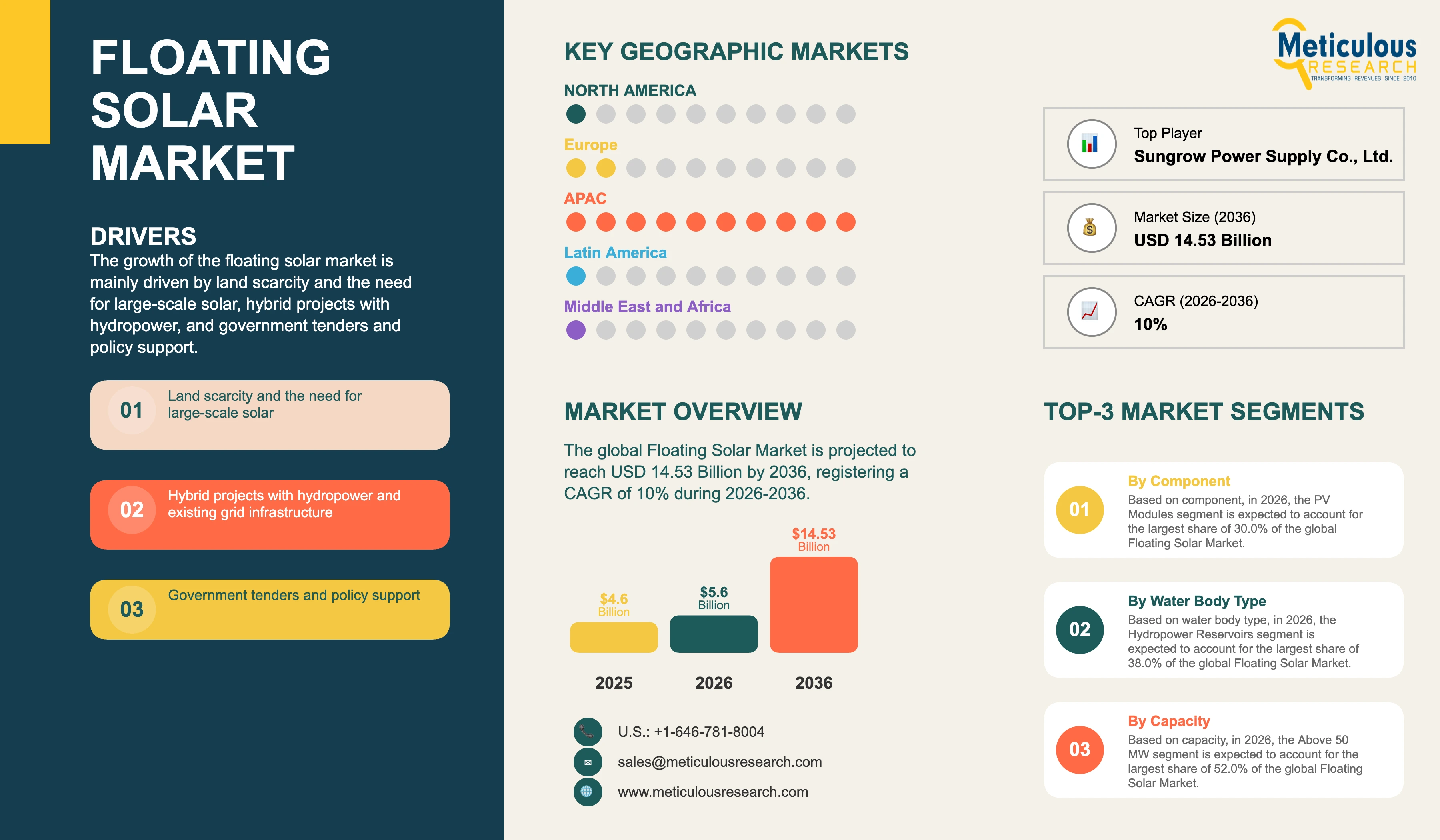
The global floating solar market was valued at USD 4.60 billion in 2025. This market is expected to reach USD 14.53 billion by 2036 from an estimated USD 5.60 billion in 2026, registering a CAGR of 10.0% during the forecast period (2026-2036).
- Published
- Nov 2026
- Pages
- 259
- Format
- PDF + Excel
- Report ID
- MREP - 1042541
- Base year
- 2025
- 2025 · BASELINE
- $4.60B
- 2036
- $14.53B
- CAGR 2026–2036
- 10.0%
2025 baseline · 2026–2036 forecast at 10.0% CAGR · hover a bar for the value
Key highlights
India's National Institute of Solar Energy estimated in its first national assessment that the country's reservoirs could host about 102 GW of floating solar capacity, and India's largest floating solar park, at the Omkareshwar reservoir on the Narmada River in Madhya Pradesh, has reached about 278 MW with plans to scale up to 600 MW, showing the large potential of floating solar in land-constrained countries.
Ciel & Terre, working with Larsen & Toubro and SJVN Green Energy, commissioned a 120 MWp floating solar project at Omkareshwar in 2024 using a new rock bolt anchoring system developed for the site's hard rock conditions, while Tata Power Renewable Energy completed its own floating solar project at Omkareshwar in November 2024.
Masdar and PLN Nusantara Power commissioned the 145 MW Cirata floating solar plant on a hydropower reservoir in West Java, Indonesia, in 2023, one of the largest floating solar plants in Southeast Asia, and the partners have signed an agreement to expand its capacity significantly, while Indonesia is planning further floating solar projects on its reservoirs and lakes.
Wood Mackenzie projected in its Floating Solar Landscape 2024 report that Asia-Pacific will account for about 81% of global floating solar capacity by 2033, with India, China, and Indonesia as the leading countries, reflecting the region's land constraints, large reservoirs, and strong government support.
In Europe, Q Energy began construction of a 74.3 MW floating solar project in France, which is set to become Europe's largest floating solar plant, while Germany, the Netherlands, and other countries are developing floating solar on former mining lakes, gravel pits, and industrial water bodies, although Germany limits coverage of artificial lakes to protect ecosystems.
The International Energy Agency reported that more than 600 GW of solar PV was added worldwide in 2025, and as solar deployment grows in densely populated countries in Asia and Europe, floating solar is becoming an important way to add capacity without competing for agricultural or urban land.
By component, PV modules account for the largest share of 30.0% in 2026, while mooring and anchoring systems register the highest CAGR.
By water body type, hydropower reservoirs account for the largest share of 38.0% in 2026, while nearshore and offshore waters register the highest CAGR.
By capacity, projects above 50 MW account for the largest share in 2026 and register the highest CAGR.
By geography, Asia-Pacific accounts for the largest share of 74.0% in 2026, while Europe registers the highest CAGR of 12.3%.
Report summary
| Particulars | Details |
|---|---|
| Base Year | 2025 |
| Estimated Year | 2026 |
| Forecast Period | 2026-2036 |
| Market Size in 2025 | USD 4.60 billion |
| Market Size in 2026 | USD 5.60 billion |
| Market Size by 2036 | USD 14.53 billion |
| CAGR (2026-2036) | 10.0% |
| Format | PDF, Excel & Cloud Portal · 259 pages |
| Largest Segment by Component (2026) | PV Modules (30.0%) |
| Largest Segment by Water Body Type (2026) | Hydropower Reservoirs (38.0%) |
| Largest Region (2026) | Asia-Pacific (74.0%) |
| Fastest-Growing Region | Europe (CAGR 12.3%) |
| Segments Covered | Component, Water Body Type, Capacity, and Geography |
| Geographic Scope | Asia-Pacific, Europe, North America, Latin America, and Middle East and Africa |
| Key Companies Profiled | Sungrow, Ciel & Terre, Ocean Sun, Zimmermann PV-Floating, Scotra, SolarDuck, Oceans of Energy, BayWa r.e., Masdar, Tata Power Renewable Energy, and Larsen & Toubro |
Report overview
Segments covered: component, water body type, capacity.
The growth of this market is mainly driven by the scarcity and high cost of land for large solar projects in densely populated countries, the large untapped potential of hydropower reservoirs, irrigation reservoirs, lakes, and industrial water bodies, the ability to use existing grid connections at hydropower plants, government programs and tenders for floating solar in India, China, Indonesia, South Korea, Thailand, the Philippines, and Europe, higher energy yields from the cooling effect of water, reduced water evaporation from reservoirs, and the development of nearshore and offshore floating solar technologies. However, factors such as higher costs than ground-mounted solar, technical challenges related to mooring, anchoring, waves, wind, and corrosion, environmental and permitting concerns about effects on water quality and ecosystems, limited long-term performance data, and restrictions on the share of water surfaces that can be covered in some countries are expected to restrain the growth of this market to some extent.
Floating solar, also called floating photovoltaics or FPV, refers to solar power systems installed on structures that float on the surface of water bodies such as hydropower reservoirs, irrigation reservoirs, lakes, ponds, former mining pits, water treatment ponds, and increasingly nearshore and offshore waters. A floating solar system typically includes solar modules mounted on floats or pontoons made of high-density polyethylene or other materials, mooring and anchoring systems that keep the array in place, electrical cables, inverters, and connections to the shore and the grid. Floating solar allows solar power to be produced without using land, and it can benefit from the cooling effect of water, which can improve module efficiency.
This market covers the global value of floating solar systems installed each year, including PV modules, floating structures, mooring and anchoring systems, inverters and electrical balance of system, and installation and services, for projects on inland water bodies and nearshore and offshore waters. It is segmented by component, water body type, capacity, and geography. Ground-mounted and rooftop solar, solar installations on fixed piles in water without floating structures, and the value of electricity sold are not included.
Floating solar began with small projects in Japan and Europe in the late 2000s and early 2010s and has grown into a significant segment of the solar industry, particularly in Asia. China built several very large floating solar plants on flooded coal mining subsidence areas and lakes, and it remains one of the largest markets. India, Indonesia, South Korea, Thailand, Vietnam, the Philippines, Bangladesh, Taiwan, and Singapore have developed floating solar projects on reservoirs and lakes, often supported by government tenders and utilities. In Europe, the Netherlands, France, Germany, and the U.K. have built floating solar on gravel pits, mining lakes, reservoirs, and industrial water bodies.
Floating solar offers several advantages over ground-mounted solar, particularly in land-constrained regions. It avoids the need for land, which is scarce and expensive in many densely populated countries and islands. On hydropower reservoirs, floating solar can use existing transmission lines and substations, and hydropower can be used to balance solar output, creating hybrid power plants. Water cooling can increase module efficiency, shading reduces evaporation from reservoirs, which is valuable in dry regions, and floating solar can reduce algae growth in some water bodies. For industrial sites, mines, and water utilities, floating solar on ponds and reservoirs can supply clean electricity close to where it is used.
However, floating solar is generally more expensive than ground-mounted solar because of the cost of floats, mooring, anchoring, and marine-grade components, and it requires careful engineering to handle wind, waves, water level changes, and corrosion. Environmental authorities may require studies of effects on water quality, fish, birds, and other ecosystems, and some countries limit the share of a water surface that can be covered. Despite these challenges, falling module prices, improved float designs, standardized mooring systems, and growing experience have reduced costs and risks.
Nearshore and offshore floating solar is an emerging frontier that could greatly expand the potential of the technology. Companies such as Ocean Sun, SolarDuck, and Oceans of Energy have developed systems designed to withstand waves and marine conditions, and pilot projects have been installed in the North Sea, Norway, Asia, and other regions. Offshore floating solar could eventually be combined with offshore wind farms to share grid connections and space, although the technology is still at an early stage.
The market includes float and structure suppliers, mooring and anchoring specialists, module and inverter manufacturers, engineering, procurement, and construction companies, and project developers. Leading participants include Sungrow, Ciel & Terre, Ocean Sun, Zimmermann PV-Floating, Scotra, SolarDuck, Oceans of Energy, BayWa r.e., Masdar, Tata Power Renewable Energy, and Larsen & Toubro.
Over the forecast period, the floating solar market is expected to grow steadily, driven by large reservoir projects in Asia-Pacific, growing interest in Europe, hybrid projects with hydropower, and early commercial offshore projects. Asia-Pacific is expected to remain by far the largest market, while Europe is expected to grow fastest at a CAGR of 12.3%.
Among regions, Asia-Pacific is expected to account for the largest share of 74.0% of the market in 2026, mainly due to land scarcity, large reservoirs and lakes, and strong government support in China, India, Indonesia, and other countries.
Among regions, Europe is projected to register the highest CAGR of 12.3% during the forecast period, driven by land constraints, mining and gravel lakes, French tenders, and offshore pilots in the North Sea.
The report profiles 11 float suppliers, offshore technology developers, project developers, and EPC companies, including Sungrow, Ciel & Terre, Ocean Sun, Zimmermann PV-Floating, Scotra, SolarDuck, Oceans of Energy, BayWa r.e., Masdar, Tata Power Renewable Energy, and Larsen & Toubro. The top five players account for an estimated 28.0% of the market in 2025.
What comes next: Floating Solar and the Future of Water-Surface Generation, a Meticulous Next™ foresight brief.
Report infographic
Market dynamics
17 factors across 5 forcesLand scarcity and the need for large-scale solar
Solar energy is expanding rapidly around the world, and the International Energy Agency reported that more than 600 GW of solar PV capacity was added globally in 2025. Large utility-scale solar projects require large areas of land, which is scarce, expensive, or contested in many densely populated countries, such as India, Bangladesh, Japan, South Korea, Taiwan, Singapore, Indonesia, the Philippines, Vietnam, and the Netherlands. Land acquisition for solar projects can also face opposition from farmers and local communities, and it can take a long time.
Floating solar allows governments and developers to add large amounts of solar capacity without using land, by using reservoirs, lakes, and other water bodies that are often owned by governments or utilities. India's National Institute of Solar Energy estimated that the country's reservoirs alone could host about 102 GW of floating solar, and similar assessments in other countries have found large potential. These factors make floating solar an important part of renewable energy plans in land-constrained countries, and they support the strong position of Asia-Pacific, which accounts for the largest share of the market.
Hybrid projects with hydropower and existing grid infrastructure
Hydropower reservoirs are particularly attractive sites for floating solar because they already have transmission lines, substations, and grid connections, which reduces costs and avoids long delays for new grid connections. Hydropower can also be used to balance the variable output of solar, storing water when solar output is high and generating more electricity when it is low, which improves the value of both resources. Governments and utilities in India, Indonesia, Thailand, Vietnam, Brazil, Ghana, and other countries are developing floating solar on hydropower reservoirs, and multilateral development banks have supported several such projects.
Floating solar on reservoirs can also reduce evaporation, which is valuable in regions facing drought and water stress. These advantages make hydropower reservoirs the largest water body type in this market, and they support the growth of large projects above 50 MW, which form the largest capacity segment.
Government tenders and policy support
Governments in many countries have launched tenders, targets, and programs for floating solar. India has awarded floating solar projects through central and state agencies, including at Omkareshwar, Ramagundam, and other reservoirs, and it has assessed national potential. China supports floating solar on mining subsidence areas and lakes. Indonesia has identified many reservoirs and lakes for floating solar after the Cirata project, and South Korea, Thailand, the Philippines, Vietnam, and Bangladesh have floating solar plans. In Europe, France has included floating solar in its solar tenders, and the Netherlands and Germany have supported floating solar on artificial lakes.
These policies provide project pipelines, financing support, and access to water bodies, which are essential for floating solar development. Development banks such as the World Bank and the Asian Development Bank have also supported floating solar through technical assistance and financing, which helps reduce risks in emerging markets.
Floating solar is also increasingly included in national energy plans and integrated resource plans as a way to meet renewable energy targets without using farmland or forests. In some countries, governments have mapped suitable reservoirs and lakes, set aside water bodies for floating solar, and simplified permitting for projects on artificial water bodies, which reduces development time and risk for developers.
Performance benefits and falling costs
Water cooling can increase the efficiency of solar modules compared with ground-mounted systems in hot climates, and floating systems can reduce dust on modules. At the same time, falling module prices, improved float designs, mass production of floats, standardized mooring systems, and experience from many projects have reduced the cost of floating solar. Bifacial modules can also capture light reflected from the water surface. These improvements are narrowing the cost gap with ground-mounted solar and making floating solar competitive in more markets, particularly where land costs are high.
Advances in anchoring and mooring, such as systems designed for hard rock reservoir beds and for large water level changes, are allowing floating solar to be used in more challenging sites, and mooring and anchoring systems form the fastest-growing component segment in this market.
Digital monitoring is also improving the operation and reliability of floating solar plants of all sizes. Sensors on floats, mooring lines, and electrical equipment allow operators to track loads, movements, and performance in real time and to detect problems before they cause failures. Drones and underwater inspections are used to check floats and anchors. These tools improve reliability and reduce operation and maintenance costs, which strengthens the case for floating solar in new markets.
Table of contents
11 chapters · 110 sections · 259 pages · click to expandSegmental analysis
| Segment | Largest share (2026) | Fastest growth (2026–2036) |
|---|---|---|
| By Capacity Segment | Projects above 50 MW | Projects above 50 MW |
By Capacity Segment
- Projects above 50 MW are expected to account for the largest share of the market in 2026 and to register the highest CAGR, driven by large reservoir and lake projects in Asia.
Geographic analysis
Asia-Pacific
Largest shareIn 2026, Asia-Pacific is expected to account for the largest share of 74.0% of the global floating solar market. The large share of this region is mainly due to the land scarcity and high population density of many Asian countries, large numbers of hydropower and irrigation reservoirs, lakes, and mining subsidence areas, strong government support and tenders for floating solar in China, India, Indonesia, South Korea, Thailand, Vietnam, the Philippines, and Taiwan, and the presence of major float and module manufacturers in the region. China has built many large floating solar plants on coal mining subsidence areas and lakes, and it remains one of the largest markets. India has significant potential, estimated by the National Institute of Solar Energy at about 102 GW on reservoirs, and has commissioned large projects such as Omkareshwar and Ramagundam. Indonesia's Cirata project has opened a pipeline of reservoir projects, South Korea has developed large projects such as those on the Saemangeum reclaimed area and dam reservoirs, and Thailand and Vietnam have government-backed floating solar programs on hydropower reservoirs. Wood Mackenzie projected that Asia-Pacific will account for about 81% of global floating solar capacity by 2033. Asia-Pacific is expected to remain the largest region throughout the forecast period.
Europe
Fastest growthEurope is projected to register the highest CAGR of 12.3% during the forecast period. The rapid growth of this region is mainly driven by land constraints in the Netherlands, Belgium, and other densely populated countries, the availability of gravel pits, mining lakes, reservoirs, and industrial water bodies, the inclusion of floating solar in French solar tenders, growing projects in Germany, Italy, and the U.K., and interest in offshore solar in the North Sea, where companies such as Oceans of Energy and SolarDuck are developing pilot projects.
North America
North America, Latin America, and the Middle East and Africa are smaller markets. In the U.S., floating solar is used mainly by water utilities, municipalities, military bases, and industrial sites, with projects in New Jersey, California, and other states, while Brazil has developed floating solar on hydropower reservoirs, and African countries such as Ghana, Zambia, and Zimbabwe are studying or developing hybrid projects on large reservoirs, and Gulf countries are exploring floating solar for water storage and treatment facilities.
Competitive landscape
The floating solar market includes float and structure suppliers, mooring and anchoring specialists, module and inverter manufacturers, engineering, procurement, and construction companies, and project developers. Leading participants operating in this market include float and system suppliers such as Sungrow, Ciel & Terre, Zimmermann PV-Floating, and Scotra; offshore floating solar developers such as Ocean Sun, SolarDuck, and Oceans of Energy; and developers and EPC companies such as BayWa r.e., Masdar, Tata Power Renewable Energy, and Larsen & Toubro.
Companies compete mainly on float design, durability, ability to handle wind, waves, and water level changes, mooring and anchoring expertise, cost, local manufacturing, project references, and engineering and installation capabilities. Float suppliers with large project track records and local manufacturing, such as Sungrow and Ciel & Terre, hold strong positions in Asia, while European suppliers focus on high-quality systems for European lakes and offshore conditions. Developers and EPC companies with experience in reservoir projects and relationships with utilities and governments have an advantage in winning large tenders, while offshore specialists compete for research funding and pilot contracts.
The top five players are estimated to account for 28.0% of the global floating solar market in 2025. This moderate concentration reflects the large number of float suppliers, EPC companies, and developers involved in projects, particularly in China, India, and Southeast Asia.
Players use several strategies to grow and strengthen their positions in this market, including developing new float and mooring designs for larger and more exposed sites, local manufacturing, partnerships with EPC companies, utilities, and developers, participation in government tenders, and investment in offshore pilots. For example, Ciel & Terre developed a rock bolt anchoring system for the Omkareshwar project, and Masdar partnered with PLN Nusantara Power to develop and expand the Cirata project.
Competition is expected to intensify as more companies enter the market and as projects become larger, and suppliers that can offer reliable systems for difficult sites and offshore conditions are expected to gain an advantage. Price competition among float suppliers is strong in China and India, while European and offshore markets reward technical performance and proven durability.
Some of the key players operating in the floating solar market are Sungrow Power Supply Co., Ltd., Ciel & Terre International, Ocean Sun AS, Zimmermann PV-Floating GmbH, Scotra Co., Ltd., SolarDuck B.V., Oceans of Energy B.V., BayWa r.e. AG, Masdar (Abu Dhabi Future Energy Company), Tata Power Renewable Energy Limited, and Larsen & Toubro Limited.
- —
Projects at Omkareshwar in India were commissioned, Masdar and PLN agreed to expand the Cirata project in Indonesia, Q Energy began building Europe's largest floating solar plant in France, and offshore pilots expanded in the North Sea.
- Sungrow
- Ciel & Terre
- Ocean Sun
- Zimmermann PV-Floating
- Scotra
- SolarDuck
- Oceans of Energy
- BayWa r.e
- Masdar
- Tata Power Renewable Energy
- Larsen & Toubro
Expert perspectives
Floating solar has become an important solution for countries with limited land and large water bodies, particularly in South and Southeast Asia and East Asia. The combination of land scarcity, existing grid connections at hydropower reservoirs, government tenders, and improving technology has created a large and growing project pipeline. Asia-Pacific dominates the market and will continue to do so throughout the forecast period, while Europe is becoming a fast-growing market for lakes, industrial water bodies, and offshore pilots, supported by land constraints and national tenders.
Over the forecast period, the floating solar market is expected to grow at a CAGR of 10.0%, driven by large reservoir projects in India, Indonesia, China, and Southeast Asia, hybrid hydropower and solar plants, growth in Europe, and the first commercial offshore projects. The main risks are higher costs than ground-mounted solar, environmental restrictions, financing challenges in emerging markets, and technical failures in harsh conditions, but we expect costs and risks to fall as standards and experience grow.
PV modules remain the largest component, while mooring and anchoring systems grow fastest as projects move to deeper, larger, and more exposed water bodies. Hydropower reservoirs remain the largest water body type because of their size and grid access, while nearshore and offshore waters grow fastest from a small base. Projects above 50 MW are the largest and fastest-growing capacity segment.
Asia-Pacific remains the largest region, while Europe is the fastest-growing region at a CAGR of 12.3%.
For float and mooring suppliers, the key priorities are to prove durability in harsh conditions, reduce costs through standardization and local manufacturing, and develop solutions for offshore sites. For developers and utilities, the priority is to identify suitable water bodies, address environmental and community concerns early, secure grid access, and use hybrid designs with hydropower and storage to maximize value. We believe that companies with strong engineering expertise, reliable products, local presence in Asia, and proven track records on large reservoirs will gain the most from this growing market.
We also expect floating solar to become more closely linked with water management, as utilities and governments see the value of reducing evaporation, improving water quality, and combining energy and water infrastructure. Offshore floating solar is the most uncertain but potentially largest opportunity, and its development will depend on successful pilots, cost reductions, and supportive marine spatial planning. Overall, we see floating solar as a stable and steadily growing part of the global solar market, especially in countries where land is the main constraint on solar deployment.
Customer perspectives
Director of Renewable Projects - hydropower utility, Southeast Asia
Floating solar lets us add hundreds of megawatts on our reservoir quickly, using the grid connection we already have, and our hydropower can balance the solar output. Mooring for changing water levels was the hardest part of the design.
Project Developer - renewable energy company, Netherlands
We have very little available land, so lakes, sand pits, and eventually the North Sea are where we can grow solar, but permits require careful ecological studies.
Operations Manager - water utility, U.S.
A floating array on our treatment pond cuts our pumping costs and reduces algae and evaporation, and it did not require us to buy any additional land.
Frequently asked questions
The market was valued at USD 4.60 billion in 2025 and USD 3.40 billion in 2024, and is estimated at USD 5.60 billion in 2026. These values represent the installed value of floating solar systems, including modules, floats, mooring, electrical equipment, and installation.
The market is expected to reach USD 14.53 billion by 2036, supported by land scarcity, hybrid hydropower projects, government tenders, performance benefits, and falling costs.
The market is expected to register a CAGR of 10.0% from 2026 to 2036, supported by strong project pipelines in Asia-Pacific, as large reservoir projects expand in Asia, Europe grows, and offshore floating solar begins to commercialize.
Floating solar, also known as floating photovoltaics, FPV, or floatovoltaics, refers to solar power systems installed on floats or pontoons on water bodies such as reservoirs, lakes, ponds, and coastal waters, held in place by mooring and anchoring systems and connected to the grid.
Market growth is mainly driven by land scarcity and the need for large-scale solar, hybrid projects with hydropower and existing grid infrastructure, government tenders and policy support, and performance benefits and falling costs.
Higher costs than ground-mounted solar and environmental concerns and coverage restrictions restrain growth, while technical risks from wind, waves, and corrosion and limited long-term performance data remain key challenges.
Key opportunities over the forecast period include nearshore and offshore floating solar, hybrid floating solar and hydropower in emerging markets, industrial, mining, and water utility applications, and floating solar with storage.
Among components, PV modules are expected to account for the largest share of 30.0% of the market in 2026, mainly due to their central role in every system and the growth of large projects, while mooring and anchoring systems are projected to register the highest CAGR.
Among water body types, hydropower reservoirs are expected to account for the largest share of 38.0% of the market in 2026, mainly due to their large area, existing grid connections, and hybrid operation with hydropower, while nearshore and offshore waters are projected to register the highest CAGR.
Among capacity segments, projects above 50 MW are expected to account for the largest share of the market in 2026 and to register the highest CAGR, driven by large reservoir and lake projects in Asia.
Among regions, Asia-Pacific is expected to account for the largest share of 74.0% of the market in 2026, mainly due to land scarcity, large reservoirs and lakes, and strong government support in China, India, Indonesia, and other countries.
Among regions, Europe is projected to register the highest CAGR of 12.3% during the forecast period, driven by land constraints, mining and gravel lakes, French tenders, and offshore pilots in the North Sea.
The report profiles 11 float suppliers, offshore technology developers, project developers, and EPC companies, including Sungrow, Ciel & Terre, Ocean Sun, Zimmermann PV-Floating, Scotra, SolarDuck, Oceans of Energy, BayWa r.e., Masdar, Tata Power Renewable Energy, and Larsen & Toubro. The top five players account for an estimated 28.0% of the market in 2025.
Projects at Omkareshwar in India were commissioned, Masdar and PLN agreed to expand the Cirata project in Indonesia, Q Energy began building Europe's largest floating solar plant in France, and offshore pilots expanded in the North Sea.
Cite this report
Meticulous Research. (2026). Floating Solar Market - Global Opportunity Analysis and Industry Forecast (2026-2036) (Report No. MREP - 1042541). Meticulous Market Research Pvt. Ltd. https://www.meticulousresearch.com/product/floating-solar-market-7224