Fixed Gas Detection Systems Market (2026-2036)
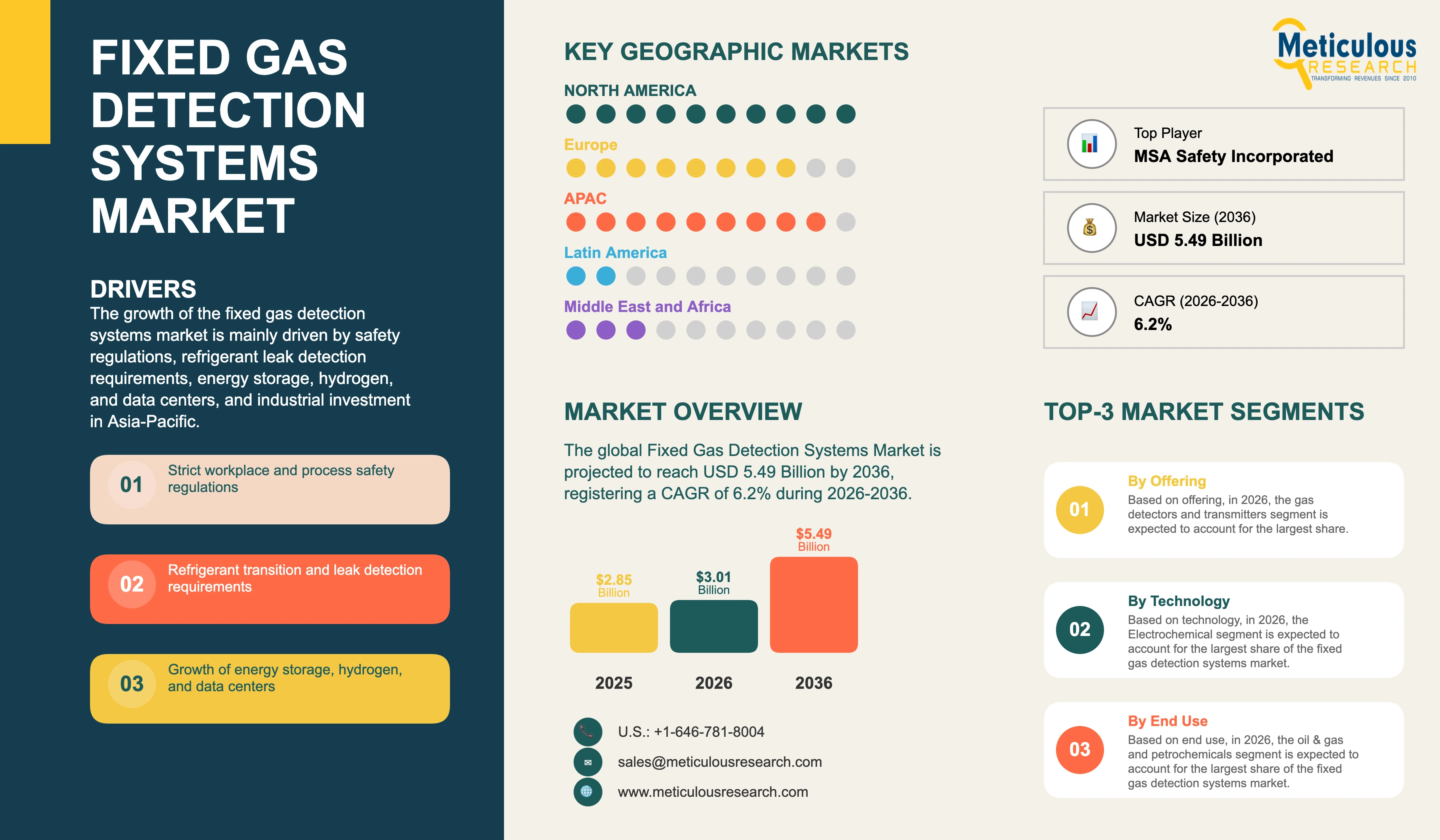
The global fixed gas detection systems market was valued at USD 2.85 billion in 2025. This market is expected to reach USD 5.49 billion by 2036 from an estimated USD 3.01 billion in 2026, registering a CAGR of 6.2% during the forecast period (2026-2036).
- Published
- Nov 2026
- Pages
- 270
- Format
- PDF + Excel
- Report ID
- MRSE - 1042707
- Base year
- 2025
- 2025 · BASELINE
- $2.85B
- 2036
- $5.49B
- CAGR 2026–2036
- 6.2%
2025 baseline · 2026–2036 forecast at 6.2% CAGR · hover a bar for the value
Key highlights
MSA Safety reported 2025 detection sales of USD 763 million, which include fixed gas and flame detection and portable gas detection, and said detection had become its largest product category at 41% of sales, citing exceptional fixed detection performance and favorable underlying demand for fixed and portable detection.
Dräger reported that safety division order intake rose more than 6% in 2025, net of currency effects, with engineered solutions and gas detection as the biggest drivers, and safety division net sales of EUR 1,486 million. The company said it holds top global positions in gas detection.
Halma's safety sector grew organic constant-currency revenue by 6.5% in its 2025/26 fiscal year, and the group reported growth in U.S. gas detection and gas management in Asia-Pacific. Halma also acquired E2S Group for about GBP 230 million and Safetec, a provider of fire and gas safety solutions for large industrial projects, for about EUR 72.5 million.
Key provisions of the U.S. EPA Emissions Reduction and Reclamation rule took effect on January 1, 2026, including mandatory automatic leak detection for new commercial and industrial refrigeration systems with 1,500 pounds or more of HFCs or substitutes with a global warming potential above 53.
UL 60335-2-40 requires refrigerant leak detection for many systems using A2L refrigerants such as R32 and R454B, and sensor and detector makers, including Process Sensing Technologies, Sensata, and Figaro, have introduced certified A2L refrigerant detectors and modules for HVAC equipment.
Macurco, a DwyerOmega brand, launched the UL 2075-listed HD-6 hydrogen gas detector in September 2026 for battery energy storage systems and data centers, reflecting the growing need for fixed hydrogen detection in new energy applications such as battery storage, hydrogen fueling, and data center backup power.
By offering, gas detectors and transmitters account for the largest share of 52.0% in 2026, while software and wireless connectivity registers the highest CAGR.
By technology, electrochemical accounts for the largest share in 2026, while point infrared registers the highest CAGR.
By gas type, combustible gases account for the largest share in 2026, while refrigerant gases register the highest CAGR.
By end use, oil & gas and petrochemicals account for the largest share of 34.0% in 2026, while power generation and energy storage registers the highest CAGR.
By geography, North America accounts for the largest share of 32.0% in 2026, while Asia-Pacific registers the highest CAGR of 7.6%.
Report summary
| Particulars | Details |
|---|---|
| Forecast Period | 2026-2036 |
| Base Year | 2025 |
| Estimated Year | 2026 |
| CAGR (Value) | 6.2% |
| Format | PDF, Excel & Cloud Portal · 270 pages |
| Market Size (Value) in 2025 | USD 2.85 billion |
| Market Size (Value) in 2026 | USD 3.01 billion |
| Market Size (Value) by 2036 | USD 5.49 billion |
| Largest Segment by Offering (2026) | Gas Detectors and Transmitters (52.0%) |
| Largest Segment by End Use (2026) | Oil & Gas and Petrochemicals (34.0%) |
| Largest Region (2026) | North America (32.0%) |
| Fastest-Growing Region | Asia-Pacific (CAGR 7.6%) |
| Key Companies | 12 companies and other companies |
| Segments Covered | Offering, Technology, Gas Type, End Use, Geography |
| Countries Covered | U.S., Canada, Germany, U.K., France, Italy, Netherlands, Norway, Spain, Rest of Europe, China, Japan, India, South Korea, Australia, Southeast Asia, Rest of Asia-Pacific, Saudi Arabia, UAE, Qatar, South Africa, Rest of Middle East & Africa, Brazil, Mexico, Rest of Latin America |
Report overview
Segments covered: offering, technology, gas type, end use.
The growth of this market is mainly driven by strict workplace safety and process safety regulations in oil and gas, chemicals, and other hazardous industries, new requirements for refrigerant leak detection driven by the transition to low global warming potential refrigerants, including mildly flammable A2L refrigerants, and by U.S. automatic leak detection rules for large refrigeration systems, the rapid growth of battery energy storage systems, hydrogen projects, and data centers that require gas detection, investment in LNG, petrochemical, and semiconductor facilities in Asia and the Middle East, and the adoption of wireless and connected detection systems. However, factors such as the high cost of installation, calibration, and maintenance, false alarms and sensor drift, and the cyclical nature of capital spending in oil and gas are expected to restrain the growth of this market to some extent.
Fixed gas detection systems are permanently installed systems that continuously monitor the air for combustible, toxic, or asphyxiant gases and raise alarms or trigger automatic safety actions when gas concentrations exceed set limits. A typical system includes gas detectors or transmitters installed at locations where leaks are likely, controllers or control panels that receive signals from the detectors and activate alarms, ventilation, or shutdown systems, and software for configuration, monitoring, and reporting. Fixed systems are used to protect workers, plants, and the public in oil and gas facilities, chemical plants, refineries, wastewater plants, mines, refrigeration systems, parking garages, battery storage facilities, and many other places.
This report covers global revenue from fixed gas detection systems, including gas detectors and transmitters, controllers and control panels, software and wireless connectivity, and installation, calibration, and services. Technologies covered include catalytic bead, electrochemical, point infrared, open-path infrared and ultrasonic, and semiconductor, photoionization, and other sensors. Portable and personal gas detectors, flame detectors, stand-alone residential carbon monoxide and smoke alarms, laboratory gas analyzers, and continuous emissions monitoring systems are excluded from the scope of this report. Refrigerant leak sensors embedded by HVAC manufacturers in individual residential units are also excluded, while commercial and industrial refrigerant monitors are included.
Different sensor technologies are used for different gases and operating conditions, and many facilities use several technologies together. Catalytic bead sensors are a long-established technology for combustible gases, while point infrared sensors are increasingly preferred for hydrocarbons and refrigerants because they do not need oxygen, cannot be poisoned, and require less frequent calibration. Electrochemical sensors are used for toxic gases such as hydrogen sulfide, carbon monoxide, ammonia, and chlorine, and for oxygen. Open-path infrared detectors monitor gas along a line of sight of up to a few hundred meters, and ultrasonic detectors identify the sound of high-pressure gas leaks, which makes them useful in outdoor and windy locations. Semiconductor and photoionization sensors are used for specific gases and volatile organic compounds. Laser-based detectors are also gaining use for fast and selective detection of methane and other gases.
The oil and gas industry is the largest user of fixed gas detection, because production facilities, LNG plants, refineries, pipelines, and petrochemical plants handle large volumes of flammable and toxic gases. Safety standards such as IEC 61511 for safety instrumented systems, hazardous area certification under ATEX, IECEx, and North American standards, and company process safety requirements make fixed gas detection mandatory at these facilities. Chemicals, water and wastewater, mining, power generation, food and beverage, pharmaceuticals, and semiconductor manufacturing are also major users.
Commercial buildings and HVAC and refrigeration systems are a fast-growing application for fixed gas detection systems. As regulations phase down high global warming potential HFC refrigerants, the industry is moving to alternatives such as A2L refrigerants, ammonia, carbon dioxide, and hydrocarbons, which are flammable, toxic, or present asphyxiation risks. Building codes and product safety standards increasingly require refrigerant leak detection, and the U.S. EPA's Emissions Reduction and Reclamation rule now requires automatic leak detection for large new refrigeration systems.
The market includes global safety equipment manufacturers, process instrumentation companies, specialized gas detection companies, and sensor manufacturers. Leading companies include MSA Safety, Honeywell, Dräger, Teledyne, Emerson, Halma, Riken Keiki, New Cosmos Electric, Hanwei Electronics, DwyerOmega, Danfoss, and RKI Instruments. Many systems are sold through distributors, system integrators, and engineering contractors, and services such as calibration and maintenance are an important source of recurring revenue. Many suppliers also sell sensors and components to other detector manufacturers and HVAC equipment makers, and some offer complete engineered fire and gas systems.
Over the forecast period, the market is expected to grow steadily, driven by refrigerant transition rules, new energy applications such as battery energy storage, hydrogen, and data centers, industrial investment in Asia-Pacific and the Middle East, and the replacement of older catalytic systems with infrared, wireless, and connected solutions. Asia-Pacific is expected to be the fastest-growing region, while North America remains the largest.
Report infographic
Market dynamics
18 factors across 5 forcesStrict workplace safety and process safety regulations
Fixed gas detection is required by law or by industry standards in many hazardous facilities. Occupational safety regulations in the U.S., the EU, China, India, the Middle East, and other regions require employers to protect workers from exposure to toxic gases and from fire and explosion hazards, and process safety rules require facilities that handle hazardous chemicals to identify and control leak risks. In many cases, fixed gas detectors are part of safety instrumented systems that automatically shut down equipment or activate ventilation when a leak is detected.
Major industrial accidents involving gas leaks, fires, and explosions have led regulators and companies to tighten requirements over time. Insurance companies also require fixed gas detection at many facilities, and international oil companies and engineering contractors apply detailed gas detection standards on new projects worldwide. These requirements create stable demand for new systems, upgrades, and services, regardless of economic conditions. Regulators are also increasing enforcement and inspection, which encourages facilities to replace outdated systems and improve maintenance and calibration practices. In addition, many companies apply global safety standards across all their sites, which spreads advanced gas detection practices to facilities in emerging markets.
Refrigerant transition and leak detection requirements
The phase-down of HFC refrigerants under the Kigali Amendment, the U.S. AIM Act, and the EU F-gas regulation is driving a shift to refrigerants with lower global warming potential, many of which are flammable or toxic. Mildly flammable A2L refrigerants such as R32 and R454B are now widely used in new air conditioning and heat pump equipment, and safety standards such as UL 60335-2-40 require refrigerant leak detection for many of these systems. Ammonia, carbon dioxide, and hydrocarbon refrigerants used in industrial and commercial refrigeration also require gas detection under safety codes.
In the U.S., key provisions of the EPA's Emissions Reduction and Reclamation rule took effect on January 1, 2026, including mandatory automatic leak detection for new commercial and industrial refrigeration systems with 1,500 pounds or more of HFCs or substitutes with a global warming potential above 53. Supermarkets, cold storage facilities, and industrial refrigeration operators must install fixed monitoring systems to detect leaks quickly, which increases demand for multi-zone refrigerant monitors. MSA Safety, Danfoss, Honeywell, DwyerOmega, and many other suppliers have launched new refrigerant monitors and leak detection products to serve this market, and sensor makers have introduced certified A2L sensors for integration into HVAC equipment.
Growth of energy storage, hydrogen, and data centers
Battery energy storage systems can release flammable gases such as hydrogen, carbon monoxide, and hydrocarbons during battery failure and thermal runaway, and fire codes and standards increasingly require gas detection in battery enclosures. Hydrogen production, storage, and fueling facilities also require fixed hydrogen detection, because hydrogen is highly flammable and difficult to see or smell. Data centers use battery rooms, backup generators, and cooling systems that may require hydrogen, refrigerant, and other gas detection.
These applications are growing rapidly worldwide, and each new installation creates demand for detectors and monitoring. Macurco launched the UL 2075-listed HD-6 hydrogen detector in September 2026 specifically for battery energy storage systems and data centers, and other suppliers are developing detectors and integrated monitoring solutions for these markets. Early detection of battery off-gas can provide warning before thermal runaway, giving operators time to isolate affected modules. Hydrogen projects, including electrolyzers, storage, pipelines, and fueling stations, are being developed in Europe, North America, Asia, and the Middle East, and each facility requires multiple hydrogen detectors.
Industrial investment in Asia-Pacific and the Middle East
Large investments in LNG, refining, petrochemicals, chemicals, semiconductors, and batteries in China, India, Southeast Asia, Saudi Arabia, Qatar, and the UAE require extensive fixed gas detection systems. New LNG plants, refineries, and petrochemical complexes typically install thousands of gas detectors, and semiconductor fabrication plants require detection for many toxic and flammable process gases.
Rising safety awareness and stricter regulations in China and India are also increasing the use of fixed gas detection in smaller industrial facilities, municipal gas networks, and commercial buildings. Halma reported growth in gas management in Asia-Pacific, and Chinese suppliers such as Hanwei Electronics serve a large domestic market. City gas safety campaigns in China have also increased the installation of gas detectors in restaurants, commercial kitchens, and industrial users of piped gas.
Table of contents
12 chapters · 140 sections · 270 pages · click to expandSegmental analysis
| Segment | Largest share (2026) | Fastest growth (2026–2036) |
|---|---|---|
| By Offering | Combustible gases | Refrigerant gases |
By Offering
- The combustible gases segment is expected to account for the largest share of the fixed gas detection systems market, while the refrigerant gases segment is projected to register the highest CAGR during the forecast period.
Geographic analysis
North America
Largest shareIn 2026, North America is expected to account for the largest share of 32.0% of the global fixed gas detection systems market. The large share of this region is mainly due to the large oil and gas, LNG, petrochemical, and chemical industries in the U.S. and Canada, strict occupational safety and process safety regulations, new U.S. automatic leak detection requirements for large refrigeration systems, the rapid growth of data centers and battery energy storage, and the presence of leading suppliers such as MSA Safety, Honeywell, Teledyne, Emerson, and DwyerOmega. Halma also reported growth in U.S. gas detection in its 2025/26 fiscal year. Large LNG export projects on the U.S. Gulf Coast and petrochemical expansions in Texas and Louisiana also require extensive gas detection systems.
Asia-Pacific
Asia-Pacific is the second-largest market and is projected to register the highest CAGR of 7.6% during the forecast period. The rapid growth of this region is mainly due to large investments in LNG, refining, petrochemicals, chemicals, semiconductors, and batteries in China, India, South Korea, and Southeast Asia, stricter safety regulations and enforcement in China and India, the expansion of city gas networks, and the rapid growth of battery energy storage and data centers. Japanese suppliers such as Riken Keiki and New Cosmos Electric and Chinese suppliers such as Hanwei Electronics are strong in the region. India is investing heavily in refining, petrochemicals, city gas distribution, and semiconductors, and Southeast Asian countries are building new LNG terminals and chemical plants, all of which require fixed gas detection.
Europe
Europe is the third-largest market, supported by strict safety and environmental regulations, a large chemical industry, the EU F-gas regulation, the shift to natural refrigerants, and investment in hydrogen and battery storage. Dräger reported strong growth in its EMEA safety business in 2025. Europe is expected to grow more slowly than the global average, as most of its industrial base is mature and demand is driven mainly by upgrades and regulations.
Middle East & Africa
The Middle East & Africa is supported by large oil, gas, LNG, and petrochemical projects in Saudi Arabia, Qatar, and the UAE, and Latin America is supported by oil and gas, mining, and industrial projects, particularly in Brazil, Mexico, Argentina, and Guyana.
Competitive landscape
The global fixed gas detection systems market is moderately consolidated, with the top five players estimated to account for about 45% of the market in 2025. The market includes global safety equipment manufacturers, process instrumentation companies, specialized gas detection companies, and many regional suppliers.
MSA Safety is one of the leading suppliers of fixed gas and flame detection systems through its General Monitors, Senscient, and Bacharach brands, and it reported strong fixed detection performance in 2025. Honeywell offers a broad range of fixed gas detectors and systems for industrial and commercial applications, while Dräger is a leading supplier of fixed and portable gas detection with strong positions in Europe.
Teledyne offers fixed gas and flame detection through Teledyne Gas and Flame Detection, Emerson provides gas detection as part of its Rosemount portfolio, and Halma serves the market through Crowcon, Sensitron, and other companies. Riken Keiki and New Cosmos Electric are leading Japanese suppliers, Hanwei Electronics is a leading Chinese supplier, and DwyerOmega, Danfoss, and RKI Instruments serve commercial, refrigeration, and industrial markets. Companies compete on sensor technology, reliability, certifications, product range, service capabilities, and price. Key strategies include developing infrared, laser, ultrasonic, and wireless detectors, expanding refrigerant and hydrogen detection portfolios, building software and connected services, and acquiring specialized companies to expand capabilities.
The competitive landscape is expected to evolve as refrigerant detection, battery storage, and hydrogen applications grow and as software and services become more important. Suppliers with strong technology, certifications, and service networks will be best positioned. Regional suppliers in China, India, and other emerging markets compete mainly on price and local service, and they are gaining share in domestic markets. Sensor manufacturers such as Figaro, Process Sensing Technologies, and Sensata supply sensors and modules to detector makers and HVAC manufacturers, and some are moving into complete detector products. Price competition is increasing in commercial and refrigerant detection, where many new suppliers have entered the market, while competition in hazardous-area industrial detection is focused more on reliability, certifications, and project experience. Long-term framework agreements with major oil, gas, and chemical companies give leading suppliers a strong position.
Some of the key players operating in the fixed gas detection systems market are MSA Safety Incorporated, Honeywell International Inc., Drägerwerk AG & Co. KGaA, Teledyne Technologies Incorporated, Emerson Electric Co., Halma plc, Riken Keiki Co., Ltd., New Cosmos Electric Co., Ltd., Hanwei Electronics Group Corporation, DwyerOmega, Danfoss A/S, and RKI Instruments, Inc., among others.
- —
MSA Safety reported detection sales of USD 763 million in 2025, Halma acquired E2S and Safetec, Dräger reported gas detection as a key driver of 2025 safety orders, and Macurco launched the HD-6 hydrogen detector for battery storage and data centers in 2026.
- MSA Safety Incorporated
- Honeywell International Inc.
- Drägerwerk AG & Co. KGaA
- Teledyne Technologies Incorporated
- Emerson Electric Co.
- Halma plc
- Riken Keiki Co., Ltd.
- New Cosmos Electric Co., Ltd.
- Hanwei Electronics Group Corporation
- DwyerOmega
- Danfoss A/S
- RKI Instruments, Inc.
Expert perspectives
The fixed gas detection systems market is a stable, regulation-driven market that is gaining new growth drivers from refrigerant transition rules, battery energy storage, hydrogen, and data centers. We expect steady growth over the forecast period.
Over the forecast period, the market is expected to grow at a CAGR of 6.2%, from USD 3.01 billion in 2026 to USD 5.49 billion in 2036. Growth will be supported by safety regulations, refrigerant leak detection requirements, new energy applications, and industrial investment in Asia-Pacific and the Middle East, while installation and maintenance costs, false alarms, and oil and gas cycles will moderate growth.
In terms of segments, gas detectors and transmitters remain the largest offering, while software and wireless connectivity grow fastest. Electrochemical sensors remain the largest technology, while point infrared grows fastest. Combustible gases remain the largest gas type, while refrigerant gases grow fastest. Oil and gas and petrochemicals remain the largest end use, while power generation and energy storage grows fastest. North America remains the largest region, while Asia-Pacific grows fastest at a CAGR of 7.6%.
For suppliers, the key priorities are to expand refrigerant, hydrogen, and battery off-gas detection portfolios, to develop wireless and connected systems with software and analytics, and to build service capabilities that generate recurring revenue. Certifications for new refrigerants and applications will be an important competitive factor. Suppliers should also reduce dependence on oil and gas by expanding in commercial, refrigeration, water, and energy storage markets. We expect the shift from catalytic to infrared sensors to continue, and we expect connected systems to become standard in new installations over the next decade. In our view, refrigerant detection and energy storage will be the most important new growth drivers.
Our estimates are based on the reported detection sales of leading suppliers, the share of fixed systems in their detection portfolios, the installed base in key end uses, and announced investments in LNG, petrochemicals, semiconductors, refrigeration, battery storage, and hydrogen. We note that regulatory changes, such as the EPA's reconsideration of parts of the AIM Act rules, could affect the pace of refrigerant detection growth in the U.S., but safety standards for A2L and natural refrigerants will continue to require leak detection.
We also expect services and software to account for a growing share of supplier revenue, as customers seek to reduce maintenance effort and demonstrate compliance. We believe that suppliers able to combine sensors, software, and services will gain share, particularly among large multi-site customers in oil and gas, retail, and data centers.
Customer perspectives
Facilities Director - supermarket chain, U.S.
New refrigerant rules require automatic leak detection on our larger systems, so we are installing multi-zone monitors and connecting them to our building management system for reporting.
Engineering Manager - battery energy storage developer, Asia-Pacific
Fire codes and our insurers require gas detection in every battery enclosure, and we need connected detectors that we can monitor remotely at unmanned sites.
“Our new plants require thousands of gas detectors, and we prefer infrared and open-path detectors that need less calibration and give fewer false alarms. Reliability and certification are our top priorities.”
Frequently asked questions
The global fixed gas detection systems market was valued at USD 2.85 billion in 2025, up from USD 2.70 billion in 2024, and is estimated at USD 3.01 billion in 2026. The market includes gas detectors and transmitters, controllers and control panels, software and wireless connectivity, and installation, calibration, and services.
Cite this report
Meticulous Research. (2026). Fixed Gas Detection Systems Market - Global Opportunity Analysis and Industry Forecast (2026-2036) (Report No. MRSE - 1042707). Meticulous Market Research Pvt. Ltd. https://www.meticulousresearch.com/product/fixed-gas-detection-systems-market-7390