Die Attach Adhesives Market (2026-2036)
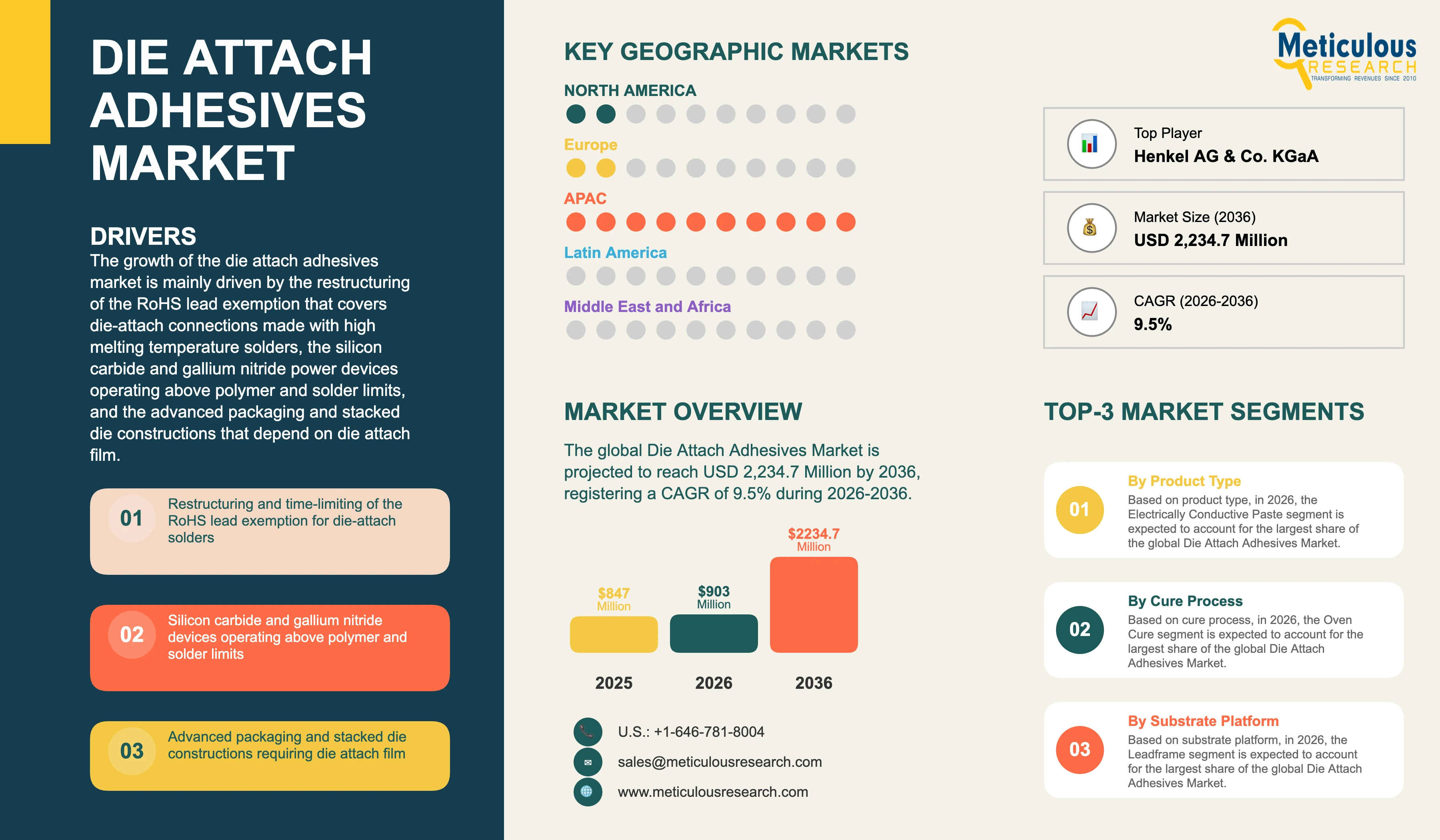
The global die attach adhesives market was valued at USD 847.0 million in 2025. This market is expected to reach USD 2,234.7 million by 2036 from an estimated USD 903.0 million in 2026, registering a CAGR of 9.5% during the forecast period (2026-2036).
- Published
- Nov 2026
- Pages
- 259
- Format
- PDF + Excel
- Report ID
- MRSE - 1042650
- Base year
- 2025
- 2025 · BASELINE
- $847.0M
- 2036
- $2.23B
- CAGR 2026–2036
- 9.5%
2025 baseline · 2026–2036 forecast at 9.5% CAGR · hover a bar for the value
Key highlights
The global die attach adhesives market is estimated at USD 903.0 million in 2026 and is projected to reach USD 2,234.7 million by 2036.
Market volume is estimated at 4.20 kilotons in 2026 and is projected to reach 11.70 kilotons by 2036 at a CAGR of 10.8%.
The average selling price is estimated at USD 215.00 per kg in 2026 and is projected to reach USD 191.00 per kg by 2036.
Electrically conductive paste is expected to account for the largest product type share in 2026, while silver sinter paste is projected to register the highest CAGR of 16.8%.
Oven cure is expected to hold the largest cure process share in 2026, while pressureless sintering is projected to grow fastest at a CAGR of 17.2%.
Leadframe is expected to be the largest substrate platform in 2026, while direct bonded copper is projected to register the highest CAGR of 14.6%.
Integrated circuits and logic are expected to be the largest end-use device segment in 2026, while power discretes and modules are projected to grow fastest at a CAGR of 13.8%.
Asia-Pacific is expected to hold the largest regional share in 2026, and it is also projected to register the highest CAGR of 10.2%.
A Commission delegated directive signed on 8 September 2025 replaces RoHS Annex III point 7(a) on lead in high melting temperature type solders and splits it into seven sub-entries.
One of those sub-entries covers integral die-attach connections meeting set thermal, electrical and melting-point conditions, and expires on 31 December 2027.
The general point 7(a) entry expires on 30 June 2027, and the exemption applies to all RoHS Annex I categories except applications covered by point 24 of Annex III.
Indium Corporation states thermal conductivity above 200 W/mK and electrical resistivity of 5 micro-ohm centimetres for its QuickSinter QS815-SD pressureless silver sintering paste.
The same paste is stated at 92 wt% silver, sinterable within 12 minutes, with die shear strength above 30 MPa and voiding below 2%.
Henkel groups its die attach offering into die attach films, electrically non-conductive die attach pastes and electrically conductive pastes, alongside pressure-less and pressure-assisted sintering materials.
Pressureless sintering pastes are stated to be compatible with inline reflow ovens, which removes a dedicated sinter press from the assembly line.
Report summary
| Particulars | Details |
|---|---|
| Base Year | 2025 |
| Forecast Period | 2026-2036 |
| Market Size in 2025 | USD 847.0 million |
| Market Size in 2026 | USD 903.0 million |
| Market Size by 2036 | USD 2,234.7 million |
| Value CAGR (2026-2036) | 9.5% |
| Format | PDF, Excel & Cloud Portal · 259 pages |
| Volume in 2026 | 4.20 kilotons |
| Volume by 2036 | 11.70 kilotons |
| Volume CAGR (2026-2036) | 10.8% |
| Average Selling Price in 2026 | USD 215.00 per kg |
| Average Selling Price by 2036 | USD 191.00 per kg |
| Measurement Basis | Adhesive paste, film and sinter paste consumed in die attach, with film converted to mass at its adhesive layer weight, excluding solder preforms, solder paste and solder balls, underfill, encapsulant and mould compound, and temporary wafer bonding materials |
| Largest Product Type Segment | Electrically conductive paste |
| Fastest-Growing Product Type Segment | Silver sinter paste (CAGR 16.8%) |
| Largest Cure Process Segment | Oven cure |
| Fastest-Growing Cure Process Segment | Pressureless sintering (CAGR 17.2%) |
| Largest Substrate Platform | Leadframe |
| Fastest-Growing Substrate Platform | Direct bonded copper (CAGR 14.6%) |
| Largest End-Use Device Segment | Integrated circuits and logic |
| Fastest-Growing End-Use Device Segment | Power discretes and modules (CAGR 13.8%) |
| Largest Region | Asia-Pacific |
| Fastest-Growing Region | Asia-Pacific (CAGR 10.2%) |
| Segments Covered | Product Type, Cure Process, Substrate Platform, End-Use Device, and Geography |
| Geographies Covered | Asia-Pacific, Europe, North America, Latin America, and Middle East & Africa |
| Companies Profiled | 13 companies, including Henkel AG & Co. KGaA, Resonac Holdings Corporation, Heraeus Holding GmbH, Element Solutions Inc, Indium Corporation, and Sumitomo Bakelite Co., Ltd. |
Report overview
Segments covered: product type, cure process, substrate platform, end-use device.
In volume terms, this market is estimated at 4.20 kilotons in 2026 and is projected to reach 11.70 kilotons by 2036, registering a CAGR of 10.8% during the same period. The average selling price is estimated at USD 215.00 per kg in 2026 and is projected to decline to USD 191.00 per kg by 2036 as silver loading is reduced through formulation and as copper-based alternatives take a share of the sintering volume.
The growth of this market is mainly driven by the restructuring of the RoHS lead exemption that covers die-attach connections made with high melting temperature solders, the silicon carbide and gallium nitride power devices operating above the junction temperatures that polymer and solder attach materials sustain, the advanced packaging and stacked die constructions that depend on die attach film, and the automotive qualification requirements applied to power and sensor packages. However, factors such as the silver loading that exposes material cost directly to metal price, and the voiding and bond line control that pressureless sintering demands of an assembly process, are expected to restrain the growth of this market to some extent.
Electrically conductive paste accounts for the largest share of this market because it carries the established leadframe and discrete device positions where an electrical path through the attach layer is required. Silver sinter paste grows faster because it delivers thermal conductivity above 200 W/mK against single-digit figures for filled polymer pastes, which is what wide bandgap power devices require.
Die attach adhesives are the materials dispensed or laminated between a semiconductor die and its leadframe, substrate or an adjacent die to hold the die in position and carry heat and, where required, current away from it. Market sizing in this report is on both a value basis in USD and a volume basis in kilotons, with average selling price derived from the two and die attach film converted to mass at its adhesive layer weight. The measurement basis is adhesive paste, film and sinter paste consumed in die attach, and it excludes solder preforms, solder paste and solder balls, underfill, encapsulant and mould compound, and temporary wafer bonding materials.
Henkel AG & Co. KGaA groups die attach adhesives as a parent category containing die attach films and electrically non-conductive die attach pastes, distinguishes electrically conductive pastes from non-conductive pastes in the same range, and describes its sintering offering as pressure-less and pressure-assisted sintering materials. The applications named against that range are leadframe and laminate wirebond semiconductor devices, larger dies and irregular surfaces where high thermal conductivity matters, power devices and wide bandgap semiconductors, and automotive-grade packages addressed through automotive grade standards. Material selection therefore proceeds from the package platform and the thermal requirement rather than from the resin system.
The performance gap between polymer attach and sintered metal attach is the structural fact in this market. Indium Corporation states thermal conductivity above 200 W/mK and electrical resistivity of 5 micro-ohm centimetres for its QuickSinter QS815-SD pressureless silver sintering paste, at 92 wt% silver, with die shear strength above 30 MPa and voiding below 2%. Filled polymer pastes operate an order of magnitude below that on thermal conductivity, and high-lead solder sits between the two. A device dissipating heat through a small die area is limited by the attach layer rather than by the die, which is why the choice of attach material is made at device design rather than at assembly.
The Commission delegated directive signed on 8 September 2025, which replaces point 7(a) of Annex III to the RoHS Directive covering lead in high melting temperature type solders and splits it into seven sub-entries, one of which covers integral die-attach connections meeting set thermal, electrical and melting-point conditions, with the general entry expiring on 30 June 2027 and the sub-entries on 31 December 2027. The sub-entries carry the same scope as the previous exemption and apply to all categories in Annex I to the Directive except applications covered by point 24 of Annex III. Separating die-attach use into its own sub-entry with a stated expiry places the high-lead solder route on a defined timetable rather than leaving it inside a general exemption, and device makers planning package qualification beyond that date work on the alternatives. Conductive adhesive and sintered silver are the two routes that carry the thermal and electrical performance those packages need.
Process capability rather than material performance decides which sinter route a line can run. Pressure-assisted sintering achieves the densest joints and has been the established method for power modules, and it requires a press that applies force to each die during the sinter cycle. Indium Corporation states that its pressureless paste is sinterable within 12 minutes and compatible with inline reflow ovens while also being suited to pressurised sintering. An assembly line that can sinter in a reflow oven it already owns adopts the material without capital approval, which is the difference between a materials decision and an equipment programme.
Film and paste serve different package geometries rather than competing directly. Die attach film is laminated to the wafer backside and singulated with the die, which gives a uniform bond line thickness across the die and no fillet, and that combination is what stacked die and thin die constructions require. Paste is dispensed per die and accommodates irregular surfaces and large die, which Henkel names specifically alongside production flexibility and high thermal conductivity. Bond line uniformity governs in memory stacks and logic packages, while thermal path and die size govern in power devices, so the two formats grow on separate device populations.
Substrate finish constrains the material as much as the die does. Indium Corporation lists copper, silver and gold finished surfaces including leadframe, direct bonded copper and intelligent power module pad finishes for its sinter paste, and bonding to die with silver, gold or copper surfaces. Sintered silver forms a metallurgical joint and therefore requires a metallised die backside and a compatible substrate finish, where a polymer paste bonds to a wider range of surfaces without metallisation. Adding a backside metal layer to a wafer is a front-end cost carried before the die reaches assembly, so the total cost comparison between sinter and polymer attach is settled upstream of the packaging decision.
Automotive qualification sets the evidence requirement that holds a material in place once chosen. Henkel addresses automotive-grade packages through automotive grade standards and maintains a separate position for semiconductors in automotive applications. A die attach material enters the qualification file for a package and for the device built on it, so a substitution reopens temperature cycling, high-temperature storage and power cycling evidence rather than only a purchasing decision. Power and sensor devices going into vehicles carry the longest qualification programmes in this market, and the suppliers already inside those files hold the positions for the life of the device.
Leadframe is expected to account for the largest share in 2026.
Direct bonded copper is projected to register the highest CAGR of 14.6% during the forecast period.
Asia-Pacific is expected to account for the largest share in 2026, and it is also projected to register the highest CAGR of 10.2%, supported by assembly and test capacity concentration and by Japanese and Korean materials supply. China is projected to grow at 11.6%, Taiwan at 9.4% and South Korea at 8.8%.
Asia-Pacific is projected to register the highest CAGR of 10.2% during the forecast period.
Europe is projected to grow at a CAGR of 8.4%, supported by the regional power semiconductor device base and by sintering materials developed there. Germany is projected to register a CAGR of 8.8%.
The Middle East & Africa is projected to grow at a CAGR of 7.2% from a small base with no significant regional assembly capacity. Latin America is projected to grow at a CAGR of 6.8%, with Mexico the principal market as electronics assembly locates there.
Henkel AG & Co. KGaA, Resonac Holdings Corporation, Heraeus Holding GmbH, Element Solutions Inc and Indium Corporation together accounted for an estimated 61.5% of this market in 2026. The 13 companies profiled in this report together accounted for an estimated 86.5%.
Report infographic
Market dynamics
15 factors across 5 forcesRestructuring and Time-Limiting of the RoHS Lead Exemption for Die-Attach Solders
The Commission delegated directive signed on 8 September 2025 replaces point 7(a) of RoHS Annex III and splits lead in high melting temperature type solders into seven sub-entries, 7(a)-I to 7(a)-VII, covering internal interconnections, integral die-attach connections meeting set thermal, electrical and melting-point conditions, first-level solder joints, second-level solder joints, hermetic sealing, certain lamps, and audio transducers above 200 degrees Celsius peak operating temperature. The general entry expires on 30 June 2027 and the sub-entries on 31 December 2027, and member states must apply their implementing provisions from the day after the last day of the sixth month following entry into force. Die-attach use is now identified and dated separately rather than sheltered inside a general exemption, so a device qualified on high-lead solder carries a defined horizon. Conductive adhesive and sintered silver are the routes that match the thermal and electrical performance those joints require, which places the substitution demand in this market rather than in solder.
Silicon Carbide and Gallium Nitride Devices Operating Above Polymer and Solder Limits
A wide bandgap device dissipates heat through a smaller die area than the silicon part it replaces and operates at junction temperatures that a filled polymer attach layer cannot sustain over a vehicle life. Indium Corporation states thermal conductivity above 200 W/mK for its pressureless silver sinter paste against single-digit figures for filled polymer pastes, with electrical resistivity of 5 micro-ohm centimetres and die shear strength above 30 MPa. Henkel names power devices and wide bandgap semiconductors among the applications for its sintering materials and links copper sintering to the same device class. The attach layer rather than the die becomes the thermal bottleneck in these packages, so the material is selected at device design and the specification is fixed before assembly tendering begins. Die area shrinks as device efficiency improves, so heat flux through the attach layer rises even where total dissipation is unchanged, and the material requirement tightens with each device generation rather than with device volume.
Advanced Packaging and Stacked Die Constructions Requiring Die Attach Film
Die attach film is laminated to the wafer backside and singulated with the die, which produces a bond line of uniform thickness with no fillet spreading beyond the die edge. Memory stacks and thin die logic packages cannot tolerate the bond line variation or the fillet that a dispensed paste produces, since the next die sits directly above. Henkel carries die attach films as a named sub-category within die attach adhesives and references stacked die among the constructions served. Film consumption scales with die count per package rather than with package count, so each additional layer in a stack adds a bonded interface and the material that goes with it.
Automotive Qualification Requirements on Power and Sensor Packages
Henkel states that it addresses automotive-grade packages through automotive grade standards and maintains a separate offering position for semiconductors in automotive applications. A die attach material sits inside the qualification file for both the package and the device, so temperature cycling, high-temperature storage and power cycling evidence attaches to the specific material rather than to the supplier. Vehicle electrification raises both the number of power devices per vehicle and the duty they carry, which increases the share of total die attach volume governed by the longest qualification programmes in the market. Suppliers inside those files hold the position for the production life of the device, so share moves at the rate new devices are qualified rather than at the rate contracts are renewed. Sensor packages add a second requirement, since a bonded sensor die must not be stressed by the attach layer across temperature, which rules out the stiffest joints regardless of their thermal performance.
Table of contents
12 chapters · 136 sections · 259 pages · click to expandSegmental analysis
| Segment | Largest share (2026) | Fastest growth (2026–2036) |
|---|---|---|
| By Product Type | Electrically conductive paste | Silver sinter paste |
| By Cure Process | Oven cure | Pressureless sintering |
| By Substrate Platform | Leadframe | Direct bonded copper |
| By End-Use Device | Integrated circuits and logic | Power discretes and modules |
| Other segments | Oven cure | Silver sinter paste |
By Product Type
- Die Attach Adhesives Market Analysis by Product Type
- The electrically conductive paste segment is expected to account for the largest share of the global die attach adhesives market.
- The large share of this segment is mainly due to the installed leadframe and discrete device base that requires an electrical path through the attach layer, the dispensing equipment already present on those lines, and the qualification files in which silver-filled epoxy pastes already sit across long-running device families.
- Henkel distinguishes electrically conductive pastes from non-conductive pastes within the same range, which indicates both are maintained as volume positions rather than one succeeding the other.
- However, the silver sinter paste segment is projected to register the highest CAGR of 16.8% during the forecast period.
- The rapid growth of this segment is attributed to thermal conductivity above 200 W/mK that Indium Corporation states for its pressureless paste against single-digit figures for filled polymers, the silicon carbide and gallium nitride devices that cannot reject heat through a polymer layer over a vehicle life, and the separation of die-attach high-lead solder into a RoHS sub-entry expiring on 31 December 2027 which removes the incumbent alternative on a defined timetable.
- Die attach film holds the stacked and thin die constructions where a uniform bond line and the absence of a fillet are requirements rather than preferences, and it is applied at wafer level and singulated with the die.
- Electrically non-conductive paste holds the devices whose die backside must be isolated from the substrate, where neither a conductive paste nor a sintered metal joint can be used at any thermal performance.
- Henkel carries both film and non-conductive paste as named sub-categories of die attach adhesives rather than as variants, which reflects that each answers a package requirement the others cannot meet.
- Electrically conductive paste is expected to account for the largest share in 2026, supported by the installed leadframe and discrete device base.
By Cure Process
- Die Attach Adhesives Market Analysis by Cure Process
- The oven cure segment is expected to account for the largest share of the global die attach adhesives market.
- The large share of this segment is mainly due to the batch and inline oven capacity already installed across assembly and test operations, the epoxy chemistries that make up most conductive and non-conductive paste volume and cure thermally, and the absence of any equipment change required to run them.
- Henkel describes a low-temperature cure position within its paste range, which indicates the cure temperature rather than the cure method is where differentiation sits in this segment.
- However, the pressureless sintering segment is projected to register the highest CAGR of 17.2% during the forecast period.
- The rapid growth of this segment is attributed to the 12-minute sinter cycle and inline reflow oven compatibility that Indium Corporation states for QuickSinter QS815-SD, which lets a line adopt sintered attach without a press and without a capital programme, the published voiding below 2% and die shear strength above 30 MPa that bring pressureless joints close to pressure-assisted performance, and the discrete and mid-power device populations that could never justify a sinter press.
- Pressure-assisted sintering retains the highest-power module positions where joint density governs and the press is already installed, and Henkel maintains both routes within one offering.
- Snap cure holds the high-throughput assembly where the cure time rather than the joint property sets the line rate.
- Cure temperature is the differentiator within thermal cure rather than cure method, since a lower cure temperature reduces warpage on thin die and organic substrates, and Henkel describes a low-temperature cure position within its paste range on that basis.
By Substrate Platform
- Die Attach Adhesives Market Analysis by Substrate Platform
- The leadframe segment is expected to account for the largest share of the global die attach adhesives market.
- The large share of this segment is mainly due to the unit volume of discrete devices, small-signal transistors, diodes and low pin count integrated circuits built on leadframes, the wirebond assembly flow that Henkel names for its paste range alongside laminate, and the cost position a stamped or etched metal frame holds against an organic substrate.
- However, the direct bonded copper segment is projected to register the highest CAGR of 14.6% during the forecast period.
- The rapid growth of this segment is attributed to the power module construction that direct bonded copper supports and that silicon carbide and gallium nitride devices are built into, the inclusion of direct bonded copper among the substrate finishes Indium Corporation lists for its sinter paste, and the thermal path through a ceramic-backed copper layer that a laminate substrate cannot provide.
By End-Use Device
- Die Attach Adhesives Market Analysis by End-Use Device
- The integrated circuits and logic segment is expected to account for the largest share of the global die attach adhesives market.
- The large share of this segment is mainly due to the unit volume of packaged logic and analogue devices across every electronics end market, the die area that mid-size and large logic die present to the attach layer, and the leadframe and laminate wirebond flows that Henkel names for its paste and film ranges.
- However, the power discretes and modules segment is projected to register the highest CAGR of 13.8% during the forecast period.
- The rapid growth of this segment is attributed to the wide bandgap device content that vehicle electrification, industrial drives and grid conversion are adding, the thermal performance that forces these packages onto sintered attach rather than polymer paste, and the expiry of the RoHS die-attach sub-entry on 31 December 2027 which removes high-lead solder from the options available to new qualifications.
- Indium Corporation names high-power IGBTs, MOSFETs and semiconductor diodes directly for its sinter paste.
Other segments
- Silver sinter paste is projected to register the highest CAGR of 16.8% during the forecast period.
- Oven cure is expected to hold the largest share in 2026.
- Pressureless sintering is projected to register the highest CAGR of 17.2% during the forecast period.
- Integrated circuits and logic are expected to hold the largest share in 2026.
- Power discretes and modules are projected to register the highest CAGR of 13.8% during the forecast period.
Geographic analysis
Asia-Pacific
Largest shareIn 2026, Asia-Pacific is expected to account for the largest share of the global die attach adhesives market, and it is also projected to register the highest CAGR of 10.2% during the forecast period. The large share and rapid growth of this region are mainly due to the concentration of assembly and test capacity across China, Taiwan, South Korea, Malaysia and the Philippines where die attach is consumed rather than where devices are designed, the Japanese and Korean materials suppliers that formulate die attach film and paste including Resonac Holdings Corporation, Sumitomo Bakelite Co., Ltd., Shin-Etsu Chemical Co., Ltd. and LG Chem, Ltd., and the silicon carbide device and power module capacity being built in China. China is projected to register a CAGR of 11.6%, Taiwan 9.4% and South Korea 8.8% during the forecast period. Japan is projected to register a CAGR of 7.6%. Formulation and consumption sit in different places in this market, which is the structural feature behind the regional pattern. Japanese and Korean suppliers hold much of the die attach film and paste formulation capability, European suppliers hold sintering materials, and American suppliers hold sinter paste alongside solder, while consumption concentrates in the assembly and test operations of Taiwan, China and southeast Asia. Qualification is held by the device maker rather than by the assembly subcontractor, so a material specified in a design centre in Europe or North America is consumed in a plant in Asia-Pacific. Value capture consequently stays with the formulator while volume growth appears in the assembly regions.
Europe
Europe holds a position disproportionate to its assembly capacity, supported by the power semiconductor device base and by the sintering materials and equipment developed in the region, with Heraeus Holding GmbH and Henkel AG & Co. KGaA supplying from it, and the region is projected to grow at 8.4%. The RoHS delegated directive signed on 8 September 2025 applies to products placed on the European market, so the die-attach exemption timetable reaches device makers wherever they assemble. Germany is projected to register a CAGR of 8.8% during the forecast period.
North America
North America is projected to grow at 7.8%, supported by power and radio frequency device manufacturing and by the materials suppliers based there including Indium Corporation, Element Solutions Inc, Dow Inc. and Master Bond, Inc., with the United States projected at 7.9%.
Latin America
Latin America is projected to grow at 6.8%, with Mexico the principal market as electronics assembly locates there.
Middle East & Africa
The Middle East & Africa is projected to grow at 7.2% from a small base, with no significant regional assembly capacity.
Competitive landscape
The global die attach adhesives market is characterised by the presence of diversified adhesive companies, precious metal and electronic materials specialists, and Japanese and Korean semiconductor materials producers serving device makers and assembly subcontractors. Competition is contested on the completeness of the attach portfolio rather than on a single material, since a device maker selects the attach route at design and expects one supplier to serve the package across its production life. Henkel AG & Co. KGaA, Resonac Holdings Corporation, Heraeus Holding GmbH, Element Solutions Inc and Indium Corporation together accounted for an estimated 61.5% of this market in 2026, while the companies profiled in this report together accounted for an estimated 86.5%.
Henkel AG & Co. KGaA carries die attach films, electrically non-conductive die attach pastes, electrically conductive pastes and both pressure-less and pressure-assisted sintering materials in one range under the LOCTITE ABLESTIK brand, names power devices and wide bandgap semiconductors among the applications, links copper sintering to the same device class, and addresses automotive-grade packages through automotive grade standards. Indium Corporation publishes QuickSinter QS815-SD as a pressureless silver sintering paste at 92 wt% silver with thermal conductivity above 200 W/mK, resistivity of 5 micro-ohm centimetres, die shear strength above 30 MPa, voiding below 2% and a 12-minute sinter cycle compatible with inline reflow ovens. Element Solutions Inc supplies sintered die attach under the ALPHA Argomax range for power electronics. Pressureless sintering performance, copper sintering and portfolio completeness accounted for most competitive activity through 2026.
Japanese and Korean materials producers hold the die attach film positions that the adhesive specialists do not contest on equal terms, since film is a wafer-level product made on coating lines rather than a dispensed paste. Resonac Holdings Corporation, Sumitomo Bakelite Co., Ltd. and LG Chem, Ltd. supply into memory and logic packaging from that base, while Nagase & Co., Ltd., Kyocera Corporation and Shin-Etsu Chemical Co., Ltd. serve paste and encapsulation positions alongside. Some of the key players operating in the die attach adhesives market are Henkel AG & Co. KGaA (Germany), Resonac Holdings Corporation (Japan), Heraeus Holding GmbH (Germany), Element Solutions Inc (U.S.), Indium Corporation (U.S.), Sumitomo Bakelite Co., Ltd. (Japan), Shin-Etsu Chemical Co., Ltd. (Japan), Nagase & Co., Ltd. (Japan), Kyocera Corporation (Japan), LG Chem, Ltd. (South Korea), Dow Inc. (U.S.), Master Bond, Inc. (U.S.), and Darbond Technology Co., Ltd. (China), among others.
- —
A Commission delegated directive signed on 8 September 2025 replaced RoHS Annex III point 7(a) and split it into seven sub-entries, with the general entry expiring on 30 June 2027 and the sub-entries, including integral die-attach connections, on 31 December 2027. Indium Corporation published QuickSinter QS815-SD as a pressureless silver sintering paste at 92 wt% silver with thermal conductivity above 200 W/mK, voiding below 2% and a 12-minute sinter cycle compatible with inline reflow ovens.
- Henkel AG & Co. KGaA
- Resonac Holdings Corporation
- Heraeus Holding GmbH
- Element Solutions Inc
- Indium Corporation
- Sumitomo Bakelite Co., Ltd
Expert perspectives
Volume grows at 10.8% against 9.5% in value over the forecast period, and the average selling price falls from USD 215.00 per kg in 2026 to USD 191.00 per kg by 2036 as silver loading is reduced through formulation and copper-based alternatives take a share of sintering volume. Silver rather than the formulation is the dominant cost at 92 wt% loading, so price in this market moves with a traded metal and not with manufacturing scale.
The RoHS change signed on 8 September 2025 is the most consequential development in this market in years. Separating integral die-attach connections into their own sub-entry with an expiry of 31 December 2027 puts a date on the high-lead solder route that device makers previously treated as indefinite. Qualification programmes for devices shipping beyond that date are being written on conductive adhesive and sintered silver now, and the installed base that regulation is opening would not have moved on price.
Pressureless sintering is where the growth concentrates and the reason is capital rather than chemistry. A 12-minute cycle compatible with an inline reflow oven, at thermal conductivity above 200 W/mK with voiding below 2%, lets a line adopt sintered attach without buying a press. The discrete and mid-power device populations that could never justify a sinter press are far larger by unit count than the high-power modules where pressure sintering established itself, so removing the equipment barrier changes the addressable base rather than the share within it.
Copper sintering is the development that would reset the cost structure. It removes the silver price exposure and the electromigration and sulphur-corrosion behaviours silver carries, and Henkel already links it to wide bandgap applications from within a commercial range. The barrier is the controlled or reducing atmosphere copper needs during sintering rather than the joint performance, so the supplier that reaches a copper paste sintering in production atmospheres captures a substitution rather than defending a position.
Film and paste are not competing products and should not be read as a single contest. Film is laminated at wafer level, singulated with the die and gives a uniform bond line with no fillet, which stacked and thin die require absolutely. Paste is dispensed per die and handles large and irregular surfaces that no film serves. Film volume scales with die count per package and paste volume with package count and die area, so the two grow on separate device populations and a supplier needs both to be considered.
Portfolio breadth rather than material advantage decides who is in the running. A device maker selects the attach route at design and holds the material in the package and device qualification file for the production life, so a supplier without a sinter position is excluded from wide bandgap power and one without film is excluded from stacked die. Substitution for commercial reasons alone is rare in this market, which is why the regulatory timetable rather than competitive pricing is what is moving the installed base.
Customer perspectives
Attach route selection happens at device design rather than at assembly procurement, and the published reliability evidence rather than the price decides which material enters the qualification file.
Equipment compatibility and process window ownership decide whether an assembly operation can run a material, and the inspection burden rather than the material price is the practical cost of moving to pressureless sintering.
Stacked die construction requires bond line uniformity and fillet absence that only wafer-level film provides, and consumption in that application scales with die count per package rather than with package output.
“The attach layer is our thermal bottleneck, not the die, so we choose the attach route when we design the device rather than when we tender the assembly. High-lead solder now has a date on it, which means anything we qualify for the next decade has to be sinter or conductive adhesive. What we need from a supplier is published power cycling and void data, because our qualification file carries that material for the life of the part.”
“We can run a sinter paste in the reflow oven we already own if the cycle fits, and that is a different conversation from buying a press. Pressureless means we own the process window instead of relying on applied force, so we have to measure voiding rather than assume it, and that is extra inspection. The material is specified by our customer, so our job is proving we can hold the window.”
“In a stack we cannot have a fillet or a bond line that varies, because the next die sits straight on top of it. Film is laminated at wafer level and singulated with the die, so the thickness is fixed and the edge is clean, and no dispensed paste gives us that. Our consumption goes up with every layer we add to the stack rather than with the number of packages we ship.”
Frequently asked questions
This market was valued at USD 788.5 million in 2024 and USD 847.0 million in 2025, and is estimated at USD 903.0 million in 2026. In volume terms it is estimated at 4.20 kilotons in 2026.
Cite this report
Meticulous Research. (2026). Die Attach Adhesives Market - Global Opportunity Analysis and Industry Forecast (2026-2036) (Report No. MRSE - 1042650). Meticulous Market Research Pvt. Ltd. https://www.meticulousresearch.com/product/die-attach-adhesives-market-7333