GCC Desalination Market (2026-2036)
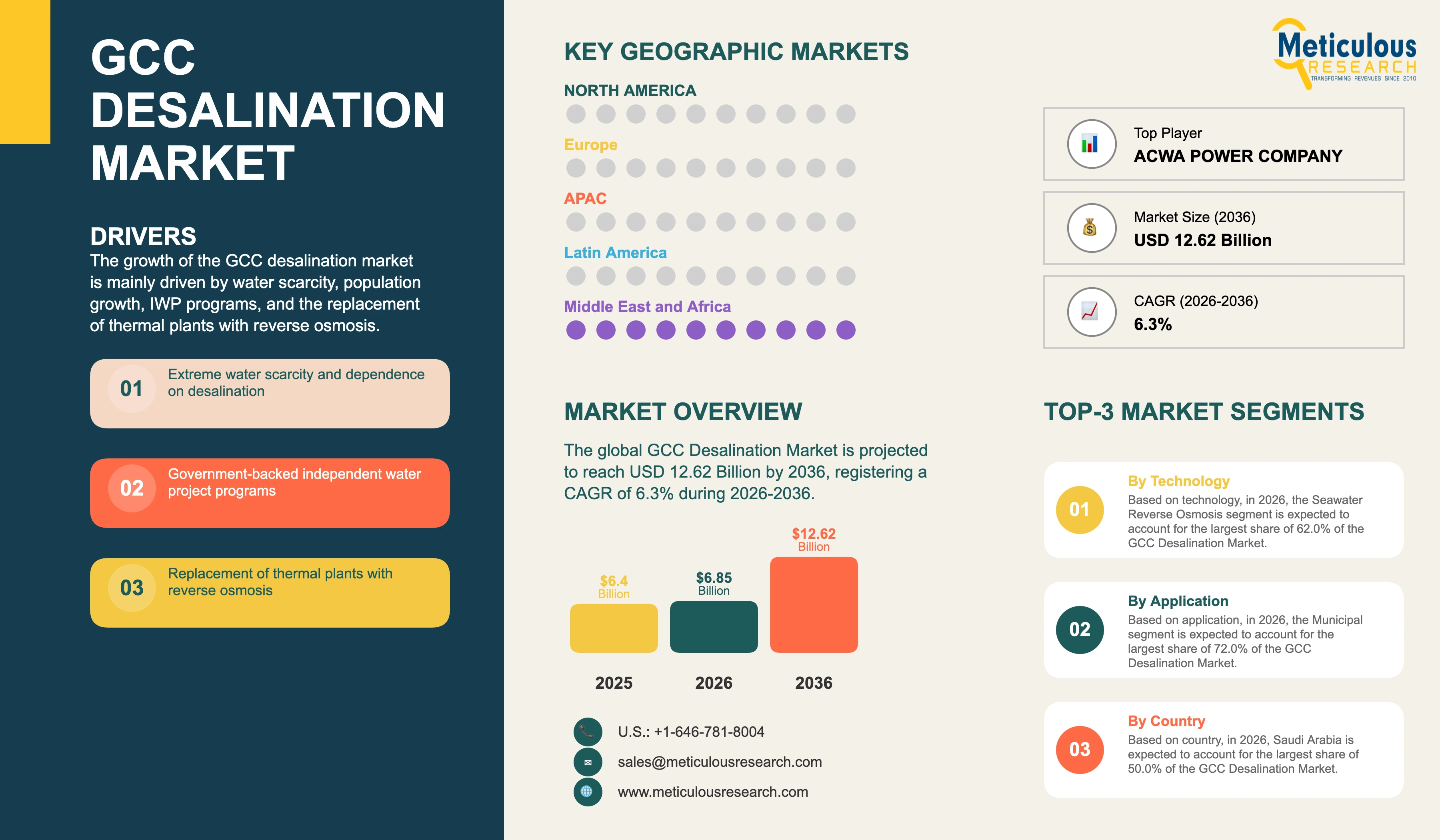
GCC Desalination Market Size The GCC desalination market was valued at USD 6.40 billion in 2025. This market is expected to reach USD 12.62 billion by 2036 from an estimated USD 6.85 billion in 2026, registering a CAGR of 6.3% during the forecast period (2026-2036). The growth of this market is mainly
- Published
- Nov 2026
- Pages
- 190
- Format
- PDF + Excel
- Report ID
- MRSE - 1042586
- Base year
- 2025
- 2025 · BASELINE
- $6.40B
- 2036
- $12.62B
- CAGR 2026–2036
- 6.3%
2025 baseline · 2026–2036 forecast at 6.3% CAGR · hover a bar for the value
Key highlights
Desalination contracts awarded across the GCC reached about USD 3.8 billion in 2025, according to the regional projects tracker MEED Projects, with Saudi Arabia accounting for the vast majority of this value, and the largest award was the USD 700 million Shoaiba 6 seawater reverse osmosis plant with a capacity of 500,000 cubic metres per day.
Saudi Arabia's Sharakat, formerly the Saudi Water Partnership Company (SWPC), signed agreements worth about USD 693 million for the Ras Mohaisen independent water plant with a consortium led by Acwa, with initial operations planned for the first quarter of 2028, and it awarded the Jubail 4 and Jubail 6 IWPs, valued at about USD 485 million each, in October 2025.
Acwa, the Saudi utility developer formerly known as ACWA Power, signed a memorandum of understanding with Veolia in 2026 to optimize the design, performance, and energy use of its desalination plants, which have a total capacity of about 9.7 million cubic metres per day, including about 4.1 million cubic metres per day in Saudi Arabia.
Abu Dhabi's Emirates Water & Electricity Company awarded the USD 400 million Saadiyat seawater reverse osmosis IWP in 2025, Etihad Water & Electricity is preparing a USD 400 million SWRO IWP in Fujairah, and the Dubai Electricity and Water Authority signed a water purchase agreement in October 2026 for the second phase of the Hassyan plant with a capacity of about 272,000 cubic metres per day.
MEED reported in March 2026 that power and water assets in the Gulf face strategic risks following Iranian attacks on the region, highlighting the importance of large plants such as Saudi Arabia's Ras Al-Khair, which produces about 1.1 million cubic metres per day, and increasing the focus of governments on resilience, storage, and distributed capacity.
By technology, seawater reverse osmosis account for the largest share of 62.0% in 2026 and also register the highest CAGR.
By offering, plant design, engineering, and construction accounts for the largest share in 2026, while operation and maintenance services register the highest CAGR.
By plant capacity, large-scale (above 200, 000 m³/day) accounts for the largest share in 2026 and also registers the highest CAGR.
By application, municipal accounts for the largest share of 72.0% in 2026, while industrial registers the highest CAGR.
By country, Saudi Arabia accounts for the largest share of 50.0% in 2026, while Saudi Arabia registers the highest CAGR of 7.0%.
Report summary
| Particulars | Details |
|---|---|
| Base Year | 2025 |
| Estimated Year | 2026 |
| Forecast Period | 2026-2036 |
| Market Size in 2025 | USD 6.40 billion |
| Market Size in 2026 | USD 6.85 billion |
| Market Size by 2036 | USD 12.62 billion |
| CAGR (2026-2036) | 6.3% |
| Format | PDF, Excel & Cloud Portal · 190 pages |
| Largest Segment by Technology (2026) | Seawater Reverse Osmosis (62.0%) |
| Largest Segment by Application (2026) | Municipal (72.0%) |
| Largest Country (2026) | Saudi Arabia (50.0%) |
| Fastest-Growing Country | Saudi Arabia (CAGR 7.0%) |
| Companies Profiled | 15 companies and other companies |
| Segments Covered | Technology, Offering, Plant Capacity, Application, Country |
| Countries Covered | Saudi Arabia, U.A.E., Kuwait, Qatar, Oman, Bahrain |
Report overview
Segments covered: technology, offering, plant capacity, application.
Desalination is the process of removing salts and other dissolved minerals from seawater or brackish water to produce fresh water for drinking, industrial, and other uses. The GCC desalination market covers the design, engineering, and construction of desalination plants, the supply of equipment, membranes, energy recovery devices, and consumables, and the operation and maintenance of plants in Saudi Arabia, the U.A.E., Kuwait, Qatar, Oman, and Bahrain. It includes seawater reverse osmosis, multi-stage flash, multi-effect distillation, and hybrid and other technologies used in municipal, industrial, and other applications. This report measures the market on a revenue basis, covering spending on plant construction, equipment, and services. The sale of desalinated water under water purchase agreements, water transmission pipelines, and wastewater treatment and reuse are analyzed in separate reports.
The GCC is the center of the global desalination industry in terms of both installed capacity and new investment. The six GCC countries have some of the lowest levels of renewable freshwater per person in the world, and groundwater resources have been heavily depleted, so desalinated seawater is the main source of drinking water for most of the population. Regional estimates suggest that the GCC accounts for roughly half of global installed desalination capacity and around 40% of desalinated water produced worldwide. Saudi Arabia is the largest desalination market in the world, and the Saudi Water Authority, formerly the Saline Water Conversion Corporation, operates more than 30 plants with a combined capacity of about 7.5 million cubic metres per day, while private IWPs add substantial further capacity.
The structure of the market has changed significantly over the past decade. Historically, most GCC desalination plants were built and operated by government utilities and used thermal technologies, such as multi-stage flash and multi-effect distillation, which were often combined with power plants to use waste heat. Today, most new capacity is procured through independent water project models, in which private developers finance, build, own, and operate plants and sell water to state offtakers under long-term water purchase agreements, typically for 25 years. Saudi Arabia's Sharakat, Abu Dhabi's Emirates Water & Electricity Company, Dubai Electricity and Water Authority, Etihad Water & Electricity, Oman's Nama Power and Water Procurement Company, and Kuwait's and Qatar's utilities are the main procurers.
Seawater reverse osmosis has become the dominant technology for new plants, since it uses much less energy than thermal desalination and can be powered by grid electricity, including solar power, rather than requiring co-located steam generation. Large SWRO plants such as Rabigh 3, Rabigh 4, Jazlah, and Shuaibah 3 in Saudi Arabia, each with a capacity of about 600,000 cubic metres per day, and Taweelah in Abu Dhabi are among the largest reverse osmosis plants in the world. Governments are also retiring or converting older thermal plants, as shown by the conversion of the Shuaibah 3 plant, which won the Desalination Plant of the Year 2025 award from Global Water Intelligence.
Plant design, engineering, and construction accounts for the largest share of the market by offering, reflecting the large capital investments in new plants. Operation and maintenance services account for a large and stable share, since the GCC has a very large installed base of plants that require continuous operation, maintenance, membrane replacement, and chemicals. Equipment, membranes, and consumables include high-pressure pumps, energy recovery devices, reverse osmosis membranes, ultrafiltration pretreatment systems, and chemicals supplied by companies such as Toray, DuPont, LG Chem, Energy Recovery, and others.
The market is served by developers and operators, engineering, procurement, and construction contractors, technology providers, and equipment and membrane suppliers. Acwa is the leading developer and operator in the region, and it won or was named preferred bidder for roughly two-thirds of GCC independent water projects in 2024. Other important developers include Engie, GS Inima, Marubeni, Sumitomo, and Metito, while Veolia and its Sidem subsidiary, Acciona, Suez, Doosan Enerbility, Fisia Italimpianti, Larsen & Toubro, Lantania, and IDE Technologies are major engineering and technology providers.
Saudi Arabia accounts for the largest share of the market and is also the fastest-growing country, supported by Vision 2030, large IWP programs, giga-projects such as NEOM, and the replacement of thermal plants. The U.A.E. is the second-largest market, followed by Kuwait, Qatar, Oman, and Bahrain. Project awards can vary significantly from year to year, and MEED expects 2026 to be a year of consolidation after a surge in Saudi awards in 2025, but the long-term need for new and replacement capacity remains strong.
Over the forecast period, the GCC desalination market is expected to grow steadily, supported by water demand growth, IWP programs, thermal-to-reverse osmosis conversion, and industrial expansion. At the same time, energy efficiency, renewable energy integration, brine management, digitalization, and the resilience of water infrastructure will become increasingly important.
Saudi Arabia is expected to account for the largest share of 50.0% of the market in 2026, mainly due to its position as the world's largest desalination market, its large IWP program, the replacement of thermal plants, and demand from giga-projects and industry.
Saudi Arabia is also projected to register the highest CAGR of 7.0% during the forecast period, driven by its continued IWP pipeline, thermal plant replacement, water transmission projects, and industrial demand.
The report profiles 15 companies, including Acwa, Veolia (Sidem), Acciona, Suez, Doosan Enerbility, Metito, Fisia Italimpianti, Larsen & Toubro, Engie, GS Inima, IDE Technologies, Toray Industries, DuPont, LG Chem, and Energy Recovery.
Under independent water project models, state offtakers such as Sharakat and Emirates Water & Electricity Company tender plants to private developers, which finance, build, own, and operate the plants and sell water under long-term water purchase agreements, typically for 25 years.
Report infographic
Market dynamics
18 factors across 5 forcesExtreme water scarcity and dependence on desalination
The GCC countries have arid climates, very low rainfall, no permanent rivers, and limited renewable groundwater, and decades of intensive groundwater use for agriculture have depleted aquifers in many areas. As a result, desalinated seawater supplies most municipal drinking water in the region, and in several countries, such as Kuwait, Qatar, and Bahrain, almost all potable water comes from desalination. Governments consider desalination capacity to be strategic infrastructure, on a par with power generation, and they plan new capacity well in advance of demand to maintain water security.
Governments are also seeking to reduce the use of non-renewable groundwater, particularly in Saudi Arabia, which increases reliance on desalinated water for municipal and industrial supply. As existing plants age and demand grows, the need for both new and replacement capacity remains high.
Climate change is expected to increase temperatures and water stress further in the region, which reinforces the long-term importance of desalination and encourages governments to maintain reserve capacity and invest in storage.
Population growth, urbanization, and economic diversification
The GCC population continues to grow, supported by natural growth and large numbers of expatriate workers, and cities such as Riyadh, Jeddah, Dubai, Abu Dhabi, and Doha are expanding rapidly. Economic diversification programs, including Saudi Vision 2030, are creating new cities, tourism destinations, industrial zones, and giga-projects such as NEOM, the Red Sea Project, and Qiddiya, which require large new supplies of water. Tourism growth, major events, and rising living standards also increase per capita water demand.
These developments require not only new desalination plants but also water transmission pipelines and storage, and governments are planning integrated water infrastructure programs to supply growing population centers, often far from the coast.
Industrial cities such as Jubail and Yanbu in Saudi Arabia and Ras Laffan in Qatar also continue to expand, which adds to demand for dedicated desalination capacity for industrial users.
Government-backed independent water project programs
GCC governments have established structured programs for procuring new desalination capacity from private developers under independent water project models. Saudi Arabia's Sharakat, formerly SWPC, publishes a seven-year statement outlining planned IWPs, independent sewage treatment plants, and transmission projects, and its latest statement, released in March 2026, set out the next phase of the kingdom's water infrastructure plans. Standardized contracts, repeat developers, and predictable tendering timelines support efficient project delivery, and long-term water purchase agreements with creditworthy state offtakers attract international finance.
In 2025, GCC desalination contract awards reached about USD 3.8 billion according to MEED Projects, led by Saudi Arabia's Shoaiba 6, Ras Mohaisen, Jubail 4, and Jubail 6 projects, while Abu Dhabi awarded the Saadiyat SWRO IWP. These programs provide a strong pipeline of construction, equipment, and operation and maintenance opportunities over the forecast period.
The IWP model also transfers performance risk to private developers, which encourages the use of efficient technologies and professional operation and maintenance, supporting demand for advanced equipment and services.
Replacement of thermal plants with reverse osmosis
Many older GCC desalination plants use multi-stage flash or multi-effect distillation technologies that consume large amounts of energy and are often coupled with aging gas-fired power plants. As these plants reach the end of their lives and as governments seek to reduce energy use, fuel consumption, and carbon emissions, they are being replaced or converted to seawater reverse osmosis, which typically uses a fraction of the energy of thermal desalination. Decoupling water production from power generation also gives utilities more flexibility to use renewable electricity and to operate power plants more efficiently.
The conversion of the Shuaibah 3 plant from thermal to reverse osmosis technology, which won the Desalination Plant of the Year 2025 award, shows the potential of this approach, and similar replacement and conversion projects are planned across the region.
Rising industrial water demand
Industrial demand for desalinated water is growing in the GCC, driven by oil and gas production and processing, refining and petrochemicals, mining and metals, power generation, hydrogen and ammonia projects, data centers, and new manufacturing industries. Many industrial users require high-quality water, including ultrapure water for some processes, and they often build dedicated desalination plants or contract with developers for supply. Saudi Aramco's gas developments, Ma'aden's mining operations, and green hydrogen projects such as NEOM Green Hydrogen are examples of industrial projects requiring desalination capacity.
Industrial users also increasingly combine desalination with water reuse and zero liquid discharge systems to meet environmental requirements and reduce water costs.
Table of contents
12 chapters · 124 sections · 190 pages · click to expandSegmental analysis
| Segment | Largest share (2026) | Fastest growth (2026–2036) |
|---|---|---|
| By Technology | Plant design, engineering, and construction | Operation and maintenance services |
By Technology
- The plant design, engineering, and construction segment is expected to account for the largest share of the GCC desalination market, while the operation and maintenance services segment is projected to register the highest CAGR during the forecast period.
- The large-scale (above 200, 000 m³/day) segment is expected to account for the largest share of the GCC desalination market, and it is also projected to register the highest CAGR during the forecast period.
Geographic analysis
Middle East & Africa
Largest shareThe GCC desalination market was valued at USD 6.40 billion in 2025. This market is expected to reach USD 12.62 billion by 2036 from an estimated USD 6.85 billion in 2026, registering a CAGR of 6.3% during the forecast period (2026-2036). The growth of this market is mainly driven by extreme water scarcity and very limited renewable freshwater resources in the Gulf countries, rapid population growth, urbanization, and tourism, large government-backed independent water project (IWP) programs in Saudi Arabia, the U.A.E., Oman, and other GCC countries, the replacement of aging thermal desalination plants with energy-efficient seawater reverse osmosis plants, and rising industrial water demand from oil and gas, petrochemicals, mining, power generation, and giga-projects. However, factors such as the high energy use and capital cost of desalination, environmental concerns over brine discharge and carbon emissions, fluctuations in project award timing, and security risks to critical water infrastructure are expected to restrain the growth of this market to some extent. In 2026, Saudi Arabia is expected to account for the largest share of 50.0% of the GCC desalination market. The large share of this country is mainly due to its position as the largest desalination market in the world, its large and growing population, the Saudi Water Authority's large fleet of plants, the large IWP program managed by Sharakat, the replacement of thermal plants, and water demand from giga-projects and industrial development under Vision 2030. Saudi Arabia accounted for the vast majority of GCC desalination contract awards in 2025, according to MEED Projects, including Shoaiba 6, Ras Mohaisen, and Jubail 4 and 6. Saudi Arabia is also projected to register the highest CAGR of 7.0% during the forecast period. The rapid growth of this country is driven by the continued pipeline of IWPs, including Ras Al-Khair, Tabuk, Shuqaiq, and Jizan, the replacement and conversion of thermal plants, water transmission projects linking coastal plants with inland cities, and industrial and giga-project demand, as well as growing operation and maintenance spending on a very large installed base. The U.A.E. is the second-largest market, supported by large plants in Abu Dhabi, Dubai, Sharjah, and the Northern Emirates, such as Taweelah, Mirfa 2, Shuweihat 4, Saadiyat, Hassyan, Hamriyah, and Fujairah. Abu Dhabi and Dubai are replacing thermal capacity with reverse osmosis and integrating desalination with solar power, although MEED notes limited visible desalination momentum in 2026. Kuwait and Qatar depend almost entirely on desalination for drinking water and are investing in new independent water and power projects, such as Kuwait's Az-Zour North and Al-Khairan projects and Qatar's Facility E, while Oman is expanding reverse osmosis capacity through Nama Power and Water Procurement Company, and Bahrain is upgrading and expanding its plants, including the Hawar project. Kuwait and Qatar are also investing in water storage to improve resilience, and Oman's growing tourism and industrial sectors are increasing water demand in regions such as Duqm and Salalah. Market dynamics differ significantly across the six GCC countries because of their size and procurement approach. Saudi Arabia operates rolling multi-year programs, the U.A.E. has a mature market with periodic large awards, and the smaller markets procure capacity based on specific supply needs. All GCC countries share a strong focus on energy efficiency, renewable integration, and water security. Regional cooperation, such as discussions on a GCC water interconnection network, could also influence future capacity planning. GCC Desalination Market Size Geographic Analysis
Competitive landscape
The GCC desalination market is moderately consolidated, with the top five players estimated to account for about 40% of the market in 2025. The market includes developers and operators, engineering, procurement, and construction contractors, desalination technology providers, and equipment and membrane suppliers.
Acwa is the leading developer and operator in the GCC, with about 9.7 million cubic metres per day of desalination capacity worldwide and about 4.1 million cubic metres per day in Saudi Arabia, and it won or was named preferred bidder for roughly two-thirds of GCC independent water projects in 2024. Engie, GS Inima, Metito, Marubeni, and Sumitomo are other important developers. Veolia, through its Sidem subsidiary, Acciona, Suez, Doosan Enerbility, Fisia Italimpianti, Larsen & Toubro, and IDE Technologies are leading engineering and technology providers, while Toray Industries, DuPont, and LG Chem supply reverse osmosis membranes and Energy Recovery supplies energy recovery devices.
Companies in this market compete on water tariff, energy efficiency, technical expertise, project execution track record, financing capabilities, local partnerships and content, operation and maintenance performance, and environmental performance. Key strategies include participation in IWP tenders through consortia, partnerships between developers and technology providers, investment in energy efficiency and digital optimization, local manufacturing and service capabilities, and expansion into adjacent markets such as water transmission, wastewater treatment, and reuse.
Competition for IWP contracts is intense, and low tariffs have put pressure on margins, which encourages developers to work closely with technology providers to reduce costs, as shown by the agreement between Acwa and Veolia. International contractors from Europe, Asia, and India compete with regional companies, and Chinese and Korean contractors are increasingly active in the region. Japanese trading houses also play an important role as equity investors in IWP consortia. Long-term relationships with offtakers remain an important advantage.
We expect the market to remain led by a small number of large developers and contractors, while equipment and membrane suppliers compete on performance and cost. Companies that can deliver low-carbon, efficient, and resilient plants and long-term operation and maintenance services are expected to have an advantage.
Some of the key players operating in the GCC desalination market are Acwa (ACWA Power Company), Veolia Environnement S.A. (Sidem), Acciona, S.A., Suez S.A., Doosan Enerbility Co., Ltd., Metito Holdings Ltd., Fisia Italimpianti S.p.A., Larsen & Toubro Limited, Engie S.A., GS Inima Environment S.A., IDE Technologies Ltd., Toray Industries, Inc., DuPont de Nemours, Inc., LG Chem Ltd., and Energy Recovery, Inc., among others.
- —
GCC desalination contract awards reached about USD 3.8 billion in 2025 according to MEED Projects, Sharakat signed the Ras Mohaisen IWP agreements, Acwa and Veolia signed a 2026 agreement to optimize Acwa's desalination fleet, and DEWA signed a water purchase agreement for the second phase of the Hassyan plant in October 2026.
- Acciona
- Suez
- Doosan Enerbility
- Fisia Italimpianti
- Larsen & Toubro
- IDE Technologies
Expert perspectives
The GCC is and will remain the world's most important desalination market, since desalinated water is the foundation of water supply for the region's growing cities and industries. The market is mature in terms of installed capacity but continues to grow, driven by new capacity, replacement of aging thermal plants, and rising operation and maintenance needs, and it is increasingly shaped by efficiency, sustainability, and resilience requirements.
Over the forecast period, the market is expected to grow at a CAGR of 6.3%, from USD 6.85 billion in 2026 to USD 12.62 billion in 2036. Growth will be supported by water scarcity, population and economic growth, IWP programs, thermal-to-reverse osmosis conversion, and industrial demand.
Among the market segments, seawater reverse osmosis is the largest and fastest-growing technology, plant design, engineering, and construction is the largest offering, while operation and maintenance services grow fastest, large-scale plants are the largest and fastest-growing capacity segment, and municipal is the largest application, while industrial grows fastest. Saudi Arabia is the largest country market and is also the fastest-growing country at a CAGR of 7.0%.
In our view, the most important change over the next decade will be the decarbonization of desalination. As renewable electricity becomes cheaper and governments pursue net-zero goals, desalination plants will increasingly be powered by solar energy, and thermal plants will largely be replaced by reverse osmosis. This will reduce the cost and emissions of water production and change the mix of equipment and services in the market.
We also expect resilience to become a much more important factor in planning. The concentration of water supply in a few large coastal plants creates risks, and governments are likely to invest in storage, redundancy, distributed capacity, and cybersecurity, which could create new opportunities for small and medium-scale plants and service providers. Water storage and interconnection between networks will also become more important parts of planning.
Award timing will continue to vary from year to year, but the long-term pipeline of IWPs, replacement projects, and industrial demand provides a solid foundation for growth. Operation and maintenance, membrane replacement, and plant optimization will provide stable recurring revenues across the cycle.
Brine management and resource recovery represent an important longer-term opportunity, and companies that develop economically viable technologies for recovering minerals from brine could open new revenue streams.
Overall, we believe the GCC desalination market will grow steadily and remain a global center of innovation in large-scale, efficient, and low-carbon desalination. Its experience will also shape desalination projects in other water-scarce regions.
Customer perspectives
This comment explains why seawater reverse osmosis accounts for 62.0% of the market, why municipal applications account for 72.0% of the market, and why Saudi Arabia is the largest and fastest-growing country market.
Chief Technical Officer - Desalination developer, U.A.E.
Energy is our biggest operating cost, so we are investing in more efficient equipment, digital optimization, and solar power across our plants to stay competitive in tenders.
This comment explains why operation and maintenance services are the fastest-growing offering and why energy efficiency and renewable energy integration are key priorities.
This comment explains why industrial applications are the fastest-growing application segment.
“Our IWP program is focused on large reverse osmosis plants with the lowest lifetime cost of water. We also want to replace older thermal capacity and improve the reliability of supply to inland cities.”
“Our new production units require reliable, high-quality water, so we are adding dedicated desalination and reuse capacity rather than relying only on the municipal network.”
Frequently asked questions
The GCC desalination market was valued at USD 6.40 billion in 2025, up from USD 6.00 billion in 2024, and is estimated at USD 6.85 billion in 2026. The market includes plant design, engineering, and construction, equipment, membranes, and consumables, and operation and maintenance services for seawater reverse osmosis, multi-stage flash, multi-effect distillation, and other desalination plants.
Cite this report
Meticulous Research. (2026). GCC Desalination Market - Global Opportunity Analysis and Industry Forecast (2026-2036) (Report No. MRSE - 1042586). Meticulous Market Research Pvt. Ltd. https://www.meticulousresearch.com/product/gcc-desalination-market-7269