Extracellular Vesicles Market (2026-2036)
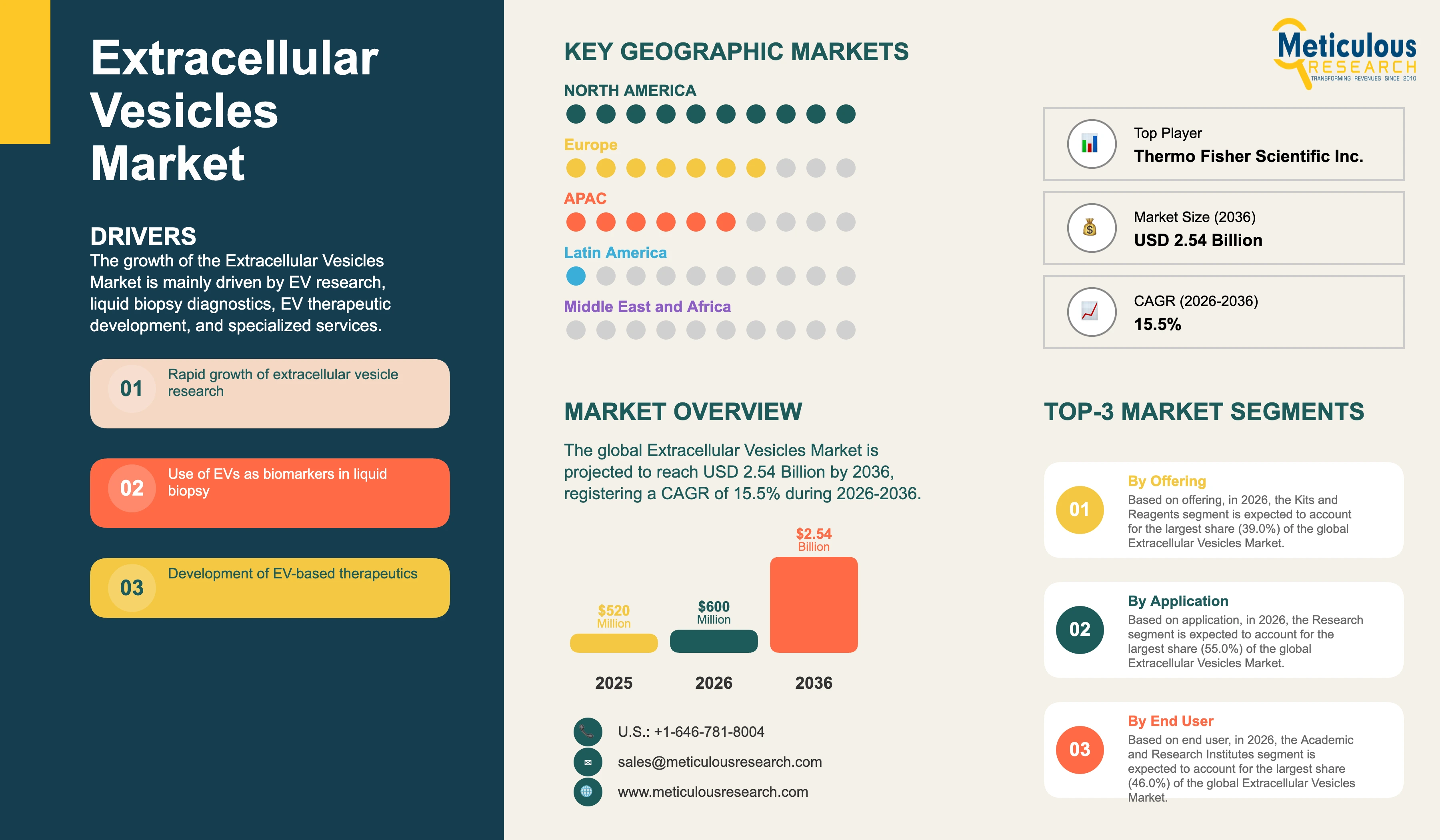
The global extracellular vesicles market was valued at USD 520 million in 2025. This market is expected to reach USD 2.54 billion by 2036 from an estimated USD 600 million in 2026, registering a CAGR of 15.5% during the forecast period (2026-2036).
- Published
- Nov 2026
- Pages
- 248
- Format
- PDF + Excel
- Report ID
- MRHC - 1042589
- Base year
- 2025
- 2025 · BASELINE
- $520.0M
- 2036
- $2.54B
- CAGR 2026–2036
- 15.5%
2025 baseline · 2026–2036 forecast at 15.5% CAGR · hover a bar for the value
Key highlights
In August 2025, Bio-Techne agreed to sell its Exosome Diagnostics business, including the urine-based ExoDx Prostate test and its CLIA-certified laboratory, to Mdxhealth in a deal valued at USD 15 million in cash and stock over five years, while retaining access to its proprietary exosome technology for kit development, and Mdxhealth said it expects the business to contribute more than USD 20 million in revenue.
Capricor Therapeutics' deramiocel, an allogeneic cardiosphere-derived cell therapy designed to work through exosome signaling, is under FDA review for Duchenne muscular dystrophy, and in August 2026 the FDA extended the review deadline to November 22, 2026 after Capricor submitted additional Phase 3 data supporting a narrower upper limb indication, following an advisory committee vote of 9 to 3 against effectiveness in cardiomyopathy in July 2026.
Direct Biologics' ExoFlo, an extracellular vesicle product derived from bone marrow mesenchymal stem cells, is being evaluated in the global Phase III EXTINGUISH ARDS study in hospitalized adults with moderate-to-severe acute respiratory distress syndrome, one of the most advanced EV therapeutic programs in late-stage development, and its results are expected to influence investment across the EV therapeutics field.
The International Society for Extracellular Vesicles (ISEV) published updated MISEV2023 guidelines on the minimal information for studies of extracellular vesicles in 2024, setting recommended practices for EV isolation, characterization, and reporting that are shaping the methods and products used across research and industry.
The FDA's approval of Ryoncil, an allogeneic bone marrow-derived mesenchymal stromal cell therapy, was described by EV researchers in 2025 as an important milestone for the therapeutic EV field, since many EV therapeutics are derived from the same type of cells and are believed to carry part of their therapeutic effect, and it may help regulators assess related products.
By offering, kits and reagents account for the largest share of 39.0% in 2026, while services register the highest CAGR.
By application, research accounts for the largest share in 2026, while therapeutics register the highest CAGR.
By sample source, cell culture media accounts for the largest share in 2026, while blood (plasma and serum) registers the highest CAGR.
By end user, academic and research institutes account for the largest share of 46.0% in 2026, while pharmaceutical and biotechnology companies register the highest CAGR.
By geography, North America accounts for the largest share of 42.0% in 2026, while Asia-Pacific registers the highest CAGR of 18.0%.
Report summary
| Particulars | Details |
|---|---|
| Base Year | 2025 |
| Estimated Year | 2026 |
| Forecast Period | 2026-2036 |
| Market Size in 2025 | USD 520 million |
| Market Size in 2026 | USD 600 million |
| Market Size by 2036 | USD 2.54 billion |
| CAGR (2026-2036) | 15.5% |
| Format | PDF, Excel & Cloud Portal · 248 pages |
| Largest Segment by Offering (2026) | Kits and Reagents (39.0%) |
| Largest Segment by End User (2026) | Academic and Research Institutes (46.0%) |
| Largest Region (2026) | North America (42.0%) |
| Fastest-Growing Region | Asia-Pacific (CAGR 18.0%) |
| Companies Profiled | 16 companies and other companies |
| Segments Covered | Offering, Application, Sample Source, End User, Geography |
| Countries Covered | U.S., Canada, U.K., Germany, Netherlands, Sweden, France, Italy, Spain, Belgium, Switzerland, Rest of Europe, China, South Korea, Japan, Australia, Singapore, India, Taiwan, New Zealand, Rest of Asia-Pacific, Brazil, Mexico, Argentina, Rest of Latin America, Israel, Saudi Arabia, U.A.E., South Africa, Rest of Middle East & Africa |
Report overview
Segments covered: offering, application, sample source, end user.
The growth of this market is mainly driven by the rapidly growing research on extracellular vesicles (EVs), including exosomes, as carriers of proteins, RNA, and other molecules between cells, the use of EVs as biomarkers in liquid biopsy for cancer and other diseases, the development of EV-based therapeutics derived from stem cells and engineered cells for regenerative medicine, inflammatory diseases, and drug delivery, the growing number of EV therapeutic programs in clinical trials, and the emergence of specialized CDMOs and service providers for EV characterization and manufacturing. However, factors such as the lack of standardized isolation and characterization methods, the difficulty of manufacturing EVs at large scale with consistent quality, the absence of approved EV therapeutics, regulatory uncertainty, and limited reimbursement for EV-based diagnostics are expected to restrain the growth of this market to some extent.
Extracellular vesicles are tiny, membrane-bound particles released by almost all types of cells. They include exosomes, which form inside cells and are usually 30 to 150 nanometers in size, microvesicles, which bud from the cell surface, and other vesicle types. EVs carry proteins, lipids, RNA, and DNA from their parent cells and transfer them to other cells, playing an important role in cell-to-cell communication in health and disease. This report covers EV kits and reagents, instruments, and services across research, diagnostic, and therapeutic applications, sample sources, and end users. A separate Meticulous Research report covers the narrower exosome isolation tools market in more detail.
Research on EVs has grown rapidly over the past fifteen years, as scientists have discovered that EVs are involved in cancer progression, immune responses, neurological diseases, cardiovascular disease, and tissue repair. EVs are found in blood, urine, saliva, cerebrospinal fluid, and other body fluids, which makes them attractive as biomarkers for noninvasive diagnosis. They are also being developed as therapeutics, either as naturally produced vesicles from stem cells or other cells with healing properties, or as engineered vesicles loaded with drugs, RNA, or proteins for targeted delivery.
Working with EVs requires specialized tools and methods, since EVs must first be isolated from cell culture media or body fluids using methods such as ultracentrifugation, size-exclusion chromatography, precipitation, immunoaffinity capture, ultrafiltration, or tangential flow filtration. They are then characterized using nanoparticle tracking analysis, high-sensitivity flow cytometry, electron microscopy, and protein and RNA analysis. Their cargo is analyzed using PCR, sequencing, and proteomics. Each step requires kits, reagents, and instruments, and many researchers and companies also use specialized service providers.
In diagnostics, EV-based tests analyze RNA, proteins, or other molecules carried by EVs in body fluids to detect or characterize diseases. The ExoDx Prostate test, a urine-based test that analyzes exosomal RNA to help decide whether men need a prostate biopsy, is one of the most established EV-based diagnostic tests, and it was transferred from Bio-Techne to Mdxhealth in 2025. Many other EV-based tests for cancer, neurological diseases, and other conditions are in development, and EVs are increasingly combined with cell-free DNA in multi-analyte liquid biopsy.
In therapeutics, EVs derived from mesenchymal stem cells, cardiosphere-derived cells, platelets, and other sources are being tested for conditions such as acute respiratory distress syndrome, wound healing, skin diseases, heart disease, and neurological disorders. Engineered EVs are being developed as delivery vehicles for RNA, proteins, and small molecules. No EV-based therapeutic has yet received full approval from the FDA or EMA, but several programs are in late-stage trials, and the regulatory review of Capricor's deramiocel, which is believed to act through exosome signaling, is being closely watched by the field.
The EV field also has quality and regulatory challenges, as isolation methods produce EV preparations with different purity and composition, and the lack of standardized methods has made it hard to compare results between laboratories. ISEV's MISEV2023 guidelines aim to improve consistency. Regulators have also warned about unapproved exosome products marketed directly to consumers, especially in aesthetic and regenerative clinics, which highlights the need for rigorous manufacturing and clinical evidence.
Kits and reagents account for the largest share of the market, since they are used widely in research and diagnostics for EV isolation, purification, labeling, and RNA and protein extraction. Services, including EV characterization, analysis, and CDMO manufacturing for therapeutic developers, are a large and fast-growing segment, while instruments for EV isolation and characterization, such as nanoparticle tracking analyzers, flow cytometers, and automated isolation systems, account for the rest.
The market includes life science tools companies, specialized EV product suppliers, diagnostic companies, service providers and CDMOs, and therapeutic developers. Leading companies include Thermo Fisher Scientific, QIAGEN, Bio-Techne, Mdxhealth, System Biosciences, Izon Science, Miltenyi Biotec, Malvern Panalytical, FUJIFILM Wako Pure Chemical, Cell Guidance Systems, HansaBioMed Life Sciences, Norgen Biotek, NanoFCM, RoosterBio, ExoCoBio, and Evox Therapeutics.
Over the forecast period, the EV market is expected to grow rapidly, as EV research expands, as EV-based diagnostics gain clinical evidence and reimbursement, as EV therapeutics move through late-stage trials toward approval, and as standardized and scalable tools and manufacturing services become available.
We use several isolation kits and nanoparticle tracking to follow the MISEV guidelines. Kits are our biggest recurring cost for EV work, and journal reviewers now expect more than one characterization method in every paper.
This comment explains why kits and reagents account for 39.0% of the market, why academic and research institutes account for 46.0% of the market, and why North America accounts for 42.0% of the market.
Scaling up production with consistent quality is our biggest challenge, so we work with specialized manufacturing partners and invest heavily in potency assays, because regulators want clear evidence that every batch works the same way.
This comment explains why services and therapeutics are the fastest-growing segments and why Asia-Pacific is the fastest-growing region.
For therapeutic developers, the choice of manufacturing partner and analytical methods is a long-term decision, since changing processes later requires comparability studies and regulatory review.
Blood-based EV RNA combined with cell-free DNA gives us more information about the tumor than either alone, but we need automated, clinical-grade isolation that gives the same results every time.
This comment explains why blood is the fastest-growing sample source and why clinical-grade diagnostics are an important opportunity.
Academic and research institutes are expected to account for the largest share of 46.0% of the market in 2026, while pharmaceutical and biotechnology companies are projected to register the highest CAGR as EV therapeutic programs advance.
North America is expected to account for the largest share of 42.0% of the market in 2026, mainly due to extensive EV research funded by the NIH, the presence of therapeutic developers, commercial EV diagnostics, and leading tools suppliers in the U.S.
Asia-Pacific is projected to register the highest CAGR of 18.0% during the forecast period, driven by active EV research and therapeutic development in South Korea, China, Japan, and Australia and supportive regenerative medicine policies.
The report profiles 16 leading companies, including Thermo Fisher Scientific, QIAGEN, Bio-Techne, Mdxhealth, System Biosciences, Izon Science, Miltenyi Biotec, Malvern Panalytical, FUJIFILM Wako, Cell Guidance Systems, HansaBioMed, Norgen Biotek, NanoFCM, RoosterBio, ExoCoBio, and Evox Therapeutics.
Report infographic
Market dynamics
16 factors across 5 forcesRapid growth of extracellular vesicle research
Research on extracellular vesicles has grown dramatically, with the number of scientific publications on EVs and exosomes increasing many times over the past decade. Researchers in cancer biology, immunology, neuroscience, cardiology, and regenerative medicine study EVs to understand how cells communicate and how diseases spread and progress. For example, tumor-derived EVs can prepare distant organs for metastasis, and EVs from immune cells can regulate immune responses. These discoveries have made EVs a major research field and a source of new biomarkers and therapeutic ideas.
The growth of EV research drives demand for isolation kits, characterization instruments, labeling reagents, RNA and protein analysis tools, and analytical services. Research funding from government agencies, foundations, and pharmaceutical companies supports this growth, and EV research communities, such as ISEV, promote collaboration and best practices. As researchers adopt the MISEV2023 guidelines, they often need multiple complementary methods to isolate and characterize EVs, which increases spending per study.
EV research is also expanding into new areas, such as plant-derived and milk-derived vesicles, bacterial vesicles, and EVs in agriculture and veterinary science, which further broadens the customer base for EV tools.
Pharmaceutical companies are also using EV research to understand drug resistance, immune responses to biologics, and disease mechanisms, which extends EV tool demand beyond academic laboratories. As more EV findings are published in leading journals, new researchers enter the field, creating a steadily growing base of first-time buyers for kits, reagents, and services.
Use of EVs as biomarkers in liquid biopsy
EVs carry RNA, proteins, and DNA that reflect the state of their parent cells, and they are protected from degradation by their membranes, which makes them attractive as biomarkers in body fluids. EV-based liquid biopsy can detect cancer mutations, RNA expression patterns, and protein markers that complement cell-free DNA analysis. EVs can also cross the blood-brain barrier, which makes them promising for diagnosing neurological diseases using blood samples.
The ExoDx Prostate test has demonstrated the clinical value of EV-based diagnostics, and Mdxhealth's acquisition of the test reflects confidence in its commercial potential. Many companies and research groups are developing EV-based tests for cancer detection and monitoring, neurodegenerative diseases, cardiovascular disease, and pregnancy complications. Multi-analyte tests that combine EV RNA with cell-free DNA, such as research kits from Bio-Techne, aim to improve sensitivity. This creates demand for clinical-grade isolation kits, automated systems, and diagnostic laboratory services.
Pharmaceutical companies are also interested in EV-based companion diagnostics and monitoring tests that can track how patients respond to treatment, which could create additional demand from drug developers and central laboratories. The ability to collect EVs from urine and saliva also supports the development of home-based and point-of-care sample collection, which could broaden access to testing.
Development of EV-based therapeutics
EVs are being developed as a new class of therapeutics with potential advantages over cell therapies, including lower risk of immune reactions and tumor formation, easier storage and handling, and the possibility of off-the-shelf products. EVs derived from mesenchymal stem cells and other cell types have shown anti-inflammatory, regenerative, and immune-modulating effects in preclinical and clinical studies. Late-stage programs include Direct Biologics' ExoFlo for acute respiratory distress syndrome, and many other companies are in earlier clinical stages.
Engineered EVs are also being developed as drug delivery vehicles that can carry RNA, proteins, gene editing tools, and small molecules to specific tissues, including the brain. Pharmaceutical companies have formed partnerships with EV technology companies to explore these applications. The development of EV therapeutics creates strong demand for GMP manufacturing, analytical characterization, process development services, and scalable isolation technologies, such as tangential flow filtration and chromatography.
Growth of specialized CDMOs and service providers
As EV therapeutic programs move toward clinical trials and commercial production, developers need specialized manufacturing and analytical services. Specialized CDMOs and service providers offer cell line development, upstream cell culture, EV purification, characterization, potency testing, and GMP manufacturing for EV products. Suppliers such as RoosterBio provide cell sources and media designed for EV production, and established CDMOs are adding EV manufacturing capabilities.
Service providers also support research and diagnostic customers with EV isolation, characterization, and cargo analysis services, which helps laboratories without specialized equipment or expertise. The growth of these services is one of the main drivers of market value, as services command higher prices and are used throughout development.
Table of contents
12 chapters · 156 sections · 248 pages · click to expandSegmental analysis
| Segment | Largest share (2026) | Fastest growth (2026–2036) |
|---|---|---|
| By Offering | Research | Therapeutics |
By Offering
- The research segment is expected to account for the largest share of the extracellular vesicles market, while the therapeutics segment is projected to register the highest CAGR during the forecast period.
- The cell culture media segment is expected to account for the largest share of the extracellular vesicles market, while the blood (plasma and serum) segment is projected to register the highest CAGR during the forecast period.
Geographic analysis
North America
Largest shareIn 2026, North America is expected to account for the largest share of 42.0% of the global extracellular vesicles market. The large share of this region is mainly due to the large number of academic institutions and companies conducting EV research and development in the U.S., high research funding from the NIH and other sources, the presence of EV therapeutic developers such as Direct Biologics and Capricor Therapeutics, the commercial availability of EV-based diagnostics such as the ExoDx Prostate test, and the presence of leading tools suppliers. Canada also has strong EV research and suppliers such as Norgen Biotek, and several Canadian universities run active EV biomarker and therapeutic research programs.
Europe
Europe is the second-largest market, supported by strong EV research communities in the U.K., Germany, the Netherlands, Sweden, France, Italy, Spain, Belgium, and Switzerland, the presence of companies such as QIAGEN, Miltenyi Biotec, Malvern Panalytical, Evox Therapeutics, and HansaBioMed, and EU research funding for EV projects through Horizon Europe and national research councils. European researchers have played a leading role in ISEV and in developing EV guidelines, and the U.K. and the Netherlands host some of the most active EV research groups in the world. European regulators are also working with industry on frameworks for EV therapeutics.
Asia-Pacific
Fastest growthAsia-Pacific is projected to register the highest CAGR of 18.0% during the forecast period. The rapid growth of this region is mainly driven by very active EV research and therapeutic development in South Korea, China, Japan, Australia, and Singapore, the growth of local EV companies, supportive regenerative medicine policies in Japan and South Korea, and rising research funding. South Korea is one of the most active countries in EV therapeutic development, with many companies and clinical programs, while China has a rapidly growing EV research community. New Zealand is home to Izon Science, a leading supplier of size-exclusion chromatography columns for EV isolation, and India and Taiwan are growing research markets. Japan's FUJIFILM Wako supplies EV isolation reagents, and local suppliers in China are expanding their product offerings.
Latin America
Latin America and the Middle East & Africa account for small shares of the market. Brazil, Mexico, and Argentina have growing EV research at leading universities, while Israel, Saudi Arabia, the U.A.E., and South Africa are investing in biomedical research that includes EV studies, often in collaboration with international research groups.
Competitive landscape
The global extracellular vesicles market is fragmented, with the top five players estimated to account for about 35% of the market in 2025. The market includes large life science tools companies, specialized EV product suppliers, instrument manufacturers, diagnostic companies, service providers and CDMOs, and therapeutic developers.
Thermo Fisher Scientific, QIAGEN, and Bio-Techne offer EV isolation kits, RNA extraction kits, and related reagents and instruments, and Bio-Techne continues to develop exosome-based kits after selling its Exosome Diagnostics business to Mdxhealth, which now offers the ExoDx Prostate test. System Biosciences, Izon Science, FUJIFILM Wako, HansaBioMed, Norgen Biotek, and Cell Guidance Systems are specialized suppliers of EV isolation and analysis products, while Miltenyi Biotec offers EV isolation and characterization tools, and Malvern Panalytical and NanoFCM supply characterization instruments.
RoosterBio supplies cells and media for EV production, ExoCoBio develops EV-based products in South Korea, and Evox Therapeutics develops engineered EVs for drug delivery. Many smaller companies and service providers offer EV characterization and manufacturing services, and several established CDMOs have announced EV manufacturing capabilities to serve therapeutic developers. Instrument suppliers compete mainly on sensitivity, size range, and the ability to measure fluorescence on individual vesicles.
Companies in this market compete on isolation purity and yield, reproducibility, ease of use, scalability, compatibility with downstream analysis, regulatory compliance, and price. Key strategies include product launches for specific sample types and applications, development of clinical-grade and automated workflows, partnerships with diagnostic and therapeutic developers, acquisitions, and expansion of service and manufacturing capabilities.
We expect consolidation as larger tools and diagnostics companies acquire specialized EV suppliers and technologies, and as CDMOs build EV manufacturing capabilities. Competition is likely to increase in clinical-grade diagnostics and GMP manufacturing services.
The large number of small and specialized suppliers creates a fragmented market in which researchers often choose products based on publications, recommendations from colleagues, and compatibility with their samples. Suppliers that publish validation data, support the MISEV2023 guidelines, and offer technical support have an advantage in winning and keeping customers, especially among new researchers entering the field.
Some of the key players operating in the extracellular vesicles market are Thermo Fisher Scientific Inc., QIAGEN N.V., Bio-Techne Corporation, Mdxhealth SA, System Biosciences, LLC, Izon Science Ltd., Miltenyi Biotec B.V. & Co. KG, Malvern Panalytical Ltd. (Spectris plc), FUJIFILM Wako Pure Chemical Corporation, Cell Guidance Systems Ltd., HansaBioMed Life Sciences Ltd., Norgen Biotek Corp., NanoFCM Inc., RoosterBio, Inc., ExoCoBio Inc., and Evox Therapeutics Ltd., among others.
- —
Mdxhealth acquired Bio-Techne's Exosome Diagnostics business, the FDA extended its review of Capricor's deramiocel to November 2026, ExoFlo advanced in a Phase III ARDS trial, and ISEV's MISEV2023 guidelines are shaping EV isolation and characterization methods across research and industry.
- Thermo Fisher Scientific Inc.
- QIAGEN N.V.
- Bio-Techne Corporation
- Mdxhealth SA
- System Biosciences, LLC
- Izon Science Ltd.
- Miltenyi Biotec B.V. & Co. KG
- Malvern Panalytical Ltd. (Spectris plc)
- FUJIFILM Wako Pure Chemical Corporation
- Cell Guidance Systems Ltd.
- HansaBioMed Life Sciences Ltd.
- Norgen Biotek Corp.
- NanoFCM Inc.
- RoosterBio, Inc.
- ExoCoBio Inc.
- Evox Therapeutics Ltd.
Expert perspectives
The extracellular vesicles market is at an early but promising stage, as research on EVs has grown rapidly, EV-based diagnostics have shown clinical value, and EV therapeutics are moving through clinical trials, but the field still faces important challenges in standardization, manufacturing, and regulation.
Over the forecast period, the market is expected to grow at a CAGR of 15.5%, from USD 600 million in 2026 to USD 2.54 billion in 2036. Growth will be supported by expanding EV research, liquid biopsy diagnostics, therapeutic development, and specialized services and manufacturing.
Kits and reagents remain the largest offering segment, while services grow fastest. Research is the largest application, while therapeutics grows fastest. Cell culture media is the largest sample source, while blood grows fastest. Academic and research institutes are the largest end user, while pharmaceutical and biotechnology companies grow fastest. North America remains the largest region, and Asia-Pacific is the fastest-growing region at a CAGR of 18.0%.
We see the regulatory outcome of late-stage EV-related programs as an important factor for the market over the next few years. Approval of an EV-based therapeutic would validate the field, attract new investment, and sharply increase demand for manufacturing and analytical services, while further setbacks could slow investment across the whole field. The FDA's decision on Capricor's deramiocel and the results of the ExoFlo Phase III trial are important near-term events.
In diagnostics, we believe that EV-based tests will grow mainly as part of multi-analyte liquid biopsy and in areas where other biomarkers perform poorly, such as neurological diseases and certain cancers. Reimbursement and inclusion in clinical guidelines will be critical for broad adoption, and the experience of the ExoDx Prostate test, which built clinical evidence and reimbursement over several years, provides a useful model for other EV-based tests.
For suppliers, the key priorities over the forecast period are to develop standardized, reproducible, and scalable tools, support clinical-grade diagnostics and GMP manufacturing, and help customers meet MISEV2023 and regulatory expectations. Service providers that build expertise early will be well positioned as the field matures.
We expect Asia-Pacific to play an increasingly important role in the market, with South Korea, China, and Japan leading in EV therapeutic development and local suppliers gaining share in research tools. International suppliers will need local partnerships, distribution, and manufacturing to compete effectively in the region.
Our forecast assumes steady double-digit growth in research and diagnostics, with therapeutic demand accelerating in the second half of the forecast period as the first products reach approval and commercial scale.
Customer perspectives
Buyers of EV products and services include academic and research institutes, pharmaceutical and biotechnology companies, EV therapeutic developers, diagnostic companies, hospitals and diagnostic laboratories, and CROs and CDMOs. Their purchasing decisions depend mainly on isolation purity and yield, reproducibility, ease of use, scalability, regulatory compliance, and cost.
Frequently asked questions
The global extracellular vesicles market was valued at USD 520 million in 2025, up from USD 450 million in 2024, and is estimated at USD 600 million in 2026. The market includes EV kits and reagents, instruments, and services for research, diagnostic, and therapeutic applications.
Cite this report
Meticulous Research. (2026). Extracellular Vesicles Market - Global Opportunity Analysis and Industry Forecast (2026-2036) (Report No. MRHC - 1042589). Meticulous Market Research Pvt. Ltd. https://www.meticulousresearch.com/product/extracellular-vesicles-market-7272