Exosome Isolation Market (2026-2036)
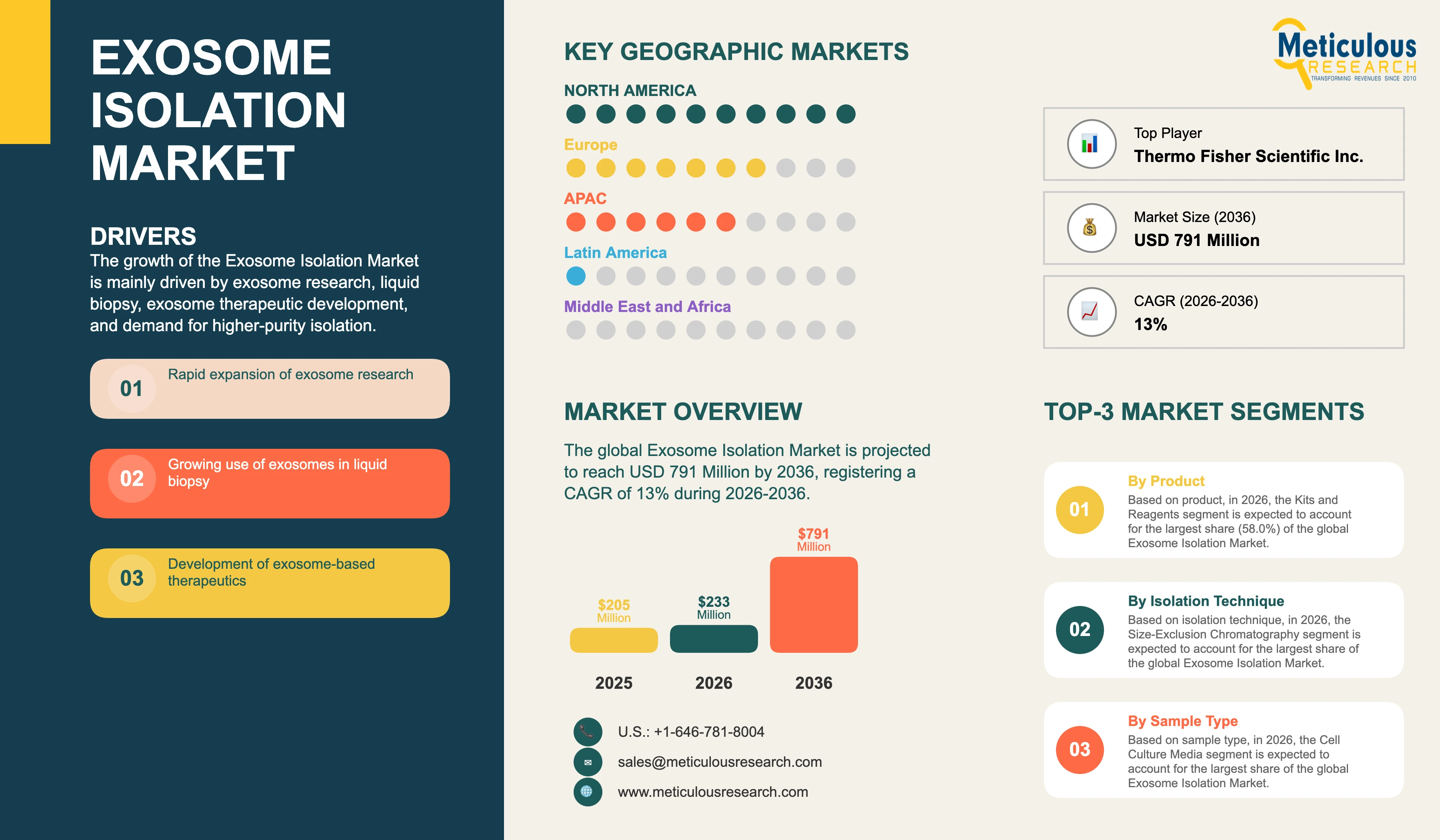
The global exosome isolation market was valued at USD 205 million in 2025. This market is expected to reach USD 791 million by 2036 from an estimated USD 233 million in 2026, registering a CAGR of 13.0% during the forecast period (2026-2036).
- Published
- Nov 2026
- Pages
- 243
- Format
- PDF + Excel
- Report ID
- MRHC - 1042590
- Base year
- 2025
- 2025 · BASELINE
- $205.0M
- 2036
- $791.0M
- CAGR 2026–2036
- 13.0%
2025 baseline · 2026–2036 forecast at 13.0% CAGR · hover a bar for the value
Key highlights
Bio-Techne has introduced the ExoLution Plus cfDNA and exoRNA Isolation Kit, which uses proprietary chemistry to co-isolate cell-free DNA and exosomal RNA from blood plasma in a single workflow, and has paired it with its QuantideX qPCR ESR1 exoMutation Kit, described by the company as the first multi-analyte liquid biopsy assay for detecting ESR1 mutations in breast cancer, currently for research use, which reflects the growing role of combined isolation workflows in cancer research.
When Bio-Techne agreed in August 2025 to sell its Exosome Diagnostics business, including the ExoDx Prostate test and CLIA-certified laboratory, to Mdxhealth, it retained access to its proprietary exosome-based technology for ongoing kit development in its precision diagnostics business, showing the strategic value of exosome isolation technology for research and diagnostic kits.
The International Society for Extracellular Vesicles (ISEV) published the MISEV2023 guidelines in 2024, which recommend that researchers carefully choose and report isolation methods, consider the trade-off between recovery and specificity, and use complementary characterization methods, increasing demand for well-validated isolation products and encouraging suppliers to publish detailed performance data for their kits and systems.
Late-stage therapeutic programs related to extracellular vesicles, such as Direct Biologics' ExoFlo in a Phase III trial for acute respiratory distress syndrome and Capricor's deramiocel, which is believed to act through exosome signaling and is under FDA review with a decision date of November 22, 2026, are increasing interest in scalable, GMP-compatible exosome isolation and purification technologies among therapeutic developers.
Mdxhealth has said it expects the ExoDx Prostate business, which relies on isolating exosomal RNA from urine, to contribute more than USD 20 million in revenue, illustrating the commercial potential of exosome isolation in clinical diagnostic testing, where each patient sample requires a reliable and reproducible isolation step.
By product, kits and reagents account for the largest share of 58.0% in 2026, while instruments and systems register the highest CAGR.
By isolation technique, size-exclusion chromatography accounts for the largest share in 2026, while microfluidic and other emerging methods register the highest CAGR.
By sample type, cell culture media accounts for the largest share in 2026, while blood (plasma and serum) registers the highest CAGR.
By end user, academic and research institutes account for the largest share of 52.0% in 2026, while pharmaceutical and biotechnology companies register the highest CAGR.
By geography, North America accounts for the largest share of 41.0% in 2026, while Asia-Pacific registers the highest CAGR of 15.5%.
Report summary
| Particulars | Details |
|---|---|
| Base Year | 2025 |
| Estimated Year | 2026 |
| Forecast Period | 2026-2036 |
| Market Size in 2025 | USD 205 million |
| Market Size in 2026 | USD 233 million |
| Market Size by 2036 | USD 791 million |
| CAGR (2026-2036) | 13.0% |
| Format | PDF, Excel & Cloud Portal · 243 pages |
| Largest Segment by Product (2026) | Kits and Reagents (58.0%) |
| Largest Segment by End User (2026) | Academic and Research Institutes (52.0%) |
| Largest Region (2026) | North America (41.0%) |
| Fastest-Growing Region | Asia-Pacific (CAGR 15.5%) |
| Companies Profiled | 13 companies and other companies |
| Segments Covered | Product, Isolation Technique, Sample Type, End User, Geography |
| Countries Covered | U.S., Canada, U.K., Germany, Netherlands, Sweden, France, Italy, Spain, Belgium, Switzerland, Rest of Europe, China, South Korea, Japan, Australia, Singapore, India, Taiwan, New Zealand, Rest of Asia-Pacific, Brazil, Mexico, Argentina, Rest of Latin America, Israel, Saudi Arabia, U.A.E., South Africa, Rest of Middle East & Africa |
Report overview
Segments covered: product, isolation technique, sample type, end user, technique.
The growth of this market is mainly driven by the rapid expansion of exosome and extracellular vesicle research in cancer, neuroscience, immunology, and regenerative medicine, the growing use of exosomes as biomarkers in liquid biopsy, which requires reliable isolation from blood, urine, and other body fluids, the development of exosome-based therapeutics that need scalable and reproducible purification methods, the adoption of the MISEV2023 guidelines that encourage rigorous isolation and characterization, and the launch of faster, higher-purity, and automated isolation products. However, factors such as the lack of a single standardized isolation method, trade-offs between yield and purity, contamination with lipoproteins and protein aggregates, the high cost of some instruments, and the difficulty of scaling isolation for clinical and manufacturing use are expected to restrain the growth of this market to some extent.
Exosomes are small extracellular vesicles, usually between 30 and 150 nanometers in size, that are released by cells and carry proteins, lipids, RNA, and DNA. Because they are found in almost all body fluids and reflect the state of their parent cells, exosomes are widely studied as biomarkers and as potential therapeutics and drug delivery vehicles. Before exosomes can be studied or used, they must be separated from cells, cell debris, proteins, lipoproteins, and other particles in the sample, which is the purpose of exosome isolation. This report covers the global market for exosome isolation kits and reagents, instruments and systems, and accessories and consumables across isolation techniques, sample types, and end users. The broader extracellular vesicles market, including characterization tools, services, and therapeutics, is covered in a separate Meticulous Research report.
Several techniques are used to isolate exosomes, each with advantages and limitations. Ultracentrifugation, the traditional method, uses very high centrifugal forces to pellet exosomes, but it is time-consuming, requires expensive equipment, and can damage vesicles or co-isolate contaminants. Precipitation methods use polymers to bring exosomes out of solution, offering simplicity and high yield but lower purity. Size-exclusion chromatography separates exosomes from smaller proteins by size, offering a good balance of purity and vesicle integrity, and it has become one of the most popular methods. Immunoaffinity capture uses antibodies or other binding molecules against exosome surface markers to isolate specific exosome subpopulations with high purity. Ultrafiltration and tangential flow filtration concentrate exosomes using membranes and are well suited to processing large volumes, while microfluidic and other emerging methods aim to isolate exosomes quickly from small sample volumes.
The choice of isolation method depends on the sample type, the volume available, the required purity and yield, and the downstream application. For example, blood plasma contains very large amounts of proteins and lipoproteins that can contaminate exosome preparations, so methods with high specificity, such as size-exclusion chromatography and immunoaffinity capture, are often used. Cell culture media used in research and therapeutic production may require processing of large volumes, which favors ultracentrifugation and tangential flow filtration. Urine samples used in diagnostics require simple and reproducible methods suitable for clinical laboratories.
Kits and reagents account for the largest share of the market, since they are used in large numbers in research and diagnostic laboratories and offer simple, standardized workflows. Leading suppliers include Thermo Fisher Scientific, QIAGEN, System Biosciences, Izon Science, Bio-Techne, Miltenyi Biotec, FUJIFILM Wako, HansaBioMed, Norgen Biotek, and Cell Guidance Systems, which offer precipitation reagents, size-exclusion columns, spin columns, membrane affinity kits, immunoaffinity beads, and kits that isolate exosomal RNA and protein. Instruments include ultracentrifuges, automated size-exclusion and isolation systems, and tangential flow filtration systems, while consumables include columns, filters, tubes, and beads.
Research is the largest source of demand, as thousands of laboratories worldwide study exosomes in cancer, neuroscience, cardiovascular disease, immunology, and regenerative medicine. Diagnostic applications, such as exosome-based liquid biopsy for cancer and neurological diseases, require reliable, clinical-grade isolation from blood and urine, and they are an important growth area. Therapeutic developers need scalable, GMP-compatible isolation and purification methods, such as tangential flow filtration and chromatography, which creates demand for bioprocessing instruments and consumables.
The lack of a single standard isolation method remains a central issue. Different methods produce exosome preparations with different purity and composition, which affects research results and makes comparisons between studies difficult. ISEV's MISEV2023 guidelines encourage researchers to report methods in detail and to consider the trade-off between recovery and specificity, and many researchers now combine methods, such as size-exclusion chromatography with ultrafiltration, to improve purity.
Over the forecast period, the exosome isolation market is expected to grow strongly, as exosome research expands, as diagnostic and therapeutic applications move toward the clinic, and as suppliers develop faster, purer, more automated, and more scalable isolation solutions.
The market includes life science tools companies, specialized exosome product suppliers, and bioprocessing equipment suppliers. Leading companies include Thermo Fisher Scientific, QIAGEN, Bio-Techne, System Biosciences, Izon Science, Miltenyi Biotec, FUJIFILM Wako Pure Chemical, HansaBioMed Life Sciences, Norgen Biotek, Cell Guidance Systems, Beckman Coulter (Danaher), Repligen, and Exosomics.
Academic and research institutes are expected to account for the largest share of 52.0% of the market in 2026, while pharmaceutical and biotechnology companies are projected to register the highest CAGR.
North America is expected to account for the largest share of 41.0% of the market in 2026, mainly due to extensive exosome research, therapeutic and diagnostic developers, high research funding, and leading suppliers in the U.S.
Asia-Pacific is projected to register the highest CAGR of 15.5% during the forecast period, driven by active exosome research and therapeutic and product development in China, South Korea, Japan, and Australia.
The report profiles 13 leading companies, including Thermo Fisher Scientific, QIAGEN, Bio-Techne, System Biosciences, Izon Science, Miltenyi Biotec, FUJIFILM Wako, HansaBioMed, Norgen Biotek, Cell Guidance Systems, Beckman Coulter, Repligen, and Exosomics.
Report infographic
Market dynamics
16 factors across 5 forcesRapid expansion of exosome research
Exosome research has grown rapidly over the past decade, as scientists have discovered that exosomes play important roles in cancer progression and metastasis, immune regulation, neurological diseases, cardiovascular disease, and tissue repair. The number of scientific publications on exosomes and extracellular vesicles has increased many times, and exosome research is now active in universities, research institutes, and pharmaceutical companies around the world. Every exosome study begins with isolation, which makes isolation kits and instruments one of the most widely used product categories in the field.
As more researchers enter the field and existing researchers expand their work, demand for isolation products grows. Researchers often test several methods to find the best one for their samples and applications, and the MISEV2023 guidelines encourage the use of multiple complementary methods, which increases spending per study. Research funding from governments, foundations, and pharmaceutical companies supports this growth.
Core facilities at universities and research institutes are also expanding their exosome services, often buying several isolation systems and large volumes of kits to support many research groups. The growing number of review articles, training courses, and conferences on exosomes helps new researchers enter the field, which steadily expands the customer base for isolation products.
Exosome research is also expanding into new sample types and organisms, including milk, plant, bacterial, and animal exosomes, which creates demand for isolation products optimized for these sources.
Growing use of exosomes in liquid biopsy
Exosomes carry RNA, proteins, and DNA from their parent cells, including tumor cells, and they are protected from degradation by their membranes, which makes them valuable biomarkers in body fluids. Exosome-based liquid biopsy can detect cancer mutations, RNA expression patterns, and protein markers in blood and urine, and it can complement cell-free DNA analysis. The ExoDx Prostate test, which analyzes exosomal RNA from urine, has demonstrated the clinical value of exosome-based diagnostics, and Mdxhealth expects the test to contribute more than USD 20 million in revenue.
Diagnostic developers need isolation methods that are reproducible, fast, and compatible with clinical laboratory workflows and automation. Kits that co-isolate exosomal RNA and cell-free DNA, such as Bio-Techne's ExoLution Plus, enable multi-analyte liquid biopsy and increase the value of each sample. As exosome-based diagnostic tests gain clinical evidence and reimbursement, demand for clinical-grade isolation kits and automated systems is expected to increase significantly.
Brain-derived exosomes isolated from blood are a promising source of biomarkers for neurodegenerative diseases, such as Alzheimer's and Parkinson's disease, and their isolation requires specialized immunoaffinity methods, which supports demand for high-specificity products.
Development of exosome-based therapeutics
Exosome-based therapeutics, derived from mesenchymal stem cells and other cells or engineered to carry drugs, are being developed for a range of diseases, and several programs are in clinical trials, including Direct Biologics' ExoFlo in a Phase III trial for acute respiratory distress syndrome. Therapeutic development requires isolation and purification methods that can process large volumes of cell culture media, produce consistent and pure products, and meet GMP requirements. Tangential flow filtration, chromatography, and other scalable methods are increasingly used for this purpose.
The growth of therapeutic programs creates demand for bioprocessing instruments, filters, chromatography resins, and process development services. If late-stage programs succeed and exosome therapeutics gain approval, demand for commercial-scale isolation and purification could grow rapidly. Suppliers of bioprocessing equipment, such as Repligen, are positioned to benefit.
Therapeutic developers also use isolation products in early research and preclinical studies before scaling up, so the growth of the therapeutic pipeline increases demand across the full range of isolation products, from research kits to manufacturing systems. Quality control laboratories need small-scale isolation methods to test manufacturing samples, which adds further demand.
Adoption of MISEV2023 and demand for higher purity
The MISEV2023 guidelines published by ISEV in 2024 set expectations for how exosome and extracellular vesicle studies should be conducted and reported, including careful selection and reporting of isolation methods and the use of complementary characterization techniques. Journals and funding agencies increasingly expect researchers to follow these guidelines, which encourages the use of well-validated isolation products and methods that offer higher purity, such as size-exclusion chromatography and immunoaffinity capture.
This trend drives a shift away from simple precipitation methods toward higher-purity methods and combined workflows, and it encourages suppliers to publish validation data and develop products that meet these expectations.
Table of contents
12 chapters · 151 sections · 243 pages · click to expandSegmental analysis
| Segment | Largest share (2026) | Fastest growth (2026–2036) |
|---|---|---|
| By Product | Size-exclusion chromatography | Microfluidic and other emerging methods |
By Product
- The size-exclusion chromatography segment is expected to account for the largest share of the exosome isolation market, while the microfluidic and other emerging methods segment is projected to register the highest CAGR during the forecast period.
- The cell culture media segment is expected to account for the largest share of the exosome isolation market, while the blood (plasma and serum) segment is projected to register the highest CAGR during the forecast period.
Geographic analysis
North America
Largest shareIn 2026, North America is expected to account for the largest share of 41.0% of the global exosome isolation market. The large share of this region is mainly due to the large number of academic institutions and companies conducting exosome research in the U.S., high research funding from the NIH and other sources, the presence of exosome therapeutic and diagnostic developers, the commercial availability of exosome-based diagnostics such as the ExoDx Prostate test, and the presence of leading suppliers, such as Thermo Fisher Scientific, System Biosciences, and Bio-Techne. Canada also has active exosome research and suppliers such as Norgen Biotek. The U.S. is also home to many exosome therapeutic startups and to diagnostic companies developing exosome-based liquid biopsy tests, which drive demand for clinical-grade and scalable isolation products.
Europe
Europe is the second-largest market, supported by strong exosome and EV research communities in the U.K., Germany, the Netherlands, Sweden, France, Italy, Spain, Belgium, and Switzerland, many of them supported by national research councils, the presence of suppliers such as QIAGEN, Miltenyi Biotec, HansaBioMed, Cell Guidance Systems, and Exosomics, and EU research funding. European researchers have played a leading role in developing EV guidelines through ISEV, and several European universities run some of the most active EV research programs in the world. Germany and the U.K. are the largest national markets in the region.
Asia-Pacific
Fastest growthAsia-Pacific is projected to register the highest CAGR of 15.5% during the forecast period. The rapid growth of this region is mainly driven by very active exosome research in China, South Korea, Japan, Australia, and Singapore, the large number of exosome therapeutic and product developers in South Korea and China, rising research funding, and the presence of suppliers such as FUJIFILM Wako in Japan and Izon Science in New Zealand. India and Taiwan are also growing research markets. South Korea has a particularly large number of exosome product developers, including companies working on regenerative and skin care applications, which creates strong demand for isolation products at both research and manufacturing scale.
Latin America
Latin America and the Middle East & Africa account for small shares of the market. Brazil, Mexico, and Argentina have growing exosome research, while Israel, Saudi Arabia, the U.A.E., and South Africa are investing in biomedical research that includes exosome studies. Products in these regions are sold mainly through distributors, and price sensitivity is higher than in North America and Europe.
Competitive landscape
The global exosome isolation market is fragmented, with the top five players estimated to account for about 40% of the market in 2025. The market includes large life science tools companies, specialized exosome product suppliers, and bioprocessing and laboratory equipment suppliers.
Thermo Fisher Scientific offers exosome isolation reagents and related products, while QIAGEN offers membrane affinity-based kits for exosome and exosomal RNA isolation. System Biosciences is well known for its precipitation-based exosome isolation reagents and other exosome research tools, while Izon Science is a leading supplier of size-exclusion columns and automated fraction collectors. Bio-Techne offers exosome isolation kits, including kits that co-isolate exosomal RNA and cell-free DNA, and continues to develop exosome-based kits after selling its Exosome Diagnostics business.
Miltenyi Biotec offers immunomagnetic exosome isolation products, FUJIFILM Wako offers affinity-based exosome isolation kits, and HansaBioMed, Norgen Biotek, Cell Guidance Systems, and Exosomics offer specialized isolation products. Beckman Coulter supplies ultracentrifuges widely used for exosome isolation, and Repligen supplies tangential flow filtration systems used in exosome therapeutic process development and manufacturing.
The market is fragmented because many isolation methods are in use and no single method dominates all applications, which allows specialized suppliers to compete successfully with large life science companies. Researchers often choose products based on publications, recommendations from colleagues, and their experience with specific sample types, so suppliers invest in application notes, validation studies, training, and technical support to build loyalty.
Companies in this market compete on isolation purity and yield, speed, ease of use, reproducibility, scalability, compatibility with sample types and downstream analysis, and price. Key strategies adopted by these companies include product launches for specific sample types and applications, the development of automated and clinical-grade systems, partnerships with diagnostic and therapeutic developers, and the publication of validation data.
We expect consolidation as larger life science and diagnostics companies acquire specialized exosome suppliers, and as competition increases in automated, clinical-grade, and scalable isolation solutions. Local suppliers in China and South Korea are also expected to gain share in their home markets with lower-cost products, adding to price pressure on international suppliers.
Some of the key players operating in the exosome isolation market are Thermo Fisher Scientific Inc., QIAGEN N.V., Bio-Techne Corporation, System Biosciences, LLC, Izon Science Ltd., Miltenyi Biotec B.V. & Co. KG, FUJIFILM Wako Pure Chemical Corporation, HansaBioMed Life Sciences Ltd., Norgen Biotek Corp., Cell Guidance Systems Ltd., Beckman Coulter, Inc. (Danaher Corporation), Repligen Corporation, and Exosomics S.p.A., among others.
- —
Bio-Techne introduced its ExoLution Plus kit for co-isolating exosomal RNA and cell-free DNA and retained exosome technology after selling Exosome Diagnostics to Mdxhealth, while MISEV2023 guidelines and late-stage exosome therapeutics are increasing demand for high-purity, automated, and scalable isolation products.
- Thermo Fisher Scientific Inc.
- QIAGEN N.V.
- Bio-Techne Corporation
- System Biosciences, LLC
- Izon Science Ltd.
- Miltenyi Biotec B.V. & Co. KG
- FUJIFILM Wako Pure Chemical Corporation
- HansaBioMed Life Sciences Ltd.
- Norgen Biotek Corp.
- Cell Guidance Systems Ltd.
- Beckman Coulter, Inc. · Danaher Corporation
- Repligen Corporation
- Exosomics S.p.A
Expert perspectives
Exosome isolation is the essential first step in exosome research, diagnostics, and therapeutic development, and the growth of the field is directly reflected in demand for isolation products. The market is moving from simple, research-oriented methods toward higher-purity, automated, and scalable solutions as exosome applications move toward the clinic.
Over the forecast period, the market is expected to grow at a CAGR of 13.0%, from USD 233 million in 2026 to USD 791 million in 2036. Growth will be supported by exosome research, liquid biopsy diagnostics, therapeutic development, and the adoption of MISEV2023 guidelines.
Kits and reagents remain the largest product segment, while instruments and systems grow fastest. Size-exclusion chromatography is the largest technique, while microfluidic and other emerging methods grow fastest from a small base. Cell culture media is the largest sample type, while blood grows fastest. Academic and research institutes are the largest end user, while pharmaceutical and biotechnology companies grow fastest. North America remains the largest region, and Asia-Pacific is the fastest-growing region at a CAGR of 15.5%.
We believe that the most important long-term growth drivers are clinical diagnostics and therapeutic manufacturing. Both require isolation methods that are much more standardized, reproducible, and scalable than most current research methods, and suppliers that can meet these requirements will capture a growing share of value.
In research, we expect a continued shift from precipitation and ultracentrifugation toward size-exclusion chromatography, immunoaffinity, and combined methods, driven by MISEV2023 and by researchers' need for more reliable results. This shift supports higher prices per sample and more spending on automation.
We also expect the boundary between research tools and bioprocessing equipment to blur, as therapeutic developers adopt chromatography and filtration technologies from the biologics industry and adapt them for exosomes. Suppliers with experience in both areas will have an advantage.
For suppliers, the key priorities are to improve purity and reproducibility, develop automated and clinical-grade systems, support scalable GMP manufacturing, and integrate isolation with downstream analysis. Validation data and alignment with MISEV2023 will be important for winning customer trust.
Asia-Pacific will be an important growth region, with South Korea and China leading in therapeutic and product development and large research communities across the region. Suppliers that build local partnerships and offer products at competitive prices will be best placed to benefit from this growth.
Regulatory outcomes for late-stage exosome-related therapeutics and the clinical adoption of exosome-based diagnostics will be important factors for the market in the coming years, and positive outcomes could accelerate demand for scalable and clinical-grade isolation.
Customer perspectives
Postdoctoral Researcher - neuroscience laboratory, U.S. university
We moved from ultracentrifugation to size-exclusion columns because the preparations are cleaner and more consistent. We still buy several kits to compare methods for each new sample type we work with.
Head of Assay Development - liquid biopsy company, Europe
For clinical tests, we need automated isolation from plasma that gives the same result every time. Removing lipoproteins without losing exosomes is still a challenge, and we test new isolation products from different suppliers every year.
Process Development Lead - exosome therapeutics company, South Korea
Ultracentrifugation does not scale to our volumes, so we use tangential flow filtration and chromatography to purify exosomes from large culture volumes under GMP, and we need suppliers that can support us all the way from development to commercial scale.
Frequently asked questions
The global exosome isolation market was valued at USD 205 million in 2025, up from USD 181 million in 2024 on strong research demand, and is estimated at USD 233 million in 2026. The market includes all exosome isolation kits and reagents, instruments and systems, and accessories and consumables.
Cite this report
Meticulous Research. (2026). Exosome Isolation Market - Global Opportunity Analysis and Industry Forecast (2026-2036) (Report No. MRHC - 1042590). Meticulous Market Research Pvt. Ltd. https://www.meticulousresearch.com/product/exosome-isolation-market-7273