EV Onboard Chargers Market (2026-2036)
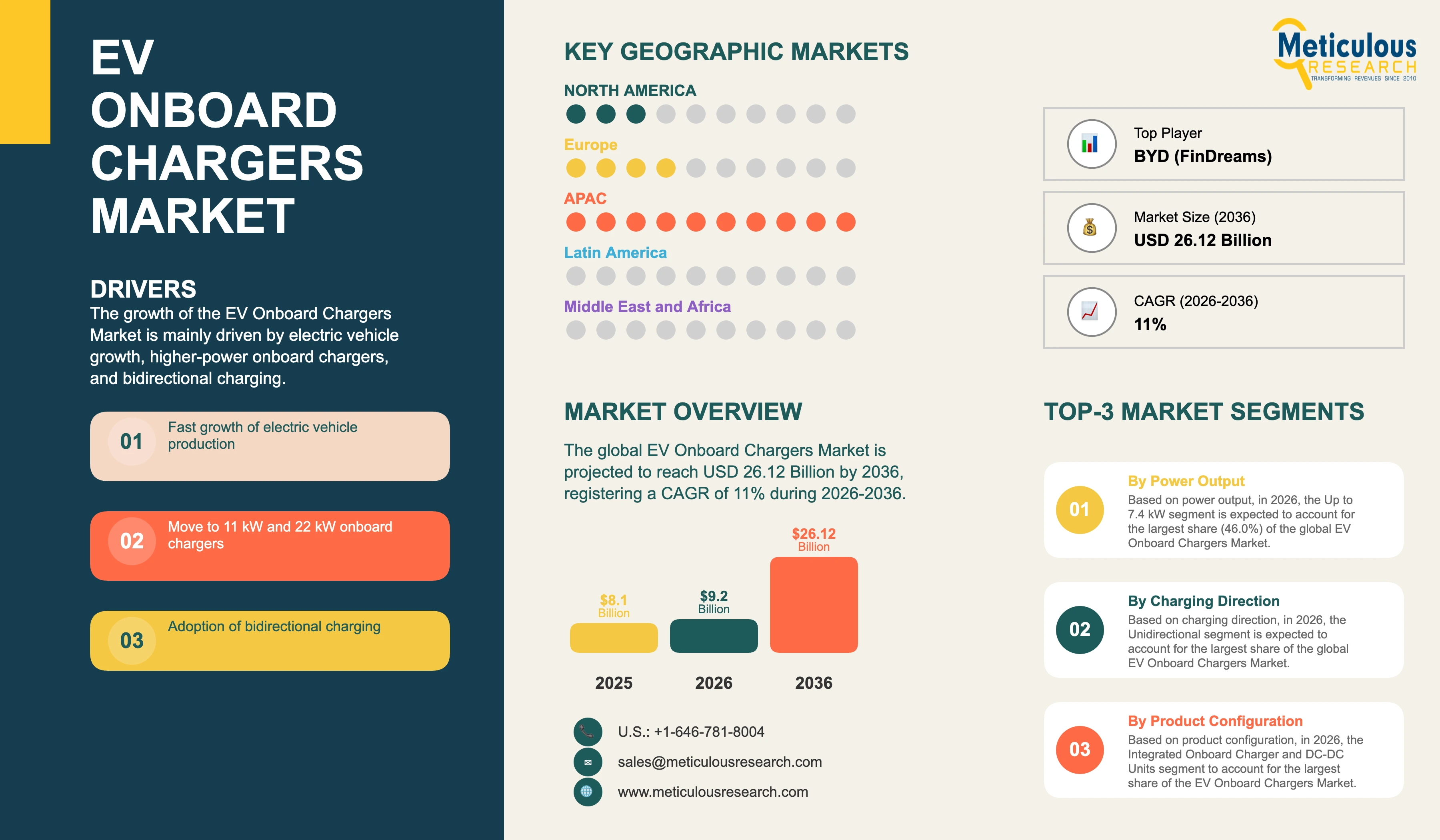
The global EV onboard chargers market was valued at USD 8.10 billion in 2025. This market is expected to reach USD 26.12 billion by 2036 from an estimated USD 9.20 billion in 2026, registering a CAGR of 11.0% during the forecast period (2026-2036).
- Published
- Nov 2026
- Pages
- 269
- Format
- PDF + Excel
- Report ID
- MRAUTO - 1042876
- Base year
- 2025
- 2025 · BASELINE
- $8.10B
- 2036
- $26.12B
- CAGR 2026–2036
- 11.0%
2025 baseline · 2026–2036 forecast at 11.0% CAGR · hover a bar for the value
Key highlights
Global electric car sales grew by 20% to more than 20 million units in 2025, accounting for one in four new cars sold, according to the IEA. Every battery electric and plug-in hybrid vehicle uses an onboard charger for AC charging, so electric vehicle growth directly drives onboard charger demand.
Visteon-Shinry Power Electronics, a joint venture of Visteon and Shinry Technologies, and Infineon announced at electronica 2026 in Munich that they are developing a single-stage onboard charger using Infineon's gallium nitride bidirectional switches. The charger supports 22 kW three-phase and 19.2 kW single-phase AC charging and full vehicle-to-everything bidirectional capability.
BorgWarner secured an agreement with a major North American vehicle maker to supply its bidirectional 800V onboard charger for premium battery electric vehicle platforms, with power from 19.2 kW single-phase to 22 kW three-phase, and production slated to start in January 2027, according to BorgWarner.
Acbel Polytech presented a 400V/800V 2-in-1 combo unit integrating an 11 kW onboard charger with vehicle-to-load functionality and a DC-DC converter at Power2Drive Europe 2026, reflecting the move to integrated onboard charger and DC-DC units.
Fraunhofer unveiled a gallium nitride-based onboard charger design in 2026, targeting smaller, lighter, and more efficient power electronics for 800V electric vehicles, showing the role of new semiconductor technologies in onboard charger development. Smaller onboard chargers are easier to integrate with other power electronics and save weight.
Leading suppliers include BYD (FinDreams), Shenzhen VMAX New Energy, Shinry Technologies, LG Magna e-Powertrain, BorgWarner, Valeo, Lear, Delta Electronics, Hyundai Mobis, Preh, and Kostal. Several vehicle makers, such as Tesla and BYD, design or produce onboard chargers in-house, which limits the market open to independent suppliers in some programs. Bidirectional onboard chargers are the fastest-growing charging direction and are expected to account for about half of the market by 2036, supported by vehicle-to-load, vehicle-to-home, and vehicle-to-grid services. Integrated onboard charger and DC-DC units are the largest and fastest-growing product configuration, led by Chinese vehicle makers.
By power output, up to 7.4 kW accounts for the largest share of 46.0% in 2026, while above 11 kW registers the highest CAGR.
By charging direction, unidirectional onboard chargers account for the larger share in 2026, while bidirectional onboard chargers register the higher CAGR.
By product configuration, integrated onboard charger and DC-DC units account for the larger share in 2026 and also register the higher CAGR.
By propulsion type, battery electric vehicles account for the larger share of 72.0% in 2026 and also register the higher CAGR.
By geography, Asia-Pacific accounts for the largest share of 58.0% in 2026, while Europe registers the highest CAGR of 13.2%.
Report summary
| Particulars | Details |
|---|---|
| Forecast Period | 2026-2036 |
| Base Year | 2025 |
| Estimated Year | 2026 |
| CAGR (Value) | 11.0% |
| Format | PDF, Excel & Cloud Portal · 269 pages |
| Market Size (Value) in 2025 | USD 8.10 billion |
| Market Size (Value) in 2026 | USD 9.20 billion |
| Market Size (Value) in 2036 | USD 26.12 billion |
| Largest Segment by Power Output (2026) | Up to 7.4 kW (46.0%) |
| Largest Segment by Propulsion Type (2026) | Battery Electric Vehicles (72.0%) |
| Largest Region (2026) | Asia-Pacific (58.0%) |
| Fastest-Growing Region | Europe (CAGR 13.2%) |
| Segments Covered | Power Output, Charging Direction, Product Configuration, Propulsion Type, Geography |
| Countries Covered | U.S., Canada, Germany, France, U.K., Norway, Netherlands, Sweden, Denmark, Belgium, Spain, Italy, Austria, Poland, Czech Republic, Hungary, Rest of Europe, China, South Korea, Japan, India, Thailand, Indonesia, Malaysia, Vietnam, Taiwan, Philippines, Australia, Rest of Asia-Pacific, Brazil, Mexico, Chile, Colombia, Rest of Latin America, Turkey, UAE, Saudi Arabia, Israel, Morocco, South Africa, Rest of Middle East & Africa |
| Key Companies | 11 companies and other companies |
Report overview
Segments covered: power output, charging direction, product configuration, propulsion type.
An onboard charger is the power electronics unit inside a plug-in vehicle that converts alternating current from the grid, home wall box, or public AC charger into direct current to charge the high-voltage battery. Onboard chargers range from single-phase units of 3.3 kW to 7.4 kW to three-phase units of 11 kW and 22 kW, and a growing number are bidirectional, allowing the vehicle to supply power to devices, homes, or the grid. They are supplied as standalone units or integrated with the DC-DC converter and power distribution unit.
The growth of this market is mainly driven by the fast growth of battery electric and plug-in hybrid vehicle production, the growing use of home and workplace AC charging, the move to higher-power 11 kW and 22 kW onboard chargers, especially in Europe, the adoption of bidirectional onboard chargers for vehicle-to-load, vehicle-to-home, and vehicle-to-grid uses, and the shift to 800V platforms, which require new onboard charger designs. In addition, new semiconductor technologies, such as silicon carbide and gallium nitride, are making onboard chargers smaller, lighter, and more efficient. However, strong price pressure, integration of onboard chargers into multi-in-one units, and the growth of DC fast charging are expected to restrain the growth of this market to some extent.
Most electric vehicle charging takes place at home, at work, or at public AC chargers, where the vehicle's onboard charger converts AC power from the grid into DC power for the battery. DC fast chargers bypass the onboard charger and supply DC power directly to the battery, but they are used mainly for long trips and by drivers without home charging. Because most charging uses AC power, every battery electric and plug-in hybrid vehicle needs an onboard charger, and its power rating determines how quickly the vehicle can charge from AC sources.
This report covers the global EV onboard chargers market, including onboard chargers of up to 7.4 kW, 7.5-11 kW, and above 11 kW, unidirectional and bidirectional onboard chargers, and standalone onboard chargers and integrated onboard charger and DC-DC units, for battery electric vehicles and plug-in hybrid and range-extended vehicles, including passenger cars and commercial vehicles. The market is valued at the selling price of onboard chargers supplied to vehicle makers, including the onboard charger portion of integrated units and units made in-house by vehicle makers valued at an estimated market price. The market is analyzed by power output, charging direction, product configuration, propulsion type, and geography. DC-DC converters and DC fast chargers are covered in separate reports.
Onboard charger power differs widely by region, mainly because of differences in home power supply. In China, North America, and other markets with single-phase home power, many vehicles use onboard chargers of 6.6 kW to 7.4 kW, although North American vehicles increasingly offer 11 kW to 19.2 kW single-phase units. In Europe, where three-phase power is common, 11 kW onboard chargers are standard on most new electric vehicles and 22 kW units are offered on some models. Plug-in hybrid vehicles, which have smaller batteries, usually use lower-power onboard chargers of 3.3 kW to 7.4 kW.
In most current designs, an onboard charger has two main power conversion stages. The first stage, the power factor correction stage, converts AC power to DC power and keeps the current drawn from the grid clean. The second stage, an isolated DC-DC converter, adjusts the voltage to match the battery and provides electrical isolation for safety. New designs are reducing the number of stages and parts. Visteon-Shinry Power Electronics and Infineon are developing a single-stage onboard charger using gallium nitride bidirectional switches, which removes the DC-link capacitors and reduces size and complexity.
Bidirectional onboard chargers are one of the most important trends in this market. They allow vehicles to supply power to external devices through vehicle-to-load, to power homes during outages through vehicle-to-home, and to supply power to the grid through vehicle-to-grid. Vehicle-to-load is already common on new Chinese and Korean electric vehicles, and vehicle makers in Europe and North America are launching vehicle-to-home and vehicle-to-grid services. Bidirectional onboard chargers are the fastest-growing charging direction in this market.
The market is served by Chinese onboard charger suppliers, such as Shenzhen VMAX New Energy and Shinry Technologies, vehicle makers' in-house units, such as BYD's FinDreams, and global suppliers, such as LG Magna e-Powertrain, BorgWarner, Valeo, Lear, Delta Electronics, Hyundai Mobis, Preh, and Kostal. Chinese suppliers have gained a large share of the market through low costs and close relationships with Chinese vehicle makers. Integration of the onboard charger with the DC-DC converter and power distribution unit into 2-in-1 or 3-in-1 units has become common, especially in China.
In 2026, onboard chargers of up to 7.4 kW account for the largest share of the market by power output, while onboard chargers above 11 kW are the fastest-growing power output. Unidirectional onboard chargers account for the largest share by charging direction, while bidirectional onboard chargers are the fastest-growing charging direction. Integrated onboard charger and DC-DC units account for the largest share by product configuration and are also the fastest-growing configuration. Battery electric vehicles account for the largest share by propulsion type and are also the fastest-growing propulsion type. Asia-Pacific accounts for the largest share of the market, while Europe is the fastest-growing region.
Market growth over the forecast period will depend on electric vehicle production, the mix of onboard charger power levels, the adoption of bidirectional charging, the move to 800V platforms, and price trends. Integration into multi-in-one units and strong price pressure will limit growth in market value compared with unit volumes. Overall, the growth of electric vehicles and the move to higher-power and bidirectional onboard chargers are expected to drive steady growth in market value through 2036.
Battery electric vehicles are expected to account for the largest share of 72.0% of the market in 2026 and are also projected to register the highest CAGR, driven by fast production growth and higher-power onboard chargers.
Asia-Pacific is expected to account for the largest share of 58.0% of the market in 2026, mainly due to China's large electric and plug-in hybrid vehicle production and strong local onboard charger suppliers.
Europe is projected to register the highest CAGR of 13.2% during the forecast period, driven by CO2 rules, standard 11 kW and growing 22 kW onboard chargers, and vehicle-to-grid services.
The report profiles 11 companies, including BYD (FinDreams), Shenzhen VMAX New Energy, Shinry Technologies, LG Magna e-Powertrain, BorgWarner, Valeo, Lear, Delta Electronics, Hyundai Mobis, Preh, and Kostal.
A bidirectional onboard charger can both charge the vehicle battery from AC power and send power from the battery back out, allowing vehicle-to-load, vehicle-to-home, and vehicle-to-grid uses.
Most charging takes place at home, at work, or at public AC chargers, which supply AC power that must be converted by the onboard charger, while DC fast chargers are used mainly for long trips.
In 2026, the integrated onboard charger and DC-DC units segment is expected to account for the larger share of the EV onboard chargers market, and it is also projected to register the higher CAGR during the forecast period.
Report infographic
Market dynamics
17 factors across 5 forcesFast growth of electric vehicle production
Every battery electric and plug-in hybrid vehicle needs an onboard charger, so demand is closely linked to plug-in vehicle production. Global electric car sales grew by 20% to more than 20 million units in 2025, according to the IEA, led by China, with growing volumes in Europe, North America, and emerging markets. Plug-in hybrid and range-extended vehicles, which have grown quickly in China, also use onboard chargers, although usually at lower power levels.
Electric vehicle production is expected to keep growing over the forecast period, supported by falling battery costs, wider model choice, better charging networks, and government policies, such as CO2 rules in Europe and support schemes in China and India. Battery electric vehicles, which use higher-power and more valuable onboard chargers than plug-in hybrids, are expected to grow faster, which supports growth in onboard charger value.
Growth of home and workplace AC charging
Most electric vehicle owners charge at home or at work using AC wall boxes, which rely on the vehicle's onboard charger. Home charging is the cheapest and most convenient way to charge, and the number of home and workplace chargers is growing quickly in China, Europe, and North America. Public AC chargers are also widely installed in cities, especially in Europe, where many drivers do not have home parking.
Because AC charging remains the main way to charge for most drivers, vehicle makers continue to fit onboard chargers to all plug-in vehicles and are increasing their power to reduce charging times. Growth in AC charging infrastructure supports steady demand for onboard chargers and encourages the adoption of higher-power units that make better use of available home and public AC power.
Move to higher-power 11 kW and 22 kW onboard chargers
Vehicle makers are increasing onboard charger power to reduce AC charging times, especially for electric vehicles with larger batteries. In Europe, 11 kW three-phase onboard chargers are now standard on most new electric vehicles, and 22 kW units are offered on a growing number of models. In North America, vehicle makers are offering 11 kW to 19.2 kW single-phase onboard chargers on larger vehicles, such as electric pickup trucks and SUVs, to make better use of high-power home chargers.
Higher-power onboard chargers are more valuable than lower-power units, which increases market value. BorgWarner's bidirectional 800V onboard charger, which offers 19.2 kW single-phase and 22 kW three-phase operation, shows the move to higher power, according to BorgWarner. Onboard chargers above 11 kW are the fastest-growing power output in this market, supported by premium vehicles, commercial vehicles, and the needs of fleet operators.
Adoption of bidirectional charging
Bidirectional onboard chargers allow electric vehicles to supply power through vehicle-to-load, vehicle-to-home, and vehicle-to-grid. Vehicle-to-load, which allows drivers to power tools, appliances, and camping equipment, is already offered on many new electric vehicles, especially in China and Korea. Vehicle-to-home and vehicle-to-grid allow vehicles to supply power to homes during outages or to help balance the grid, which can earn money for vehicle owners and support the use of renewable energy.
At the same time, vehicle makers, utilities, and energy companies are launching vehicle-to-grid services in Europe, North America, and Japan, and charging standards, such as ISO 15118-20, are being updated to support bidirectional charging. Bidirectional onboard chargers are more complex and valuable than unidirectional units. The Visteon-Shinry Power Electronics and Infineon onboard charger and the BorgWarner 800V onboard charger both offer bidirectional capability. Bidirectional onboard chargers are the fastest-growing charging direction in this market.
Shift to 800V platforms and new semiconductor technologies
The move to 800V vehicle platforms requires onboard chargers that can charge 800V batteries efficiently from standard AC power, which requires new circuit designs and higher-voltage semiconductors. Many new onboard chargers use silicon carbide devices, which offer lower losses at high voltage, and gallium nitride devices are emerging for compact, high-frequency designs. Fraunhofer unveiled a gallium nitride-based onboard charger design in 2026 for 800V vehicles, and Visteon-Shinry Power Electronics and Infineon are developing a single-stage onboard charger using gallium nitride bidirectional switches. These technologies make onboard chargers smaller, lighter, and more efficient, which helps vehicle makers reduce charging losses and integrate onboard chargers into compact multi-in-one units. 800V onboard chargers are more valuable than 400V units, and the spread of 800V platforms from premium vehicles to mid-priced models, especially in China, Korea, and Europe, supports growth in market value over the forecast period.
Table of contents
12 chapters · 176 sections · 269 pages · click to expandSegmental analysis
| Segment | Largest share (2026) | Fastest growth (2026–2036) |
|---|---|---|
| By Power Output | Up to 7.4 kW | Above 11 kW |
| By Charging Direction | Unidirectional onboard chargers | Bidirectional onboard chargers |
| By Product Configuration | Integrated onboard charger and DC-DC units | Integrated onboard charger and DC-DC units |
| By Propulsion Type | Battery electric vehicles | Battery electric vehicles |
By Power Output
- EV Onboard Chargers Market Analysis by Power Output
- The up to 7.4 kW segment is expected to account for the largest share of 46.0% of the global EV onboard chargers market.
- The large share of this segment is mainly due to the use of 6.6 kW to 7.4 kW onboard chargers in most electric vehicles in China, which is the largest electric vehicle market, the use of lower-power onboard chargers in plug-in hybrid and range-extended vehicles, which have smaller batteries, the lower cost of these units, which suits lower-priced electric vehicles, and the large share of single-phase home power in Asia and other regions.
- BYD (FinDreams), Shenzhen VMAX New Energy, and Shinry Technologies are among the leading suppliers of these onboard chargers.
- However, the above 11 kW segment is projected to register the highest CAGR during the forecast period.
- The rapid growth of this segment is driven by the adoption of 22 kW three-phase onboard chargers on more models in Europe, the use of 11 kW to 19.2 kW single-phase onboard chargers on electric pickup trucks and SUVs in North America, the growth of electric vans, buses, and trucks that need high-power onboard chargers, and the launch of bidirectional high-power units, such as BorgWarner's 19.2 kW and 22 kW 800V onboard charger and the 22 kW single-stage onboard charger being developed by Visteon-Shinry Power Electronics and Infineon.
- Onboard chargers of up to 7.4 kW are expected to account for the largest share of 46.0% of the market in 2026, while onboard chargers above 11 kW are projected to register the highest CAGR, driven by 22 kW units in Europe and high-power units in North America.
By Charging Direction
- EV Onboard Chargers Market Analysis by Charging Direction
- The unidirectional onboard chargers segment is expected to account for the largest share of the global EV onboard chargers market.
- The large share of this segment is mainly due to the use of unidirectional onboard chargers in most electric and plug-in hybrid vehicles produced today, their lower cost and simpler design, the limited availability of vehicle-to-home and vehicle-to-grid services in most markets, and the use of separate inverters for vehicle-to-load on some vehicles.
- Many lower-priced electric vehicles continue to use unidirectional onboard chargers to reduce cost.
- However, the bidirectional onboard chargers segment is projected to register the highest CAGR during the forecast period.
- The rapid growth of this segment is driven by the spread of vehicle-to-load features on new electric vehicles, the launch of vehicle-to-home and vehicle-to-grid services by vehicle makers and utilities in Europe, North America, and Japan, the adoption of charging standards that support bidirectional charging, such as ISO 15118-20, and new bidirectional onboard charger designs from suppliers, such as BorgWarner and Visteon-Shinry Power Electronics.
- Bidirectional units are expected to account for about half of the market by 2036.
- The unidirectional onboard chargers segment is expected to account for the larger share of the EV onboard chargers market, while the bidirectional onboard chargers segment is projected to register the higher CAGR during the forecast period.
By Product Configuration
- EV Onboard Chargers Market Analysis by Product Configuration
- The integrated onboard charger and DC-DC units segment is expected to account for the largest share of the global EV onboard chargers market.
- The large share of this segment is mainly due to the wide use of 2-in-1 and 3-in-1 units that combine the onboard charger, DC-DC converter, and power distribution unit in Chinese electric vehicles, which account for most global production, the lower cost, size, and weight of integrated units, shared cooling and housings, and the strong position of Chinese suppliers in integrated units.
- Shenzhen VMAX New Energy, Shinry Technologies, and BYD (FinDreams) are among the leading suppliers of integrated units.
- The integrated onboard charger and DC-DC units segment is also projected to register the highest CAGR during the forecast period.
- The rapid growth of this segment is driven by vehicle makers' efforts to reduce cost and size, the adoption of integrated units by vehicle makers in Europe, North America, and Korea, the move to power domain units and multi-in-one e-axles, and new integrated products from global suppliers, such as Acbel Polytech's 400V/800V 2-in-1 combo unit with an 11 kW onboard charger and DC-DC converter.
By Propulsion Type
- EV Onboard Chargers Market Analysis by Propulsion Type
- The battery electric vehicles segment is expected to account for the largest share of 72.0% of the global EV onboard chargers market.
- The large share of this segment is mainly due to the large and fast-growing production of battery electric vehicles, the use of higher-power and more valuable onboard chargers in battery electric vehicles, which have larger batteries than plug-in hybrids, the adoption of 11 kW and 22 kW onboard chargers in Europe, and the faster adoption of bidirectional and 800V onboard chargers in battery electric vehicles.
- The battery electric vehicles segment is also projected to register the highest CAGR during the forecast period.
- The rapid growth of this segment is driven by the fast growth of battery electric vehicle production, with global electric car sales exceeding 20 million units in 2025 according to the IEA, the move to higher-power and bidirectional onboard chargers, the spread of 800V platforms, and the electrification of vans, buses, and trucks.
- Plug-in hybrid and range-extended vehicles are also growing in China and Europe, but they use lower-power onboard chargers.
Geographic analysis
Asia-Pacific
Largest shareIn 2026, Asia-Pacific is expected to account for the largest share of 58.0% of the global EV onboard chargers market. The large share of this region is mainly due to China's position as the largest electric vehicle producer in the world, the large production of plug-in hybrid and range-extended vehicles in China, the wide adoption of integrated onboard charger and DC-DC units and vehicle-to-load features by Chinese vehicle makers, and the presence of leading onboard charger producers, such as BYD (FinDreams), Shenzhen VMAX New Energy, Shinry Technologies, LG Magna e-Powertrain, and Hyundai Mobis. South Korea and Japan are also important markets, supported by electric vehicle production by Hyundai, Kia, and Japanese vehicle makers, and Japan has long experience with vehicle-to-home systems. India and Southeast Asia are growing quickly as electric vehicle production expands.
Europe
Fastest growthHowever, Europe is projected to register the highest CAGR of 13.2% during the forecast period. The rapid growth of this region is mainly driven by strict CO2 emission rules for new cars and vans, which require vehicle makers to sell more electric vehicles, the use of 11 kW three-phase onboard chargers as standard and the growing adoption of 22 kW units, the high share of drivers who rely on public AC charging in cities, the launch of vehicle-to-home and vehicle-to-grid services, and the fast growth of electric vans. These factors increase onboard charger value per vehicle in Europe compared with other regions. Chinese vehicle makers building plants in Europe, such as in Hungary and Spain, also add local demand. Germany is the largest market in Europe, supported by large electric vehicle production and sales, followed by France, the U.K., Norway, the Netherlands, and Sweden, which have high electric vehicle adoption rates and dense AC charging networks, and Central and Eastern European countries, such as Hungary, Poland, and the Czech Republic, which are important locations for electric vehicle and power electronics production. European suppliers, such as Valeo, Preh, and Kostal, and global suppliers with European operations, such as BorgWarner, Lear, and Delta Electronics, serve the region, while Chinese suppliers are expanding their presence. Vehicle-to-grid pilots in the Netherlands, the U.K., Germany, and France are supporting bidirectional onboard charger adoption, and several European vehicle makers have launched vehicle-to-home products with energy partners.
North America
North America accounts for a significant share of the market, supported by electric vehicle production by Tesla, General Motors, Ford, Hyundai, and other vehicle makers, the use of high-power single-phase onboard chargers in electric pickup trucks and SUVs, and growing interest in vehicle-to-home backup power. BorgWarner will supply its bidirectional 800V onboard charger to a major North American vehicle maker from January 2027, according to BorgWarner. However, the end of federal electric vehicle purchase incentives in the U.S. in 2025 has slowed growth.
Latin America
Latin America and the Middle East & Africa account for small shares, with growth supported by electric vehicle adoption in Brazil, Mexico, Chile, Turkey, and the Gulf countries.
Competitive landscape
The global EV onboard chargers market includes Chinese onboard charger suppliers, vehicle makers' in-house operations, and global automotive power electronics suppliers. Chinese suppliers hold a large share of the market through low costs and close relationships with Chinese vehicle makers, while global suppliers serve vehicle makers in Europe, North America, Korea, and Japan. Competition is strong, and prices have fallen quickly, especially in China, where many smaller suppliers also compete for business from new vehicle makers.
BYD, through FinDreams, is one of the largest producers of onboard chargers, supplying its own large electric vehicle production. Shenzhen VMAX New Energy and Shinry Technologies are leading independent suppliers in China, with Shinry also active globally through Visteon-Shinry Power Electronics. LG Magna e-Powertrain, BorgWarner, Valeo, Lear, Delta Electronics, Hyundai Mobis, Preh, and Kostal are major global suppliers. Tesla designs its own onboard chargers and other power electronics, and several Chinese vehicle makers have also built in-house capabilities.
Companies in this market compete on cost, efficiency, power density, size and weight, reliability, bidirectional capability, grid compliance, and the ability to offer integrated onboard charger and DC-DC units. Key strategies include developing bidirectional, 800V, and higher-power onboard chargers, adopting gallium nitride and silicon carbide technologies, developing integrated power domain units, building local production in China, Europe, and North America, and forming partnerships with semiconductor makers.
Recent competitive activity has focused on new technologies and higher-power bidirectional products. Visteon-Shinry Power Electronics and Infineon announced the development of a single-stage 22 kW gallium nitride onboard charger at electronica 2026, BorgWarner secured an agreement to supply its bidirectional 800V onboard charger to a major North American vehicle maker, and Acbel Polytech presented an integrated 11 kW onboard charger and DC-DC converter unit at Power2Drive Europe 2026.
We expect competition to increase over the forecast period as Chinese suppliers expand abroad, as prices continue to fall, and as integration changes how onboard chargers are bought. Suppliers with low costs, strong bidirectional and 800V capabilities, new semiconductor technologies, and integrated product offerings are expected to strengthen their positions, while consolidation among smaller suppliers is likely, especially among European and North American suppliers that lack scale.
Some of the key players operating in the EV onboard chargers market are BYD Company Limited (FinDreams), Shenzhen VMAX New Energy Co., Ltd., Shinry Technologies Co., Ltd., LG Magna e-Powertrain Co., Ltd., BorgWarner Inc., Valeo SE, Lear Corporation, Delta Electronics, Inc., Hyundai Mobis Co., Ltd., Preh GmbH, and Kostal Group, among others.
- —
Visteon-Shinry Power Electronics and Infineon announced a single-stage 22 kW gallium nitride onboard charger at electronica 2026, and BorgWarner agreed to supply its bidirectional 800V onboard charger to a major North American vehicle maker from January 2027.
- BorgWarner
- Valeo
- Lear
- Delta Electronics
- Hyundai Mobis
- Preh
- Kostal
Expert perspectives
EV onboard chargers are a core part of every plug-in vehicle, and the market is growing with electric vehicle production while moving to higher-power, bidirectional, and integrated designs. Although price pressure is strong, rising onboard charger value per vehicle in Europe and North America and the spread of bidirectional charging support steady growth in market value.
Over the forecast period, the market is expected to grow at a CAGR of 11.0%, from USD 9.20 billion in 2026 to USD 26.12 billion in 2036. Growth will be driven by the fast growth of electric vehicle production, the growth of home and workplace AC charging, the move to higher-power onboard chargers, the adoption of bidirectional charging, and the shift to 800V platforms and new semiconductor technologies.
Among the market segments, onboard chargers of up to 7.4 kW are the largest power output, while units above 11 kW grow fastest. Unidirectional onboard chargers are the largest charging direction, while bidirectional units grow fastest. Integrated onboard charger and DC-DC units are both the largest and the fastest-growing product configuration. Battery electric vehicles are both the largest and the fastest-growing propulsion type. Asia-Pacific is the largest region, while Europe grows fastest, at a CAGR of 13.2%.
In our view, bidirectional charging will be by far the most important change in this market over the next decade. As vehicle-to-home and vehicle-to-grid services grow, vehicle makers will need bidirectional onboard chargers with proven grid compliance and software, which increases onboard charger value. Suppliers that combine strong hardware with grid communication software and partnerships with energy companies will gain the most. We expect vehicle-to-home to grow first, as it offers clear value to customers in the form of backup power and lower energy bills.
We also see integration and new semiconductor technologies as key competitive factors for all suppliers. Integrated onboard charger and DC-DC units are already standard in China and are spreading to other regions, while gallium nitride and silicon carbide devices are making onboard chargers smaller and cheaper. Suppliers that adopt these technologies early, control costs, and offer integrated power domain units will be best placed to compete with low-cost Chinese suppliers.
Overall, we believe that the EV onboard chargers market will grow steadily over the forecast period, with high-power onboard chargers, bidirectional units, integrated units, battery electric vehicles, and Europe providing the fastest growth. Companies with low costs, bidirectional and 800V capabilities, new semiconductor technologies, and integrated product offerings will be best positioned to capture this growth, while price pressure and the growth of DC fast charging remain the main risks.
Customer perspectives
Customers in the EV onboard chargers market are mainly vehicle makers of electric passenger cars and commercial vehicles, along with e-axle and power electronics suppliers that integrate onboard chargers into larger units. They focus on cost, efficiency, power density, size and weight, reliability, compatibility with charging stations in different countries, and bidirectional capability. Vehicle makers increasingly ask for integrated onboard charger and DC-DC units, 800V-ready designs, and bidirectional units that support vehicle-to-load, vehicle-to-home, and vehicle-to-grid. They also value suppliers that can support grid certification, software updates, and production in several regions. Commercial vehicle makers focus on high power and durability for depot charging. Fleet operators also want chargers that support depot energy management. Many also look for proven quality and fast engineering support.
“11 kW is now the minimum our customers accept, and our new models offer 22 kW. Bidirectional charging is part of our next platform for vehicle-to-grid services.”
“We buy the charger, DC-DC converter, and power distribution unit as one unit. Cost per vehicle is what matters most, and integration keeps cutting it.”
“Our customers want to back up their homes during power cuts. A bidirectional onboard charger lets the truck power the house.”
Frequently asked questions
The global EV onboard chargers market was valued at USD 8.10 billion in 2025, up from USD 7.00 billion in 2024, and is estimated at USD 9.20 billion in 2026. The market includes standalone and integrated onboard chargers for battery electric and plug-in hybrid vehicles.
The global EV onboard chargers market is expected to reach USD 26.12 billion by 2036, driven by electric vehicle growth, higher-power and bidirectional onboard chargers, and the shift to 800V platforms.
The market is expected to register a CAGR of 11.0% from 2026 to 2036, with the fastest growth in onboard chargers above 11 kW, bidirectional units, integrated units, battery electric vehicles, and Europe.
Market growth is mainly driven by the fast growth of electric vehicle production, the growth of home and workplace AC charging, the move to higher-power onboard chargers, the adoption of bidirectional charging, and the shift to 800V platforms and new semiconductor technologies.
Strong price pressure and Chinese competition and the growth of DC fast charging and in-house production restrain growth, while grid compliance, standards, and interoperability and thermal management and power density are key challenges.
Key growth opportunities include bidirectional onboard chargers for vehicle-to-grid and vehicle-to-home, gallium nitride and silicon carbide onboard chargers, integrated onboard charger and DC-DC units, and onboard chargers for electric commercial vehicles.
Onboard chargers of up to 7.4 kW are expected to account for the largest share of 46.0% of the market in 2026, while onboard chargers above 11 kW are projected to register the highest CAGR, driven by 22 kW units in Europe and high-power units in North America.
In 2026, the unidirectional onboard chargers segment is expected to account for the larger share of the EV onboard chargers market, while the bidirectional onboard chargers segment is projected to register the higher CAGR during the forecast period.
In 2026, the integrated onboard charger and DC-DC units segment is expected to account for the larger share of the EV onboard chargers market, and it is also projected to register the higher CAGR during the forecast period.
Battery electric vehicles are expected to account for the largest share of 72.0% of the market in 2026 and are also projected to register the highest CAGR, driven by fast production growth and higher-power onboard chargers.
Asia-Pacific is expected to account for the largest share of 58.0% of the market in 2026, mainly due to China's large electric and plug-in hybrid vehicle production and strong local onboard charger suppliers.
Europe is projected to register the highest CAGR of 13.2% during the forecast period, driven by CO2 rules, standard 11 kW and growing 22 kW onboard chargers, and vehicle-to-grid services.
The report profiles 11 companies, including BYD (FinDreams), Shenzhen VMAX New Energy, Shinry Technologies, LG Magna e-Powertrain, BorgWarner, Valeo, Lear, Delta Electronics, Hyundai Mobis, Preh, and Kostal.
Visteon-Shinry Power Electronics and Infineon announced a single-stage 22 kW gallium nitride onboard charger at electronica 2026, and BorgWarner agreed to supply its bidirectional 800V onboard charger to a major North American vehicle maker from January 2027.
A bidirectional onboard charger can both charge the vehicle battery from AC power and send power from the battery back out, allowing vehicle-to-load, vehicle-to-home, and vehicle-to-grid uses.
Most charging takes place at home, at work, or at public AC chargers, which supply AC power that must be converted by the onboard charger, while DC fast chargers are used mainly for long trips.
Cite this report
Meticulous Research. (2026). EV Onboard Chargers Market - Global Opportunity Analysis and Industry Forecast (2026-2036) (Report No. MRAUTO - 1042876). Meticulous Market Research Pvt. Ltd. https://www.meticulousresearch.com/product/ev-onboard-chargers-market-7559