EV Battery Thermal Runaway Protection Market (2026-2036)
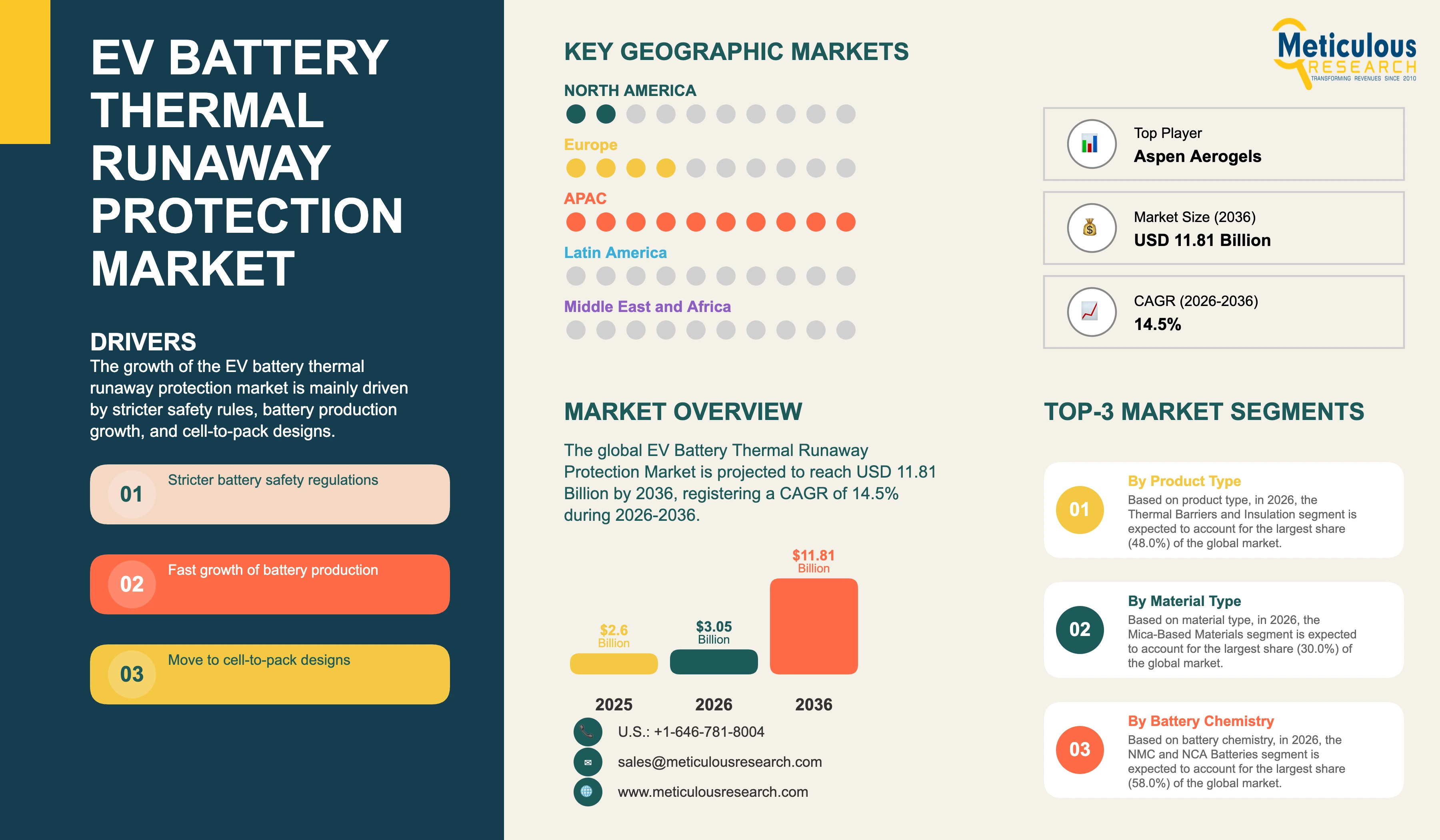
The global EV battery thermal runaway protection market was valued at USD 2.60 billion in 2025. This market is expected to reach USD 11.81 billion by 2036 from an estimated USD 3.05 billion in 2026, registering a CAGR of 14.5% during the forecast period (2026-2036).
- Published
- Nov 2026
- Pages
- 260
- Format
- PDF + Excel
- Report ID
- MRAUTO - 1042878
- Base year
- 2025
- 2025 · BASELINE
- $2.60B
- 2036
- $11.81B
- CAGR 2026–2036
- 14.5%
2025 baseline · 2026–2036 forecast at 14.5% CAGR · hover a bar for the value
Key highlights
China's updated battery safety standard GB 38031-2025 took effect for new vehicle type approvals on July 1, 2026, with existing approved vehicles generally following from July 1, 2027. The standard requires battery packs to show no fire or explosion for at least two hours after thermal runaway is triggered in a cell, replacing the earlier rule that only required a five-minute warning before fire or explosion.
The updated standard also adds a bottom impact test and a safety test after 300 fast-charging cycles, followed by an external short-circuit test that must show no fire or explosion, according to China's State Council. These requirements apply to the world's largest electric vehicle market and are pushing vehicle makers and battery makers to add more protection inside battery packs.
EV battery deployment reached 1.2 TWh in 2025, an increase of almost 30% compared with 2024, according to the IEA, with China accounting for about 60% of the global total and the European Union for almost 15%. Every kilowatt-hour of battery capacity requires thermal runaway protection materials and components.
Aspen Aerogels, a leading supplier of aerogel thermal barriers, reported thermal barrier revenue of USD 168.9 million in 2025, down sharply from 2024 because of lower electric vehicle production at General Motors, according to Aspen Aerogels. The company secured its seventh European vehicle maker design win, with Volvo Cars, and expects its European business to grow from 2027.
Electric trucks accounted for about 8% of global EV battery deployment in 2025, up from less than 5% in 2024, according to the IEA. Commercial vehicles use very large battery packs with many cells, which require large amounts of thermal runaway protection.
Leading suppliers include Aspen Aerogels, Alkegen, Saint-Gobain, 3M, Morgan Advanced Materials, Rogers Corporation, Von Roll, Henkel, H.B. Fuller, Wacker Chemie, W. L. Gore & Associates, Sensata Technologies, and Donaldson. Aerogel-based materials are the fastest-growing material type, as thin, light barriers help pack designers meet safety rules without losing space for cells.
By product type, thermal barriers and insulation accounts for the largest share of 48.0% in 2026, while early detection sensors register the highest CAGR.
By material type, mica-based materials account for the largest share in 2026, while aerogel-based materials register the highest CAGR.
By battery chemistry, NMC and NCA batteries account for the largest share in 2026, while LFP batteries register the highest CAGR.
By vehicle type, passenger cars account for the larger share of 86.0% in 2026, while commercial vehicles register the higher CAGR.
By geography, Asia-Pacific accounts for the largest share of 62.0% in 2026, while Asia-Pacific registers the highest CAGR of 15.2%.
Report summary
| Particulars | Details |
|---|---|
| Base Year | 2025 |
| Estimated Year | 2026 |
| Forecast Period | 2026-2036 |
| Market Size in 2025 | USD 2.60 billion |
| Market Size in 2026 | USD 3.05 billion |
| Market Size by 2036 | USD 11.81 billion |
| CAGR (2026-2036) | 14.5% |
| Format | PDF, Excel & Cloud Portal · 260 pages |
| Largest Segment by Product Type (2026) | Thermal Barriers and Insulation (48.0%) |
| Largest Segment by Vehicle Type (2026) | Passenger Cars (86.0%) |
| Largest Region (2026) | Asia-Pacific (62.0%) |
| Fastest-Growing Region | Asia-Pacific (CAGR 15.2%) |
| Companies Profiled | 13 companies and other companies |
| Segments Covered | Product Type, Material Type, Battery Chemistry, Vehicle Type, Geography |
| Countries Covered | U.S., Canada, Germany, Hungary, Poland, France, Sweden, U.K., Spain, Italy, Czech Republic, Norway, Netherlands, Belgium, Rest of Europe, China, South Korea, Japan, India, Thailand, Indonesia, Malaysia, Vietnam, Taiwan, Australia, Rest of Asia-Pacific, Brazil, Mexico, Chile, Colombia, Rest of Latin America, Turkey, Morocco, UAE, Saudi Arabia, Israel, South Africa, Rest of Middle East & Africa |
Report overview
Segments covered: product type, material type, battery chemistry, vehicle type.
EV battery thermal runaway protection covers the materials and components used inside electric vehicle battery packs to stop a failing cell from spreading heat and fire to neighboring cells, to protect the vehicle cabin, and to warn of a developing failure. They include thermal barriers and insulation placed between cells and under pack lids, fire-resistant encapsulants and coatings, venting and gas management components that release hot gases safely, and early detection sensors that detect gas, pressure, or temperature changes at the first sign of a cell failure.
The growth of this market is mainly driven by stricter battery safety rules, especially China's GB 38031-2025 standard, which requires battery packs to show no fire or explosion after thermal runaway, the fast growth of electric vehicle production and battery deployment, the move to larger and more energy-dense battery packs and cell-to-pack designs, which place cells closer together, the faster charging of new electric vehicles, which increases thermal stress, and growing attention from vehicle makers, insurers, and the public to battery fire risks. In addition, the electrification of buses and trucks, which use very large battery packs, is creating new demand. However, cost pressure on battery packs, slower electric vehicle growth in some markets, and safer cell chemistries that need less protection are expected to restrain the growth of this market to some extent.
Thermal runaway happens when a lithium-ion cell overheats because of an internal short circuit, damage, overcharging, or a manufacturing defect, and the heat starts chemical reactions that release more heat and flammable gases. In a battery pack with hundreds or thousands of cells packed closely together, the heat from one failing cell can trigger the cells next to it, leading to a chain reaction, known as thermal propagation, that can end in a fire. Electric vehicle battery fires are rare, but they are hard to put out and receive wide public attention, so preventing them is a top priority for vehicle makers.
This report covers the global EV battery thermal runaway protection market, including thermal barriers and insulation, fire-resistant encapsulants and coatings, venting and gas management components, early detection sensors, and other products, made of mica, aerogel, ceramic and glass fiber, and polymer foam and composite materials, for battery packs using NMC and NCA, LFP, and other chemistries, in passenger cars and commercial vehicles. The market is valued at the selling price of these materials and components supplied to battery makers, battery pack makers, and vehicle makers. The market is analyzed by product type, material type, battery chemistry, vehicle type, and geography. Battery cooling systems, battery management systems, and the cells themselves are not included.
Battery makers and vehicle makers use several layers of protection to stop thermal propagation. Thermal barriers, such as aerogel pads, mica sheets, and ceramic papers, are placed between cells or groups of cells to slow the flow of heat. Mica sheets and fire-resistant coatings protect the pack lid and the vehicle floor from hot gases and flames. Encapsulants and fire-resistant foams fill the space between cells to absorb heat and hold cells in place. Venting components, such as burst valves and degassing units, release hot gases from the pack in a controlled way, and sensors detect gas, pressure, or temperature changes at the first sign of a failure so that the vehicle can warn occupants.
Regulation is the strongest driver of this market, and China has set the highest bar. China's GB 38031-2025 standard, which took effect for new vehicle type approvals on July 1, 2026, requires battery packs to show no fire or explosion for at least two hours after thermal runaway is triggered in a cell, a much stricter requirement than the earlier five-minute warning rule. Other regions are also tightening rules through the UN Global Technical Regulation on electric vehicle safety and national standards, and insurers and fleet operators are asking for proof of battery safety.
Battery designs are also changing in ways that increase the need for protection. Cell-to-pack designs remove modules and place cells closer together, which removes some of the natural barriers that modules provided. Higher-energy cells, such as high-nickel NMC cells, release more energy during thermal runaway, and faster charging increases thermal stress. At the same time, LFP cells, which are less likely to go into thermal runaway and release less heat, are taking a larger share of the market, which changes the type and amount of protection needed.
The market is served by specialist material suppliers, such as Aspen Aerogels, Alkegen, Morgan Advanced Materials, Von Roll, and Rogers Corporation, large material and chemical companies, such as Saint-Gobain, 3M, Henkel, H.B. Fuller, and Wacker Chemie, and component suppliers, such as W. L. Gore & Associates and Donaldson for venting and Sensata Technologies for sensors. Many Chinese suppliers also produce mica, aerogel, and fire-resistant materials for Chinese battery makers at low cost. Battery makers and vehicle makers usually test and qualify protection materials together with suppliers for each new battery design.
In 2026, thermal barriers and insulation account for the largest share of the market by product type, while early detection sensors are the fastest-growing product type. Mica-based materials account for the largest share by material type, while aerogel-based materials are the fastest-growing material type. Batteries using NMC and NCA chemistries account for the largest share by battery chemistry, while LFP batteries are the fastest-growing chemistry. Passenger cars account for the largest share by vehicle type, while commercial vehicles are the fastest-growing vehicle type. Asia-Pacific accounts for the largest share of the market and is also the fastest-growing region.
Market growth over the forecast period will depend on the pace of electric vehicle and battery production growth, the adoption of stricter battery safety rules outside China, the mix of battery chemistries and pack designs, and price trends for protection materials. Cost pressure and safer cell designs will limit growth in protection value per kilowatt-hour, while rising battery volumes and stricter rules support strong growth in total market value. Overall, the market is expected to grow faster than battery production in the near term as vehicle makers comply with the new Chinese standard.
Passenger cars are expected to account for the largest share of 86.0% of the market in 2026, while commercial vehicles are projected to register the highest CAGR, driven by electric buses and trucks with very large battery packs.
Asia-Pacific is expected to account for the largest share of 62.0% of the market in 2026, mainly due to China's large electric vehicle and battery production and the implementation of the GB 38031-2025 standard.
Asia-Pacific is also projected to register the highest CAGR of 15.2% during the forecast period, driven by compliance with China's new standard, continued battery production growth, and electric vehicle growth in India and Southeast Asia.
The report profiles 13 companies, including Aspen Aerogels, Alkegen, Saint-Gobain, 3M, Morgan Advanced Materials, Rogers Corporation, Von Roll, Henkel, H.B. Fuller, Wacker Chemie, W. L. Gore & Associates, Sensata Technologies, and Donaldson.
The standard requires electric vehicle battery packs to show no fire or explosion for at least two hours after thermal runaway is triggered in a cell, and it adds a bottom impact test and a safety test after 300 fast-charging cycles.
This report covers only materials and components used to stop thermal runaway and propagation in EV battery packs. Broader aerogel and thermal interface material markets, which serve many other industries, are covered in separate reports.
Report infographic
Market dynamics
17 factors across 5 forcesStricter battery safety regulations
Battery safety rules are becoming much stricter, led by China's GB 38031-2025 standard, which took effect for new vehicle type approvals on July 1, 2026. The standard requires battery packs to show no fire or explosion for at least two hours after thermal runaway is triggered in a cell, and it adds a bottom impact test and a safety test after 300 fast-charging cycles. The earlier standard only required a five-minute warning before fire or explosion. Existing approved vehicles generally follow from July 1, 2027.
Meeting the no-fire, no-explosion requirement requires vehicle makers and battery makers to add more and better thermal barriers, fire-resistant materials, venting systems, and detection sensors to their battery packs. Because China is the largest electric vehicle market and Chinese battery makers supply vehicle makers around the world, the standard is raising protection levels globally. Regulators in other regions are also reviewing battery safety rules through the UN Global Technical Regulation on electric vehicle safety.
Fast growth of electric vehicle and battery production
Thermal runaway protection materials and components are needed in every electric vehicle battery pack, so demand is closely linked to battery production. EV battery deployment reached 1.2 TWh in 2025, an increase of almost 30% compared with 2024, according to the IEA. Global electric car sales topped 20 million units in 2025, and the IEA expects sales of about 23 million units in 2026, close to 30% of all cars sold worldwide.
Battery production is expected to keep growing over the forecast period, supported by falling battery costs, wider model choice, and government policies, as well as the electrification of buses and trucks, which use very large battery packs. Plug-in hybrid vehicles also need protection, as their battery packs are often placed in tight spaces close to the cabin. This growth provides a large and expanding base of demand for protection products.
Move to cell-to-pack designs and higher-energy cells
Battery makers and vehicle makers are moving to cell-to-pack and cell-to-body designs that remove modules and place cells closer together to increase energy density and reduce cost. Without modules, there are fewer natural barriers to stop heat from spreading between cells, so pack designers must add thermal barriers between cells and fire-resistant materials around them. Cell-to-pack designs have become the most common battery integration approach, especially in China.
At the same time, high-nickel NMC and NCA cells used in long-range and performance vehicles store more energy and release more heat during thermal runaway, which requires stronger protection. Larger cells, such as long prismatic and large cylindrical cells, also contain more energy per cell, which increases the challenge of stopping propagation. These trends increase the amount and value of protection needed per battery pack.
Faster charging and higher voltage
New electric vehicles charge faster, using 800V and higher systems and charging rates of several C, which increases heat generation and stress on cells. Repeated fast charging can increase the risk of cell defects, such as lithium plating, which can lead to internal short circuits. China's updated standard adds a safety test after 300 fast-charging cycles to address this risk, according to China's State Council.
Faster charging and higher voltage therefore increase the need for protection materials that can withstand higher temperatures and for sensors that can detect early signs of failure. Higher-voltage packs also need materials with good electrical insulation at high temperatures, which favors mica, ceramic, and specially formulated aerogel materials. These requirements increase the value of protection per pack.
Growing attention to battery fire risks from insurers and fleets
Electric vehicle battery fires, although rare, receive wide public and media attention, and incidents in car parks, ships, and buildings have raised concern among regulators, insurers, fire services, and building owners. Insurers are taking battery fire risk into account in premiums for electric vehicles, fleets, and parking facilities, and shipping companies have introduced rules for carrying electric vehicles. Bus and truck fleet operators also want proof that their vehicles meet high safety levels because of the large number of passengers and the cost of vehicle losses. This attention is pushing vehicle makers to treat battery fire safety as a key part of their brand and to go beyond minimum legal requirements, which increases demand for high-performance thermal barriers, fire-resistant materials, venting systems, and early detection sensors in battery packs. Battery fire safety is also becoming a selling point, as BYD has highlighted that its second-generation Blade Battery exceeds the requirements of China's new standard.
Table of contents
12 chapters · 184 sections · 260 pages · click to expandSegmental analysis
| Segment | Largest share (2026) | Fastest growth (2026–2036) |
|---|---|---|
| By Product Type | Thermal barriers and insulation | Early detection sensors |
| By Material Type | Mica-based materials | Aerogel-based materials |
| By Battery Chemistry | NMC and NCA batteries | LFP batteries |
| By Vehicle Type | Passenger cars | Commercial vehicles |
| Other segments | Mica-based materials | Aerogel-based materials |
By Product Type
- EV Battery Thermal Runaway Protection Market Analysis by Product Type
- The thermal barriers and insulation segment is expected to account for the largest share of 48.0% of the global EV battery thermal runaway protection market.
- The large share of this segment is mainly due to the use of thermal barriers between cells, groups of cells, and under the pack lid in almost all electric vehicle battery packs, their central role in stopping thermal propagation, the larger amounts of barriers needed in cell-to-pack designs, and the higher value of advanced barriers, such as aerogel and mica laminates, used to meet stricter safety rules.
- Aspen Aerogels, Alkegen, Saint-Gobain, Morgan Advanced Materials, Von Roll, and Rogers Corporation are among the leading suppliers of thermal barriers.
- However, the early detection sensors segment is projected to register the highest CAGR during the forecast period.
- The rapid growth of this segment is driven by new safety rules that require early warning and no fire or explosion after thermal runaway, the ability of gas and pressure sensors to detect cell failures earlier than temperature sensors, the needs of fleets, buses, and parked vehicles for early warning, and the integration of sensors with battery management software.
- Sensata Technologies is among the leading suppliers of battery gas and pressure sensors.
By Material Type
- EV Battery Thermal Runaway Protection Market Analysis by Material Type
- The mica-based materials segment is expected to account for the largest share of the global EV battery thermal runaway protection market.
- The large share of this segment is mainly due to the wide use of mica sheets and laminates under battery pack lids and between cells, their ability to withstand very high temperatures and flames while providing electrical insulation, their low cost compared with aerogels, and the large production of mica materials in China, where most electric vehicle batteries are made.
- Von Roll and many Chinese suppliers are leading producers of mica materials for battery packs.
- However, the aerogel-based materials segment is projected to register the highest CAGR during the forecast period.
- The rapid growth of this segment is driven by the very low thermal conductivity of aerogels, which allows thin and light barriers between cells, the need for stronger protection between cells in cell-to-pack designs and high-energy NMC packs, new design wins with vehicle makers in Europe, Korea, Japan, and China, and falling aerogel costs as production grows.
- Aspen Aerogels secured its seventh European vehicle maker design win, with Volvo Cars, according to Aspen Aerogels.
By Battery Chemistry
- EV Battery Thermal Runaway Protection Market Analysis by Battery Chemistry
- The NMC and NCA batteries segment is expected to account for the largest share of the global EV battery thermal runaway protection market.
- The large share of this segment is mainly due to the higher energy and heat released by NMC and NCA cells during thermal runaway, which requires more and higher-performance protection per kilowatt-hour, the wide use of these chemistries in long-range and premium electric vehicles in Europe, North America, Korea, and Japan, and the use of high-value aerogel barriers in many NMC packs.
- However, the LFP batteries segment is projected to register the highest CAGR during the forecast period.
- The rapid growth of this segment is driven by the fast growth of LFP batteries in China, Europe, and other markets as vehicle makers look to reduce battery costs, the need for LFP packs to meet China's no-fire, no-explosion standard, the use of larger LFP cells and cell-to-pack designs, and faster charging of new LFP batteries.
- Although LFP cells need less protection per kilowatt-hour, their fast volume growth makes them the fastest-growing chemistry in this market.
By Vehicle Type
- EV Battery Thermal Runaway Protection Market Analysis by Vehicle Type
- The passenger cars segment is expected to account for the largest share of 86.0% of the global EV battery thermal runaway protection market.
- The large share of this segment is mainly due to the very large number of electric passenger cars produced each year, with global electric car sales topping 20 million units in 2025 according to the IEA, the use of protection materials in every electric and plug-in hybrid car battery pack, the fast adoption of cell-to-pack designs and high-energy cells in passenger cars, and the need for passenger car makers to meet China's new standard.
- However, the commercial vehicles segment is projected to register the highest CAGR during the forecast period.
- The rapid growth of this segment is driven by the fast growth of electric buses and trucks, whose share of global EV battery deployment rose in 2025 according to the IEA, the very large battery packs used in commercial vehicles, the high safety requirements for buses carrying many passengers, and the needs of fleet operators and battery swapping stations for strong protection and early detection.
Other segments
- The mica-based materials segment is expected to account for the largest share of the EV battery thermal runaway protection market, while the aerogel-based materials segment is projected to register the highest CAGR during the forecast period.
- The NMC and NCA batteries segment is expected to account for the largest share of the EV battery thermal runaway protection market, while the LFP batteries segment is projected to register the highest CAGR during the forecast period.
Geographic analysis
Asia-Pacific
Largest shareIn 2026, Asia-Pacific is expected to account for the largest share of 62.0% of the global EV battery thermal runaway protection market. The large share of this region is mainly due to China's position as the largest producer of electric vehicles and batteries, accounting for about 60% of global EV battery deployment in 2025 according to the IEA, the implementation of China's GB 38031-2025 no-fire, no-explosion standard, the presence of leading battery makers, such as CATL and BYD, in China and of LG Energy Solution, Samsung SDI, SK On, and Panasonic in Korea and Japan, and the large Chinese production of mica, aerogel, and fire-resistant materials. China's large electric bus fleet and fast-growing electric truck production add further demand for protection in large battery packs. Asia-Pacific is also projected to register the highest CAGR of 15.2% during the forecast period. The rapid growth of this region is mainly driven by the need for Chinese vehicle makers and battery makers to meet the new standard for new vehicle approvals from July 2026 and for existing vehicles from July 2027, continued growth of electric vehicle and electric bus production in China, the growth of electric vehicle production in India, Thailand, and Indonesia, and the use of stricter safety designs by Korean and Japanese battery makers for export markets. Suppliers are expanding production and testing capabilities in the region. India is expected to be one of the fastest-growing countries, supported by electric vehicle, bus, and two-wheeler production and new battery safety rules.
Europe
Europe accounts for a significant share of the market, supported by strict CO2 rules that require vehicle makers to sell more electric vehicles, the production of premium electric vehicles with high-energy NMC packs, the growth of electric buses and trucks, and the presence of battery production in Hungary, Poland, Germany, and Sweden. Aspen Aerogels expects its European thermal barrier business to grow from 2027 based on design wins with seven European vehicle makers, according to Aspen Aerogels. Germany is the largest market in the region, followed by Hungary, Poland, France, and Sweden, where many large battery plants are located. Chinese and Korean battery makers with plants in Hungary and Poland also apply their safety designs in Europe.
North America
North America accounts for a smaller share of the market than Asia-Pacific and Europe, as electric vehicle production slowed in late 2025 after the end of federal purchase incentives, and General Motors reduced electric vehicle production, which led to a sharp fall in thermal barrier demand at some suppliers, according to Aspen Aerogels. However, battery production in the U.S. and Canada, the growth of electric trucks and buses, and battery energy storage projects support long-term demand. Mexico is also an important location for battery pack assembly for North American vehicle plants.
Latin America
Latin America and the Middle East & Africa account for small shares, with growth supported by electric bus adoption in Chile, Brazil, Colombia, and the Gulf countries.
Competitive landscape
The global EV battery thermal runaway protection market includes specialist thermal protection material suppliers, large material and chemical companies, venting and sensor component suppliers, and many Chinese material producers. The market is fragmented, as different products, such as thermal barriers, encapsulants, venting components, and sensors, are supplied by different groups of companies, and battery makers often buy from several suppliers for each pack design.
Aspen Aerogels is a leading supplier of aerogel thermal barriers, with thermal barrier revenue of USD 168.9 million in 2025, according to Aspen Aerogels. Alkegen, Saint-Gobain, Morgan Advanced Materials, and Rogers Corporation supply ceramic fiber, aerogel, and foam barriers, Von Roll supplies mica materials, 3M, Henkel, H.B. Fuller, and Wacker Chemie supply fire-resistant encapsulants, coatings, and adhesives, W. L. Gore & Associates and Donaldson supply venting components, and Sensata Technologies supplies battery gas and pressure sensors.
Companies in this market compete on protection performance, thickness and weight, cost, durability, testing support, and the ability to help battery makers and vehicle makers pass thermal propagation tests. Key strategies include developing thinner and lighter barriers, lower-cost solutions for LFP packs, and system-level protection packages, building local production and testing capabilities in China and Europe, and winning design positions with battery makers and vehicle makers for new platforms.
Recent competitive activity reflects the impact of new regulations and uneven electric vehicle demand. China's GB 38031-2025 standard took effect for new vehicle approvals on July 1, 2026, driving pack redesigns, while Aspen Aerogels reported lower thermal barrier revenue in 2025 because of lower North American electric vehicle production and secured its seventh European vehicle maker design win, with Volvo Cars, according to Aspen Aerogels.
We expect competition to increase over the forecast period as Chinese suppliers expand abroad, as battery makers look for lower-cost protection solutions, and as safety rules tighten in other regions. Suppliers with strong testing support, local production in China and Europe, a broad range of protection products, and low-cost solutions for LFP packs are expected to strengthen their positions, while consolidation among smaller suppliers is likely, especially among Western suppliers facing low-cost Chinese competition.
Some of the key players operating in the EV battery thermal runaway protection market are Aspen Aerogels, Inc., Alkegen, Saint-Gobain S.A., 3M Company, Morgan Advanced Materials plc, Rogers Corporation, Von Roll Holding AG, Henkel AG & Co. KGaA, H.B. Fuller Company, Wacker Chemie AG, W. L. Gore & Associates, Inc., Sensata Technologies, Inc., and Donaldson Company, Inc., among others.
- —
China's GB 38031-2025 standard took effect for new vehicle approvals on July 1, 2026, requiring no fire or explosion after thermal runaway, and Aspen Aerogels secured its seventh European vehicle maker design win, with Volvo Cars.
- Aspen Aerogels, Inc.
- Alkegen
- Saint-Gobain S.A.
- 3M Company
- Morgan Advanced Materials plc
- Rogers Corporation
- Von Roll Holding AG
- Henkel AG & Co. KGaA
- H.B. Fuller Company
- Wacker Chemie AG
- W. L. Gore & Associates, Inc.
- Sensata Technologies, Inc.
- Donaldson Company, Inc.
Expert perspectives
EV battery thermal runaway protection has moved from a design choice to a regulatory requirement, led by China's no-fire, no-explosion standard. As battery packs become larger, more energy-dense, and faster-charging, and as cell-to-pack designs remove modules, the need for effective protection inside battery packs is growing faster than battery production in the near term.
Over the forecast period, the market is expected to grow at a CAGR of 14.5%, from USD 3.05 billion in 2026 to USD 11.81 billion in 2036. Growth will be driven by stricter battery safety regulations, the fast growth of electric vehicle and battery production, the move to cell-to-pack designs and higher-energy cells, faster charging and higher voltage, and growing attention to battery fire risks from insurers and fleets.
Among the market segments, thermal barriers and insulation are the largest product type, while early detection sensors grow fastest. Mica-based materials are the largest material type, while aerogel-based materials grow fastest. NMC and NCA batteries are the largest chemistry, while LFP batteries grow fastest. Passenger cars are the largest vehicle type, while commercial vehicles grow fastest. Asia-Pacific is both the largest and the fastest-growing region, at a CAGR of 15.2%.
In our view, China's GB 38031-2025 standard will shape this market for the next several years. As Chinese vehicle makers and battery makers redesign their packs to meet the standard, and as Chinese vehicles and batteries are exported worldwide, the no-fire, no-explosion requirement is likely to become a global benchmark. Suppliers that can help customers pass the new tests quickly will gain the most. We expect the strongest demand growth in 2026 and 2027, as new and existing vehicle models are brought into line with the standard.
We also see the move to system-level protection and early detection as the most important long-term trends in this market. Vehicle makers will increasingly combine barriers, fire-resistant materials, venting, and sensors into integrated protection strategies, which favors suppliers with broad product ranges and engineering support. However, cost pressure and the growth of safer LFP cells will limit protection value per kilowatt-hour, so suppliers must keep reducing costs and offer solutions designed for LFP packs.
Overall, we believe that the EV battery thermal runaway protection market will grow strongly over the forecast period, with early detection sensors, aerogel materials, LFP batteries, commercial vehicles, and Asia-Pacific providing the fastest growth. Companies with strong testing support, broad product ranges, low-cost solutions, and local production in China and Europe will be best positioned to capture this growth, while cost pressure and uneven electric vehicle growth remain the main risks.
Customer perspectives
“The new standard means no fire and no explosion for two hours. We had to add better barriers between cells and new venting paths in every pack.”
“We moved to cell-to-pack to gain range, so the barrier between cells has to be thin and light. Aerogel lets us meet safety targets without losing much space.”
“Our buses carry many passengers, so early warning is critical. We now ask for gas sensors in every battery pack so drivers can act quickly.”
Frequently asked questions
The global EV battery thermal runaway protection market was valued at USD 2.60 billion in 2025, up from USD 2.15 billion in 2024, and is estimated at USD 3.05 billion in 2026. The market includes thermal barriers, encapsulants and coatings, venting components, and detection sensors for electric vehicle battery packs.
The global EV battery thermal runaway protection market is expected to reach USD 11.81 billion by 2036, driven by stricter safety rules, battery production growth, cell-to-pack designs, and faster charging.
The market is expected to register a CAGR of 14.5% from 2026 to 2036, with the fastest growth in early detection sensors, aerogel-based materials, LFP batteries, commercial vehicles, and Asia-Pacific.
Market growth is mainly driven by stricter battery safety regulations, the fast growth of electric vehicle and battery production, the move to cell-to-pack designs and higher-energy cells, faster charging and higher voltage, and growing attention to battery fire risks from insurers and fleets.
Cost pressure on battery packs and safer cell chemistries and uneven electric vehicle growth restrain growth, while testing, validation, and the lack of harmonized standards and balancing safety with weight, space, and thermal management are key challenges.
Key growth opportunities include compliance with China's no-fire, no-explosion standard, thermal runaway protection for LFP and sodium-ion packs, early detection and battery monitoring sensors, and protection for electric buses, trucks, and battery swapping.
Thermal barriers and insulation are expected to account for the largest share of 48.0% of the market in 2026, while early detection sensors are projected to register the highest CAGR, driven by new safety rules and fleet requirements.
In 2026, the mica-based materials segment is expected to account for the largest share of the EV battery thermal runaway protection market, while the aerogel-based materials segment is projected to register the highest CAGR during the forecast period.
In 2026, the NMC and NCA batteries segment is expected to account for the largest share of the EV battery thermal runaway protection market, while the LFP batteries segment is projected to register the highest CAGR during the forecast period.
Passenger cars are expected to account for the largest share of 86.0% of the market in 2026, while commercial vehicles are projected to register the highest CAGR, driven by electric buses and trucks with very large battery packs.
Asia-Pacific is expected to account for the largest share of 62.0% of the market in 2026, mainly due to China's large electric vehicle and battery production and the implementation of the GB 38031-2025 standard.
Asia-Pacific is also projected to register the highest CAGR of 15.2% during the forecast period, driven by compliance with China's new standard, continued battery production growth, and electric vehicle growth in India and Southeast Asia.
The report profiles 13 companies, including Aspen Aerogels, Alkegen, Saint-Gobain, 3M, Morgan Advanced Materials, Rogers Corporation, Von Roll, Henkel, H.B. Fuller, Wacker Chemie, W. L. Gore & Associates, Sensata Technologies, and Donaldson.
China's GB 38031-2025 standard took effect for new vehicle approvals on July 1, 2026, requiring no fire or explosion after thermal runaway, and Aspen Aerogels secured its seventh European vehicle maker design win, with Volvo Cars.
The standard requires electric vehicle battery packs to show no fire or explosion for at least two hours after thermal runaway is triggered in a cell, and it adds a bottom impact test and a safety test after 300 fast-charging cycles.
This report covers only materials and components used to stop thermal runaway and propagation in EV battery packs. Broader aerogel and thermal interface material markets, which serve many other industries, are covered in separate reports.
Cite this report
Meticulous Research. (2026). EV Battery Thermal Runaway Protection Market - Global Opportunity Analysis and Industry Forecast (2026-2036) (Report No. MRAUTO - 1042878). Meticulous Market Research Pvt. Ltd. https://www.meticulousresearch.com/product/ev-battery-thermal-runaway-protection-market-7561