Embedded Finance Market (2026-2036)
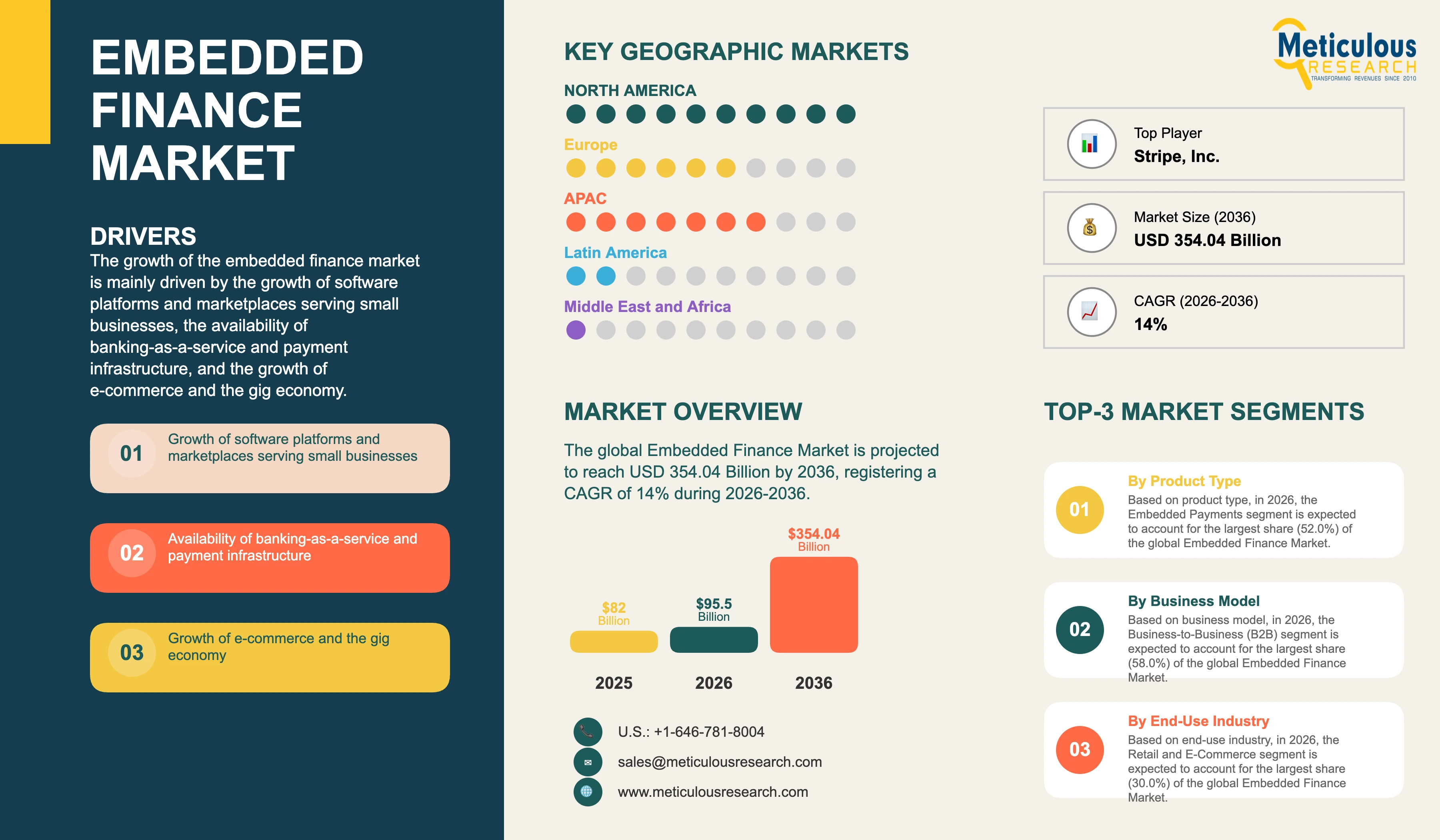
The global embedded finance market was valued at USD 82.00 billion in 2025. This market is expected to reach USD 354.04 billion by 2036 from an estimated USD 95.50 billion in 2026, registering a CAGR of 14.0% during the forecast period (2026-2036).
- Published
- Nov 2026
- Pages
- 289
- Format
- PDF + Excel
- Report ID
- MRICT - 1042491
- Base year
- 2025
- 2025 · BASELINE
- $82.00B
- 2036
- $354.0B
- CAGR 2026–2036
- 14.0%
2025 baseline · 2026–2036 forecast at 14.0% CAGR · hover a bar for the value
Key highlights
Embedded finance allows non-financial companies, such as e-commerce platforms, software providers, marketplaces, retailers, and mobility platforms, to offer financial services to their customers within their own products, using licensed partners and infrastructure providers in the background.
Leading payment infrastructure providers, such as Stripe, Adyen, PayPal, and Block, have expanded beyond payments into embedded lending, accounts, cards, and treasury services for platforms and their business customers.
Buy now, pay later providers, such as Klarna and Affirm, have become major embedded lending players, with Klarna completing its initial public offering on the New York Stock Exchange in September 2025 and Affirm partnering with large retailers and wallets to offer installment payments at checkout.
The collapse of banking-as-a-service middleware provider Synapse in 2024, which left many end users without access to their funds, and consent orders issued by U.S. regulators to several partner banks have increased regulatory scrutiny and pushed the industry toward stronger compliance and record-keeping.
Vertical software platforms for restaurants, retailers, healthcare practices, field services, and other industries, such as Toast and Shopify, earn a growing share of their revenue from embedded payments, lending, and banking services offered to their merchants.
Instant payment systems, such as UPI in India, Pix in Brazil, and FedNow in the U.S., and open banking frameworks are enabling new embedded pay-by-bank and account-based services that can reduce costs compared with card payments.
Stripe's acquisition of Bridge, a stablecoin infrastructure provider, and the growing use of stablecoins for cross-border payouts show how embedded finance providers are adding new payment rails to their platforms.
Embedded insurance, such as travel, shipping, device, and auto coverage offered at the point of sale, is one of the faster-growing areas of embedded finance, as insurers partner with platforms to reach customers at lower distribution cost.
Earned wage access and instant payouts for gig workers and creators are growing quickly, delivered through payroll providers, employers, and platforms using embedded accounts and cards.
By product type, embedded payments account for the largest share of 52.0% in 2026, while embedded lending registers the highest CAGR.
By business model, B2B accounts for the largest share in 2026 and also registers the highest CAGR.
By end-use industry, retail and e-commerce accounts for the largest share of 30.0% in 2026, while software and SaaS platforms register the highest CAGR.
By geography, North America accounts for the largest share of 40.0% in 2026, while Asia-Pacific registers the highest CAGR of 16.0%.
Report summary
| Particulars | Details |
|---|---|
| Base Year | 2025 |
| Estimated Year | 2026 |
| Forecast Period | 2026-2036 |
| Market Size in 2025 | USD 82.00 billion |
| Market Size in 2026 | USD 95.50 billion |
| Market Size by 2036 | USD 354.04 billion |
| CAGR (2026-2036) | 14.0% |
| Format | PDF, Excel & Cloud Portal · 289 pages |
| Largest Segment by Product Type (2026) | Embedded Payments (52.0%) |
| Largest Segment by End-Use Industry (2026) | Retail and E-Commerce (30.0%) |
| Largest Region (2026) | North America (40.0%) |
| Fastest-Growing Region | Asia-Pacific (CAGR 16.0%) |
| Segments Covered | Product Type, Business Model, End-Use Industry, and Geography |
| Geographic Scope | North America, Asia-Pacific, Europe, Latin America, and Middle East and Africa |
| Key Companies Profiled | Stripe, Adyen, PayPal, Block, Shopify, Marqeta, Klarna, Affirm, Solaris, Unit, Galileo, Cross River Bank, Toast, and Swan |
Report overview
Segments covered: product type, business model, end-use industry.
The growth of this market is mainly driven by the growing number of software platforms, marketplaces, and retailers that offer payments, lending, accounts, cards, and insurance directly within their products, the rapid growth of vertical software platforms serving small businesses, the availability of banking-as-a-service and payment infrastructure through application programming interfaces, the growth of e-commerce and the gig economy, and the ability of platforms to use their own data to offer better-targeted financial products. However, factors such as increased regulatory scrutiny of banking-as-a-service partnerships, compliance and risk management requirements, credit risk in embedded lending, and the complexity of operating financial products are expected to restrain the growth of this market to some extent.
Embedded finance refers to the integration of financial services, such as payments, lending, deposit accounts, cards, insurance, and investments, into the products and customer journeys of non-financial companies. Instead of sending customers to a bank or insurer, a platform offers these services directly at the point where they are needed, such as financing at checkout, insurance when booking a trip, a business account inside accounting software, or instant payouts for gig workers. The financial products are usually provided by licensed banks, lenders, and insurers, while technology providers supply the infrastructure that connects them to the platform.
This market covers the global revenue generated from embedded financial services, measured in value, including fees, interest margins, interchange, and other revenue earned by platforms, infrastructure providers, and licensed partners from embedded payments, embedded lending, embedded banking and cards, embedded insurance, and embedded investments and wealth products. It is segmented by product type, business model, end-use industry, and geography. Revenue from traditional banking and insurance products sold directly by financial institutions is not included.
The embedded finance value chain includes three main groups, starting with brands and platforms, such as e-commerce sites, marketplaces, software providers, retailers, and mobility apps, which which own the customer relationship and decide which financial products to offer. Enablers and infrastructure providers, such as Stripe, Adyen, Marqeta, Unit, Solaris, Galileo, and Swan, provide the technology, compliance tools, and program management needed to launch financial products. Licensed providers, such as banks, lenders, and insurers, hold the licenses, balance sheets, and regulatory responsibility. Revenue is shared among these groups in different ways depending on the product and the model. In payments, platforms often earn a share of processing fees, while in lending, revenue may come from interest, origination fees, or referral fees, and in card programs, revenue usually comes from interchange fees shared between the issuing bank, the program manager, and the platform. Some large platforms, such as Shopify and Toast, have built extensive financial services businesses, while others offer only a few products through partners.
Embedded finance has grown rapidly over the past decade, starting with embedded payments, as platforms such as Shopify, Uber, and Airbnb integrated payment processing into their services. It has since expanded into lending, as platforms use their data on merchant sales or customer behavior to offer working capital loans and installment payments, and into accounts, cards, and treasury services, which allow businesses and consumers to store and spend money within platforms. Embedded insurance, such as travel, shipping, device, and auto insurance offered at the point of sale, has also grown quickly. Investment products, such as savings accounts, round-up investing, and brokerage services embedded in consumer apps, have also expanded, particularly among younger customers.
The market faced a period of adjustment in 2024 and 2025, as rising interest rates reduced funding for fintech start-ups, and regulatory scrutiny of banking-as-a-service partnerships increased after problems at Synapse and enforcement actions against several partner banks in the U.S. Many providers strengthened their compliance programs, and some partner banks reduced the number of programs they supported. At the same time, large platforms continued to expand their embedded finance offerings, and payment providers, such as Stripe and Adyen, grew their platform businesses. The industry is now moving toward more sustainable models, with greater focus on compliance, risk controls, profitability, and clear allocation of responsibilities among platforms, infrastructure providers, and licensed partners.
Over the forecast period, embedded finance is expected to grow strongly, supported by the growth of vertical software platforms, e-commerce, and the gig economy, the expansion of open banking and instant payments, and the use of AI to improve credit decisions, fraud detection, and personalization. Growth is expected to be particularly strong in Asia-Pacific and Latin America, where super apps and digital platforms play a central role in financial services. Embedded finance is also expected to expand into new areas, such as B2B payments and trade credit, payroll and earned wage access, healthcare payments, and AI-driven commerce, in which software agents make purchases and payments on behalf of users. The share of financial services delivered through non-financial platforms is expected to rise steadily as consumers and businesses become used to accessing financial products where they shop, work, and run their businesses.
Embedded checkout, installment payments, and seller payouts are central to our platform. We have chosen partners that can support us in many countries with strong compliance, because regulators now look closely at how platforms manage these products.
Marketplaces and retailers are expected to expand embedded financing and payout services to support their sellers and customers.
Strong demand from retailers and marketplaces is why embedded payments account for 52.0% of the market and retail and e-commerce accounts for 30.0%.
Many of our users and merchants never had a bank account or loan before, and they trust our app more than a bank. Offering payments, credit, and insurance inside our app has become one of our fastest-growing businesses in the region.
Super apps are expected to expand into investments and insurance as their users' financial needs grow.
The growth of super apps and digital platforms is why Asia-Pacific is the fastest-growing region in this market.
Report infographic
Market dynamics
15 factors across 5 forcesGrowth of software platforms and marketplaces serving small businesses
Vertical software platforms, which provide specialized, industry-specific software for restaurants, retailers, salons, fitness studios, healthcare practices, construction firms, and other small businesses, have become one of the most important channels for embedded finance. These platforms are part of their customers' daily operations, which allows them to offer payments, working capital, business accounts, cards, and payroll services in a convenient way.
Embedded finance can generate more revenue for software platforms than their software subscriptions, and companies such as Toast, Shopify, Mindbody, ServiceTitan, and many others earn a large share of their revenue from payments and financial services. Marketplaces, such as Amazon, eBay, Etsy, and Mercado Libre, also offer financing and payment services to their sellers. Software and SaaS platforms form the fastest-growing end-use industry in this market, and B2B is both the largest and fastest-growing business model. Software platforms also benefit from higher customer retention when they embed financial services, because merchants that use the platform's payments, lending, and accounts are less likely to switch to competitors. This makes embedded finance a strategic priority for software companies as well as a source of revenue.
Availability of banking-as-a-service and payment infrastructure
Banking-as-a-service and payment infrastructure providers allow non-financial companies of all sizes to launch financial products quickly through application programming interfaces, without building their own banking infrastructure or obtaining licenses. Providers such as Stripe, Adyen, Marqeta, Unit, Solaris, Galileo, Swan, and Cross River Bank offer card issuing, accounts, lending, payouts, and compliance tools that platforms can integrate into their products.
This infrastructure has reduced the cost and time required to launch embedded financial products from years to months or weeks. Card issuing platforms, such as Marqeta, have enabled many companies to launch branded debit, credit, and expense cards, and payment providers offer instant payouts, multi-currency accounts, and treasury services. Embedded payments account for the largest share of the market by product type. Banks are also increasingly offering their own embedded finance capabilities, providing APIs and white-label products to platforms, which expands the supply of licensed partners and creates competition with fintech infrastructure providers.
Growth of e-commerce and the gig economy
The growth of e-commerce, social commerce, and digital marketplaces has increased demand for embedded payments, installment payments, and checkout financing. Consumers increasingly expect to pay and finance purchases with a few clicks, and retailers use embedded financing to increase conversion and average order values.
The gig economy and creator economy, including ride-hailing, delivery, freelancing, and content creation platforms, have created demand for instant payouts, earned wage access, accounts, and cards for workers and creators. Platforms such as Uber, DoorDash, and Lyft offer instant payouts and debit cards to their workers, and creator platforms offer payouts and financial tools to creators. Cross-border marketplaces also need multi-currency payouts for sellers in many countries. Retail and e-commerce accounts for the largest share of the market by end-use industry. Social media and content platforms are also adding payment and commerce features, which creates new opportunities for embedded checkout, tipping, and creator payouts.
Use of platform data to improve financial products
Platforms have detailed data on their customers' sales, transactions, and behavior, which can be used to assess credit risk more accurately than traditional lenders and to offer financing that is repaid automatically from future sales. Merchant cash advances and revenue-based financing, offered by Shopify Capital, Square Loans, Stripe Capital, Amazon, and others, use this data to provide fast and flexible working capital to small businesses.
Platform data also allows insurers and platforms to offer more relevant insurance products at the right moment, such as shipping insurance at checkout or coverage for gig workers. AI is improving the ability of platforms to use this data for underwriting, fraud prevention, and personalization. Platforms can also monitor sales in real time and adjust credit limits quickly, which helps manage risk. Embedded lending is the fastest-growing product type in this market. Repayment through automatic deductions from sales or payouts reduces collection costs and default risk, which allows platforms and their lending partners to offer financing to businesses that banks may not serve. Merchant financing provided by platforms has become an important source of working capital for small businesses in the U.S., Europe, and emerging markets.
Table of contents
11 chapters · 123 sections · 289 pages · click to expandSegmental analysis
| Segment | Largest share (2026) | Fastest growth (2026–2036) |
|---|---|---|
| By Product Type | Embedded payments | Embedded lending |
| By Business Model | B2B | B2B |
| By End-Use Industry | Retail and e-commerce | Software and SaaS platforms |
By Product Type
- Embedded Finance Analysis by Product Type
- The embedded payments segment is expected to account for the largest share of 52.0% of the market.
- The large share of this segment is mainly due to the widespread integration of payment processing into e-commerce platforms, marketplaces, software platforms, and mobile apps, which generate large volumes of transactions and fees.
- Embedded payments include online and in-person payment acceptance, checkout, payouts, and payment facilitation services that platforms offer to their merchants and users, often through providers such as Stripe, Adyen, PayPal, Block, and Fiserv.
- Many software platforms now act as payment facilitators, earning a share of the processing fees on their merchants' transactions.
- Payments are usually the first financial product that platforms embed, and they create the transaction data that enables lending and other services.
- Competition has reduced payment margins, but volumes continue to grow with e-commerce and digital commerce.
- Embedded payments are expected to remain the largest product type by revenue over the forecast period, although their share will decline as other products grow faster.
- Payment providers are also adding value-added services, such as fraud prevention, currency conversion, tax calculation, and payouts, which increase revenue per transaction.
- Software platforms increasingly use payment facilitation models, which allow them to onboard merchants quickly and earn a larger share of payment revenue, although this also increases their responsibility for risk and compliance.
- However, the embedded lending segment is projected to register the highest CAGR during the forecast period.
- The rapid growth of this segment is driven by the growth of merchant financing, buy now, pay later, B2B trade credit, and consumer financing offered within platforms, using platform data for underwriting.
- Buy now, pay later providers, such as Klarna and Affirm, have expanded through partnerships with retailers, payment providers, and digital wallets, and merchant financing programs offered by Shopify, Square, Stripe, and Amazon provide billions of dollars in working capital to small businesses each year.
- B2B buy now, pay later and trade credit, offered by providers on procurement and marketplace platforms, are also growing quickly.
- Embedded banking and cards, embedded insurance, and embedded investments and wealth make up the rest of the market.
- Embedded banking and cards include business and consumer accounts, debit and credit cards, expense cards, and treasury services offered within platforms, often through providers such as Marqeta, Unit, Galileo, Solaris, and Swan.
- Embedded insurance includes travel, shipping, device, auto, and gig worker coverage, while embedded investments include savings and brokerage products offered within apps.
- Embedded banking and cards and embedded insurance are both expected to grow faster than the overall market, as more platforms add these products to their offerings.
By Business Model
- Embedded Finance Analysis by Business Model
- The B2B segment is expected to account for the largest share of the market and is also projected to register the highest CAGR during the forecast period.
- The large share and fast growth of this segment are mainly due to the growing number of software platforms and marketplaces that offer payments, lending, accounts, and cards to the businesses they serve.
- B2B embedded finance includes a wide range of services offered by software platforms to small businesses, by marketplaces to sellers, and by procurement and accounting software to companies, such as merchant payments, working capital, business accounts, expense cards, invoice financing, and treasury services.
- Small businesses often find these services more convenient and accessible than those offered by traditional banks.
- Companies such as Shopify, Toast, Amazon, Stripe, and many vertical software providers are major players in B2B embedded finance.
- B2B is expected to remain the largest business model over the forecast period.
- B2B embedded finance also includes services for larger companies, such as embedded treasury, foreign exchange, and supply chain finance offered within enterprise software and procurement platforms.
- B2C makes up the rest of the market and includes buy now, pay later, consumer payments, accounts and cards offered by retailers and apps, and embedded insurance and investments for consumers.
- Consumer-facing embedded finance is growing with the adoption of digital wallets, installment payments, and app-based banking, particularly among younger consumers who are comfortable accessing financial services through non-bank brands.
- Retailers, automakers, telecom companies, and mobility apps are among the largest providers of B2C embedded finance.
By End-Use Industry
- Embedded Finance Analysis by End-Use Industry
- The retail and e-commerce segment is expected to account for the largest share of 30.0% of the market.
- The large share of this segment is mainly due to the large volume of payments, installment financing, and insurance offered at checkout by online and physical retailers and marketplaces.
- Retailers and e-commerce platforms use embedded payments to provide seamless checkout, buy now, pay later to increase sales, co-branded cards and loyalty programs to increase customer engagement, and embedded insurance, such as shipping and product protection.
- Marketplaces, such as Amazon, Mercado Libre, and Shopee, offer financing and payment services to millions of sellers.
- Social commerce and live commerce are also creating new opportunities for embedded payments.
- Retail and e-commerce is expected to remain the largest end-use industry over the forecast period.
- Online sellers also use embedded working capital offered by marketplaces and e-commerce platforms to finance inventory and marketing, which links retail and e-commerce closely with embedded lending.
- Retailers are also launching their own branded payment and financial services, such as co-branded cards and loyalty-linked accounts, to strengthen customer relationships.
- In emerging markets, e-commerce platforms often provide the first access to credit for many consumers and small sellers.
- However, the software and SaaS platforms segment is projected to register the highest CAGR during the forecast period.
- The rapid growth of this segment is driven by the adoption of embedded payments, lending, and banking by vertical software providers serving small businesses.
- Transportation, mobility, and gig economy, manufacturing and B2B distribution, travel and hospitality, healthcare, telecommunications and media, and other industries make up the rest of the market.
- Transportation, mobility, and gig economy platforms use embedded finance for driver and courier payouts, vehicle financing, and insurance, while travel and hospitality companies use embedded payments and travel insurance.
- Healthcare providers and software platforms are adding patient financing and payment services.
- Manufacturing and B2B distribution companies are adopting embedded B2B payments, trade credit, and invoice financing, which are among the fastest-growing areas of embedded finance.
Geographic analysis
North America
Largest shareIn 2026, North America is expected to account for the largest share of 40.0% of the global embedded finance market. The large share of this region is mainly due to the large number of software platforms, marketplaces, and fintech companies in the U.S., the well-developed banking-as-a-service ecosystem, and the high revenue per transaction in the U.S. payments and credit card market. The U.S. is home to leading embedded finance providers, such as Stripe, PayPal, Block, Affirm, Marqeta, Unit, and Galileo, and to many vertical software platforms that earn significant revenue from embedded finance. Partner banks, such as Cross River Bank, provide licenses and balance sheets for many fintech programs, although regulatory scrutiny has increased. Canada is also a growing market, supported by Shopify and other platforms and by the development of open banking. North America is expected to remain the largest region throughout the forecast period. The U.S. also has a large number of buy now, pay later users and a strong market for co-branded and private-label cards, which contribute to the region's high revenue. Mexico and Colombia are also growing markets, supported by digital wallets and platforms.
Asia-Pacific
Fastest growthAsia-Pacific is projected to register the highest CAGR of 16.0% during the forecast period. Growth is driven by super apps, such as Grab, GoTo, and Paytm, large e-commerce platforms, the growth of digital payments, such as UPI in India, and supportive regulation for digital banking and lending in many countries. China has a large and mature digital finance ecosystem led by Alipay and WeChat Pay, while India, Indonesia, the Philippines, and Vietnam are among the fastest-growing markets, supported by digital public infrastructure and rising smartphone use. Japan and Australia also have growing embedded finance markets, supported by e-commerce and buy now, pay later adoption.
Europe
Europe holds a significant share of the market, supported by open banking under PSD2, banking-as-a-service providers, such as Solaris, Swan, and Railsr, and the presence of Adyen and Klarna.
Latin America
Latin America and the Middle East and Africa are growing quickly, supported by digital platforms, such as Mercado Libre and M-Pesa, and by instant payment systems, such as Pix in Brazil.
Middle East & Africa
The UAE and Saudi Arabia are also developing open banking frameworks and fintech sandboxes that support embedded finance. Nigeria, Kenya, and Egypt are also seeing rapid growth in digital platforms that offer payments and credit.
Competitive landscape
The embedded finance market is fragmented, with large payment providers, banking-as-a-service and card issuing platforms, lending and buy now, pay later providers, partner banks, and large platforms that offer financial services. Leading companies in the market include Stripe, Adyen, PayPal, Block, Shopify, Marqeta, Klarna, Affirm, Solaris, Unit, Galileo, Cross River Bank, Toast, and Swan.
Infrastructure providers compete on the breadth of their products, ease of integration, compliance capabilities, reliability, pricing, and geographic coverage, while platforms compete on the quality and relevance of the financial products they offer to their customers. Large payment providers have an advantage in scale and product breadth, while specialized providers focus on specific products, such as card issuing or lending. Partner banks, such as Cross River Bank, play a key role by providing licenses and balance sheets, while large platforms, such as Shopify and Toast, both use and build embedded finance capabilities.
The top five players are estimated to account for 32.0% of the embedded finance market in 2025, reflecting the strong positions of large payment providers and platforms and the large number of specialized providers. Concentration is higher in embedded payments, where a few large providers process a large share of platform transactions, and lower in lending, insurance, and banking. Many platforms use several providers for different products and countries. This multi-provider approach increases competition.
Players use several strategies to grow in this market, including expanding product portfolios, obtaining banking licenses or deepening bank partnerships, strengthening compliance capabilities, expanding into new countries, acquiring complementary companies, and developing AI capabilities. Stripe acquired Bridge to add stablecoin capabilities, and many providers have invested in compliance after increased regulatory scrutiny.
Competition is expected to center on product breadth, compliance and risk management, ease of integration, global coverage, and the ability to help platforms generate revenue. Providers that combine full-stack capabilities with strong compliance are expected to gain share. Smaller providers may become acquisition targets as consolidation continues, and banks may increase their role as direct providers of embedded finance infrastructure. Payment networks, such as Visa and Mastercard, are also expanding their roles in embedded finance through tokenization, card issuing, and open banking services.
Some of the key players operating in the embedded finance market are Stripe, Inc., Adyen N.V., PayPal Holdings, Inc., Block, Inc., Shopify Inc., Marqeta, Inc., Klarna Group plc, Affirm Holdings, Inc., Solaris SE, Unit Finance, Inc., Galileo Financial Technologies, LLC, Cross River Bank, Toast, Inc., and Swan SAS.
- —
Klarna completed its initial public offering in September 2025, Stripe expanded its stablecoin capabilities through Bridge, and banking-as-a-service providers and partner banks strengthened their compliance programs following regulatory actions.
- Stripe
- Adyen
- PayPal
- Block
- Shopify
- Marqeta
- Klarna
- Affirm
- Solaris
- Unit
- Galileo
- Cross River Bank
- Toast
- Swan
Expert perspectives
Embedded finance is becoming a standard part of how software platforms, marketplaces, and retailers serve their customers, and it is shifting a growing share of financial services revenue to non-financial companies and their technology partners. After a period of adjustment in 2024 and 2025, the market is entering a phase of more disciplined growth, with greater emphasis on compliance, risk management, and profitability.
Over the forecast period, the market is expected to grow at about 14.0% per year, supported by vertical software platforms, B2B embedded finance, e-commerce, the gig economy, and digital platforms in emerging markets. Lending and insurance are expected to grow faster than payments, as platforms use their data to offer more financial products. Regulatory requirements are expected to increase, which will favor providers and platforms with strong compliance and risk management capabilities. Interest rates and credit conditions will affect the growth and profitability of embedded lending, and the pace of open banking adoption will influence account-based services.
Embedded lending is the fastest-growing product type, B2B is both the largest and fastest-growing business model, and software and SaaS platforms is the fastest-growing end-use industry. Embedded payments and retail and e-commerce remain the largest segments.
North America remains the largest region, while Asia-Pacific is the fastest-growing region at a CAGR of 16.0%. The main swing factors are regulation of banking-as-a-service and lending, interest rates and credit conditions, the growth of software platforms, and the adoption of open banking, instant payments, and stablecoins.
For platforms, the key decisions are which financial products to offer first, which partners to use, and how to manage compliance and risk. Platforms should also consider how embedded finance affects customer retention and lifetime value, not only direct revenue. Many platforms are expected to move from offering a single financial product to building broader financial services offerings over time. For infrastructure providers and banks, success depends on offering reliable, compliant, and easy-to-use products that help platforms generate revenue.
Overall, embedded finance is expected to continue reshaping financial services, with the most successful participants combining strong distribution, data, and compliance capabilities. AI-driven commerce and new payment rails, such as instant payments and stablecoins, could open further growth opportunities later in the forecast period. Banks that partner effectively with platforms may also regain a larger role in customer relationships, while banks that do not may lose share of revenue to non-financial companies. The balance of power between platforms, infrastructure providers, and banks is expected to remain a defining feature of the market.
Customer perspectives
Chief Financial Officer - vertical software platform for restaurants, U.S.
Payments and working capital loans now generate more revenue for us than our software subscriptions do. Our customers like getting funding based on their daily sales without filling in long bank forms.
Software platforms are expected to continue adding financial products, such as accounts, cards, and payroll, to increase revenue and customer loyalty.
The growth of vertical software platforms is why software and SaaS platforms form the fastest-growing end-use industry and B2B is the largest business model.
Frequently asked questions
The market was valued at USD 82.00 billion in 2025 and USD 70.00 billion in 2024, and is estimated at USD 95.50 billion in 2026.
Cite this report
Meticulous Research. (2026). Embedded Finance Market - Global Opportunity Analysis and Industry Forecast (2026-2036) (Report No. MRICT - 1042491). Meticulous Market Research Pvt. Ltd. https://www.meticulousresearch.com/product/embedded-finance-market-7174