Electrophoretic Coatings Market (2026-2036)
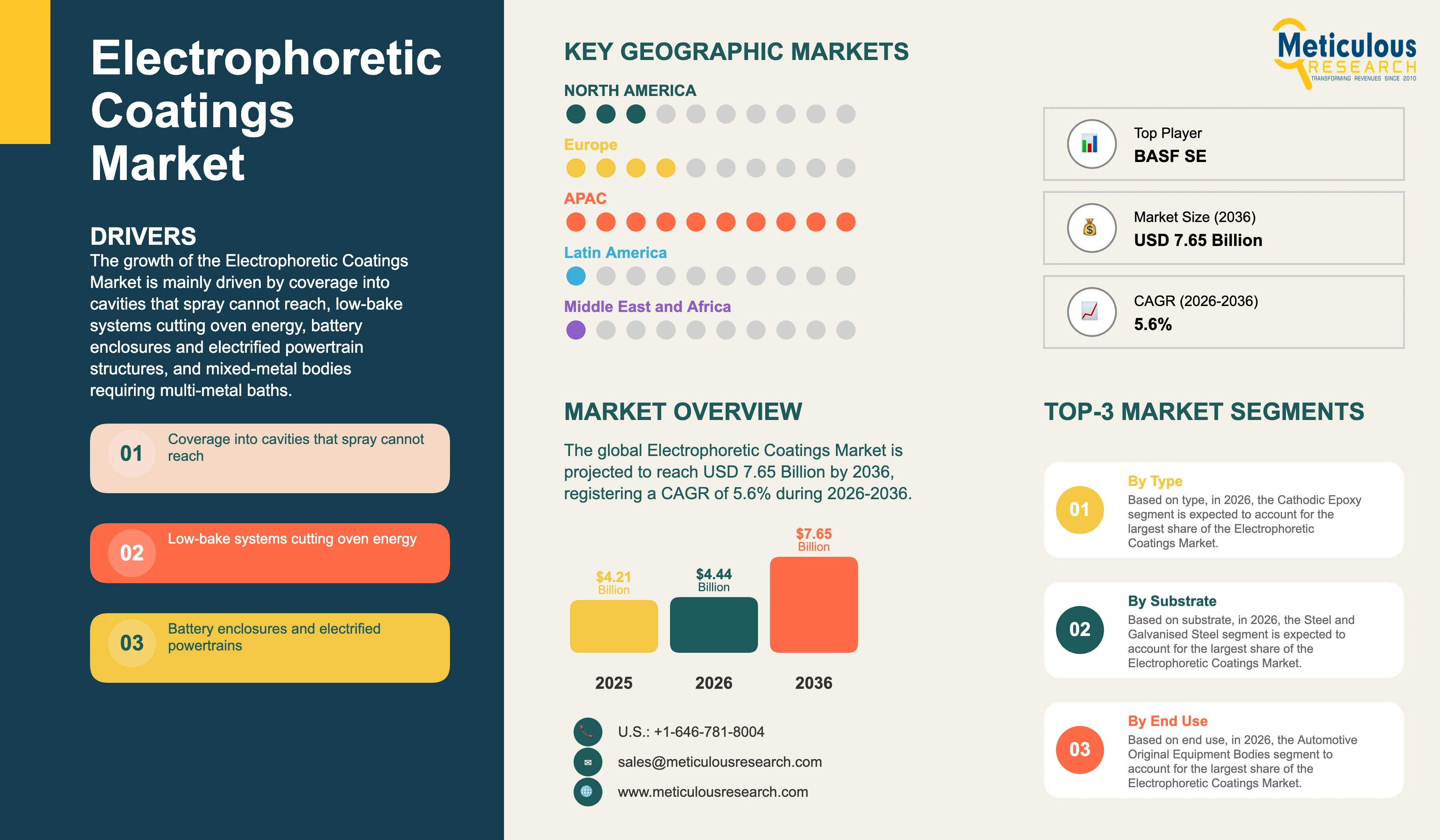
The electrophoretic coatings market is valued at USD 4.44 billion in 2026 and is projected to reach USD 7.65 billion by 2036, at a CAGR of 5.6% during the forecast period. The market was valued at USD 4.21 billion in 2025 and at USD 4.02 billion in 2024.
- Published
- Nov 2026
- Pages
- 249
- Format
- PDF + Excel
- Report ID
- MRCHM - 1042765
- Base year
- 2025
- 2024 · HISTORICAL
- $4.02B
- 2036
- $7.65B
- CAGR 2026–2036
- 5.6%
2024–2025 baseline · 2026–2036 forecast at 5.6% CAGR · hover a bar for the value
Key highlights
This market measures electrophoretic coating materials as supplied, covering resin feed, pigment paste and replenishment for cathodic and anodic electrodeposition, taken at the coating supplier gate on a tonne basis.
Excluded are pre-treatment and phosphating chemistry, primer surfacer, basecoat and clearcoat, bath equipment, rectifiers, ultrafiltration membranes and ovens.
Deposition is driven by applied voltage, so coating reaches cavities, box sections, weld seams and internal surfaces that no spray process covers, and is deposited at a controlled thickness on every wetted surface at once.
Published bath parameters for a cathodic epoxy system run at 18.5% solids, pH 5.6, conductivity of 1,300 microsiemens per centimetre, bath temperature of 28 degrees to 36 degrees Celsius and 120 volts to 400 volts.
Film build on that system is specified at 15 microns to 22 microns with a minimum coating time of 120 seconds and a cure of 15 minutes at 175 degrees Celsius with a tolerance of 10 degrees on the object.
A newer system in the same family runs at pH 5.4, conductivity of 1.7 millisiemens per centimetre, 200 volts to 400 volts and a pigment to binder ratio of 0.20, with film build of 13 microns to 25 microns and cure of 15 to 20 minutes at 175 degrees Celsius with a tolerance of 20 degrees.
That broader cure window is what allows a single bath to serve body areas that reach different temperatures in the same oven, which is the constraint that governs e-coat selection on a mixed body.
BASF states that its cathodic epoxy family is tin-free, free of hazardous air pollutants and below 1% solvent content, with up to 20% lower consumption and 30% lower run-outs.
The same family is stated to have coated more than 200 million cars and to protect more than 30 million new cars a year, which against world vehicle production of 96.4 million units in 2025 places roughly a third of global output on one product family.
Closed-loop rinsing is stated to cut line water use by at least 20%, with a biomass balance approach delivering a further 40% saving in carbon dioxide per kilogram.
PPG launched a low-temperature-cure electrocoat platform on 6 June 2023, positioned on curing below competing technologies over thicker substrates and complex assemblies with lower energy use and reduced carbon dioxide emissions at manufacturing plants.
Dibutyltin compounds carry a limit of 0.1% tin by weight in mixtures and articles supplied to the general public under the European chemicals regime, with the extended deadline for paints and coatings using dibutyltin catalysts applied to articles having run to 1 January 2015.
World vehicle production reached 96.4 million units in 2025 against 92.7 million in 2024, with China at 34.53 million units and European output down 0.8% at 17.2 million.
New energy vehicle production in China reached 16.626 million units in 2025, up 29%, and integrated battery housings in those platforms bring a new electrophoretic coating application into the same paint shop.
Cathodic epoxy chemistry is expected to hold the largest type share of this market in 2026 at 62.0% and to grow at 5.2%, while anodic systems grow slowest at 3.6% and other electrophoretic systems fastest at 9.4%.
Standard bake systems curing above 170 degrees Celsius hold 68.0% of this market in 2026 and grow at 4.6%, against 7.2% for medium bake systems and 9.8% for low-bake systems curing below 150 degrees.
Steel and galvanised steel are expected to account for the largest substrate share of this market in 2026 at 71.0% and to grow at 5.2%, while multi-metal assemblies grow fastest at 7.6% and aluminium and mixed metal at 6.8%.
Value grows ahead of volume throughout, at 5.6% against 3.8%, because formulation improvement reduces the kilograms applied per body while the mix moves toward dearer low-cure and multi-metal systems.
Report summary
| Particulars | Details |
|---|---|
| Base Year | 2025 |
| Actual Years | 2024-2025 |
| Forecast Period | 2026-2036 |
| Market Size in 2024 | USD 4.02 billion |
| Market Size in 2025 | USD 4.21 billion |
| Market Size in 2026 | USD 4.44 billion |
| Market Size in 2036 | USD 7.65 billion |
| Value CAGR (2026-2036) | 5.6% |
| Format | PDF, Excel & Cloud Portal · 249 pages |
| Volume in 2025 | 1,098.00 kilotons |
| Volume in 2026 | 1,142.00 kilotons |
| Volume in 2036 | 1,660.00 kilotons |
| Volume CAGR (2026-2036) | 3.8% |
| Average Selling Price, 2026 | USD 3,890 per tonne |
| Average Selling Price, 2036 | USD 4,610 per tonne |
| Units | Value in USD million; volume in kilotons of coating material as supplied; price in USD per tonne |
| Measurement Basis | Electrophoretic coating materials as supplied, covering resin feed, pigment paste and replenishment for cathodic and anodic electrodeposition, taken at the coating supplier gate on a tonne basis |
| Historical Value Growth | Value grew at 5.1% a year between 2024 and 2026 on volume growth of 3.7% a year and price growth of 1.4% a year; the forecast of 5.6% carries volume growth of 3.8% and price growth of 1.7%, with value growing ahead of volume throughout because formulation improvement reduces the material applied per body while the mix moves toward low-cure, multi-metal and electrified powertrain systems |
| Price Increase Note | The average selling price rises on mix rather than on repricing, because low-cure, multi-metal and dielectric systems are priced above standard cathodic epoxy, so a shift of share toward them lifts the blended figure without either repricing |
| Deposition Basis | Deposition is driven by an applied field and is self-limiting as the deposited film insulates the surface, so coating reaches cavities, box sections, weld seams and internal surfaces at a controlled thickness that no spray process delivers |
| Bath Parameter Basis | Published parameters for a cathodic epoxy system are bath solids of 18.5% with a tolerance of 1.5 points, pH 5.6 with a tolerance of 0.2, conductivity of 1,300 microsiemens per centimetre with a tolerance of 500, bath temperature of 28 degrees to 36 degrees Celsius, 120 volts to 400 volts and a minimum coating time of 120 seconds; a newer system in the same family runs at pH 5.4, 1.7 millisiemens per centimetre, 200 volts to 400 volts and a pigment to binder ratio of 0.20 with a tolerance of 0.04 |
| Film and Cure Basis | Film build is specified at 15 microns to 22 microns on the first system and 13 microns to 25 microns on the second, with cure of 15 minutes at 175 degrees Celsius plus or minus 10 degrees on the object for the first and 15 to 20 minutes at 175 degrees plus or minus 20 degrees for the second; the wider window is what allows one bath to cure thin panels and thick sections in the same oven pass |
| Efficiency Basis | The current cathodic epoxy family is stated to be tin-free, free of hazardous air pollutants and below 1% solvent content, with up to 20% lower consumption, 30% lower run-outs, 20% higher ultrafiltration module efficiency, at least 20% lower line water use from closed-loop rinsing and a further 40% saving in carbon dioxide per kilogram through a biomass balance approach |
| Penetration Basis | One cathodic epoxy family is stated to have coated more than 200 million cars and to protect more than 30 million new cars a year, which against world vehicle production of 96.4 million units in 2025 places roughly a third of annual output on a single product line and leaves the principal application at effectively complete penetration |
| Vehicle Production Basis | World motor vehicle production reached 96.4 million units in 2025, up 3.9% from 92.7 million in 2024, with China at 34.53 million units, the United States at 10.24 million, India at 6.49 million and European production down 0.8% at 17.2 million; global sales were 99.8 million units, up 4.7% |
| Electrification Basis | New energy vehicle production in China reached 16.626 million units in 2025, up 29%, and integrated battery housings on those platforms are large coated structures that enter the same paint shop as the body, which adds coated area per vehicle rather than substituting for the body shell |
| Low-Cure Development Basis | PPG launched a low-temperature-cure electrocoat platform on 6 June 2023, positioned on curing below competing technologies over thicker substrates and complex assemblies with lower energy use and reduced carbon dioxide emissions at manufacturing plants |
| Tin Restriction Basis | Dibutyltin compounds carry a limit of 0.1% expressed as tin by weight in mixtures and articles supplied to the general public under Annex XVII of the European chemicals regime, applying from 1 January 2012, with the extended deadline for paints and coatings using dibutyltin catalysts applied to articles having run to 1 January 2015; tri-substituted organostannic compounds carry the same limit from 1 July 2010 |
| Overlap Note | Pre-treatment and phosphating chemistry, primer surfacer, basecoat and clearcoat are counted in separate titles, so any sizing reconciliation against automotive coatings or pretreatment titles has to be made on the electrodeposition boundary |
| Exclusions | Pre-treatment, cleaning, phosphating and zirconium conversion chemistry; primer surfacer, basecoat, clearcoat and underbody sealer; cavity wax and seam sealer; bath tanks, rectifiers, ultrafiltration membranes, anolyte systems and ovens; autodeposition coatings, which are not current-driven; powder and liquid spray primers |
| Segments: Type | Cathodic Epoxy; Cathodic Acrylic; Anodic Systems; Other Electrophoretic Systems |
| Segments: Substrate | Steel and Galvanised Steel; Aluminium and Mixed Metal; Zinc, Magnesium and Other Metals; Multi-Metal Assemblies |
| Segments: Cure Temperature | Standard Bake Above 170 Degrees Celsius; Medium Bake 150 to 170 Degrees Celsius; Low Bake Below 150 Degrees Celsius |
| Segments: End Use | Automotive Original Equipment Bodies; Automotive Components and Aftermarket; Appliances and Electronics; Industrial and Agricultural Equipment; Fasteners, Hardware and Furniture; Battery Enclosures and Electrified Powertrain |
| Largest Segment by Type, 2026 | Cathodic Epoxy, at 62.0% |
| Fastest-Growing Segment by Type | Other Electrophoretic Systems, at 9.4% |
| Slowest-Growing Segment by Type | Anodic Systems, at 3.6% |
| Largest Segment by Substrate, 2026 | Steel and Galvanised Steel, at 71.0% |
| Fastest-Growing Segment by Substrate | Multi-Metal Assemblies, at 7.6% |
| Largest Segment by Cure Temperature, 2026 | Standard Bake Above 170 Degrees Celsius, at 68.0% |
| Fastest-Growing Segment by Cure Temperature | Low Bake Below 150 Degrees Celsius, at 9.8% |
| Largest Segment by End Use, 2026 | Automotive Original Equipment Bodies, at 48.0% |
| Fastest-Growing Segment by End Use | Battery Enclosures and Electrified Powertrain, at 11.8% |
| Slowest-Growing Segment by End Use | Automotive Original Equipment Bodies, at 5.0% |
| Largest Region, 2026 | Asia-Pacific, at 54.0% |
| Fastest-Growing Region | Middle East & Africa, at 7.0% |
| Fastest-Growing Country | India, at 9.2% |
| Slowest-Growing Country | Japan, at 2.8% |
| Regions Covered | Asia-Pacific; Europe; North America; Latin America; Middle East & Africa |
| Countries Covered | China; Japan; India; South Korea; Germany; France; Spain; U.K.; U.S.; Canada; Mexico; Brazil |
| Key Players | BASF SE; PPG Industries, Inc.; Axalta Coating Systems Ltd.; Nippon Paint Holdings Co., Ltd.; Kansai Paint Co., Ltd.; KCC Corporation; The Sherwin-Williams Company; Shanghai Kinlita Chemical Co., Ltd. |
| Supply Structure Note | Automotive coatings groups sell the bath as a managed process covering film build, throwpower, cure window and bath control across every substrate a plant runs, which concentrates supply and holds incumbent positions for the life of a line; general industrial lines are shorter and are bought on cost per part |
| Corporate Development Note | The merger of Axalta Coating Systems Ltd. with Akzo Nobel N.V. to form Axanzo was approved by shareholders of both companies on 5 August 2026, with the companies operating independently until closing expected in early 2027 |
| Top Five Share, 2026 | 63.0% |
| Profiled Companies Share, 2026 | 78.0% |
| Currency | USD |
Report overview
Market value is measured in in USD million; volume in kilotons of coating material as supplied; price in USD per tonne. Segments covered: type, substrate, cure temperature, end use.
In volume terms, the market is estimated at 1,142.00 kilotons of coating material as supplied in 2026, rising to 1,660.00 kilotons by 2036, at a CAGR of 3.8%. The average selling price is estimated at USD 3,890 per tonne in 2026 and USD 4,610 per tonne in 2036, the increase reflecting a mix shift toward low-cure, multi-metal and electrified powertrain systems rather than any repricing of standard cathodic epoxy.
The growth of this market is mainly driven by corrosion protection on vehicle bodies that no spray process can deliver into cavities and box sections, low-bake systems growing at 9.8%, battery enclosure and electrified powertrain applications growing at 11.8%, and mixed-metal body construction requiring multi-metal compatible baths. However, factors such as automotive body application already at near-complete penetration, formulation improvement reducing the material consumed per body, world vehicle production growing at single-digit rates with European output falling, and bath chemistry locked into installed lines that cannot be requalified cheaply are expected to restrain the growth of this market to some extent.
Among end uses, automotive original equipment bodies are expected to hold the largest share of this market in 2026, while battery enclosures and electrified powertrain applications are expected to record the highest CAGR during the forecast period. Geographically, Asia-Pacific is expected to account for the largest share of this market in 2026, while the Middle East & Africa is expected to register the highest CAGR during the forecast period.
A body shell is immersed in the bath and made cathodic, charged resin and pigment migrate to it under an applied field, and the deposited film insulates the surface as it builds, which stops deposition at a self-limiting thickness. Coating therefore reaches cavities, box sections and weld seams at a controlled film build that no spray process can deliver.
Film build is therefore set by the chemistry and the voltage rather than by the operator, and once the bath is inside its window the same thickness appears on the thousandth body as on the first, which is what a corrosion warranty written across a model run requires.
That throwpower is the entire reason the process holds the position it does in automotive manufacture. A sprayed primer covers what the gun can see, while corrosion starts in the enclosed sections that the gun cannot reach.
Published parameters for a cathodic epoxy system place bath solids at 18.5% with a tolerance of 1.5 points, pH at 5.6, conductivity at 1,300 microsiemens per centimetre, bath temperature at 28 degrees to 36 degrees Celsius and voltage between 120 and 400 volts, with a minimum coating time of 120 seconds.
Film build on that system is 15 microns to 22 microns and cure is 15 minutes at 175 degrees Celsius with a tolerance of 10 degrees measured on the object, while a newer system in the same family runs to 13 microns to 25 microns with a cure window of 15 to 20 minutes at 175 degrees plus or minus 20 degrees.
The wider cure window matters more than the film build. A body in an oven does not reach a single temperature, so thin roof panels and thick sill sections cure at different points, and a bath that tolerates 40 degrees of spread serves a body that a narrower system would not.
Pigment to binder ratio is specified at 0.20 with a tolerance of 0.04, which sets the balance between corrosion performance from the pigment and the throwpower and film formation that come from the binder, and is the formulation variable a plant cannot adjust.
Conductivity, solids and pH move together as the bath works, and each is specified with a tolerance rather than as a target, with conductivity on the newer system allowed 1.7 millisiemens per centimetre plus or minus 0.5 and solids a range rather than a point value.
The bath is a plant rather than a drum of paint. Resin feed and pigment paste are dosed against depletion, ultrafiltration recovers coating from the rinse stages and returns it to the tank, and the anolyte system controls the acid balance, so transfer efficiency across a working line is close to complete.
That recovery is what makes consumption fall as formulations improve. BASF states up to 20% lower consumption and 30% lower run-outs on its current cathodic epoxy family, with 20% higher ultrafiltration module efficiency and at least 20% lower line water use from closed-loop rinsing.
Solvent content on that family is stated below 1% with no hazardous air pollutants, which is the environmental position that moved automotive primers to this process in the first place and leaves little further reduction available.
Penetration in the principal application is effectively complete. The same product family is stated to have coated more than 200 million cars and to protect more than 30 million new cars a year, against world production of 96.4 million vehicles in 2025, so the installed process base is the market rather than a conversion opportunity.
Volume therefore follows vehicle output. World production rose 3.9% to 96.4 million units in 2025 from 92.7 million in 2024, with China at 34.53 million units, the United States at 10.24 million, India at 6.49 million and European output down 0.8% at 17.2 million.
Tin is leaving the chemistry. Dibutyltin compounds carry a 0.1% limit expressed as tin by weight in mixtures and articles supplied to the general public under the European chemicals regime, and the extended deadline for paints and coatings using dibutyltin catalysts applied to articles ran to 1 January 2015, with suppliers now marketing tin-free lines.
Cure temperature is the live technical contest. PPG launched a low-temperature-cure electrocoat platform on 6 June 2023 positioned on lower energy use and reduced carbon dioxide emissions at manufacturing plants while curing over thicker substrates and complex assemblies.
Lowering the bake serves two purposes at once, because oven energy is among the largest single loads in a paint shop and because aluminium and mixed-metal bodies carry dimensional and joining constraints that a 175 degree bake aggravates.
Electrification is adding application rather than replacing it. New energy vehicle production in China reached 16.626 million units in 2025, up 29%, and integrated battery housings on those platforms are large coated structures that enter the same paint shop as the body.
Anodic systems reverse the polarity and deposit an acrylic or polyester film on the anode, which dissolves a small amount of the substrate into the bath and limits corrosion performance, so they hold the positions where appearance and cost matter more than cavity protection.
Cathodic acrylic chemistry sits between the two, delivering exterior durability and colour that epoxy cannot while retaining the throwpower of a cathodic process, which is why it carries appliance, component and single-coat decorative work.
Outside automotive the process serves appliances, agricultural and construction equipment, fasteners, hardware and furniture frames, where the argument is cost per part and complete coverage of complex fabrications rather than a corrosion warranty.
Report infographic
Market dynamics
17 factors across 5 forcesCoverage Into Cavities That Spray Cannot Reach
Deposition under an applied field is self-limiting, so a film builds on every wetted surface to a controlled thickness of 15 microns to 25 microns including box sections, weld seams and internal cavities, and corrosion begins precisely in those enclosed sections.
A sprayed primer covers line of sight and leaves the enclosed structure to wax, sealer or nothing, which is why a corrosion warranty measured in years rather than months rests on the electrodeposited layer.
Automotive original equipment bodies hold the largest end use share of this market in 2026 at 48.0% and grow at 5.0%, with automotive components and aftermarket work adding 18.0% at 5.6%.
No substitute delivers the same coverage, since autodeposition reaches cavities without current but bonds only to iron-bearing substrates, and powder or liquid spray primers cannot enter an enclosed section at all.
Low-Bake Systems Cutting Oven Energy
Cure at 175 degrees Celsius for 15 to 20 minutes makes the e-coat oven one of the largest energy loads in a paint shop, and a system that cures below 150 degrees removes part of that load without changing the line layout.
PPG launched a low-temperature-cure platform on 6 June 2023 positioned on lower energy use and reduced carbon dioxide emissions at manufacturing plants while curing over thicker substrates and complex assemblies, which is the condition a lower bake usually fails.
Low-bake systems curing below 150 degrees Celsius record the highest cure temperature CAGR in this market at 9.8% from an 8.0% share in 2026, with medium bake systems at 7.2% against 4.6% for standard bake above 170 degrees.
A lower bake also shortens the ramp and the cool-down, which releases oven length rather than only energy, and on a line running near capacity that is throughput rather than cost.
Battery Enclosures and Electrified Powertrain Structures
An integrated battery housing is a large fabricated structure with enclosed sections and mixed metals that enters the same paint shop as the body, and it requires corrosion protection on surfaces that will never be inspected again.
New energy vehicle production in China reached 16.626 million units in 2025, up 29%, which adds coated structure area per vehicle rather than substituting for the body shell that already carries the coating.
Battery enclosures and electrified powertrain applications record the highest end use CAGR in this market at 11.8% from a 5.0% share in 2026, and other electrophoretic systems, which carry low-cure and dielectric formulations, grow at 9.4%.
Those structures are also coated before assembly into the vehicle in many plants, which means the coating has to survive the joining and sealing operations that follow rather than only the service environment.
Mixed-Metal Bodies Requiring Multi-Metal Baths
A body built from galvanised steel, aluminium and occasionally magnesium deposits differently at each surface and reacts differently to the bath chemistry, so a single bath has to hold film build and adhesion across all of them.
Aluminium content also raises the dimensional and joining sensitivity of the structure, which reinforces the move to a lower bake and makes multi-metal compatibility and cure window a single purchase requirement rather than two.
Multi-metal assemblies record the highest substrate CAGR in this market at 7.6% and aluminium and mixed metal grow at 6.8%, against 5.2% for steel and galvanised steel on the largest substrate share at 71.0%.
Table of contents
12 chapters · 133 sections · 249 pages · click to expandSegmental analysis
| Segment | Largest share (2026) | Fastest growth (2026–2036) |
|---|---|---|
| By Type | Cathodic epoxy | Other electrophoretic systems |
| By Substrate | Steel and galvanised steel | Multi-metal assemblies |
| By Cure Temperature | Standard bake systems | Low-bake systems |
| By End Use | Automotive original equipment bodies | Battery enclosures and electrified powertrain |
By Type
- Electrophoretic Coatings Market Analysis by Type
- This market is segmented into cathodic epoxy, cathodic acrylic, anodic systems, and other electrophoretic systems.
- Cathodic epoxy is expected to account for the largest share of this market in 2026.
- The chemistry carries the corrosion performance that automotive body specification is written around, delivers the throwpower needed to reach cavities and box sections, and is the system installed on virtually every vehicle assembly plant bath in operation.
- Published parameters for those systems place film build at 15 microns to 25 microns with cure at 175 degrees Celsius and pigment to binder ratios around 0.20, and the generational improvements have come as consumption reduction, tin removal and wider cure windows rather than as new chemistry.
- Other electrophoretic systems are expected to record the highest CAGR during the forecast period, at 9.4%, carried by low-cure formulations and by systems developed for battery enclosures and electrified powertrain structures where electrical and thermal requirements sit alongside corrosion.
- Film thickness on those systems is also tightly bounded, because a thicker film raises material cost and edge build without improving cavity protection while a thinner one fails the corrosion requirement, which leaves 15 microns to 25 microns as the working range across the segment.
- Cathodic acrylic grows at 6.4% on appliance, component and decorative work where colour and exterior durability matter more than cavity protection, and anodic systems grow slowest at 3.6%, held to applications where the lower corrosion performance is acceptable.
By Substrate
- Electrophoretic Coatings Market Analysis by Substrate
- This market is segmented into steel and galvanised steel, aluminium and mixed metal, zinc, magnesium and other metals, and multi-metal assemblies.
- Steel and galvanised steel are expected to hold the largest share of this market in 2026, since the body shell, the components around it and most industrial fabrication remain steel, and bath chemistry has been developed against that substrate for four decades.
- Multi-metal assemblies are expected to record the highest CAGR during the forecast period, at 7.6%, because a structure combining galvanised steel with aluminium deposits differently at each surface and requires a bath qualified across all of them rather than optimised for one.
- Galvanised surfaces also interact with the bath differently from bare steel, producing gassing and film defects if the chemistry and the pre-treatment are not matched, so the substrate decision is made jointly with the conversion coating that precedes it.
- Aluminium and mixed metal grow at 6.8% on body lightweighting and battery structures, and zinc, magnesium and other metals grow at 5.8% on castings and hardware.
By Cure Temperature
- Electrophoretic Coatings Market Analysis by Cure Temperature
- This market is segmented into standard bake above 170 degrees Celsius, medium bake at 150 degrees to 170 degrees, and low bake below 150 degrees.
- Standard bake systems are expected to account for the largest share of this market in 2026, reflecting the installed oven base and the published cure of 15 to 20 minutes at 175 degrees Celsius that body specifications are written around.
- Low-bake systems are expected to record the highest CAGR during the forecast period, at 9.8%, driven by oven energy cost and by aluminium and mixed-metal structures that a higher bake aggravates, with the qualification hurdle being cure over thick sections rather than over flat panels.
- Cure temperature also governs which structures can be coated together, since a battery tray, a body shell and a cast component reach different temperatures in the same oven and a narrow window forces them onto separate passes.
- Medium bake systems grow at 7.2% as the practical step for a plant that cannot requalify to a low bake but can recover energy from a reduced set point, while standard bake systems grow at 4.6%.
By End Use
- Electrophoretic Coatings Market Analysis by End Use
- This market is segmented into automotive original equipment bodies, automotive components and aftermarket, appliances and electronics, industrial and agricultural equipment, fasteners, hardware and furniture, and battery enclosures and electrified powertrain.
- Automotive original equipment bodies are expected to hold the largest share of this market in 2026, with one coating family alone stated to protect more than 30 million new cars a year against world production of 96.4 million vehicles in 2025.
- Battery enclosures and electrified powertrain applications are expected to record the highest CAGR during the forecast period, at 11.8%, as integrated housings add coated structure to vehicles that already carry a coated body, with Chinese new energy vehicle production at 16.626 million units in 2025.
- Automotive components and aftermarket work grows at 5.6% on brackets, suspension parts, seat frames and fasteners coated away from the body line, and appliances and electronics grow at 5.4% where cathodic acrylic competes on appearance as well as protection.
- Fasteners, hardware and furniture grow at 6.0% and industrial and agricultural equipment at 5.8%, both ahead of automotive bodies at 5.0%, where penetration is complete and volume follows vehicle output.
Geographic analysis
Asia-Pacific
Largest shareAsia-Pacific is expected to account for the largest share of this market in 2026, at 54.0%. Vehicle assembly, component manufacture and appliance production are concentrated in the region, and China alone produced 34.53 million vehicles in 2025, an increase of roughly 3.25 million units in a single year. China holds the largest country position by a wide margin, carried by both conventional and new energy vehicle assembly, with new energy vehicle output of 16.626 million units in 2025 bringing battery enclosure coating demand with it. Japan is expected to record the lowest country CAGR in this market at 2.8%, on flat domestic assembly and a mature industrial base. India is expected to register the highest country CAGR in this market at 9.2%, on vehicle production of 6.49 million units in 2025 and on appliance and equipment manufacture, with South Korea growing on vehicle assembly and battery structure production.
Europe
Europe is expected to hold the second-largest regional share in 2026, at 20.0%, and to grow at 4.2%, the slowest of the five regions. Regional vehicle production fell 0.8% to 17.2 million units in 2025, and the chemistry restrictions that have driven tin and solvent out of these formulations originate in the region. Germany anchors the European position on vehicle and equipment assembly, with France, Spain and the U.K. following on vehicle plants and component manufacture, and the regional mix weighted toward the low-cure and multi-metal systems that aluminium-intensive bodies require.
North America
North America is expected to account for 18.0% of this market in 2026 and to grow at 4.8%, with the U.S. producing 10.24 million vehicles in 2025 and holding most of the regional position, Canada following on assembly and components, and Mexico counted under Latin America in this study.
Middle East & Africa
The Middle East & Africa is expected to register the highest regional CAGR in this market at 7.0% from a 3.0% share in 2026, on assembly plant investment and equipment manufacture.
Latin America
Latin America grows at 5.4% on 5.0%, with Brazil and Mexico holding the regional vehicle assembly and component base.
Competitive landscape
Supply is concentrated among automotive coatings groups that sell the bath as a managed process, since a vehicle plant buys film build, throwpower, cure window and bath control across every substrate it runs rather than a coating by the tonne.
Scale follows from that. One cathodic epoxy family is stated to have coated more than 200 million cars and to protect more than 30 million new cars a year, which against world production of 96.4 million vehicles in 2025 places roughly a third of annual output on a single product line.
BASF SE, PPG Industries, Inc. and Axalta Coating Systems Ltd. hold the largest positions on automotive original equipment baths, competing on cure temperature, consumption per body and multi-metal compatibility rather than on price per tonne, with PPG having launched a low-temperature-cure platform on 6 June 2023.
The Asian groups hold most of the regional assembly base, with Nippon Paint Holdings Co., Ltd., Kansai Paint Co., Ltd. and KCC Corporation supplying vehicle and component plants across the region and Shanghai Kinlita Chemical Co., Ltd. supplying electrophoretic coatings for vehicle bodies and industrial applications in China.
The Sherwin-Williams Company carries the general industrial position on appliances, fasteners, hardware and equipment, where lines are shorter and the purchase is cost per part rather than a corrosion warranty.
Ownership is changing at the top of the market, with the merger of Axalta Coating Systems Ltd. and Akzo Nobel N.V. to form Axanzo approved by shareholders of both companies on 5 August 2026 and the companies operating independently until closing expected in early 2027.
Entry at the automotive end is effectively closed for the life of a line, so competition for new volume runs through greenfield plants, aluminium-intensive programmes and battery structure sourcing rather than through displacement on a running bath.
Some of the key players operating in the electrophoretic coatings market are BASF SE, PPG Industries, Inc., Axalta Coating Systems Ltd., Nippon Paint Holdings Co., Ltd., Kansai Paint Co., Ltd., KCC Corporation, The Sherwin-Williams Company, and Shanghai Kinlita Chemical Co., Ltd., among others.
- BASF SE
- PPG Industries, Inc.
- Axalta Coating Systems Ltd.
- Nippon Paint Holdings Co., Ltd.
- Kansai Paint Co., Ltd.
- KCC Corporation
- Sherwin-Williams Company
- Shanghai Kinlita Chemical Co., Ltd
Expert perspectives
The named demand driver for this title is automotive corrosion protection, and it is both correct and finished. Deposition under an applied field reaches cavities, box sections and weld seams at a controlled 15 microns to 25 microns, which no spray process matches, and that is why the process has been standard on vehicle bodies for decades.
Being standard is the problem with it as a growth argument. One coating family alone is stated to have covered more than 200 million cars and to protect more than 30 million new cars a year against world production of 96.4 million vehicles in 2025, so there is no conversion left to win and volume tracks vehicle output, which rose 3.9% in 2025 while European production fell 0.8%.
The technical direction also works against tonnage. Current systems are stated to deliver up to 20% lower consumption, 30% lower run-outs and 20% higher ultrafiltration module efficiency, so each generation puts fewer kilograms on the same body, which is why volume grows at 3.8% against value growth of 5.6%.
Growth therefore sits in the bake rather than in the film. Low-cure systems grow at 9.8% against 4.6% for standard bake above 170 degrees, because oven energy is among the largest loads in a paint shop and because aluminium and mixed-metal bodies are dimensionally sensitive to a 175 degree cure, which is the platform PPG launched on in June 2023.
The second growth line is additional coated structure rather than additional vehicles. Integrated battery housings enter the same paint shop as the body, Chinese new energy vehicle production reached 16.626 million units in 2025 at 29% growth, and battery enclosure and electrified powertrain work grows at 11.8%.
A supplier positioning here should treat the body bath as an incumbency to defend on cure window, consumption and multi-metal qualification, and treat battery structures, low-cure platforms and general industrial fabrication as where new volume is available. Selling corrosion protection into an application that has had it for forty years will not move a specification.
Customer perspectives
A vehicle assembly plant buys a managed bath rather than a coating, because the tank holds the output of the whole plant and a film build fault shows up as rework on finished bodies rather than as a material defect.
That buyer judges a proposal on cure window first, since a body reaches different temperatures in the same oven and a system that cannot hold 175 degrees Celsius plus or minus 20 degrees cannot coat a mixed structure.
A plant engineer buys oven energy reduction, because the bake is among the largest single loads on the site and a lower set point is one of the few savings available without rebuilding the line.
A corporate purchasing function buys substance declarations as much as performance, which is why tin-free status, solvent content below 1% and the absence of hazardous air pollutants appear on product literature aimed at assemblers rather than at platers.
A battery pack engineer buys corrosion, thermal and electrical behaviour on one structure, and needs the coating to reach internal surfaces of a housing that will never be opened for inspection.
A component supplier plating fasteners or brackets buys cost per part and complete coverage of a complex fabrication, and is far more price-sensitive than a vehicle assembly plant because the coating is a visible share of part cost.
An appliance manufacturer buys appearance alongside protection, which is where cathodic acrylic systems compete rather than the epoxy chemistry written into body specifications.
Every buyer in this market also carries the switching cost, because changing bath supplier means requalifying film build, throwpower, adhesion and cure on each substrate and working the tank down or dumping it, which is measured in lost production.
What distinguishes a buyer prepared to change is a new line, a new structure or a new substrate, which is why aluminium bodies, battery enclosures and greenfield plants are where specification decisions are actually contested.
Frequently asked questions
The market is valued at USD 4.44 billion in 2026 and is projected to reach USD 7.65 billion by 2036, at a CAGR of 5.6%. It was valued at USD 4.21 billion in 2025 and USD 4.02 billion in 2024.
Electrophoretic coating materials as supplied, covering resin feed, pigment paste and replenishment for cathodic and anodic electrodeposition, taken at the coating supplier gate on a tonne basis. Pre-treatment and phosphating chemistry, primer surfacer, basecoat, clearcoat, bath equipment, rectifiers, ultrafiltration membranes and ovens are excluded.
Because deposition is driven by an applied field and is self-limiting as the deposited film insulates the surface, so coating reaches cavities, box sections, weld seams and internal surfaces at a controlled 15 microns to 25 microns. A sprayed primer covers line of sight, and corrosion begins in the enclosed sections a gun cannot reach.
A cathodic epoxy system runs at 18.5% solids, pH 5.6, conductivity of 1,300 microsiemens per centimetre, 28 to 36 degrees Celsius and 120 to 400 volts, with film build of 15 to 22 microns and cure of 15 minutes at 175 degrees Celsius plus or minus 10 degrees. A newer system in the same family runs at pH 5.4, 200 to 400 volts, film build of 13 to 25 microns and a cure window of 175 degrees plus or minus 20 degrees.
Because a body does not reach a single temperature in the oven, so thin roof panels and thick sill sections cure at different points in the same pass. A bath that tolerates 40 degrees of spread serves a body that a narrower system cannot.
Effectively complete. One cathodic epoxy family alone is stated to have coated more than 200 million cars and to protect more than 30 million new cars a year, against world vehicle production of 96.4 million units in 2025, so volume follows vehicle output.
World production reached 96.4 million units in 2025, up 3.9% from 92.7 million in 2024, with sales of 99.8 million units. China produced 34.53 million vehicles, the United States 10.24 million and India 6.49 million, while European production fell 0.8% to 17.2 million.
Because formulation improvement reduces the material applied per body, with current systems stated to deliver up to 20% lower consumption and 30% lower run-outs. Volume grows at 3.8% against value growth of 5.6%, with the difference carried by mix toward low-cure, multi-metal and dielectric systems.
In the bake and in additional coated structure. Low-bake systems grow at 9.8% against 4.6% for standard bake, and battery enclosures and electrified powertrain applications grow at 11.8% against 5.0% for automotive original equipment bodies.
Because the e-coat oven is among the largest single energy loads in a paint shop and aluminium and mixed-metal bodies are sensitive to a 175 degree cure. PPG launched a low-temperature-cure platform on 6 June 2023 positioned on lower energy use and reduced carbon dioxide emissions.
It adds coated structure per vehicle rather than replacing the body. An integrated battery housing enters the same paint shop as the body, and Chinese new energy vehicle production reached 16.626 million units in 2025, up 29%.
Dibutyltin compounds carry a limit of 0.1% expressed as tin by weight in mixtures and articles supplied to the general public under Annex XVII of the European chemicals regime from 1 January 2012, with the extended deadline for coatings applied to articles having run to 1 January 2015. Suppliers now market tin-free systems with solvent content below 1% and no hazardous air pollutants.
Steel and galvanised steel hold the largest substrate share in 2026 at 71.0% and grow at 5.2%, while multi-metal assemblies grow fastest at 7.6%. Standard bake systems hold 68.0% by cure temperature at 4.6%, with low bake fastest at 9.8%.
Because the bath holds the output of a whole plant and a change means requalifying film build, throwpower, adhesion and cure on every substrate, then working the tank down or dumping it. The switching cost is measured in lost production rather than in price per tonne.
Asia-Pacific holds 54.0% of this market in 2026 and grows at 6.4%, followed by Europe at 20.0% and North America at 18.0%. The Middle East and Africa grows fastest among regions at 7.0%, and India fastest among countries at 9.2% while Japan grows slowest at 2.8%.
Automotive coatings groups that sell the bath as a managed process, including BASF SE, PPG Industries, Inc., Axalta Coating Systems Ltd., Nippon Paint Holdings Co., Ltd., Kansai Paint Co., Ltd., KCC Corporation, The Sherwin-Williams Company and Shanghai Kinlita Chemical Co., Ltd. The top five hold 63.0% of this market in 2026 and the profiled companies 78.0%.
Cite this report
Meticulous Research. (2026). Electrophoretic Coatings Market - Global Opportunity Analysis and Industry Forecast (2026-2036) (Report No. MRCHM - 1042765). Meticulous Market Research Pvt. Ltd. https://www.meticulousresearch.com/product/electrophoretic-coatings-market-7448